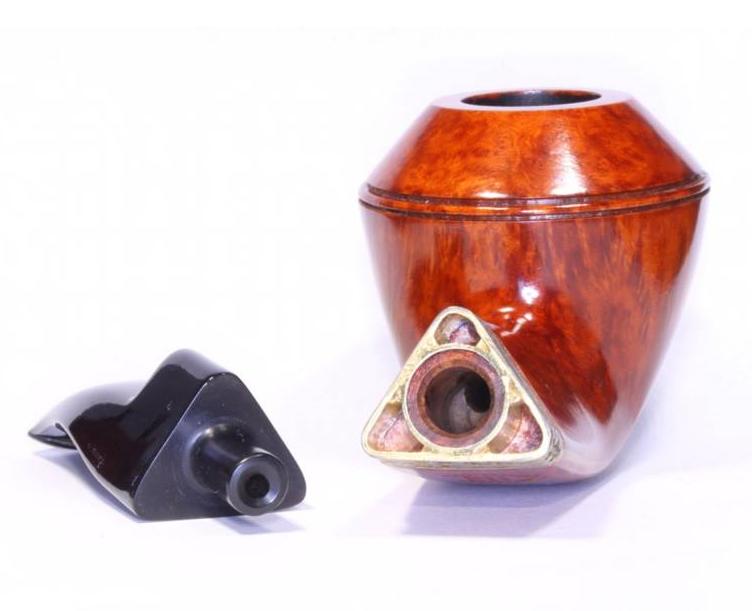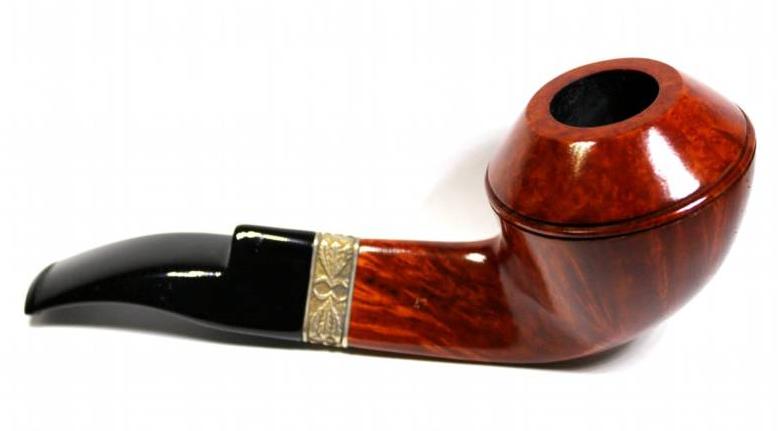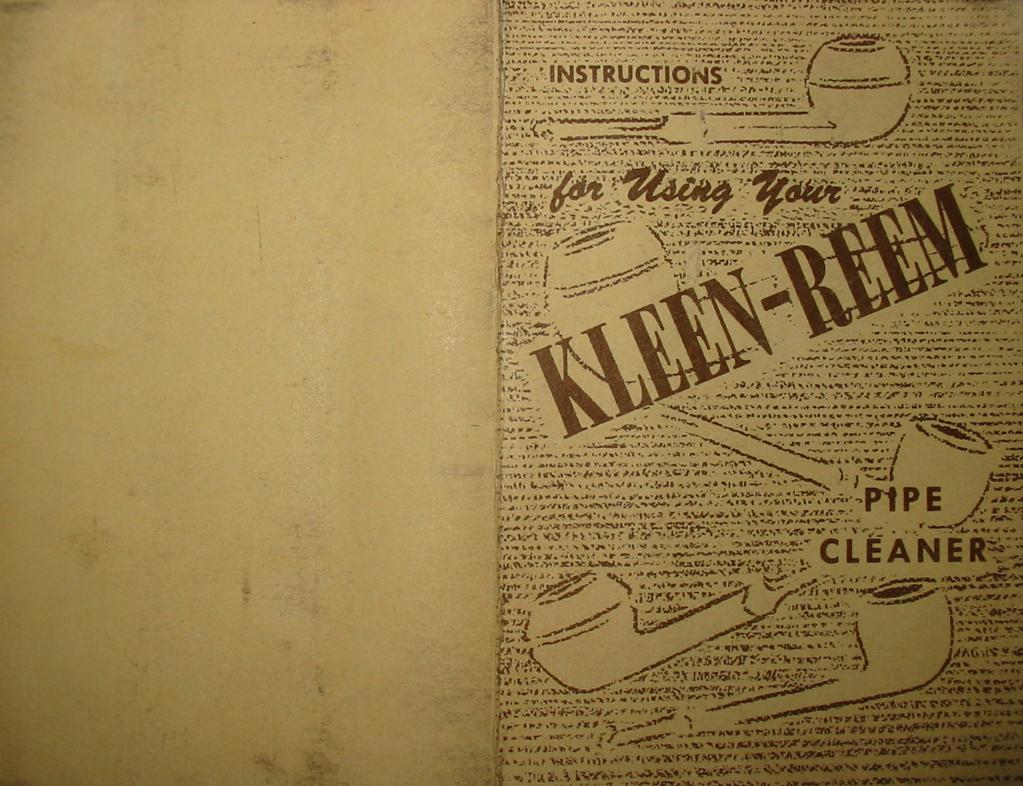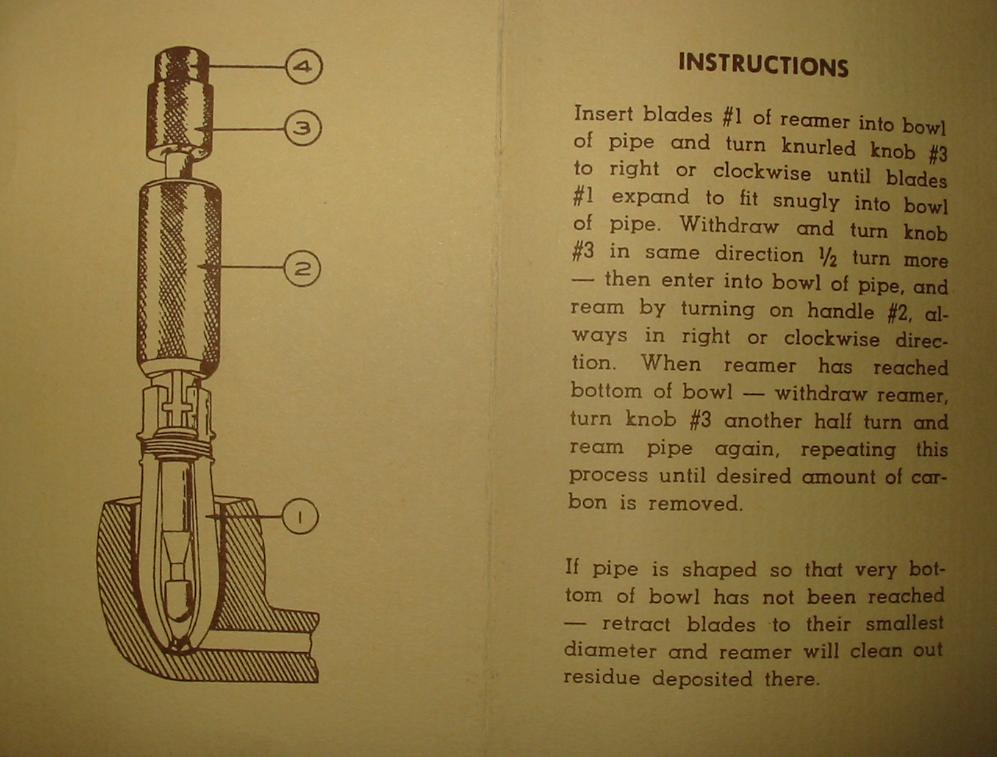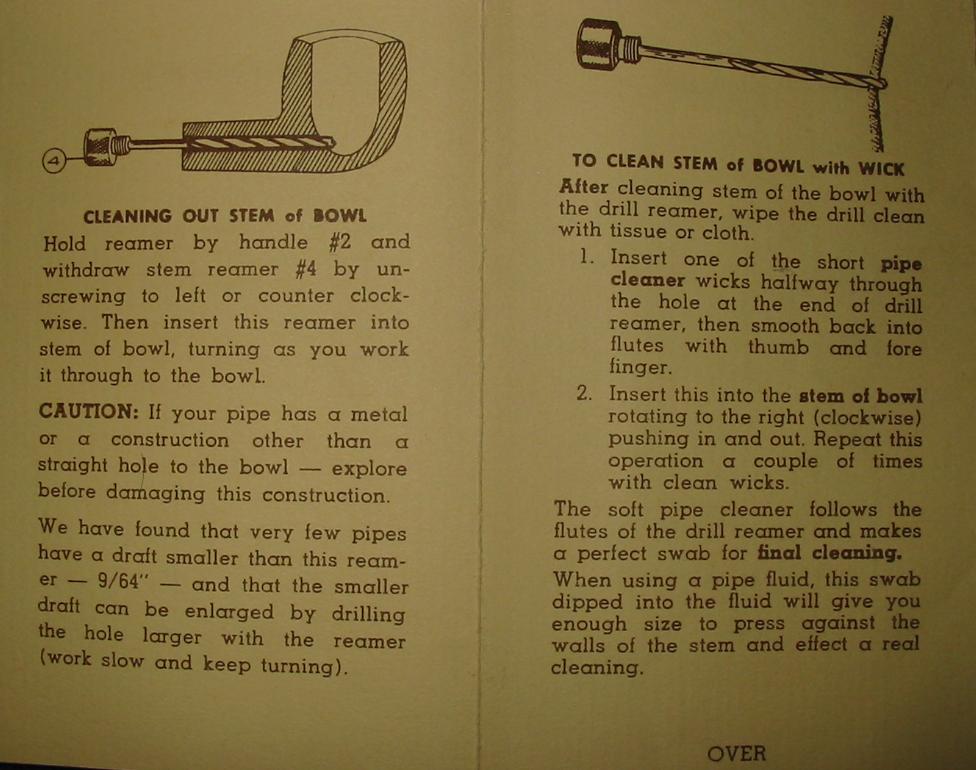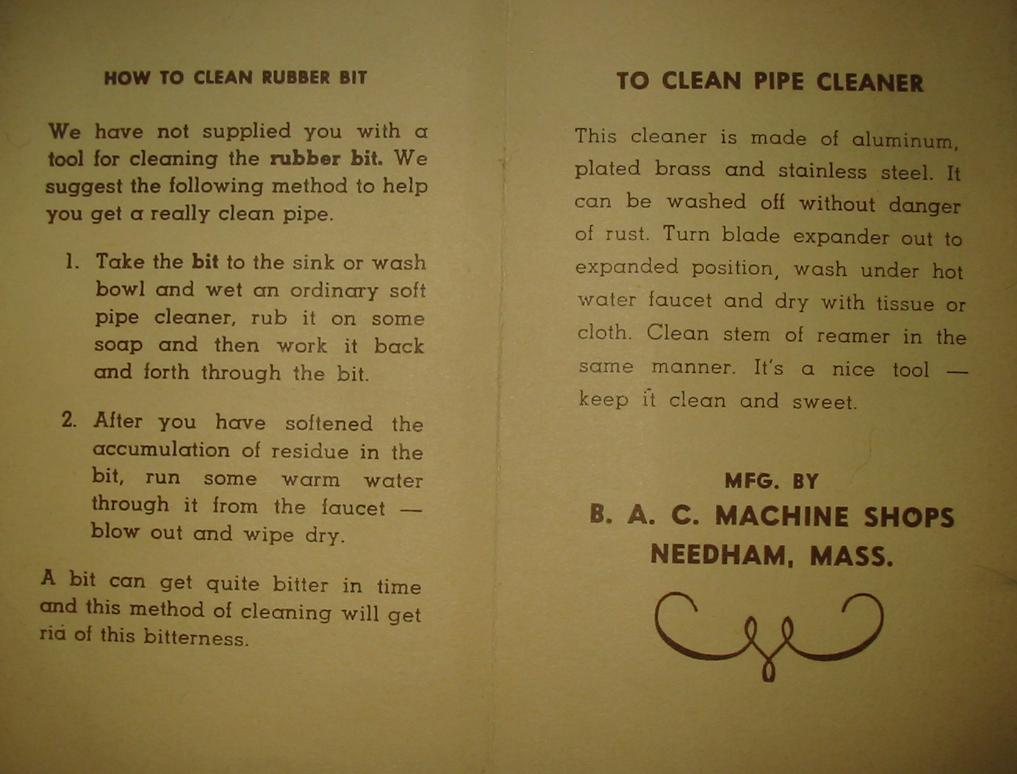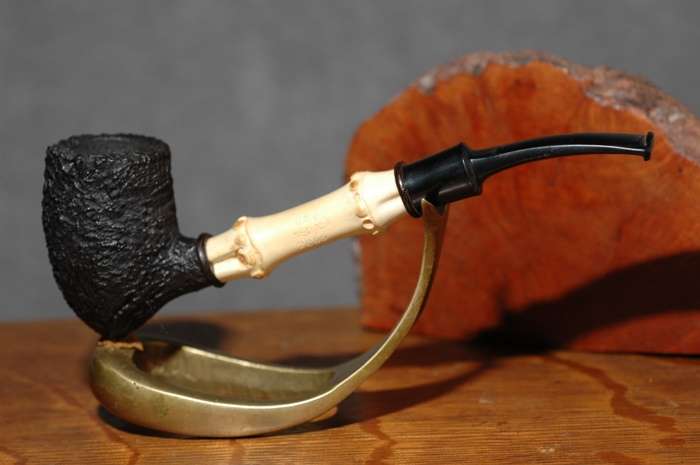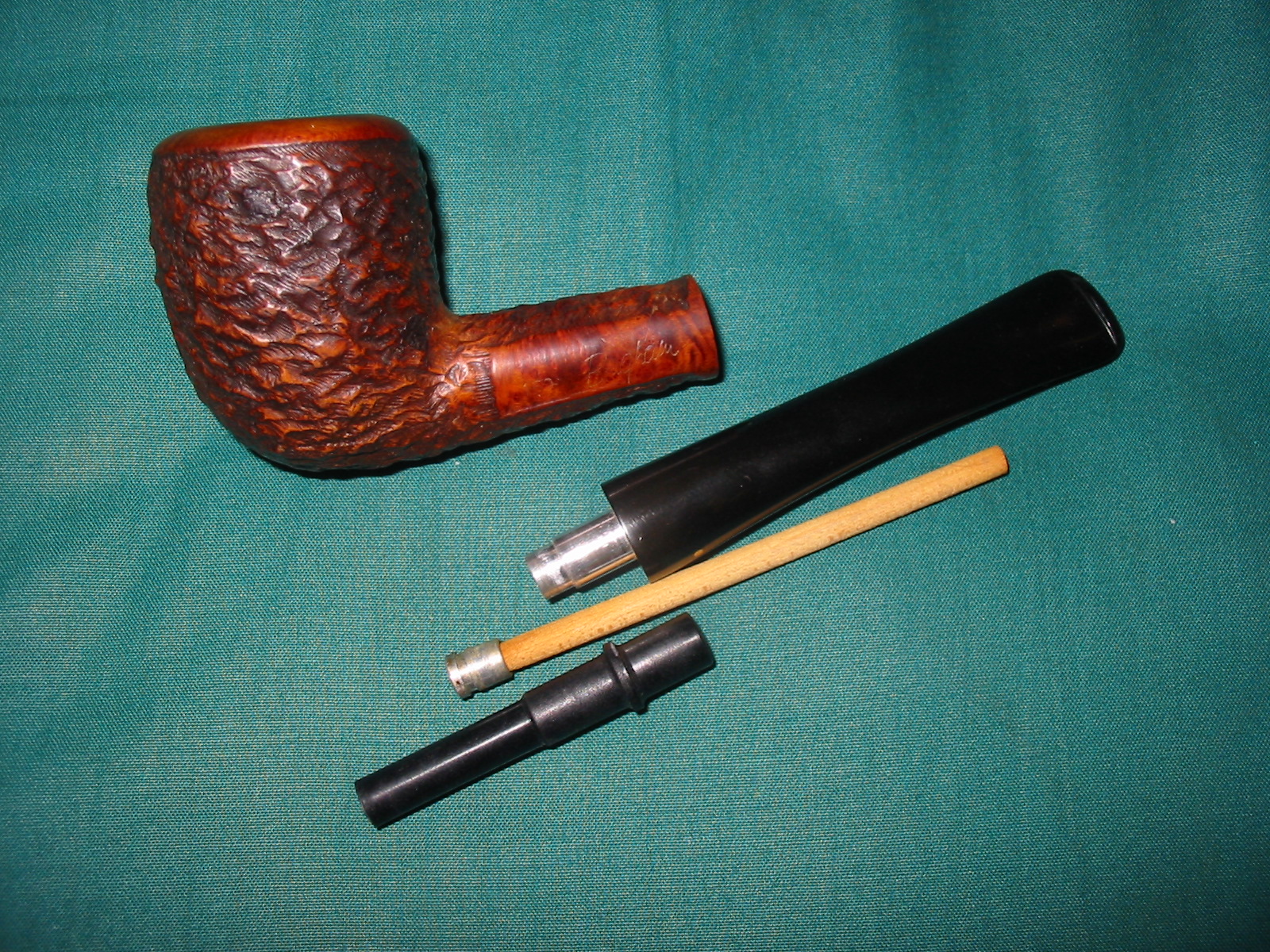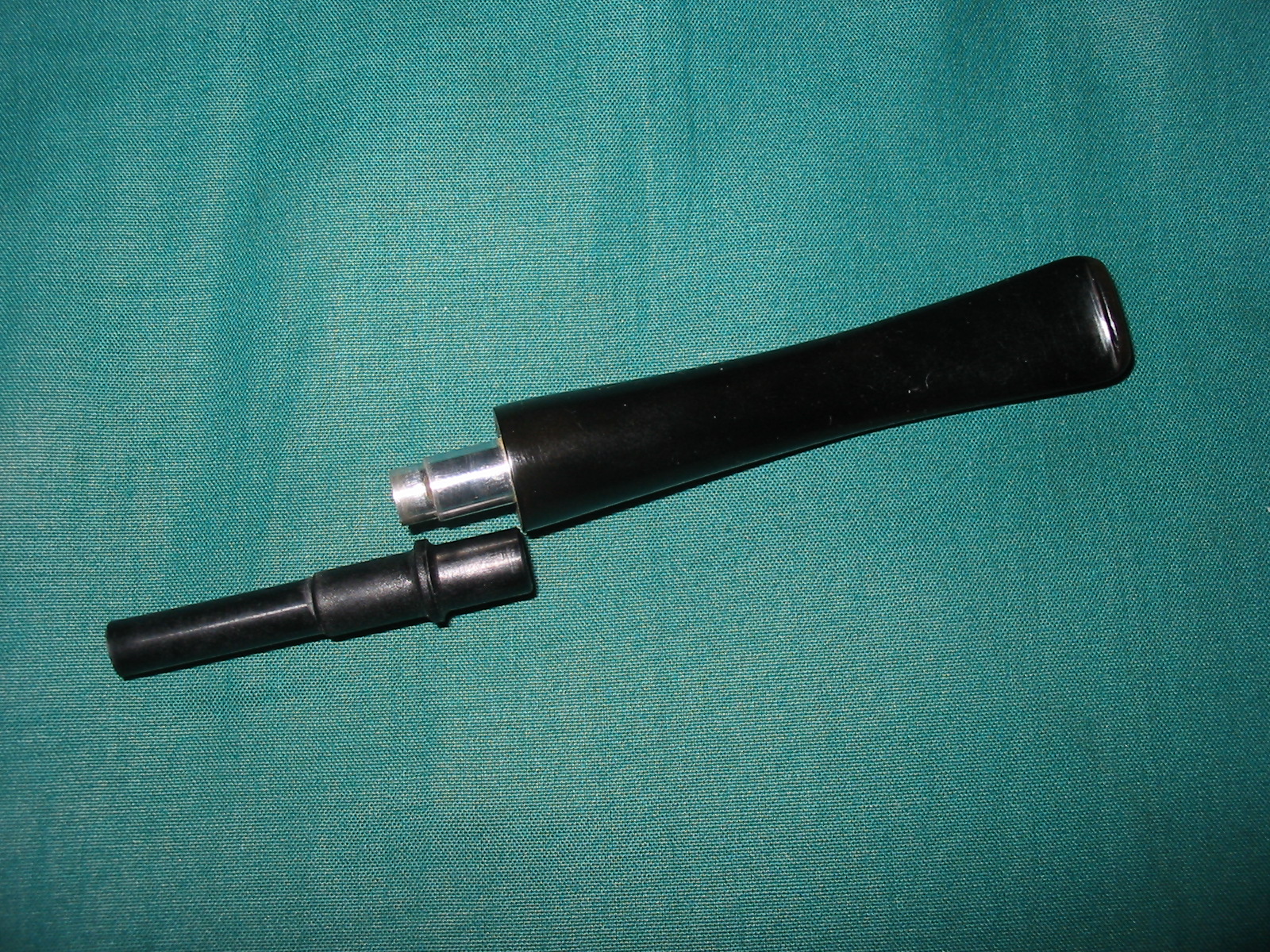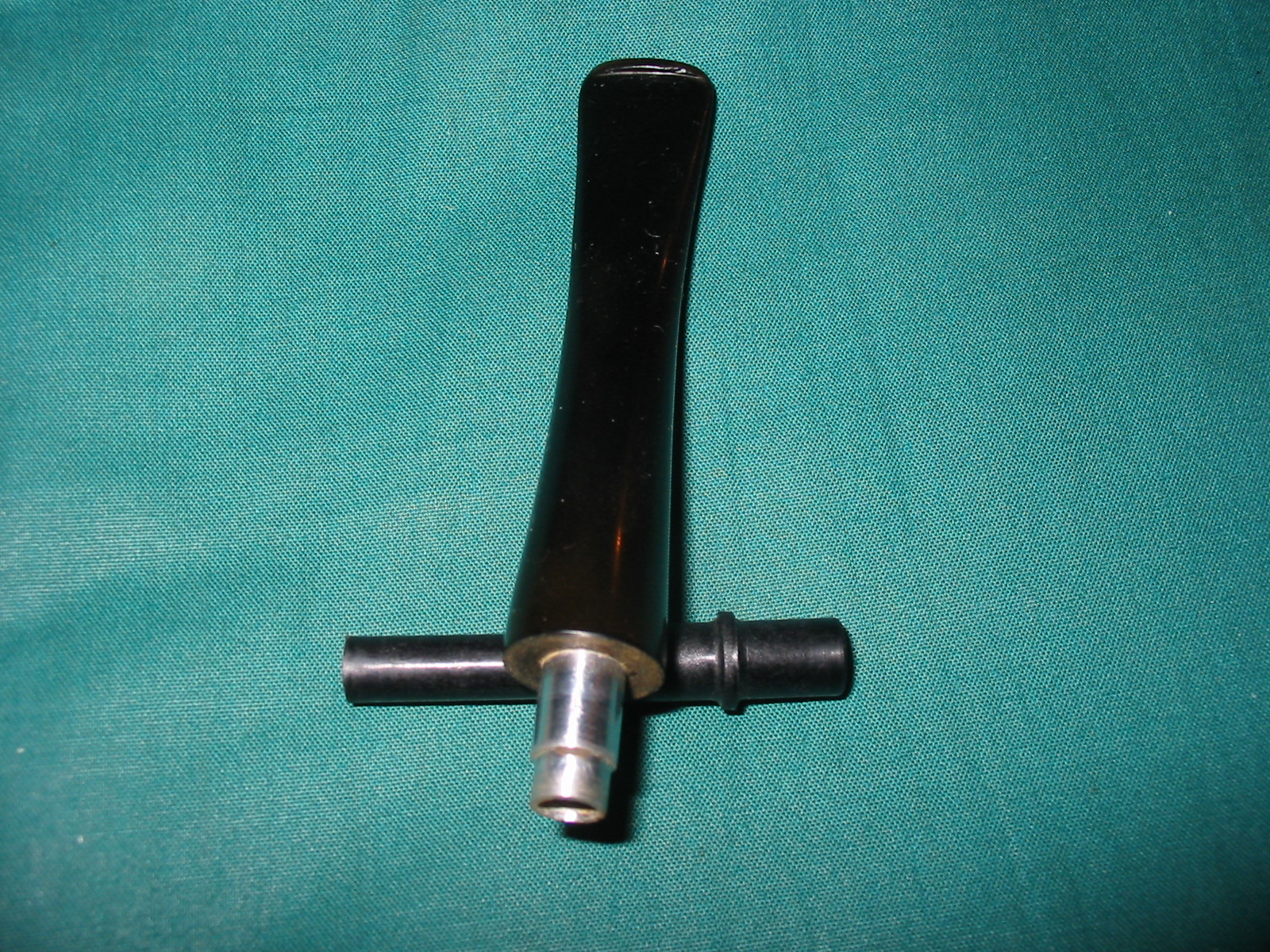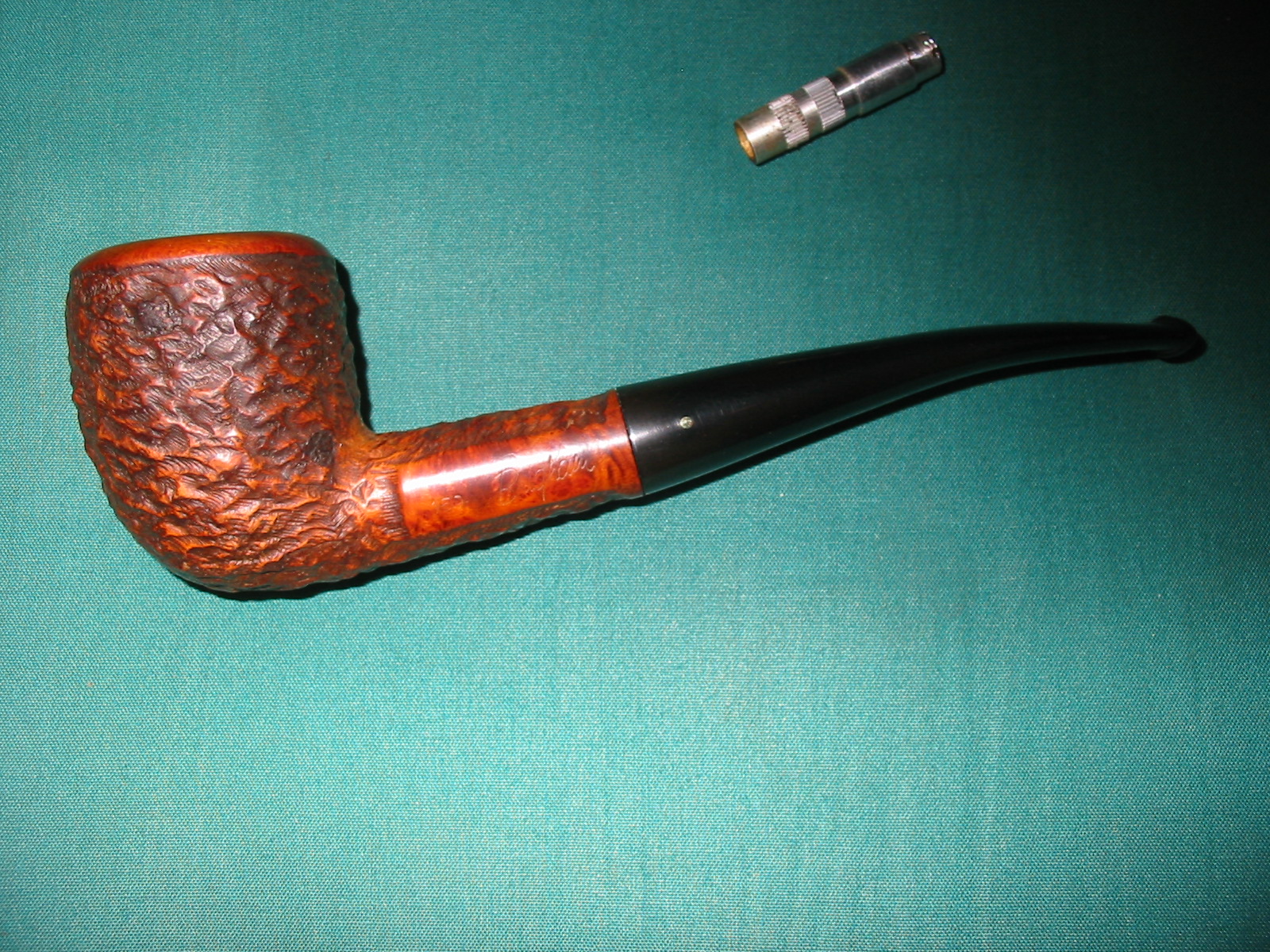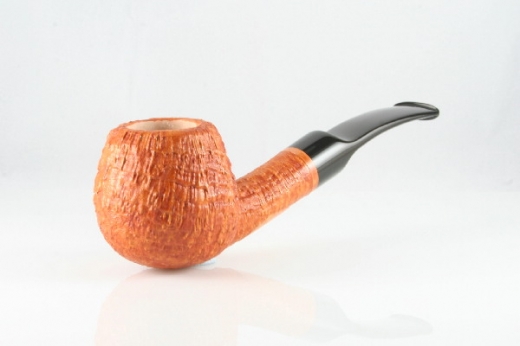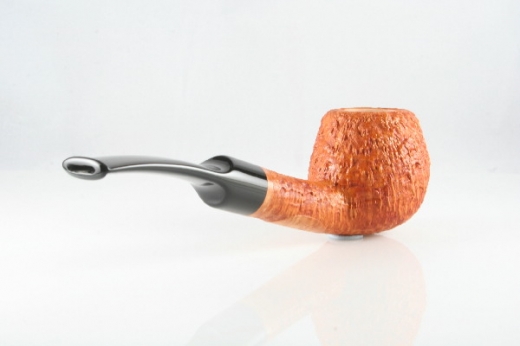
This morning while organizing my workspace I came across the instruction booklet for my Kleen Reem Pipe Reamer. I thought I would put the booklet here on the blog for others to access. It is a great read.
Author Archives: rebornpipes
Review of a Hand Made Medici Bamboo Acorn
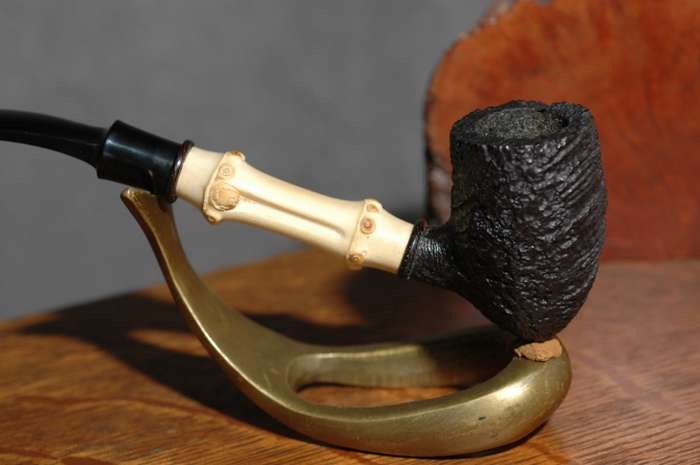
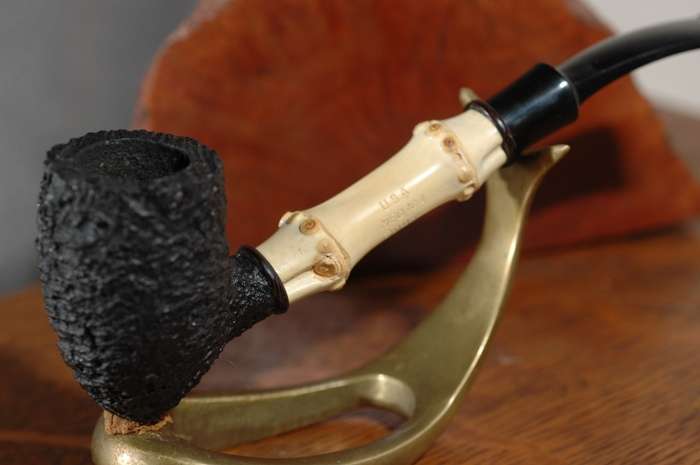
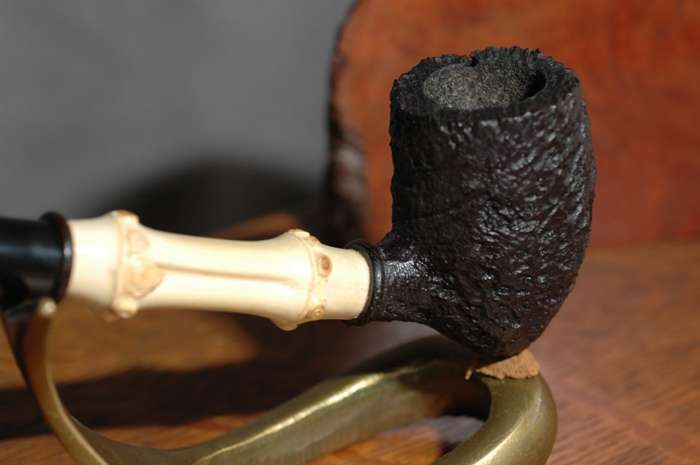
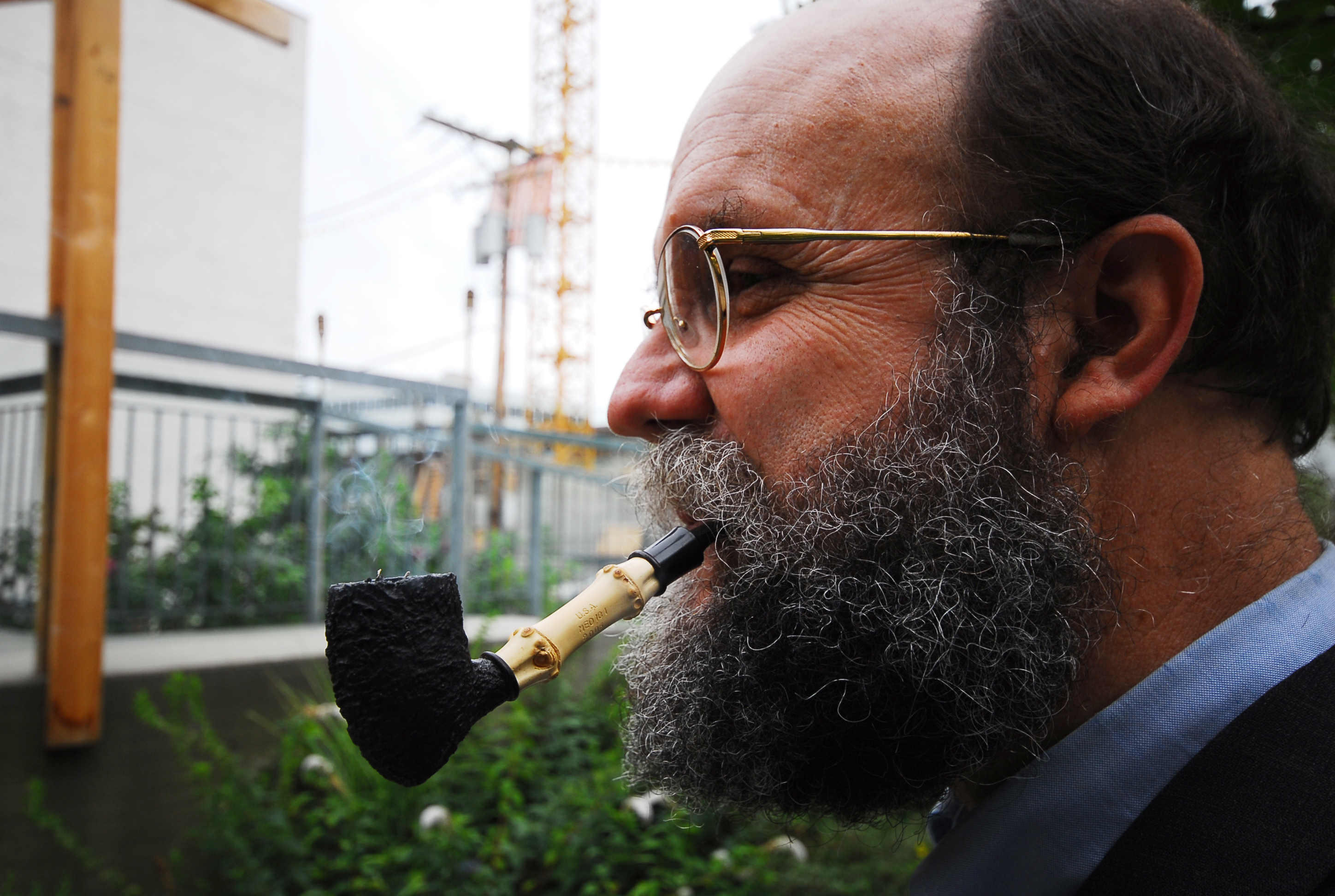
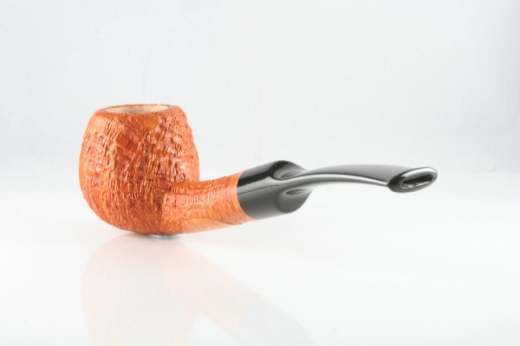
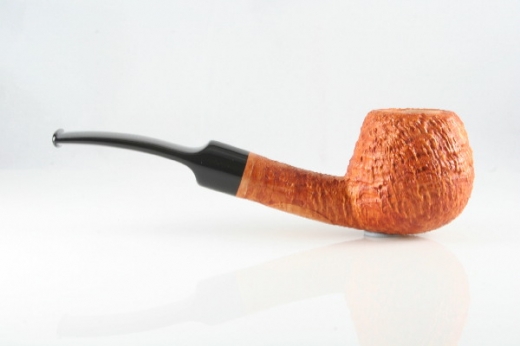
When I first saw this Medici Bamboo Acorn pipe I knew that I had to have it. The Medici mark is made by or for Todd Johnson of Todd Johnson pipes. I bought this one and later found out via Adam Davidson that it was carved by him when he worked with Todd. I bought it from a fellow Smoker’s Forums in late 2006 or early 2007. And I have been smoking it since that time and it is a great smoke. Since I had the day off today I decided to write a review on this beauty. The length of the pipe is 6 inches long and the bowl height is 2 inches. The chamber diameter is 3/4 inches and depth is 1 1/2 inches. It is great sized pipe and very light weight. It is comfortable in the hand. The overall shape is something like a ¼ bent acorn with a nicely done bamboo shank extension. The stamping is on the bamboo shank. It is stamped USA over MEDICI over 2006.
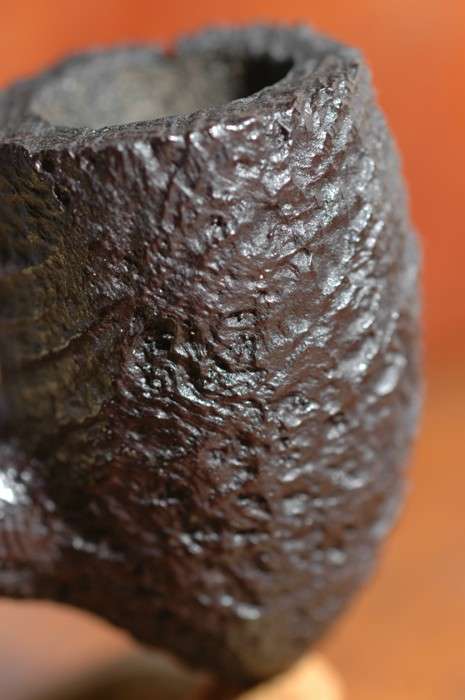
The finish on the outside of the pipe is a gnarly sandblast that highlights the ring grain on the front and the back side of the pipe and birdseye on the sides of the bowl. I have come to love the tactile feel of the sandblast on this pipe. The bamboo shank is a two knuckle piece that is very light coloured and natural looking. There is an ebony ring that is on the shank where it meets the bowl and where it meets the stem. The shank is joined to the bowl by a stainless steel tenon and the stem also has a stainless steel tenon. The shank is unlined bamboo between the mortise and the joint at the bowl. The staining on this appears to be a black but in the light it has highlights of a burgundy or red that shines through.
The stem itself is a well made saddle stem handcrafted from acrylic. The blade of the stem is well tapered and thin without sacrificing durability. The saddle and blade have been carved in such a way to make it look almost like a military bit with the blade meeting the saddle on a rounded platform. The blade is flattened on the sides tapering back to the button. It is a comfortable bit in the mouth and it so light that it makes an easy clencher. The tenon is stainless and sits against the ebony ring/disk that caps off the open end of the bamboo. The disk is applied in such a way that is forms a band around the end of the bamboo. The button is exactly the way I like them – thinner on the edges with a gentle rise at the centre top and bottom. It fits well behind the teeth for a comfortable feel. The draught hole in the end of the button is also funneled to deliver a mouthpiece that has the same diameter from start to finish. Comfortable and well executed. A pipe cleaner passes easily through the pipe with no obstruction.
The internal mechanics of the pipe are very well executed. The bowl chamber is drilled to a ¾ inch diameter. The inner edge of the bowl us straight and clean to the rim. The outer edge is sharp and clean with the blast coming right to inner edge of the rim. I don’t believe the bowl was coated. It is actually hard to remember back to the time of the first smoke of this one and it now has a nice solid cake of Virginia tobacco. There were no flaws or visible pits in the interior. The draught hole is centered at the bottom of the bowl and seems to have a slight funnel as well – like a shallow Y- leading into the shank and stem. There is a very easy and open draw to the pipe. The fit of the stem to the shank is very good – smooth and tight with no light showing at the joint. The tenon sits deep in the mortise against the ebony ring/disk. The fit of the tenon is smooth and tight. The edges of the stainless tenon have been polished and rounded so there are no sharp edges. The drilling of the draught in the bamboo shank is straight and centered in the back of the mortise. The air pulls clearly through the pipe with no whistling at all. Using a light to shine through the various airways reveals smoothly executed airways on the inside. It also appears that the stainless tenon that attaches the bamboo and the disk on the bowl is also polished and smoothed out as there is no catch when a pipe cleaner is pushed through the airway.
Since I was writing this up today I decided to smoke a bowl in while I took down my Christmas light. I loaded a bowl of aged McClelland’s 5100 and puffed on it as I unwound the lights from the columns on the porch. The tobacco packed as easily as I had remembered and kept burning after the second light. I love that about this pipe. Sitting outdoors or inside the thing almost smokes itself. The draught on the pipe is superb. The smoke was uncomplicated and effortless. It was just as I remembered it from the first bowl many years ago. It has always smoked incredibly well and delivered a flavourful and effortless smoke.
I end this post with a picture taken by a friend of me with the pipe in my mouth. I had just received it in the mail and had decided to save it for this occasion. What was the occasion you might ask? It was the wedding of a good friend. He had asked me to officiate at is wedding and when it was over I had gone outside to fire up this pipe for the first time. I did not notice but his photographer shot this picture. It was a gorgeous Vancouver afternoon and a perfect day for a smoke outside the church under one of the trees along the curb.
Thanks Adam for crafting a beautiful and great smoking pipe. Thanks for providing me with over five years of great smoking. This pipe is a veritable Virginia machine.
Replacing a Tenon on a Brigham System Pipe
Blog by Steve Laug
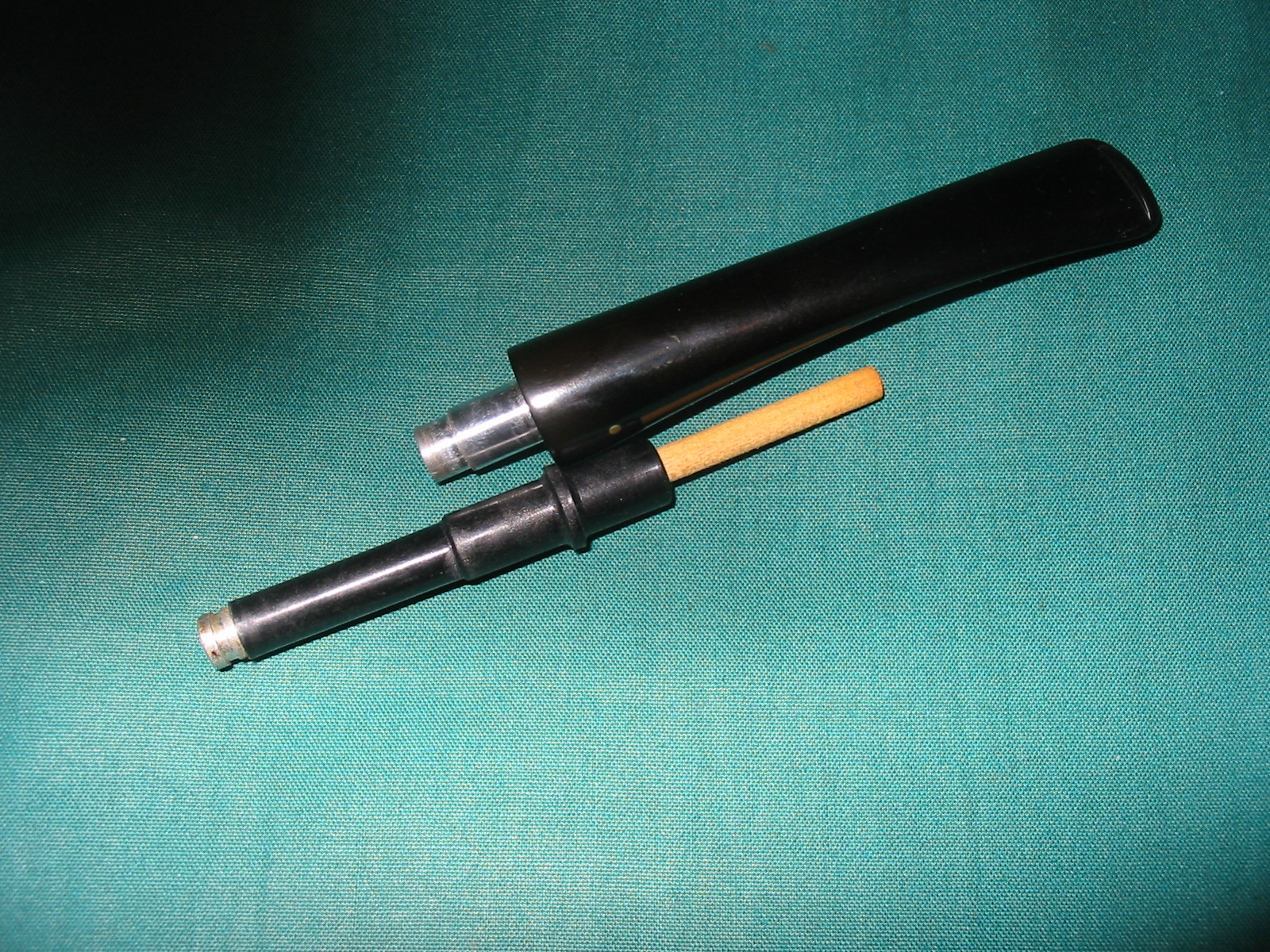
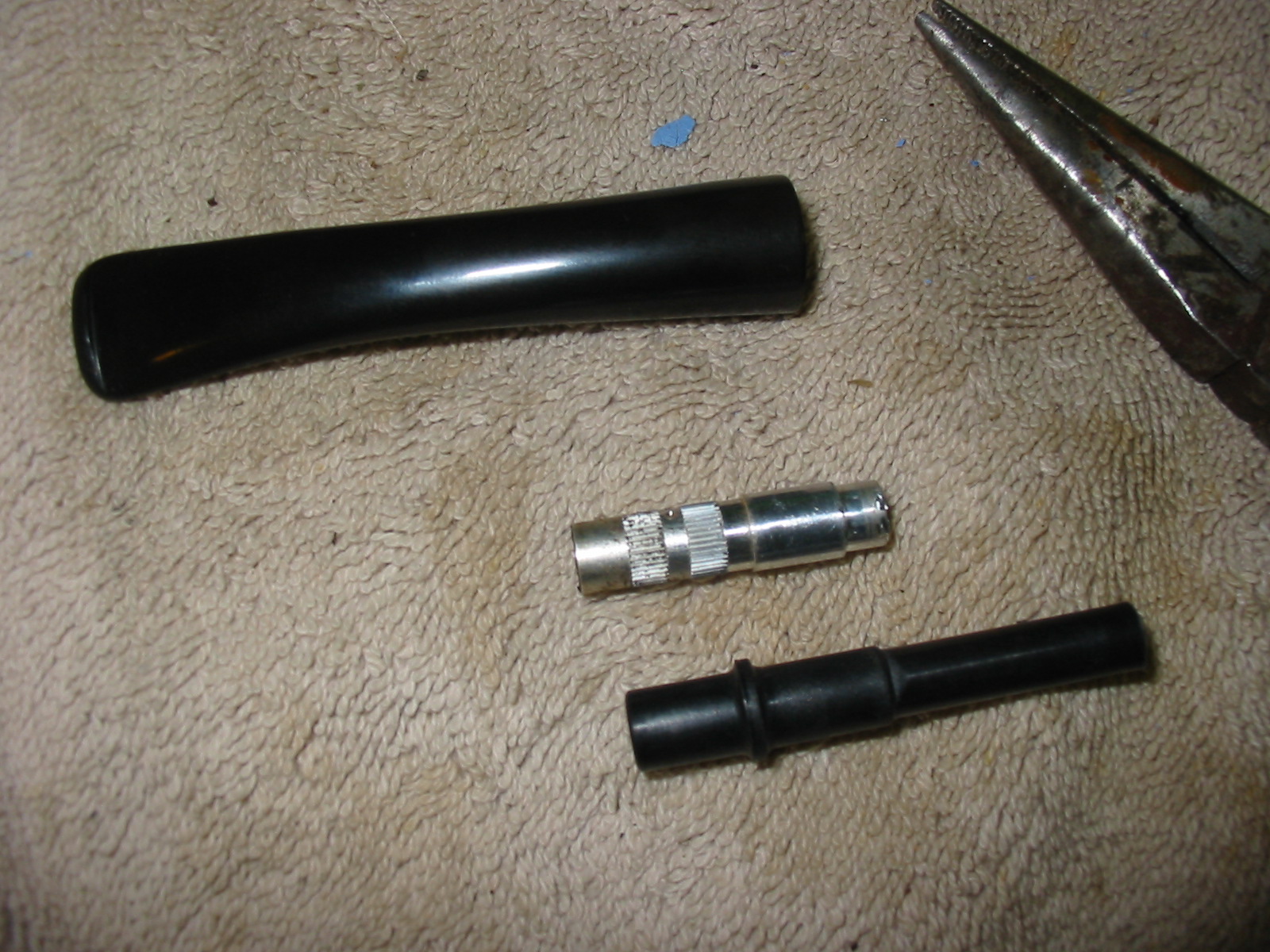
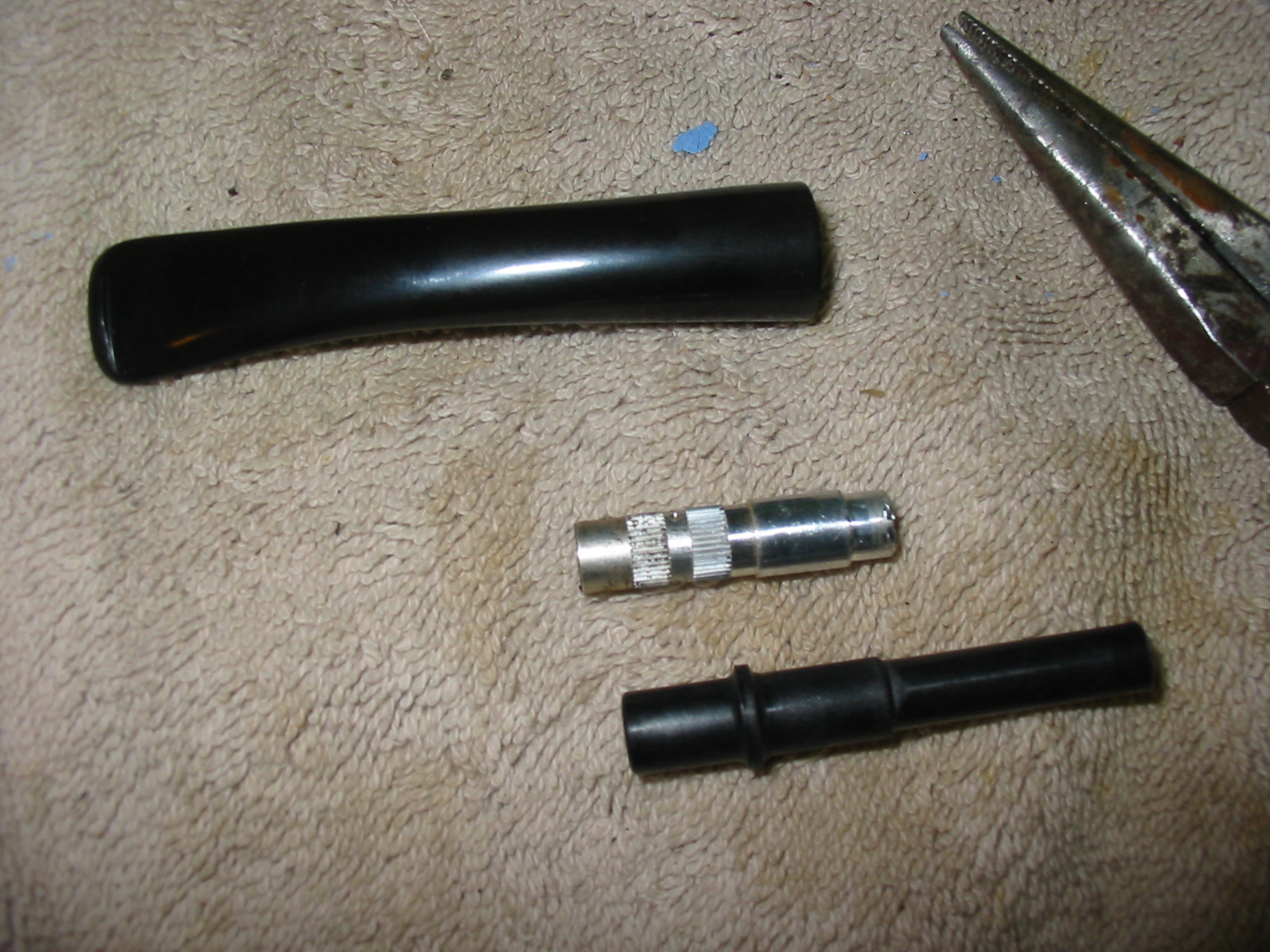
I have written about the restoration of this old Brigham one dot pipe in an earlier blog post. https://rebornpipes.wordpress.com/2012/09/17/a-frustrating-brigham-1-dot-rehabilitation/ I was contacted by Brigham in a comment to the post with the following: “Great work! It is nice to see someone put in the extra effort. If you would like a free nylon tenon to replace the aluminum just send us an email at sales@brigham1906.com” I wrote to them after reading this and they sent me the nylon tenon pictured below to replace the metal one that I had remedied earlier by cutting off. You can read the previous post and see why that was necessary. But needless to say it took me until this morning to rise to the challenge of replacing the tenon. There were multiple reasons for this. The first being that I was uncertain as to how the metal tenon was inserted and how it could be removed. Second, the metal end of the maple filter had broken off and was stuck in the bottom of the shank right against the airway which did not allow me to insert the tenon to the full length with the new filter in place. This morning I had a day off so I decided to tackle the replacement. In the photo below you can see the dismantled pipe. The metal tenon is cut back, the maple filter is below that and the new nylon tenon is at the bottom of the picture.
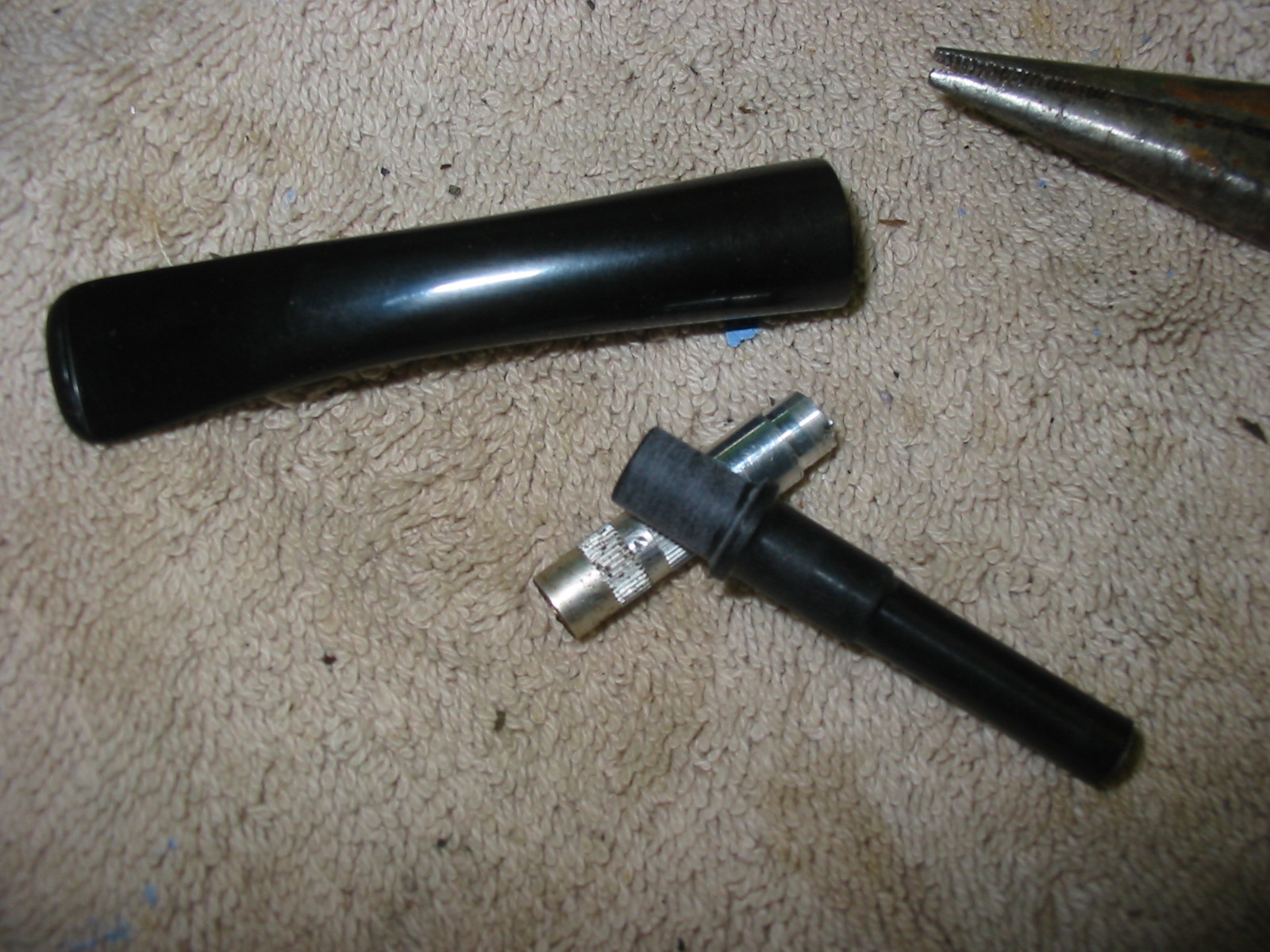
I lined the two tenons up to an idea about the length. I wanted to know how deeply the metal tenon was inserted into the stem. From the look of the new nylon one I was not dealing with a lot of depth to the tenon insert. I still did not know how it was inserted and what held it in place but my guess was glue, similar to what I use to hold Delrin tenons that I have inserted. The next two photos below show the tenon depth. The third photo below shows the maple filter inserted. I was concerned how I would get that length into the shank of the pipe with the metal end cap firmly stuck in the shank.
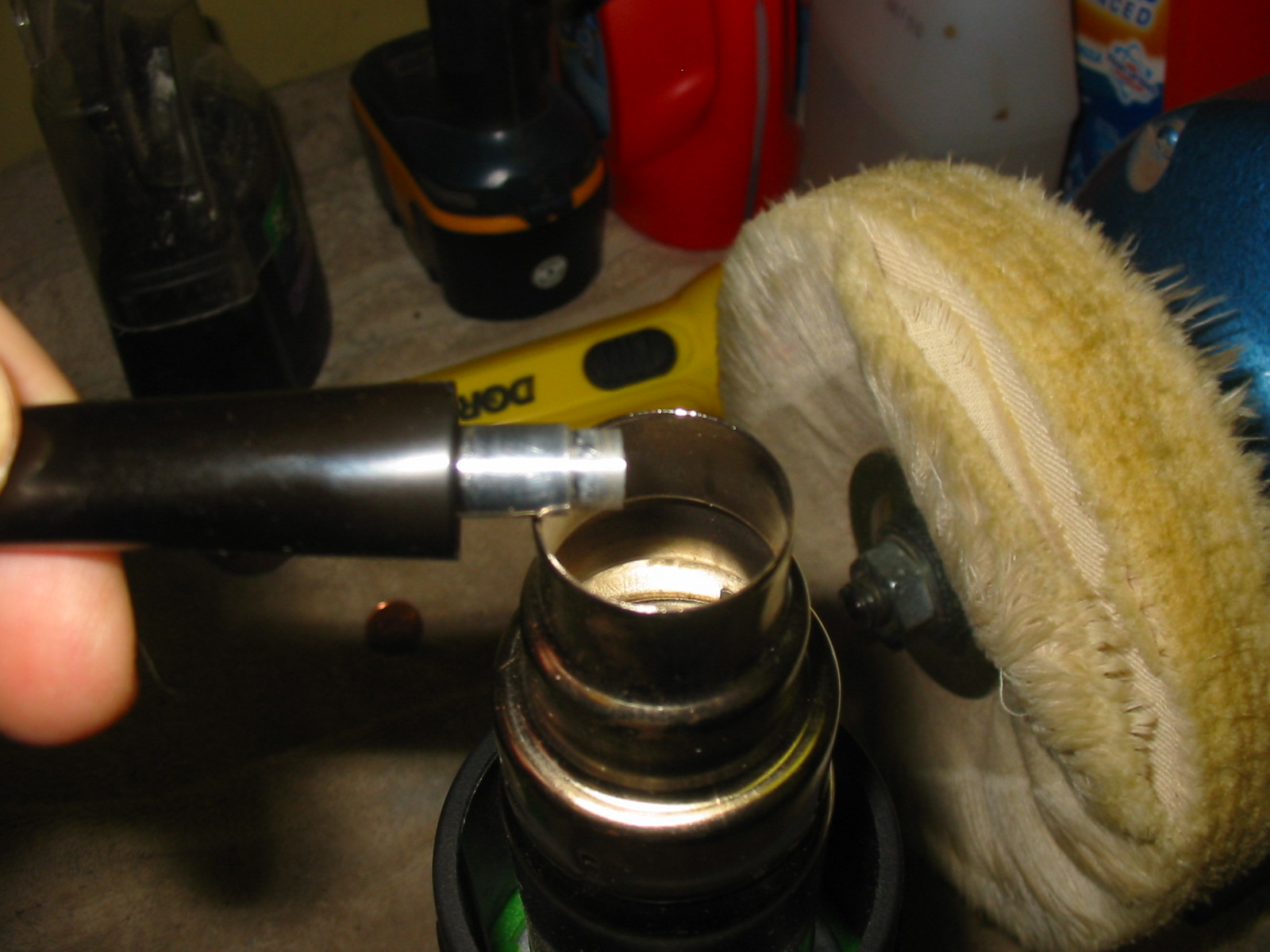
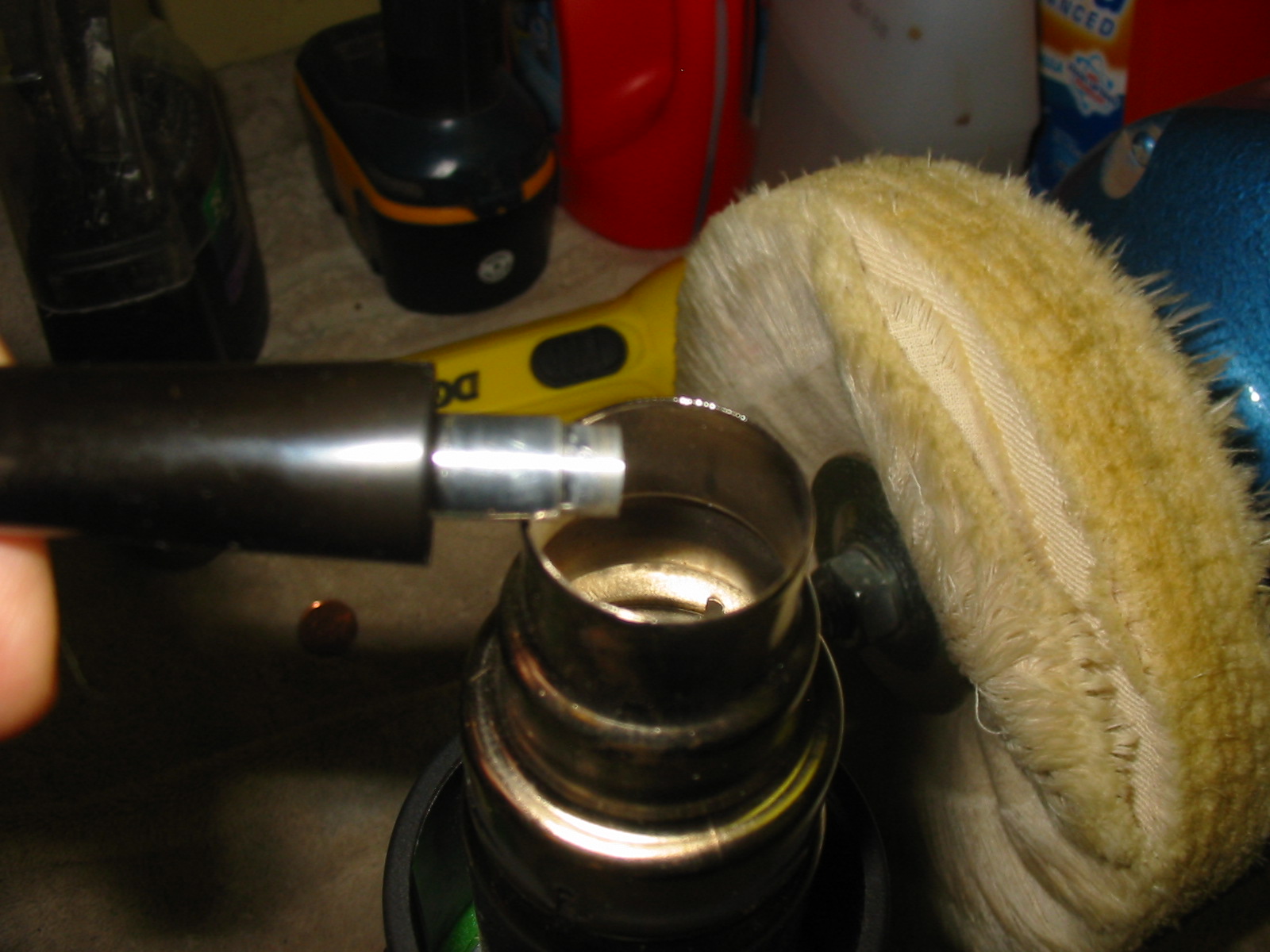
I set up my heat gun on its stand on the top of the washing machine in the laundry room. Pardon the cleaning supplies pictured below around the heat gun. I heated the metal tenon and not the stem. I have found that to heat the stem can damage the vulcanite and it seems to take a long time to heat the glue in the tenon insert. I heat the tenon instead and the heat on the metal carries back into the stem and loosens the glue. The two pictures below show the heating process. It does not take more than 2 or 3 minutes to heat the glue and soften it.
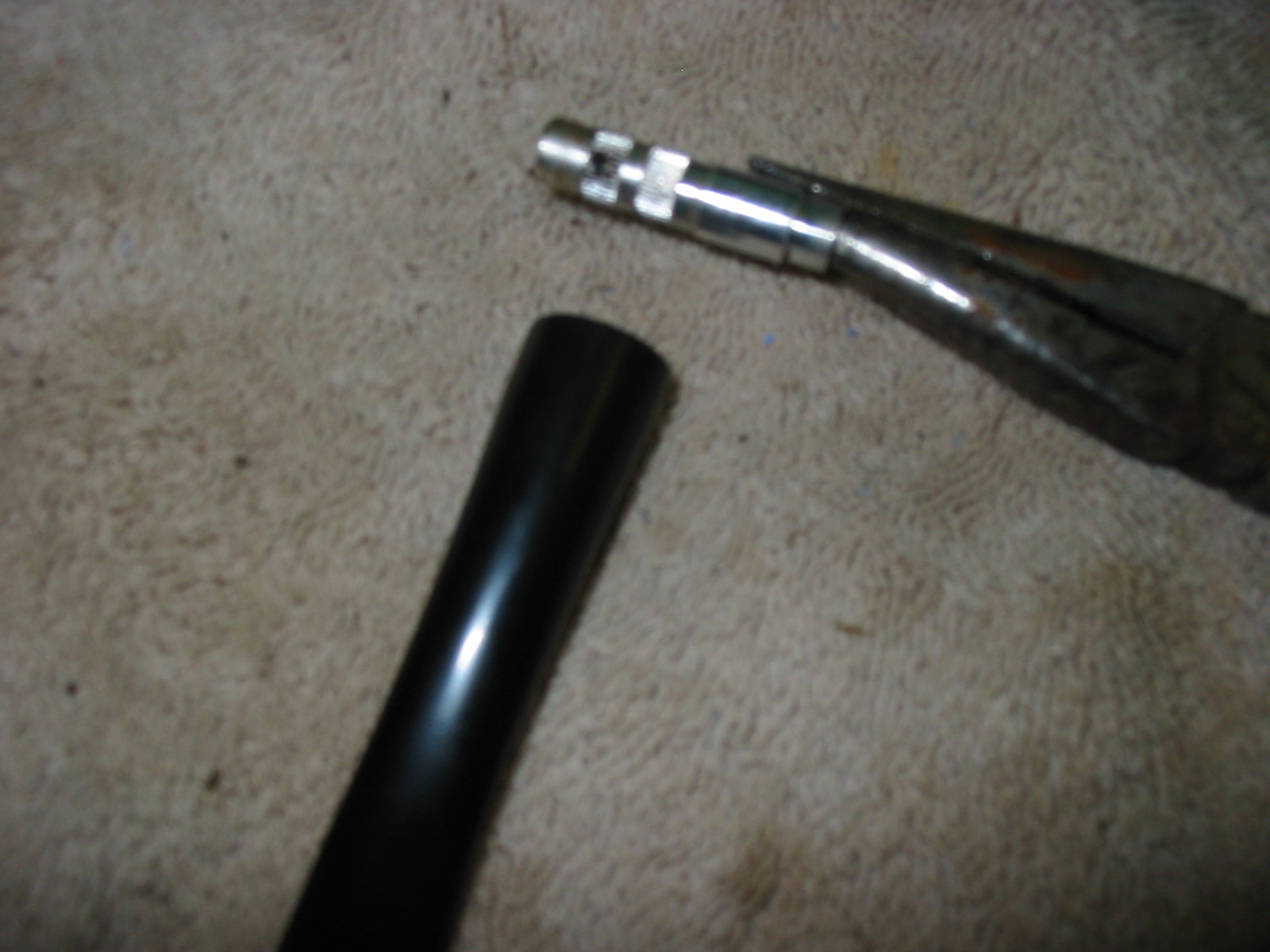
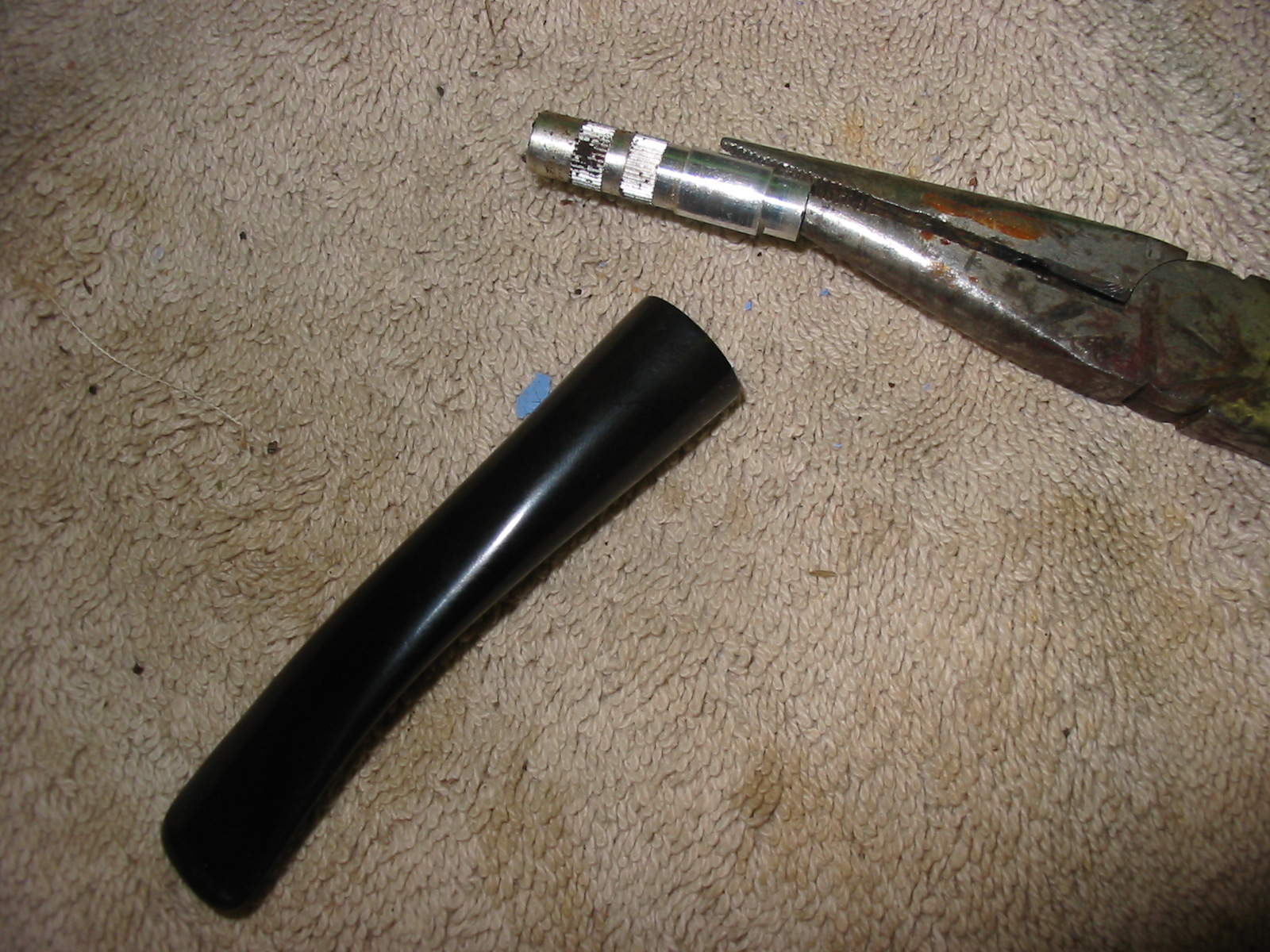
I use a pair of needle nose pliars to gently pull on the tenon. I do not want to damage the tenon because I may want to use it again (you never know when you might use it again so you don’t want to ruin it). I pulled gently and it came out pretty easily. You can see from the next pictures below that the metal was scored in two bands around the insert to provide a grip with the glue and the vulcanite.
Once it was removed I put the old tenon insert next to the new one to measure length and also diameter. I wanted to know how deeply it would sit in the stem and also whether I would need to drill the hole a bit large to fit it correctly in the stem. You can see in the next two photos that the older insert (metal) is a bit longer than the new one. You can also see that the new one has a ridge around the diameter that would sit against the flush edge of the stem. I decided to remove that ridge and to split the difference in the length and insert the tenon end more deeply than the ridge would allow. Once I had removed it I still had some work to do as the hole in the stem was too small in diameter to take the new insert. I started by sanding a bit off of the insert to see if that would help it fit. I quickly saw that in order to fit I would have to remove more material than was wise in the diameter of the tenon end. So I would have to enlarge the hole. The third photo below shows the tenon end after I had sanded it. I still had not removed the ridge at this point as I was more concerned with diameter at the moment.
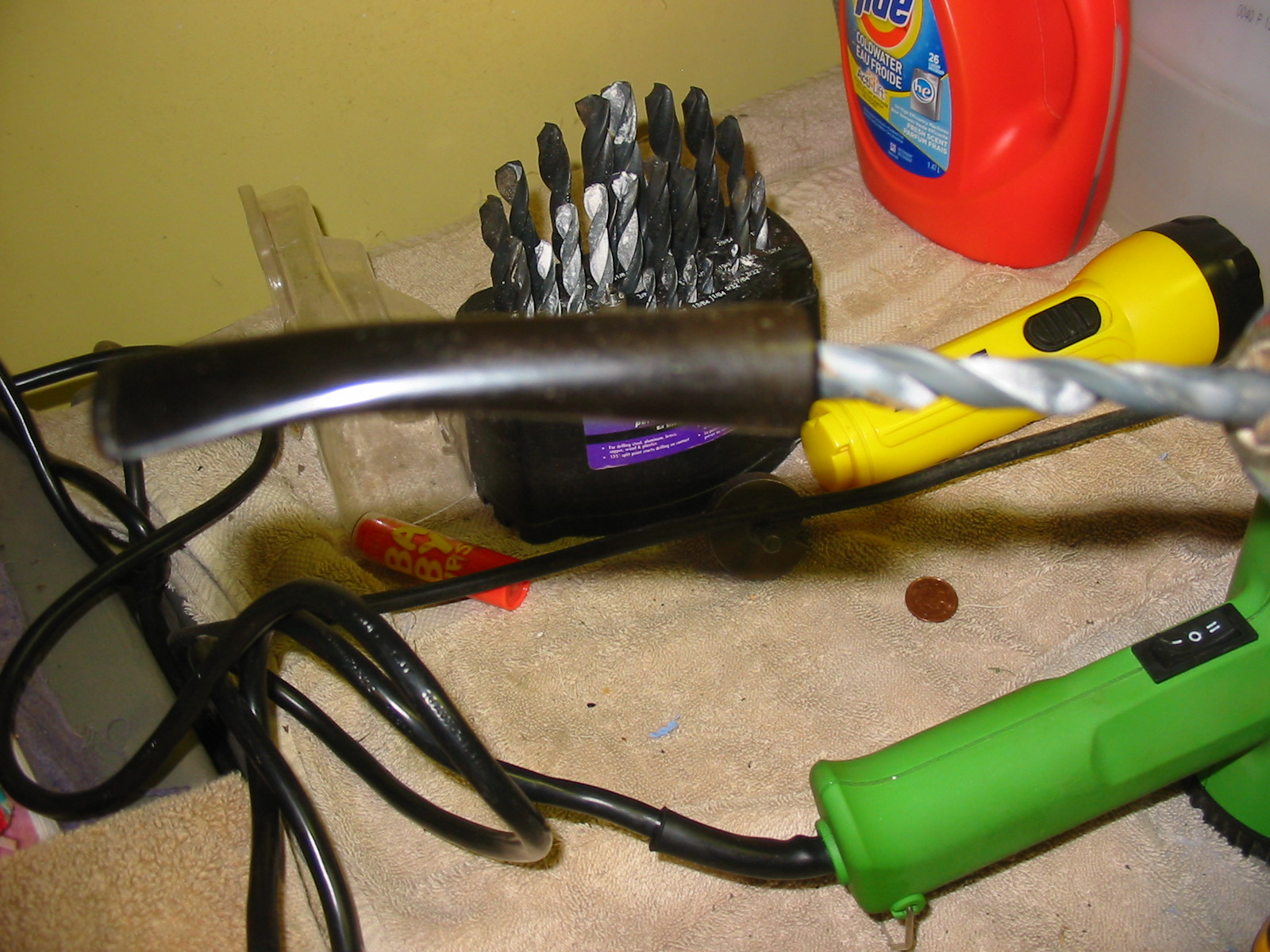
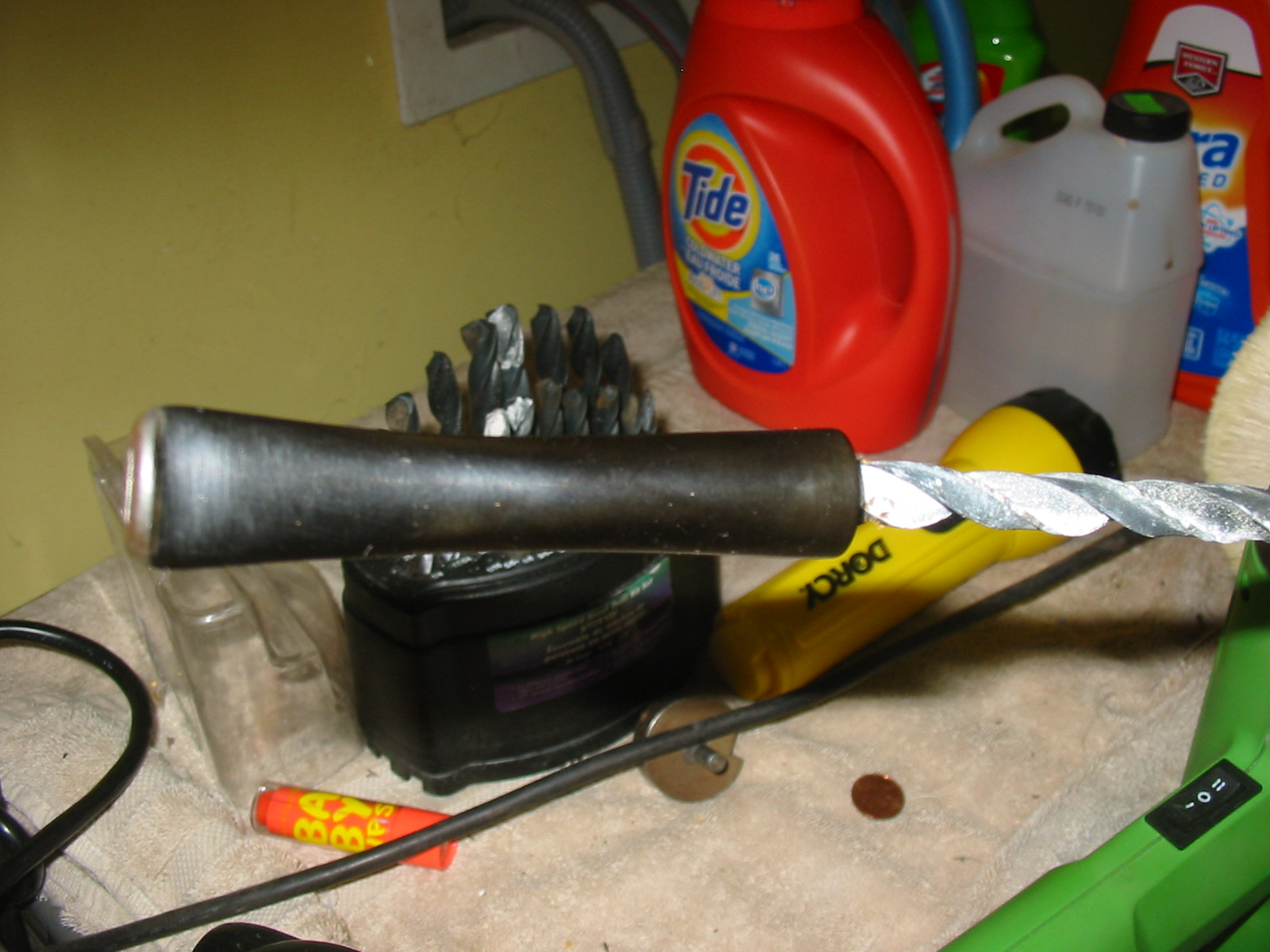
I began with a drill bit the same size as the hole and turned it in by hand to smooth out the walls of the hole. Then I moved up once size of drill bit and used my cordless drill. The trick here is not to hold the bit at an angle and to slowly turn the bit into the stem. I generally start doing this by hand without power. I make the drill stationary and then slowly turn the stem onto the bit. Once I have it started I slowly use the electric drill to take it deeper into the stem. The first photo below shows that process and set up.
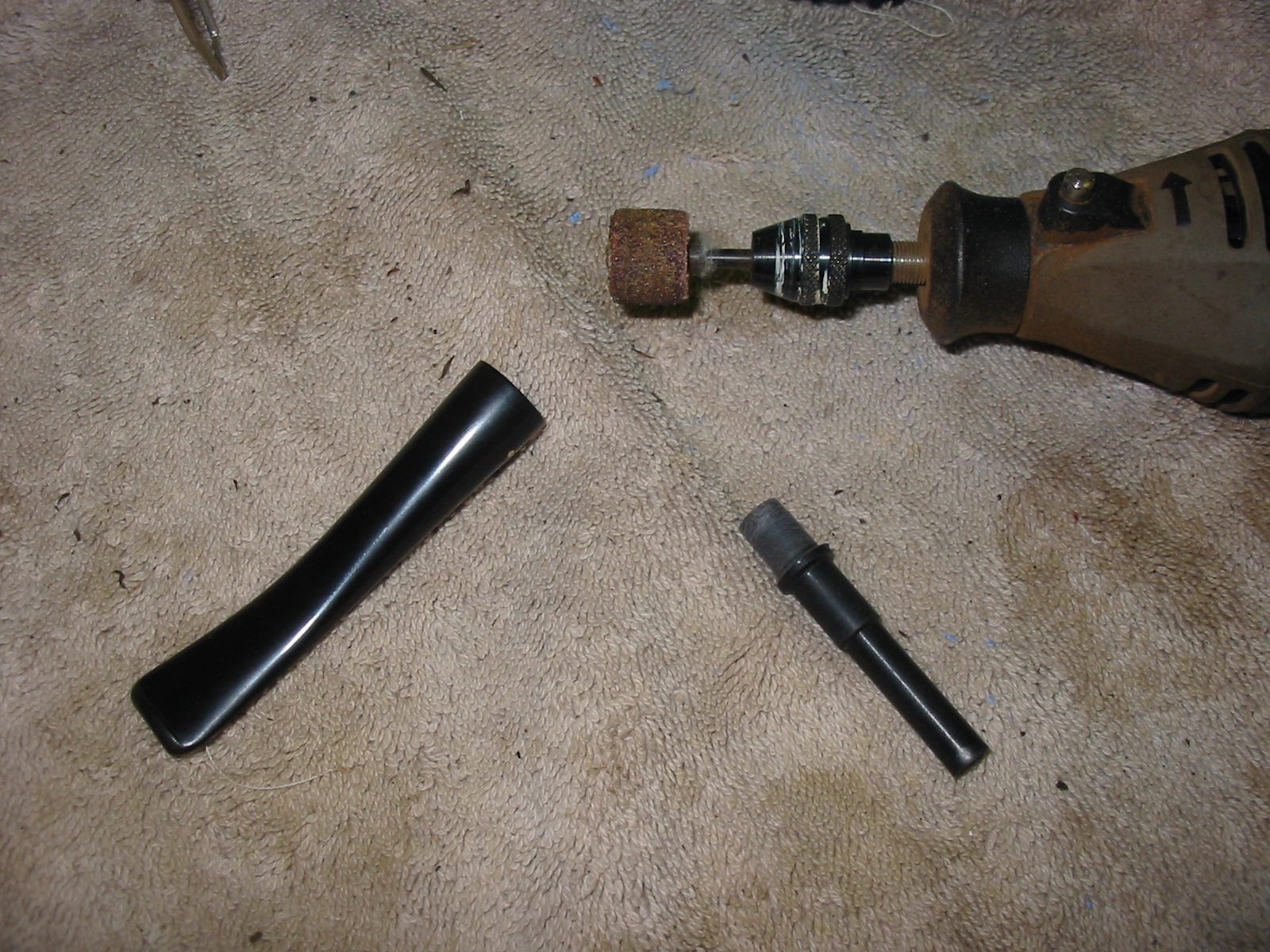
The next photo shows the next sized drill bit that I used. I followed the same procedure turning it on by hand first and then finishing with low power on the drill. After this drilling the insert fit tightly and I was ready to remove the ridge on the new tenon. I used my Dremel with the sanding drum to remove the ridge. I used it at a slow speed as I only wanted to remove the ridge and not change the diameter of the end. It did not take long. In the second photo below you can see the Dremel and the tenon before I sanded it.
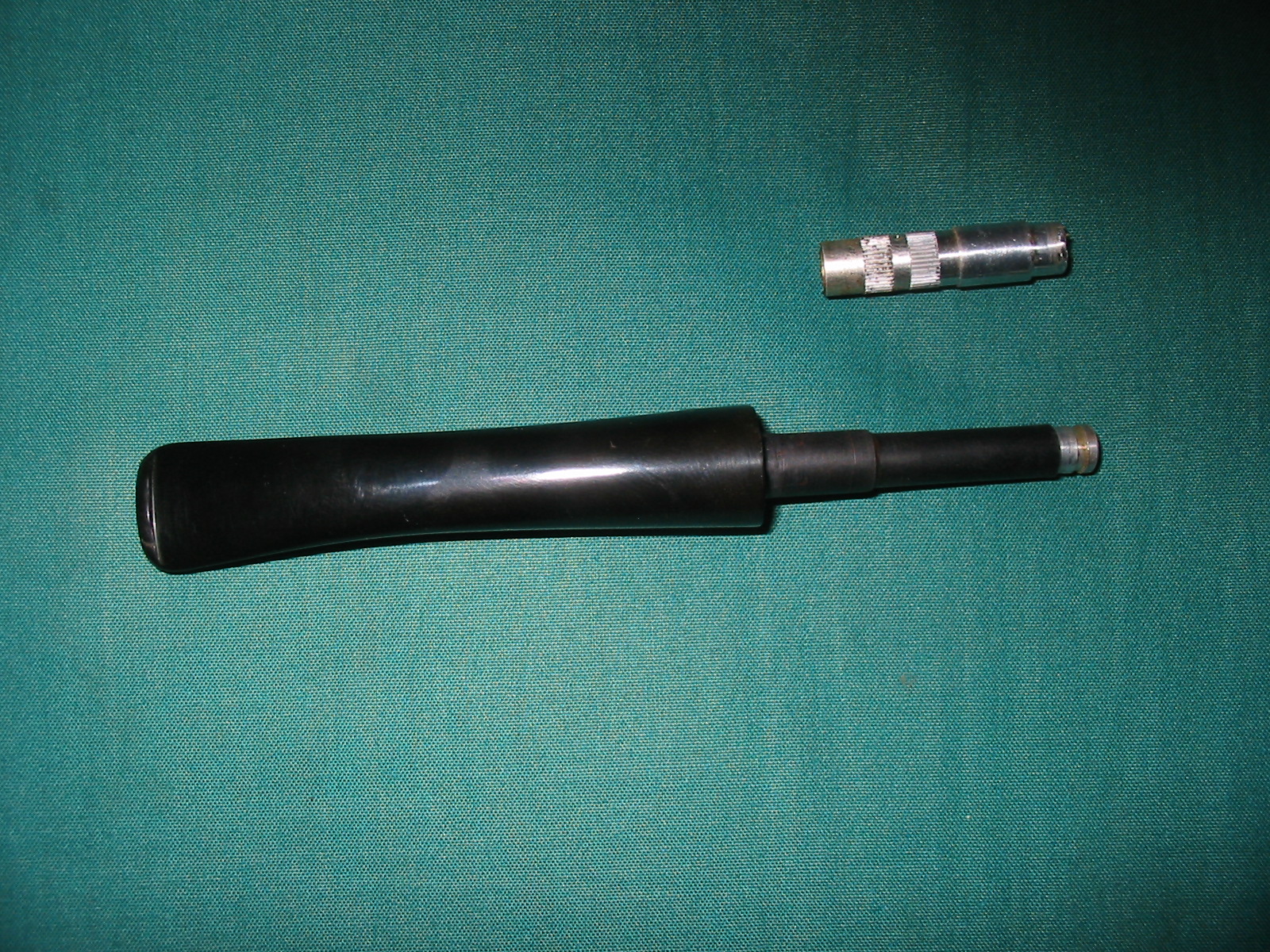
After sanding the ridge I put several drops of superglue on the tenon surface and inserted it in the stem. The fit was perfect and the joint tight and strong. You have to work quickly once the glue is on the tenon insert as it dries very quickly. To facilitate the pressure fit I inserted the tenon in the shank to give me something to push against. I pushed the tenon into place and in the photo below you can see the fit. Above the newly inserted tenon I also included the old insert in the picture.
Once I had a good fit on the tenon insert it was time to try and remove the stuck metal end cap in the shank. This had given me problems as mentioned in the earlier blog post. This time I decided to use a larger drill bit and see if I could drill it carefully until the metal locked onto the bit and I could then extract it. The first drill bit pulled a major piece of the metal cap out but there still was a piece remaining. I used a larger sized bit and carefully inserted it in the shank and drill at low speed until I felt the metal lock on. Then I extracted the end cap – a ¼ inch piece of metal – from the shank. I finally had gotten it all out of the shank. I then pushed the next filter into the new tenon and inserted the stem into the shank. It was a perfect fit… well almost. I removed it and did a counter sink on the shank with my Buck knife and then the stem fit tightly in place. The three photos below show the finished pipe.
Saturday at the Old Pipe Shop
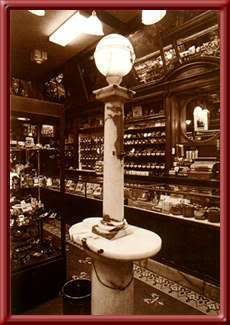
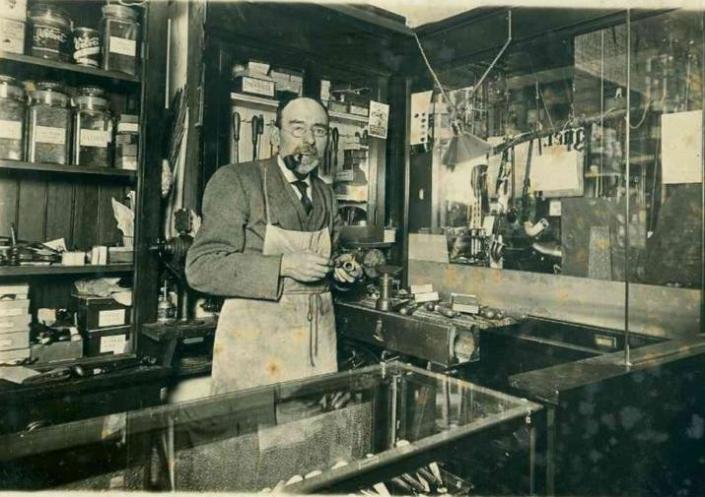
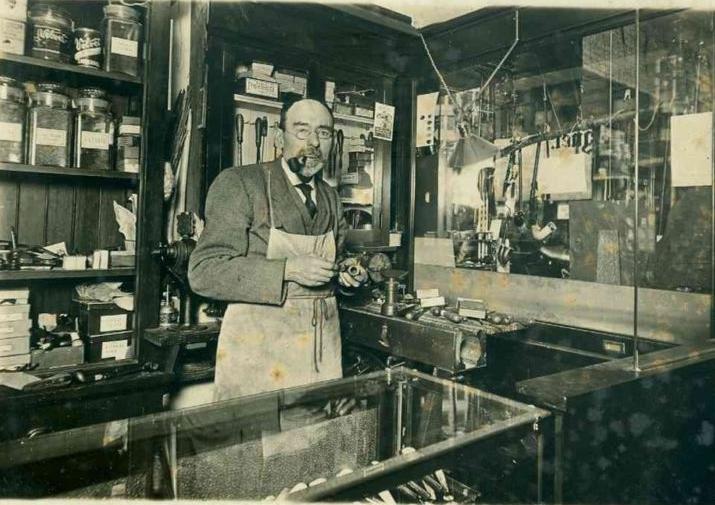
I love looking at old photos like the one above and crafting a story from the photo. This one evokes memories for me and others of like age of certain nostalgic pleasure cherished in the recesses of our minds. For some of you the idea of a shop like this is a piece from the lost past and one you might long for. Come with me to the shop and I will introduce you to the resident pipeman.
The shop is situated on a busy side street, just around the corner, in the heart of the business district of the city. It has large windows on the front of the narrow shop and there is a recessed entry door to the right of centre. As we come along the front of the shop you can see the display of pipes in one part of the window. They catch your attention if you have the soul of a pipeman. There are a wide range of pipes in the window – everything from Comoy’s and Barlings to ornate Meerschaums that marry form and function in beautiful ways. The number of pipes and tobacciana in the window speaks with promise of the rich treasures that await us when we walk through the door. But more interestingly, look at the man in the window with a pipe in his mouth and wearing a suit and tie under his work apron. He is bent over a buffer and methodically turns a pipe bowl that is pushed on the finger of one hand and held against the turning wheel of the buffer with the other. He is intent on his work and while we watch I tell you that his name is Andrew. He is a pipeman extraordinaire and is a fountain of pipe and tobacco knowledge. Once he finishes the buffing he looks up at us and gives us a nod. Let’s go inside and meet him.
We push the front door open and a set of small bells hanging on the door chime our arrival. The rich looking oak cabinetry and counters give an aura of age to the room. The air is pungent with the fragrant mix of tobacco aromas – burned and unburned. On our left as we walk into the shop is the full service repair area where Andrew is working. Further down the display counter is a cash register. It is tall and ancient looking.The wall behind the counter is filled with jars of bulk tobacco each with an exotic name. The jars have small hand lettered cards that give a description of the components of the blend inside them. Next to these are shelves of assorted tins of tobacco for sale. Looking to your right you see that the opposite wall is lined with cabinets filled with pipes and underneath the display cases are rows of drawers. These cases extend the length of the wall. The drawers are waist high and above them are oak and glass cases, backlit to give a clear view of the pipes inside. There is so much to take in as you look around. Back to the other side again, just past the work counter is a humidor that houses cigars – not one of those modern walk in affairs but an old oak cabinet that is about 5 feet wide and 6 foot tall displaying the boxes of cigars. Looking down the centre of the shop you can see that at the far end there is a cozy sitting area with old well-polished black leather chairs and a chesterfield. There are side tables next to the chairs that hold matches, pipe cleaners and ash trays. Several older gentlemen are occupying the chesterfield and one of the chairs. They nod and lift a pipe to us as we walk in and then go back to their conversations and puffing.
After our look around the shop from the doorway I stop at the repair area to talk with Andrew and introduce you to him. “Hi Andrew, this is my friend Pat. I wanted to bring him in and introduce him to a taste of the past and to you of course. He is a relative new pipe smoker but he is learning quickly to enjoy the hobby.”
Without taking his pipe out of his mouth he welcomes you to his shop. He says, “Nice to meet you Pat, welcome to a taste of the past. Help yourself to the tobacco on the counter and the table in the back. Make yourself at home”. He turns to me and says, “I am just about finished working on the new stem your old Comoy’s Author”. He holds it up to show me – it is a fat stem that really works well with the nice piece of briar. The pipe looks finished to me but Andrew says, “I have to give it a good polishing and then you can have it back. Why don’t you take Pat back to the chairs, fire up a bowl and visit with the gents while I finish. When I am done I will bring it back to you and join you for a bowl or two.”
We head toward the back of the shop and the chairs, but our progress is slowed by the need to check out the shelves of pipes on display. I show you the drawers that house many more pipes. Each drawer is filled with many beautiful new pipes. At the end of the line just before the chairs, there is a display of estate pipes that Andrew has refurbished and is selling. There are some definite deals to be found there and I am sure one or two are calling my name like sirens. The first one I am drawn to is a nice older bent GBD Rhodesian with a tapered stem. The stem and bowl are flawless – no bite marks on the stem, no dents in the briar and the bowl is clean and ready for the new owner. I can’t pass this one up. “Look at this beauty Pat; I have to have this one,” I say as I show it to you. But you are already preoccupied and I see that your eye has been caught by an old Charatan Bell 33X shaped sandblast pipe. I watch, chuckling as you reach for it with the look of a new owner in your eyes. “That one has your name on it for sure, Pat,” I say. While you are looking I find another one that speaks to me – a nice older Loewe Lovat with lovely straight grain. Evidently I speak out loud, though I think I am talking to myself, “Two new pipes should do it for now – and I will have the old author back in my hands”.
Meanwhile I am stopped short in my reverie as I am brought back to the moment when you exclaim, “Wow, what a great place. I love the additions we are adding to our collections, Steve. I can’t wait to give them a try”. With that we head to the table in the midst of the gathering.
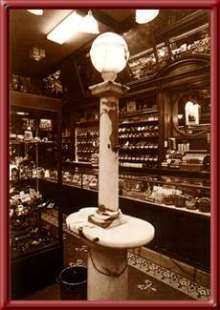
There on the table in front of the chesterfield are several open tins of tobacco. They are there for us to freely sample. We pick them up and sniff the fresh tobacco. I choose a nice stoved Virginia and you pick a rich English blend. We each pack our “new” pipe with the chosen tobacco and walk to the side of the sitting area where there is an old Electrolier. Andrew had told me that it was crafted from rare Mexican Onyx and is the last functioning model of its kind in the world. It was purchased in 1910 for $250.00 dollars and is a priceless piece of history. It has gas flames that are always burning and on the shelf around the centre column is a small box of cedar splints for lighting a pipe or cigar. We light our pipes with a splint. We tamp the bowls, relight and then extinguish the splints, dropping them in the bucket next to the lighter. We head back to the chairs and settle in for some great conversation and a smoke.
It is quiet for a while as we contentedly puff the sweet tobaccos and savour them. Slowly the conversation picks up again. Several of the regulars are there and we talk about the pipes we have picked up and the tobaccos smoked since our last conversation. One of the old gents, William has the most amazing collection of Dunhills that I have ever seen. I ask him, “William did you bring along any of your amazing Dunnies that you could show my friend Pat? I know he has never seen anything like them and that I never tire of looking at them.”
William reaches to the side table and picks up his leather pipe bag and opens it. He carefully takes out several of the pipes he had brought with him. He said, “I have these two older Shells that I brought along. The first is a 20’s vintage bulldog with an amazing blast. The second is a billiard that has a really craggy blast from the early 30’s. These are the only two I have with me other than the Bruyere in my mug (the one in his mouth is a beautiful old Bruyere billiard. I had seen it before and knew that it was a 1950’s vintage piece). Here have a look young feller.” With that he handed the pipes to Pat who sat on the edge of his seat puffing furiously as he held these pieces of history in his hands. He turned them over and over and the gents around the tables started to chuckle.
William said, “What do you think Pat? Ever seen anything like that pair?”
Pat replied, “No sir. I never even thought I would see something like them let alone have them in my hands. How long have you had them? Where did you pick them up?” He handed the little bulldog to me as he continued to examine the billiard and wait for the story that he knew was coming.
William laughed and said, “I picked the pair up at an antique shop many years ago now and have maintained the trust while they are in my hands. One day they will make their way into the next owner’s hands.” With that he waxed eloquent about how we hold pipes in trust, acting as stewards for the time that we live and then they pass them on to the next generation of pipemen who will also carry on the trust throughout their life times before passing them forward. Several of the other gents commented on the idea of the trust. This set a show and tell in motion as each of them pulled out their treasures and showed some of the pipes in their care. I sat there amazed as 80 year old William and several of the older gents gave us a glimpse of their collections and the incredible stories attached to each pipe. I looked over at Pat and noticed that he seemed to be lost in his own world as he continued to turn the pipes over in his hands checking out the blast and the flow of the old pipes. The stories just whirled around him.
Before we knew it our bowls had burned down to ash. Pat handed the two old pipes back to William and we carefully emptied the ash into the ashtrays, cleaned, repacked and relit our pipes. Pat commented, “What a great way to spend a day”. We sat and chatted about pipes and tobaccos with the other gents in the circle for the rest of the afternoon. The conversation waxed and waned as different ones left to relight their pipes or call it a day. Others came and took their places. The back of the shop was cloaked in a wonderfully smelling haze of pipe smoke. At one point in the afternoon the bell at the front of the shop tinkled as another of the regulars came in with a thermos of coffee to share with us. We laughed and commented as he put the thermos on the centre table and went to the back room and came out with some mismatched mugs, cream and some sugar. He went back and brought in a jar of teaspoons and set that on the table as well. Various ones poured a cup of coffee and thanked the newcomer for his gift. He winked at us and reached inside his shoulder bag and brought out a tin of cookies. We sipped coffee and munched the cookies, enjoying the treat. There was not much conversation going on while sipped and nibbled. We were too busy eating to interrupt the pleasure with conversation.
It was into the quiet reverie that the words, “Hey Steve, I have your pipe finished”. Andrew stepped into the circle of chairs with my pipe in his hands. “It passes my inspection. I gave it the final bit of buffing and it’s done for you. Load up a bowl and give it a smoke. I want to know what you think of it and if I need to make any adjustments for you before you take it home.” With that he handed me the pipe and took his place on the remaining chair in the circle. He tamped his pipe and puffed as he watched me take the pipe and load it up.
As the tobacco caught fire I said, “Thanks Andrew I am sure it is fine. I have never been disappointed with your work. But I will lay the pipe I have in my mouth down for a bit, load this one up and let you know.” The draw was as good as it had always been before I dropped the pipe and ruined the old stem. The feel in the mouth was perfect. The taper of the stem and the button shape were exactly to my liking. The bend in the stem made it hang exactly the way I remembered it had before. “Andrew, you got it perfect. I can’t think of a thing I would change.” I puffed contentedly on my old friend with a new stem.
Andrew chuckled, winked at me and puffed on his pipe. “We will see if you still think that after I give you the bill Steve.” He poured himself a coffee, stirred in some cream and entered into the stream of conversation around the circle. He sipped his coffee while holding his pipe in his hand. It seemed to me that I had never seen him without a pipe in his hand or his mouth. There were beads of coffee on his moustache as he set the cup down and reinserted his pipe in his mouth. He puffed gently and the pipe came back to life with a puff of smoke.
The afternoon went on like that for a while until, one by one; the gathering broke up with promises of see you next week. Soon Pat and I were the only ones left in the shop. “Well I guess we should go and get some work done before the day is over, eh Pat,” I said. So we made our way to the cash register to settle up for the “new” pipes and the repair bill. I took out my wallet and handed Andrew the payment. He chuckled when I exclaimed at how little the bill was. I am constantly amazed at the prices he charges for the fine work that he does. But then again I know he does it for the love of the pipe. We bid farewell and left shop with our pipes in our mouths. Andrew waved through the window to us and went back to work on his buffer.
Review of a Hand Made Larrysson Apple
Blog by Steve Laug
For quite some time I had wanted a pipe crafted by Paul Hubertt, a Larrysson pipe. Have a look at his website and you will see some of the beautiful pipes he has made and sold and those still remaining for sale http://www.larryssonpipes.com/index.php Several years ago I saw this one on his website and took the plunge. I have been smoking it since that time, enjoying it and thought it was about time to write a review. It is a beauty to be sure. The length of the pipe is a nice short 5 inches and the bowl height is 1 3/8 inches. The chamber diameter is 3/4 inches and depth is 1 1/8 inches. It is a perfect size for me, and feels great in the hand. The overall shape is something like a ¼ bent apple. The stamping is in a smooth oval on the underside of the shank. It is stamped Larrysson in script over HAND MADE over CORNWALL over ENGLAND and underneath all is the date stamp – 72-09 which I believe means the 72nd pipe of 2009.
The finish on the outside of the pipe is a beautiful sandblast that highlights the ring grain on the pipe. There is a tactile feel that adds to the beauty of this particular sandblasted pipe. On the shank Paul continued the blast but left a smooth band near the stem shank junction and in an oval on the underside of the shank for the stamping. The rim and underside of the bowl obviously had a birdseye grain and the blast highlight that as well with small pits and whirls. The staining on this appears to use a contrasting series of browns to highlight the blast. There is a medium brown undertone that is interesting and over that is a lighter brown or almost tan overstain. The combination works very well and as I have smoked it the variation is developing depth. The stem itself is a well made saddle stem handcrafted from acrylic. The blade of the stem is well tapered and thin without sacrificing durability. The design along with the slight bend makes it fit very comfortably in the mouth. It also rests well enough that it can be clenched quite easily. The tenon is delrin and is countersunk at the end for good mechanics. The button is exactly the way I like them – thinner on the edges with a gentle rise at the centre top and bottom. It fits well behind the teeth for a comfortable feel. The draught hole in the end of the button is also funneled to deliver a mouthpiece that has the same diameter from start to finish. Comfortable and well executed. A pipe cleaner passes easily through the pipe with no obstruction.
The internal mechanics of the pipe are well executed. The bowl chamber is drilled to a ¾ inch diameter. The inner edge of the bowl us straight and clean to the rim. The outer edge is rounded down to the edges of the bowl with the blast coming right to inner edge. The bowl is not coated with a bowl coating and the raw briar was sanded smooth and very clean. There were no flaws or visible pits in the interior. The draught hole is centered at the bottom of the bowl and seems to have a slight funnel as well – like a shallow Y- leading into the shank and stem. There is a very easy and open draw to the pipe. The fit of the stem to the shank is very good – smooth and tight with no light showing at the joint. The tenon sits deep in the mortise – if not exactly the same length then impressively close! The fit of the tenon is also smooth. The drilling of the draught in the shank is straight and centered in the back of the mortise. The air pulls clearly through the pipe with no whistling at all. Using a light to shine through the various airways reveals smoothly executed airways on the inside. Paul’s mechanics are very well done.
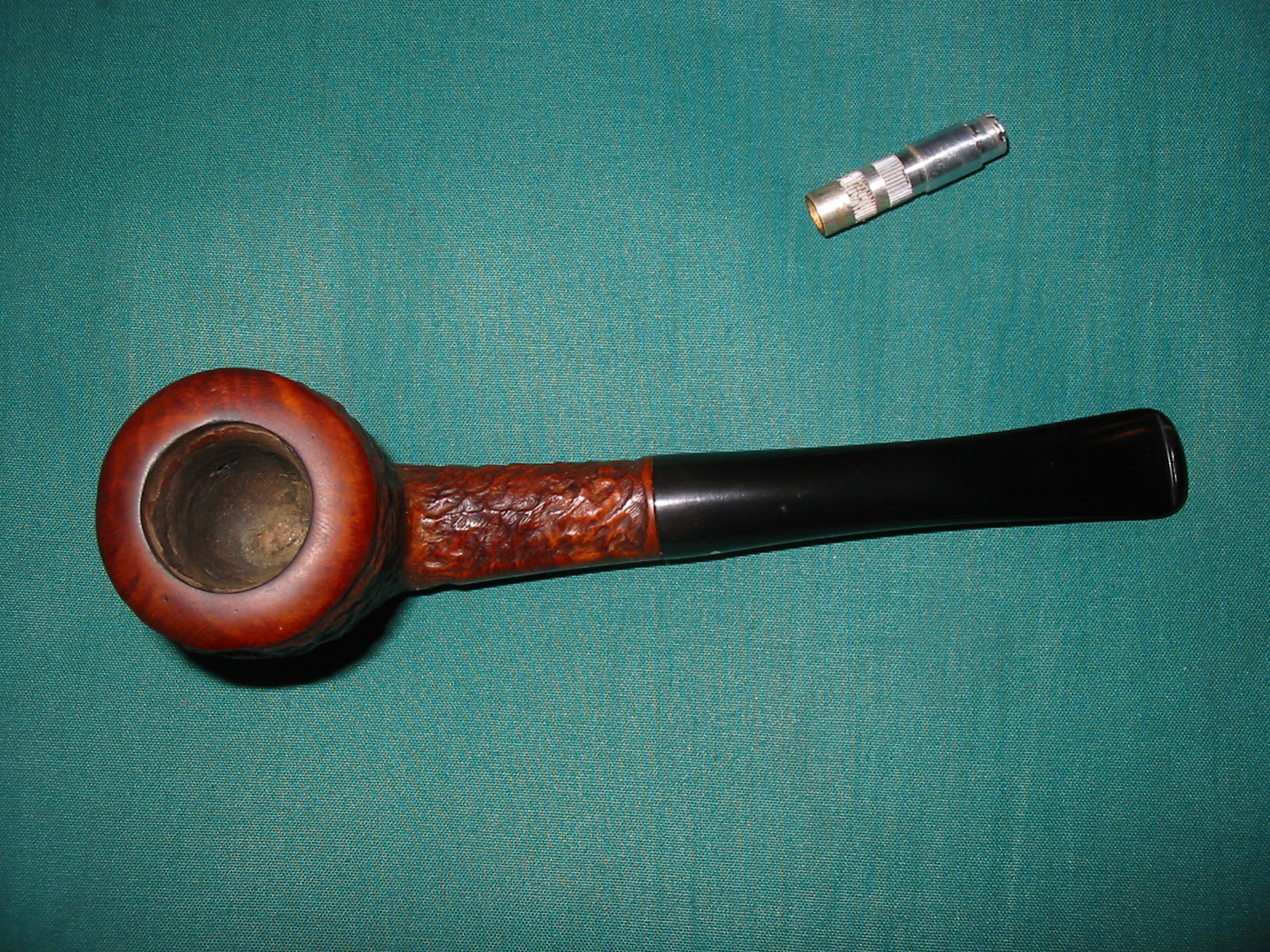
Today I smoked it when I went for my walk. I loaded a bowl of aged McClelland’s 5100 and took a walk in the neighbourhood. The tobacco packed very easily and lit well. The draught on the pipe was superb. The smoke was uncomplicated and effortless. From the first bowl many years ago now until today this bowl smoked incredibly well. It always has delivered a flavourful and effortless smoke. I am looking forward to another bowl later this afternoon.
Thanks Paul for a well made pipe that smokes as good as it looks!
Sweetening a Pipe – An Alternative to the Salt and Alcohol Treatment
Blog by Steve Laug
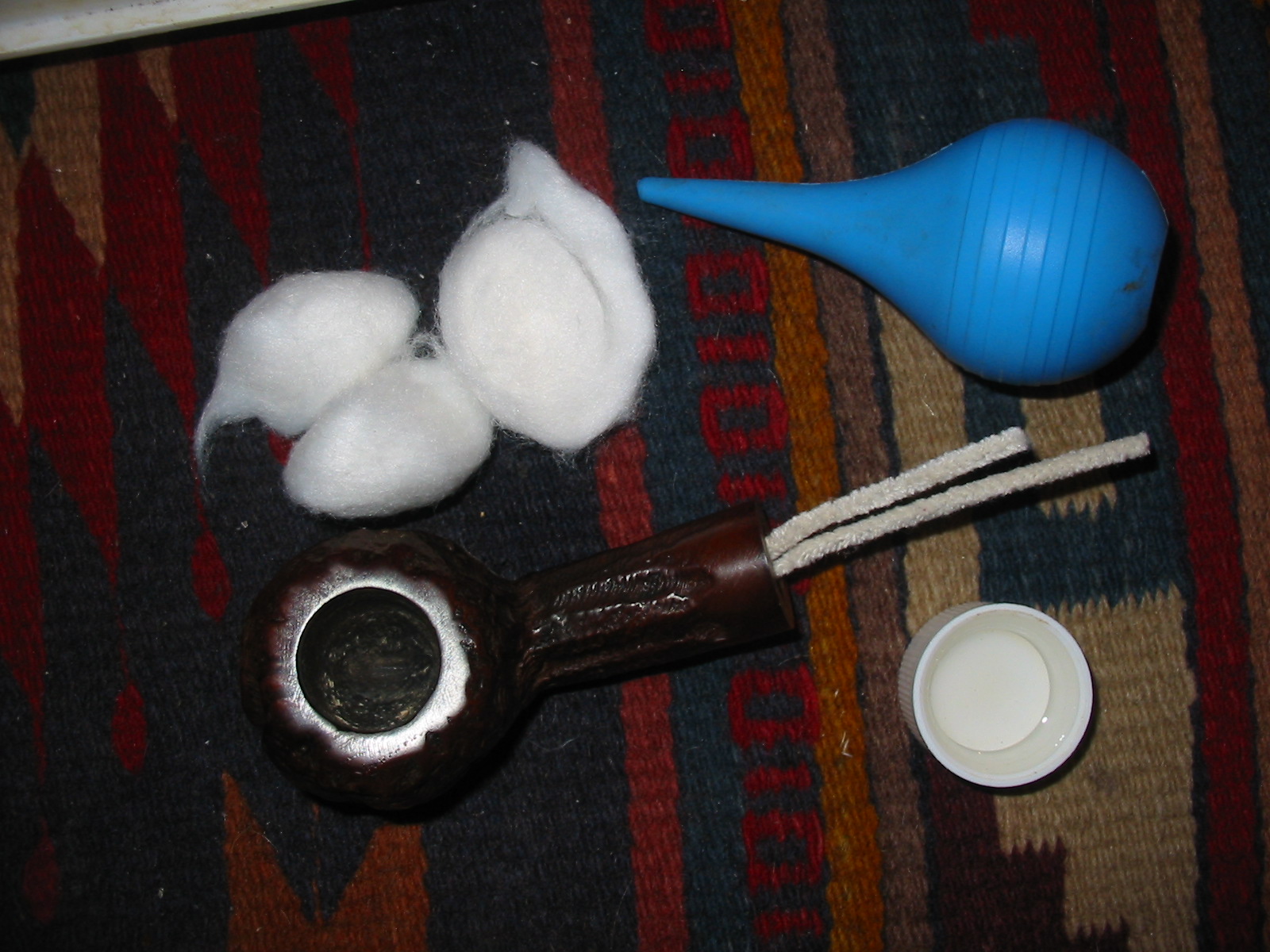
After writing the post about using the salt and alcohol treatment to sweeten sour pipes or estate pipes I decided I would also write about an alternative method that I have used and still continue to use at times. The process is much the same as the salt and alcohol treatment and the effect is much the same. In some sense the cotton bolls are easier to work with and there is certainly no leaching of salts or such into the briar of the bowl. The cotton bolls are neutral and work quite well. They are easy to remove. The only difference I find is that the alcohol does not dissipate into the air as well with the cotton and they are still damp when I remove them from the bowl the next morning.
The tools
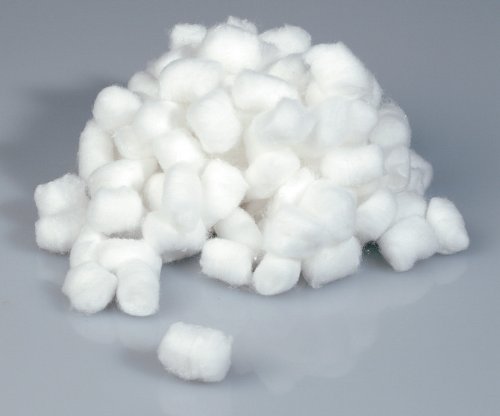
COTTON BOLLS– I buy cotton bolls in bulk at pharmacies, variety stores or the local dollar store down the street from my house. I find that the cheaper ones work as well as the more expensive. The difference is in the number of bolls that it takes to fill the pipe bowl. There are several features of the cotton boll method that endear it for me. The first feature is that it is easy to stuff in the bowl of the pipe and is readily available. The second, like the salt method, is that it provides multiple surfaces onto which the leached out oils and tars can migrate. Like the salt treatment, I have used the cotton boll method for many years. And over the years I have never had a problem with it. I have never had a shank or a bowl crack or split after it has been cleaned using this method. So ultimately the choice is yours to make. Experiment with both and see which one you favour and continue to use it to your advantage.
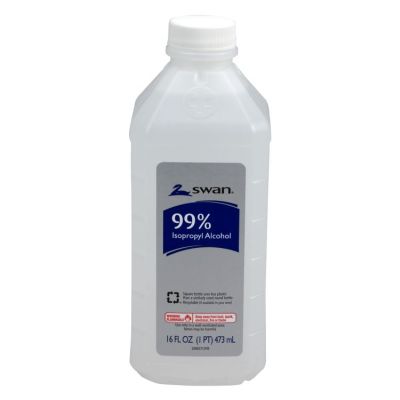
ALCOHOL – As before with the description of the salt and alcohol treatment, I use the highest percentage isopropyl alcohol that I can get through my local pharmacy. Most of the time I am able to purchase 99% Isopropyl alcohol or Rubbing Alcohol but have also used 91% Isopropyl with no ill effects. I just purchased a bottle of Everclear while traveling and will be trying it out as well. The water content in the 99% Isopropyl is 1% and I find that it evaporates quite quickly and does not saturate the briar. Much has been written about using an alcohol that is not a human consumable form. Many have spoken of the danger of using it in the pipe bowl or in cleaning the stem of a pipe that is going to be put in the mouth. However, I have found that once the cotton bolls and alcohol have been removed from the bowl and the pipe air dries there is no remaining alcohol in the bowl. With the removal of the cotton bolls I have found that there is always some residual alcohol in the bowl after I take out the cotton. It seems to keep the alcohol longer than the salt did. To remove the last of it I use a match and light the inside of the bowl to burn off any remaining alcohol. It quickly burns the alcohol and does not harm the pipe bowl. Once that is done the bowl is dry to the touch. From my experience the alcohol burns off and any remaining in the briar dries out quickly over the next few hours that the pipe sits.
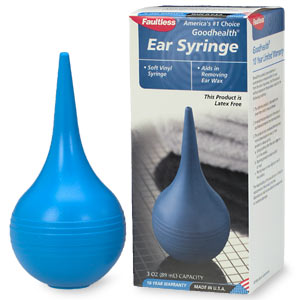
EAR SYRINGE – I use the same ear syringe to fill the bowl with alcohol as I explained in the previous post. It truly is an indispensable tool for my refurbishing kit. I use it in this process and also in the process of removing excess water from the bowl when I am making a pipe mud patch. It is rubber and works incredibly well at keeping the alcohol off the outer finish of the pipe. By squeezing the bulb you can draw alcohol into the syringe and then be squeezing it again over the bowl of the pipe the alcohol is poured into the bowl quickly and without a mess. The syringe is resilient and durable. I have had mine for a long time.
The method
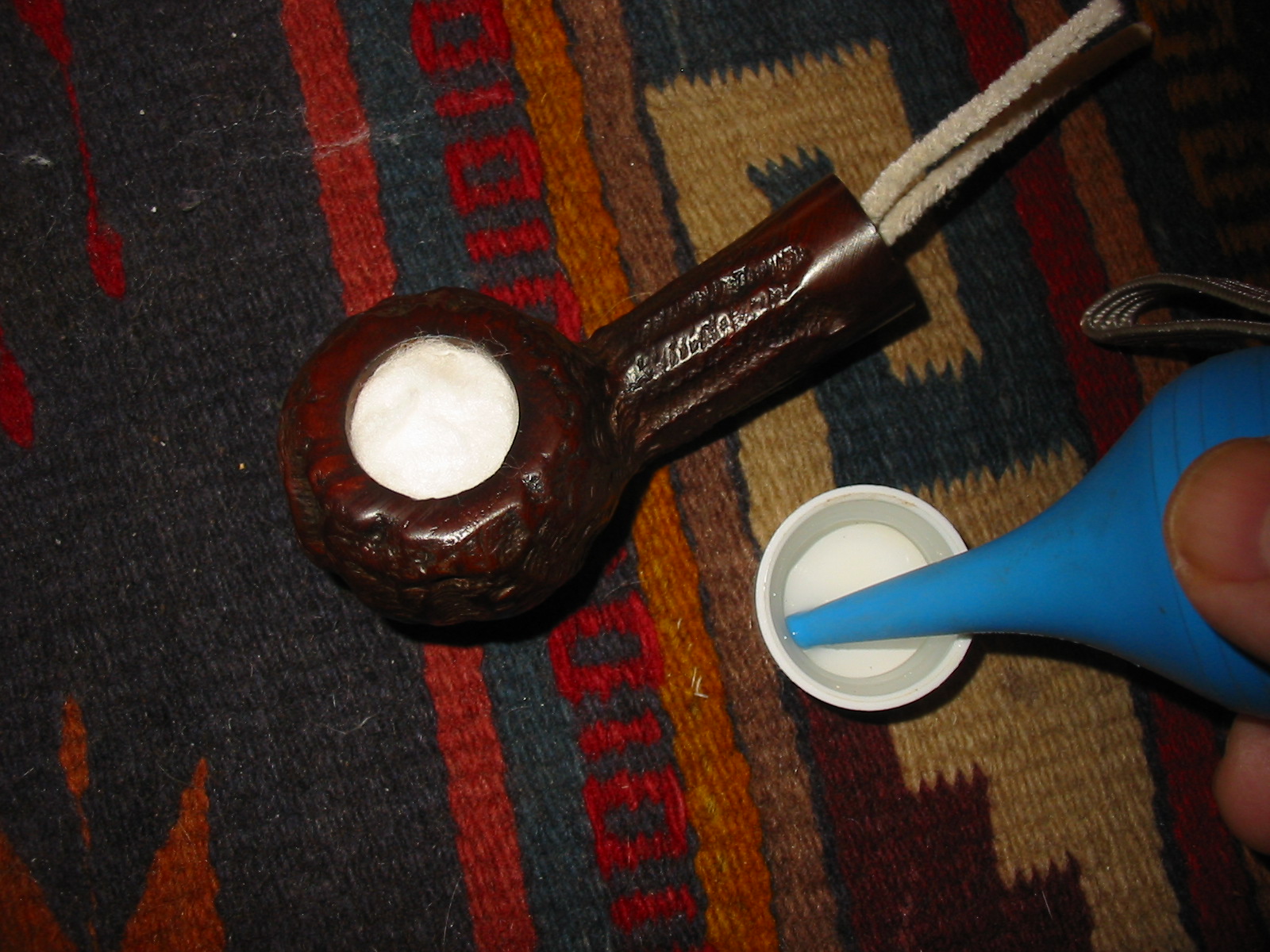
I remove the stem from the bowl and then stuff several cotton bolls into the bowl. An average sized bowl will take two or three cotton bolls pressed down tightly into the pipe. I press them tightly as I do not want them to spring up when I fill the bowl with the alcohol. I want them inside the bowl and not overlapping and touching the rim of the pipe. The photo below shows the bowl ready to be filled. The second photo below shows the bowl stuffed with the cotton bolls and the alcohol ready to be loaded into the syringe and then put in the bowl. When I pack the bowl with cotton bolls I try to leave it a bit below the edge of the bowl. I also insert a folded pipe cleaner in the shank and airway to close off the airway and provide a bit of a plug for the alcohol. It also acts as a wick and draws the tars and oils from the airway.
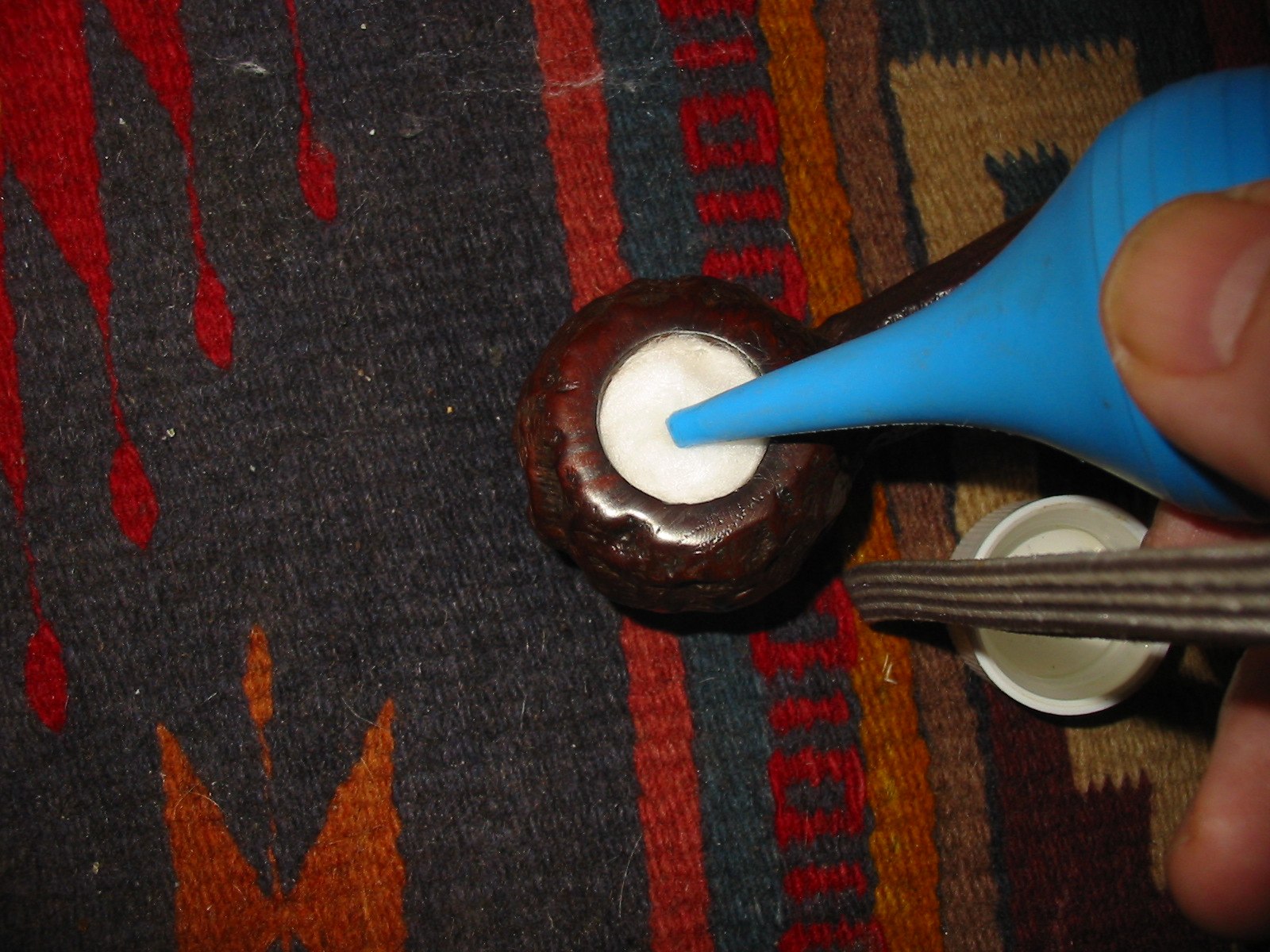
The next photos below show how I fill the bowl with alcohol. I have found that the cotton absorbs more of the alcohol than the salt does and it takes several syringe loads to fill the bowl. I pour Isopropyl alcohol into the cap of the alcohol bottle and get the ear syringe and the bowl ready for work. The first photo shows the loading of the syringe. The second photo shows the filling of the bowl from the syringe. I do this by putting the tip of the syringe in the top of the bowl and squeezing it until the bowl is filled with the alcohol.
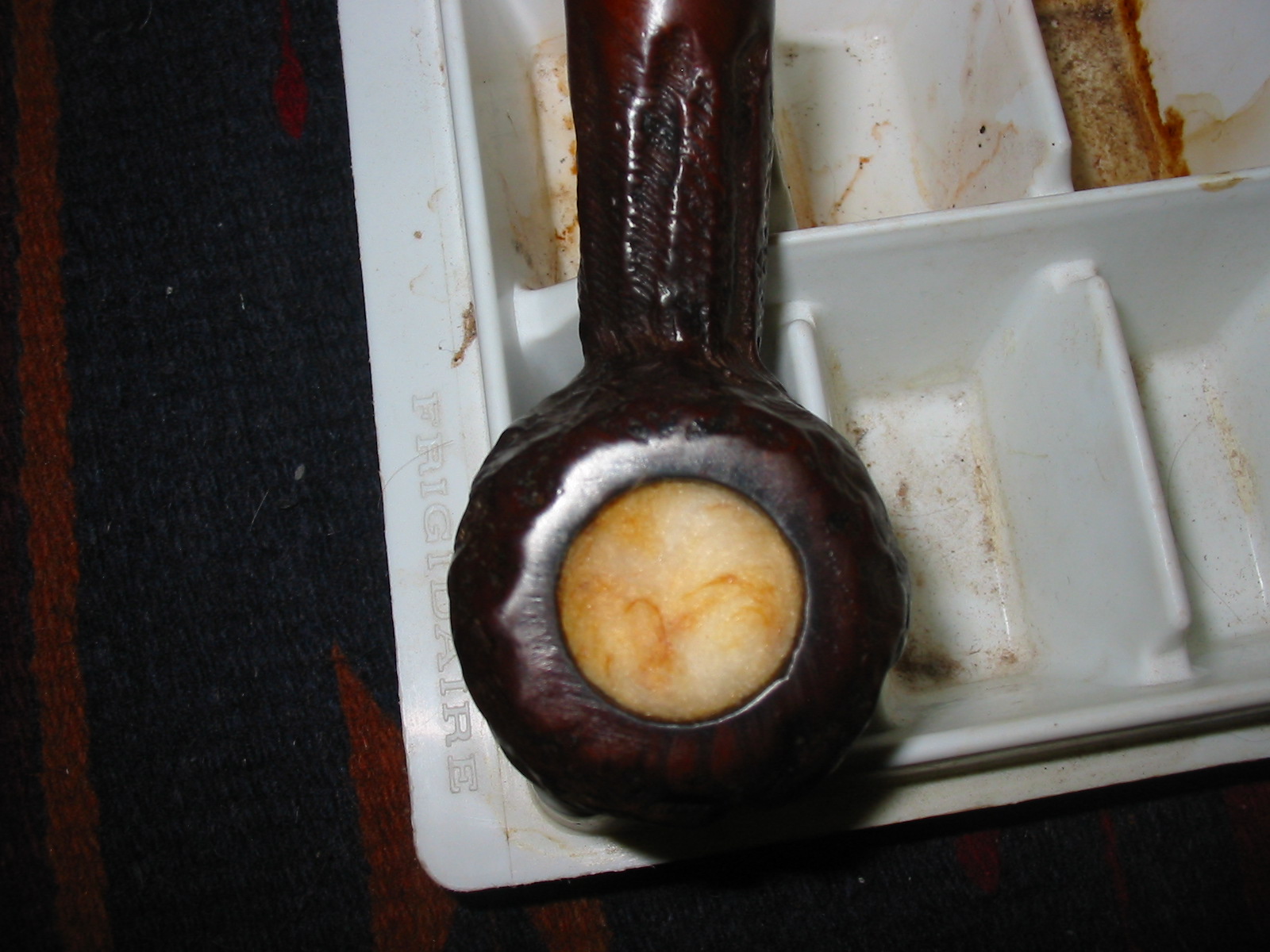
Once the bowl is filled I place the loaded bowl in the ice tray that I use to keep the pipe upright while the alcohol and cotton do their work drawing out the tars and oils. The process works quite quickly and the salt begins to darken with the oils and tars within a few moments. The photo below shows the newly filled bowl as it sits on the ice cube tray.
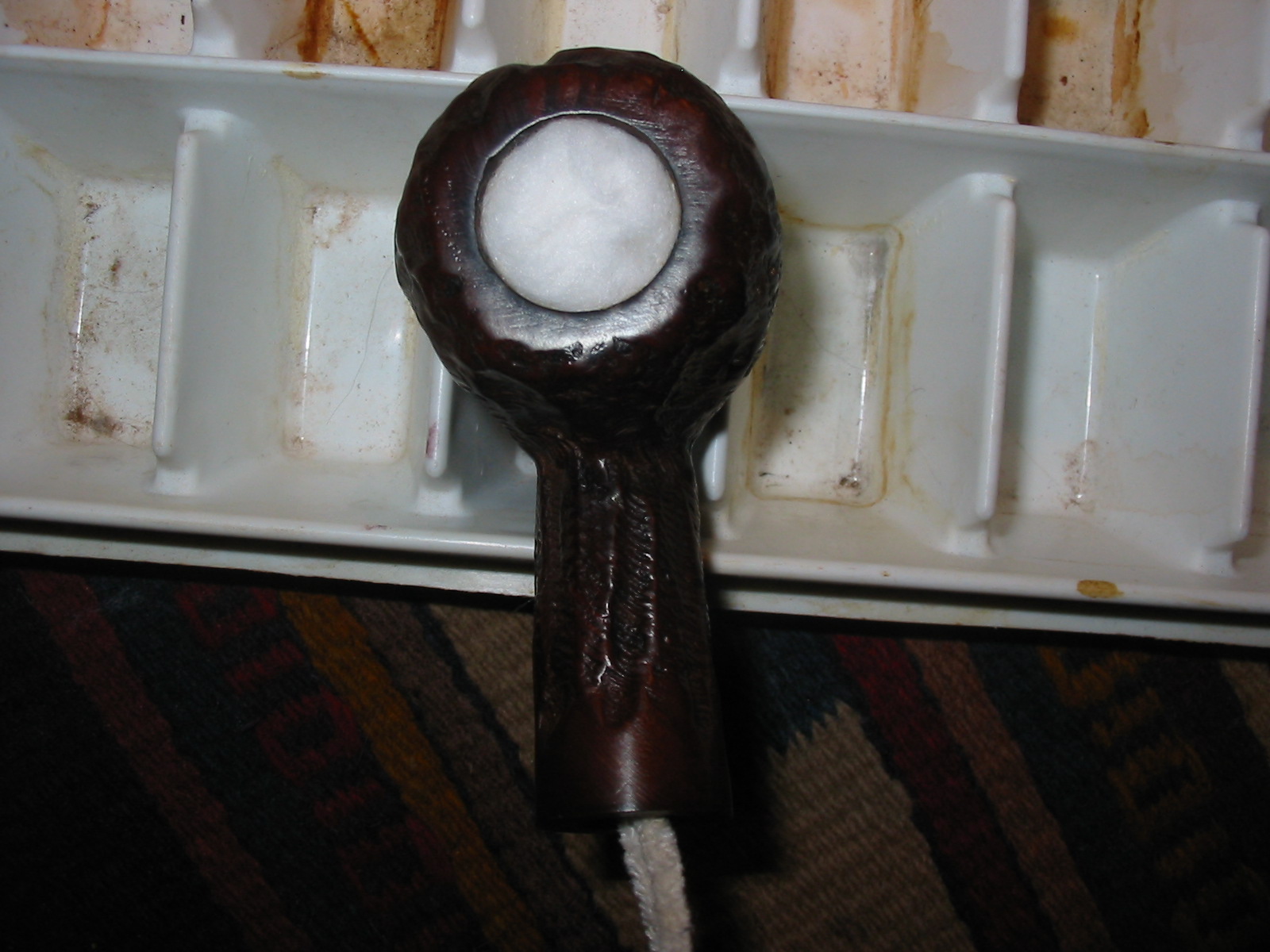
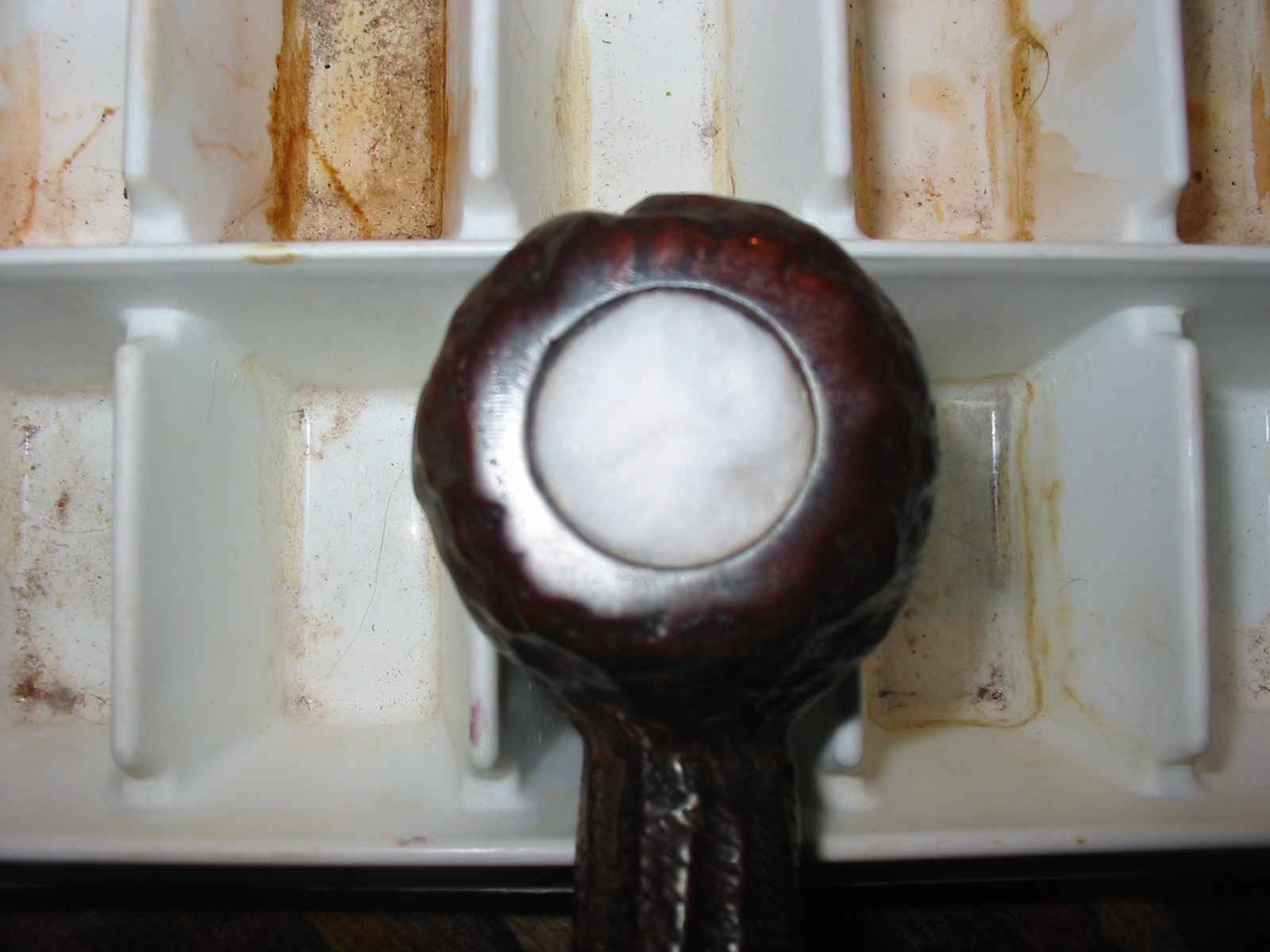
The next series of photos shows the cotton turning brown beginning with the edges and working toward the centre of the bowl. The first photo below is taken after the bowl had been sitting for 2-3 minutes. At this point the cotton is beginning to darken at the edges but it is barely visible in the photos.
The photo below was taken after the pipe bowl had been sitting 15 minutes in the tray. The brown colouration is moving around the edges and in toward the centre of the bowl.
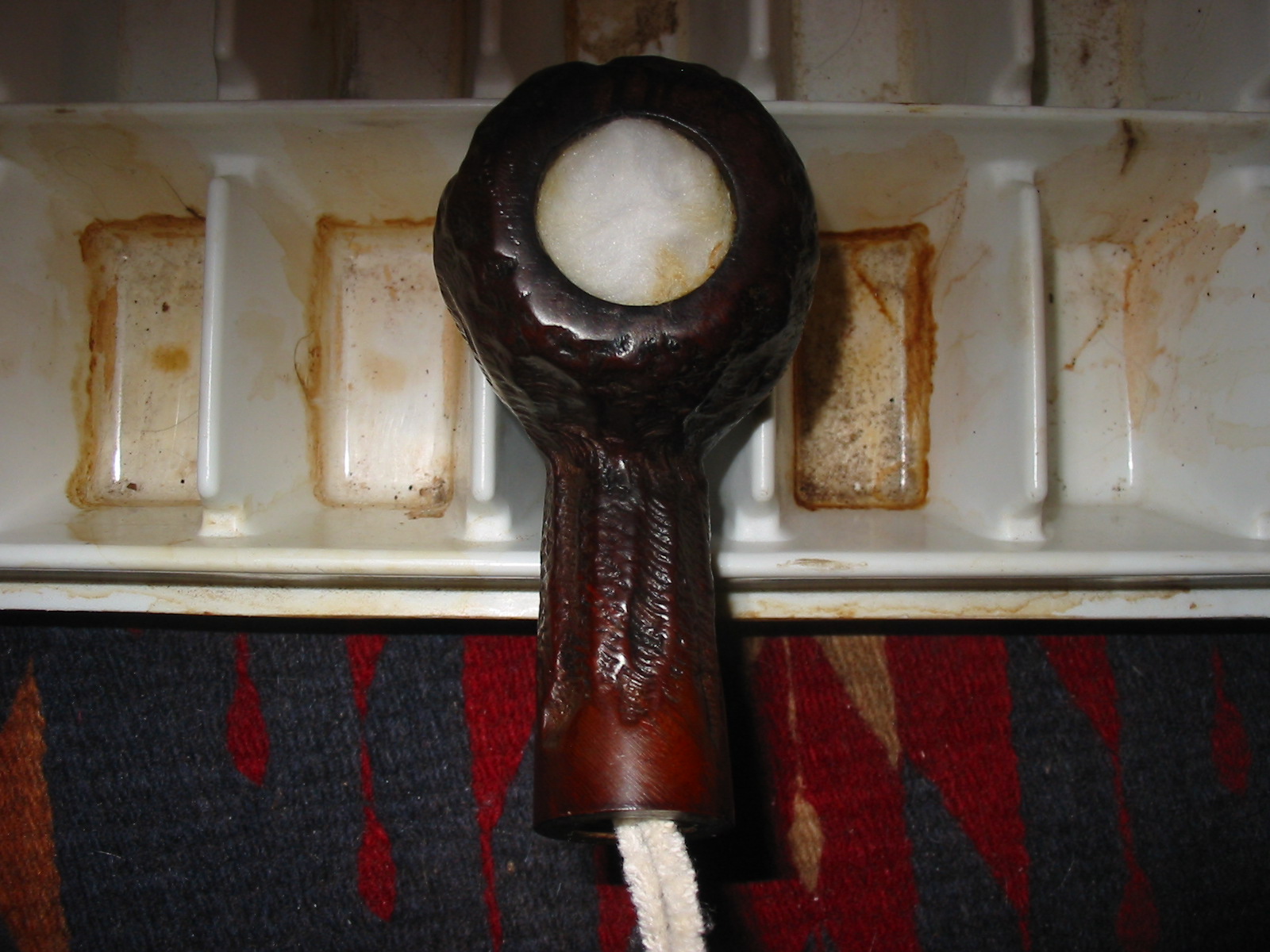
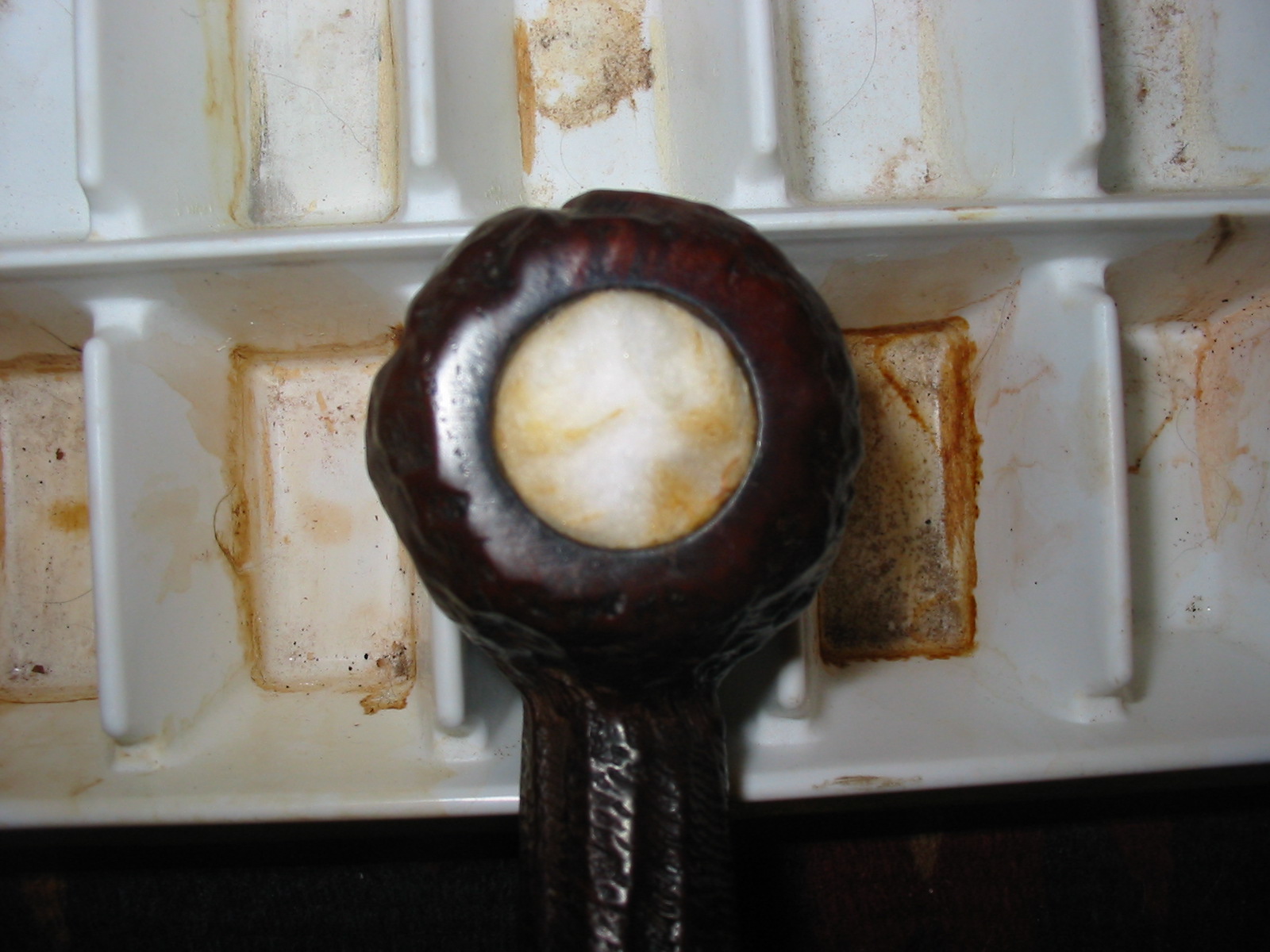
After the bowl sat for a half hour, I took the picture below to show the movement of the brown tars and oils toward the centre. On this pipe I had cleaned the shank with many pipe cleaners before getting to this point so there is very little leaching of tars and oils into the pipe cleaner.
Forty five minutes later I took the photo below and then tamped the cotton bolls down with my thumb. Then I set the pipe aside for the night to let the treatment do its work.
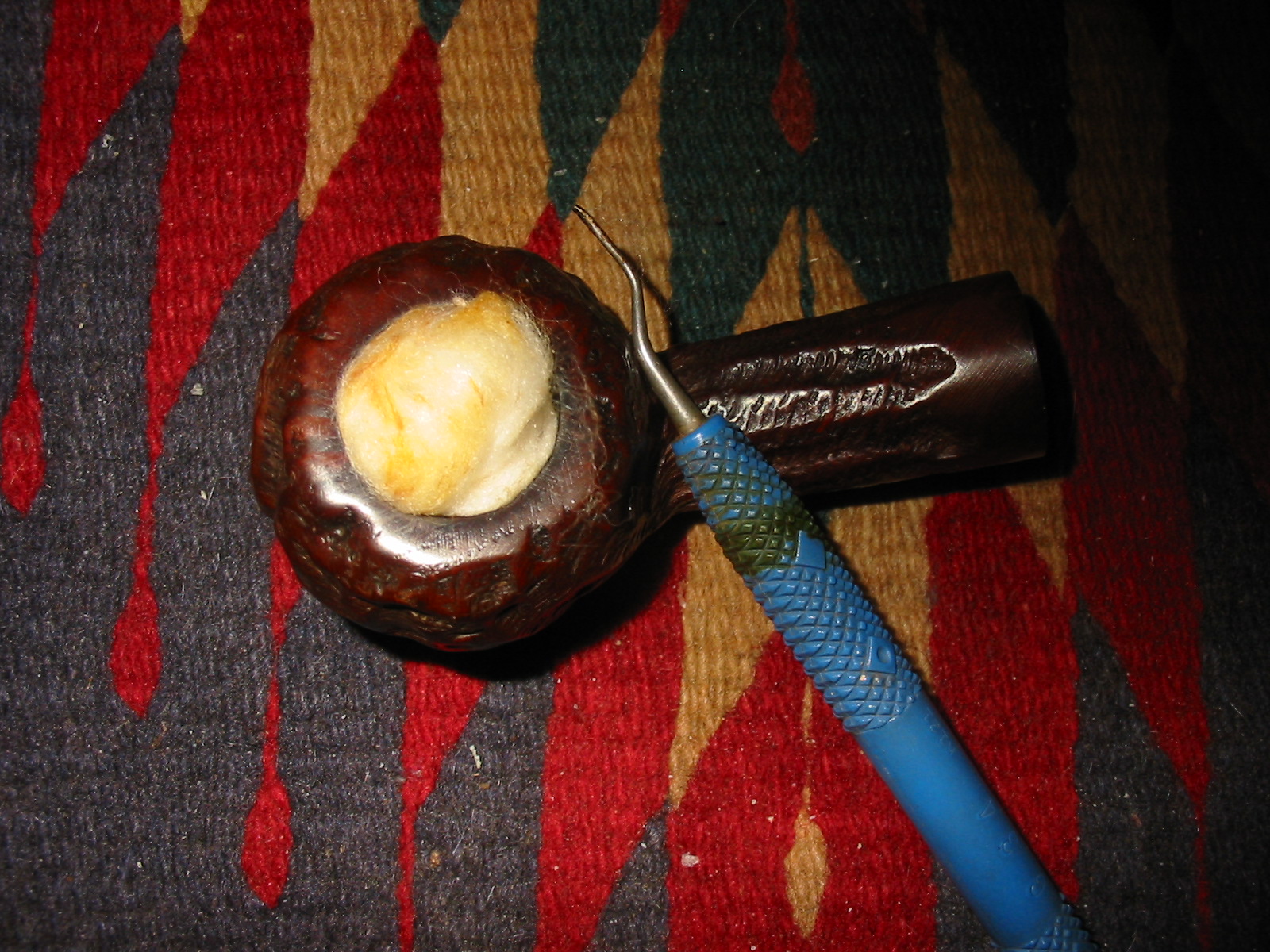
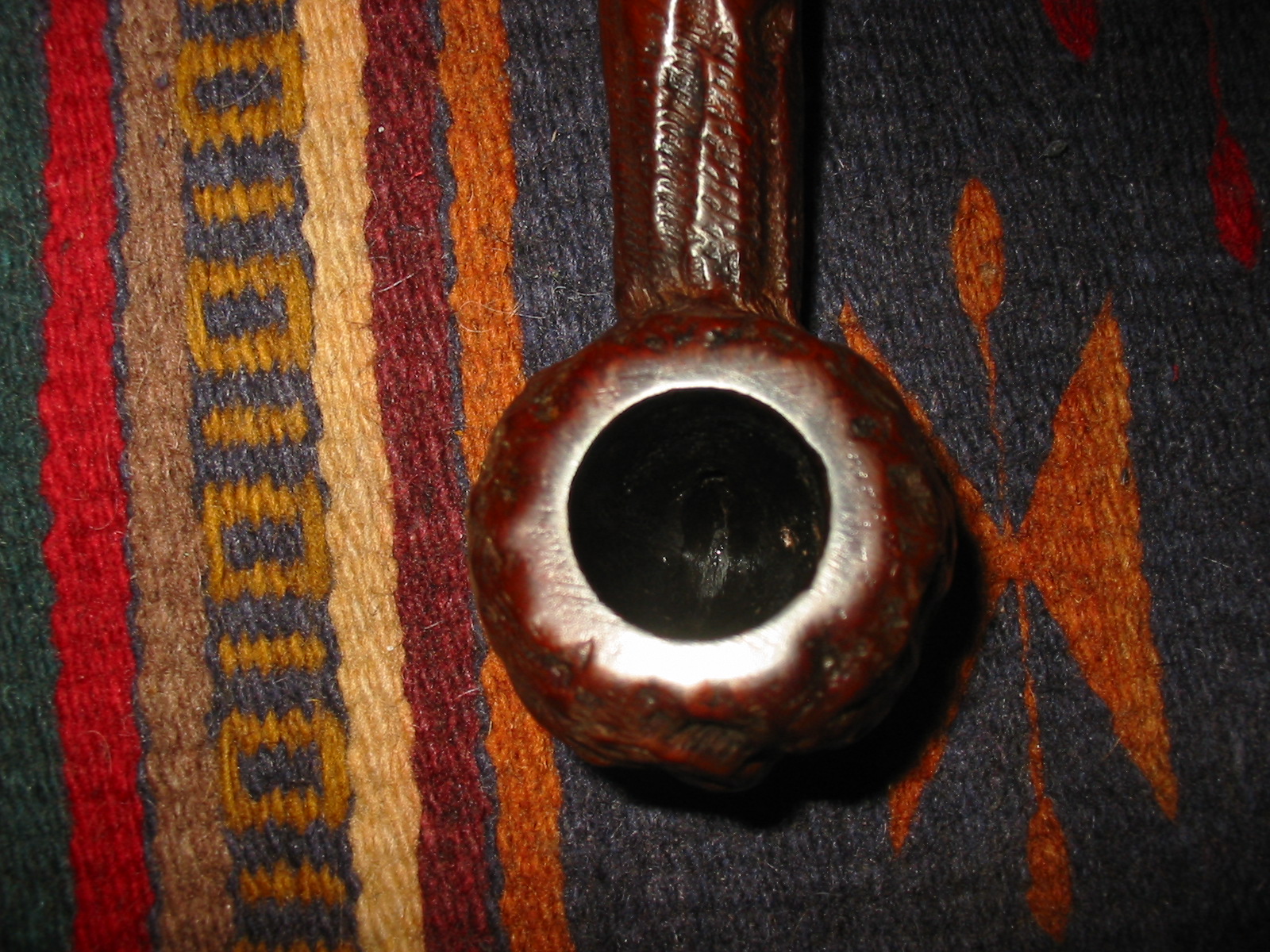
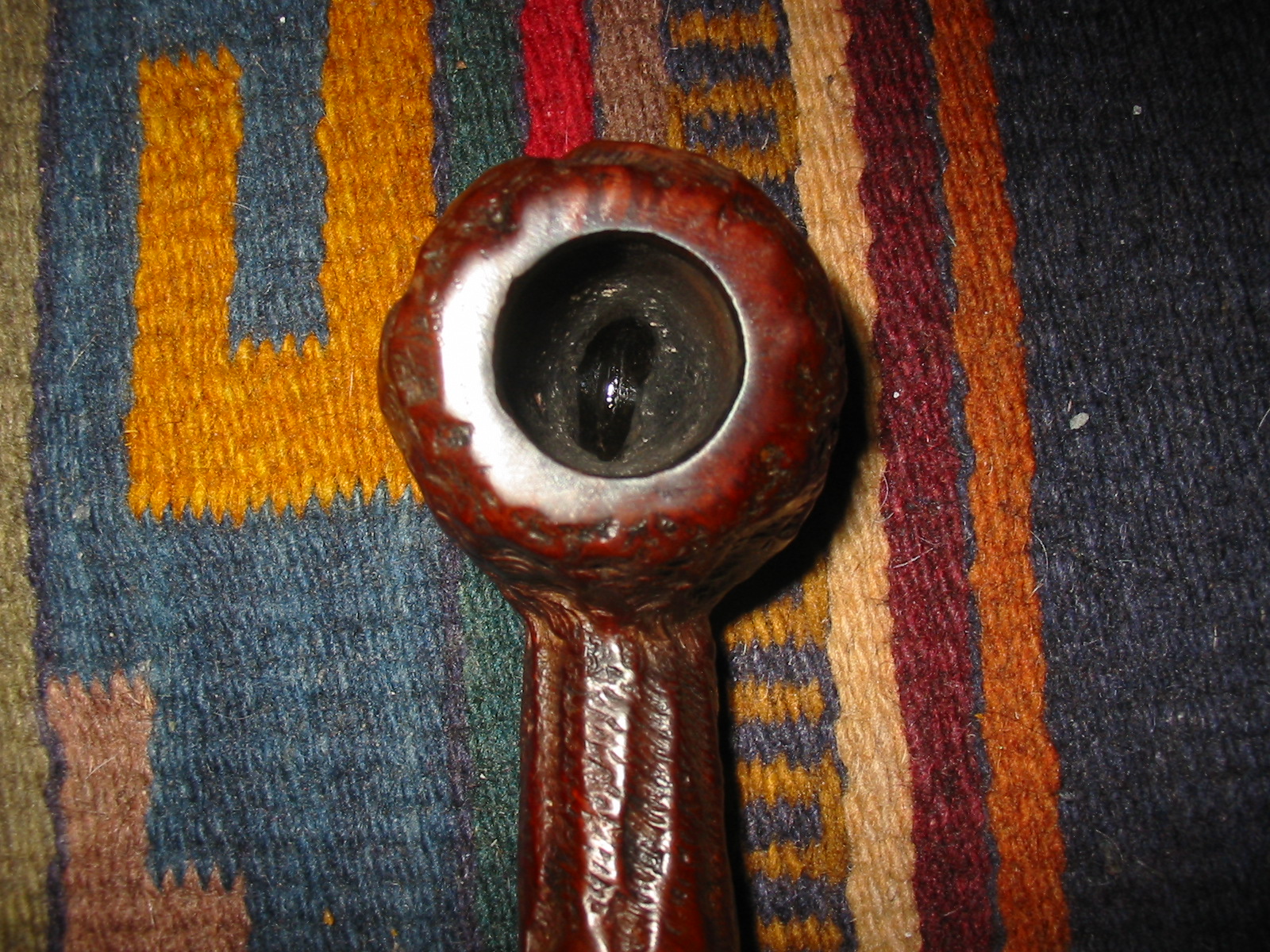
This morning the cotton was darkened and the alcohol was evaporated. I used my dental pick to remove the cotton bolls from the pipe and threw them away. I removed the pipe cleaner from the shank as well. I used several pipe cleaners to wipe out the inside of the shank and several folded pipe cleaners to wipe out the inside of the bowl. The bowl was still wet from the remaining alcohol so flamed it with a lighter to quickly burn out the alcohol. The four photos below show the extent of the tars and oils removed in the brown cotton bolls and the dental pick I use to remove the cotton bolls. The final photos show the clean bowl. The pipe smells clean and fresh. When I have finished cleaning the pipe I set the bowl aside and let it dry for several days before smoking it.
Making an Alcohol Bath
Blog by Steve Laug
I use an alcohol bath for a lot of my pipe refurbishing work, particularly if I plan on restaining the pipe. The alcohol bath allows the pipe to soak submerged in isopropyl alcohol. This soak loosens the grit and grime in the finish and also removes the topcoat of wax and the stain. I have found it indispensable in loosening old finishes and allowing me fairly easy access to the briar beneath the finish. I have also found that it softens the old putty fills on pipes I plan on removing the fills from and reworking them with briar dust and superglue. I have referred to it often in the pages of the rebornpipes blog so I figured it was time to write about how I go about making the bath.
Equipment
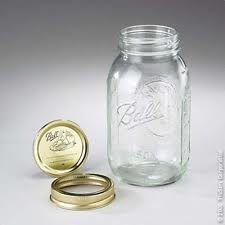
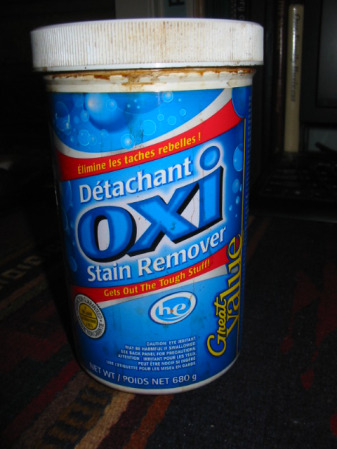
CONTAINER – You will need a container with a lid that seals tightly. I fill my alcohol bath and reuse it over and over again. You can use any container that has a screw top lid such as a Mason jar, jam jar, plastic container with a screw top, or any other lid that seals tightly. I have found that a one quart jar or container works best as I often have more than one pipe in the soak at the same time. I use a recycled Oxyclean plastic jar. The screw top lid keeps the liquid from evaporating as well as splashing when you shake it a bit in the process of cleaning the bowl. I have included pictures of several types of jars that I have used. I think the strengths and drawbacks of each are readily clear. I generally use the plastic jars as I have dropped the glass ones in the past or knocked them off the work bench and found a mess that needed to be cleaned up.

Mason Jar with a screw top. I have used wide mouth Mason jars as they give more room for me to get my hand in the jar to add or remove pipe bowls
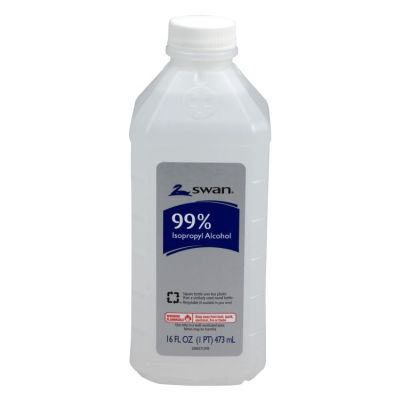
ALCOHOL – For the alcohol I fill the bath with I use the highest percentage isopropyl alcohol that I can get through my local pharmacy. Most of the time I am able to purchase 99% Isopropyl alcohol or Rubbing Alcohol but have also used 91% Isopropyl with no ill effects. I just purchased a bottle of Everclear while traveling and will be trying it out as well. The water content in the 99% Isopropyl is 1% and I find that it evaporates quite quickly once I remove the pipe from the bath and does not saturate the briar. Much has been written about using an alcohol that is not a human consumable form. Many have spoken of the danger of using it in the pipe bowl or in cleaning the stem of a pipe that is going to be put in the mouth. However, I have found that once the pipe has been removed from the alcohol it air dries very quickly. Once I am done working on it there is no remaining alcohol in the bowl.
CLOTH – I use a piece of cotton cloth (a piece of an old tee shirt) to filter the alcohol when I clean the bath monthly or bimonthly. I pour the alcohol through the cloth into an old bowl I have here and then clean out the jar and return the filtered alcohol to the jar.
Setting up the alcohol bath
I wash the new jar or container with hot soapy water and rinse it well. I am not sure that is necessary but it is a habit that I have with any new jars or containers. Once it is dried off I fill the bowl with the isopropyl alcohol up to one inch from the rim. I leave room for displacement as the level rises when I place the bowls in the bath. From experience I have learned that this amount of space leaves room in my container for two or three pipe bowls. Once the alcohol is in the container the bath is ready to go. I put the lid on tightly and set it aside until I need to use it.
Using the alcohol bath
When I have a pipe bowl that I want to soak in the alcohol bath I clean it well before putting it into the bath. I set aside the stem and then ream the bowl and clean out the bowl and shank until the pipe cleaners are clean. There is no need in dropping dirty pipes into the soak. The exception to the cleaning is that I will often leave a caked and tarred rim as found because the alcohol bath will loosen and soften the residue and make removal much easier. Once the pipe is clean I drop it in the bath to soak. It is always fascinating to me to see whether the briar floats or sinks. I have seen both and it is fairly unpredictable. I used to think that lightweight briar floated and by and large it does but there are exceptions. I leave the bowls to soak for a minimum of two hours and a maximum of 8 hours (overnight). Once the soak is over I remove the bowl from the bath, dry it off with a soft cloth and set it aside. The alcohol evaporates quite quickly. If the finish is still spotty or the rustication or sandblast surface still dirty I will scrub it quickly over the bath with a brass bristle tire brush or a tooth brush – dipping it into the alcohol of the bath and scrubbing the surface until it is clean. Once it is clean and the way I want it I dry it off and set it aside. Bowls that have been soaked and cleaned are ready to be sanded or stained within minutes of drying off. I have had no residual effects from soaking the bowls. Once they dry and the pipe sits for a couple of days before smoking there has been no ill effects.
Life expectancy of the alcohol in the bath
I have often been asked how often I change the alcohol in the bath and have to say that I probably don’t do it as much as most people think. I will filter the alcohol either monthly or bi-monthly by pouring it through the cloth that I mentioned above in the equipment portion of this post. I tighten the lid and shake the alcohol bath for several minutes to loosen any sediment in the bottom of the bowl and then pour it. I find that the filtering removes the sediments and floating particles in the alcohol. I then wash the container with warm soapy water to remove grime on the inside of the container and then dry it off and pour the alcohol back in the container. Over time the alcohol changes colour and takes on a rich dark brown patina. It still works very well and I find that the bath will also work well to give the pipe a nice even under patina to whatever stain I want to use on the finished pipe. I suppose that if I wanted to soak a virgin or light coloured bowl I would start with clean, clear alcohol but I have not done that to this point.
Here is a picture of my current alcohol bath and you will note the rich brown colour of the alcohol.
Considerations when buying a pipe (by Rob)
Arno posted this great article on buying a pipe on his blog. I thought it was a great read so I have reblogged it here on rebornpipes
Rob is one of the oldest and well respected members of the Dutch pipesmokers forum. He is a pensioned man who knows the ropes of life. Nonetheless he always stays positive and is an inspiration for many. Rob is a very experienced pipe smoker and he regularly writes nice pieces for the Dutch forum. This is one of them, “Considerations when buying a pipe”:
Buying a new pipe is simple. You step into the pipe shop and after some searching and comparing you pick a pipe that you think you are going to be content with.
Unfortunately / fortunately it’s not like that. Buying a pipe requires insight and a bit of experience.
How are you being received by the shop owner? Do you get coffee? Do you feel that he takes the time for you?
Are you a tobacco omnivore, or do you only smoke shag cut (in…
View original post 508 more words
George Khoubesser and Malaga Pipes
Blog by Steve Laug
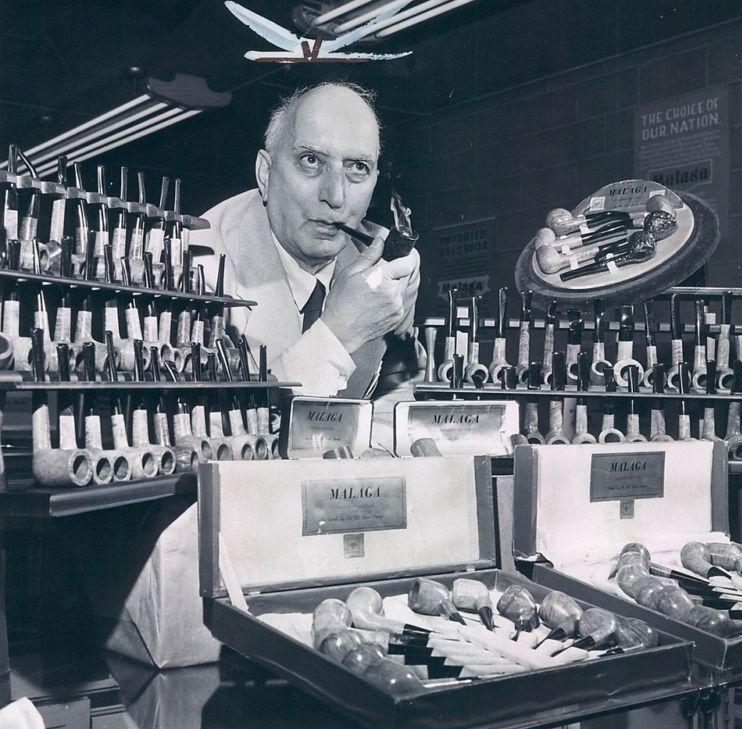
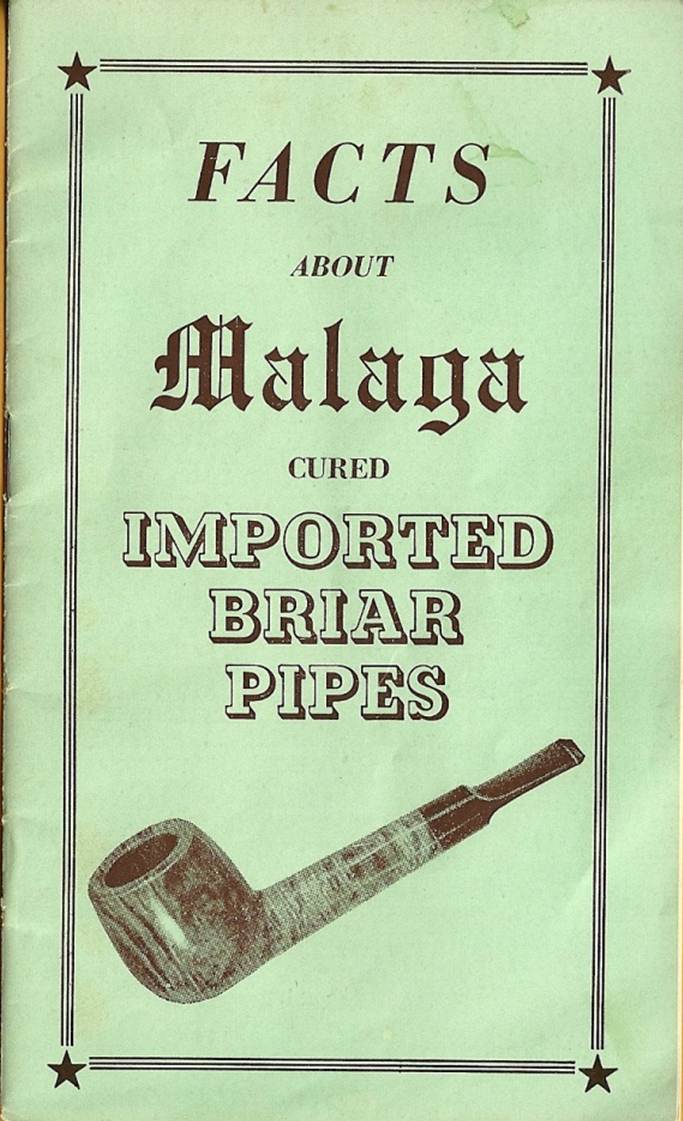
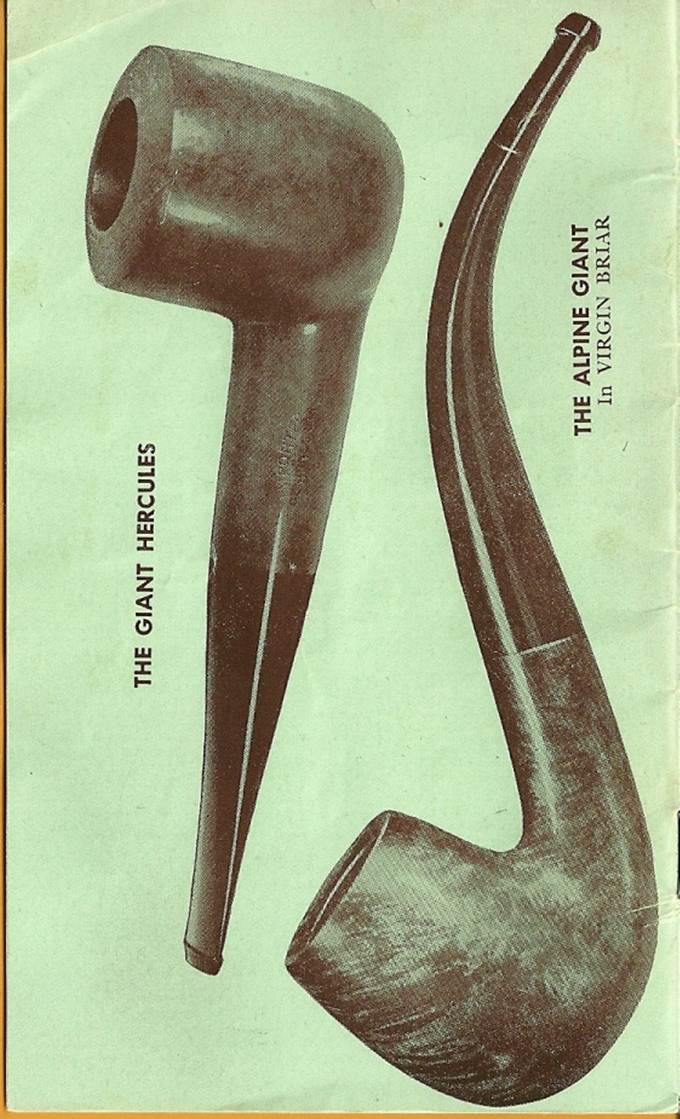
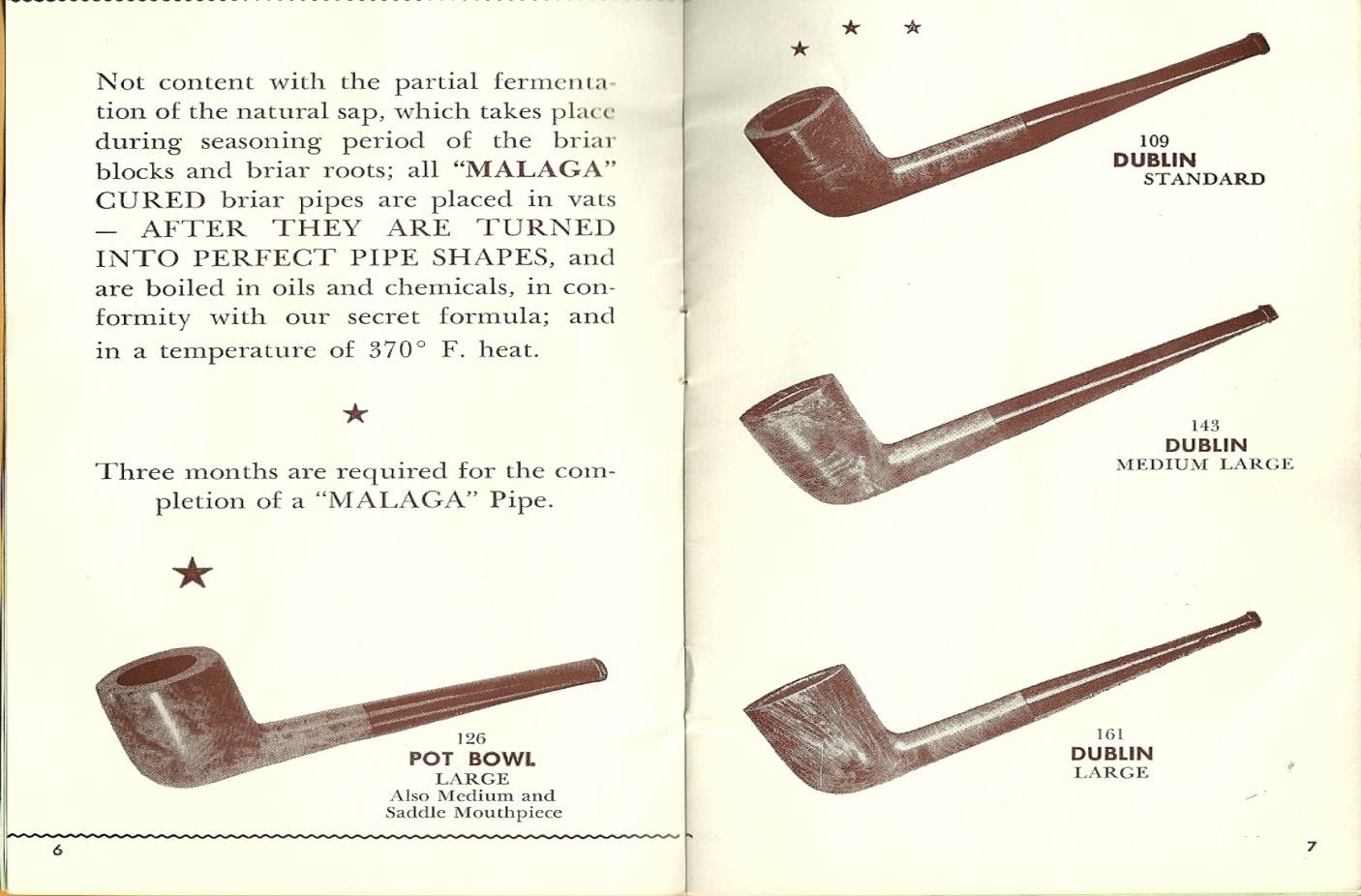
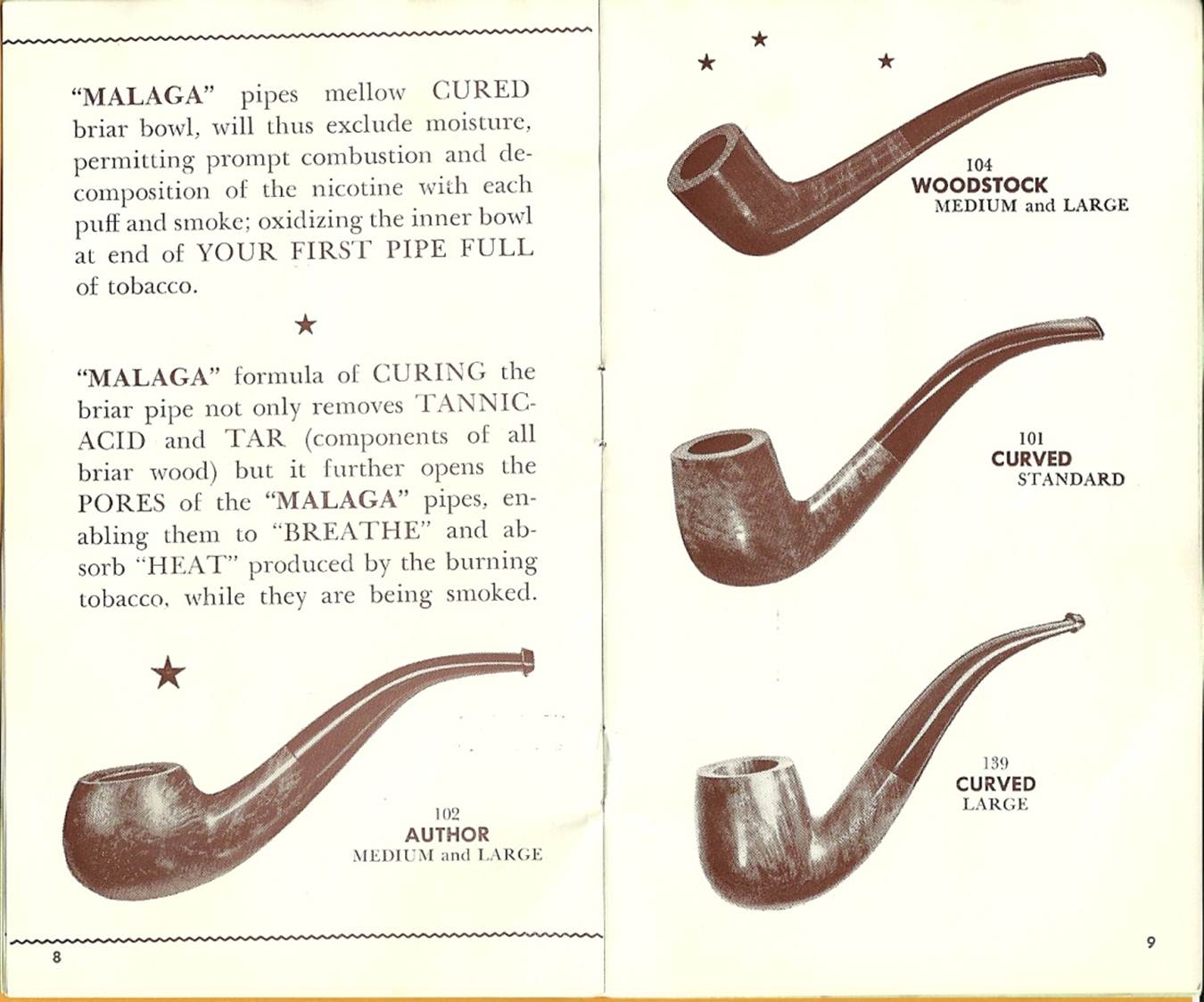
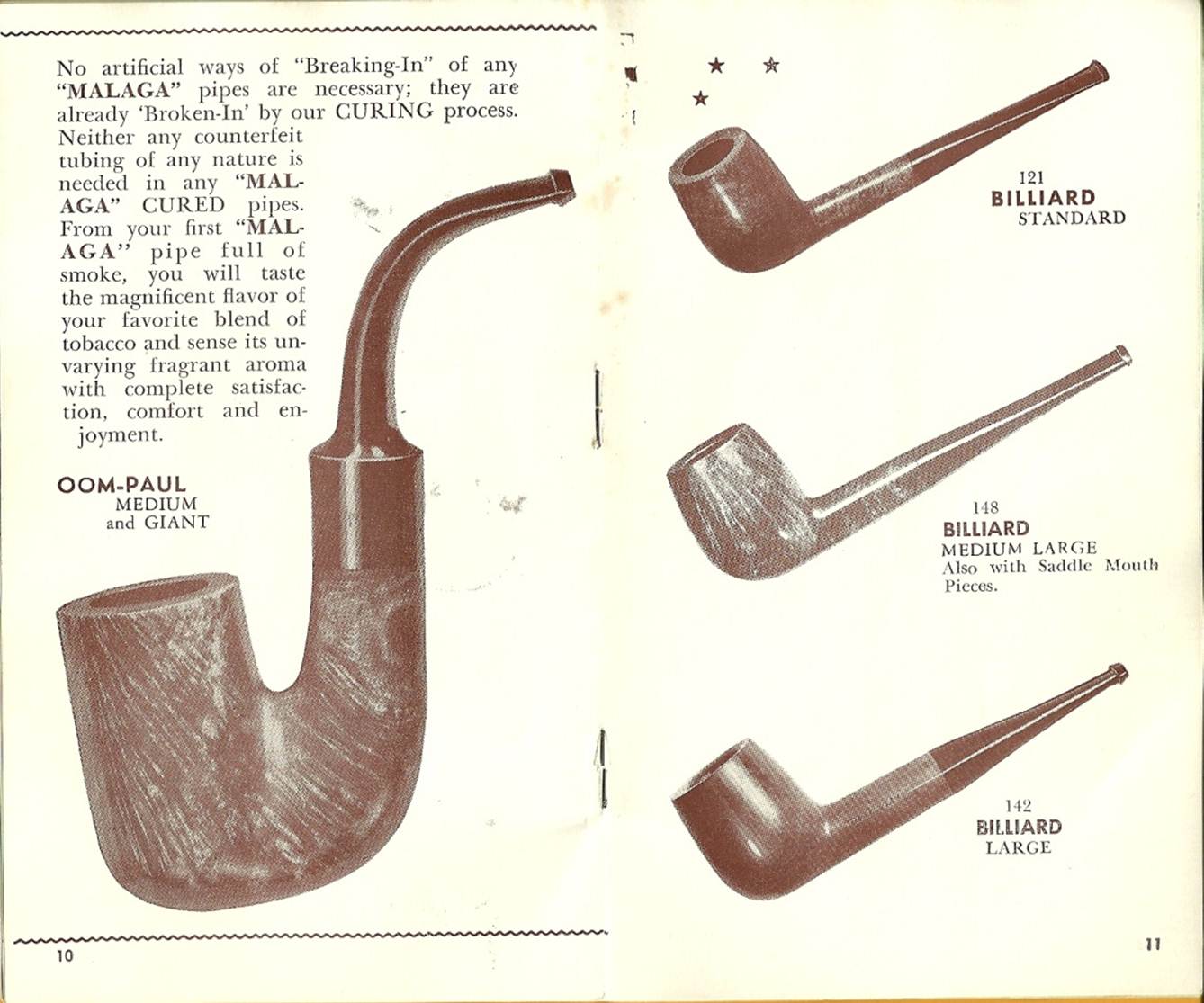
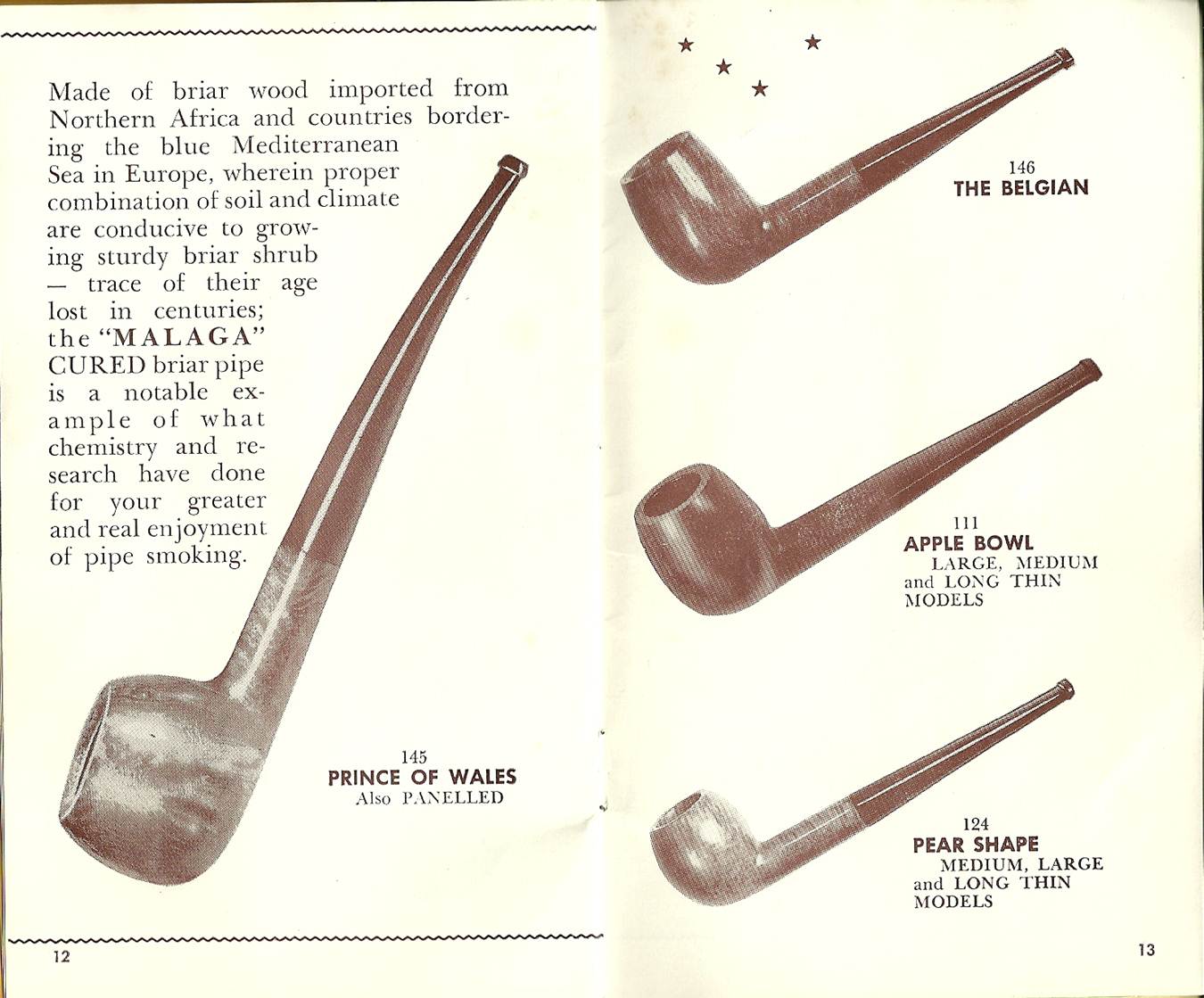
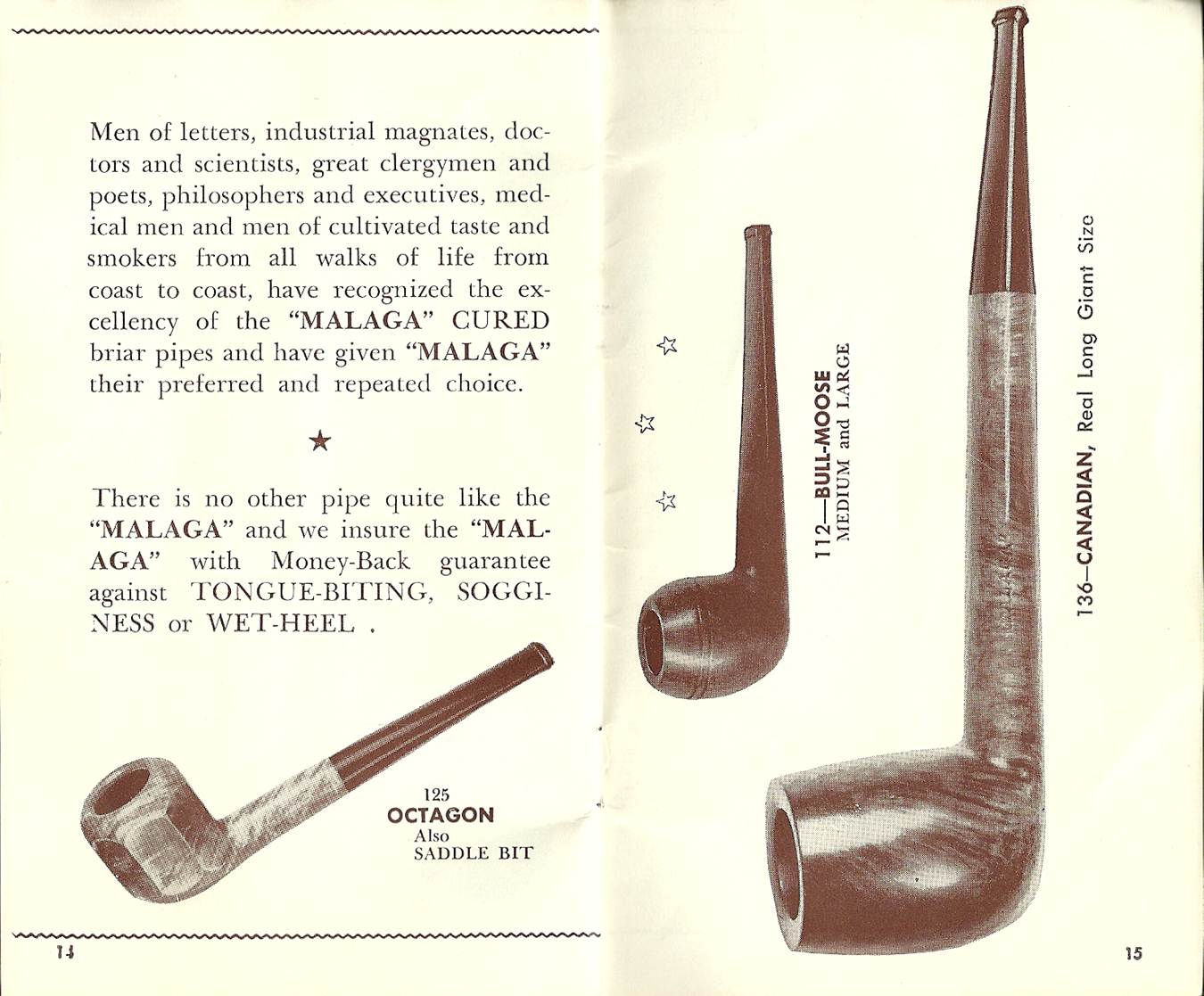
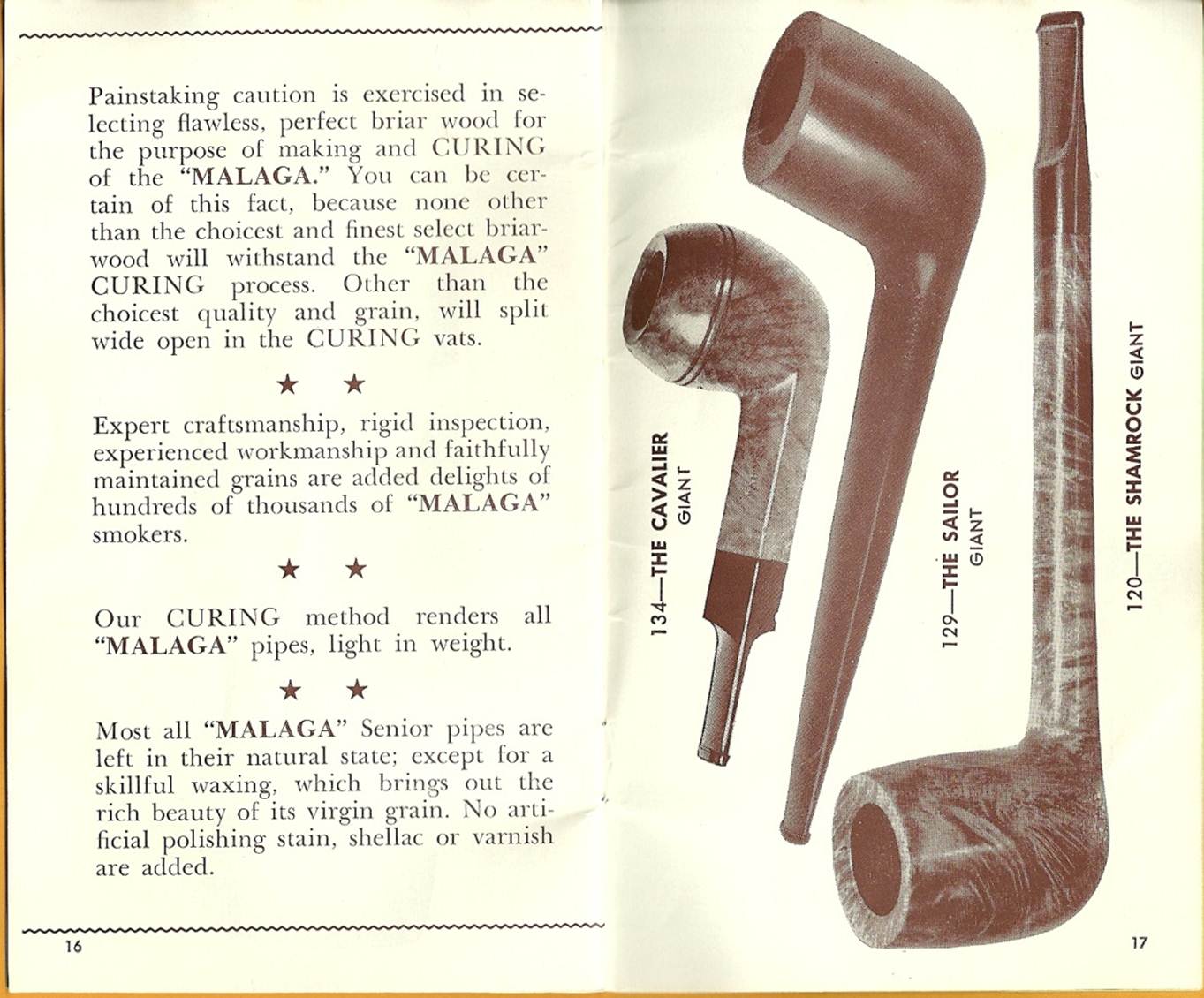
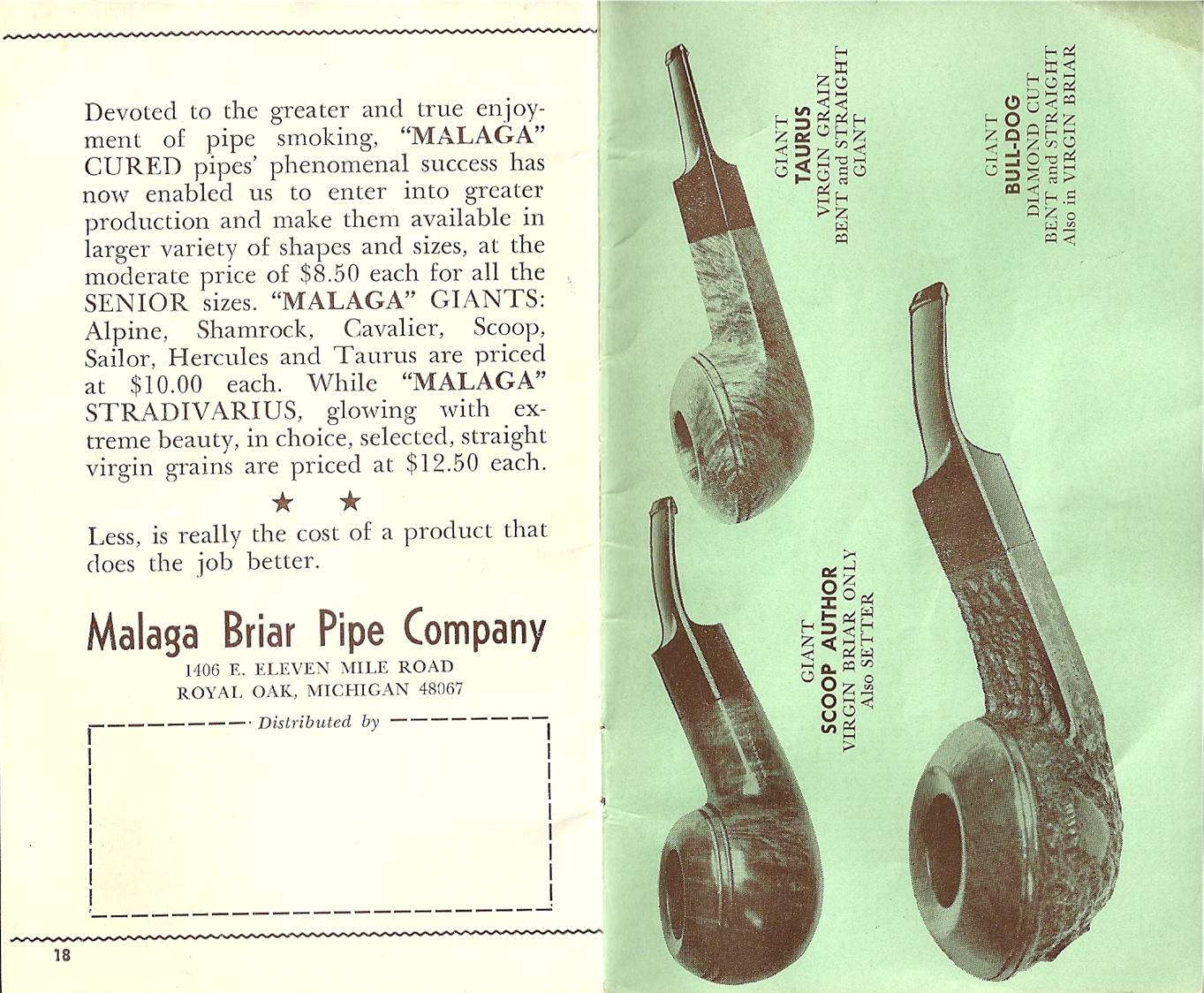
A few years ago I came across the pictures of George Khoubesser, the principal behind Malaga Pipes. I believe I was researching the pipes as I had come across a rusticated bulldog in a junk shop and wanted to know what I had. I sold that pipe and have kicked myself repeatedly for getting rid of it. I have been looking for just the right Malaga pipe since then. I thought I would share the photos and the old Malaga catalogue I have as an electronic copy.
Here are the photos of George Khoubesser
And here is the old catalogue
To Use or Not to Use – the Salt and Alcohol Treatment
Blog by Steve Laug
I have been weighing the pros and cons of writing about the salt and alcohol treatment for a while now. It is a topic that is fraught with a lot of emotion from both sides of the table – those who swear by the method (proponents) and those who are vehemently against it (opponents). Much contradictory material has been posted and written on the use of salt and alcoholto sweeten a sour pipe bowl or to remove ghosting. Some swear by the method and have had no ill experience to speak of in their use of the method for what adds up to many years in many places. Others have untold numbers of horror stories of split shanks, cracked bowls and ruined pipes. The whole drama has taken on urban myth proportions. I decided to enter the fracas with my own experience – testing and proving or disproving the myth with my own stories of success. Here is a post that describes the tools and the process I have used for over 15 years with no problems of split shanks or other bad experiences of that kind.
The tools
SALT – I always use a Kosher Coarse ground salt. I never use iodized salt as I do not want the iodine to leach out into the briar. I have found that coarse ground salt has several features that keep me coming back to it. The first feature is that it does not dissolve in the bowl when the alcohol is poured over it and left to sit. The second is that it provides multiple surfaces onto which the oils and tars that are leached out migrate. Over the years I have never had a problem with this form of salt. I have never had a shank or a bowl crack or split after it has been cleaned with the salt and alcohol treatment.
ALCOHOL – I use the highest percentage isopropyl alcohol that I can get through my local pharmacy. Most of the time I am able to purchase 99% Isopropyl alcohol or Rubbing Alcohol but have also used 91% Isopropyl with no ill effects. I just purchased a bottle of Everclear while traveling and will be trying it out as well. The water content in the 99% Isopropyl is 1% and I find that it evaporates quite quickly and does not saturate the briar. Much has been written about using an alcohol that is not a human consumable form. Many have spoken of the danger of using it in the pipe bowl or in cleaning the stem of a pipe that is going to be put in the mouth. However, I have found that once the salt and alcohol medium has been removed from the bowl and the pipe air dries there is no remaining alcohol in the bowl. I have even used a match to light the inside of the bowl to burn off any remaining alcohol but had no success in getting the alcohol to flame. This and the fact that the bowl is dry to the touch cause me to believe that the alcohol that was used in the bowl is no longer present. I am sure others will say that the chemical components of the isopropyl are somehow compromising the integrity of the briar but I cannot find proof from that in my experience. All I know is that is some inexplicable way the combination of the alcohol and salt seems to provide a medium that causes the oils to leach out of the briar and come to rest on the salt crystals.
EAR SYRINGE – I stumbled on this tool that has become my go to tool for putting the alcohol in the bowl of the pipe. It is the humble bulbous ear syringe that is readily available at pharmacies for use with infants and adults. It is rubber and works incredibly well at keeping the alcohol off the outer finish of the pipe. By squeezing the bulb you can draw alcohol into the syringe and then be squeezing it again over the bowl of the pipe the alcohol is poured into the bowl quickly and without a mess. I have used the same syringe for over 12 years without little wear and tear on the bulb. I rinse it out with warm water after each use to keep it clean and fresh.
The method
I remove the stem from the bowl and then dip the bowl into my jar of kosher coarse salt. I usually lay the bowl on top of the salt and with a finger load the bowl with salt in much the same manner I load a bowl with tobacco. The photo below shows the bowl being filled. The second photo below shows the filled bowl. I fill the bowl leaving it a bit below the edge of the bowl. I don’t want the salt to be above the rim so that when I put the alcohol in the bowl it does not spill out onto the rim and spoil the finish.
Once I have the bowl filled I lay it in an old ice cube tray. I have found this is a great rest for a lot of the work I do in refurbishing pipe bowls. I then fold a pipe cleaner in half and insert it into the shank as far as the airway. I do this to keep the salt from coming up the shank. It also keeps the airway free of pieces of the coarse salt. The alcohol does wick up the pipe cleaners and I find that as the alcohol works in the bowl and evaporates it also works in the shank and leaches out the oils and tars. The next photo below shows the bowl with the pipe cleaner inserted and the bowl ready to receive the isopropyl alcohol.
I pour Isopropyl alcohol into the cap of the alcohol bottle and get the ear syringe and the bowl ready for work. The first photo shows the tools ready to use. The next two photos show the filling of the ear syringe with Isopropyl alcohol. Once it is filled I put the tip of the syringe in the top of the bowl and fill it with the alcohol. The next three photos show the filling of the bowl.
Once the bowl is filled with isopropyl I place the filled bowl in the ice cube tray and let it sit while the alcohol and salt draw out the tars and oils. The process works quite quickly and the salt begins to darken with the oils and tars within a few moments. The next series of photos shows the salt turning brown beginning with the edges and working toward the centre of the bowl.

A final photo before I left it for the night. The pipe cleaner is rich brown from the oils and tars leached from the shank
This morning the salt was darkened and the alcohol was evaporated. I dumped out the salt and pulled out the pipe cleaner. The shank and the bowl were dry and the salt fell out easily. I wiped out the remaining crystals from the bowl and cleaned the shank with a folded pipe cleaner. If the bowl had still been wet I would have flamed it with a lighter or a match to quickly burn out the remaining alcohol. This time that was not necessary. The photo below shows the clean bowl. The pipe smells clean and fresh. When I have finished cleaning the pipe I set the bowl aside and let it dry for several days before smoking it.