Category Archives: Pipe and Tobacco Historical Documents

Peterson’s Pipes Brochure from Genin, Trudeau & Co. LTD. in Montreal, Quebec


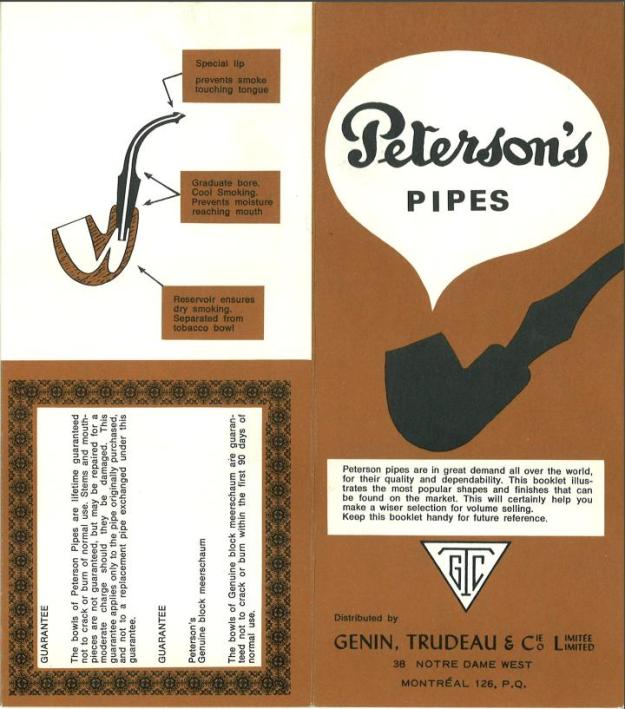
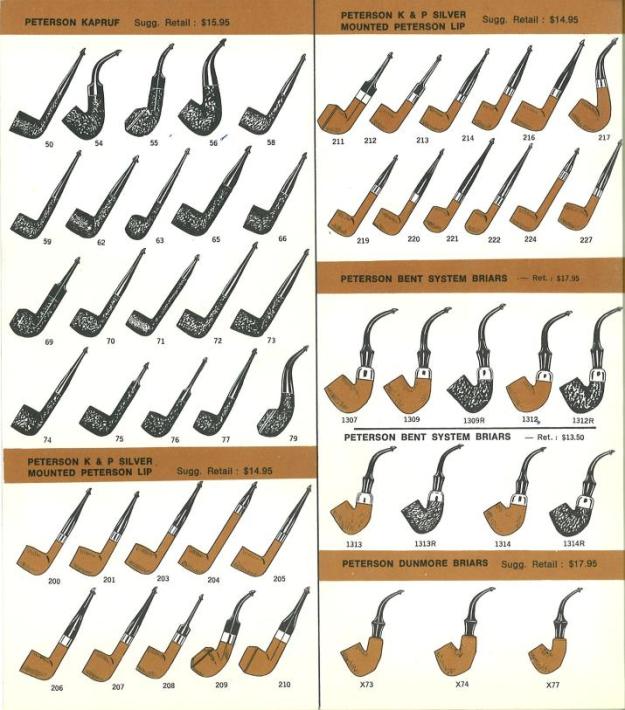
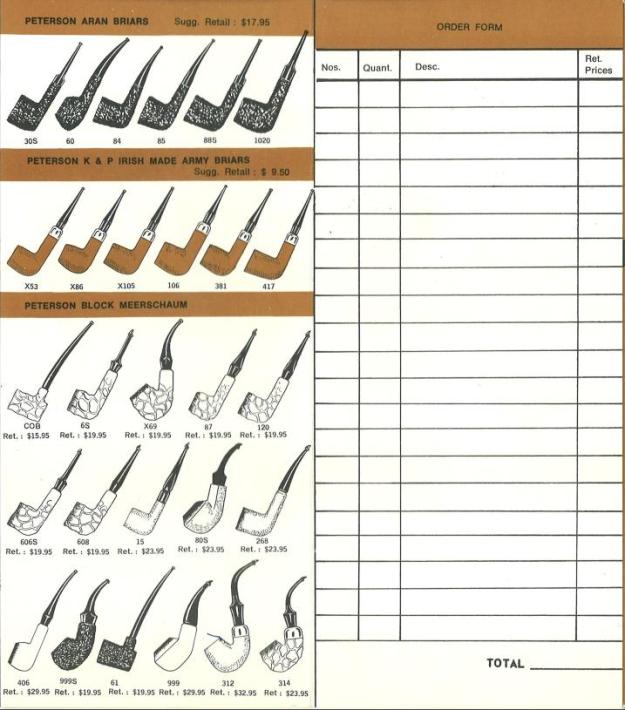
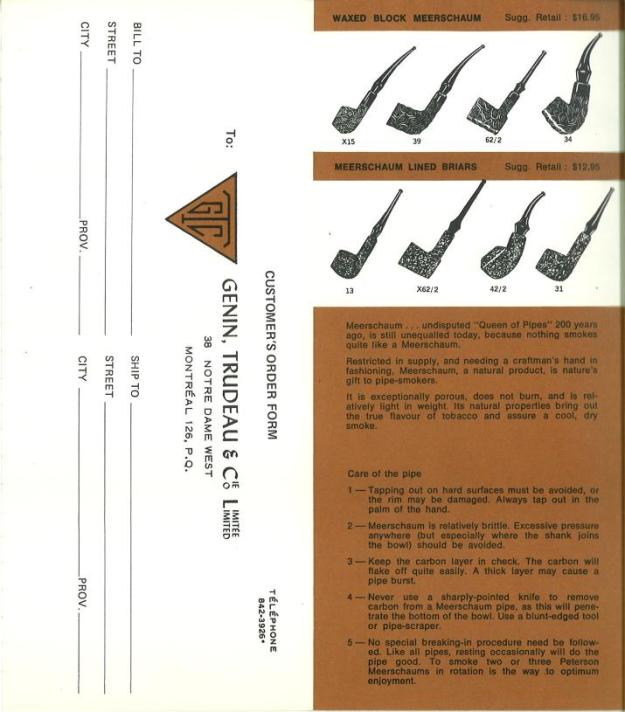
I also picked up a copy of a Peterson’s Pipes Brochure that is really interesting. It has some great drawings of the system and also of the various shapes that are available. The brochure as an order blank that the buyer can send to Genin, Trudeau & Co. at 38 Notre Dame West in Montreal, Quebec, Canada. The postal code on the cover of the brochure gives it some age though I am not sure how old it is. Perhaps some of you will be able to help date this brochure. It would be great to know potential age.

pete1 pete2 pete3 pete4

An Older Julius Vesz Catalogue


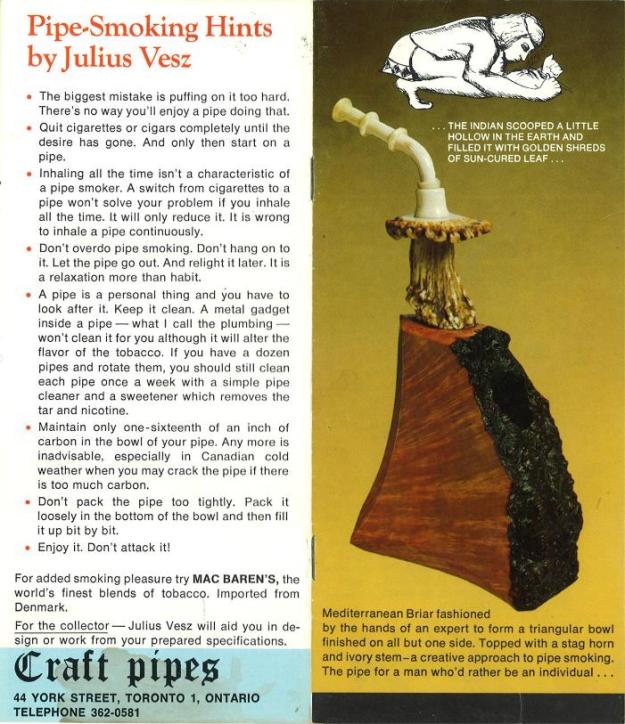
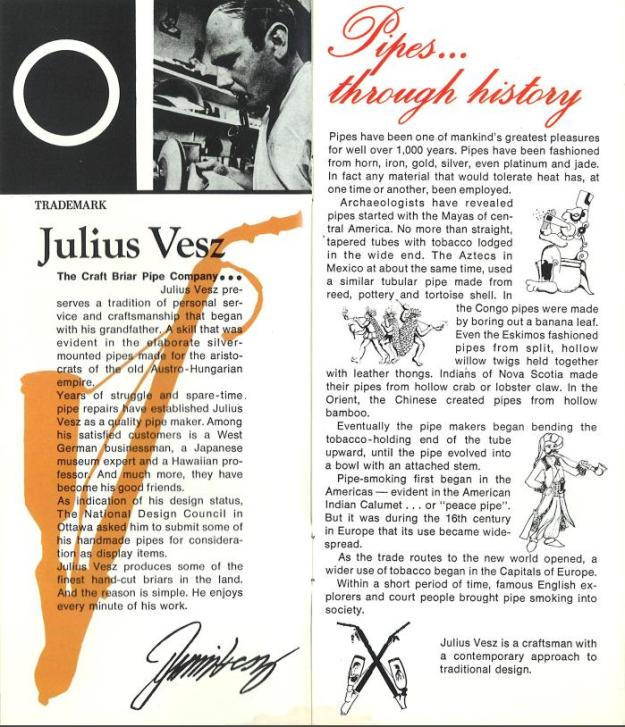
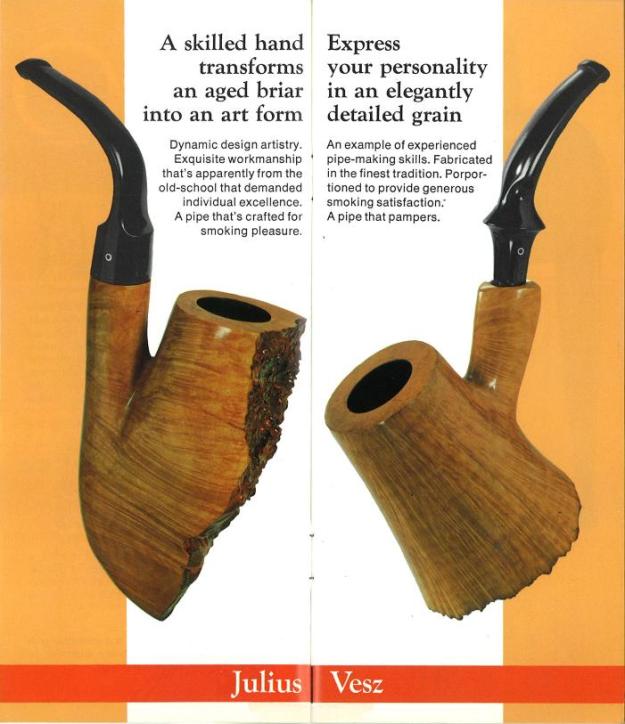
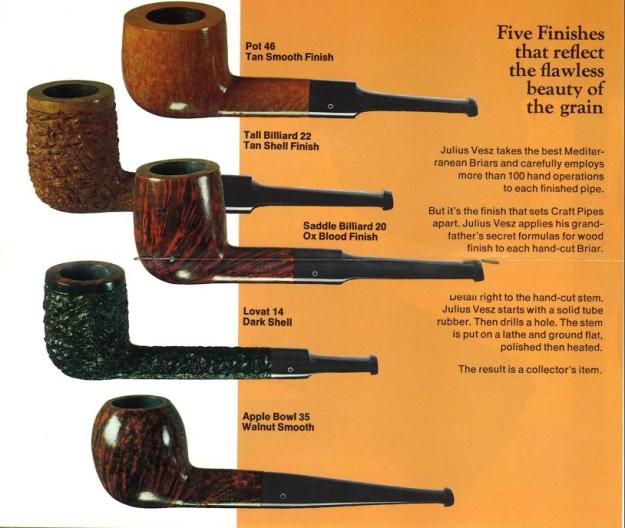
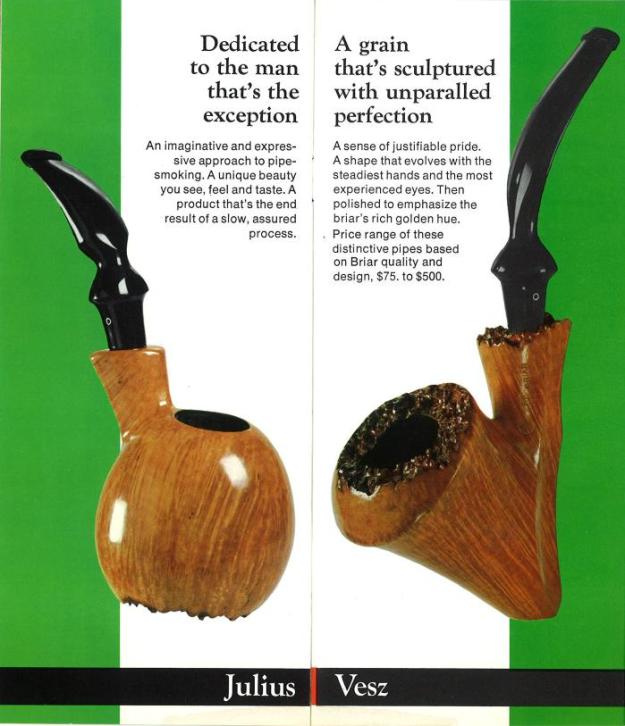
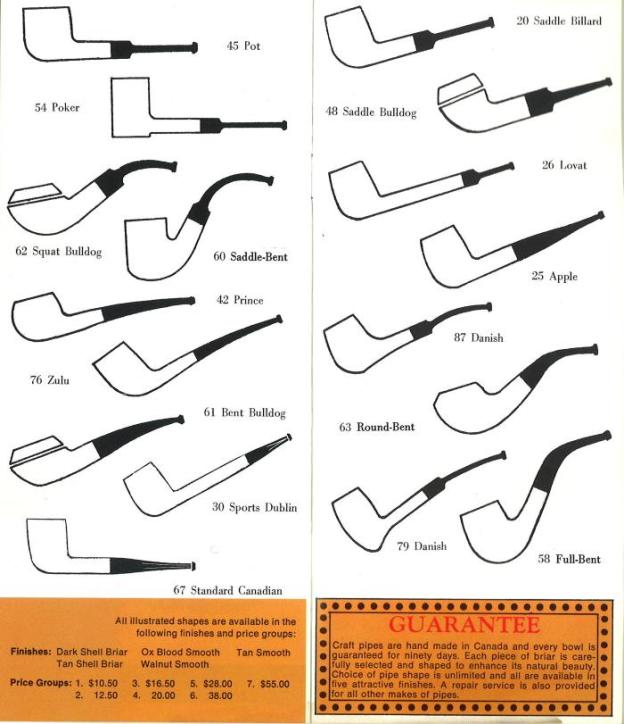
On Sunday I visited R.J. Clarke Tobacconist here in Vancouver and he gave me a bag of tobacco literature. There are catalogues, brochures, flyers, inserts and letters from suppliers. There is some pretty interesting memorabilia in the bag. I am scanning the documents and will be posting them here on the blog to give them a wide audience. The first of these is an older Julius Vesz catalogue. I have several of Julius’ pipes and enjoy them. They smoke cool and dry. So this was a great addition to the information I have on the pipes. I thought I would share it with you all. Enjoy the brochure.

vesz1 vesz2 vesz3vesz4vesz5vesz6

A Stanwell of Denmark Brochure


Blog by Steve Laug

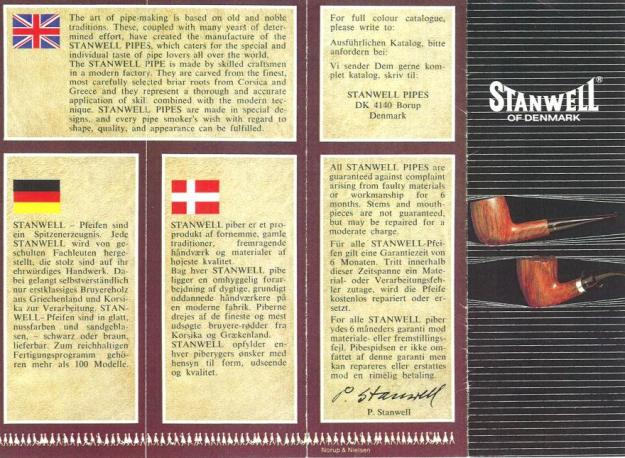
In one of the boxes that came to me from my brother was a pipe in a Stanwell box. The pipe was not a Stanwell but the box was. Inside the box was a nicely folded brochure with a variety of pipe shapes offered by the company on the inside of the brochure. On the outside was a write up in English, German and Danish about the company and how they made their pipes. There was also a short statement of the Stanwell pipe Guarantee. I was able to scan it and have posted it here for those of you who enjoy these older historical documents.

Stanwell1Stanwell2

Peacemaker Brochure


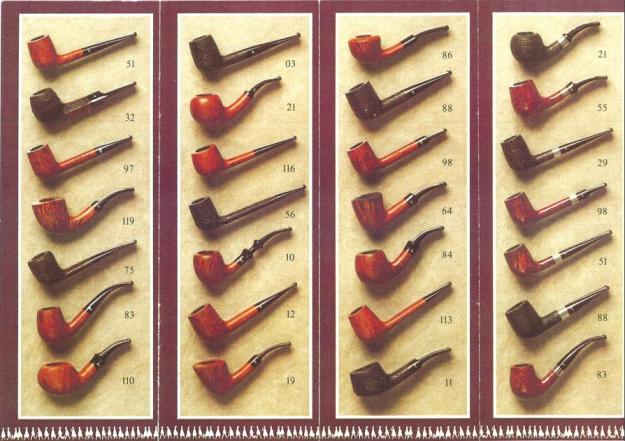
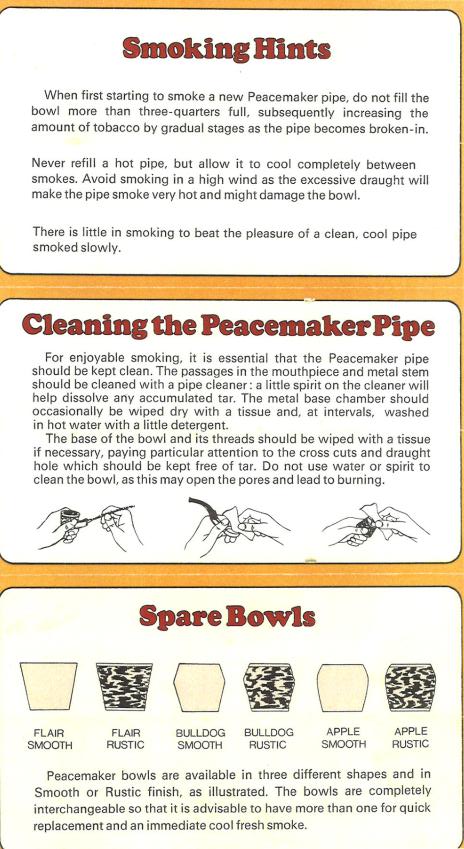
When my brother sent me the latest batch of pipes there was a boxed Peacemaker. I wrote about it earlier on the blog. Inside the box was this brochure. It always interests me to be able to see the original literature that came with a pipe and advertised its strengths. This brochure is double sided and on the front side explains the Peacemaker, its special features and its guarantee. On the other side are some general smoking hints, care for the pipe and then some of the variety of bowls that are available in terms of shape and finish. It makes a fascinating step back in time to read the descriptions and the promises. I scanned it to post it here so you all could enjoy it as well. Thanks for looking.

Peace1

Peace2

Butz-Choquin Pamphlet


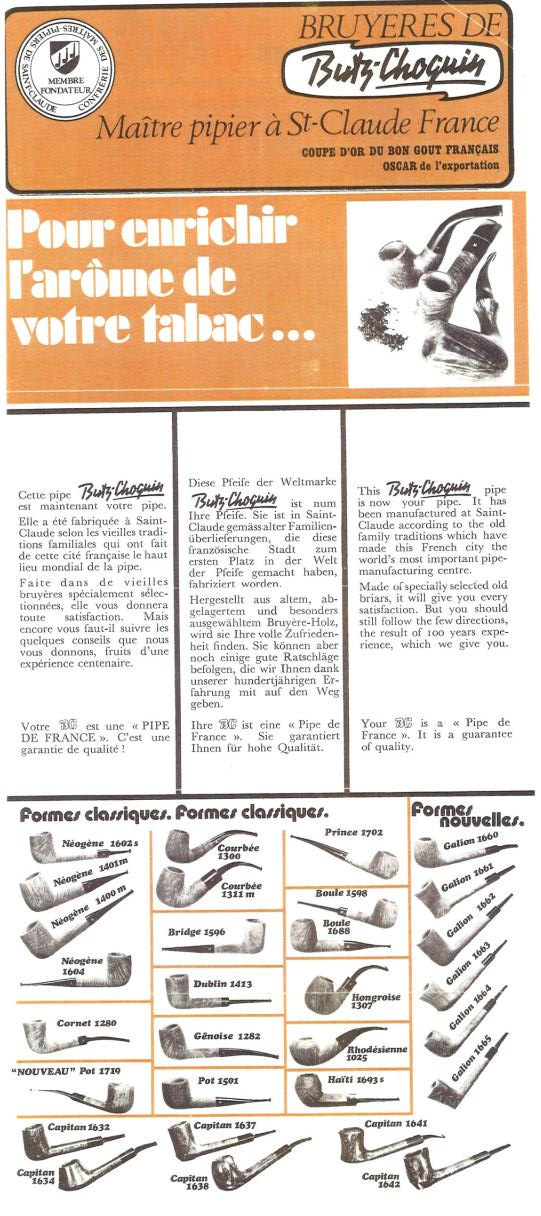
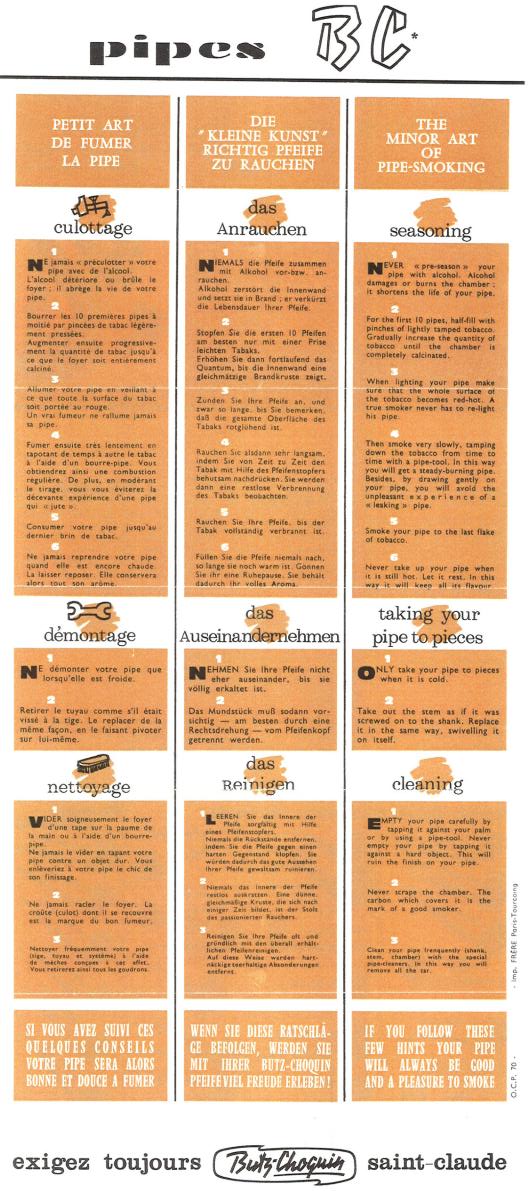
WIth the recent Butz-Choquin Chombord pipe that I refurbished there was a great pamphlet in the box with it. I thought it would be good to post that here as well for all of you to enjoy. I particularly found the write up on “The Minor Art of Pipe-Smoking” fun to read. The language is clearly translated by one whose first language is not English so it make it more enjoyable to read. Enjoy.

BC Brochure2

BC Brochure1

KAYWOODIE & YELLO-BOLE SHAPE NUMBERS


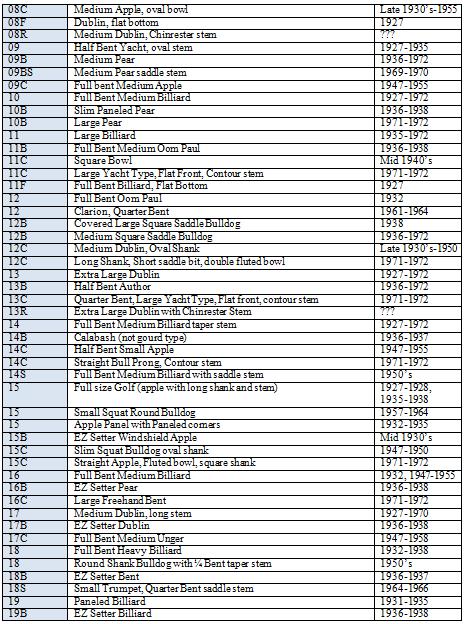
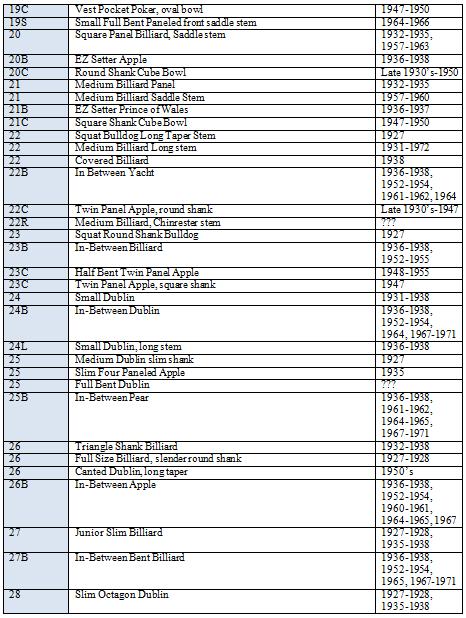
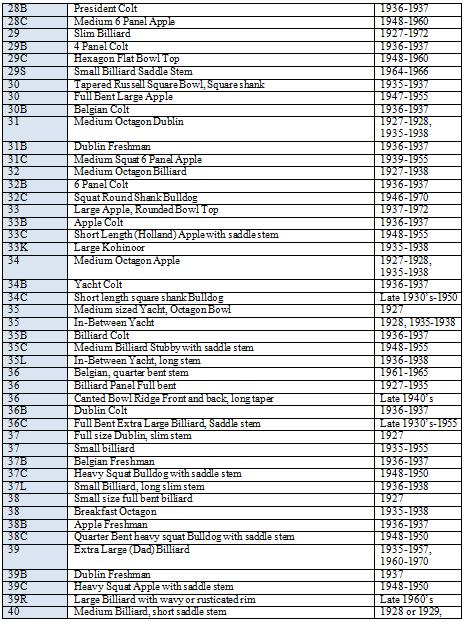
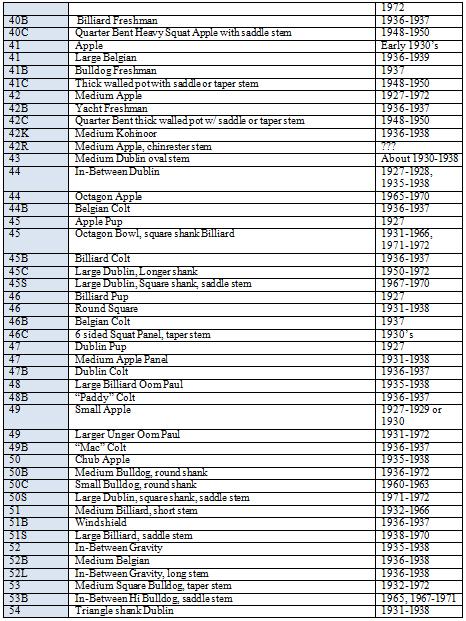
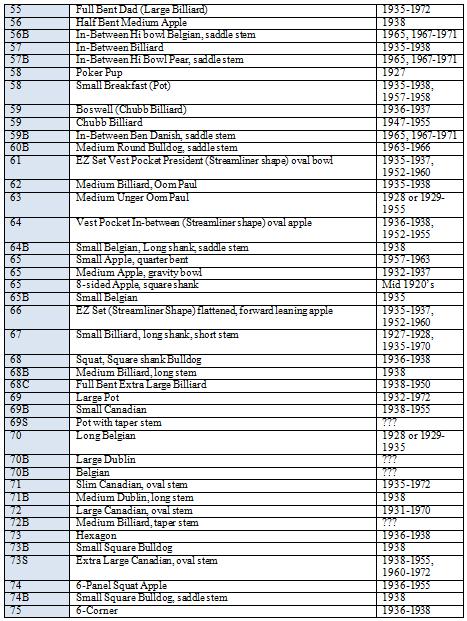
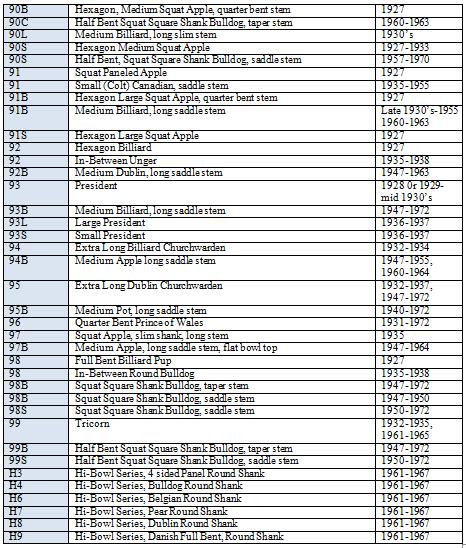
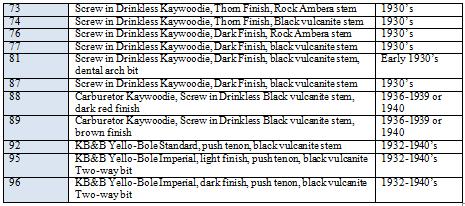
Troy Wilburn, one of our blog writers and good friend of rebornpipes sent me a shape number list for old Kaywoodie and Yello-Bole pipes. I found it very useful and typed it into a chart format. Troy said that he got the data for this came from the Kaywoodie Forums. If you have not visited the forums here is the link: http://kaywoodie.myfreeforum.org/. I decided to post the chart here for easy access. Thank you to the KW forum for the information.

You will notice that some shape numbers are listed more than once as they got recycled over the 45 years of the Reiss-Premier/Kaywoodie two digit shape number era (1927-1972)YB1 YB2 YB3 YB4 YB5 YB6 YB7 YB8

2-digit prefixes for 4-digit pipes – you might find an odd ball or a rare one that is not on the list.
From the time of the first Kaywoodie until 1938 for Kaywoodie and for Yello-Bole, Kaufmann Brothers & Bondy used a 4-digit number system (plus a letter sometimes) to identify the line and shape number. The 4-digits were not used after 1938. The first two, which we’ll call the prefix, referred to the finish and the second two, the suffix numbers referred to the shape number.YB9 YB10Thanks again to the Kaywoodie Forum and those who have collected the information over the years. This information is extremely useful to those of us who collect Kaywoodie and Yello-Bole pipes. If you have not visited the forum I would encourage you to visit the great folks there. The forum contains a wealth of information.

Gift from a Newfoundland Friend– Rare & Unique Unsmoked Ellsworth Roto Bowl


Blog by Steve Laug

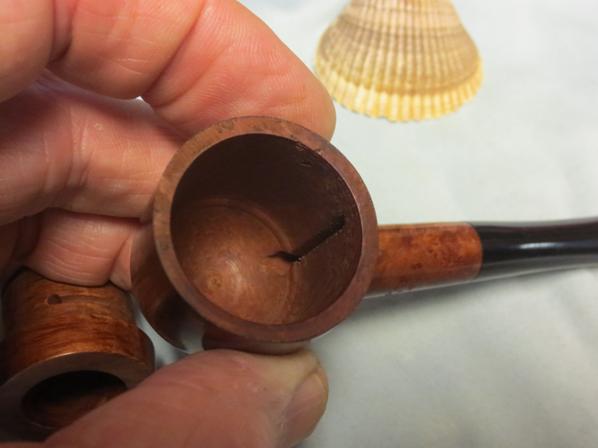
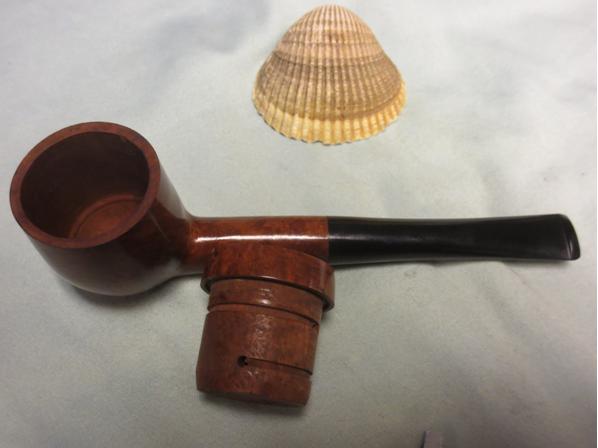
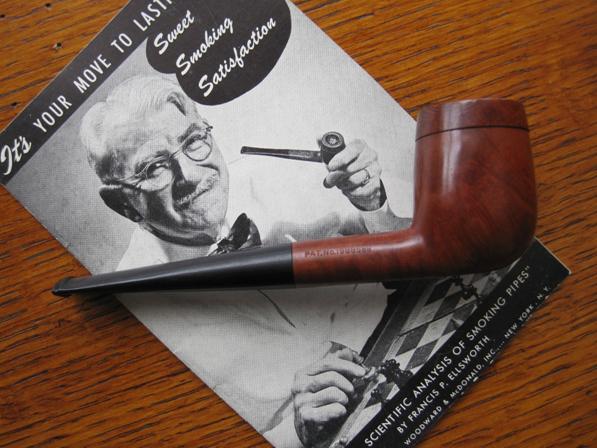
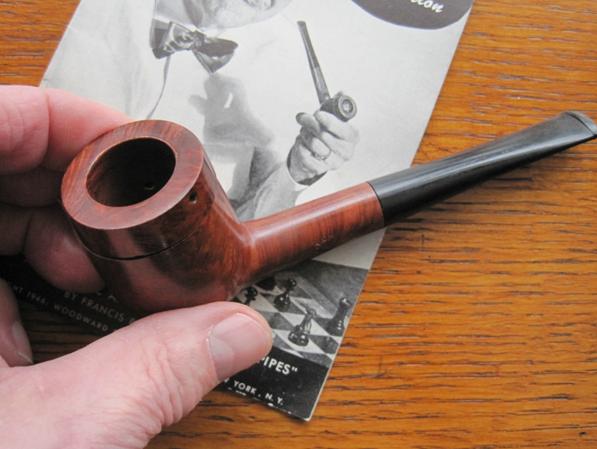
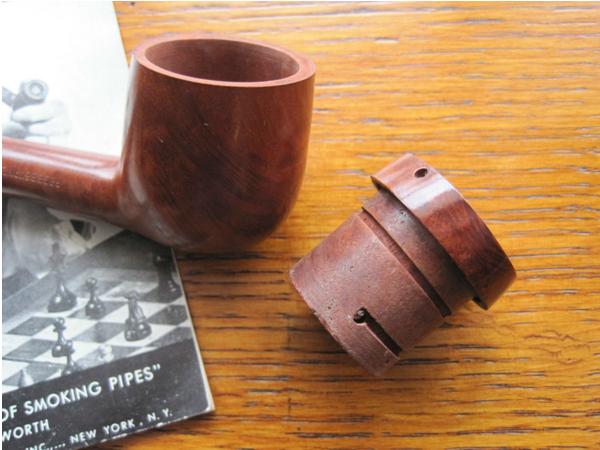
A friend I did a pipe repair for in Newfoundland, on the east coast of Canada, left a message on my phone the other day to let me know that he was sending a package to me. He said that it would have a couple of horn stem pipes – old timers and a unsmoked unique pipe that he thought I would be interested in having. He had purchased 6 of these pipes that were unsmoked and sent me one of them. The package arrived yesterday and the horn stem pipes were great and would clean up nicely. The Roto Bowl is in stellar shape and is a (New Old Stock) NOS pipe. I had never heard of the brand but was intrigued by his description of it over the phone when we talked over a month ago. I took some photos of the pipe when I unpacked it to show you all. It is pretty unique. The overall length of the pipe is 5 1/2 inches. Ellsworth1 Ellsworth2 Ellsworth3 Ellsworth4I rotated the bowl insert from the base and took a photo of the inside of the bowl to show the unique drilling it had. There are two air holes on the bottom on the sides and then two of them half way up the bowl sides.Ellsworth5When I lifted the bowl insert out of the bowl (it was pressure fit and was easily removed) I could see that the airway entered the bottom of the outer bowl perfectly centered. There was a groove carved from the airway up to the height of the upper air holes in the bowl insert.Ellsworth6 Ellsworth7 Ellsworth8There were also marks on what would have been the front and the back of the bowl insert. The first mark was a single small drilled circle and the second one was two drilled circles. When the single mark was turned to the back of the bowl the airflow was constricted by at least half. When the double marks were turned to the back the flow was wide open. It kind of works like a Kirsten end valve is controlling the airflow from the bowl to the stem. It controls burn rate as well. Each turn of the bowl insert modified the airflow proportionally between the single and the double mark. Overall this little pipe was intriguing to say the least. It was yet again another attempt to find a drier and cooler smoke.

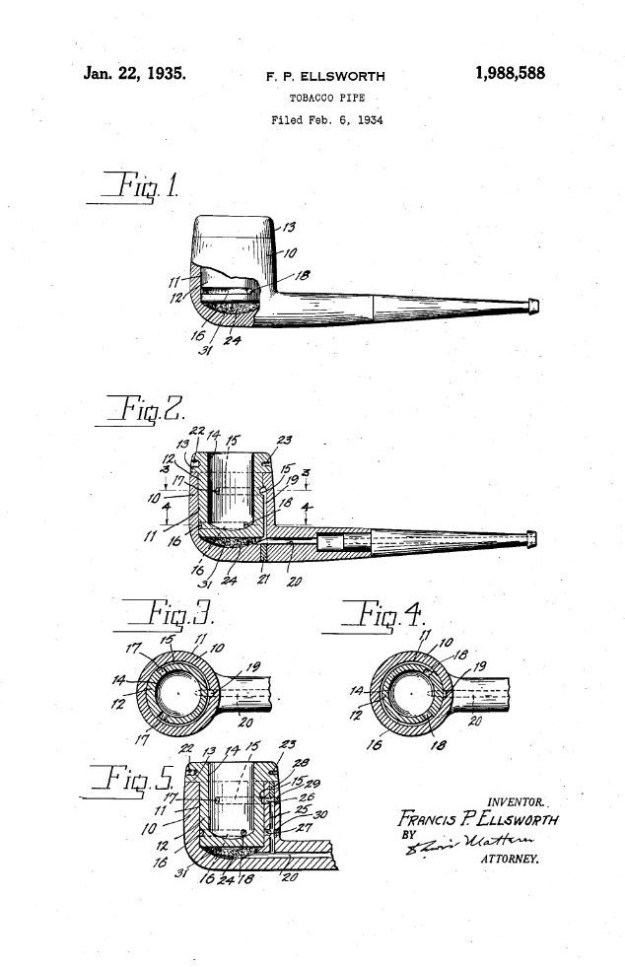
Since I had never heard of the brand I did some searching on the web and found a bit of information based on the stamping I found on the pipe. On the left side of the shank it is stamped with the name of the pipe in a circle with ROTO arched on the top of the circle and Bowl arched on the underside. There was a dot in between ROTO and BOWL and one in the centre of the stamp. On the right side of the shank it is stamped PAT. NO. 1988588 and on the underside of the shank Imported Briar. There are no other marks or stamping on the pipe, the bowl insert or the stem.

I found the first information on eBay on a previous sale (http://www.ebay.com/itm/Vintage-Ellsworth-Roto-Bowl-Pipe-NOS-1946-/272119388370?hash=item3f5b9458d2:g:~MoAAOSwKtlWq9Xh). The link will likely be dead shortly so I copied the text and the photos for reference. The seller not only gave some pertinent information on the brand but also photos of the booklet that came with the pipe. Here is what the seller said about the pipe (including the sales pitch).

“Here is your chance to own one of the rarest of the rare in Brand New unsmoked condition with original instruction booklet. This pipe was manufactured in small number in 1946 by Francis P. Ellsworth. It is called a Roto-Bowl and was quite the invention. This pipe sold new in 1946 for $12.50 and in today’s dollar that amounts to $123.00. You can see why not many of these pipes were sold. Check out the pics for the best description. This pipe would enhance even the most advanced collection. I searched the internet and could find out very little about these pipes.”

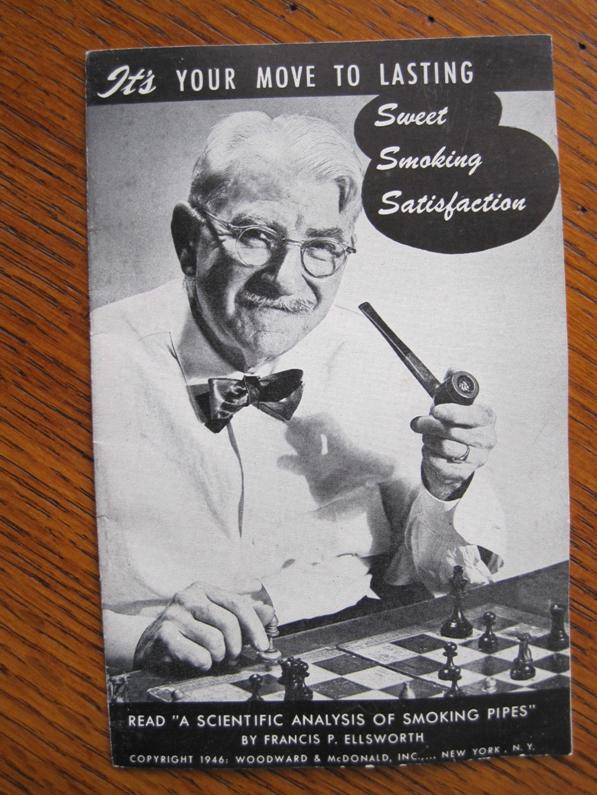
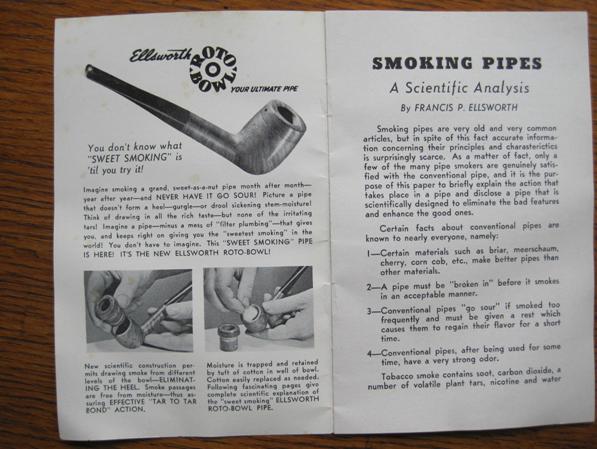
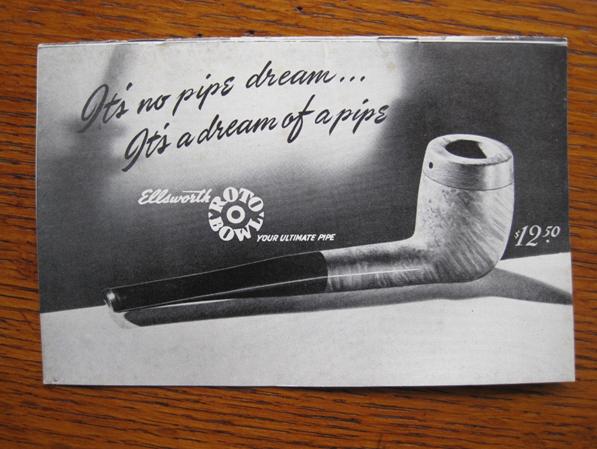
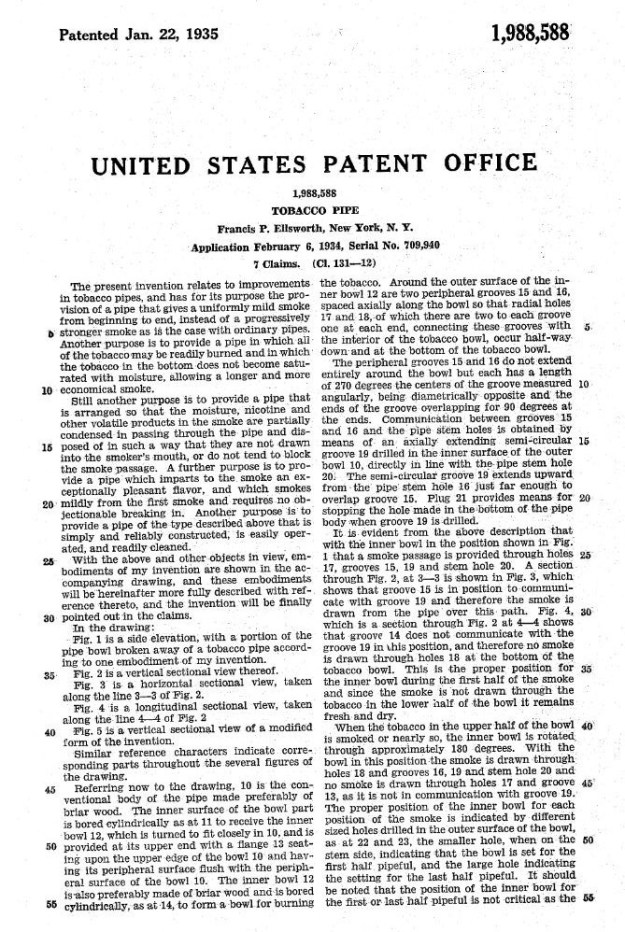
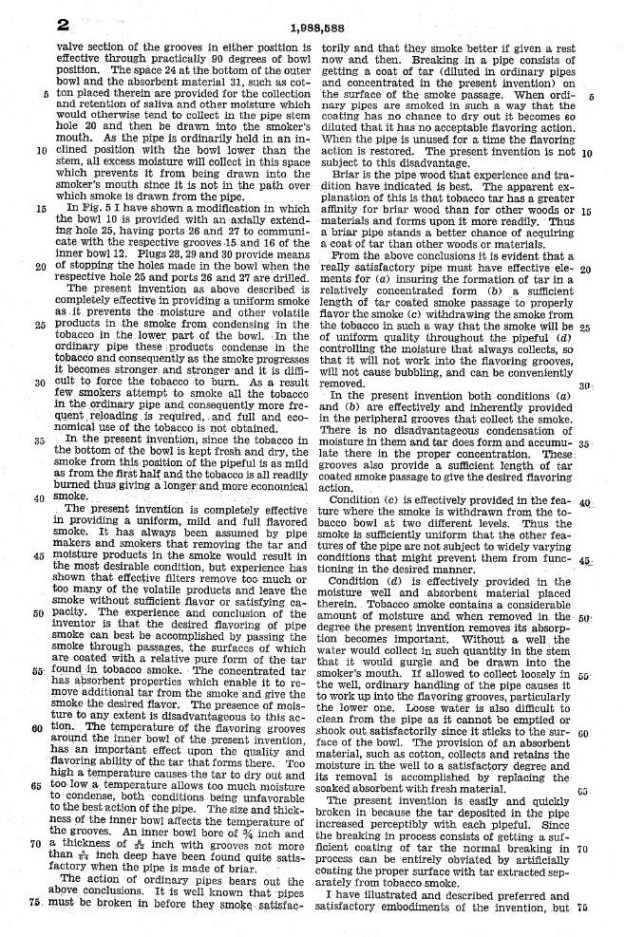
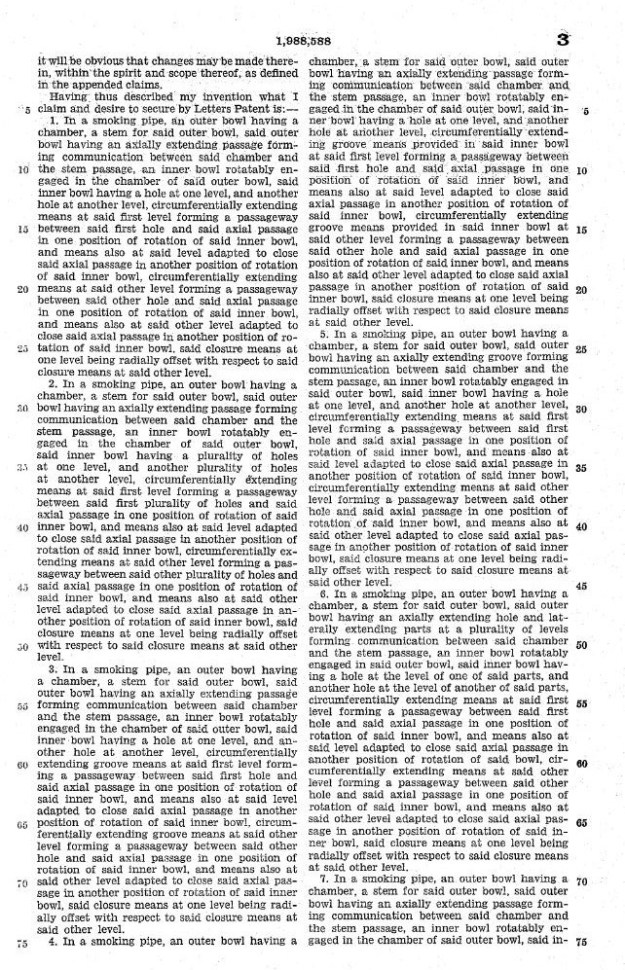
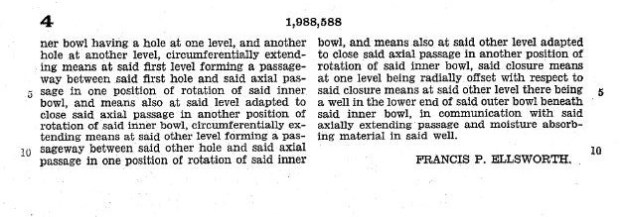
I saved the photos he included with the sale information and have included them below.Ellsworth9 Ellsworth10 Ellsworth11The brochure gave me some more information as well as the name of the pipe’s inventor, Francis P. Ellsworth. The brochure was produced in 1946 by Woodward and McDonald Inc, New York. Some of the descriptive phrases and turn of phrase on the cover were great. The first is “It’s Your Move to Lasting Sweet Smoking Satisfaction” and “Read a Scientific Analysis of Smoking Pipes”. On the back cover it reads “It’s no pipe dream…it’s a dream of a pipe”. Take time to read the inside of the booklet as it is a fun read. The 1940’s description and “Scientific” information is entertaining.Ellsworth12 Ellsworth13I would never have guessed that the bowl was to be smoked with a cotton ball placed in the bottom of the bowl between the bowl and the insert for trapping and retaining moisture from the smoke. I know that there are more pages in the booklet but this is all that were included by the eBay seller. Here is a photo of the back cover of the booklet.Ellsworth14Further digging using the patent number on the right shank led to me the following link on the US Patent Search website: http://pdfpiw.uspto.gov/.piw?docid=01988588&PageNum=1&&IDKey=E06B2A6032A2&HomeUrl=http://patft.uspto.gov/netacgi/nph-Parser?Sect1=PTO1%2526Sect2=HITOFF%2526d=PALL%2526p=1%2526u=%25252Fnetahtml%25252FPTO%25252Fsrchnum.htm%2526r=1%2526f=G%2526l=50%2526s1=1,988,588.PN.%2526OS=PN/1,988,588%2526RS=PN/1,988,588

Included with the patent information is a set of drawings by the inventor and also a narrative description of the pipe and how it was supposed to work. It makes for fascinating reading for those of us who love the descriptions and details of these old timers.Ellsworth15 Ellsworth16 Ellsworth17 Ellsworth18 Ellsworth19This was a rare pipe for me not just because of its uniqueness and age but because it is one of very few that I have received that I did not have to work on or clean up. I want to give a shout out to Joe in Newfoundland for the amazing gift pipe. Thanks so much Joe for thinking of me.

Who Made Brewster Imported Briar Pipes or Who is the Unknown Italian Maker


Blog by Steve Laug

Robert M. Boughton in his recent blog on Brewster pipes quoted part of my earlier blog on the brand. Here is the link to Robert’s blog: https://rebornpipes.com/2016/01/13/another-brewster-that-looks-better-now-than-when-it-was-made/. In a personal email he suggested that I post the history of the brand in a separate blog to make access to the information accessible to those searching for information on the brand. So I have copied the pertinent material and edited it to read more clearly in the blog below. Thanks for reading.
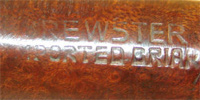
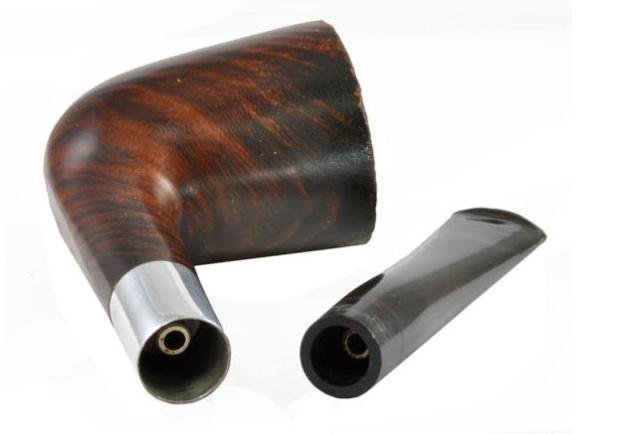
brewster1bIn February, 2014 I cleaned and restemmed a bowl that was stamped with the stamping on the shank shown in the photo above. If you want to read the details of the restoration you can do so at the following link: https://rebornpipes.com/2014/02/14/giving-a-brewster-round-top-billiard-a-face-lift/ In the course of working on the pipe I did some research to see if I could find out information on the maker. To me everything about it seemed to point to some kind of Dr. Grabow connection. The metal mortise was threaded and Grabow stems fit perfectly. The mortise tenon system was identical. I had a hunch that there was some kind of connection but I wanted to verify what I was thinking.

I looked first in the books I had available here. In “Who Made that Pipe” all I learned that the brand was Italian made followed by the words unknown maker. That was not overly helpful. I suppose some of the pipes were stamped made in Italy. But unknown maker left too much out to me. There had to be more information. I turned to my online sources. I looked on Pipedia and there found much the same information – Italian made followed by question marks as to the maker. The pipephil website (http://www.pipephil.eu/logos/en/logo-b7.html) called “Pipes: Logos and Stampings” had the same information but said that it was an export brand of an unknown Italian company. So far I was coming up empty handed but I was not going to give up on this one. I spent time searching the web with Google and other search engines and came up with no added insight.

Not to be daunted I decided to take a different tack. I found the Dr. Grabow Company website online and wrote an email to their information centre seeking information on the brand. I never received a reply from them. I wanted to follow-up on my hunch from the stamping and the metal insert in the shank that somehow this pipe was related to Dr. Grabow pipes. I had no clue how it was related but it certainly looked like it to meso I went to the Dr. Grabow forum on-line and posted my questions http://drgrabows.myfreeforum.org/index.php. While I waited for a response to my question I read some of the forum of back posts and found a series of posts regarding the brand. I read the following and immediately had more questions. The Grabow connection was not clear but I had found that the pipe may have been a promotional item during the course of one year – 1964. Here is the quote that gave me the information:

“A couple months back, I scored a Brewster off eBay for five bucks. Research on this forum and the wild, untamed internet tells me the Brewster pipes were all made in one batch in 1964 as a promotional item for Sir Walter Raleigh.”

Now I knew that the pipe came from that time period and had been a promo item for a pipe tobacco company.

Later that evening while relaxing, my iPhone vibrated notifying me of a new email. I picked up the phone and saw that I had a response to the questions that I had posted on the forum. Dave Whitney, author of the book on refurbishing called “Old Briar”, had responded to my request for information. What he sent me was extremely helpful and a true goldmine of information. His answer confirmed the Dr. Grabow connection and gave critical information that I had not been able to find anywhere. I have grouped the comments on the brand under three bullets that show three different individual’s comments on Brewster. It is interesting to note that all agree.

Dave Whitney: Here’s what I have from my accumulated notes on Brewster – much of it looks like it came off this forum, ted/td being one of the early ones to help build this forum and a former Sparta CEO.

• All the Brewsters were “made” in about 64’… Brewster… is probably from Fratelli Rossi from 64’… Ted, an older pipe smoker than me, suggested the Brewster pipes are comparable to the Willard pipes, and that Brewsters were often sold either with tobacco, or in a coupon offer. For example Brewster was sold as a redemption offer with Brown and Williamson for Sir Walter Raleigh tobacco.

• Further information came from Dr. B… I think (in my feeble state of mind, after today) that Brewster was sold as a redemption offer with Brown and Williamson for Sir Walter Raleigh tobacco. But, Mastercraft in 74 had a LOAD of them left. We (Mastercraft) sold them as closeouts along with several pipes in baskets of 4 dozen at $3.98. We also included a bunch of Mastercraft from F. Rossi at the same price……..Rossi pipes are another story……Remind me of the “sticky lacquer” and I’ll tell it…….ted
Mastercraft was founded by Bernard Hochstein, an Orthodox Jew. Old, White Haired, Santa Claus looking (still alive at 96, last time I knew), and he was REKNOWNED for his ability to “strong arm” the European pipe suppliers into selling pipes to M/C at a bargain. Probably the best (never say nothing) negotiator that I’ve ever met. He sold a business (Mastercraft) to UST for 6 million in STOCK. He’s probably worth 60 million today. Mr. Hochstein could negotiate a peace in the Middle East in a very few days, and talk all parties outta’ their pants in the process.

OK, so Mr H “rapes” the Italian suppliers even up till 1964 when the Surgeon General’s (SG) report comes out. As it turns out, “rape” worked both ways. A supplier, Fratelli Rossi, (still in business) took an order in 1963 for over 1 million pipes at 1/2 dollar (US) per pipe. When the SG’s report comes out, Rossi has filled a small part of the order for Hochstein, and had orders for a great many more pipes than Hochstein ordered. Rossi decided to experiment with his lacquer …Whose pipes did he experiment on? Hochsteins.

When I started at Mastercraft we had 1215 cartons of pipes from Rossi… Mastercraft Standard….72 dozen per carton, with lacquer so “tacky” that if you held the pipe as if you were smoking it, you’d have to “shake” it out of your hand. Rossi left out the curing agent. Ever touched wet paint?……..After 10 years they were still STICKY…..after 20 years, they were still STICKY.

We fought these SOB’s for years, when finally Luther Marlow (you’ll see topics about him) concluded that we could re-spray them with the Grabow lacquer and sell em’ (Ed. Note: Here is the Grabow Connection I smelled). We did, and we did. Through a “drive” by the UST salesforce, we sold every one. So if you have a Mastercraft Standard with what looks to be “heavy” lacquer, you are probably right.

• Hussar…..Rossi also made Brewster. Better lacquer job though… Brewster was sold as a redemption offer with Brown and Williamson for Sir Walter Raleigh tobacco. But, Mastercraft in 74 had a LOAD of them left. We (Mastercraft) sold them as closeouts along with several pipes in baskets of 4 dozen at $3.98.

When I started with Mastercraft in the early 70’s we had over 400 cartons of pipes from Hully. Each carton contained 60 to 80 dozen, most of which were stamped Brewster or Stetson and these had a base cost (from the 60’s or earlier) of $2.80 /dz. Some of the smaller pipes, called Southern Assortment were $1.90 / dz. May be partly to blame for them going out of business.

Dave had supplied some very helpful information on the brand. It gave a definitive date and origin to the pipe. The Italian connection and the Dr. Grabow link were clear in Dave’s answer. Now I wanted to know something about maker, Rossi. Fortunately Dave kindly included that information in his answer as well. It is as follows:

From approximately 1946 up to the end, Ferdinando Rossi II, a grandchild of the founder, headed the company. But after World War II the world of the pipe changed dramatically. Especially in Italy, where those big pipe factories mainly turned out pipes for the lower priced segments of the international mass markets. The demand for these pipes shrunk considerably as more and more smokers turned to cigarettes. Rossi got into this vortex as well. Little by little the number of pipes produced sank. This evolution was accelerated by the upcoming fame of pipes from Denmark. As well, new Italian brands established after the war like Castello, Brebbia or little later Savinelli operated cleverer and thus were more successful.

So the decline went on through the 1960’s and 1970’s, even though Rossi offered more than 800 possible shapes in dozens of lines and uncounted finishes. Besides the completely machine made pipes there were also some lines of semi-freehands and even quite considerable freehands were made. But all these efforts could not stop the fall anyway. Due to increasing financial difficulties Rossi closed down in 1985, just one year before the 100th anniversary.

In the years around 1870 and still later the bulk of Italian pipes was made by time taking and laboriously manual work. Mainly based on families who sold their pipes to travelling purchasers handing them on to some wholesaler. Most pipes were still made of box or olive wood.

Ferdinando Rossi from Milan was one of the most important wholesalers for tobacco related goods of northern Italy. When he attended one of his pipe suppliers in Saint-Claude in 1880 he got hooked on the idea to establish this manner of industrialised briar pipe production in Italy as well. Rossi went abroad several times to buy the hardware here and there because the special features of machines for pipemaking were secrets – well kept by the French in those days. Many machines and tools had to be modified on Rossi’s defaults.

[From the Catalogue “La Regina della Pipa” (1896)] He acquired a large area of land in Barasso in the province of Varese and founded the Fabbrica di Pipe di Radica Rossi in 1886. For sure there was no lack of skilled workers and Rossi personally recruited 30 craftsmen of different occupations from the environment to get started. After a few years the enterprise had developed well and entered into export trades. In 1892 e.g. the ledgers registered the first pipes shipped to Brazil.

One reason of success was the ultramodern conception of the factory and its equipment at the given time. To give an example: a system of canals invented by Rossi drove water to turbines propelling downstream generators, which supplied the entire machinery with electricity. Also lighting and heating were already electrically operated.

In the first years after 1900 Rossi grew steadily and became one of the ten biggest pipe manufacturers of the world. Rossi’s rapid ascent produced further foundations of pipemaking firms in the area.

I love hunting down as much of the old company histories I can find concerning the pipes that I refurbish. For me this information gives a colour and flavour to the pipe I hold in my hands and rework. It gives me the back story on the pipe and adds another dimension to the work of refurbishing. I have reposted the details of the history of Brewster Imported Briar here for those who like me enjoy this kind of thing.

A Blast From the Past – 2 Unopened Boxes of Kentucky Club White Burley Tobacco


Blog by Steve Laug

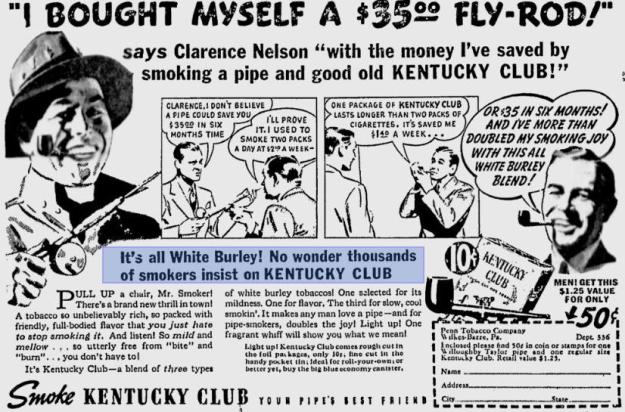
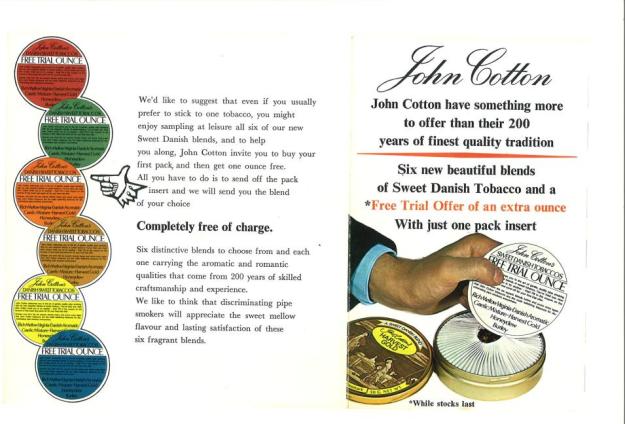
I am always on the lookout for aged tobacco, whether it is in tins, boxes or foil pouches. I love the look of the old packaging and trying the old tobacco. On a recent trip to Idaho Falls I came across this pair of packets of Kentucky Club in one of the antique malls I visited. From a bit of research I found that the Original Kentucky Club pipe mixture was a mild blend of high grades of White Burley from Tennessee and Bright Virginias from Carolina and Georgia districts. The next two photos are advertisements for Kentucky Club that give a bit of feel for the age of the brand. I don’t what the age of the tobacco I found is but the fellow who sold it to me with two pipes thought it was from the 50s. So it has a bit of age on it.KC

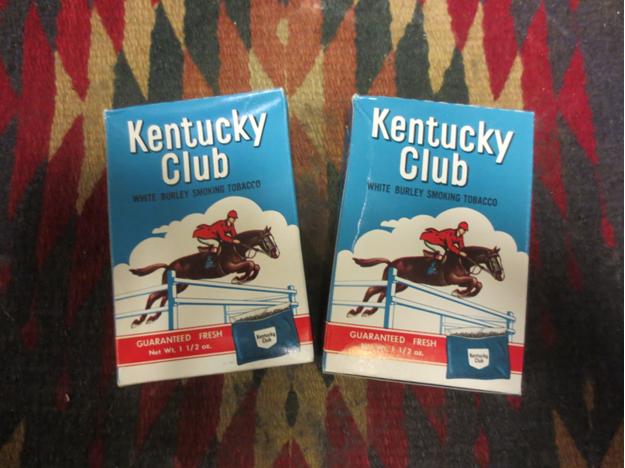
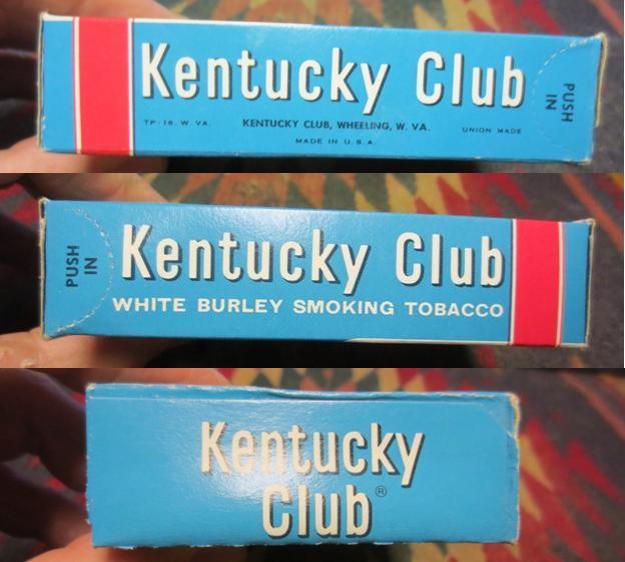
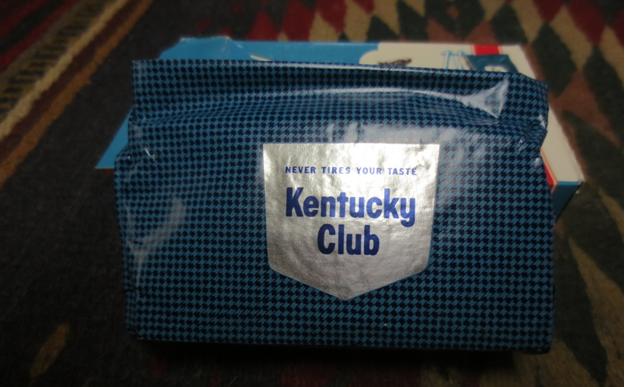
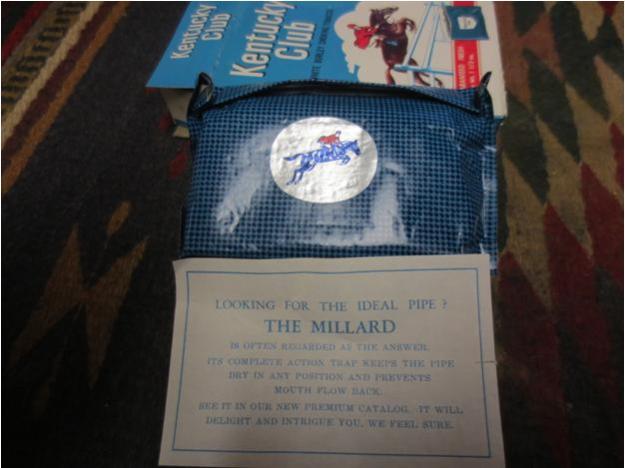
KC4 The two boxes were wrapped together in a torn brittle plastic package. When the shopkeeper gave them to me the plastic fell off. The two cardboard boxes are printed in basically three colours so it is not a modern printing process. The packaging makes me think the seller was correct in his thinking it came from the 50s. I picked up the two unopened boxes for about $8.KC5 The boxes are printed Kentucky Club White Burley Smoking Tobacco with a picture of a jumping horse. At the bottom of the box cover it says Guaranteed Fresh Net Wt. 1 ½ oz. with a picture of a blue pouch with the Kentucky Club logo. This is on both the front and the back of the box. On one of the long edges it reads Kentucky Club over TP-16, W. VA. Kentucky Club, Wheeling, W. Va. Union Made. Under that it reads Made in USA. There is a perforated PUSH IN tab on the top edge. On the other long edge it reads Kentucky Club over White Burley Smoking Tobacco. This side also has the PUSH IN tab at the top. On the top and bottom of the box it read Kentucky Club.KC6 I opened one of the boxes to look at the contents. Inside was a foil pouch of tobacco. The pouch is checker board black and blue. On one side is a silver medallion that has the words Never Tires Your Taste over Kentucky Club. On the other side it has a jockey and horse jumping inside a silver circle like the logo of the tobacco. The tightly sealed foil pouch let none of the aroma of the tobacco escape. That in itself was a good sign. The contents were a little dry as the tobacco was crunchy. Around the outside of the pouch was wrapped a coupon for a Millard Pipe.KC7

KC8 The one side of the insert read: “Looking for the ideal pipe? The Millard is often regarded as the answer. Its complete action trap keeps the pipe dry in any position and prevents mouth flow back. See it in our new premium catalog. It will delight and intrigue your, we feel sure.”

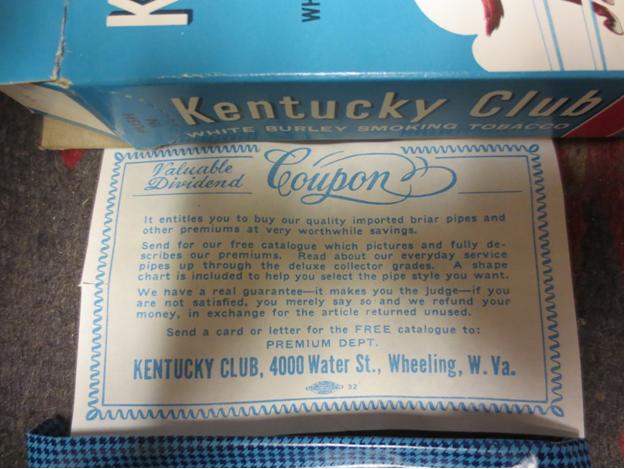
On the other side it reads: “Valuable Dividend Coupon. It entitles you to buy our quality imported briar pipes and other premiums at very worthwhile savings. Send for our free catalog which pictures and fully describes our premiums. Read about our everyday service pipes up through the deluxe collector grades. A shape chart is included to help you select the pipe style you want. We have a real guarantee – it makes you the judge – if you are not satisfied, you merely say so and we refund your money, in exchange for the article returned unused. Send a card or letter for the free catalogue to: Premium Dept. Kentucky Club, 4000 Water St., Wheeling, W. Va.”

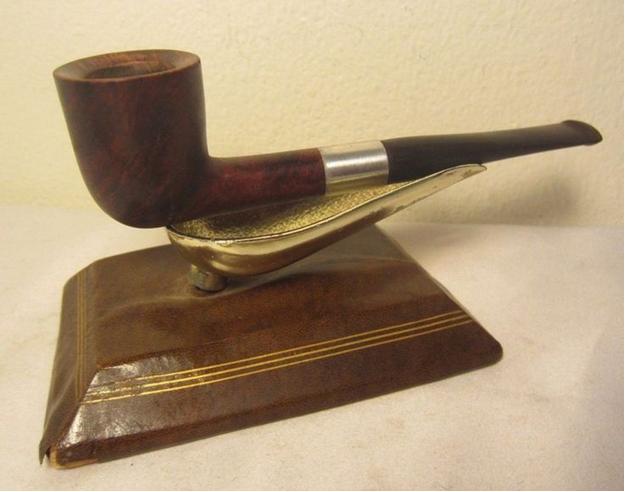
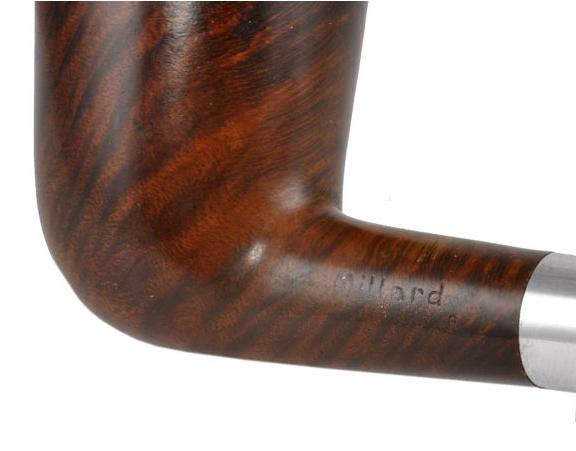
The combination of the design of the pouch, the packaging and the insert make me even more certain that the seller was correct in his general assessment of the age of this tobacco.KC9 I did a bit of digging to find out about The Millard Pipe – which seemed to have been a type of system pipe. I was able to find a Millard pipe through Google photos and it turns out that it was a pipe with a design very similar to a Keyser Hygienic Patent Pipe. The inner tube in the shank and a similar tube in the stem with a military mount stem. Now I am going to have to hunt down one of these Millard Pipes.KC10

KC11

KC12

Now I’ve Seen Everything


Guest Blog by Robert M. Boughton
Member, North American Society of Pipe Collectors
http://www.naspc.org
http://www.roadrunnerpipes.com
http://about.me/boughtonrobert

“What will they think of next?”
― From “What Will They Think of Next?” Canadian science TV series (1976-1979), with Joseph Campanella and guest hosts

INTRODUCTION
On tonight’s episode, we’ll look at some of the most unusual smoking pipes ever conceived by innovative inventors whose lives have been committed to making the world the place we now know it to be! First from Langley, Virginia in the United States, a pipe that was, for many years during the Cold War, classified “Top Secret” by the intelligence community there; then to the United Kingdom for a glance at a pipe even children can enjoy, however illicitly; next to another U.K. company, originally headquartered in the U.S., known best for its metal pipes that have sold 44,000,000 and counting, but which also holds the distinction of having introduced this “unbreakable” pipe; back to the U.S., in San Marcos, Texas, for a pipe you can literally stick almost anywhere you find yourself…and more!

CUT TO COMMERCIAL BREAK

OUR PROGRAM CONTINUES

For those James Bond fans who think his gadgets are cool enough to die for, created by the ingenious Q in his ever-clever if not always quite perfected lab full of spy toys for Her Majesty’s secret agents with a 00-series license to kill clearance, we offer this glimpse of real-life tradecraft brought to you by the brilliant though perhaps somewhat sociopathic inventors at the Central Intelligence Agency: the meerschaum small billiard pipe, c. 1950s, complete with a screw-in tenon that can be removed for the open shank to act as a gun barrel. Capable of firing a single .22-caliber bullet by simply pressing the tiny ventilation-like system “trigger” on the underside of the shank, this is one tobacco pipe that would indeed be deadly to use.Rob1 Although this petite, gorgeous beauty of a meerschaum, very similar to the women in Bond thrillers, was capable of being enjoyed in the usual sense of the term (with a nice bowl of tobacco), in this case the word smoked takes on a more sinister meaning. Note the somewhat creepy, lightly used condition of the bit just below the lip, indicating the pipe’s actual use at least once by an actual non-official cover (NOC), or deep-cover and fully-deniable, CIA agent.
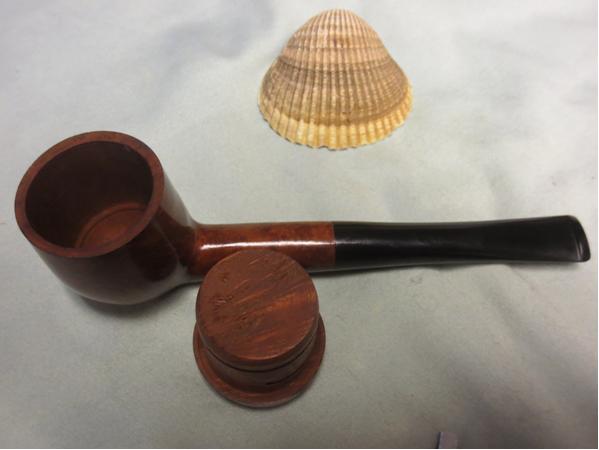
Now, onto our next amazing variation from the norm in the world of tobacco pipes: the Puff Pop Lollipop Pipe! That’s right – Lollipop Pipe! Distributed by everyonedoesit.com, these unique candy pipes are fashioned with clear, hollow, plastic combination shanks/bits leading into the same old lollipops enjoyed by generations of children – except that one side of the round ball of candy is hollowed out to add real pipe tobacco, and the other is flat.Rob2 Although there is a clear drawback here – the pipe shapes are limited to the one shown above – they are designed as sitters. The Puff Pop Pipes, cutting-edge versions of the old-fashioned candy on a stick, create an “original, cool, easily usable, tasty smoking accessory.” And that leaves out the obvious, disposable. Conceived by the “think tank that is Pitara, who are all about dual purpose,” they are available to order only online at a site that requires anyone who wishes to enter to certify he is 18 or older. That certainly ensures that potential underage smokers will be weeded out. The real draw of this great new pipe variety is that the tobacco taste and aroma are sweetened and flavored and “come in a number of different mind crackling flavors and colors, for all to enjoy.” Now, there’s a great idea!

Now onto a pipe – “The Pipe” – invented by Super Temp in 1963 with sales beginning in 1965, during the height of the Hippie movement, by Tar Gard. Not until 1971 did The Pipe become part of Falcon family, the renowned inventor of the metal pipe. Constructed of virtually unbreakable materials that led Falcon to drop this line quietly in 1972, due to the very nature of The Pipe’s unconventional construction, their manufacture passed to yet another pipe interest. Responsibility for making The Pipe moved for the last time to RJ Reynolds in 1973, the final year of its short period of manufacture but seemingly permanent existence. They remain available to collectors to this day, perhaps due to their all but indestructible nature.Rob3 At last we come to the last but not least of this evening’s scientific wonders: Grabber Pipes! Available in two great traditional shapes and made of the usual briar, with one major difference, these pipes are modernized with the insertion of magnets to allow pipe enjoyers on-the go, or those who don’t have a pipe rack, to set the finished Grabber on almost anything metallic!Rob4

Rob5 And that concludes tonight’s episode. Thank you for joining us, and look forward to the next account of scientific breakthroughs.

CONCLUSION
What can I add other than…now I’ve seen everything! Anyone with an account of any tobacco pipe odder than these, please, do tell.

SOURCES
For those of you who are interested, here are the websites to visit for more information.

http://www.popularmechanics.com/culture/movies/g985/23-most-memorable-james-bond-gadgets/?slide=1 23 Most Memorable Bond Gadgets – Popular Mechanics
http://www.ebaumsworld.com/pictures/view/81348090/ CIA pipe-gun
https://www.cia.gov/news-information/featured-story-archive/2007-featured-story-archive/cia-museum.html CIA Museum
http://www.everyonedoesit.com/online_headshop/puff-pops-lollipop-pipes.cfm# Puff Pop – Lollipop Pipes
http://www.pipetobacco.com/grabber.html Magnet pipes
http://www.thepipe.info/info/anatomy.html Anatomy of The Pipe
http://www.thepipe.info/history/index.html#Timeline The Pipe Timeline