Author Archives: Greg

Unknown's avatar

About Greg

I am medically retired from my 'career', have been since 1999. For quite some time I missed my old job a lot. I enjoyed it, I was good at it and didn't have any desire to do anything else. But the Lord had other plans for me. Now He has called me to work for Him. He has graciously given me some talent to work with words. He has also seen fit to guide me with the Holy Spirit to study and comprehend His Word. Don't misunderstand; I am no scholar nor a pastor. I'm just trying to be obedient to my Lord and Savior and do what He asks me, in a way that would please and bring glory to His holy Name.

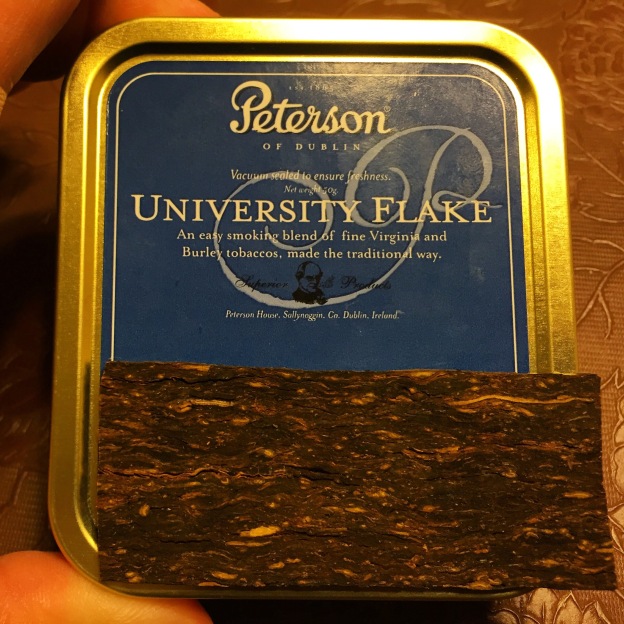
Peterson University Flake: a lesson in subjectivity


Just after the first of the year a new tobacconist opened in my area. Though they are primarily a cigar store, the last few months they’ve started really delving into pipes and pipe tobacco, giving me a new choice to shop locally; they are about 20 minutes away so it’s not very often I get […]

http://smokingjacketmagazine.com/2015/11/11/peterson-university-flake-a-lesson-in-subjectivity/

Why You Need to Disassemble a Pipe


It’s been a while since I’ve been able to do much restoration work but I did have this short video I cobbled together with an article and thought I’d share it here; I know this is something many of the regular readers here will identify with and have come in contact with. And for new folks that may be searching for information I figured they would find it here easier than where it was first posted. 

Why You Need to Disassemble a Pipe – Tobacco University (Reblogged from Smoking Jacket Magazine.)

I know some folks aren’t big on regular, routine maintenance/cleaning of their pipes; I get a little lax at times, too. But for the best performance, enjoyment, and taste from you pipe it is very necessary to have a routine and actually do it. Being one who enjoys and has restored many old estate pipes […]

Briar, cleaning, featured, stuck stem, pipe, pipe smoking, maintenance

http://smokingjacketmagazine.com/2015/10/28/why-you-need-to-disassemble-a-pipe-tobacco-university/

A New Vision for a Butz-Choquin Galion 1661 Sitter


A wonderful example of risk/reward in pipe restoration displayed on this one.

Charles Lemon's avatar

This is a story about potential and a bit of risk-taking to fulfil it. When I pulled this pipe from the refurb box, I immediately felt that it wasn’t quite living up to its potential, not necessarily as a functional pipe, but rather as an “objet d’art”. Pipes, in my mind, fall into that rare category of things that serve a simple function but can also be beautiful works of art in their own right. This large Butz-Choquin sitter was several points off course in that respect. It’s shape seemed heavy and ponderous, and to top it off, it had been “customized” by a previous owner who carved a linear design around the bowl, and signed it with a large “SK” on the bottom. He was presumably proud of his handiwork, but it did not ring any aesthetic or artistic bells for me.

Apart from the custom carvings, the pipe was…

View original post 890 more words

Smoke Rings


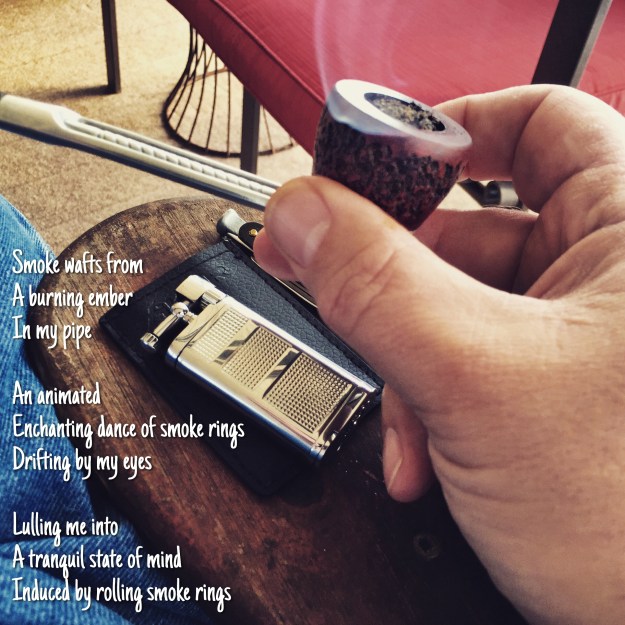
Circumstances and events of life have had me out of the shop for too long now, something I hope to rectify very soon. Since I’ve been unable to work on any of my projects I’ve been doing a little writing again, a passion I’ve let lay dormant for a while. At any rate, I thought this particular poem might be of interest to you good pipe men and women so, without further adieu, I share “Smoke Rings” with you.

Greg's avatarPotholes in the Road of Life

A few days ago Carpe Diem Haiku Kai did an exercise on, what else, haiku: specifically form. The challenge was to stretch ourselves by doing three haiku in slightly different ways: one 3-5-3 stanza, one traditional 5-7-5, and a free form stanza. It took me a little longer than usual to get this done; I had an idea but it took several tries to get something I was pleased with. Consequently I missed the deadline but have a chained haiku that I really like.

Smoke wafts from
A burning ember
In my pipe

An animated
Enchanting dance of smoke rings
Drifting by my eyes

Lulling me into
A tranquil state of mind
Induced by rolling smoke rings

As you can see, I stayed with the guidelines using stanzas of 3-5-3, 5-7-5, and 5-6-7 for the free form ending, while, in my mind at least, chaining them into one poem. Even…

View original post 22 more words

Undressing a Stanwell Black Diamond


Blog by Greg Wolford

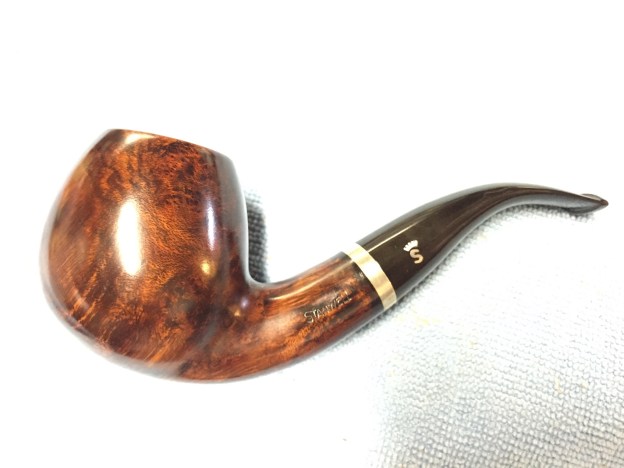
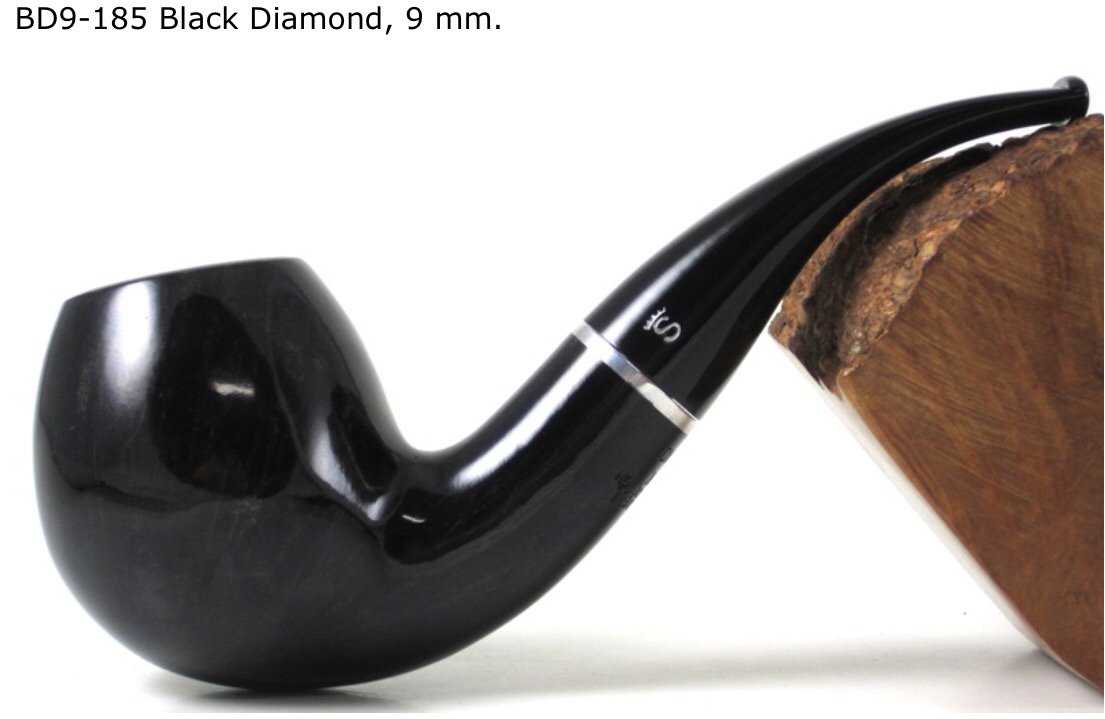
A few days ago I received a Stanwell Black Diamond shape 185 in the mail, gifted to me from an Instagram friend. It was a pipe he’d bought as an estate and hadn’t touched. When it arrived it was a “dress black” pipe, covered with a matte black opaque finish that needed some TLC: the rim was a bit uneven from being bumped or tapped out, the finish was “thin” in a few spots, with the briar peeking through, and needed to be cleaned internally. I thought I was going to do a quick clean up and smoke it but the story developed into something more soon. So I didn’t plan on all that I ended up doing and didn’t take photos. I even forgot to take a before picture so I’m using a “stock” picture of this model.

I cleaned the bowl, stem and shank first. This pipe had almost no cake and was not very dirty at all; it took only half dozen or so pipe cleaners to get it done. As I said before, I thought this was be a really fast job when I saw how little use the pipe had had. But it, of course, didn’t turn out quite so simple.

I wiped the stummel down with alcohol to clean off the surface and prepare it for a treatment with a new idea I had: colored wax. Some time back, Steve had mentioned to me about a product that Hobby Lobby carried that was a rub on/rub off wax that comes in different colors and might be good to highlight stem or shank nomenclature. I picked up a tube of black and have tried it once or twice with less than great results. But I thought it might be just the thing to touch up the black finish on this pipe and shine it up, too. The alcohol removed a little of the black coat but not too much as I cleaned it so I knew the finish was removable at this pint, in case the idea didn’t work. After the briar dried I rubbed the ebony wax onto the pipe, let it haze and buffed it off by hand. I did about three coats of the wax and wasn’t really thrilled with the pipe, even though the color “took”.

The bumpy rim was irritating to me and I knew it would continue to be a distraction. Although I was worried about what lay under the opaque finish, I decided to top the bowl and go from there. The newly smooth rim pleased me and I couldn’t help but wonder what was under that black coat. So I began to sand the black away to see.

The coating was fairly thick and took some time to remove. I sanded with 220 grit paper until the black was mostly gone. It was a pleasant surprise that no fills were under that coat. In fact, the grain was pretty nice. So I moved on to 400 grit paper and then buffed the briar with tripoli to see how it looked; it was nice and the black would make a great contrast stain. I wiped the pipe down with alcohol again to remove the wax and dust and started sanding with 600 grit paper. After I was happy with the smooth surface of the pipe I removed the tape I’d applied earlier to the stamping to protect it and began to work gently around the black patches under the tape to make as little damage as possible to the nomenclature but break up the black.

I mixed up some Fiebing’s dark brown leather dye with isopropyl alcohol in a 1:3 ratio. I applied and flamed the stain several times to get a nice, even coat. Then I wiped the bowl down with alcohol wetted pads until I removed enough due to see the grain well. I moved to the buffer where I buffed with tripoli and white diamond before laying the stummel aside to deal with the stem.

The stem on this pipe is acrylic and was in good shape; there were no major scratches or tooth dents so I polished it with plastic polish and then reassembled the pipe. Then the entire pipe got several coats of carnauba wax and buffed to a shine on a clean flannel buff and then a bit more by hand with a microfiber cloth.

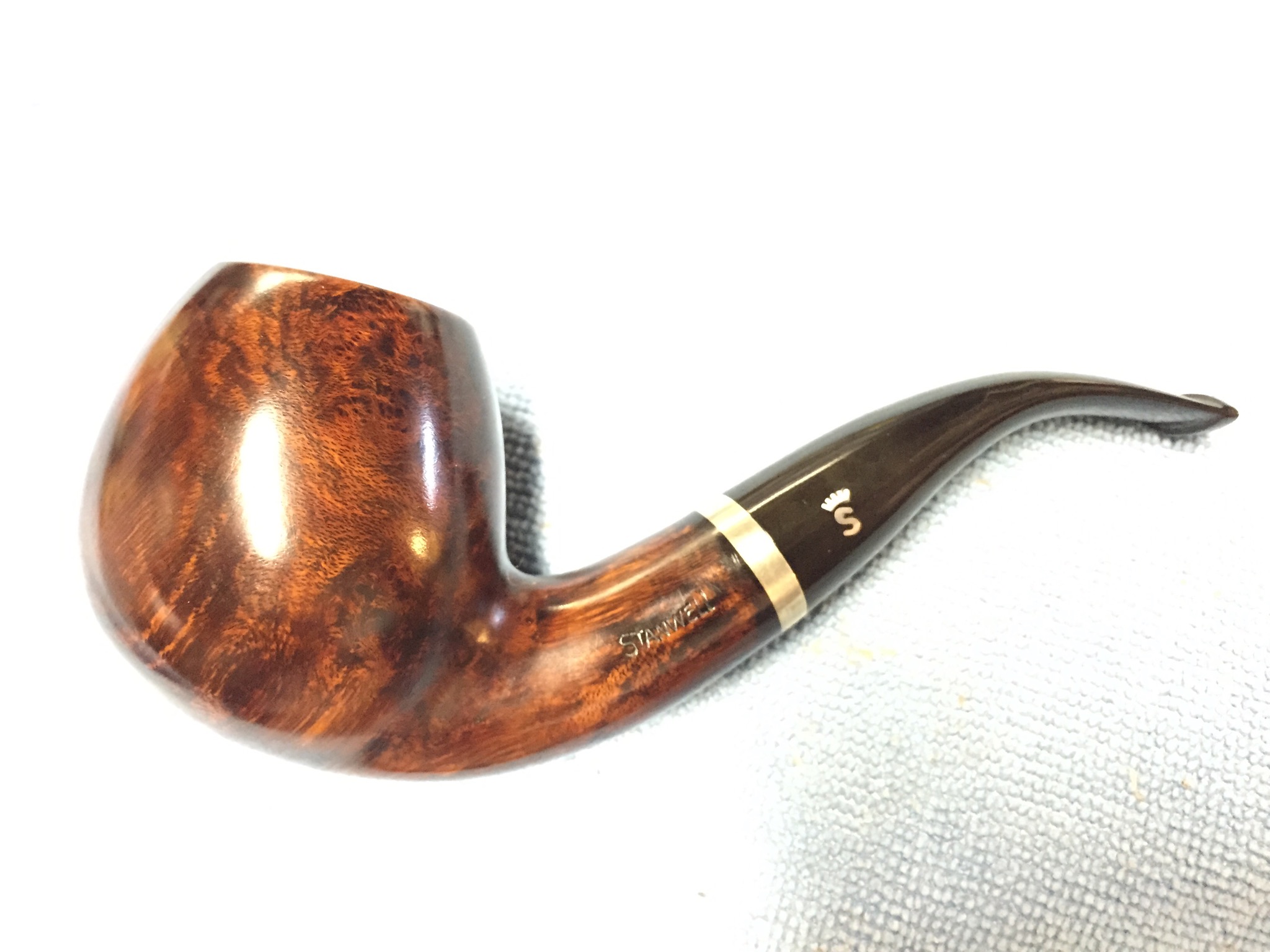
I’m really pleased with the “undress” pipe. And I’m relieved that the briar under the “coat” was as nice as it is. This large, heavy pipe will now have a spot on my rack, to be used and enjoyed, something that it hasn’t had much of in its life. IMG_0986.PNG

IMG_0982.JPG

Carving Your Own- Getting Started with a Pre-Drilled Pipe Kit


Blog by Greg Wolford

One of the forums I belong to has started a group project: carve our own pipe from a kit/pre-drilled block. It’s just getting started but one thing has become apparent to me: lots of folks want to try but are at s loss as to where to start.

The whole idea here is to have fun and get started with a minimal amount of tools and money invested for the real beginners. It seems lots of folks think that a lot of large, expensive machinery is needed to make any pipe. While the professional pipe maker may have and need these, the DIY-guy/gal doesn’t need a lot to start from a kit.

My son has carved three pipes and I have carved one, all using hand tools, not counting the buffer. I thought that a short list and video might be helpful to any want-to-try pipe carver.

All of the tools except one can be found at Home Depot; I use them as the example because I bought it looked up most of them there/on their website. The exception is the vulcrylic file which I got from Amazon.com.

3-Piece Steel WoodChuck Set
http://thd.co/1mDsSfB
6-1/2 in. Pro Coping Wood Handle Saw
http://thd.co/1iXdvMA
8 in. 4-in-Hand Rasp and File
http://thd.co/SXnKpr
2-3/4 in. Swiveling Vacuum Base Vise
http://thd.co/1kWm4pf
2 Vul-Crylic Wax File Jewelers Carving Filing Hand Tool https://www.amazon.com/dp/B000RAYCES/ref=cm_sw_r_awd_Kj1Iub1ARRHYX

There are other sources for tools and sandpaper etcetera but this will get you started. The blocks/kits are available from a variety of suppliers, too, including but not limited to PIMO, Pipe Makers Emporium, and Vermont Freehand. These sources, with many others, also sell various finishing products such as dyes and waxes. But again, this ought to get one off on the right foot.

Happy carving!

Carving and Rusticating My First Pipe


Blog by Greg Wolford

Last winter sometime I got myself a pre-drilled pipe kit from an eBay auction; it is from Mr. Brog and is pear wood. I don’t remember exact how I did it but I really messed it up with a terribly wavy cut on the front using a coping saw; I made a few other small cuts that weren’t bad but made the block a mess added to the front cut. I was very unhappy with myself over it and put the kit away, forgetting about it, figuring it was a total loss.

Last week my son found it while he was carving a briar kit I’d bought him a few months ago and gave it to me. I decided that I was going to go ahead and try my hand at carving it, to get a feel for the process and maybe even salvage it. Considering the bad start I had, I didn’t plan on writing about this so I didn’t take many photos. But I’ve been asked about how I rusticated it so here we go.

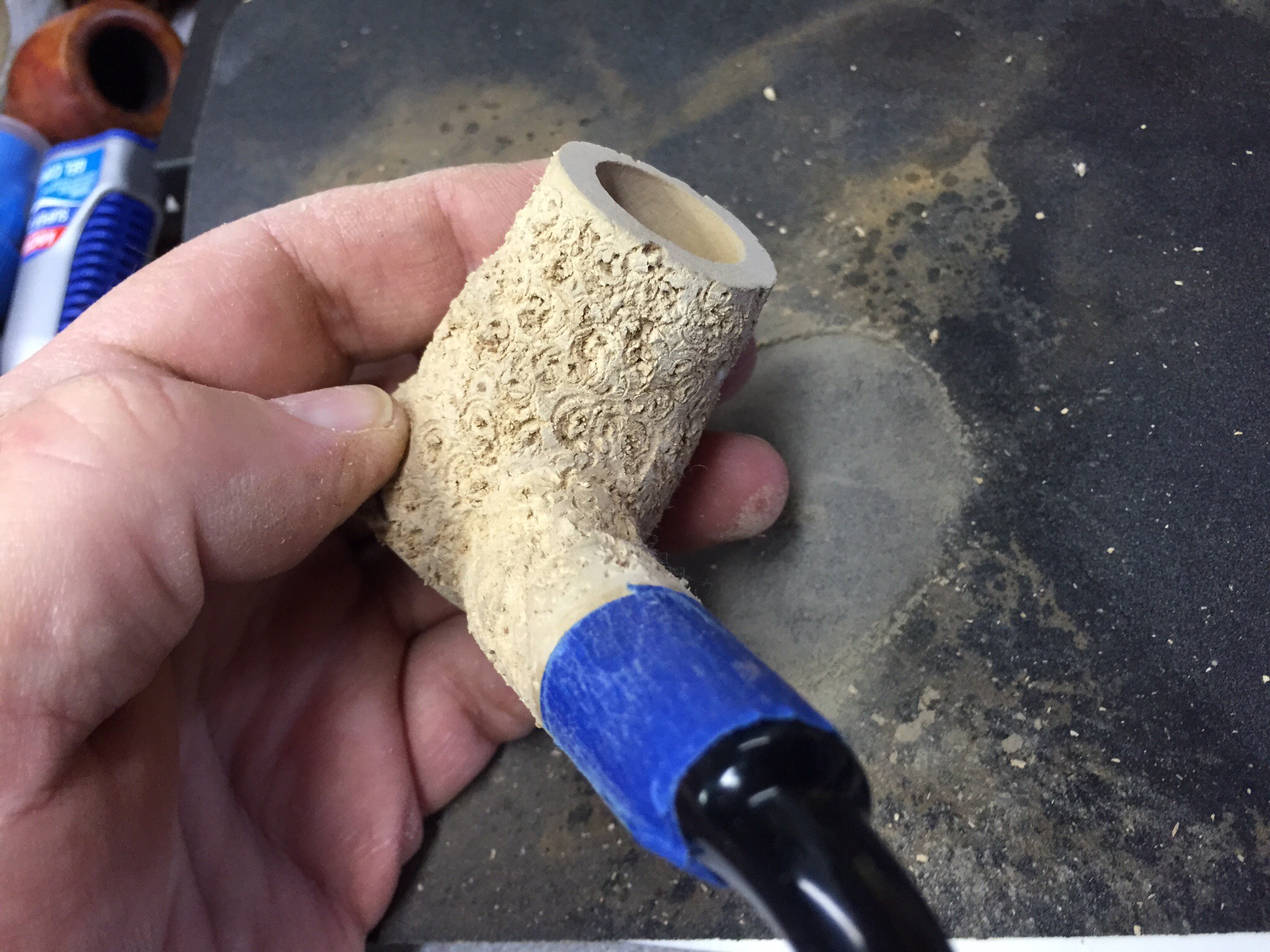
I used only files and sandpaper, no more sawing (LOL), to do all of the rest of the pipe except for two things: the rim I carved lightly with a Dremel and I buffed it lightly on the buffer. This is an idea I’d where I started, with the wavy face:

IMG_2271

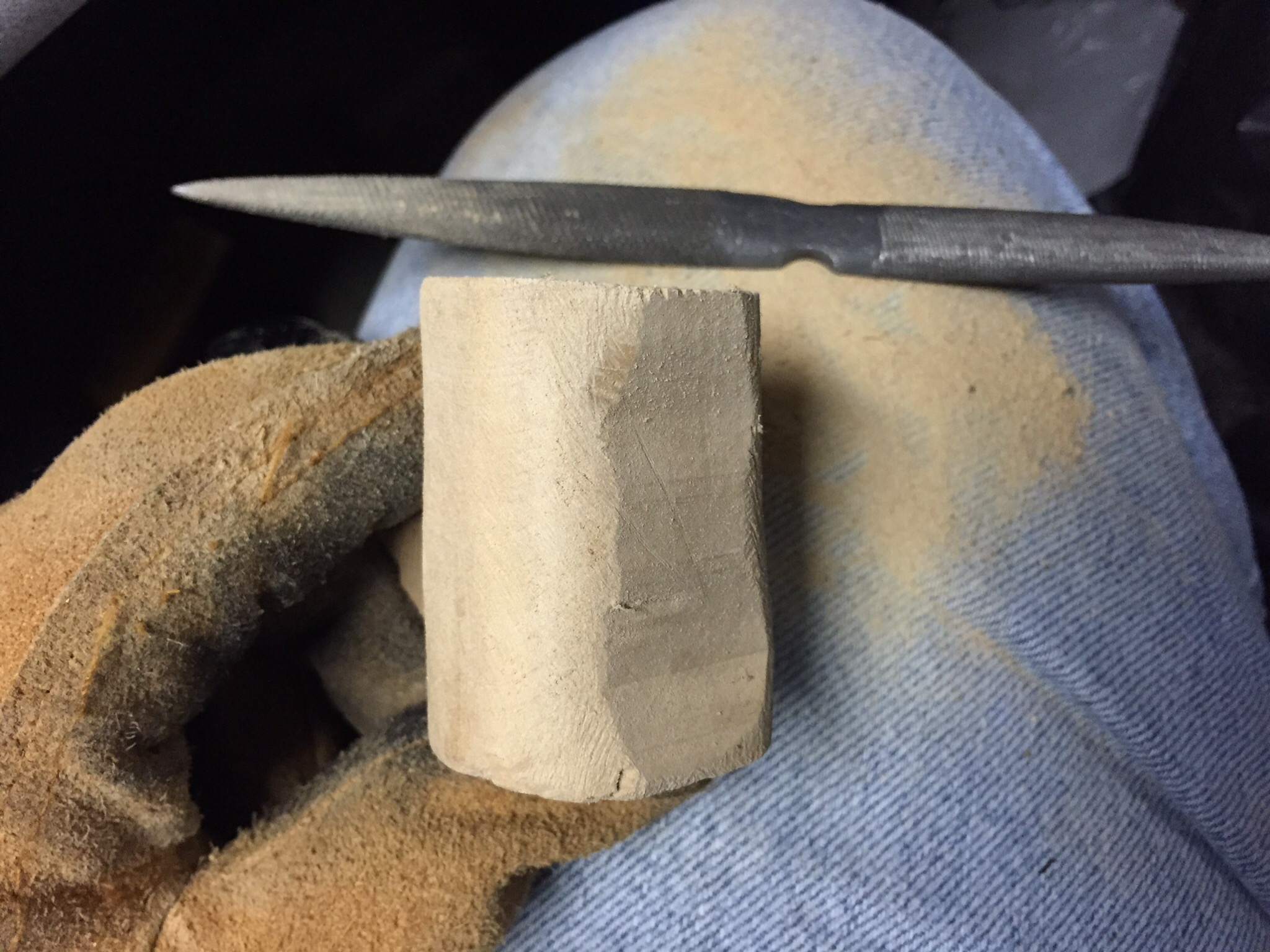
I used various files, including the above pictured vulcrylic file, to shape the block; my plan was to get a volcano type shape and hide the poor face-cut in the process. This proved to be a challenge since the front couldn’t be shaped too much or I’d end up with a much too thin wall.

I filed and sanded, slowly bringing out, more or less, the shape I had in mind. I also worked at the shank to a decent transition to the stem, which was a fair amount of work with all the material that needed to be removed. After I had gotten as far as I felt I could go with the shaping and was fairly happy with it I decided this would be a rusticated pipe; it would blend the faults better I thought and, being pear, there was no grain to speak of.

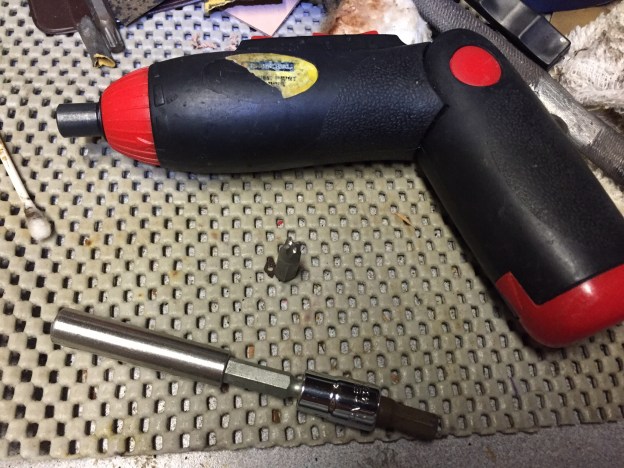
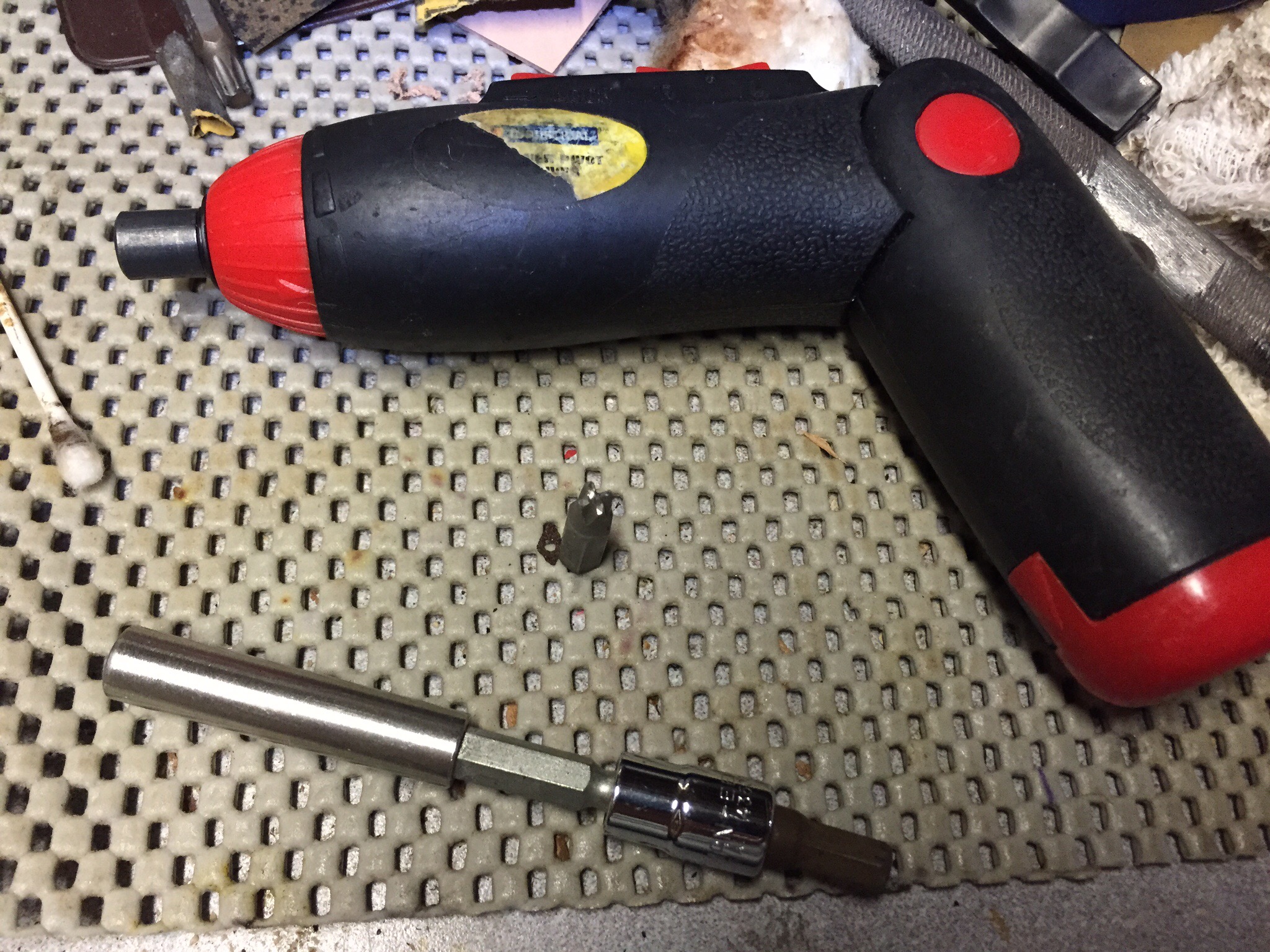
I’ve been wanting to try my hand at rustication and make a tool for a while. I’ve read many ideas on how to do this, mostly on this blog, so I knew what I wanted to try. I have many small screwdriver bits lying around from cheap screwdriver kits I’ve had over the years. The bits are usually not very hard and of low quality, often stripping out on tough screws/bolts; one of these would be my starting point. I held the number 2 Phillips head bit I chose in a pair of vice grips while using a Dremel cutting disk to cut the “X” on the bit tip. This is what I ended up with:

IMG_2332.JPG

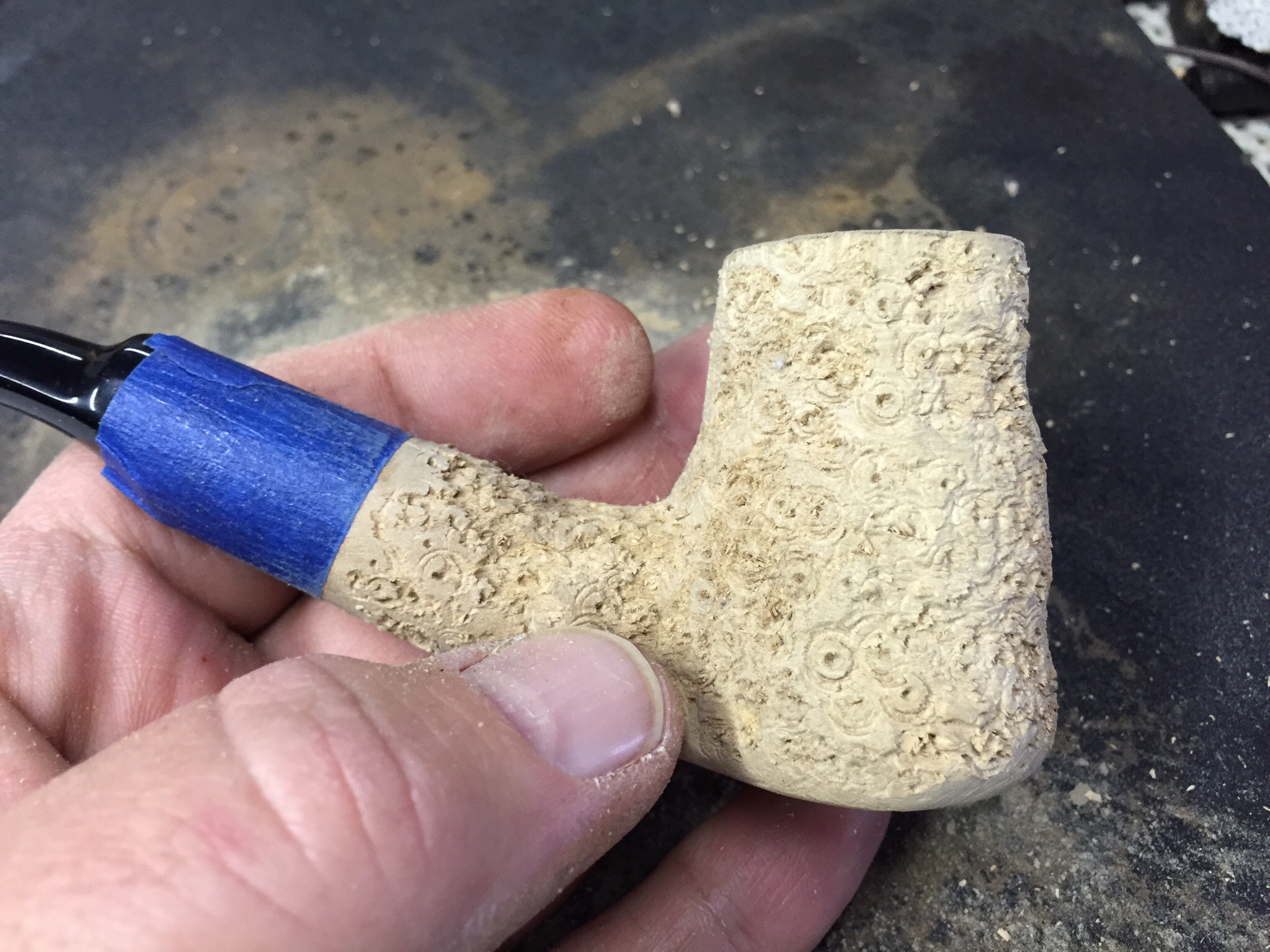
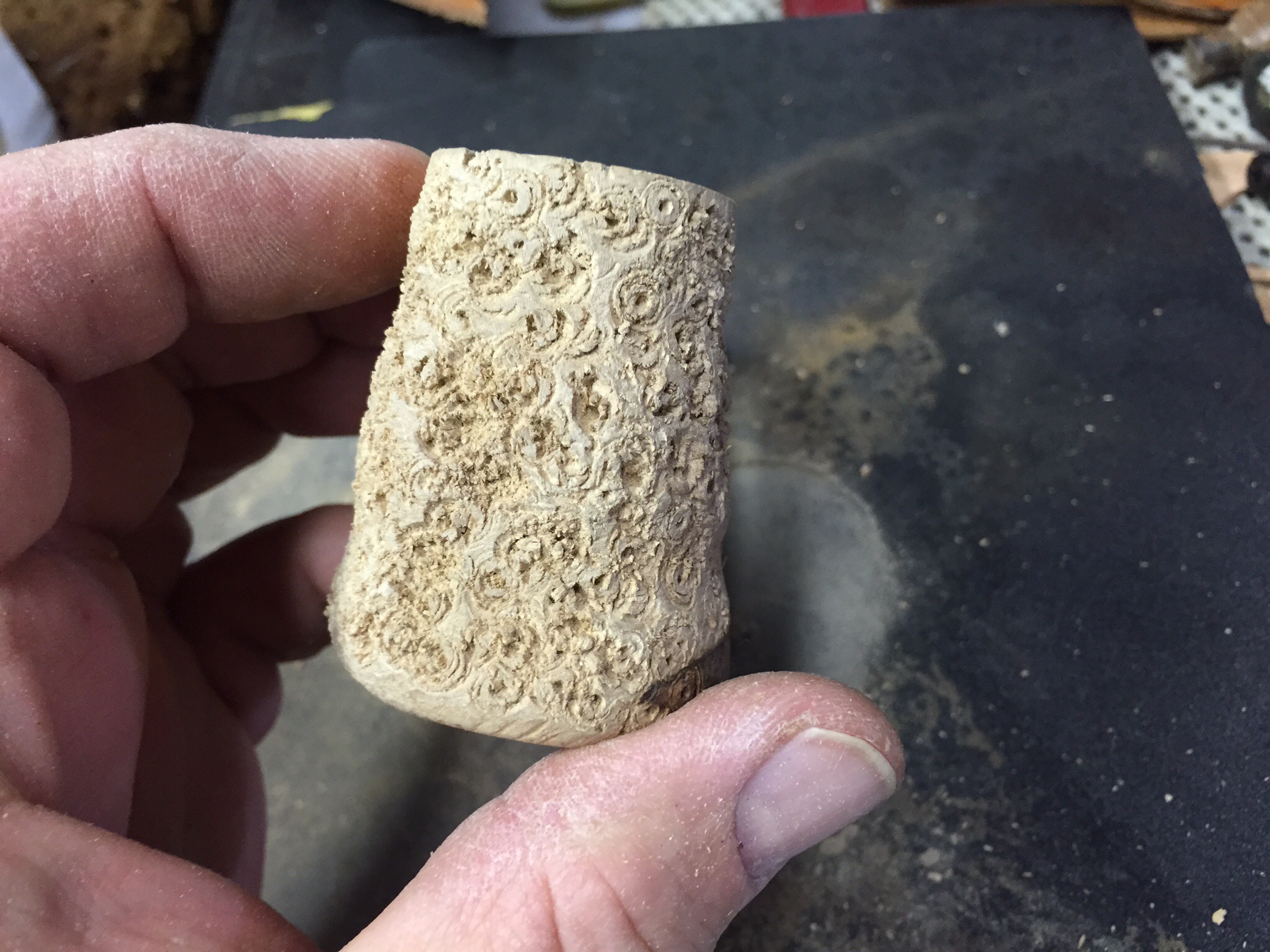
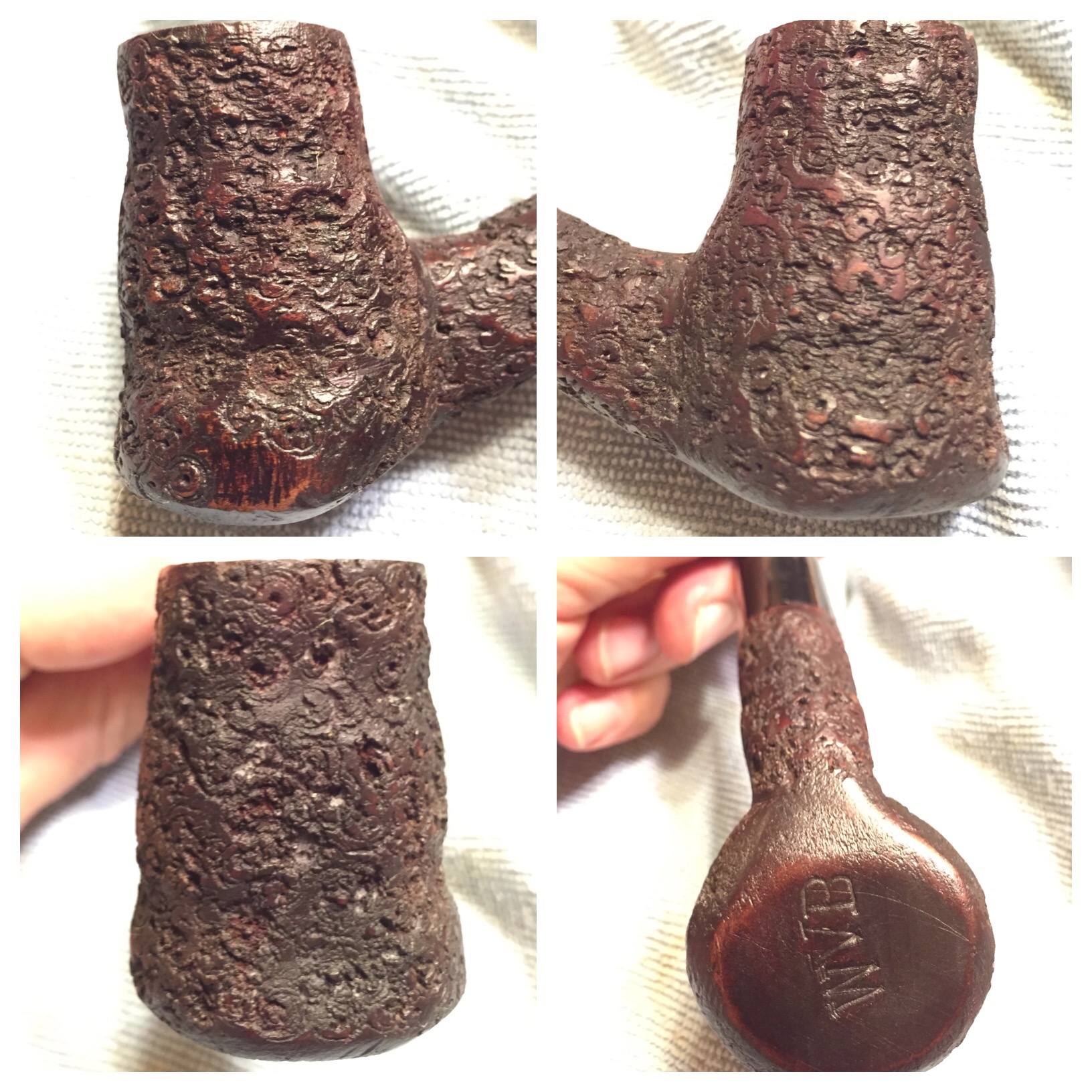
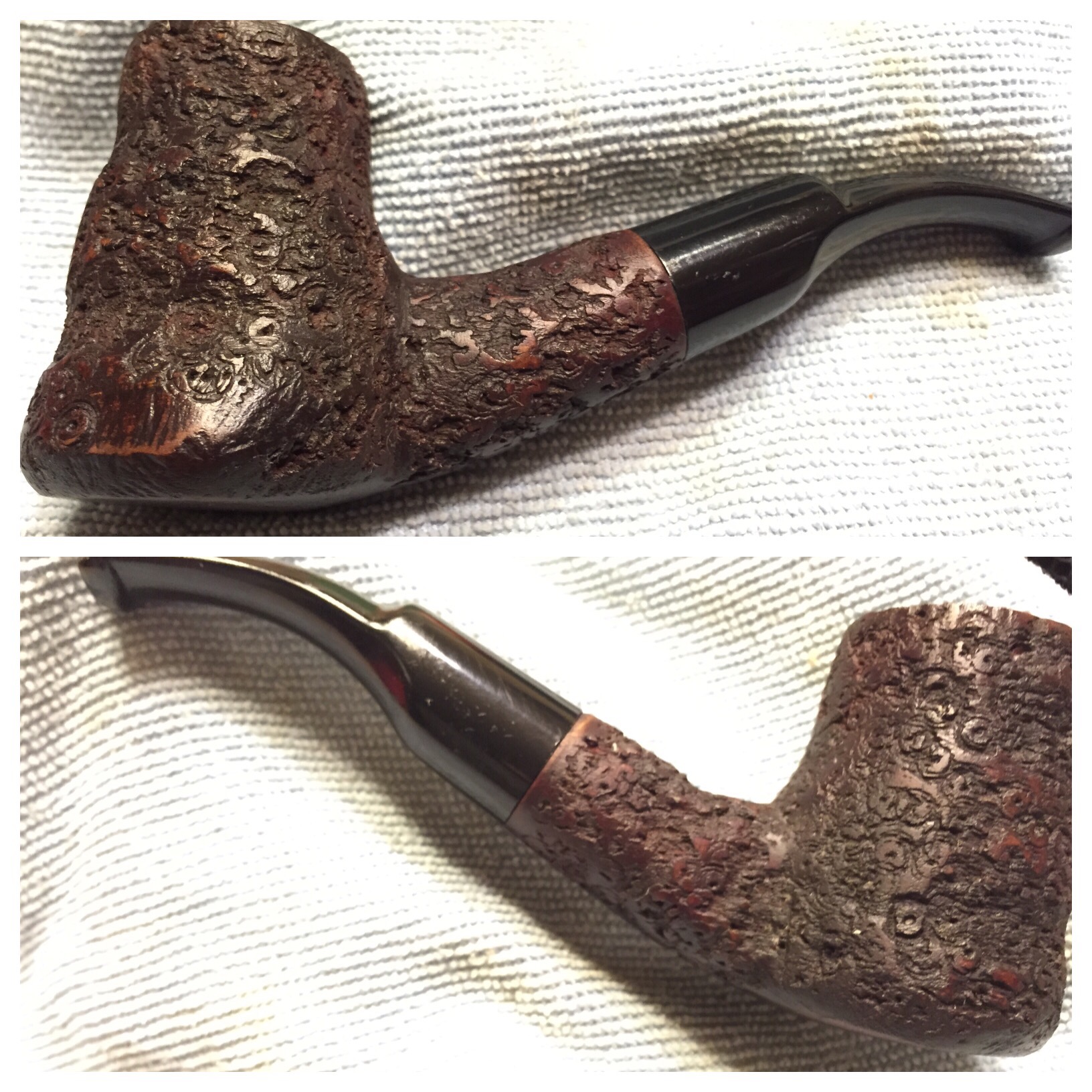
There are now four cutting “teeth” on the bit, one which is slightly longer than the others (by accident I might say). I then chucked this up in a battery-powered screwdriver that had an adjustable handle; it can be used anywhere from straight to a 90-degree angle. I pressed the bit into the wood, depressed the switch, and began rusticating the stummel. This turned out to be a rather fun and enjoyable process I soon found. By varying the pressure, time the bit was rotating, and letting the tool “walk”, I was able to get a pretty interesting and fairly consistent pattern.

IMG_2320.JPG

IMG_2323.JPG

IMG_2322.JPG

IMG_2321.JPG

I used a small carving bit in the Dremel to lightly carve the rim because the smooth rim didn’t match the pipe in my opinion.

I then scrubbed the stummel with a wire brush, to knock off the dust and debris from the process. I applied Fiebing’s mahogany leather dye, two coats which I dried with the heat gun rather than flaming because my grandson was helping me with this entire project. I hand buffed the extra stain off with an old rag and steel wool. Next I sanded the wood lightly with 320-grit paper to knock down the really sharp edges that remained. Them I buffed the stummel with Tripoli to further reduce harsh edges and give it a very small amount of contrast. Lastly, I waxed it with Halcyon II and buffed it by hand with a shoe brush.

IMG_2330.JPG

IMG_2331.JPG

In the end I saved the kit, though it’s not as nice a project as I’d hoped for. But this system of bits ground into various shapes and used with the battery-powered screwdriver is an idea I really think made the project a success. I think that making different tools from different bits coupled with the variations one can achieve with the driver are a great tool to play with in the future, one that I hope others will find useful, too, and maybe find better variations on the idea to share with us for future use. Below is the driver, bit, and extension I used.

IMG_2333.JPG

An Old Meerschaum Bowl Restemmed and Reborn


Blog by Greg Wolford

Over the past couple of months I’ve been moving my workshop upstairs to an empty bedroom. With winter’s quick approach, I wanted to be ready for the bone-stiffening cold so I could do more restorations this year. All but the buffer had been moved into its new home and was close to being tidily organized when my plan went south; our son was moving back home and would need my new space back for his room!

It was a rather quick transition so all of my supplies were hastily packed up and moved back to the basement garage. In my rush, I didn’t think to make notes on boxes or anything else to help me sort through it later, I only packed quickly and securely and moved it all out. I felt like I got evicted! (Please note, that is not what happened to my son.) So finding any of the half-dozen projects I had in the works is now a daunting challenge; our garage serves as a catch-all of sorts, with our laundry area, my workshop, my wife’s “over flow” from her antique booth, and all of my son’s extras now piled in there.

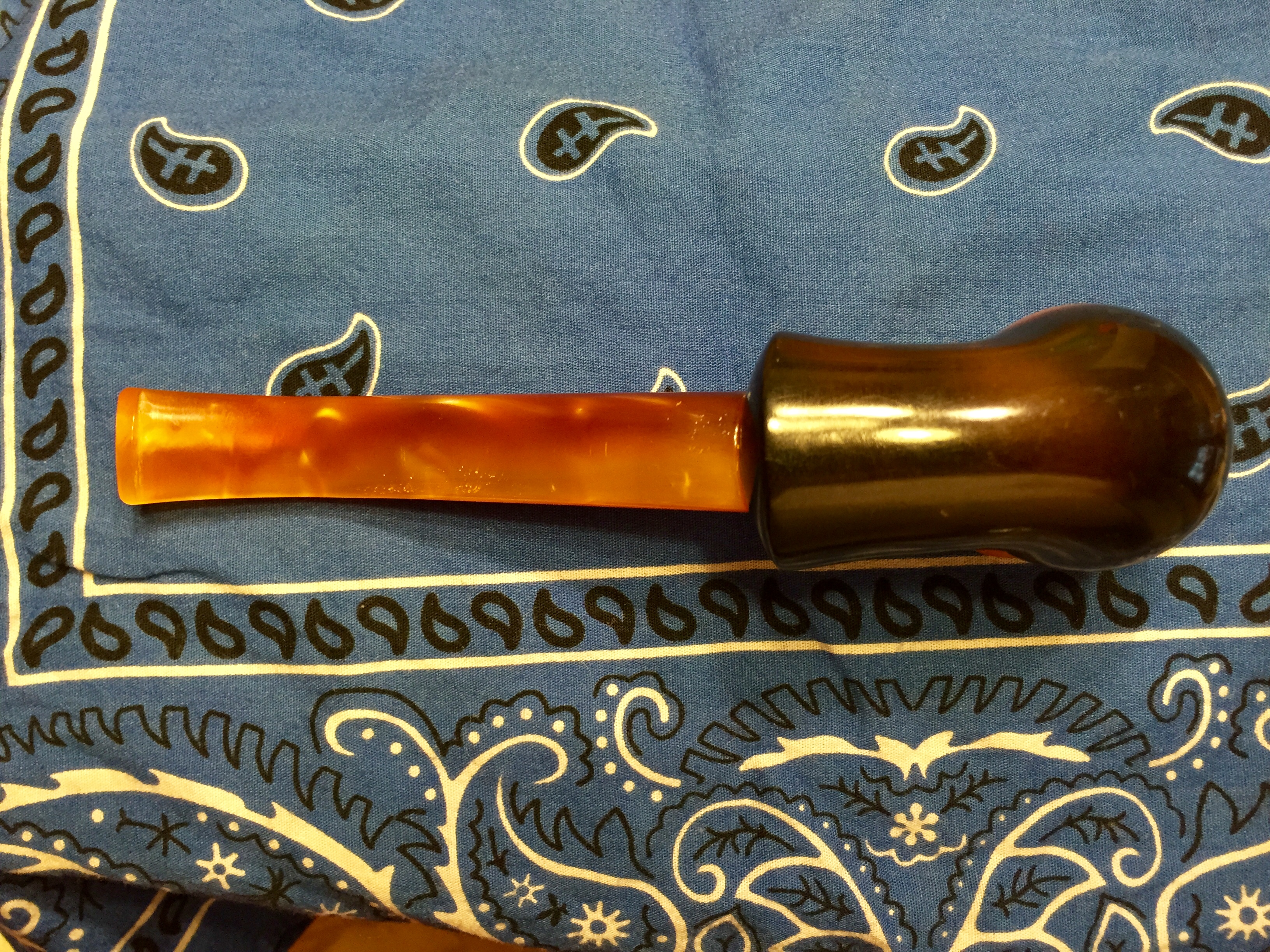
The other day I did manage to find an old meerschaum bowl that I’d began to work on. It came to me in a lot I had gotten a couple of months ago I think, along with another bowl and aOld Meer couple of pipes (this is the only before photo I have).  In fact, this bowl was the main reason I got the lot; it looked old and interesting to me.
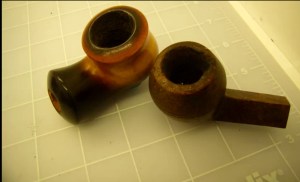
After doing a little research and getting some comments from friends on Instagram and Facebook I think it may be an Austrian meerschaum; I originally thought it was African. If I am correct, this pipe, well, bowl, is probably over 100 years old. It originally had a wooden shank extension which is now long gone. At first I thought of trying to make some sort of extension to replace it but soon decided that was more than I was willing to risk/attempt on this bowl.

(I forgot to take photos along the way; sorry folks.)

There was a think but soft and crumbly cake in the bowl and lots of oily build up in the shank. I gently reamed the cake back to very close to the meerschaum walls with my Castleford reamer, followed by an old round-ended, dull knife that I use for this purpose. Then I used some 400 grit wet/dry paper to get the last of the cake out and leave a nice, smooth bowl.

For the shank I stared with the poker-end of a Czech-tool, opening up the airway very gently. Then I moved to pipe cleaners that were dampened with isopropyl alcohol. Then I used alcohol dampened and dry cotton swabs to clean the shank. Do note the term dampened here; you do not want to get the meerschaum too wet. It took some time and many cleaners and cotton swabs to get the shank clean; there were also bits of meerschaum that were loose or came loose in the cleaning process that had to be removed. I also wiped out the bowl with several dampened cotton swabs after cleaning the shank. I also wiped off the outside of the bowl with alcohol dampened cotton balls; other than the rim, the exterior was quite clean. Then I let the pipe rest, to dry, overnight.

The next morning I examined the shank and found it to be a little rough inside. There was also a small divot in the bottom of the “lip” where the extension was and the new tenon would enter. I took the same dull reaming knife and scraped the mortise very gently to smooth it out; this took only a couple of passes and removed very little material but made a bug difference. I put a drop of amber superglue in the divot and sprayed it lightly with glue accelerator (I used a cloth to cover the pipe from over-spray) and then let it cure for a little while as I piddled with other things in the garage. I repeated this a second time and the result was a nice hard, smooth mortise entrance. Now it was time to decide on a stem.

Since the extension was gone, the mortise was very large, which would limit my stem options. I looked through my stems and found two candidates that had tenons large enough to work: a fancy vulcanite one and a long, round tapered acrylic one. It was a pretty easy choice when I put them up to the pipe to compare: acrylic wins by a long shot! The amber/bronze color of the stem just looked “right” with this bowl to my eye so now it was time to fit it.

I used my PME tenon turning tool to slowly reduce the size of the tenon.I noticed as I was cleaning the shank that the mortise narrowed a bit, probably from material loss both previously and current, closer to the bowl. So, as I test fit the tenon and found it stopping at the point of the narrowing I began to turn the tenon only about halfway up the total length. By doing this in small increments I was able to tell when the tenon was almost a perfect fit, which is when I switched to 320 grit paper and sanded the tapered tenon smooth and to a very nice fit.

The new stem was in nice condition, without a lot of drawer-dings, so it didn’t require much polishing: a little sanding with 220 and 400 grits, some plastic polish and a buff (lightly) with Tripoli and white diamond. I then used a heat gun to soften the stem and put the bend in it that I wanted and was pleased with. One more round of plastic polish and then everything got a coat of Halcyon II wax.Old Meer (1) Old Meer (2)Old Meer (3) Old Meer (4)

I’d love to tell you how wonderful the old ‘meer smokes but I can’t. You see, my son, the source of my “eviction”, saw the bowl on my work table and fell in love with it, before it was even cleaned up. So, after I got it all finished I took it straight to him to “see what he thought”; he really went nuts over it all reborn! As you have probably guessed by now, the old ‘meer now has a new home in his pipe rack, his first meerschaum pipe, which I hope and expect will serve him well with many good smokes for many years to come.

Tenon Troubles- Why I Stretch Rather Than Squash


Blog by Greg Wolford

Not long ago I was asked why I go through the trouble of using a drill bit (the blunt end) to stretch out a tenon instead of simply pressing it down to enlarge it when I’m fixing a loose stem. (The original article is posted HERE) I answered with because it is less likely to bend or mushroom the tenon doing it this way but there’s another reason to use this method: “headspace”.

Ideally the tenon should fit snugly against the mortise with little or no “headspace” or gap. When a stem is loose enlarging its diameter is the best long term fix but the method for the fix has an impact on the pipe’s smoking characteristics on my opinion.

Pressing it down while it’s warm will increase the diameter but also shorten the tenon, thus increasing the gap or headspace, too, which is undesirable. By stretching the tenon to the right fit, you get a nice, snug stem and no increase in the headspace. If you are a listener to the PipesMagazine Radio show you already know the reason why this is important; and if you’re not a listener you should be! Anyway, the increased gap allows more gunk to build up in the shank and can cause a pipe to smoke wetter, neither are desirable things. So, again, in my opinion, the extra time and effort the stretch-method requires is well worth the investment.