Monthly Archives: May 2012

A Perfect Alignment of 54s


I wrote this one on my birthday a few years ago now. I love the alignment of events and items that made that a special day for me. I wanted to share it here as well.

It is funny how it takes me some time to finally get around to writing some things down. But today I decided it was time to sit down and write about a special event in my life. I celebrated my fifty fourth birthday December 7, 2008. Periodically I find myself going back and reflecting on all the individual pieces that came together for a perfect smoke that day. It was a combination of planning and serendipitous discoveries that made the event work out better than I could have ever imagined.

I spent the previous year gathering the actors for the event – each of them would play a major role in making the day memorable. Each of them came with its own unique story to contribute to the day. In almost every case their past was shrouded with a bit of mystery and certainly a lack of definitive information about their existence before finding me.

The first character I went looking to recruit was a pipe for the occasion. Not just any pipe would do as I wanted one that really fit my birthday in a special way. The more I thought about it the more I wanted to have a pipe that was as old as me. It would be great to smoke a pipe from 1954 on my 54th birthday. So I began the hunt for just such a pipe. My decision imposed limitations on me to just a few makers. The only ones that I know that can be dated to 1954 with any degree of certainty are those made by Dunhill and Peterson. There may well be others that bear a silver hallmarked band, but in my experience the banded ones I have seen were all made in the late 19th or early 20th Century. That gave me a focus for my hunt – an older Dunhill and/or a Peterson pipe.


I emailed Mike Hagley to see if he had a 1954 in his collection of Dunhill pipes that he might be willing to part with. Of course as is often the case in my experience, Mike had several from other years but not a 1954. We ended our correspondence with a promise that he would keep his eyes open for one. I cannot remember the details but eventually Mike emailed me an eBay link to a 1954 Dunhill Shell Briar in a Canadian shape. It was in decent shape but had a replacement stem that had been poorly made. The stem was not seated properly in the shank and appeared to be at an angle. I decided to bid on the pipe and see what I could do. I entered my highest bid and let it sit. I was surprised to see that I was the only bidder. The pictures were rough so it did not give a clear idea of the condition of the pipe. The short and long of it was that when the auction closed and the pipe was mine.

Two weeks went by and Canada Post finally delivered my birth year Dunhill. Upon inspection it appeared to be in very good shape. The finish and the condition of the rim and shank were very good. The reason for the misfit stem turned out to be an angled tenon and not a misdrilled shank done during the repair. What a relief. I cleaned and polished the bowl and shank and re-bent the tenon to straighten it out. (Though even with this work it still did not fit flush to the shank.) As I held it in my hands I began to wonder about getting a new stem made for it. I contacted Dr. Dave at Walker Briar Works to see if he was interested in making a new stem for me. He was up for the challenge and I sent it off to him. He researched what a 1954 Dunhill Canadian stem looked like, took an old Dunhill stem he had in stock and cut it to fit. This allowed for a properly sized white spot for a ’54. He also was able to match the taper on the stem to the original. Once it was finished he shipped it back to me and I was pleased both with his work and to have the first character for my celebration in place.

My attention shifted to the next character I needed to have in place for the day – the tobacco I would smoke in the 1954 Dunnie on my 54th birthday. I looked through my stash of tobacco and I set aside several potential favourites that I could open. But nothing struck me as the right one. I still had time to work on that so I put the search aside for awhile. I knew something would come up and be just right for the occasion.

While I was on holidays in the US, visiting family in Idaho, I decided to check out an old junk shop/antique mall that I always shop at when I am there. I have frequently found some good pipes to refurbish and some other unique tobaciana items. I walked through the many booths of things for sale – three floors worth – and picked up endless old pipes to check out and old tins that on handling proved to be empty. I did find a one pound tin of old Prince Albert that was unopened and added it to my pile but still nothing that fit the bill for what I was looking for in a birthday smoke. I carried my “treasures” to the cash register by the front door on the first floor to settle up and leave. Just as I was taking my cash out of my pocket I happened to glance over my shoulder at a shelf by the door. A small round tin on the middle shelf caught my eye. I put my money back in my pocket, left everything on the counter and went to check it out.
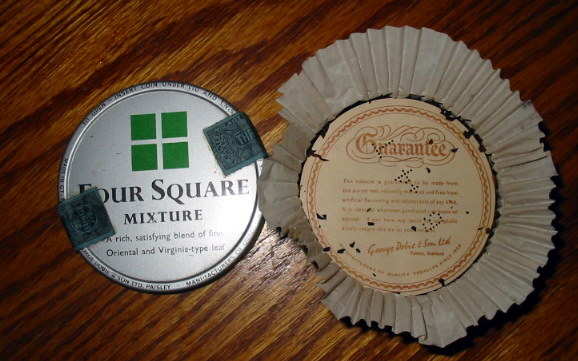
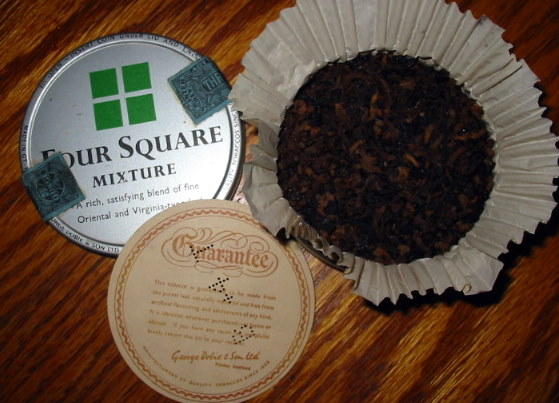


As I got closer I saw that it was a small round tin. It looked like the older 3/4 ounce tins that were available a long time ago. I could see that it was silver with some green squares. I moved the clutter away that made it hard to see and lifted the tin out to have a better look. It was clearly an old one. It had the label Dobies Four Square Mixture. It was full of tobacco and the seal and the tax stamp were still intact. I examined it carefully and found that there was no rust on the outside. The tobacco on the inside did not rattle around as I shook it. All of these are good signs when buying old tobacco. I then inspected the tobacco tax stamp and found that it was dated 1954! I could not believe my eyes. I took it to the counter and immediately added it to the haul and paid for it. I might have found my birthday tobacco to smoke in my 1954 pipe – I just needed to verify its age. I did a web search on the blend and on the importer that had its sticker on the back. The way the address and zip code were set up it pointed to a date of the 50’s. As best as I could determine I had a tin of tobacco from 1954!

The two major players were in place for the birthday celebration – a 1954 pipe and a 1954 tobacco. All that was left was for my 54th birthday to arrive, or so I thought. It was only a few months until my birthday. I had no idea of what lay ahead for me in the drama of my life. I had no clue as to how the third player in my celebration (me) was to be prepared.

In May of 2008 I was greeted at 2AM one morning with a crackling of fire and the flare of light that comes from flames illuminating my bedroom. I looked out the window to see the three houses next door to us on fire. I woke the kids and fled the house. And yes I left the Dunhill and the tobacco in the house. By 8am that morning we were back in the house and found that with all the soaking of fire hoses our basement had 3 inches of black water in it. Everything was in ruins. This time I dug out my favourite pipes and some tobacco to keep as I knew we were in for a long haul with restoration. I had the foresight to pick up the Dunhill and the Dobies Four Square Mixture. This would turn out to be a smart move in the long run.

In July my position at work was closed and I was declared redundant. I was out of work with our house being an unsellable mess. The restoration company was hard at work contacting contractors to do the restoration. I ended up being the general contractor for the repairs and was in charge of coordinating all of the trades. Those were hard days for me but my pipes helped lend moments of sanity to an otherwise insane time in my life. By the end of November we were allowed back into our basement and settled back into the routine of our lives. Only a few days before my 54th birthday we were able to finally get back to some sense of normalcy.

On December 7, 2008 – my 54th birthday I woke up early in morning and made a cup of strong Ethiopian coffee. I picked up one of my favourite books and settled on my front porch with the 54 Dunhill and the 54 Dobies in my 54 year old hands. The sun was shining and it was relatively warm in Vancouver – not something to be taken lightly in December. I popped the old tin of tobacco with a 1954 dime (I thought that would be a nice dramatic touch), removed the paper disc that was on top of the tobacco and which verbally guaranteed a great smoke or my money back and lifted the open tin to my nose. What an amazing aroma! The pungent smell of well aged Virginias and the tantalizing sourness of Orientals came together in what smell like a delightful mixture.
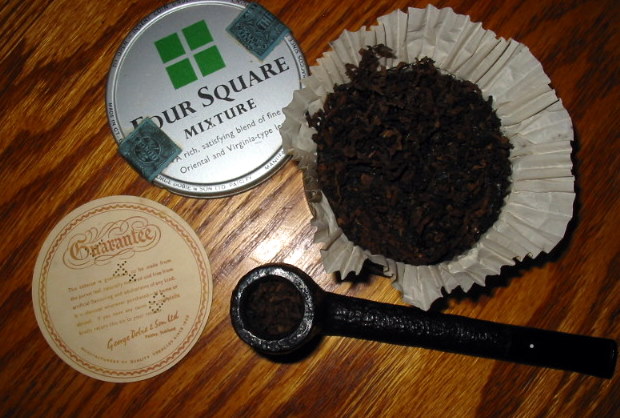
I pinched together a wad of tobacco and packed the pipe. I loaded it as I usually do and checked the draw to make sure it was the way I liked it. I used an old Zippo to light the pipe and drew the smoke into my mouth. Wow what a smoke! The alignment of 54s was complete! I had the 54 Dunhill loaded with a 54 Dobies tobacco and smoked in my 54 year old mouth. What a perfect way to begin the day of the celebration. What ever happened next would be bonus and I would end the day the way I began it – another bowl for this 54 year old in the old 54.
 

A Pipe Refurbishing Journal


I have worked out a process of refurbishing old pipes as a hobbyist that has worked for me with ongoing improvements and learning being added almost every pipe I work on. That is not to say that I am even a wannabe professional because I am not. For me it is a way of doing something that I find relaxing and rewarding as well as something that I can actually finish. With my work I am involved in ongoing dealings with people and issues that seem never to really come to closure so to take a pipe and bring it back to life and enjoy a good smoke in it is something I take great pleasure in. I thought I would write a bit about my process using and old pipe that came in the mail that I picked up off of ebay as an example.

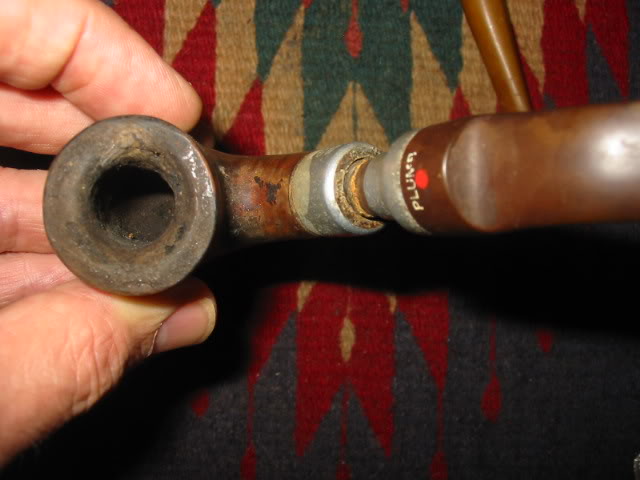
… I got home from Budapest, Hungary last week to find a package of pipes had arrived that I bought on EBay before I left. I opened the box to find a real mess waiting for me. The photos on eBay were not good and I was in no way prepared for what awaited when I opened the box. There were four pipes there – two Dr. Plumbs, a Stanwell with a broken tenon and a White Cliff meer-lined pear. The two Dr. Plumbs were what interested me in the lot and why I had initially bid. Dr. Plumb was an older second’s line of GBD and these two interested me. The first was a 9438 – GBD Rhodesian shape that I find is an all time favourite of mine. The second was a silver spigot Oom Paul – a shape that I have wanted to try for a long time.  I figured the Oom Paul would be one I kept – not sure of the others in the lot. The White Cliff and Stanwell went back in the box and I turned my attention first to the Oom Paul.

I took it out of the crumpled newspaper that wrapped it, being careful not to spill the ash and crumbling cake all over the place. It really was an ugly mess. I wanted to assess what needed to be done with it and whether it would be worth the effort. Sometimes even if it is really not worth it I will still clean it to practice methods and the use of new tools. This one was in desperate shape. The bowl was filled with crumbling cake and torn remnants of tobacco. The top was covered with a sticky and thick tar or lava that was about the thickness of a dime. The outside of the bowl had dark grime deeply embedded in the finish. It was muddy and dark enough that I could not see the grain at all. Now before you think it was an old patina finish – I assure that it was not. There was no way of even seeing the finish. It looked just like one of my dogs when he has been playing in the mud on a rainy day. I know somewhere underneath he has a black coat but it is not visible at all under the dirt and grime. This pipe was just unbelievably dirty.


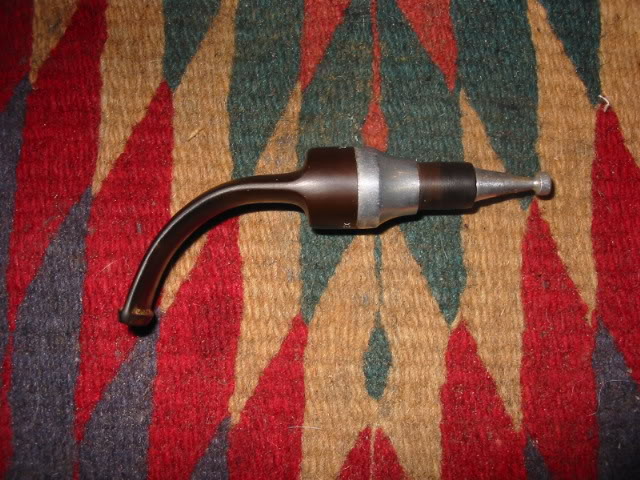
Working my way back along the shank of the pipe I came to the silver shank cap which was loose and very tarnished. It appeared to be sterling or at least silver plated under the tarnish. It had pulled away from the shank and was turned to one side. It appeared to have something engraved in it at about 1 o’clock but it was not clear under the tarnish and grime. The stem, a faux spigot, no long fit in the shank as it sat among the grime and crumbling build up of tars and a yellowish residue that erupted around the edges of the union of shank and stem. It was solidly embedded in this mess and was immoveable. The stem was an oxidized brown colour at the saddle and the curve. It had a silver cap at the end of the stem before it disappeared into the grime. That union of vulcanite and metal was a mottled edge of tarnish and grime. The button end of the stem was grimy and oxidized but it did not appear to have tooth marks or pits in it. It was merely encircled by that hard, white coloured material that can collect under a rubber bit protector. I moved to the lip of the pipe and looked at the slot. Unbelievable!! The airway was gone. The slot was filled and all that was left was a tiny hole the size of a pencil lead. The tar was erupting out of the slot and was a hard black semi circle that enclosed the button end.

I turned the pipe over in my hands to look at the underside of the bowl. I always like to check and see if I am going to be surprised by a burnout or a blackening spot that could signal an impending burnout. I scraped some of the grime off the bottom of the bowl and found a spot that appeared to be the size of a pencil eraser on the bottom. It was black but did not appear to be burned or soft in anyway. I used saliva to clean away the grime a bit for a better look at this spot. It cleaned up slowly and with a soft cloth and a bit of spit it showed that what I was dealing with was a repair in the bowl bottom – a plug of briar that had been inserted. It was a bit darker than the briar around it but it was a good solid repair and did not appear to be loose or damaged. That was a good sign.

I laid the old pipe down and gave it a good hard look. Would this be worth the effort or would I end up pitching it at some point in the cleaning process? That is always a question I ask before I get everything out to do the cleaning. I picked up and turned it over in my hands again. I checked it over one more time and figured I would start and see what happened in the process. I set up my desk top work bench with newspaper as a base and then laid out the tools of the craft! I put out a variety of reamers and brushes of different sizes. I put out the dental picks that I knew would be needed in the stem and the shank. I put out the pipe cleaners – bristle, thin and fuzzy, the alcohol and the alcohol bath that I keep handy for bowls that need a soak. I drizzled some clean alcohol around the shank stem union and with a bit of wiggling and more dripping the stem came free. I use an ear syringe for that part of the work as it allows me to control the placement of the alcohol.

I set the stem aside and turned my attention to the bowl. I wiped down the outside with a soft cloth and Murphy’s Oil Soap (undiluted) to get the grime off and get some idea of what was underneath the mess. It took several applications and wipes with the cloth to get through the grime. I also wiped it down with an alcohol wipe to get the last of it off. As I was planning on refinishing the pipe anyway I was not concerned with the finish. Underneath the grime the briar was actually quite nice – birdseye on one side and a variety of grains the rest of the way around the bowl. The shank was flame grain. It looked promising. I took a sanding block that is fine grit and sanded the top of the bowl to get the grime off. It was rock hard and since I was refinishing the pipe anyway it was the preferred method of removing the grime. Once that was done I reamed the inside of the bowl and the inside of the shank. I used my Senior Reamer to start with and then the T reamer with the four different cutting heads. The bowl was lined with a crumbling cake that needed to be taken back to the bare wood as it kept letting go and falling apart. Once it had been cleaned out I was able to inspect the bowl for cracks and burned out areas. Fortunately it was clean and uncracked.  The bottom of the bowl was below the airway so once it was cleaned I would need to use some pipe mud to build it up to the proper height.

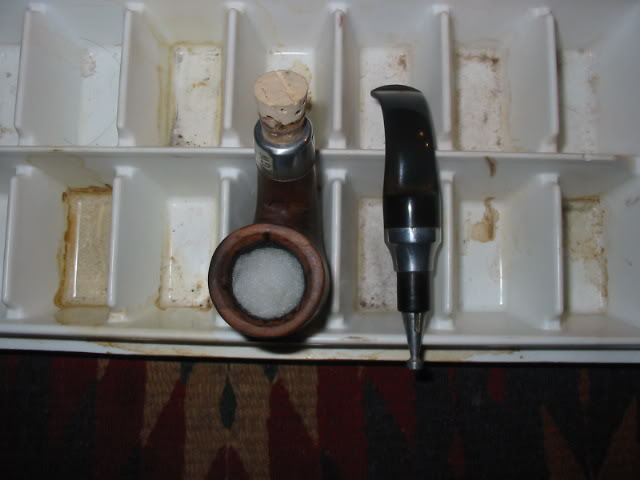
The shank was really a mess. I could not fit a standard pipe cleaner through it and had to use a dental pick to open it up. Because it is a full bent a drill bit was unworkable past about the middle of the shank. I have a dental pick that have I straightened out a bit and it worked like a champ. The pipe had a sump in it like the Peterson system pipes and it was absolutely jammed packed with tars. The stem would not even fit in the shank it was so full of junk. I used a small brass battery terminal brush to work over the inside of the shank and the sump area once I had opened it up. I blew air through to make sure it was open. I used pipe cleaners and q-tips to clean it up. I kept at it until the airway and shank were clean. Once I finished with the interior of the pipe I put the bowl in an alcohol bath over night. I have found that this takes off all the grime that is rubbed into the finish and any remaining interior grime.

While it soaked I turned my attention to the stem. I opened the airway in the stem with my dental pick from the button end. I was able to remove the stinger apparatus in the tenon and then began to work on the interior of the stem. The stem itself was a mess on the inside – a pipe cleaner would not fit through so again the dental pick did the trick. I opened it up a bit then used over a 100 pipe cleaners and a bunch of q-tips to clean out the gunk. I also used a bristle shank brush to loosen things up. Once I cleaned it with lots of alcohol and many cleaners the inside was clean. The outside needed lots of attention. The Dr. Plumb painted logo (not stamped at all just a surface paint) was sacrificed to cleanliness.  I sanded the stem with 1200 and 1500 grit sandpaper to get the brown out that even the buffer did not remove. After that was done I polished it on the buffer with red Tripoli and White Diamond. The stem was actually in very good shape once the grime and oxidation was removed. I cleaned the silver portion of the stem and the faux military mount with silver cleaner and then polished that and buffed it with a soft cloth. I also used steel wool on the stinger apparatus until the roughness and grime was gone from it and it shone. I inserted it back in the pipe for the first smoke to see if it would remain. The stem was in great shape and ready to be inserted in the shank of the pipe once it was done. It still needed to be buffed with Tripoli and White Diamond before a good coating of Carnuba was applied to keep the oxidation at bay.


I removed the bowl from the alcohol bath and found that bath had done its magic. All the grime was off and the finish as well. What remained was a soft reddish briar that was clean and smooth to the touch. After bowl dried I sanded it with 1500 and 1800 grit sandpaper, being careful of the stamping that showed up on the bottom of the shank once the grime was gone. I finished the sanding with micro mesh pads in 1800, 2400 and 4000 grit. The top had some minor burned areas and the bowl was out of round so I bevelled the bowl top into the bowl to take care of the unevenness. When I finished sanding it I washed the outside down with a damp alcohol soaked rag to remove any dust and show any scratches that needed a bit more attention. Once those were taken care of I filled the bowl with cotton boles and using the ear syringe filled the bowl and shank with clean alcohol to remove any ghosts and residual tars in the bowl. I let it sit over night while the leaching process did its work.


While bowl was undergoing that treatment I took silver polish and a soft cloth and worked on the stem metal work. For the stinger apparatus I used some 0000 steel wool to clean off the staining. I buffed the stem with Tripoli and white Diamond and laid it next to the bowl.

The next day I removed the cotton boles and let the bowl dry out. I opened a can of cherry stain that I use on these old timers that matches the original colour really well. I shook the alcohol based stain until it was well mixed and then using a soft rag and a folded pipe cleaner I applied it to the whole bowl. Once it was well coated in the stain I lit it on fire with a lighter to set the stain. Once that was done I set it aside to dry well.

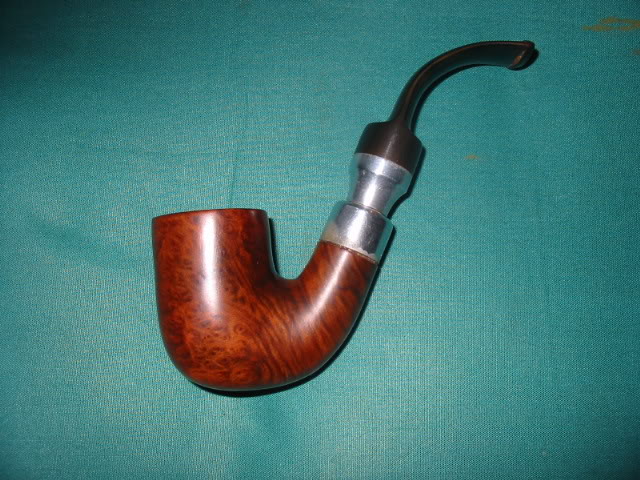
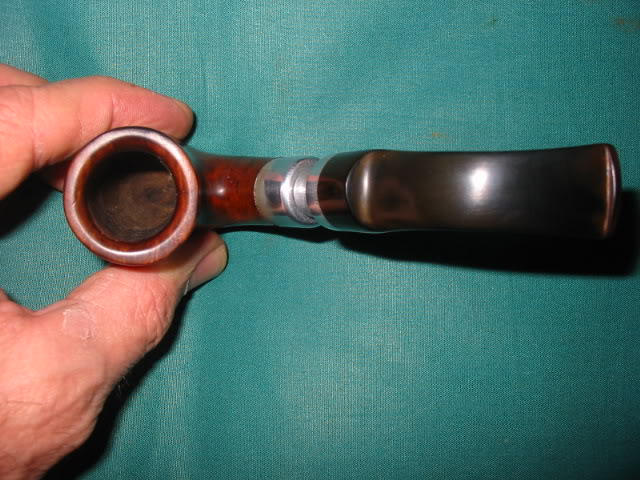
In the afternoon when the stain was dry I took it to the buffer and lightly buffed the stummel until it was smooth and shining. The finish looked really good. I gave it a good coat of wax and then polished the silver on the shank cap. I was able to turn the cap a slight bit and the initials that were engraved in it became visible – WGW. I took it back to the desk and inserted the mouth piece. It fit snugly into the shank and the look was as it should have been.


(In the last picture on the bottom right the plug in the bottom of the bowl is visible. I re-stained that area of the bowl and the plug is a little less visible.)

I then turned my attention to the inside of the bowl. I needed to raise the bottom of the bowl to meet the bottom of the draught hole and protect the plugged bottom of the bowl. I mixed a batch of pipe mud – cigar ash and water mixed to a pasty thick consistency and painted it with a folded pipe cleaner and packed it in place with a pipe tamper to raise the bottom of the bowl to the bottom of the airway. I let it dry for a day until it was hard and then prepared a bowl coating with activated charcoal and my secret ingredient and painted the inside of the bowl with it. I wanted this old timer to have a chance and with the cake gone I did not want to take a chance on burnout with it. I wanted it to have a fighting chance for a long life ahead. I set it aside to dry for two days and waited for the initial smoke once it was dry.

Two days went by and the bowl coating was dry and the mud was hard in the bottom of the bowl. I had packed the pipe in my brief case and took it to work with me for the ride home that evening. After work I packed the Dr. Plumb Oom Paul with Doc Piedmont and lit it with the Zippo. Wow what a clean, dry smoke. It was smooth and full of flavour. It is a great smoker and did not heat up at all during the smoke. I carefully knocked out the ash and inspected my bowl coating and the bottom of the bowl. It looked undisturbed and solid.

When I got home I removed the stinger that was in it to give it a go without the stinger to see what that does for it…my gut feel is that this pipe will be one of my go to pipes in the future.

A surprise gift awaited me at the door


I was just going through some files on my hard drive and came across this one and relived the event that I had written about. Do you ever have those moments when the event you are recalling comes alive again and you can see the people, hear the sounds and smell the scents yet again? That is what happened to me. I was up with my dogs early this morning as our alarm went off with a malfunction. Instead of going back to bed I decided to look over some older files and see what could be deleted. I came upon this one and just sat and relived the moment again. I remember very clearly getting a call from my daughter saying “Dad, Don dropped by a box for you. He says it is pipe tobacco that a friend gave him. Since he does not smoke a pipe he wanted you to have it.” Throughout the day I kept thinking about what could possibly be in that box. You will see why I wondered about it, beyond just curiosity when you read the rest of this tale. Here is what I wrote that afternoon when I got home and opened the box from Don.

…Over the past four years my family has been saving bottles for a homeless fellow who dumpster dives across from our house. He has an organized route through the lanes in our area searching for bottles. He pushes a grocery cart with his dog attached by a tether. He climbs into the rubbish bins and ferrets out empty returnables. He makes enough on them to provide for himself and his dog, Spaz, a little wiry terrier cross that looks a lot like Don. Over the years as I was walking by I would talk with Don. Over time we have become friends. He has been in our home for dinners on many occasions and a guest at Christmas, Thanksgiving and Easter. My wife will often make him a sack lunch and leave it on the step when we are not here. Don has become part of the family. He stops by almost weekly for a visit and a cup of tea or water. He brings his dog for a visit as well.

This morning he came by to deliver a package for me while I was at work. Some buddy of his was given a big express post package of pipe tobacco and he knew I smoked a pipe so he thought of me. My wife and girls called me to let me know. I spent the day wondering what he would have found. I also wondered about the reality of the story and if I was not just getting some of the fruit of his dumpster diving. The girls would not give me any hints other than it was a fairly large box. They certainly know how to wreck my concentration. When the day was over I packed my bag and headed home with expectation for what awaited me on the dining room table. What was it that Don brought me?

I got home and my wife and the girls were sitting on the porch with Don and Spaz. They were sipping tea and just visiting. Don had that twinkle in his eye that I had come to learn meant mischief and I really wondered what he had brought me. I grabbed a chair next to him on the porch and in front of it waiting for me just like a Christmas present on Christmas morning was a large box. It was a little worse for wear from the ride in his shopping cart. I fully expected it to be full of some tins of Amphora or something of a similar ilk. I opened the box and found a large bag inside. That bag was tied shut. I untied it and inside, double and triple bagged were these baccies. I was flabbergasted. I could tell by the look on Don’s face that he was enjoying my surprise and wonderment at his gift.

The Pease Classic Collection: (Sample 1 ounce bags)
Charing Cross
Abingdon
Blackpoint
Kennsington
Piccadilly
Stratford

The Pease Top 5 (Sample 1 ounce bags)
Barbary Coast
Haddos Delight
Cairo
Cumberland
Robusto

Aromatic sampler (1 ounce sample bags)
McClellands M55 Georgian Cream
Peter Stokkebye PS31 Optimum
Peter Stokkebye PS38 Highland Whiskey
Lane Hazelnut
McClellands 715 Raspberry and Cream

Dunhill (2 4 ounce Sample bags)
Dunhill A2000 Toasted Cavendish
Dunhill A3000 Black Cavendish

I opened my work bag and took out a pipe. I opened some Charing Cross and loaded the pipe. Don fired up a cigarette from his own makings and we sat and drank iced tea and enjoyed the beauty of the day. These were blends that I had not tried and were on the list to get. If I was to put together a list of baccies that I wanted to smoke it would have included many of these blends. I was grateful to my friend for this opportunity. I will never forget his kindness to me. One who had little in terms of the goods of this earth gifting me like this was incredibly moving. I just publicly want to acknowledge his gift to me! Thanks Don!

When I look back at that moment and the gift Don brought me I am still blown away by his generosity. Many of these tobaccos I had never had before. The Dunhill Tobaccos were ones that I was not familiar with and the aromatics were not ones I had tried before. The Pease samples were the first to go under the flame and I enjoyed them all. About a year ago now Don disappeared. I don’t know if he moved on or if he died. He struggled with major health issues and was literally wasting away. I will never forget him or his kindness to me. It was good to relive this moment today.

Why I Buy Old Estate Pipes


Blog by Steve Laug

For some the idea of putting someone else’s pipe in their mouth is repugnant and therefore something they would never do. For others the building of their own story around a specific pipe is what keeps them from buying previously owned pipes. For me both of those thoughts do not negate the pleasure I get from estate pipes.

I too enjoy buying a new pipe and then choosing the tobacco to christen it with as I work on my own story with this pipe. Though some do not like the process of breaking in a pipe, I find that I like the virgin first smoke in a new piece of briar. I love building the stories of when and how and with whom I smoked the pipe. I love thinking through why I purchased this one pipe and what it was that drew me to it. I enjoy the process of working with the carver or artisan as the pipe is born. The events and the place add dimensions to the smoke for me. It is not just a disconnected piece of wood for me. It comes dressed in a story.

The same can be said of an estate pipe. The reason I buy estates is not just for the good deal on old briar but because of the stories that are associated with them. As I smoke this pipe after it is cleaned the place and the time I found the old pipe is a part of the thinking in my mind. I remember what it was that drew me to it and where I was when I bought it. I remember who was with me and what we were doing. I always try to research as much information and the story attached to the pipe as I can. That information may be merely some data on a previous owner, or maybe just a time period. But sometimes I get the full blown story from the seller. I find out who used to own it and what they were like. I find out their tobacco likes and dislikes, not only form the story but from the ghosts in the old pipe. I can tell a lot about the pipe by the state it is in when I bought it. If it tarred and thickly caked and the stem is discoloured and has few bite marks I can see that the previous owner loved this pipe and obviously it smoked well enough to make them keep coming back to it. Often there is a bit of tobacco still in the bowl as if the person laid it down for a moment and never got back to it – kind of like I do sometimes when I get called away after just loading a pipe. There is much more that can be learned just by looking at the pipe as you handle it and clean it.

When I have exhausted the information that is available to me through the seller and through my observations I am still not finished with the story of the estate pipe in my hands. Then I use my imagination to help me put the pipe in its time and in the hands of the person who bought it. I picture their smoke as they pack the pipe with the chosen tobacco. I picture the setting of the smoke and even try to imagine what they were thinking when they chose the pipe for the first time in the shop. I know this is esoteric stuff but it is the stuff of a good story for me. It adds colour to the object in my hand. After all, this pipe comes to me with a history and to some degree I want to honour that history and enjoy it in the process.

To this data, real and imagined, this story I add my own new stories. I join a line of folks who have held this pipe and cherished it over the years. I know full well and appreciate that someone will follow me in that line and add their own stories to the ongoing life of this briar. As it has outlived its first owner I know it will outlive me. I wish at times that the old pipe could talk and tell me the stories it knows and holds. I wish it could speak of the quiet conversations with its previous owner. I wish that I could travel back and have a smoke with the previous owner and listen to their full stories. I wish also that I could jump ahead and give that info to the person who gets the pipe from me. All of that contributes to the joy of the old pipe for me. The hunt for the perfect estate pipe is good. The restoration and resurrection of old briar is good. The rekindling of fire to the tobacco in the old bowl is good. The patina and feel of old wood is good. But it is the story of the pipe, the mystery and the history that grabs me and keeps me on the hunt.

As I close these thoughts I want to use one of my finds, one of the old ones I got on the hunt. It is an Altesse Genuine Briar (with a real amber stem). I know the pipe comes from the era of the 30’s. It rests in a snake skin case that is in pretty good shape. The pipe bowl is out of round yet the overall care taken of this pipe speaks a wealth to me. Its previous owner loved this pipe. It is well smoked and well cared for. When I bought it from the antique dealer it still had a bowl load of tobacco in it. It was unsmoked tobacco so I imagine the owner loaded the bowl and somehow never got back to it. His heirs sold the pipe to a traveling antique dealer who sold it to the one I bought it from. Nowhere in the process did the bowl get dumped. It was hardened and dried out tobacco to be sure… but what must have happened to that old fellow who cherished this pipe that he did not light that bowl?? The thought of it makes me wonder. So when I cleaned it up and reloaded the bowl I raised it in his honour and said cheers old fellow. Here’s to the bowl you did not get to finish!! Enjoy the smell of your pipe as the smoke wafts your direction.

…. I know this sounds cheesy but hey… cheesy is my prerogative! Just an example of what draws me to preowned briar! Here’s to your pipes! Cheers

Journal of a Stem Patch


I had this old four hole stinger Kaywoodie Drinkless Canadian that came to me in great shape other than a fairly large bite through on the top of the stem. It was in great shape otherwise, barely smoked and very clean. No other tooth marks no dents, and no chatter – just the big old hole in the centre on the top of the stem. I thought I would take pics of the process I go through to patch it. So here it is from start to finish.

Step 1: I cleaned the hole and picked out any bits of stuff with a dental pick and wiped it down with an alcohol rag. Once it was dry, I put some soft wax on a finger nail file and inserted it in the button under the hole. The wax or grease keeps the glue from sticking to the file and permanently binding it to the stem. Here is a picture:


Step 2: I drip Super Glue on the hole and build up the edges a bit. This one is a large hole so I want to make sure that there are no bits that break free around the edges of the hole.


Step 3: The next two photos show the addition of vulcanite dust to the mix. I sanded down an old clean stem that was in my box and that I use for mixing with the glue on these larger holes. I had about a 1/2 teaspoon of dust. I dripped glue into the hole and then added the dust to the mix. After the dust I added a few drops more of glue and then dust again until the hole was filled with the vulcanite dust and glue mixture.


Step 4: I left it to dry for a half hour while I worked on another pipe that I was cleaning. Once it was dry, I removed the file and tested to make sure it was dry. I sanded the first bit with 220 grit sand paper and then a sanding block with medium grit. Here is the next shot.


Step 5: Once I had the majority of the patch smooth I moved on to 400 wet dry sandpaper to keep working at the patch and blending it into the stem.


Step 6: Once it was smooth to the touch I moved on to 600 wet dry and sanded some more in a vertical and a horizontal pattern with a small folded piece of sand paper as I worked to blend the patch.


Step 7: When it got to the point of blending that can be seen in the next photo I switched to the 1800 micromesh pads and used a spot of water on the patch to assist the blending with the pads.


Step 8: When it was smooth to touch I used the buffer and hit it with Tripoli and white diamond and then brought it back to the desk to use the 2400 and 4000 micromesh pads. Here is the finished product, waxed and ready to smoke.


A Pipeful of reflection


Yesterday I had an appointment with the old Doctor for some problems I am having with blood pressure. I have this inordinate white coat syndrome that sends my blood pressure soaring when I go to see him. So when I woke up and throughout the morning wait for the doc I was reflecting on all of the things I was “sure” he would tell me to give up in light of the impending visit. I don’t know about you, but when I am in those settings I always jump to the worst possible scenario and my mind works overtime on what is “certainly” going to happen. Not the best strategy for high blood pressure folks to be sure, but it is my way. After deleting wine and beer, red meat, adding more exercise, I was certain my pipes would have to go according to the new regimen he was going to give me. That caused me to pause and reflect for moment on my pipes and pipe smoking. I gave it some thought as to whether he would tell me to say good bye to this piece of my life in which I have come to take a lot of delight. As I thought about the possibility of quitting, I asked myself what my pipes and pipe smoking do for me. I mused for awhile and then I wrote this:

My racks of pipes are in the cabinet next to my desk in my study and a few on top of the desk and behind me. I can with a quick glance look at and enjoy them all. From my desk I can swivel my chair and look through my pipes for the one that is going to take the tobacco choice of the moment. It hit me that this for me is the point when the actual pleasure of a smoke begins. It doesn’t wait for the fire to hit the tobacco or the first puff. The entirety of the process is pleasurable and my particular restful time. The tactile experience of handling the pipes, moving through my racks and choosing just the one for the moment is a big part of the pleasure. Once the pipe is chosen I pick up a soft pipe cleaner, another tactile pleasure and run it through the stem and then place the stem between my teeth and blow any dust or fuzz from the bowl. The sounds of the air through the bowl, the slick feel of the stem, the smooth or rough or blast of the briar, all combine for a fine moment of quiet and pleasure. Often before I fill the pipe and put the match or lighter to it I just sit with the bowl in hand and reflect.

Then the tobacco of the moment is cracked open – the jar or the tin – I run the tobacco through my fingers and enjoy the feel of the flake or the ribbon or the cube cut as it drops between my fingers. As the tobacco is picked up there is a sweet aroma that slips into the room around my desk – the scent of fine Virginias, the aroma of a clean but smoked pipe. All of these combine in the moment before I pack the pipe. The tobacco goes into the bowl pinched between the fingers or rubbed out on a paper on the desk. The tobacco springs in the bowl, the feel of just the right pack, the quick flick of the flint on the steel or the match across the striker to get the light, the momentary spark and then the flame as it licks the tobacco and then the first puff of smoke. All these intersect with the just the right place to take my mind off of my troubles or my work and transport to a tranquil zone.

The amazing thing to me is that all of this occurs for me before the smoke begins to calm my soul. Before the bowl begins to warm to the touch as the fire in its belly consumes the tobacco the earnest smoke has begun. The rhythm of the puff and the exhalation of the smoke all build on the previous time to add to the pleasure of the restful thing we call pipe smoking. As the tobacco continues to burn and the smoke is blowing and snaking upward, the room fills with an aroma that surrounds the pipe and me. The aroma is sweet and satisfying. The cloud of smoke that fills the room adds to the mystique of the moment. I close my eyes and enjoy the quiet that this alone time brings to me. I guess at heart I am a solitary, an introvert and I need the retreat and the quiet to rejuvenate me in order to take on the rest of the day’s work.

The tamper and the lighter work together to bring the bowl to its maximum pack and burn. Just a bit of a tamp around the outer edge of the bowl, tilting the tamper just so to leave a crown in the center of the bowl, are part of the mystique of the smoke. Another light, with match or lighter, and the renewed cloud of smoke after the initial light has died down. The fiddling with the bowl to get it just so is part of the ritual for me that disengages my brain from all other concerns and sends me to a quiet spot. The tools of the piper are just as much a part of the ritual of the smoke as the pipe itself. It is no wonder that over the years I have collected an odd assortment of tampers, from the ordinary and utilitarian shape of the pipe nail to some beautiful sculpted tampers by a variety of tamper makers. For me the fussing with the pipe is all part of the process of the enjoyment.

When the smoke comes to an end, the pleasure continues for a bit. The taste of the tobacco is still on the lips and gums. The room note still lingers with memories of the taste in my mouth. The bowl of the pipe smells of it as well. The pipe itself is warm to the touch and worth a few minutes extra in the hand. The ash is tapped into the ash tray, or if I am on the porch into one of my plants. A pipe cleaner plunges into the bowl through the button and down the stem and shank and takes care of any ash or moisture in the airway. Folded in half it works well to swab out the bowl of any remaining ash or bits of tobacco. All of this ritual is still part of the pleasure. Once cleaned and wiped off the pipe is returned to the rack and I sit.

What is it about pipes and pipe smoking that relaxes me? The entirety of the ritual from the choice of pipe through the smoke itself and to the restoration of the pipe to its place on the rack is all part of the restfulness of the pipe to me. From start to finish and everything in between all are part of the pleasure.

Oh and the good news… the doc told me that he does not even consider me a smoker and that the pipe was not a problem for my BP… All my fretting was for nothing… or was it? At least I got to think about why I like my pipes! Now I am off to fire up another bowl, sip a good glass of red wine, and enjoy a good steak!

The Solitary Pipe Smoker


I know, a lot of pipe smokers love the comradeship of a gathering of pipe smokers who sit together and jaw away time as they chat about their hobby and the solve the crises of the world from the comfort of a wreath of smoke. But me, I need the quiet reflective time of being by myself. The rest of my life is full of people around me all the time making demands either implicitly or explicitly on my time and attention. I come home each evening tired of people and the demands of a day of work. To me at that moment the last thing I need is to sit and talk with anyone… pipe smoker or not. What I long for and seek is a quiet solace that is created by my pipe and a bit of time to disconnect from the day that has past.

I find a corner in the house, on the porch or under a tree in the yard whose only requirement is that it must be quiet – maybe the hum of passing traffic, maybe a dog barking or some other external noise that is non human is present as ambient noise, a white noise. That kind of noise is acceptable and a welcome addition to help quiet the noise in my head. In that quiet space I settle into a comfortable chair from which I can observe the life of the neighbourhood around me. The twittering of birds, the squabbles of the squirrels over the walnuts in my yard are a pleasant change. I take out a trusted and well broken in pipe and handle it carefully. I rub it down and feel the gentle curves and the variety of textures that make up stem and bowl. I sniff the warm memories of bowls that had been smoked in the past and just take time to savour the moment. Life is good. There is no rush to pack the bowl. No frantic need to get to the point. No sense of having to pack the bowl and smoke pressing upon me. I can move at my own pace in my own time with no one defining the time.

I take a deep breath and exhale slowly and just enjoy the pleasure of being for a moment. Far removed by time, space and mental thought from the demands of doing. I take out my pouch or tin of a good tobacco that I know will deliver a good smoke and begin the process. I remove a couple of flakes of sweet smelling Virginia and smell the sweet grassiness of the tobacco. I rub them out to the texture I love or I roll them into a ball in my palms and enjoy the feel of the tobacco as it is readied for packing. This ritual in itself is a moment of solitude that is hard to find in the norm of my life. Once the tobacco is just right I begin to load the bowl of my pipe. I want to make sure it is loaded just right, but I am not anal about it – that would wreck the moment. I take the tobacco and begin to tamp it into the bowl. I feel the springiness beneath my fingers and know from the years of the process that it is just right. I put the pipe in my mouth and feel the draw. While doing that I clean up the remnants of tobacco and roll the pouch or close the tin and set it aside. I sit like that for an immeasurable moment and just taste the tobacco – unlit in my pipe. There is freshness and expectancy in the taste. There is a promise of good flavour that will be released by fire. But I want to just take the time to enjoy the moment before striking the fire.

Then without knowing why, the moment of fire has arrived. I take my Zippo or a match – no reason for the choice, just what happens to be at hand. I circle the bowl with the flame drawing deeply on the pipe as the fire is drawn into the tobacco. I can feel the warmth in my mouth as it begins to catch fire. The tobacco begins to smoulder and the smoke curls out of the top of bowl and around the edges of my mouth. Ah the tastes and the sensations of that moment as the smoke rises from the bowl and I gaze at the world through the haze of a good smoke. I cannot quite explain the sensation of the moment for you – you just have to be there. There is no one talking. There is no demand on the time. There is no pressure to converse or respond to the need of another. There is no pressure from inside or outside to act. It is just the quiet moment of solitary time when my pipe delivers me to that place where I can be alone and unencumbered by anything or anyone. That is what I love about time with my pipe. It is time I cannot get in a group of pipe smokers. It is time I cannot get with another piper next to me. It is that sweet alone time that slows my life down and gives me renewed perspective to enter into the next moments of my life.

All too soon the embers smoulder out and the bowl is finished. The pipe is warm to the touch and the air around me is full of the smell of the smoke. Time begins to once again move forward. I can hear my wife and daughters moving around in the house working on dinner. I can hear their laughter and their bickering that is all a part of my life and I chuckle to myself. It is good! I can now fully enter into that piece of my life and be engaged with them. I have been able to lay aside the encumbrances of my day and become free to re-enter my family and enjoy them. Those private moments, those solitary times give me the space to disconnect from one moment and enter the next more fully. This is not to say I don’t enjoy the energy of a group of pipers together but it is these moments that energize me and keep me smoking my pipes. They have an uncanny ability to calm me and grant me serenity.

Re-staining Estate Pipes – A Pictorial Essay


Blog by Steve Laug

I am often asked by other hobbyist pipe refurbishers how I go about re-staining the pipes that I refurbish. I have answered the question in different ways over the years as I have worked out my own process. This past weekend I had some time and a box of pipes to work on so I decided to document the process I use. I took photos of four old pipes that I was reworking; these photos take you through my methods from start to finish. I have added written commentary to explain what I have done. The method I describe is how I work with estate bowls like these. I am certain that there are other methods that can be used with equal success. This is the one I have arrived at over the past ten years as I have been reworking estate pipes. I am sure that it will continue to evolve in the years ahead as it has over the past years. Here it is for your perusal and use. Feel free to use it, enjoy the process of rejuvenating the finish of an old pipe, adapt it and modify it as you will. Email your modifications and additions to the method to as we work to keep the fire alive in the home based pipe restoring hobby – slaug@uniserve.com.

I need to make a final confession before I jump ahead to describe and document the process. I totally forgot to take pictures of the state these old pipes were in when I received them. As is often the case for me, the cleaning process took on a life of its own and once it is moving along I find it hard to slow it down. So, with that out of the way, I begin with pictures of the pipes after I removed them from an hour soak in an alcohol bath.

Out of the alcohol bath
Once I have chosen the pipes to restore I remove the stems and place them in a soak of Oxyclean and water while I work on the bowls. I place the bowls in an alcohol bath. I use a plastic jar with a screw on lid to hold the 99% isopropyl alcohol for the bath. It is roughly a large mouthed quart sized jar and will hold four bowls. The size also allows me to reach in and retrieve them when they are finished. I reuse the alcohol in the bath for a long time. I find that it turns dark from the stains and the sediment settles to the bottom of the jar. I pour off the alcohol regularly and wash the jar so that there is no sediment remaining. I also top up the jar with fresh alcohol to keep the levels high enough to cover the bowls.

The first two pictures below show the four bowls after they have been removed from the bath and have been dried. (In each photo the bowls will be in the same order for ease of recognition.) Starting at the top left and working left to right you will see the effects of alcohol bath in removing finish. I have found that it does not remove all the stain but it removes the finish, waxes and oils that are over the stain. When the bowls are removed they have a flat finish look to them. The top left bowl has a slightly yellow stain once the varnish coat was removed. The top right bowl has a reddish stain that was also under a coat of varnish. The bottom left is a prehistoric GBD finish/sand blast with a dark red/brown stain. The pipe on the bottom right has a dark brown stain and had a coat of shellac or varnish over it. The varnish on the last pipe had turned milky white even before I put it in the bath and increased when I took it out of the alcohol bath. The fourth bowl will take the most work to remove the finish. All will need more hand work with an alcohol soaked soft cloth and a soft bristle tooth brush to remove the residual finish. The smooth bowls will be sanded and further cleaned.
restaining-1

restaining-2

Washed and sanded
The pictures below show the bowls after they have been washed in alcohol and sanded and rewashed and re-sanded repeatedly. The stain colour is removed as much as it will be at this point in the process. There is still a lot of work to do on each bowl before staining can be done. The top coat of varnish, wax and the grit and grime have all been removed at this point. From the pictures you can see that there is still some varnish on the bottom right pipe but the majority has been removed and the others are getting ready to go to the next step in the process. Once I finished this stage of sanding I washed them a final time with a tack (soft cotton material) cloth to remove dust and such and also let me see any remaining shiny spots on the finish.
restaining-3

restaining-4

Two of my favourite tools are shown in the following pictures (I use both constantly in the process of refurbishing and always have them near at hand) – a tooth brush and a dental pick. The dental pick allows me access to the rings on the bulldogs. I carefully use it to follow the rings around the bulldogs and clean out the grit that gets stuck in them. I follow that up with the tooth brush which allows me to rub the alcohol into the rings and to scrub other places in the blast on the prehistoric and stubborn shiny spots on the smooth pipes. They both are used in cleaning rims and the dental pick also precedes my pipe cleaners in the shank. I have straightened one end to make access to the shank easier. These pictures show the bowls after the third sanding and alcohol wash. I also sand the rims with 400, 600 and then finally with 1200 to remove any grit or rough spots on the finish. All the bowls have been sanded with 1200 grit sand paper. I sand them one more time with the 1200 grit sandpaper and then I use micromesh pads to get a good smooth surface on the bowl. If you choose to go for a scratch-free finish you can examine the bowls with a jewellers loop under a bright light and re-sand as necessary to remove any noted scratches. For the majority of the old timers that I refurbish, I sand until they are scratch free to the naked eye in a bright light. To my mind some of the deeper nicks and such lend character to the old pipe and contribute to the look of age. My main requirement is that they are smokeable when I am finished and that they look good for their age. Should you choose to go further with the finish the choice is yours as you re-work them.
restaining-5

restaining-6

The next picture shows the foursome after all the smooth pipe bowls and smooth rim on the sand blast have been sanded with 1800/2400/4000 micromesh pads. They are smooth to the touch and have a rich shine to them. This is a good time to give them an inspection for any marks or scratches that you want deal with further. After I inspect them this last time, I wipe them down with an alcohol damp cloth to get any residual grit or dust off the bowls and set them aside. The bowls are ready to be re-stained.
restaining-7

Re-staining the bowl
In preparation for staining each pipe bowl, I insert folded pipe cleaners in the shanks to enable me to manipulate them with ease while I am applying the stain. This gives me some flexibility in turning the bowl at different angles to apply the stain coat. You will note the Fiebing’s stain in the previous picture – that is the stain I use. It comes in a variety of colours and is an aniline (alcohol based) stain. It works extremely well on wood. All of these bowls were given a first coat of Fiebing’s Dark Brown stain applied heavily. While it is still wet I use a match to light the stain to set it in the grain. It does not light the bowl on fire at all but only burns off the alcohol in the stain coat. For these four bowls, I started with the blast and liberally applied the stain to the bowl. I start with the bowl held bottom up and let the stain flow toward the tops. I follow the flow of the stain to ensure that I have thoroughly and evenly covered the entire bowl surface. I finish the first coat using the dauber pictured in the lid below to stain the rim. I reapply the stain to make sure the coat is even and not streaked.
restaining-8

The picture below was taken after the second application and flaming of the stain. After the first coat of stain is dry to touch, I give each bowl a second coat of stain and set it aflame with a match or lighter. After flaming the stain the bowls are basically dry to the touch and I set them aside until they are thoroughly dry. (I often let the bowls sit over night to dry.) The next day (or later the same evening if I get impatient or curious) I take them to my buffers and see what they will look like with a light touch on the buffing wheel. I generally use the Tripoli buff with a light touch, though I have also used the White Diamond buff as well. For those who do not have a buffer I have also sanded the bowls at this point with 1200 grit sand paper or higher. If the stain is too dark to my liking I wipe the bowls with an alcohol damp cloth until I get the colour the way I want it on each pipe. That is one of the beauties of aniline stain! The briar in each pipe bowl will make them quite unique looking once the stain is buffed.
restaining-9

While the bowls are drying I turn to work on the stems. Throughout the process described above, the stems have been soaking in an OxyClean bath. I put a mixture of once scoop of OxyClean into a one quart plastic covered jar and mix it with hot tap water. I shake it until the powder is all dissolved and the liquid is a milky white. Then I place the stems in the bath to soak. Generally I soak them a minimum of two hours but often will leave them in the wash over night. They remain in the bath the entire time I am working on the bowls.

With this foursome I grew impatient and was curious to see the finished product once I buffed the stain off the bowls. The bowls were dry so I took them to the buffer. The following pictures show the bowls – stained, buffed and polished. At this point in the process, I still need to wax them with carnauba but the pictures give you the idea of what they look like. Each pipe bowl took the dark brown stain in its own way. To me one of the joys of the process is arriving at this step and seeing the freshly stained bowls. I love the contrasting colours and grain that comes through in the pipes.
restaining-10

restaining-11

restaining-12

restaining-13

The final pictures in this essay show the finished product using two of the pipes. I finished working on the stems while the stain was drying. They are both WDC pipes. The apple is an Aristocrat shape 11. The bulldog is a Royal Demuth shape 79. Both are screw mount stems with interesting diffusing apparatus in them.
restaining-15

restaining-14

Rustication – A Pictoral Essay


Over the years I have been developing a process for rusticating pipes. I have used it on old estates that I have been given or purchased where the finish did not work for me or it had too many fills or pits. The tools I use are pictured below. The one on the left is a variation of a tool that I made from plans on Tyler Lane’s Pipe making site. It is made of a piece of black 1 inch pipe. I packed it with galvanized nails and then a cap is put on the end of it. The cap is packed with steel wool to keep the nails from shifting. I plan to make another variation on this and use a T union that will serve as a handle. The current cap is hard on the palm of the hand as I twist it into the surface of the pipe. I also want to weld the nails in place to avoid any shifting of them as I use the tool. The second tool is a florist’s frog – it has a lead base with sharp spikes (watch your hands and fingers on this one) that is used in floral arrangements. I got this at an antique shop. I want to create a wooden handle for this one to give me a bit more distance from the surface of the briar when I am working it over the wood.

I start rusticating the briar with the large tool on the left and then finish with the smaller one on the right should I want to achieve a bit different pattern or rustication. Either individually or together they provide an interesting rustication. The larger tool does the gross work and the smaller one adds finesse to the rustication.

ImageImage 

For the sake of showing the process I have chosen the following old timer – a Dr. Plumb carved apple that had a finish that I did not like. It had a carved finish of lines around the bowl and then horizontally on the shank. The original pipe is pictured below in the first two pictures to give an idea of the original state of the pipe. I also include pictures of a Canadian that is riddled with fills. It smoked great but just looked awful in my opinion. I wanted to show pictures of both a previously carved finish and one with fills to show what I see as an improvement in both of these pipes after rustication. Each one has a slightly different rustication pattern to it as I was trying to achieve something different in each case. The pictures that follow will give you an idea of how the process works from start to finish. I conclude the essay with two added pipes that I rusticated to give a broad sampling of the finished look of my rustication method.

ImageImage 

To begin the process I want to work with clean pipes that do not have any finish on them other than the stain. I put the bowls in an alcohol bath for an hour to remove all the waxes, finishes and grime that is on the outside of the bowl. I also ream and clean the pipe as I will handle it pretty roughly as I rusticate it. I don’t want added grime on my work table and hands so for me a clean pipe is what I like to work with. On the Canadian I removed the band and set it aside so that it would not be damaged in the rustication process.

ImageImage 

For the purpose of this essay I will begin with the Dr. Plumb apple. I worked the rustication tool into the wood, twisting it back and forth until it had the rough look to it as can be seen below in the picture on the left. Once that was done I gave it a coat of black aniline stain. I find that the stain facilitates seeing any part of the wood that still needed to be worked or showed a pattern that was to uniform. I reworked the rustication with the larger tool to get it a bit more rough and random looking. Once I had the rustication the way I wanted it I stained the pipe a second time using a medium brown stain. This was to be the finish coat. I stained it, flamed it to set the stain, restained and set it a second time. The result was the matte finish pictured below on the right. In the light it showed some depth and variation in colour coming through from the earlier black stain that I put on after the first rustication. The third picture from taken from above shows the finished rustication before I buffed the stem and gave the entire pipe a light buff with white diamond.

ImageImageImage    


The next step is to take the pipe to my buffer. I buffed the stem with red Tripoli and then white diamond. I buffed the bowl with white diamond to knock off some of the rough edges and to soften the edges of the rustication a bit and polish the smooth areas to highlight them. From pictures below the effect of the buff can be seen. It helps to differentiate the smooth areas from the rusticated ones and give a nice contrast to the finished look. The smooth areas have been polished and have a sheen. The rough areas have a softer glow that highlights the depth of the rustication and the pebbled finish of the pipe. The tactile surface of the “new” pipe is pleasant to the hand. It also has a better look than the pipe that existed before with the carved finish.

ImageImageImageImage 


I have included the remaining pictures to show several other pipes that I have rusticated. These will give you an idea of the variety of finishes that can be achieved with the tools. It also shows a unique texture finish that I have developed that I like and repeat. The key here is to work the process repeatedly to develop your own distinctive look and feel. Rustication is an individual process as can be seen by the wide variety in rusticated pipes seen on the market. I continue to develop my method and try different patterns and also try to repeat the ones I like.

The first set of pictures show the finished Canadian that was pictured above before rustication. I used only the larger tool on this pipe. When I had finished rusticating it to my satisfaction I used a brass whitewall brush to smooth out the rustication. I took it to the buffer and used white diamond to soften and flatten out the roughness. I wanted to have a different look with this pipe which explains the process variations. I stained it with a medium brown aniline stain and was aiming for the look of old leather. The flaws and fills on this old Canadian are now hidden and a pipe that is much more pleasing to the eye is the result.

ImageImageImage Image


The second pipe is a John Bessai bent apple. I cannot find the pictures of the pipe before rustication but I remember it well. It had many fills and flaws in the wood and was a light tan colour. The pink putty fills stood out against this nice tan backdrop. They made me always bypass this pipe in my rotation. It smoked well but it was just ugly. I would pick it up and then put it down and take another one in hand. I was going to sell it but thought I would rusticate the bowl and see what it would look like. Again I was going for a leathery look. I used only the larger tool on this one as well. Once I finished the rustication I again used the brass whitewall brush to soften the rustication and buffed it with white diamond. The final rustication before staining looked much as it does in the finished pipe. The colour of the pipe is achieved by a combination of an oxblood undercoat stain and then a buff followed by a medium brown topcoat. I left the shank smooth with the stampings still visible. To me the much improved look draws me to it and the tactile nature of the pipe in hand is a bonus. As it heats up the feel is very pleasant.    

 ImageImage

The final pipe pictured below is one I carved. It was a kit I picked up from eBay. It was a small block and stem stamped Caveman pipes. I carved the shape I saw in the block. As I did, the flaws and sand pits became visible. It became clear that once more rustication was the solution yet again. I used the larger tool followed by the brass whitewall brush to soften the rustication and give the pipe my favourite old leather look. The first two pictures below show the unstained pipe after rustication. Note that I wrapped the shank with electrical tape at the stem/shank junction to protect the stem and to give a band of smooth briar. The third two pictures show the pipe after the undercoat of black stain. The final colour (seen in the last two pictures) was achieved by a combination of a black undercoat of aniline stain and a top coat of medium brown. I buffed between coats of stain. All of the above pipes were then polished with Halcyon wax and buffed with a flannel buff.

ImageImageImageImageImageImage 


The above process is demonstrated in the four pipes pictured. It is very simple. I stained each of the pipes before I rusticated them so that I could easily see where I was working. I used the larger rustication tool on all of the pipes. For the first one I used the second tool to change the rustication and then applied stain. In the last three I used a brass whitewall brush to soften the rustication and give it a leathery texture. Once I got the desire rustication I stained the pipe again for the finished colouring. The first was merely buffed with a soft touch on a white diamond buff. The remaining three were polished by hand with Halcyon wax and then buffed with a flannel buff to give it a polished look.

Give the process a try and see what you can come up with. It is a creative outlet and a means of exercising some creativity. Let us know what the finished product looks like.


The Pleasure of Playing with the Mud


One of my simple pleasures in an otherwise busy life is to refurbish pipes that I pick up on eBay and in different junk and thrift shops I frequent on my travels. As I refurbish and restore old pipes I enjoy a sense of fulfillment from not only bringing an old pipe back to life but in improving its smoke-ability. One of the tricks I have learned (I am sure I got it somewhere online) is that of raising the bottom of the bowl in a pipe that has been drilled too high. It is done with a concoction called pipe mud and given a bit of curing time can dry to a very hard surface that imparts no residual taste to my favourite tobaccos smoked in the “newly” reconditioned pipe.

Last weekend I had to mix up a batch of pipe mud to raise the floor on a pipe I was refurbishing. When I need to mix a batch of pipe mud it is a pleasure because it gives me an excuse to smoke a good cigar. Some of you don’t need an excuse to do so, but I do! My wife hates the smell of them and gives me grief over smoking them. She relegates me to the porch, which in the summer is a great place to relax and enjoy the parade of life that goes by on the sidewalk and street in front of my home. In the winter that is an altogether different matter as it is cold and damp here in Vancouver. So this excuse is a good one and works well for me. I look her straight in the eye and say, “I need to smoke it to make a batch of mud for my pipe”. Now, she likes the pipe (“likes” may be too strong a word to use but let’s just say she indulges me). So you can see the excuse works well.

I opened my humidor and looked through the cigars I have until one caught my fancy. This process is also part of the pleasure for me as I only smoke cigars that I like and none of the nasty ones that are so cheap here – Poms and Colts and the like. All of my cigars are Cubans (a perk of living in Canada and not having an embargo in place) so it is a process of finding one that I will be able to enjoy in the time I can stand being out in the cold on the porch. I picked out a nice little Romeo y Julietta and got out my punch, punched the end of the cigar and took an ash tray in which to collect the precious ash. I bundled up in my big coat, scarf and a toque (stocking cap for the non-Canadians among us) and went out on the front porch. I rolled the cigar under my nose and enjoyed the grassy smell of good tobacco. I double checked the punched hole in the end of the cigar to make sure it was perfect! Then I fired it up with my lighter. I rolled it as I lit it and drew the smoke into my mouth. I rolled it around to get the full taste of the tobacco. It had been awhile since I had a good cigar but this one quickly made me forget the damp cold of a rainy Wet Coast day in Vancouver. A good R&J cigar is a thing of wonder to me… the many dimensions to the flavour and the fullness of the taste that they deliver are excellent.

Throughout the smoke I collected the ash in my ashtray. I always make a bit of a game out of smoking my cigar and try to see how long I can keep the ash on the front before it falls off. I keep the ashtray in my lap just in case. I learned that from way to many ashes falling down the front of my coat or sweater. Besides I wanted to keep these ashes for their deeper and more “profound” purpose!

I sat and enjoyed a good cigar and the quiet afternoon with the steady drip of the rain and swish of cars going by on the street in front of the house. Too quickly the cigar was at its end and the time was over. What a great afternoon smoke and a restful break. Once the cigar was finished I use the remaining butt as food for my Rhododendrons. I crush it, break it up and sprinkle it on around the base with the remnants of coffee grounds that my Rhodies love. I carried the ash tray into the house and hung up my coat and scarf. The toque went back to its place in the secretary by the door. I kicked off my shoes and scooted into my slippers and carried the ash tray to my basement desk and work table.

I have a small cup of water at the desk and an ear syringe that gives me more control over the amount of water I add to the ashes. I want to add just enough to make a paste. I give it a few drops to start with and stir it up with a folded pipe cleaner. I continue to add water to the mixture until I get it to be the consistency that I want. One convenience of the mix is that if I add to much water I can leave it and the water will evaporate.

While the mix is sitting I prepare the pipe for the work. I remove the stem and insert a fluffy pipe cleaner into the shank with the end just extending into the bowl. I do not want to clog the airway with the mud when I put it in. This keeps that from happening. I folded a pipe cleaner in half to use as a brush to apply the mud to the bowl of the pipe. I usually put it into the bottom of the chamber and use a pipe nail to tamp it solidly in place. I fill the bottom until it is at the level I want. Tamping it down assures that I don’t get much shrinkage in the ash mixture as it dries out. I also apply the mud to the walls of the pipe where I see any cracks in the cake and around the air hole to make for a good clean entry way.

Once the mud has been applied the pipe goes into a stand to sit for two days. I want the mud to dry solidly and cure well. Once that is done I carefully load a bowl with a favourite tobacco and smoke it letting the heat do a final cure on the mud. When I am emptying the pipe I am careful. Generally I have found that after several smokes the mud is very solid and I can smoke it and clean the pipe as usual.

Hopefully by this point in this piece you can appreciate the pleasure of playing with pipe mud. I will talk with you later, right now I am going to go have a look on eBay and see if I can find a few more pipes to refurbish. In the lot of them I am sure that there will be at least one that needs a good application of pipe mud. Then I can enjoy another good cigar.