Category Archives: Pipe Related Essays

Short and not so short essays on pipes and tobacciana

Don’t Despise Me Because of What You See


I can see you looking down at me shaking your head and wondering why anyone would try to sell this piece of junk. You pick me up and turn me over in your hands. You shake your head when you see the cake so thick that you can barely squeeze your small finger let alone any more tobacco into my bowl, don’t misunderstand. You see the edges of my rim beat up from being knocked on my head to remove the dottle at the end of a smoke, don’t misunderstand. You see my finish worn and thin on the sides of the bowl and soiled with oil and grit, don’t misunderstand. You see the gap between my stem and my shank with the ooze bubbling out in the gap, please don’t misunderstand. You see the end of my stem chewed, gnawed and almost unrecognizable, don’t misunderstand.

You see, I know that you look at me and see the damage and wear on my person, but do not negate the value I have just because you cannot see through the grime and the damage. The value I have is irrespective of the appearance I have at this moment in time. I was the beloved pipe of my pipeman. In fact I was his only pipe for so many years. I think that as he grew older and I grew older he could not see or feel the subtle changes that were occurring in my person. I was like a worn shoe; I fit well in his hand and brought respite and comfort as the warmth radiated from the burning tobacco. I well remember his caress as he rubbed the sides of my bowl as he drew the smoke into his mouth. I remember the oils of his nose as he rubbed the warm bowl against his nose to oil my briar.

Yes, you see the damage and easily write me off as a pipe that has outlived its usefulness. As if, all that remained for me was the scrap heap or the fireplace. But don’t sell me short. I am not the abused waif of a careless piper who did not give a lick for his pipe. I am not a forgotten and despised pipe sitting discarded after hard use. No. I am the proud deliverer of many a grand smoke. I am the favourite pipe of the pipeman who called me his own. I have travelled with him around the globe on his business, providing him with repeatedly good smokes. You see, my state is not a reflection of neglect at all, but rather the reflection of love and affection. It is not a reflection of abuse but of jealous love.

I wish I could shout out to you to give me a chance. Clean out my bowl and shank. Polish my briar and replace my stem. Refurbish me and give me a new breath of life. I would tell you of the many good years that remain in my briar. I would speak of the fact that I will outlive you if you bring me back to life. I would deliver a well seasoned smoke from the first bowl you load and light. But alas, I cannot speak in words that most people can hear. Or maybe they are just deaf to my words or have not learned the language of the pipe. Yes that’s it. It is not my problem, as can you can no doubt see, I am not at a loss for words. It has to be the problem of the listener. Do you hear me as you hold me? Can you sense my presence?

Ah, I must be getting through to you. I see a change in your expression. The creases around your eyes and the upturned corners of your mouth show a different face than earlier looked down upon me. What is that you are doing? You twist off my stem and give my shank a look. You run your hands over the stem itself looking at the extent of the damage there and assessing what needs to be done. You hold me up to the light and look through the grease and grime at the briar of my sides and top. You nod as you look. You do hear me. You see the fine lines and the good grain. You see the rich colours under the grit. You look into my bowl and not only do you see the cake but you see the remnant of tobacco in the bottom of the bowl. You sniff the smell and the grin on your face spreads. You appreciate the tobacco smells that fill your nostrils. Oh my, will you rescue me and take me home? Will you restore me to my former state? Oh I do hope so.

What’s this? You don’t put me back on the shelf. You don’t set me down. You carry me to the front of the store and the antique dealer takes your payment for me. My, was the cost only $12? You must have some idea of what I originally cost. You just got a bargain my friend. I hear the seller ask if you would like to have me wrapped and put in a bag. I hear you say no. You would rather carry me out in your hand. I think this new relationship shows some promise. Now let’s get home and get to work on me. I can’t wait until I look like I used to and I am delivering a grand smoke to you my new friend.

Thank you for not despising me. Thank you for understanding that beneath the grime and age is a living pipe that has much life left in it. Thank you for knowing that with minimal effort, truly just minimal effort, I can be restored to a life of usefulness that will last longer than you do my friend. Ah, I can’t wait to show you what you have found.

Steve Laug 14 February 2014

When is a Pipe Not Worth Repairing?


This morning I am asking that question because sitting on my work table is an old Tinderbox Monza, made in Italy by Lorenzo. This old pipe has definitely seen better days. The bowl is over an inch in diameter and the cake in the bowl had choked it down to the point that I could not get my little finger in the bowl. The rim looked as if the pipe had been used as a hammer to the point that it had a chunk out the rear outside edge and a crack that went down the outside of the bowl with a visible fissure across the top of the rim and beginning to drop into the inner rim. The top half of the bowl looked like someone had carved at the cake with a knife and done a poor job of it. Fortunately the cake was as hard as rock so it did not do too much damage to the bowl. All of those issues are not enough for me to pitch a pipe and not work on it.

But the damage on this Monza did not stop there. The bottom of the bowl had been victimized by the self same knife wielder and he had carved over half of the bottom of the bowl away in his poor attempt at cake removal. The bottom of the bowl now flowed from the airway at a steep 30 degree angle with a jokerish gash along the front right bottom edge. At that point the bottom of the bowl is dangerously thin. You see the cake was all around the middle of the bowl like a girdle choking off the pipe but the top and bottom somehow had been miraculously purged of the cake by the knife wielding pipe abuser. This bottom of the bowl gives me pause – I could drill out the bottom of the bowl and insert a bowl plug or I could fill the bottom with a plaster of Paris fill to level it out and then coat the bottom with pipe mud. But would it be a waste of time? Would it be worth the effort?

I am not done enumerating the damage on this old pipe. The exterior of the bowl, the finish was ravaged. The front edge of the bowl was worn down like the heel on a hard playing boy’s pair of shoes. The angle and extent of the damage covered the entire front of the bowl. The striated finish, which was meant to look like tree bark was totally filled in with grit and grime to the point that it was almost smooth. It felt sticky to the touch and the smell was atrocious. I am surprised that my bride let me have it in the house. The striations on the shank were as filled in as those on the bowl so the true shape of the pipe and its finish were absolutely hidden.

But I am still not finished. The stem looked as if it was clean other than minimal oxidation… things were looking up. Maybe I would at least be able to cannibalize a stem out of this disaster. But no, it was not to be. I turned the stem over and it had a gaping hole – a chunk taken out of it that went back almost a half inch into the surface of the stem. The entire button was missing and the gap went from one side of the stem to the other – left to right. But that was not all of the damage to that poor stem – it looked as if the opening had been further opened with the self same knife. Yes the mad knife wielder had carved a slot into the airway at the bottom of the hole. The carving left the bottom of the airway paper thin. It looked as if after doing this “master” surgery the fellow had put a rubber bit protector on the stem as the calcification line on the stem was thick. Doing that after the surgery is like closing the door after the horses have left the barn!

All of these wonderful discoveries met my eye as I examined the pipe before I even considered working on it. I took the pipe apart at this point in my examination and put on the rubber gloves to probe the internals. I was pretty concerned at what would greet me when I took off the stem – if it would come off at all. With the goop that was all over this pipe it was a fair chance that the stem was “welded” in place. But to my great surprise it twisted off quite easily – no drama in this process. I peered down the shank with a penlight to see what creatures and mayhem awaited me inside the shank. I fully expected to see the interior carved by the knife wielder as he sought to make the pipe work “better” after his surgical excavations. But I literally had the wind knocked out of me when I saw a pristine shank. The shank was actually clean! The wood had a veritable glow to it as the light reflected back to me. It was not only clean but there were no tars and oils in it. This totally did not match what the condition of the bowl and externals had led me to expect. What an anomaly. Why was this so? What was going on here? These were just a few of the questions that ran through my mind as I held the bowl, sans stem in my hand.

With that discovery my thoughts regarding the fellow who had so drastically carved up this poor pipe and virtually ruined it took a turn. Rather than seeing him as some sadistically sick individual who took obvious evil delight in so ruining this old pipe to make it questionable if it could ever be restored; I began to soften in my assessment of him. I looked again at the externals of the pipe and stem. I looked at the carved and cracked bowl, the carved and ruined stem, the left over remnants of the rubber softie bit and I began to wonder if what was in my hands was the old pipe smoker’s favourite pipe. As it became harder and harder to smoke he took more drastic measures to make it last. Mind you they are not the same measures that you or I might take but they nonetheless obviously worked for him. Maybe rather than see the fellow as a pipe butcher I should see him as someone who loved this old pipe. He was going to smoke it until it truly gave up the ghost.

I began to wonder if he was not of the old school of pipe smokers who had one pipe and smoked it literally to death and threw it away and started on a new one. This one must have been a grand smoker to have been put through the trauma that it showed in it body. You can see now the tact that my mind was taking me. It would be inevitable that I clean up this old pipe – it would be an act of honouring the old briar and the old pipe smoker who had inflicted so much damage to just get the last bit of life out of his pipe. So it is with this in mind that I reamed the bowl, soaked it in an alcohol bath, scrubbed the finish with a wire brush and topped the bowl to begin the process of bringing it back to life. I have it sitting on my desk next to me now – I will need to fit a new stem on it and then refinish the bowl but it will once again deliver at least one smoke for me to explore my new theory.

So you might ask me, “When is a pipe not worth repairing?” I honestly don’t know the answer to that question. Even an hour ago I would have said this one was a goner. But now, I have “heard” the story of the pipe as I examined it looking at all of the abuse that had been inflicted on it. Now I see with different eyes. You see, that is the problem with pipe refurbishing. When others see a pipe as irreparable there is something that catches my eye that says to give it a try. I guess I have only met a very few pipes that were so damaged that they could not be brought back to life for a new season. And to be honest I still have several of them in my cupboard “seasoning”. I guess I truly don’t know the answer to the question I posed in the title.

James Upshall Bark (Unsmoked) Restoration


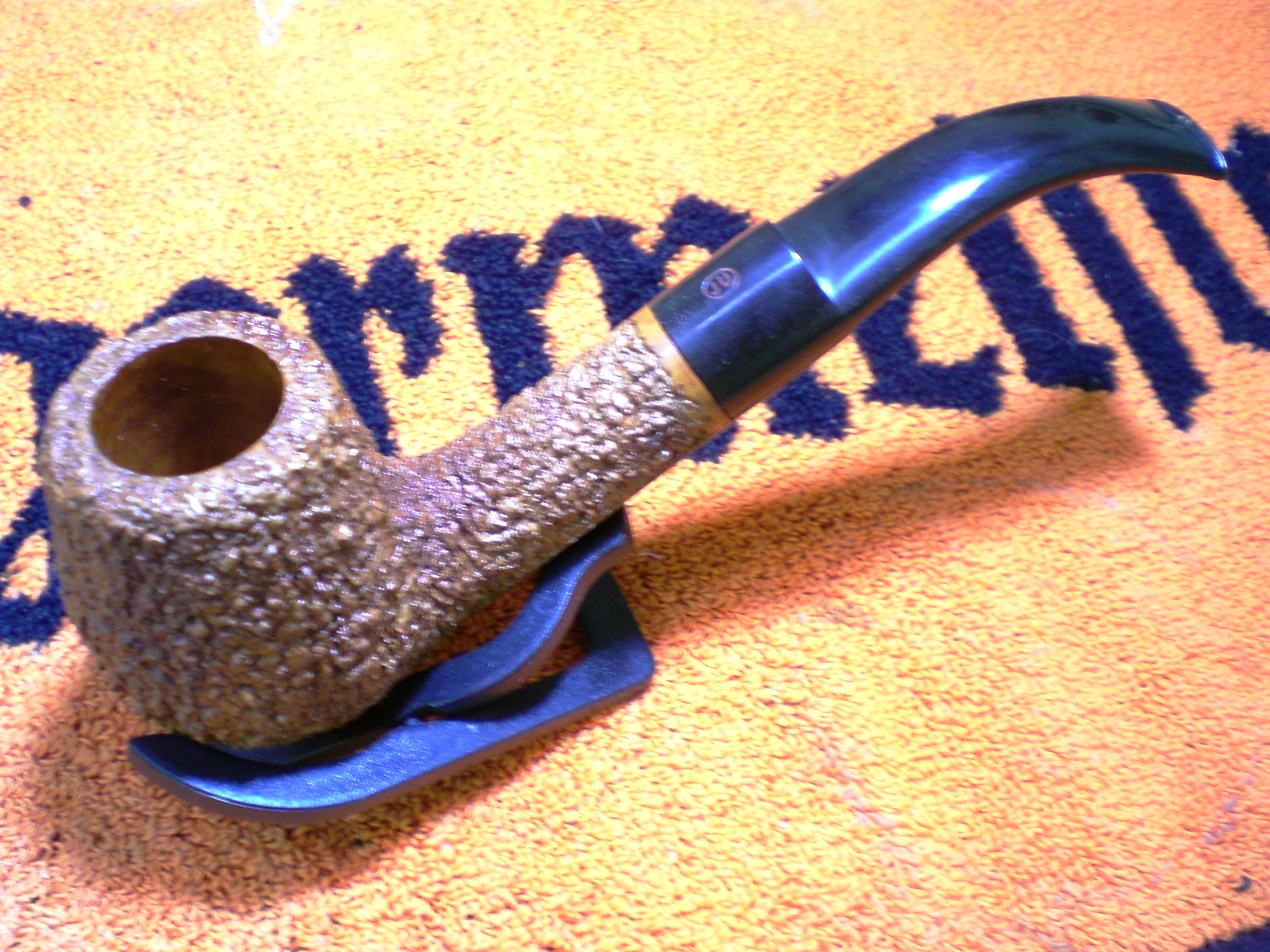
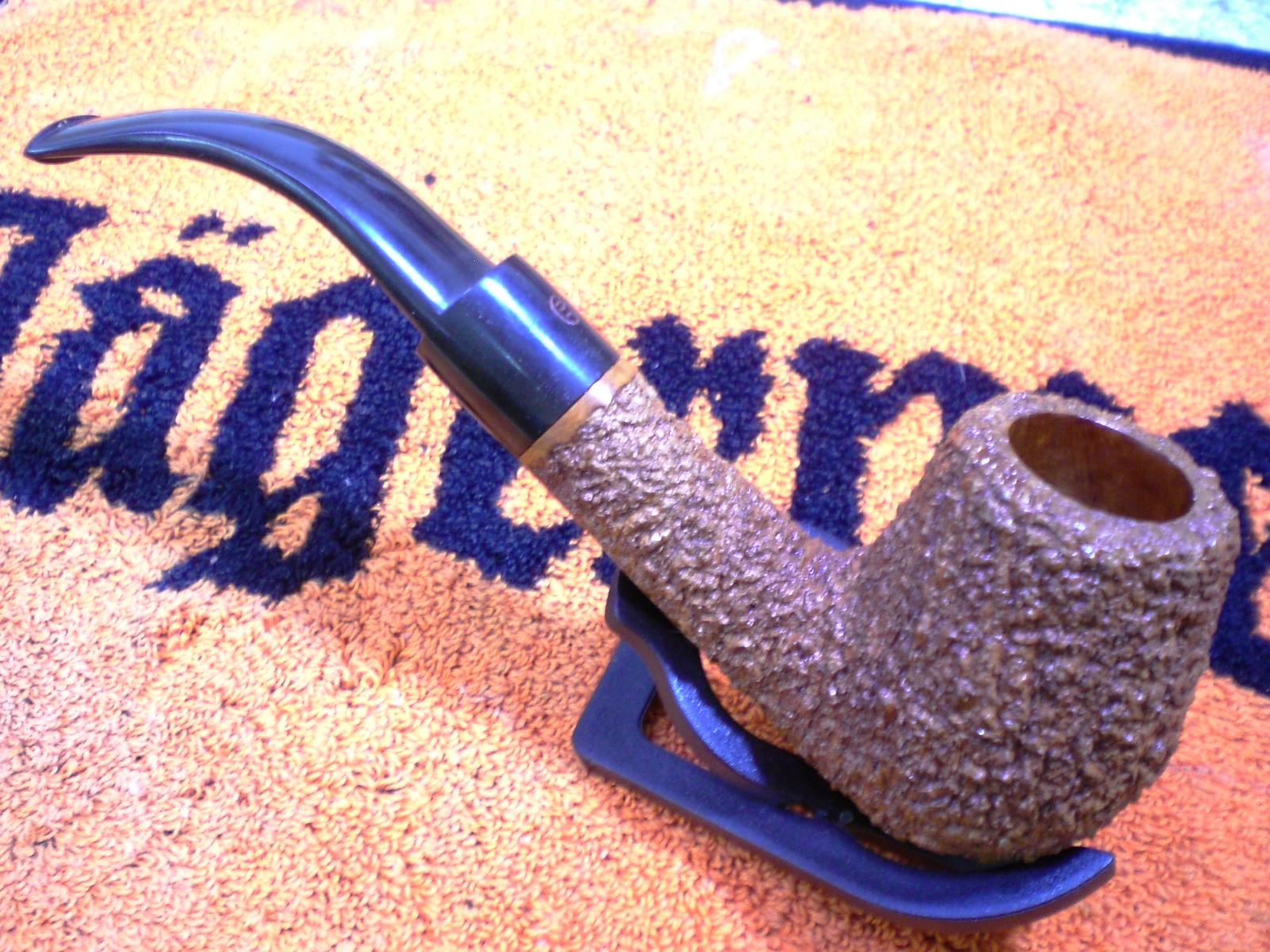
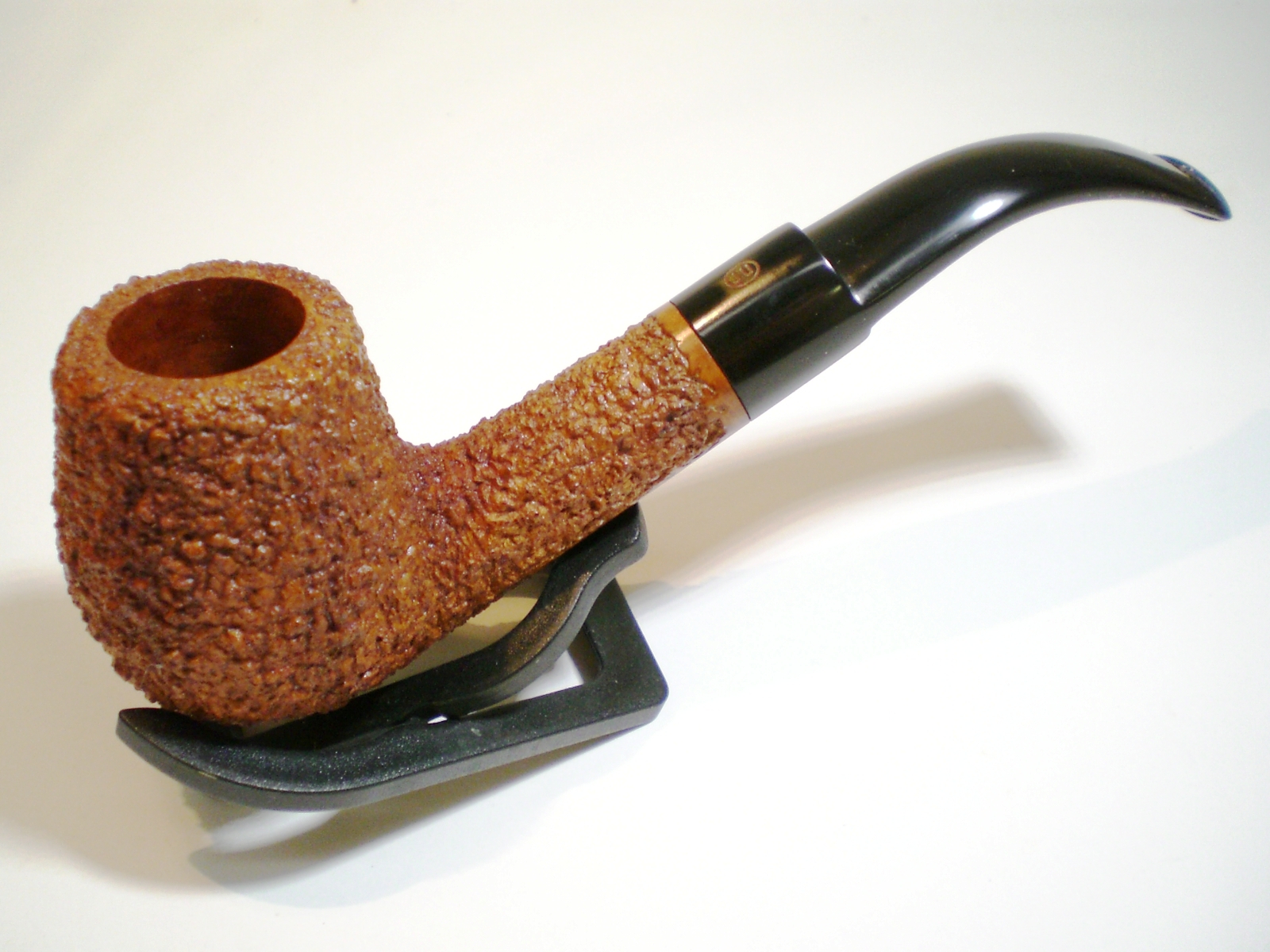
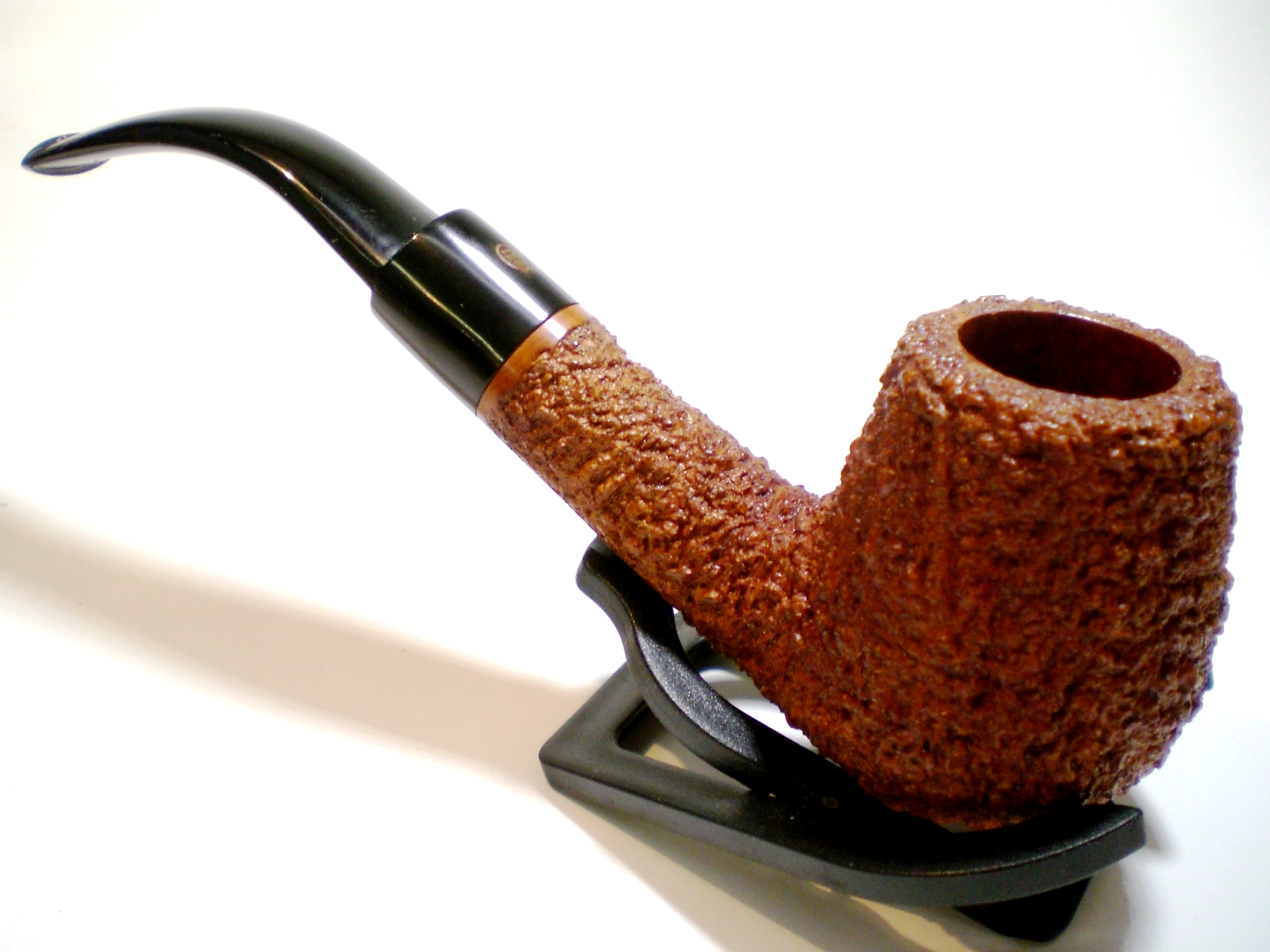
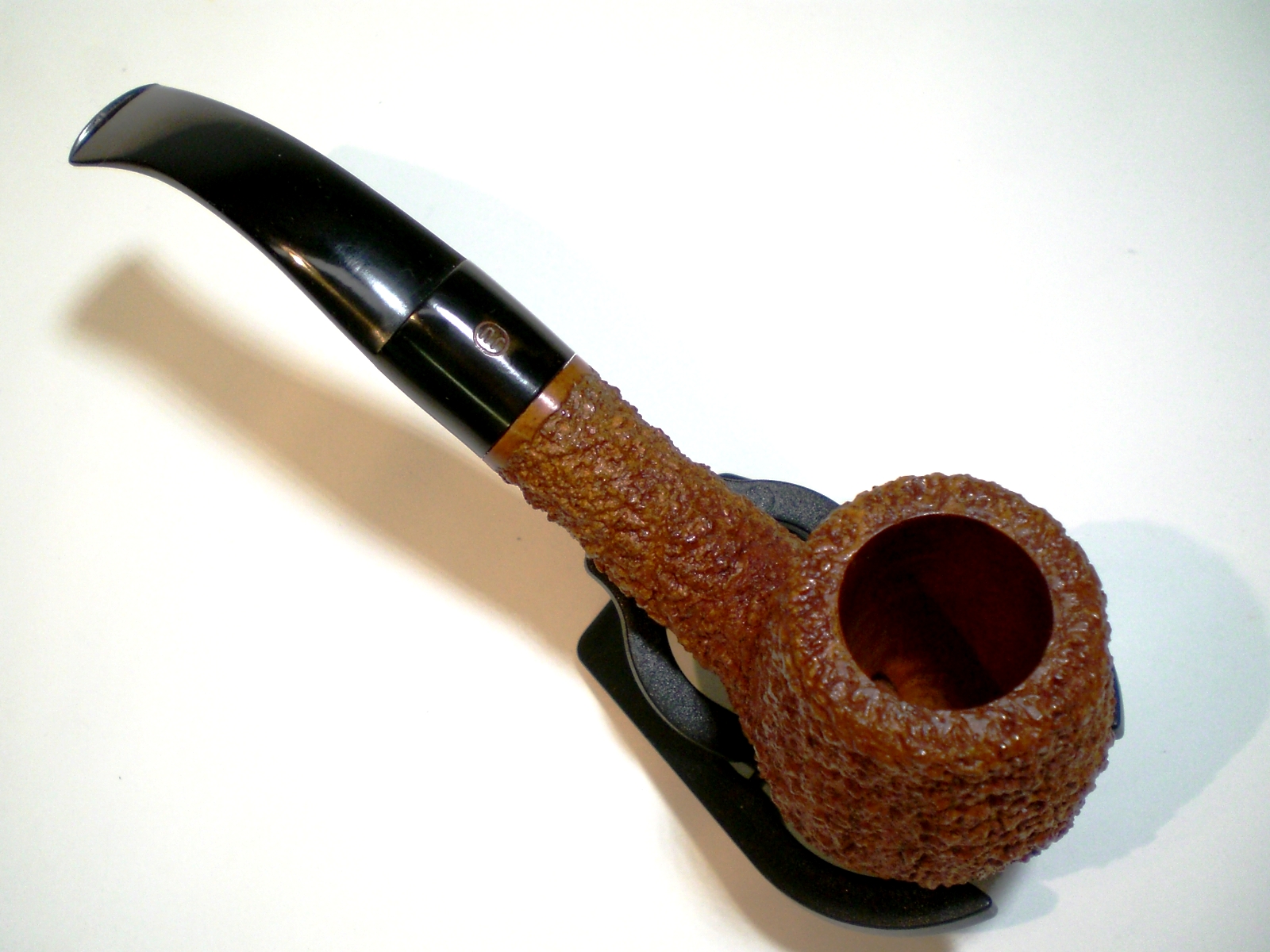
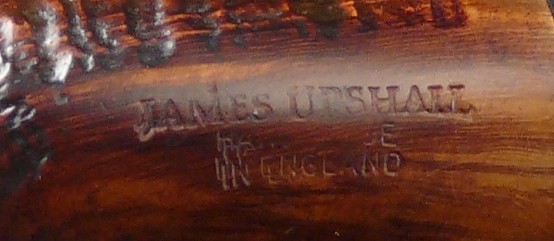
As my screen name for this blog implies, I’m a pretty big James Upshall fan. To this point, all of my Upshalls are smooth pipes of the various grades (P, S, B and ungraded). This pipe, my 8th Upshall, was advertised as “unsmoked”. The Ebay pictures were lousy, but the price was right and the seller took refunds, so I rolled the dice. I was pleasantly surprised with a beautiful Bark finish pipe and in perfect, unsmoked condition. Of course the stem was oxidized, which proved to be more stubborn than it appeared.

James_Upshall_Bark_Before (1)

James_Upshall_Bark_Before

James_Upshall_Bark_Before (3)

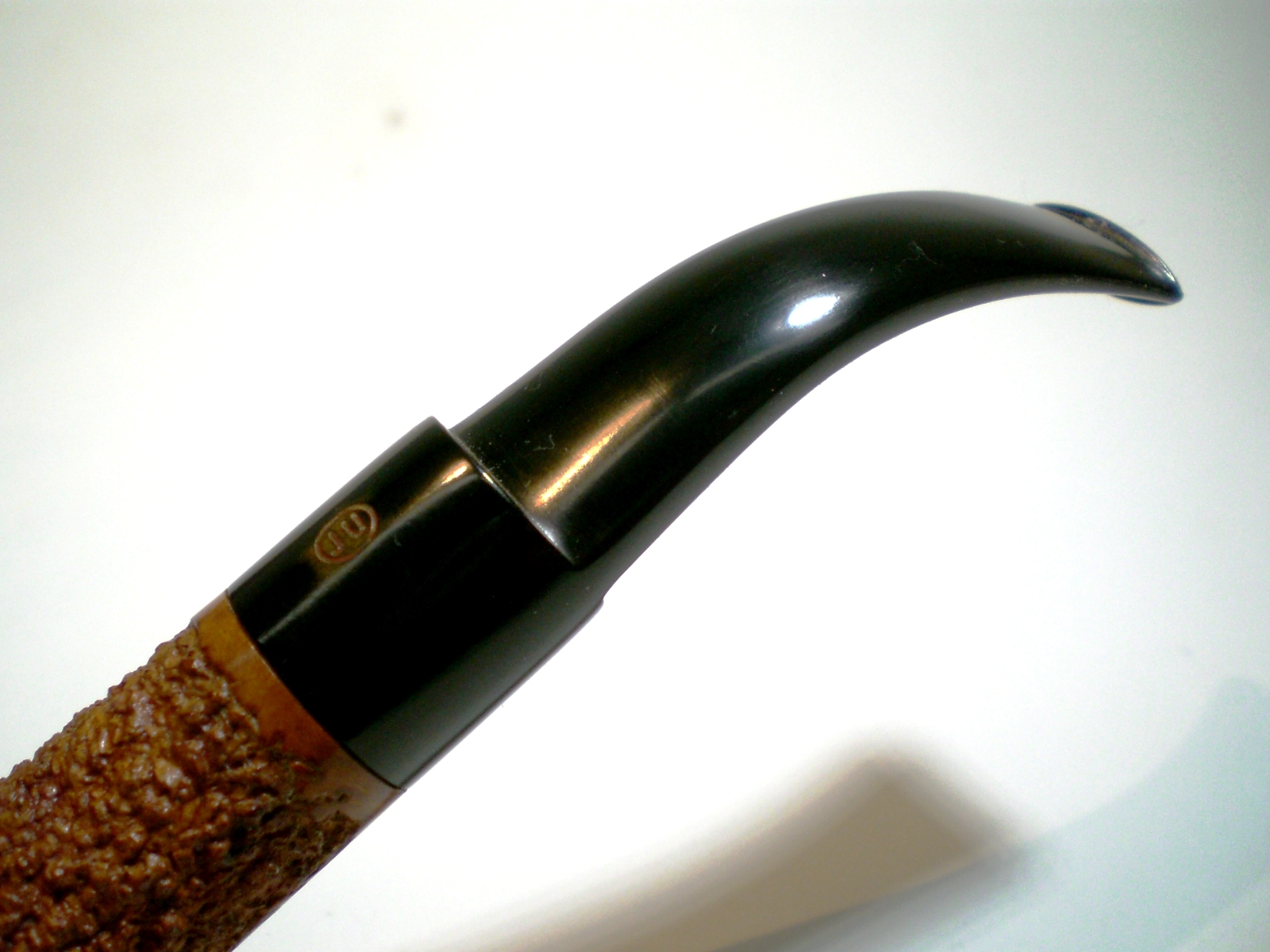
I didn’t want to soften or damage any of the stem edges on the saddle stem, so I started with a relatively fine, 2000 grit wet paper. I used a combination of popsicle stick and small, flat needle file to get the oxidation out of the creases. That took considerable effort, but I’m pleased with the results. I followed next with 8000 and 12000 grades of micromesh, also utilizing the sticks. Working around the small, stamped logo, was challenging. The stem was then buffed with white diamond and then plastic polish.

I worked in some Halycon II wax on the bowl, which was in mint condition. I used an old toothbrush to work the wax into the rough finish and then buffed it with a clean cloth.

I’m very excited to smoke this one, as it is my first unsmoked James Upshall. I’ve handled other Bark finish Upshalls in the past and some of the stem work was not to my liking. This one looks to have a good grade of vulacanite and has the feel I’m accustomed to on my polished Upshalls. The button is particularly appealing and has perfect mouth feel. I’m not a real clencher, so smaller profile buttons are to my liking. The Bark finish feels superb in my hand and it is a bit similar to the Sea Rock on my Castello. After the Rhodesian and Bulldog shapes, the classic Bent Billiard is next on my preferred shapes list.

I have several large Upshalls in my collection and I’m focusing on obtaining only smaller pipes now. Fortunately, this one isn’t too far out of my comfort zone at 60 grams. It is also about the same size as my Castello 4k pipe (also a bent billiard).

James_Upshall_Bark_Gallery (6)

James_Upshall_Bark_Gallery (1)

James_Upshall_Bark_Gallery (2)

James_Upshall_Bark_Gallery (3)

James_Upshall_Blasted - SAMPLE

The Pipe Hunt – Rule # 6: Never let them see your excitement


Growing up I remember a wrestling coach in high school giving us his wisdom regarding our opponents from a particularly tough school. “Never let them see you sweat” was his rule about setting a climate in which you could win over an opponent. For me Rule #6 is a variation on that adage. While a seller is not an opponent they are nonetheless your opposite in the purchase of a particular pipe. To put it simply Rule 6 is “Never let a seller see your excitement about what you have found”. I know this goes contrary to everything in me that wants to shout when I have found a super deal. When I turn over a pipe of a certain shape or colour, or move a pipe from underneath several others I can feel the adrenalin rise as my instinct about the pipe is met with an affirmative. It is at that moment that I hold back my exclamatory “yes” and carefully add the pipe to the lot I am carrying around the shop or have the seller carry it to the cash register to hold until I finish my hunt through the shop. I hold “yes” in and save the exulting until I am in the car or on the pipe forums!

Truthfully, this rule should probably be moved somewhere toward the top of the list of things I keep in mind when on a pipe hunt, because it has become a part of me on the hunt. I am quiet as I move through the store with the clerk as they unlock the cabinets that hold the pipes that I want to see. To help tame my enthusiasm I pick up pipes from the pipes on display that I have no intention of purchasing and “carefully” look them over and make quiet comments. Finally when I have gone through the lot I pick up the object/s of my attention and make a few general comments about the condition. Typically the clerk then carries it to the front for me and I am free to keep looking for more pipes. Though sometimes I carry the new find around the shop with me while I look at other pipes.

Even at the cash register I do not let on about my excitement over a find. I keep up the banter if I am in the mood or just quietly pay the bill and leave the shop. I have found that most sellers in shops or antique malls have no idea regarding the value of their old pipes and rather see them as stage props – hence a high price, or as dirty items that have a minimal value – hence a low price. The only time I talk about the prices is if the prices are outlandish. For instance recently I was in a Northern Alberta town here in Canada and the owner was selling a relatively new Grabow with a chewed stem for $120. I showed her on my phone what a new cost and she shrugged and said that in her town the local theatre guild and actors pay the prices she has for these items to use in their plays. Needless to say I kept my coin in my pocket and shook my head as I walked away.

I am looking for seller who sees the pipes they have as old and dirty items that they hope will sell but are not holding their breath over. I have found some great deals this way. I will give three examples from different times and years of my pipe hunting to illustrate the point. I found a nice mid 50’s Dunhill Shell billiard at a local thrift shop for $12. The sticker covered the white dot on the stem but the shape and blast caught my eye.
DunhillBilliard

I found a small group 2 sized saddle billiard Dunhill Tanshell from the 60’s for under $20 in an antique mall in the US. It was hidden in a box of old junk pipes in a far corner of the shop. It was not locked in a cupboard but rather in an old porcelain jar with the stems inserted in the jar and the bowls sticking out the top. The blast on the pipe caught my eye so I pulled it out of the jar for a better look and found that I was holding a Dunhill.
Tanshell001

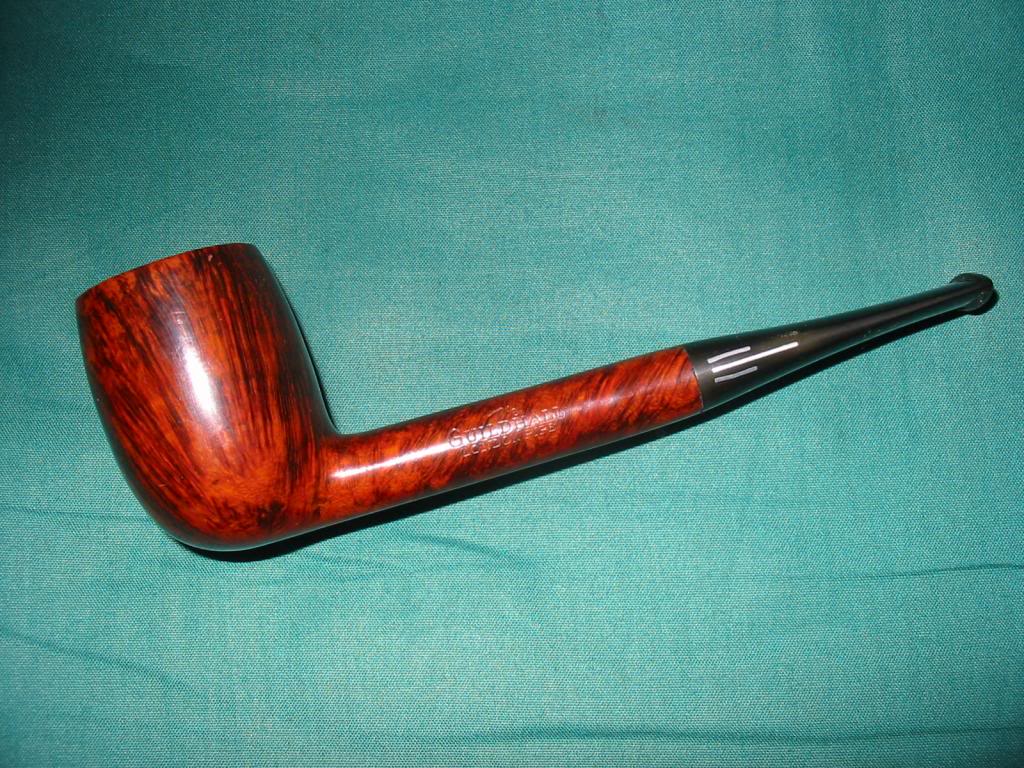
More recently I came across a beautiful Comoy’s Gulidhall Liverpool for $30 in a shop in the Edmonton. It was on a shelf with other old beat up pipes and ratty pipe bags, broken pipe racks and old tins. It was toward the back of the shelf but the grain on this pipe caught my eye and it came with me the rest of the hunt in that shop.
IMG_0778

The trick to this rule is to look and when you see them either pick them up and carry them with you or if the case is locked, note the case number and get the dealer to take them out of the case for you to examine. If the dealer unlocks the case for you then they typically want to carry them to the front for you. Play it cool with this and say that you will continue walk about the shop to look and “think” about your purchase.

You might wonder about the necessity of this rule but I can tell you it is critical in working deals and ongoing future deals with sellers. They key is to know that when you walk away happy with your amazing find, that they also are more than happy to have rid themselves of what they see as an eyesore. I have watched the price change drastically when a seller picks up on my excitement about the great price on a particular pipe. They read my reaction and I have seen the prices both escalate and de-escalate based on my response. I have had them decide quickly to not sell the pipe and when I came back at a later date the price was pushed through the roof and no longer something I would buy. I have also had them immediately back peddle and raise the price while I was standing there with excuses of mismarked prices or mistaken identification. It is critical to play your cards close to your chest when working a deal on these pipes. The words of a Kenny Rogers song, the Gambler hold true here; “You have to know when to hold ‘em and know when to fold ‘em.”

I have learned the lessons of this rule the hard way. It is very difficult to contain my excitement when I find highly valuable, collectible pipe. It is hard to not get worked up with the joy of the find. But I have found that if I do not let the cat out of the bag while I am looking the seller will let go of it at a bargain price of even less than it is marked or at the very least will not jack up the price so that next time you pass through the pipes are marked double and triple the price you paid for the first one. This rule is well worth remembering and practicing as you work the hunt.

Good hunting!

Pipe Time: A discourse on pipe smoking & the question of time – Eric Boehm


I want to take this time to thank Eric Boehm for his contributions to the rebornpipes blog. I am posting this contemplative piece written by Eric some time ago for your reading pleasure. It is great to have some of the pieces that Eric has written available for each of us to read and enjoy. Thanks again Eric.

time-warp I’ve often wondered what makes pipe smoking special. Why writers, thinkers, contemplatives and philosophers advocated so strongly for the pipe. Was it simply Lady Nicotine calling or was there something deeper in the act of smoking a pipe?

Physicists tell us that the fourth dimension (after the three coordinate spatial dimensions of x, y & z) is time. Man’s preoccupation with time is all-consuming and dominates center stage of the human experience. Work, money, science, religion, war – indeed, human history itself – all share time as the central paradigm. Einstein and modern physics are obsessed with time. Time cognition or time awareness in humans therefore is central to the human condition. Therefore, any substance or human activity that alters our perception of time is of great interest. In my opinion, the ability to alter the perceived rate of time as experienced by pipe smokers is perhaps the true gift given from the New World Amerindian to the Old World European.

The consumption of tobacco in a pipe, being a protracted affair, forces you to stop normal activities related to work and play. And during this temporary cessation of daily activity, one is afforded the opportunity to look towards the horizon, ponder, and think on the larger picture. In this sense, protracted tobacco consumption in a pipe allows one to slow down – to cheat time in a sense.

This ability to slow time perception also is related to life span, I believe. In that animals and plants with longer life spans grow slower. If we measure animal life span by heartbeats, we realize that both the elephant and the mouse have the same number of heartbeats – about a billion and a half. It’s just that there is a greater interval of time between the beats in an elephant (28 beats/min.) with a corresponding lengthening of its life span as compared to the mouse (500/min.).
Doctors tell us a slower resting heart rate is the key to a longer life. It’s counter-intuitive that exercise which temporarily elevates the heart rate, in fact helps to lower the overall heart rate when the body is at rest, between exercise events, thus extending life. Of course time doesn’t really stop in the objective sense because of tobacco. But to the pipe smoker it seems to, in the subjective sense. And perhaps that’s all that really matters.

Doctors tell us anything that increases the distance between heart beats – anything that slows down the resting heart rate – lengthens life. Maybe when Ponce de León was searching for the Fountain of Youth in Florida in the early 1500s, he didn’t realize he had the gift of life in hand already. It was called tobacco. The Indians smoking on the sidelines already knew this.

Pipe smoking eases you into the present moment – savor your pipe & you’ll savor your life.

A Review – A Cody Huey Moustache Man Pipe Tamper


Blog by Steve Laug

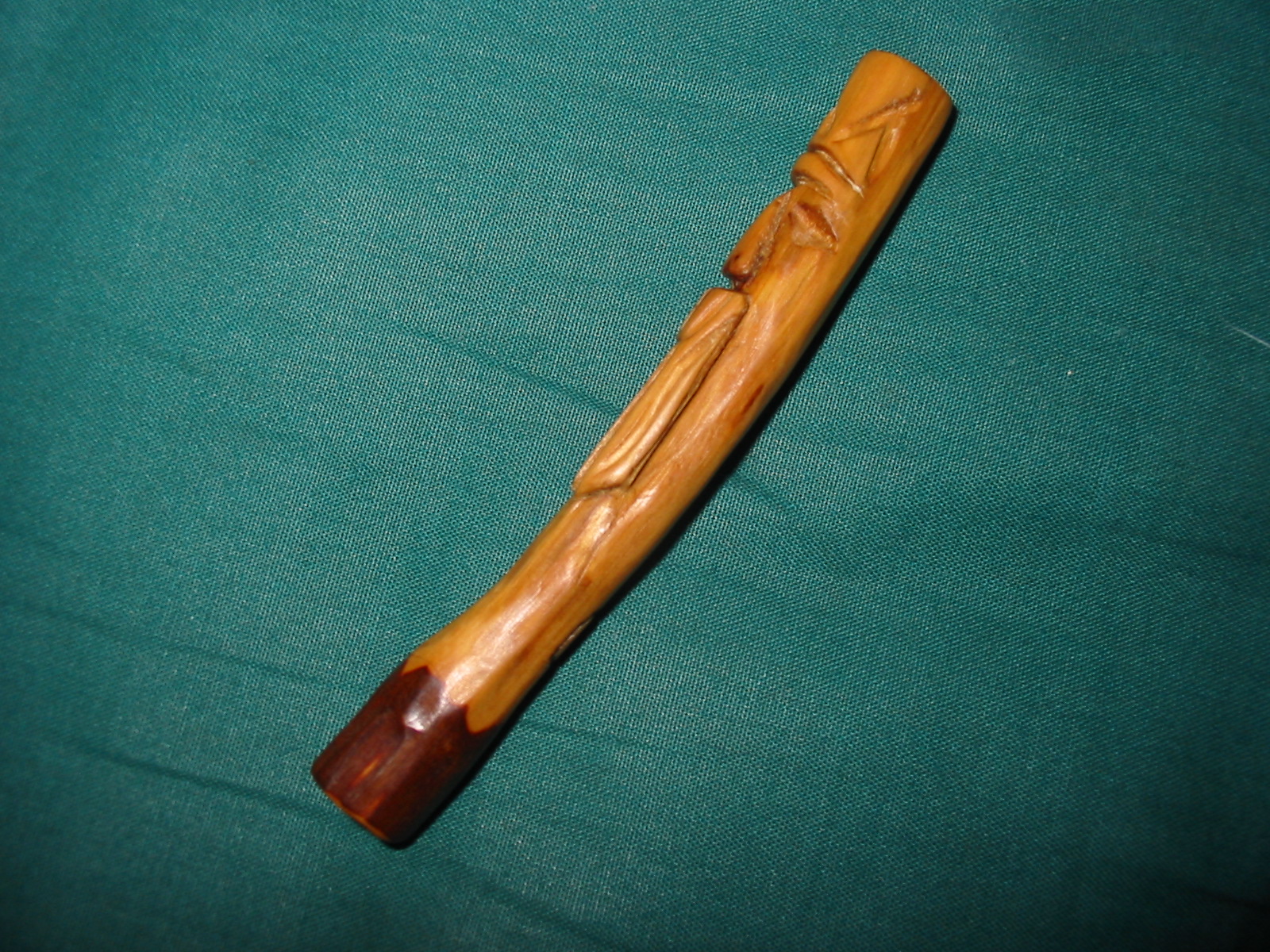
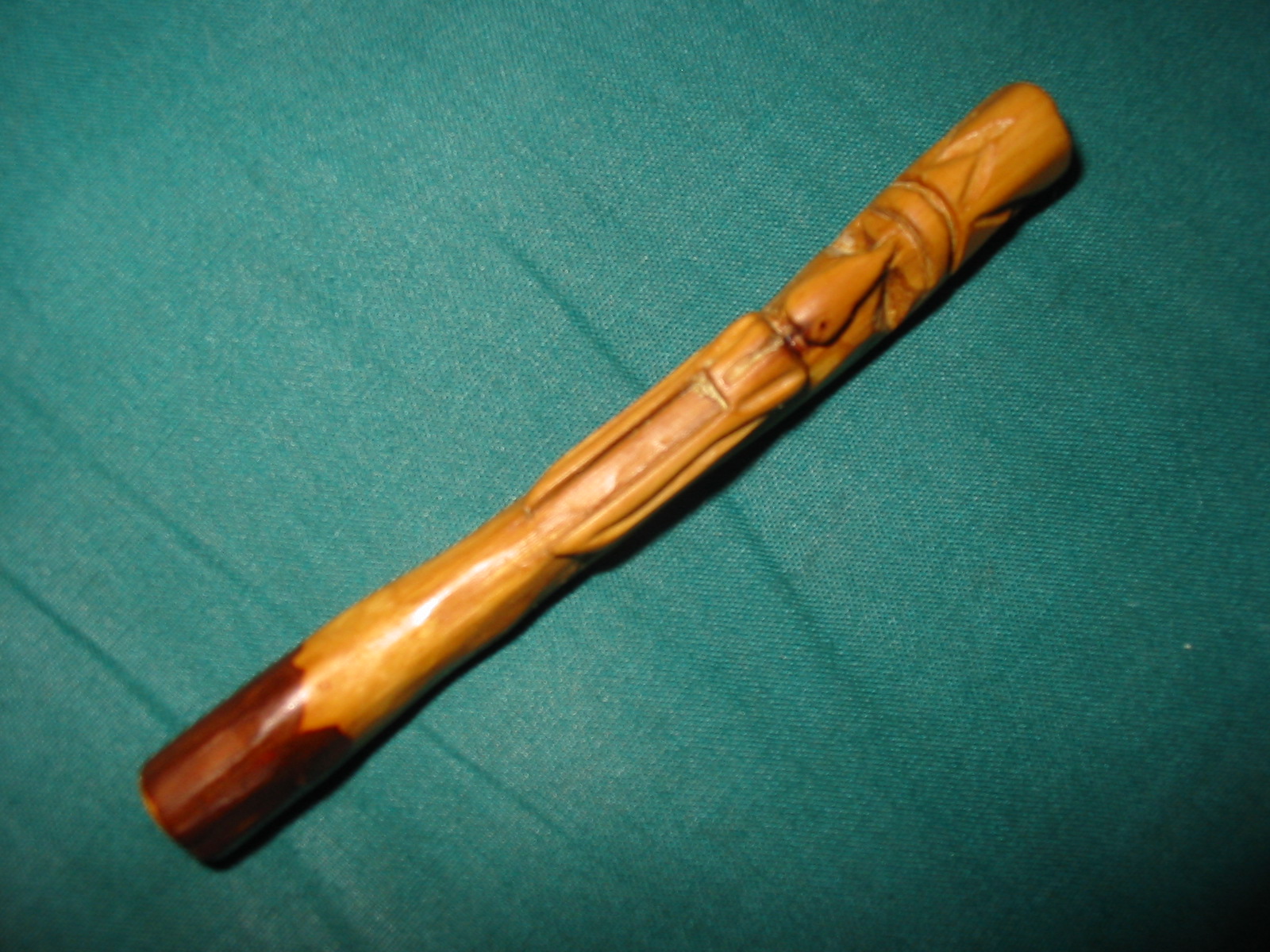
A few days ago during my lunch break I was glancing through my twitter feeds and came across a tweet by Cody Huey showing some tampers that he had carved that looked a lot like Tiki carvings. I was intrigued with his work and had not heard of him before so I tweeted him and asked the cost. He responded quickly with gracious thanks and sent me a link to his website and store. I scrolled through his tampers that were up for sale and placed an order for a new tamper. Here is a link to his website if you are interested in his work http://codyhuey.com/

tamper1

I am always interested in learning about the artisan that I am buying from so I read through his website with interest. I spent some time on the page where he wrote about his carving and his life. The part where he wrote about the connection to his granddad and his carving was fascinating to me. It seemed like he was truly continuing the family tradition. I have included his words and a picture of the two of them from his site below to give you an idea of the carver.

20130326-101255

“I started carving right after hurricane Ike. We were without power for 14 days so I had to find something to keep me occupied. I would carve fish, shamrocks, and hearts. My grandfather was a avid wood worker. I can remember him making me rubber band guns and yo-yos when I was just a youngster. He was always cutting pieces of wood and making beautiful things out of it. He made shelves, stools, and things like that. I was working on a Texas Star for him just before he passed away. After his passing I put it down for a couple of years. I have now finished it and it is in my shop. The mustache men came from me wanting to carve something a little more detailed. At the same time I was just getting back into pipe smoking and found that the faces I was carving fit perfectly into my pipe as a tamper. After talking to my dad and showing him some of my work he said that I have the talent of my grandfather but with a lot more creativity. I really enjoy carving because it is a way for me to relax and still feel somewhat connected to my PaPa.”

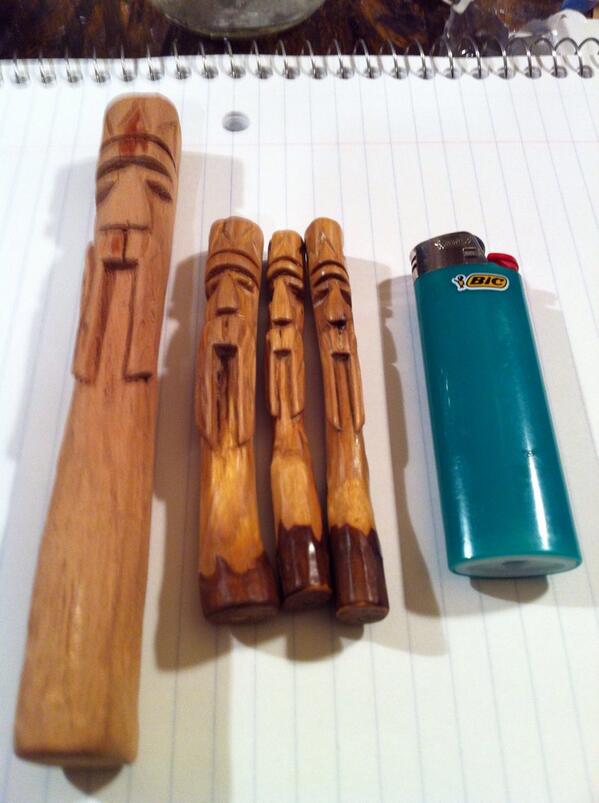
The picture below is one I copied from Twitter. It shows some of the tampers that he has carved – his daughter calls them the moustache men. There is a rustic and interesting quality to each of them that makes them unique.
tampers

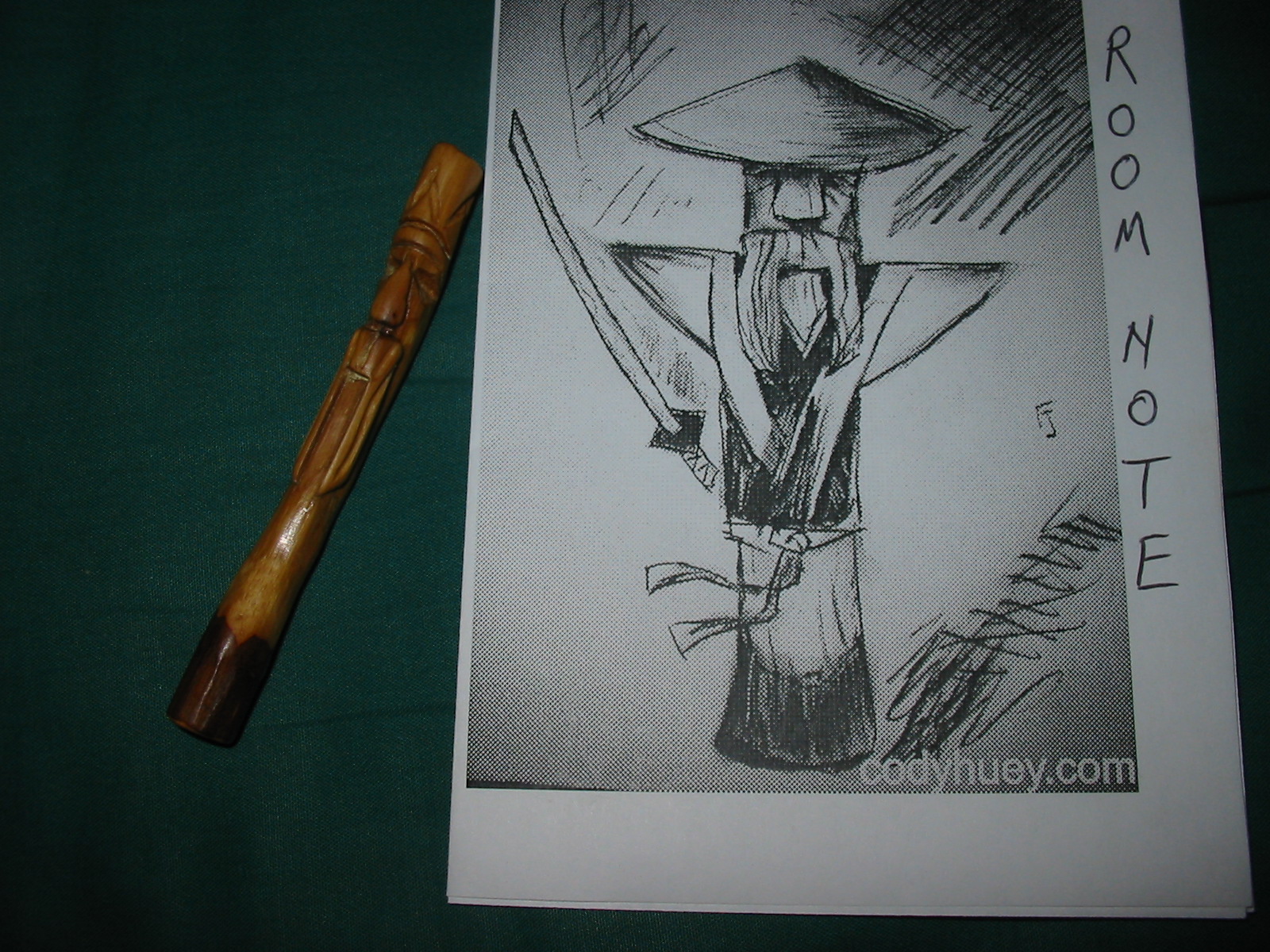
My tamper arrived yesterday and I have to say Cody packs a great package. He included a note card with a sketch of a Samurai tamper! It is very unique looking. He also included a handful of Werther’s Original Coffee flavoured toffees. He had no idea that those are one of my favourites. I then removed the well wrapped tamper to see which one he had sent me. I peeled off the wrapping and it revealed that he had sent the tamper on the far right in the above photo.
IMG_2682

Through Twitter I asked him to include some information regarding the wood he used in these tampers. Cody sent along the following information. “Each tamper is hand carved out of Pecan trimmings. Each one is a little different depending on how the Pecan limb is. They are carved, lightly oiled and buffed with carnauba wax.”

I could not be happier with my tamper. It fits well in my hand. The wood is gently curved with a slight notch below the moustache that fits perfectly against my finger when I holding it to tamp my pipe. The carving is well executed and is kind Cody’s take on Tiki carvings. The tamper is cleaned of the bark and then carved. The majority of the tamper is the clean yellowish wood that has been smoothed after carving. Cody left the layer under the bark on the last ¾ inches or so of the tamper at the bottom edge. It thus has the dark colour in the area that will spend its time in the bowl of my pipe. I think this is an ingenious idea as on my other wooden tampers this part darkens quickly due to the ash and tars of the burning tobacco.
IMG_2684

IMG_2683

Those who read this review have a look at Cody’s site and join me in enjoying these uniquely carved tampers. I know that you will not be disappointed.

Thank you Cody for a well made tamper with individualized and unique carving, nicely done! Your craftsmanship is evident in the finished product. Thank you for the nicely done finish on the piece and the well packed shipping. It came promptly through the mails without any problems. The card and the candies was a nice touch. I will enjoy this tamper for a long time to come. Glad to have been your first international order.

A Book Review – The Pipeman’s Companion by Ogden’s of Liverpool


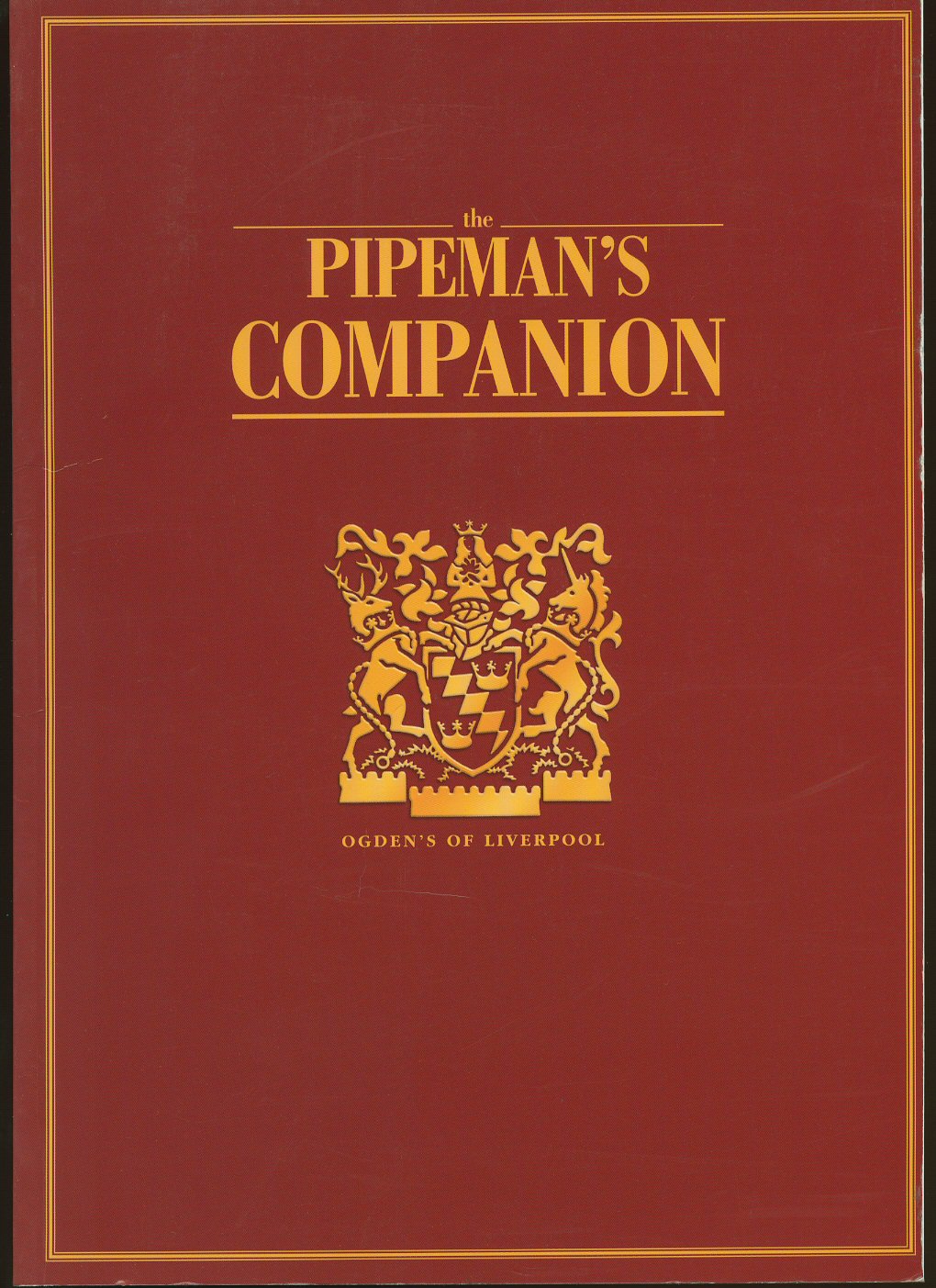
74522My copy of this book was published by Interfocus Publishing, Bristol, England. It is marked a First Edition and dated 2000. The cover of this of my edition is seen to the left and is the publisher’s original illustrated card wrap cover [softback]. It contains 59 printed pages of text with colour illustrations and photographs throughout.

On the inside cover there is a dedication that reads: To Pipe Men Everywhere from Ogden’s of Liverpool.
Across the page from the dedication is a Welcome from the editors that reads as follows:

“The Pipeman’s Companion is an unashamed celebration of the pleasures of the pipe and pipe smoking. It is brought to you by Ogden’s of Liverpool – Britain’s leading pipe tobacco manufacturer, whose world renowned brands include Gold Block, Amphora and the best-selling St. Bruno. The Pipeman’s Companion is also an invaluable reference work that all discerning pipe men will want to return to time and again. We have attempted to cover every fascinating facet of the history and practice of pipe smoking, with the aim of enhancing every pipe smoker’s understanding and enjoyment of this most satisfying of pastimes – be they experienced by pipe men, or eager new recruits. Ogden’s of Liverpool, with its distinguished past, looks forward to remaining a trusted companion to pipe men for many years to come.”

A brief glance at the table of contents gives a clear idea of what is included in the pages of the book.
Chapter One – pages 2-11 – The Smoking Story, Five Hundred Years of Pipe Smoking
Chapter Two – pages 12-20 – The Tobacco Story, Blended to Perfection
Chapter Three – pages 22-33 – The Pipe Story, Crafted with Devotion
Chapter Four – pages 34-39 – The use and Maintenance Story, A Friend for Life
Chapter Five – pages 40-47 – The Ogden’s Story, Sweet Smell of Success
Chapter Six – pages 48-53 – The Antiques Story, Bringing the Past to Life
Chapter Seven – pages 54-57 – The World Story, Pipe Smoking Across the Globe
The Glossary – pages 58-59 – Pipe Smoking, Tobacco and Pipe Terminology

The book is a beautiful table top sized book filled with highly readable text and many photos of pipes, etchings, artwork and photos of antique pipe and tobacciana. The sidebars of each page are filled with historical pictures and short notes on all things pipe and tobacco related. These side bars run next to the main body of the text and are a pleasure to read by themselves. In Chapter Three there is a great photo spread and short side bar expanded over several pages about Bill Ashton Taylor and his Ashton pipes. It has some great photos of Bill turning bowls, filing stems and flaming stain on newly made pipes. Include are charts of pipe shapes and the anatomy of a pipe etc. The pipe chapter includes not just briar but also Clay and Meerschaum with some great photos of carving and shaping Meerschaum pipes.

Chapter Four on pipe maintenance is well written and includes material on pipe lighters, matches, pipe reamers and tampers. This chapter has charts on reaming correctly and on common pipe problems solved. It is interestingly written with a great wealth of information in the space of a few pages generously interspersed with colour photos of pipes and pipe tools.

Chapter Five is a history of Ogden’s of Liverpool from its beginning to the early years of the 2000’s. It is again richly written and there are some amazing photos included of tins from the Ogden Tobacco line as well as great photos of the factory and production floor. The side bars in this section continue the tradition of the previous chapters in including tidbits of information and historic photos and artwork. For instance there is a full page of advertisements and posters for St Bruno. These alone are fascinating.

Chapter Six is on Antique Pipes and gives a collection of photos of all kinds of pipes. There is a front spread of carved Meerschaum pipes that is beautiful. Some of the pipes are huge while others are delicate and unusual. There is for instance a cased set of a Victorian couple lying in bed – two pipe bowls inserted under the “Covers” with stems set in the cover of the pipe case.

Chapter Seven is a quick world tour through word and photographs of the state of pipe smoking. It is well written and captures the universal appeal of the pipe and tobacco.

The book ends with a useful glossary of terminology. It covers pipe shapes, pipe anatomy, pipe repairs and types of tobacco and cuts of tobacco. It also covers pipe accessories and how they are used. It is a helpful list with short definitions.

The Pipeman’s Companion is a well written book that is a great read and visual display of all things pipe related. It is easily a book that could be read as you smoke your favourite bowl of St. Bruno’s or as you sit and read by the fire on a cold winter’s evening. It will provide hours of enjoyment and is a great refresher to the long time pipeman as well as important information to the new pipe smoker. It truly welcomes us into the world of pipemen throughout history. Well done Ogden’s of Liverpool for a well crafted book on the world of the pipe. Thank you for your work in producing this book.

A Book Review – Barling’s International Exhibition, London 1851 Pipe Catalogue


Blog by Steve Laug

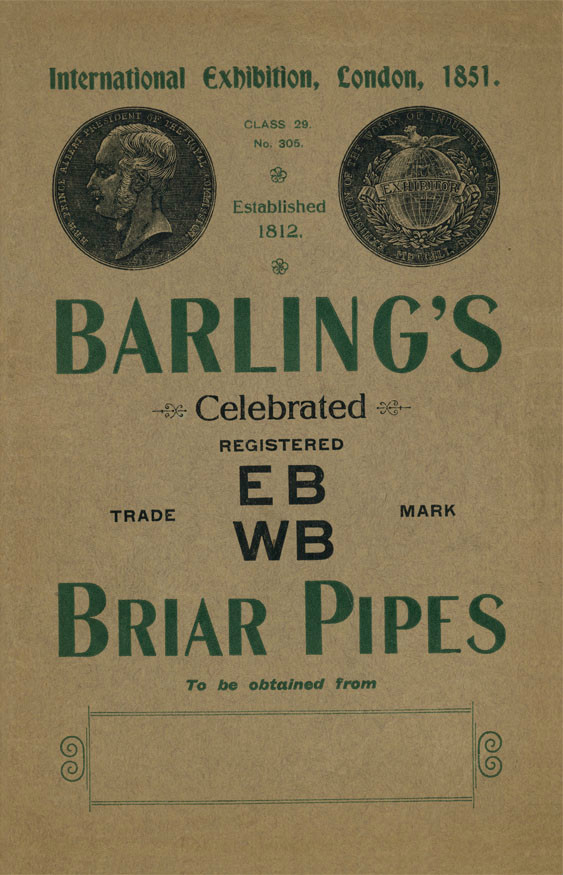
Barling Catalogue
I purchased this facsimile/reproduction catalogue of 28 pages on EBay a bit ago. It cost approximately $20 USD and the seller had quite a few available at the buy it now price.

They printed a run of 200 copies and this one is 010 of 200. It is copyrighted by Jesse Silver. There is an email address included inside the cover should you want to order a copy of the catalogue noblebrush53@yahoo.com

Included with the catalogue is a print of the Barling’s Factory. The inside is nicely done and indeed looks vintage. The type is in two colours – a reddish brown and a black. There are also nice etchings of the various pipes. Each page shows four pipes, each one number and named. The names are quite catching. Here are a few for interest sake: The Goodwood, Birkenhead, Savernake, Aberdeen, Nymph, Bent Army, Corinthian, Sydney, Elegant, Trojan and Victorian. The names don’t always reflect the shape of the pipe but sometimes do as in the Bent and the Straight Army. Some of the short chubby pipes also have unique names: The Gordon, Sporting, Hunt, Jap are just a few of the names. The overall feel of the book is like a trip back in time to a simpler and quieter era. The catalogue opens with the words: these are just a few of the many shapes that are available in Barling’s Celebrated Pipes.

I wanted to include the opening page of the catalogue for your reading pleasure. It is a note from B. Barling & Sons, London and reads as follows:

“We have much pleasure in presenting our New Catalogue illustrating some of the principal shapes and specialties in our celebrated EB/WB Briar Pipes.

Our pipes being so well and universally known (without artificial aid of advertisements), we will not here dwell on their perfection, but would ask you to kindly peruse this book, which will no doubt introduce to you some new patterns.

If you are not already a smoker of our pipes, we hope that it will lead to your giving them a trial and thus testing their quality and workmanship, we ourselves being confident of your ultimate judgment and satisfaction.

Every department of our factory being under our own practical and personal supervision, ensures every pipe turned out by us coming under our direct notice. This fact, coupled with the excellence of the materials used in their manufacture, has given our pipes a reputation second to none in the smoking world, a reputation we firmly intend to maintain and strengthen.”

I find the introduction to the catalogue a fascinating read and one that has proven to be true even in our day over 150 years later. Barling’s Pipes are still seen as quality pipes that deliver a great smoke. I have Pre-transition, Transition and Post-transition pipes and though there are certainly differences in quality of workmanship in the later pipes they nonetheless are good smokers. The pages of the catalogue are full of information both in the form of the photos and shape names and numbers but also in the stampings on the pipes and the linking of certain shapes to others with a note on the size. For instance, the Hunt, No. 344 a diamond shank billiard, is a parallel shape to shape #324 which is larger and shape #566 which is smaller.

After the main shapes portion of the catalogue the pages turn toward specialty items such as Crocodile and Morocco cases which are noted to be “unsurpassed for durability and finish” and can be obtained for any Barling pipes as a Single or a Companion case. There are several pages o of pipes with unique covers – with shapes from flat to domed, with hinges and with chains holding them in place. These are truly beautiful looking pipes. Something I was unaware of was that Barling’s made Meerschaum lined pipes as well. They show three examples with a note that they can be made for any shape of Barling’s pipes. I had to laugh at the note (so contrary to much I read today on the forums regarding meer lined pipes) that “Our Meerschaum Lined Pipes we can recommend for cool and sweet smoking. They are suitable for hard smokers and also for those who do not like briar…”

The catalogue ends with what for me has become a bit of a wish book – Specialties in Companions and Cased Amber Briars. These are the beautiful cased singles and pairs of pipes – one with a vulcanite stem and one with an amber stem on matching pipes. Others have a bent pipe and straight pipe with a military bit with two sets of stems – vulcanite and amber. Some have stem extensions made out of albatross wing bone and others have three pipes in a case. These cases are the Crocodile and Morocco cases spoken of above. The economy of size and shape make these great pocket cases for the pipes they contain. I am forever on the prowl for a set like these to add to my collection.

If you want to have a piece of history in the form of a catalogue that gives you a real feel for a time long gone you could not do better than pick up a copy of this facsimile. It is a treat for the Barling’s pipe collector and smoker and would also be a great piece for anyone who wants a nostalgic glimpse at the past.

The Pipe Hunt – Rule # 5: Never pass up pipe parts when you see them


Year ago now, I was visiting a lawn mower repairman who worked out of a shop in his back yard. I have a 30+ year old Snapper gas powered mower that works great and have had parts and gears that have broken or seized up. Joe always is able to get things back in tip top shape. It always starts with one pull of the cord. On one of my first visits to Joe he looked at what I needed and took me into his workshop. He reached up to a shelf that held many small bins and took down one that had several of the parts that I needed. He selected the one he wanted and within short order fixed my lawn mower. I asked him about the part bins and he said that he scavenges parts from where ever he can. He buys broken mowers and strips them down and buys parts whenever he can. He stock piles old parts – some of them are no longer are made so his bins are truly a treasure trove. Over the years I continue to go back to Joe and he keeps my old lawn mower running like a watch. He never has to go and buy parts because his bins hold much.

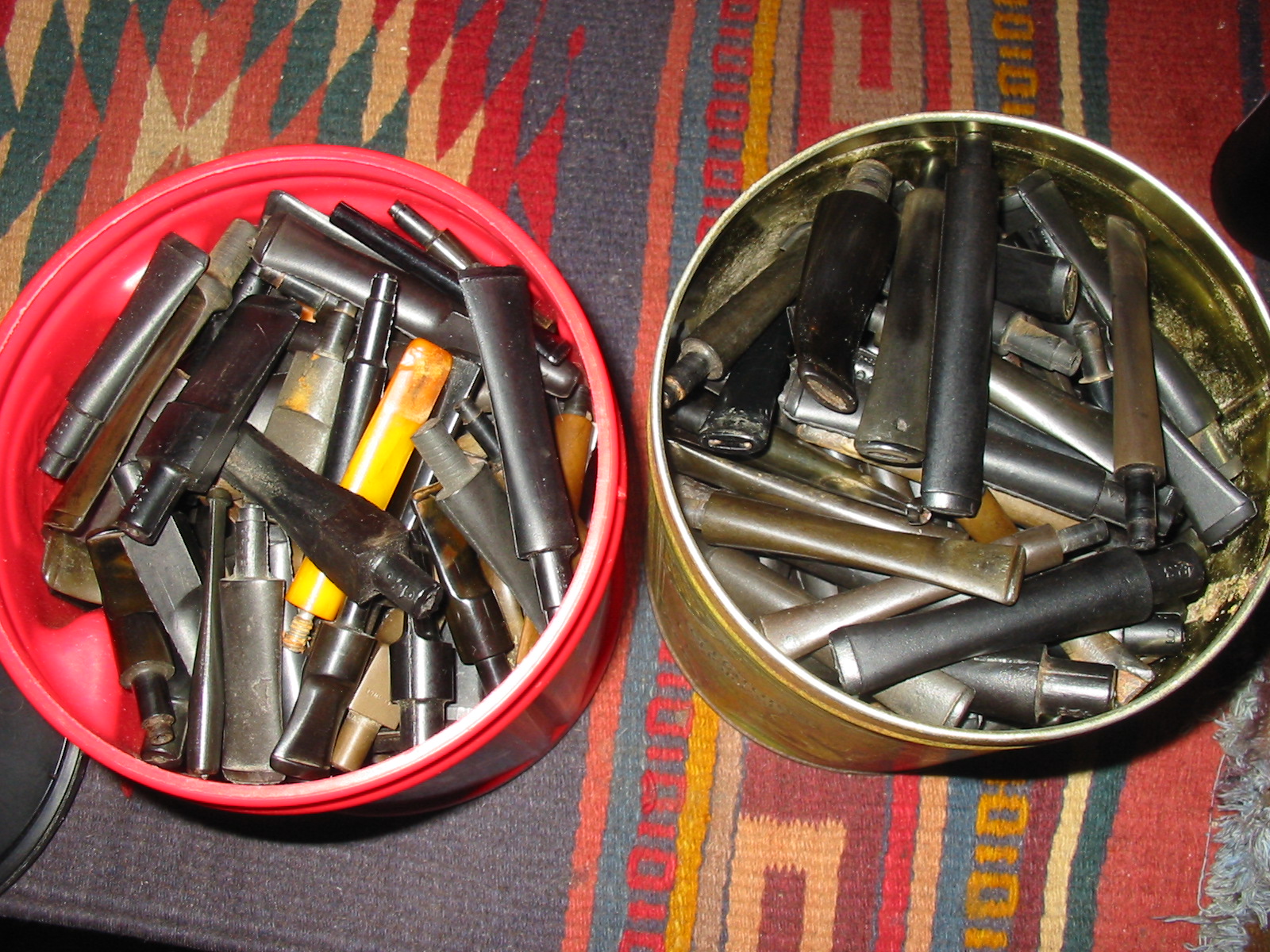
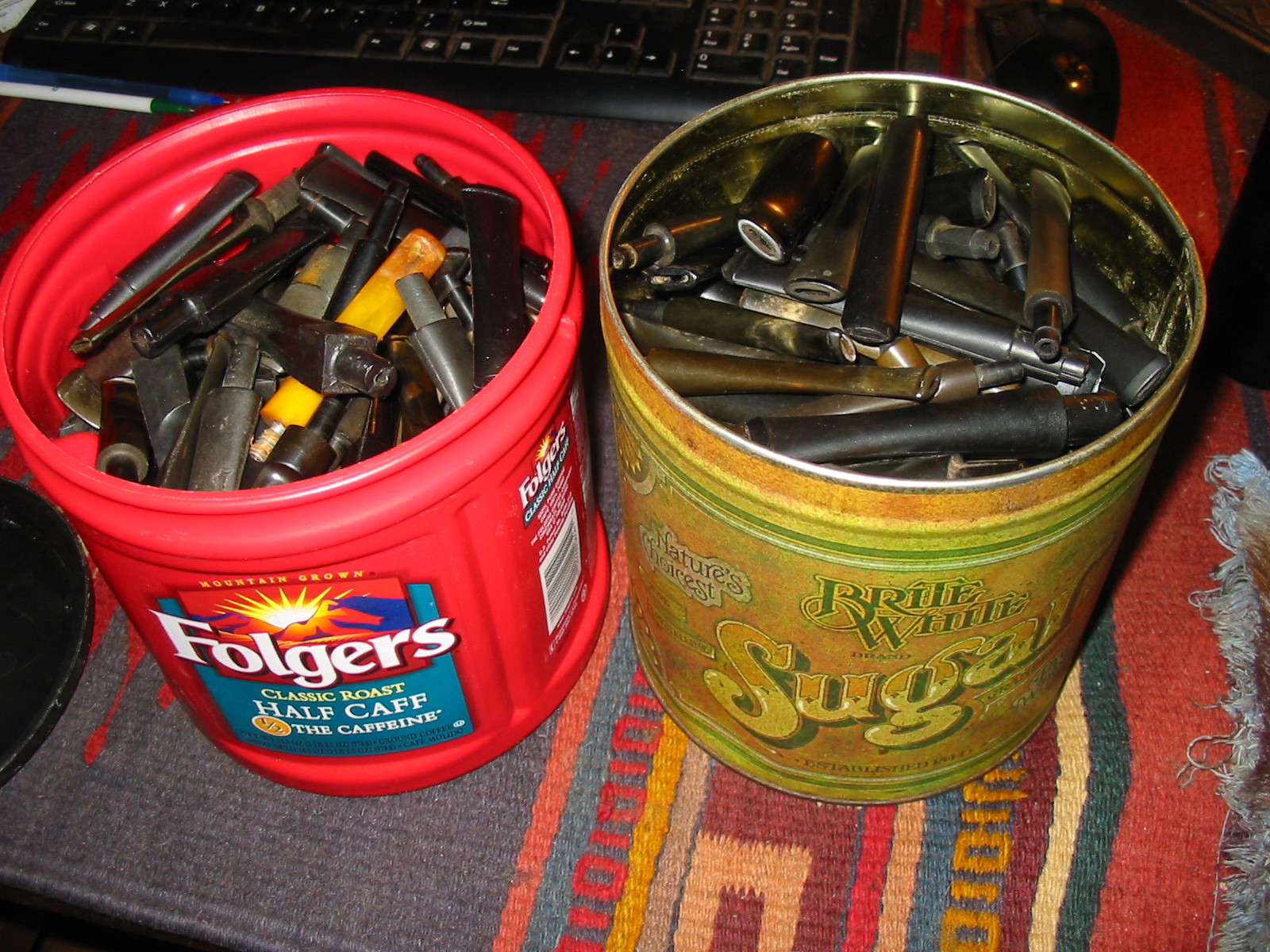
You might ask what that has to do with pipes and pipe refurbishing. Well in a very personal way it set the course of my pipe repair work. I have never forgotten Joe’s example with lawn mower parts. Since I don’t fix lawn mowers or motors I collect a totally different set of parts. I love refurbishing old pipes so I have started my own bins of pipe parts. I am looking forward to the day when I can set up a small shop of my own the yard where I can have the parts readily accessible when I am working on things. Until that time I collect the parts and store the bins in cupboards and drawers in the basement and laundry room. I have several bins of stems – old stock unused, scavenged used stems from broken pipes, new stem blanks in a variety of shapes and sizes. I buy stem blanks from Ebay and from Pipe Makers Emporium and new and used old stems where ever I find them. Currently I have them divided into a tin of round stems and a tin of different shaped stems. I also have bags of tenons, tins of stingers, a shelf of broken briar pieces and a box of bands of different sizes and shapes. I collect as many pipe parts as I can find from as many places as I find them.
IMG_2374

IMG_2375

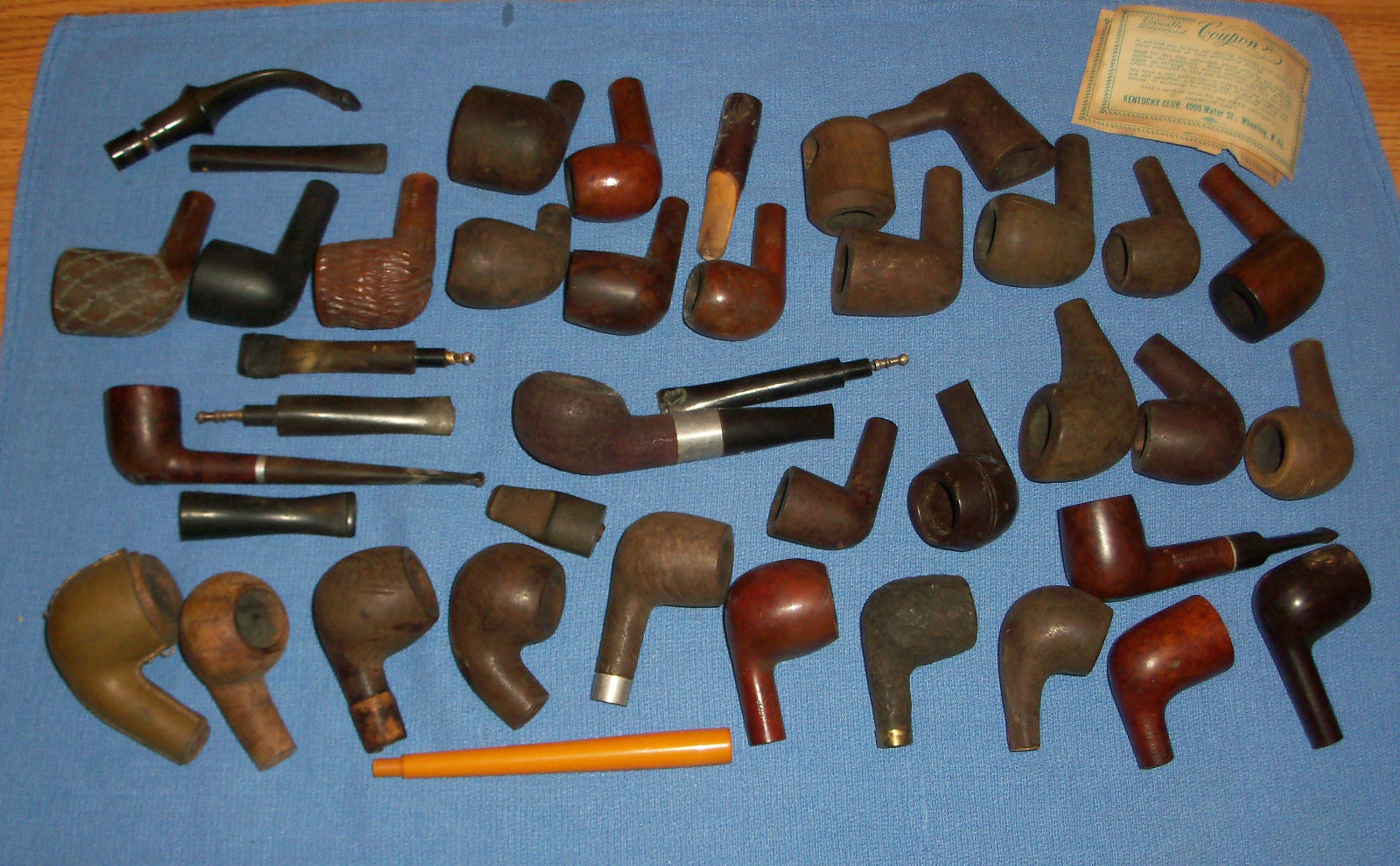
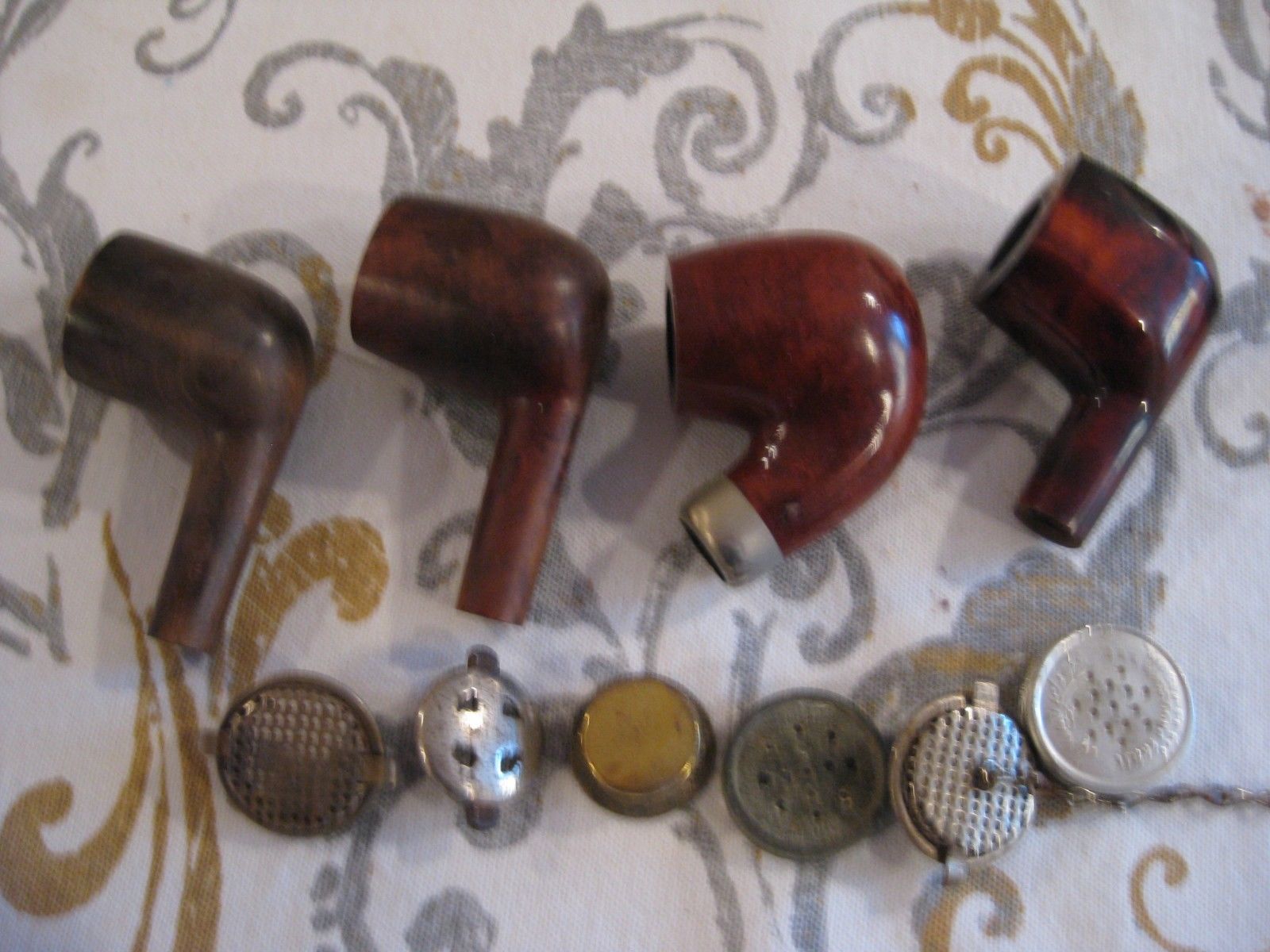
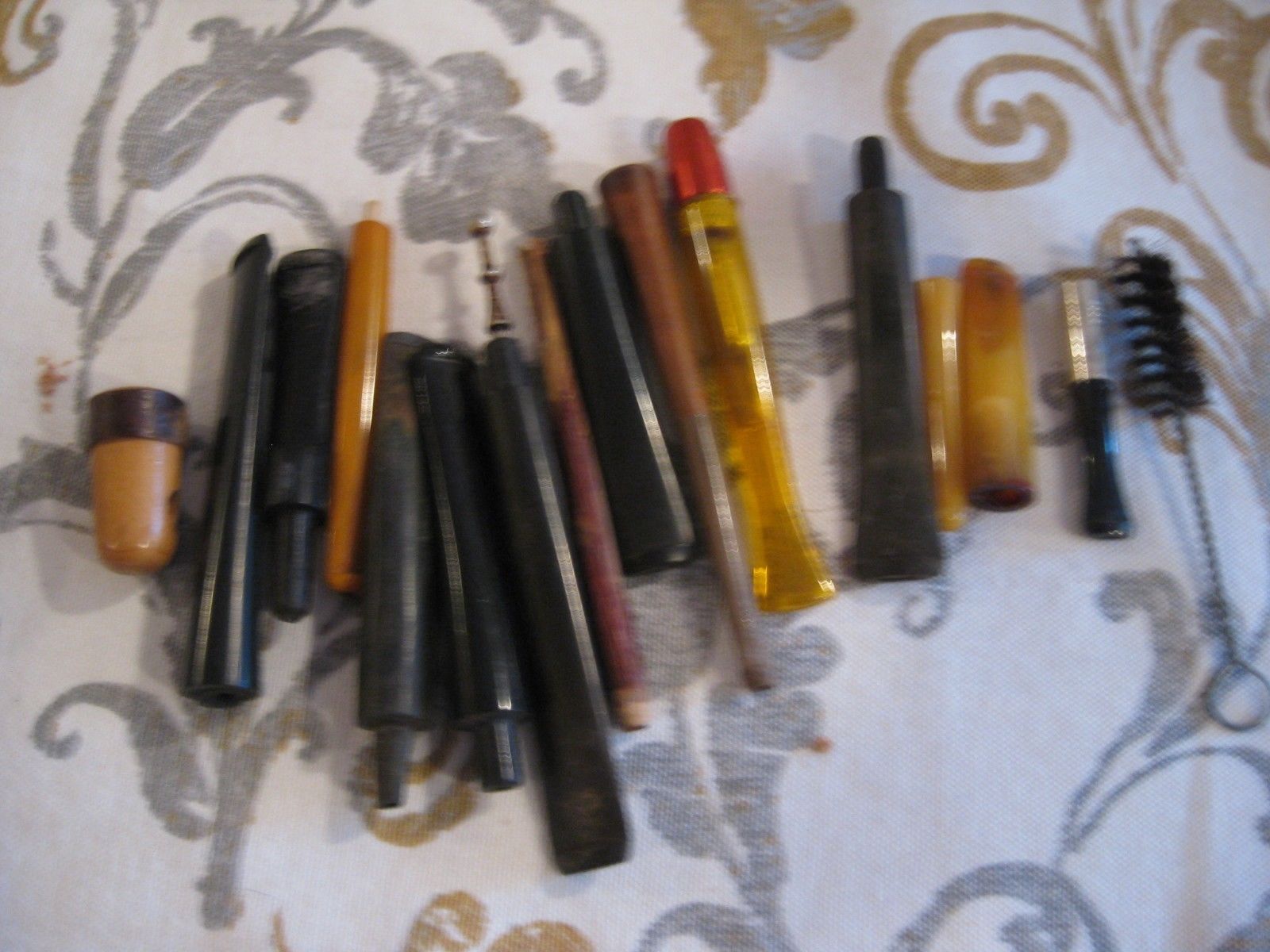
If you were to follow me around on the hunt, you would see that I don’t just look for pipes that I can refurbish or collect. I also keep an eye out for pipes that can be cannibalized for parts. I find them in the pipe lots I buy on EBay (like the pictures below) – these often have extra stems, bands, broken pipes and parts that can be recycled and put to use again. (The photos below come from random EBay ads that are of the type that I usually bid on. There are a lot of redeemable parts in the lots below. I include them to give an idea of the things I look for.)
hunt1

hunt2

hunt3

hunt4

hunt5

hunt6

I email online estate pipe sellers and ask if they have old stock used stems that they want to sell. I literally look everywhere I can think of in the process of the hunt. I have stems and parts shipped from Denmark, Sweden, Germany, England, the US and Canada. I also scavenge for them. I pick up pipe parts at flea markets, antique shops, and thrift and rummage shops. Sometimes they are attached to beat up old pipes that are worthless and other times they are sitting in an old cigar box or tobacco tin. I bring them home and the stems and the old briar are kept for repurposing in my repairs.

When I find them in a shop of any kind I make an offer to the seller for the lot and have had success in picking up the parts at a good price. Both the seller and I are happy with the deal. But important to the process is to not just look for parts – any pipe can supply parts for you. I have bought chewed stems for the sole purpose of rescuing the logo from the stem. I have heated and removed metal tenons from stems, removed threaded parts from the tenons of broken pipes to use as replacements, removed stingers and labeled them for use in pipes that I come across that had stingers that were either broken or missing. I have also removed inserted logos from the shanks of broken pipes for reuse. I have also cut down broken stems, shortened them to fit and cut new buttons for them. I also pick up pipe bowls that can be cleaned up and restemmed. I have found some amazing old pipes that have been great smokers when repaired with a new stem. I rarely skip over bowls because I find that there are many uses for them. Worst case scenario – I have sold packages of bowls and stems for others to practice on.

There truly is no end to the parts you can strip off old pipes and very little that truly needs to be thrown away. I have found that most parts can be repurposed and used on other pipes in my repair work. Thus I always keep an eye on the minutiae of the pipes I am looking at – seeing them for the whole but also seeing the individual parts that can be reused. I never pass up buying parts and search regularly for them.

I am thankful to my lawn mower repairman Joe for giving me the vision to craft Rule #5. It has served me well and will be a part of the hunt for as long as I am hunting.

Syroco Pipe Rests – Reconditioned and Brought Back to Life


When I bid on a recent Ebay lot the thing that caught my eye were the two pipe rests in the pictures. They appeared to be in good shape other than the dust and grit that had built up over the years. The first one was a two pipe rest that was made to look like tree stumps and a pebble beach or path. The second one was a single pipe rest that was a moccasin shape. They looked to be made out of Syrocco – a material that I am familiar with because of several other pipe rests that I have in my collection.
pipes6

pipes8

They arrived at my home this afternoon and awaited me when I returned from work. I opened the box and took them to the basement worktable to clean them up. However, before I went to work on them I was curious to know more about them and what the material was that made up the pieces. I used Google to hunt down information on the product and the company that made them. From the web here is what I found out.

Syroco was founded in 1890 as the Syracuse Ornamental Co. It employed generations of Central New Yorkers until it went out of business in 2005 (or 2007 some conflict in dates at this point). By then, it was making those ubiquitous plastic Adirondack-style chairs. But in its early days, the company produced unique products made from a mixture of wood flour and a casting resin. The pipe rests above are examples of that technique. They made a wide variety of products from their recipe such boxes designed to hold playing cards, picture frames, candlestick holders, ashtrays and bookends made from the wood resin.

I also hunted down information that related to a collection of Syroco materials that resides in the Special Collections Center at Syracuse University. There was an abstract there that confirmed the information on the company – from its beginning to its closure in 2005. The abstract also had the following to say about the materials used for the Syroco products – They were known for molded wood-pulp interior decorations and gift and novelty items that resembled hand-carving. Later they integrated polymers into their molding process and then moved entirely into plastics production.
I did a bit more digging into the history of the company to find out more about the founder and what they made. I also wanted to learn more about the molding process that went into the product. I found the following information. I summarize it in the next paragraphs and also include bibliographic information for those interested in digging deeper.

“The company was founded in Syracuse, New York in 1890 by immigrant Adolph Holstein, the Syracuse Ornamental Company (Syroco) and originally specialized in decorative wood carving for the local residential market. Their early products included fireplace mantelpieces and other types of interior decoration popular in late Victorian homes. To meet increasing market demand and sales opportunities Holstein developed a material looked and felt like wood but that which could be shaped, allowing multiple pieces to be produced through a molding process. The new product, which combined wood pulp brought from the Adirondacks with flour as a binder and other materials to give it strength, was extruded and then cut to fit compression molds, which had were made from original carvings in real wood.

The process favored shallow molds with little undercutting, and this served well for the creation of a wide variety of “carved” relief work to be applied to different sorts of flat surfaces such as walls, furniture and caskets. Production of this new molded product, known as SyrocoWood, was the mainstay of the company’s production through the 1940s. The finished material could be smoothed and varnished to look like wood, or it could be painted. Sales catalogues from the early 1900s through the 1920s offer hundreds of varieties of moldings, capitals, brackets, volutes, and reliefs of vases, garlands, cartouches, scrollwork, and other details in a variety of styles.

Syroco operated from a large factory complex on 581 South Clinton Street in Syracuse acquired from Smith Corona Typewriter Company. The company remained in the hands of the Holstein family for three generations, with some of Adolph’s children and grandchildren taking over management and sales positions. At its peak, about 400 workers were employed at the plant.

By the 1930s the company had also developed an extensive line of gift and novelty items made of “SyrocoWood” and also “Woodite,” a combination of wood flour and polymer. In the 1960s the company began to use injection molding for some of its products, but did not entirely abandon its old processes.

Syroco added more lines of injection molded plastics when a new plant was opened in nearby Baldwinsville in 1963 which was entirely geared to plastics production, especially PVCs and polystyrene. The company began to use plastic in new “modern” designs and new forms for clocks, mirrors, tables and a range of household items. In 1968-1969 the company launched its “Lady Syroco” home products. Beginning in 1986 Syroco produced a popular line of lawn furniture.

In 1965 the company was bought by Rexall Drug and Chemical Company (which soon changed its name to Dart Industries). Dart owned Tupperware, from which Syroco gained more knowledge of injection molding. Syroco was purchased by the Syratech Corporation of Boston in 1986 which expanded its patio furniture production. In 1995 Syratech sold Syroco to Marley PLC of Sevenoaks, England, and in 2004 Syroco was purchased by Vassallo Industries of Puerto Rico which closed the plant in 2007. In April 2010 Tessy Plastics purchased the 270,000 square foot Syroco plant to be used for storage and distribution.”

Sources:
“Corkscrews of the Syracuse Ornamental Company,” online at vintagecorkscrews.com
Hannagan, Charley. “Syroco plant closes,” Syracuse Post-Standard, June 18, 2007.
Alexander Holstein, interviewed by Sam Gruber, Syracuse, New York, Nov. 8, 2010.
Sorcher, Jamie. “Brits in deal for Syroco,” HFN The Weekly Newspaper for the Home Furnishing Network, April 3, 1995.

Armed with the information I had gathered and now understanding what the pipe rests were made of I was better able to begin cleaning and restoring them. I cleaned the grooves and carved crevices in each piece with Everclear applied with cotton swabs until the surface was free of the dirt and grit that had built up in those recesses over the years.
IMG_2333

IMG_2335

IMG_2336

I then dried the surface of the pieces with a soft cotton cloth and restained them. I decided that rather than using an aniline stain on them I would use a linseed oil based stain made by Watco. I chose to use a walnut coloured Danish Oil on both pieces. I applied the stain with a cotton swab until all the surfaces were covered and the pieces looked new with a slight shine.
IMG_2362

IMG_2363

IMG_2364

Once both pieces were finished I set them aside to dry over night. The linseed oil would protect the finish and the stain would soak into the surface of the pipe rests.
IMG_2365

IMG_2366

IMG_2367

In the morning both pieces had dried (though still slightly tacky). By this evening they should be completely dry and ready for use. The pictures below show the finished pipe rests.
IMG_2368

IMG_2369

IMG_2370

IMG_2371

IMG_2372

IMG_2373

The pipe rests have dried nicely. The moccasin has a semigloss finish to it and looks really nice. The two pipe rest with all the nooks in the stumps and roots is taking longer to dry. The high ridges are dry and semigloss. The deep grooves are still slightly tacky and thus more shiny. It has taken a day and a half for it to dry.