
Guest Blog by Robert M. Boughton
Member, North American Society of Pipe Collectors
http://www.naspc.org
http://www.roadrunnerpipes.com
http://about.me/boughtonrobert
Photos © the Author
’Tis but thy name that is my enemy;
Thou art thyself though, not a Montague.
What’s Montague? it is nor hand, nor foot,
Nor arm, nor face, nor any other part
Belonging to a man. O! be some other name:
What’s in a name? that which we call a rose
By any other name would smell as sweet;
So Romeo would, were he not Romeo call’d,
Retain that dear perfection which he owes
Without that title. Romeo, doff thy name;
And for that name, which is no part of thee,
Take all myself.
― William Shakespeare (1564-1616), English playwright and poet, in “Romeo and Juliet,” Act II, sc. 2, 1597
INTRODUCTION
This splendid rusticated full bent billiard somehow overshadowed the other pipes in one of the many estate lots I purchased in rapid succession some months past, despite my inability to identify its brand in the group photo. Of course, being also a system pipe, the slim chance that it was a Peterson’s crossed my mind, but I was more than doubtful. When the lot arrived, I was eager to see who made it and set aside the others of known make and quality in a rush to examine the nomenclature of the mysterious new addition to my pipes to be restored for resale. I was surprised and intrigued to find it was a no-name Italian.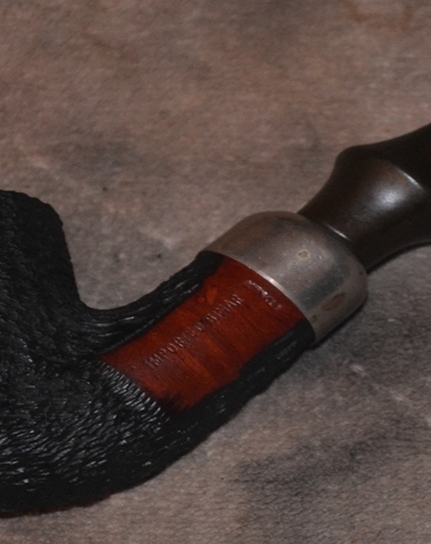 I began showing the unusual pipe to some of my friends more familiar with Italian crafters than I. The first of these was my mentor, Chuck Richards, as he was present at our tobacconist just after the package arrived when I tore my way past the over-taping that is the bad habit of so many shippers. His own exquisite pipe of the day in mouth, Chuck examined the specimen with the quick thoroughness of which he is capable, squinting and pursing his lips, but offered nothing by way of a comment, which in itself spoke volumes of his appraisal. In this way Chuck’s style is much like that of New Yorker Magazine reviews, which, if they have nothing at all good to say about a book, condemn the work to a brief blurb citing only its name, author and other trivial information.
Undaunted, perhaps or perhaps not with an undue sense of romanticism, I held onto my suspicion that the no-name bent billiard system was the reject of a well-known company such as Savinelli, Ser Jacopo, Castello or Velani – though I could not suspect a Romeo.
I can only add now that the bella pipa’s origins remain secret, but like Juliet in the Bard’s famous tragedy, I care not for its name.
Needing to know how this pipe smoked before the refurbish, I gave it a good initial cleaning with Everclear. I noted the ease with which the several pipe cleaners – that’s right, this pipe was so well cared for that I did not need to use half a pack of bristly cleaners just to test it with safety – passed through the stem and well-aligned shank opening and draught hole. After letting it have plenty of time to dry out, I loaded a bowl and relaxed on my couch. Soon I drifted into abstracted musing.
By the time I returned to the present space-time continuum, a half-hour had passed. Faint drifts of smoke wafting upward, I realized the tobacco had not yet extinguished, yet the bowl, still in my hand, was cool. The taste of the tobacco remained fresh, without a hint of wetness to the draw. I reached for my tamper and, still puffing, found that less than a quarter of the bowl had turned to ash.
Whoever crafted this pipe, I knew, was a true artist by any name.
THE REFURBISH
Finished with my one and only enjoyment of this wonderful no-name, I turned it again in my hands for another look-over.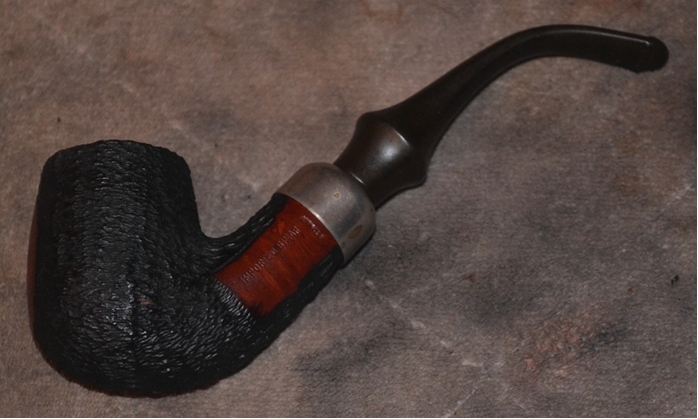
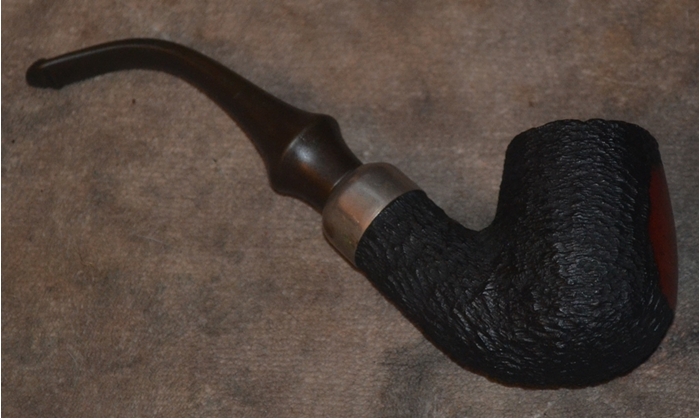
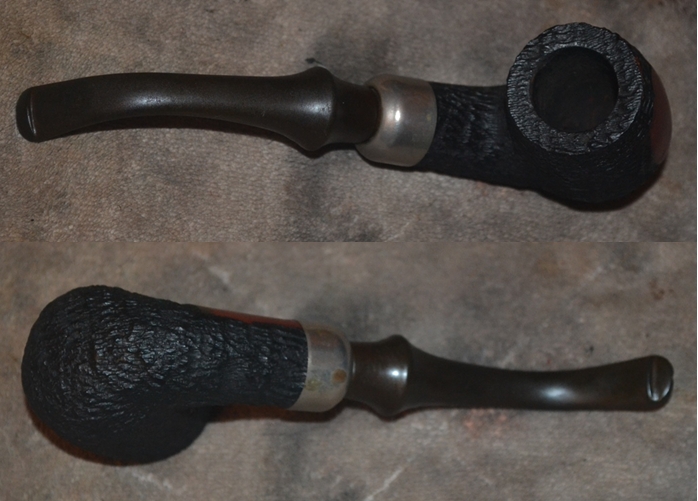
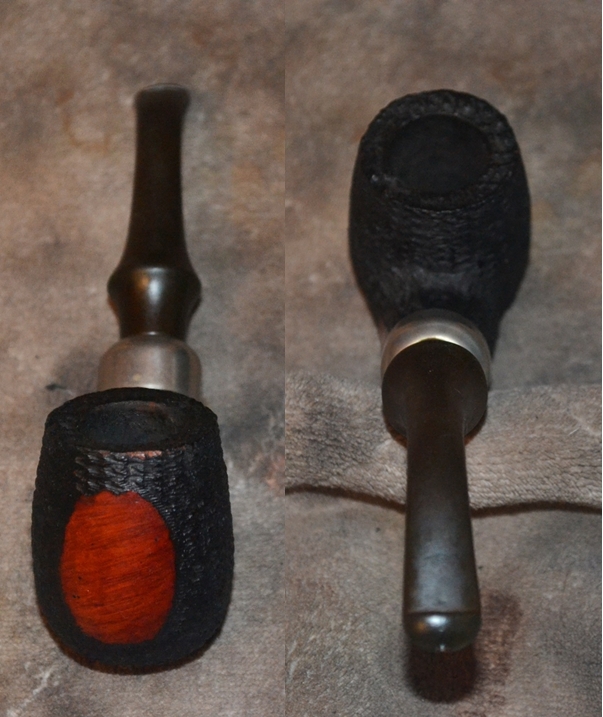
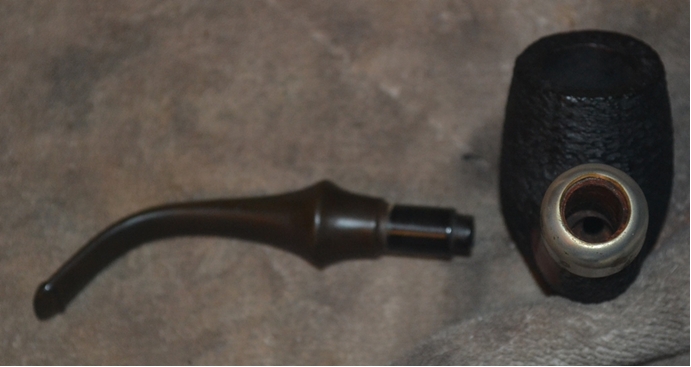 There was not a thing wrong with it that minimal cleaning and shining would not fix. The rim showed no burn. The rusticated majority of the bowl and shank was faded black from age. The deep red natural wood in two spots had but the faintest scratches. The stem was impeccable if lusterless. The steel band was in good shape. The chamber, even, was as smooth as almost any I have ever seen.
And so I began with a gentle ream of the chamber followed by a scouring using 320-grit paper to remove the mild buildup of cake. As always, I followed this by soaking a couple of small squares of cotton cloth in Everclear and washing away the carbon residue.
The next logical step was to retort the pipe. This, in fact, proved to be the step that took the most time (maybe 10 minutes), despite the previous owner’s excellent care but apparently frequent enjoyment of the bent billiard.
Following the retort, I gave the briar bowl and shank with the band, along with the stem, a bath with purified water. This revealed the minor scrapes on the patches of natural wood, which I removed with progressive increases of micromesh 1500, 2400, 3600 and 4000. I made the band sparkle with a light buff of super fine steel wool, leaving no scratches, and used the same progression of micromesh on the stem.
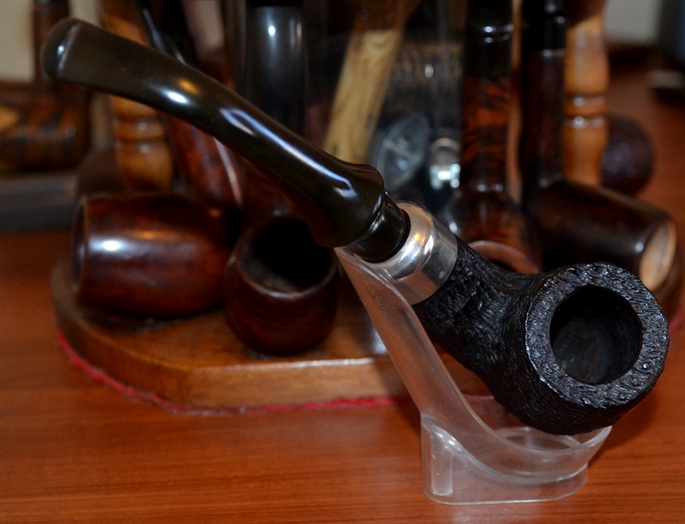
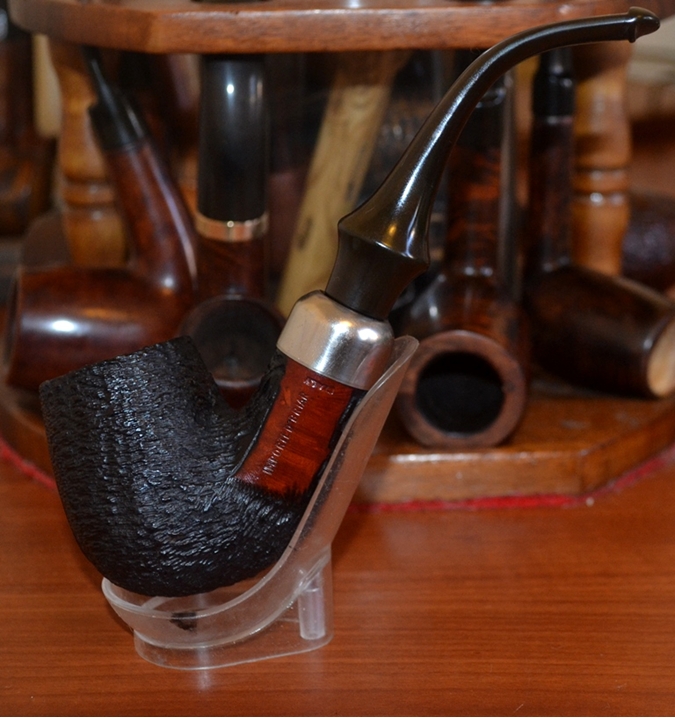
And that was all, other than buffing the stem with red and white Tripoli and White Diamond, and then the bowl and shank with the last of the Halcyon II I had on hand.


 CONCLUSION
The strain of my well-known pipe acquisition disorder almost proved too much to overcome with my intense and somewhat inexplicable desire to add a no-name Italian pipe to my collection that already overflows the boundary of a stand-up case with shelves of excellent examples of some of the best brands made. But such is the obsessive-compulsive beast of P.A.D. that the beauty of the pipe itself and the nagging doubt as to the mere possibility of a greater pedigree proved to be a great trial.
The tribulation ended with the wise arbiter of such matters, whence its powers are derived no serious pipe collector can say, granting me at least a reprieve. With every ounce of willpower I could summon, I listed the No-Name Italian Rusticated Full Bent Billiard for sale.
A glooming peace this morning with it brings;
The sun, for sorrow, will not show his head:
Go hence, to have more talk of these sad things;
Some shall be pardon’d, and some punished:
For never was a story of more woe
Than this of Juliet and her Romeo.
— Id., Act IV, sc. 3
 rebornpipes