Category Archives: Pipe Related Essays

Short and not so short essays on pipes and tobacciana

Newbie tips (web links for the uninitiated) – Eric Boehm


Blog by Eric Boehm

Eric originally posted this compendium of information on Smokers Forums. I found it to be a helpful collation of information for both the beginning and the long time pipe smoker. His recommendations and the collection of web links is a great beginning point. Each of those who use it can add your own additions and adjustments as you use the material but Eric has done a great service to pipemen everywhere with this information. I wrote to him and asked his permission to post it on rebornpipes. He graciously consented. I have edited it to make the introduction broader than that of its original format. The material is just too valuable to be lost. Thanks Eric for your work on this. To all the readers of rebornpipes – enjoy the wealth of information.

…The old adage, “And though it is much to be a nobleman, it is more to be a gentleman” (– Anthony Trollope) pretty well sums up the experience of becoming a pipeman. It wasn’t so long ago, that wisdom was imparted in the old Brick & Mortar tobacco shop, where one could spend the afternoon, leaning on the counter, sampling tobaccos, learning about pipes, and shooting the breeze with the old timers – gentlemen all. Generations grew up that way. Unfortunately, those days are long gone – chalk it up to “progress”, the faster pace of life, skyrocketing costs, stagnant paychecks – in short, all leading to more work for less gain. Pipe smoking is my way of regaining a balance in a troubled world.

When I first started to smoke a pipe in the late 1980s, I remember being a bit overwhelmed by the number of choices. The primary question was – what to smoke? Although everyone classifies their pipe tobaccos differently, I can see about 15 different categories: (1) Straight (non-flake) Virginias; (2) Virginia Flakes (Light); (3) Virginia Flakes (Full); (4) Virginia /Kentucky Blends; (5) Virginia / Burley Blends; (6) Burley Blends; (7) Virginia / Perique Blends; (8) Virginia / Oriental Blends; (9) Light / Medium Latakia Mixtures; (10) Medium / Full Latakia Mixtures; (11) Lakeland Style (Unscented); (12) Lakeland Style (Scented); (13) Ropes and Plugs; (14) Cigar Leaf Blends; and (15) Aromatics. This classification is my riff on the one provided by the Pipe Club of Norfolk (UK). Within each category, of course, there exists a multitude of individual blend choices. Thus, as a newbie you will never want for a wide variety of choices – in fact, many pipemen pursue the perfect smoke as the pursuit of their “Holy Grail”.

I was also overwhelmed, in my beginnings, by the multitude of pipe materials to choose from (e.g., briar, corn cob, cherrywood, morta [bog wood], olive, maple, clays, meerschaum, metal, etc.) and the multitude of pipe styles to choose from (e.g., quarter bents, half bents, full bents, straights, etc.), not to mention the incredible array of pipe shapes (e.g., acorn, pear, apple, author, bent apple, bent ball, bent billiard, bent brandy, bent bulldog, bent Dublin, bent egg, bent pot, billiard, blowfish, brandy, bulldog, calabash, Canadian, cavalier, chimney, churchwarden, cutty, Dublin, freehand, hawkbill, horn, Liverpool, Lovat, lumberman, Oom Paul, panel, poker, pot, prince, Rhodesian, skater, tomato, volcano, Zulu). Then there were the terms associated with the architecture of the pipe itself (e.g., lip, bit, stem, tenon, stem face, shank face, shank, stummel, bowl, mortise, draft, plenum, heel, foot, rim, chamber, etc.). And lest we forget the types of stem choices (e.g., saddle, tapered, military/army style, screw type, combination type, etc.) and bit style (e.g., standard, wide comfort, fishtail, P-lip, regular and double bore, denture bit, and double comfort bit, to name but a few). A good place to begin to appreciate these terms might be Pipedia, a “wiki for pipes”.

Sitting in my garage in the early 1980s with a clenched Dr. Grabow pipe, full of Captain Black White, I was also trying to learn the basic technique of smoking a pipe – primarily how to avoid tongue bite and palate scorching. I mean if it’s not comfortable, why the hell spend time at it? I finally managed to learn how to develop the slow rhythmic cadence of imbibing tobacco in a pipe, that, when done right, can lead to a significant satisfactory state of mind. There definitely is a “zone” or “Zen state of mind” – call it relaxation if you will – that is reached when smoking a pipe, especially with quality tobacco. I believe it’s this actual mental state that draws me back to the pipe, time and again, rather than to any chemical addiction to the nicotine itself. I would even go so far as to state that, historically, it was the gift of tobacco pipe smoking that was bequeathed to the European by the New World Amerindian, who saw pipe smoking as a religious or sacramental exercise.

What might appear to be a steep learning curve for the beginner has, I am sure, led to the gradual demise of pipe smoking in our culture, in favor of the dreaded cigarette – a fatal transition that occurred throughout the 1950s and 60s. Combined with the physical disappearance of the small mom and pop tobacco shop, where the tradition of pipe smoking was orally passed down “father to son”, so to speak, it spelled the end of the wide-spread pipe smoking culture.

As I grew up in the 1960s, I distinctly remember many pipe smokers in the streets and shops, but by the end of the decade, an entire generation gave up the pipe for the cigarette. Chalk it down to advertising, or the faster pace of life. I know that deep, repeated inhalation of tobacco will most definitely kill you. I have seen it in family members first hand. Perhaps it is this that has driven the anti-tobacco movement to mistakenly group all tobacco products as dangerous. Of historical interest to the new pipe smoker, it would be worthwhile to visit the various sites listing the biographies of famous pipe smokers, many of whom lived well into their late 80s. I think I speak for many of us when I say that pipe smoking has progressed far beyond a mere hobby, and, in fact, has become a way of life. A deeply satisfying way of life, I might add.

Why did I decide to write this article? I found that as I was welcoming new members to an online pipe smokers forum, I began to think what I would be seeking in an on-line community of pipe smokers, if I were new to the game. Due to accumulated wealth of information available in the archives on most pipe forums, a real wealth of data related to the pipe and cigar smoking community may at times seem a bit overwhelming to the newbie. I realized that what I would be seeking initially would be a single thread that could serve as an introduction to the pipe smoking craft. The thread would contain a list of hyperlinks that related to: (1) Forum options, (2) Blogs, (3) e-Magazines, (4) Societies and Clubs (5) Tobacco reviews, (6) Retailer Listings, (7) Retailers (8) Less expensive pipes, (9) Estate Pipes, (10) More expensive pipes, (11) Pipe repair sites, (12) Pipe cleaning / maintenance sites, (13) Pipe smoking technique links, (14) Pipe books, (15) Famous pipe smokers, (16) Introductions to pipe tobaccos and, finally, (17) a series of my favorite pipe related quotes.

Essentially, this is what I have prepared here: A single package of links that would enable the newbie to at least get a firm footing in the craft of pipe smoking. With a firm basis of links, the newbie would then be off to a running start and have access to the wealth of information available of the internet. It should be remembered that these are merely recommendations, and do not constitute all the links that are out there. As such, the links are meant to be jumping off points for those of you who are new to pipe smoking – nothing more, nothing less. (I would also like to take this opportunity to ask my fellow pipe travelers if there are sites not listed that you think should be, please, by all means, let me know, and I would be more than happy to oblige you). In the end, as a new pipe smoker, you will eventually find what works for you, through trial and error. Hopefully, these links will minimize the latter. Of course, you’ve already done the best thing by joining up with this forum. My goal throughout is simply to try to retain the newbie so that our pipe smoking community can continue to grow. The more the merrier. So, here goes…

(1)Forums:
http://www.smokersforums.co.uk/forums.php
http://pipesmagazine.com/forums/
http://pipechat.info/index.php?PHPSE…1nb194t81e6v3&
http://forum.pipes.org/discus/discus.cgi
http://www.puff.com/forums/vb/general-pipe-forum/
http://www.pipemakersforum.com/
http://thepipesmoker.wordpress.com/
http://www.pipesmokerscubby.com/forum.php

(2)Pipe Blogs:
http://glpease.com/BriarAndLeaf/
http://www.apassionforpipes.com/
http://www.qualitybriar.com/blog/
http://pipedia.org/index.php?title=Main_Page
http://www.smokingpipes.com/blog/index.cfm
http://olefattguy.blogspot.com/
http://briarfiles.blogspot.com/
http://smokingpipetobacco.com/
http://pipesmagazine.com/blog/category/kevins-blog/
http://pipesmagazine.com/blog/catego…-of-the-ashes/
http://talbertpipes.blogspot.com/
http://www.brothersofbriar.com/
http://blog.enriquepipes.com/
http://www.pipemakersforum.com/
http://www.loringpage.com/
http://meanderingsmoke.blogspot.com/ (Meandering Smoke)
http://www.pipesmokerunleashed.com/ Pipe Smoker Unleashed

(3)Pipe eMagazines:
http://pipesmagazine.com/ (Pipesmagazine.com)
http://www.pt-magazine.com/ (Pipes & Tobacco Magazine)
http://www.pipesmokemag.com/ (Pipe Smoke Magazine)

(4)Societies & Clubs:
http://naspc.org/ (North American Society of Pipe Collectors)
http://www.corpipesmokers.org/ (Conclave of Richmond Pipe Smokers)
http://www.seattlepipeclub.org/ (Seattle Pipe Club)
http://www.pipeshowonline.com/ (Pipe Show On-line)

(5)Tobacco Reviews:
http://www.tobaccoreviews.com/
http://luxurytobaccoreviews.com/
http://pipes.priss.org/
http://smokingpipetobacco.com/
http://pipesmagazine.com/blog/catego…bacco-reviews/
http://members.bellatlantic.net/~vze43wza/pipes.html

(6)Retailer listings:
http://pipesmagazine.com/pipe-store-locator/
http://www.pt-magazine.com/home.php?id=40
http://www.rtda.org/links.html

(7)Retailers:
http://www.smokingpipes.com/ (Smokingpipes)
http://www.cupojoes.com/ (CupOJoes)
http://www.iwanries.com/home.cfm (IwanRies)
http://www.uptowns.com/index.php (Uptowns)
http://www.pipesandcigars.com/ (Pipes & Cigars)
http://cornellanddiehl.com/ (Cornell & Diehl Tobacco)
http://www.4noggins.com/ (4 Noggins)
http://www.mac-baren.com/TopMenu/Main-2.aspx (Mac Baren Tobacco)
http://villigerstokkebye.com/ (VilligerStokkebye Tobacco)
http://www.pipetobacco.com/Merchant2…AFFIL=6E0Bo1ga
http://www.paylesspipes.com/ (Payless Pipes)
http://www.pipesandcigars.com/ (Pipes & Cigars)
http://www.lewispipe.com/ (Lewis Pipe & Tobacco)
http://www.thebriary.com/ (The Briary)
http://www.alpascia.com/pipes/ (Al Pascia)
http://www.mkelaw-pipes.com/ (Mkelaw Pipes)
http://www.libertytobacco.com/ (Liberty Tobacco)
http://www.pipemakers.org/ (Pipe Makers Emporium)
http://www.cigarandtabacltd.com/ (Cigar &Tabac, Ltd.)
http://www.faderstobac.com/ (Fader’s)
https://www.facebook.com/pages/The-B…34344463248233 (The Briar & the Burley) http://www.kramerstobaccoshop.com/fr…eframeset.html (Kramer’s Pipe & Tobacco Shop) http://www.greentreetobacco.net/home.html (Greentree Tobacco Co. Inc.)
http://www.obsidianpipe.com/ (Haunted Mists New Obsidian Oil anti-oxidation curative) http://www.parklanetobacconist.com/ (Park Lane Tobacconist)
http://tobaccoshop.com/tobacco.html (Tobacco Shop of Ridgewood NJ)
http://www.pipestud.com/ (Pipestud – rare tobacco tins)
http://www.justforhim.com/catalog/ (JustForHimTobbacconist)
http://www.marscigars.com/ (Mike Rutt’s Mars Cigars & Pipes)
http://fujipub.com/briarpatchcigar/ (Briar Patch & Cigar)
http://www.alleghenysmokeworks.com/ (Allegheny Smoke Works)
http://www.abnersworld.com/ (Abners’ World)
http://www.tobacco-barn.com/t-so-pipesandtobacco.aspx (Tobacco Barn)
http://www.ljperetti.com/ (L.J. Peretti)
http://www.outwesttobacco.com/ (Out West Tobacco)
http://www.rdfield.com/ (R. D. Field LLC)
http://www.thebriary.com/ (The Briary)
http://www.thebriarpipe.com/ (The Briar Pipe)
http://www.tinderbox.com/index.fx? ca…6406&cid=&csm= (The Tinder Box) http://www.chiefcatoonah.com/index.html (Chief Catoonah Tobacconist)
http://www.smokershaven.com/about-us.aspx (Smokers Haven)
http://www.pipeshop.com/ (Pipeshop.com)
http://www.milantobacco.com/ (Milan Tobacco)
http://mccranies.com/store/ (McCranie’s Pipe & Tobacco)
http://www.natsherman.com/ (Nat Sherman)
http://gatlinburlier.com/ (The Gatlinburlier Tobacconist)
http://www.smfrankcoinc.com/ (S.M. Frank & Co.)
http://www.boswellpipes.com/ (Boswell Pipes)
http://www.briarblues.com/ (Briar Blues)
http://www.brighampipes.com/2006%20Update.htm (Brigham Pipes)
http://www.pipeandpouch.com/avcopi.html (Pipes & Pouch)
http://www.pipes2smoke.com/ (Maxim Engel)
http://www.meerschaumstore.com/categories.asp (Meerschaum Pipes)
http://www.milantobacco.com/pipes.htm (Milan Tobacco)
http://www.aab-taxfreepipes.com/defa…=false&lang=uk (Bisgaard Pipes)
http://www.neatpipes.com/store/comersus_index.asp (Neat Pipes)
http://www.finepipes.com/ (Fine Pipes International)
http://www.lenuvolepipes.com/ (Le Nuvole Pipes)
http://www.pulversbriar.com/ (Marty Pulvers)
http://piapipes.com/default.asp?lang=uk1 (Pia Pipes)
http://www.jamesislandpiper.com/ (The James Island Piper)

(8)Less Expensive Pipes:
http://www.corncobpipe.com/ (Missouri Meerschaum corn cob pipes USA)
http://www.charlespipes.com/charlespipecollectibles (Stanwell Pipes)
http://www.peterson.ie/pipes/pipes.html (Peterson Pipes Dublin)
http://www.drgrabow.net/ (Dr. Grabow Pipes USA)
http://www.smfrankcoinc.com/kaywoodie/index.htm (Kaywoodie Pipes)
http://www.smfrankcoinc.com/ybmd/index.htm (Medico &Yello-Bole Pipes)
http://www.boswellpipes.com/index.html (Boswell Pipes USA)
http://www.premierpipes.com/Falconpi…lconpipes1.htm (Falcon Pipes)

(9)Estate Pipe Listings:
http://www.estatetobaccopipes.com/search (Ticker tape estate pipe listings)
http://exilesplace.dk (Exile’s Pipes)
EBay favorite sellers: This’ll get you started on the estate listings…
ashtonpipes1
coopersark
pipestud
thesecondhandsmoker
great-estate-pipes
bruyerepipestinashobby
pipegirl1380
beeshquatrolife
jatane
treasurepipes

(10)More Expensive Pipes:
http://www.qualitybriar.com/ (Quality Briar)
http://www.twofriendspipes.com/(Two Friends Pipes)
http://www.oldnelliepipes.com/ (Old Nellie Pipes)
http://ssl.cybersun.com/4Dscripts/we…enterstore?ams (Mark Tinsky Pipes)
http://www.downiepipes.com/home.html (Stephen Downie Pipes)
http://www.remingtonpipes.com/ (Adam Remington Pipes)
http://www.baweaverpipes.com/ (Bruce Weaver Pipes)
http://www.ashton-taylor.com/ (Ashton-Taylor Pipes)
http://www.annejulie.com/pipes.html (Anne Julie Pipes)
http://www.chhedapipes.com/ (Chheda Pipes)
http://www.bonaquisti.com/ (Bonaquisti Pipes)
http://www.cornelius-maenz.de/ (Cornelius Maenz Pipes)
http://www.pohlmannpipes.com/ (Brad Pohlmann Pipes)
http://jwh.fastmail.fm/ (Jack Howell Pipes)
http://www.smokingpipes.com/pipes/ne…dson/index.cfm (Adam Davidson)
http://www.willpurdy.com/index.htm (Will Purdy Pipes)
http://www.parkspipes.com/ (Michael Parks Pipes)
http://www.shurewoodbriarpipes.com/Welcome%21.html (Colin Rigsby Pipes)
http://www.beckerpipes.com/ (Paolo Becker Pipes)
http://www.perrywhitepipes.com/ (Perry White Pipes)
http://www.florovpipes.com/ (Alex Florov Pipes)
http://www.pipendoge.de/mehret_infoengl.htm (Tom Richard Pipes)
http://www.hedingpipes.com/ (Peter Heding Pipes)
http://www.heeschen-pipes.dk/default.asp (Peter Heeschen Pipes)
http://www.matzhold-peter.at/ (Peter Matzhold Pipes)
http://www.ailarov.com/ (Sergey Ailarov Pipes)
http://www.smpipes.com/ (Steve Morrisette Pipes)
http://www.tatupipe.com/english.html (Tatsou Tajima Pipes)
http://www.pipendoge.de/mehret_infoengl.htm (Tom Richard Mehret Pipes)
http://www.jalanpipes.com/ (J. Alan Pipes)
http://www.lobnik.com/ (Gregor Lobnik Pipes)
http://www.ming-kahuna.com/ (Ming Kahuna Pipe Accessories)
http://www.pipemoretti.com/ (Moretti Pipes)
http://perrywhitepipes.com/ (Perry White Pipes)
http://www.vollmer-nilsson.com/ (Vollmer & Nilsson Pipes)
http://www.willpurdy.com/index.htm (Will Purdy Pipes)
http://www.wolfgang-becker-pfeifen.de/ (Wolfgang Becker)
http://www.crosbypipes.com/ (John Crosby Pipes)
http://www.moritz-pipes.com/Bitmap/A…8/album_01.htm (Jurgen Moritz Pipes)
http://www.kentpipes.com/ (Kent Rasmussen Pipes)
http://www.shekitapipes.com/ (Konstantin Shekita Pipes)
http://www.ballebypipes.com/gallery/index.html (Kurt Balleby Pipes)
http://www.larryssonpipes.com/ (Larrysson Pipes)
http://www.maigursknetspipes.com/smo…71present.html (Maigurs Knets Pipes)
http://www.pipendoge.de/Revyagin_infoengl.htm (Michail Revyagin Pipes)
http://www.von-erck.com/ (Lee Von Erck Pipes)
http://raddavispipes.com/ (Rad Davis Pipes)
http://emarklepipes.com/ (Ernie Markle Pipes)
http://claessenpipes.com/ (Dirk Claessen Pipes)
http://www.andersenpipes.dk/ (Søren Eric Andersen Pipes)
http://www.formerpipes.com/former.html (Former Pipes)
http://www.p-i-p-e.com/ (Andrew Marks Pipes)
http://www.kevinarthurpipes.com/ (Kevin Arthur Pipes)
http://www.davidjonespipes.com/index.php? page=about (David Jones Pipes)
http://www.drbobpipes.com/pipes.html (Dr. Bob Pipes)
http://www.pipestudio.com/ (Elliot Nachwalter Pipes)
http://www.lunapipes.com/ (Luna Pipes)
http://www.rmperkins.com/ (RM Perkins Pipes)
http://www.enriquepipes.com/fr/accueil.htm (David Enrique Pipes)
http://www.danishpipemakers.com/makerindex.html (Danish Pipemaker List)

(11)Pipe Repairs:
http://www.nightowlpipeworks.com/home/ (Night Owl Pipe Works)
http://www.precisionpiperepair.com/ (Precision Pipe Repair)
http://www.walkerbriarworks.com/ (Walker Briar Works)
http://www.jhlowe.com/tobacco_pipe_repairs.htmhttp://www.norwoodspiperepair.com/ (Norwood’s Pipe Repair)
http://www.lewispipe.com/repair.htm (Lewis Pipe Repair)
http://www.jmarini.com/ (J Marini Pipe Repair)
http://www.americansmokingpiperepairs.com/ (American Smoking Pipe Repairs)

(12)Pipe cleaning & Maintenance:

http://pipedia.org/index.php?title=Pipe_care/cleaning

(13)Pipe smoking techniques:
http://pipedia.org/index.php?title=P…ing_techniques

(14)Books on pipes:
http://www.briarbooks.com/

(15)Famous Pipe Smokers:
http://josephcrusejohnson.blogspot.com/http://homepage.mac.com/ericmelby/Pi…us/famous.html http://www.fumeursdepipe.net/personnalites13.htm

(16)Introductions to Pipe tobaccos:
http://pipedia.org/index.php?title=Pipe_Tobaccoshttp://www.glpease.com/http://www.pipeclubofnorfolk.co.uk/touchstones.php

(17)Favorite pipe quotes:
“The fact is, Squire, the moment a man takes to a pipe, he becomes a philosopher. It’s the poor man’s friend; it calms the mind, soothes the temper, and makes a man patient under difficulties. It has made more good men, good husbands, kind masters, indulgent fathers, than any other blessed thing on this universal earth.” – Sam Slick, The Clockmaker

“I believe that pipe smoking contributes to a somewhat calm and objective judgment in all human affairs.” – Albert Einstein

“As an example to others, and not that I care for moderation myself, it has always been my rule never to smoke when asleep, and never to refrain from smoking when awake.” – Mark Twain

“A pipe is a tool by which we use our breath to turn leaves into ashes.” – Marty Pulvers

“A cigarette is to be smoked. A cigar is to be enjoyed. A pipe is to be savored.” – Groucho Marx

“A woman is an occasional pleasure but a cigar is always a smoke”. – Groucho Marx

“Nowhere in the world will such a brotherly feeling of confidence be experienced as amongst those who sit together smoking their pipes.” – The Results and Merits of Tobacco, 1844, Doctor Barnstein

“The value of tobacco is best understood when it is the last you possess and there is no chance of getting more.” – Bismarck.

“Pipe smoking is the most protracted of all forms of tobacco consumption. It may explain why pipe smokers are generally regarded as patient men and philosophers.” – Jerome E. Brooks, from The Mighty Leaf, Tobacco Through the Centuries

“Well, it keeps my hands busy, and my mouth shut.” – Exile

“…So it shall be for all time. If discord has broken out between two beings, let them smoke together. United by this bond, they will live in peace and friendship thereafter.” – Attributed to the Great Manitu, the Great Spirit.

“A pipe is the fountain of contemplation, the source of pleasure, the companion of the wise; and the man who smokes, thinks like a philosopher and acts like a Samaritan.” – Edward George Bulwer-Lytton, 1st Baron Lytton

“The pipe draws wisdom from the lips of the philosopher, and shuts up the mouth of the foolish; it generates a style of conversation, contemplative, thoughtful, benevolent, and unaffected.” – William Makepeace Thackeray, from The Social Pipe

“It smelled like cherry or chocolate or chestnuts roasting on an open fire. Or leaves burning in the back yard in those long-ago autumns when you were still allowed to burn leaves in the back yard. In those days, pipe smoke was a man’s signature scent. It was the incense in the Church of Dad, a burnt offering to the god of domesticated masculinity, a symbol of benevolent paternalism. A passing whiff of your father’s or grandfather’s brand — Erinmore Flake, say, or Royal Yacht Mixture — can summon vivid memories even decades after his death. Smell is a key that unlocks the vault of memory, and the rich aroma of pipe smoke conjures up a lost world of armchairs and ashtrays, humidors and dark-wood racks holding pipes with WASPy names like Dunhill and Ferndown and Hardcastle. It was a world of wise, contemplative men who sat and smoked and read serious, leather-bound literature, as well as a world of rugged outdoorsmen, canoeists and fly fishermen and clipper ship captains who puffed their pipes as they pored over nautical charts before sailing ’round the Horn. It was a magical world, part reality and part myth, and now it has all but disappeared, fading like smoke.” – Peter Carlson (Washington Post Staff Writer), Sunday, June 19, 2005, title: “Bowled Over No Longer”. (I’d like to add that our presence on this site refutes that pipe smoking “…now has all but disappeared, fading like smoke”).

Notes and Visual References on Barling Pipes – Compiled by Les Sechler


I came across this brief article by Les online a few years ago and have found it very helpful in narrowing down the dates for the Barling pipes that come across in my ongoing hunt for estate pipes. I wrote to Les through EBay and asked his permission to reprint the article here on rebornpipes. He graciously replied as noted below. Thank you, Les.

… if you get a comment by collector Tad Gage, his judgment is better than mine since I learned much of what I know from him as well as others. Most of this info I deduced over time by close observation of the nomenclature I found on my own pipes but also from pics I saw on ebay pieces that were listed for sale… Note – Barling nomenclature has never been an exact science and this info should be considered as a guideline rather than a mandate. Even the book done by the late John Loring about Dunhill nomenclature is not perfect since exceptions have been found in those pipes as well.

Good luck and let me know how things turn out. I have it in mind to print a small paper on the subject at some point in the future and give it away at shows. – Les Sechler

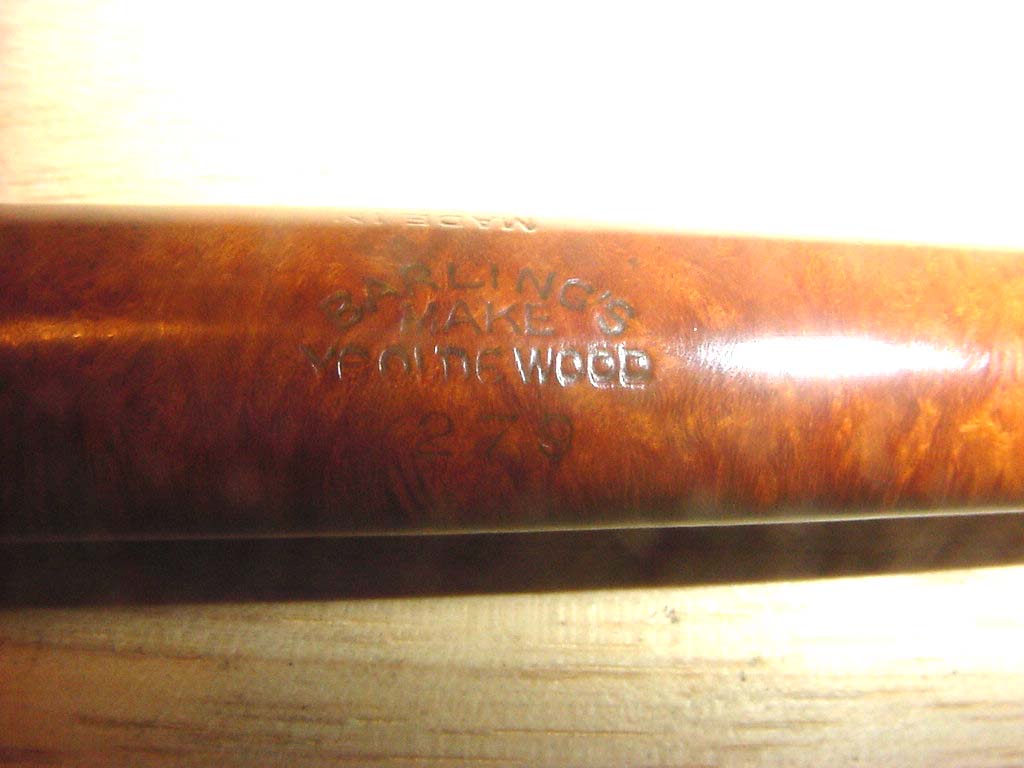
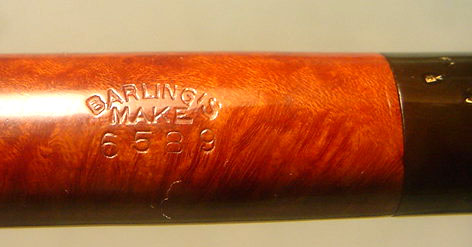
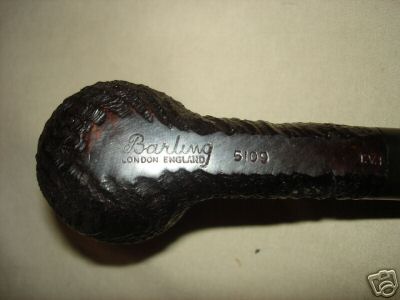
The following is a visual reference guide that allows the reader to identify the various eras of Barling nomenclature. Please note that some exceptions will occur since not every pipe had stampings that are completely in conformation to the norm.

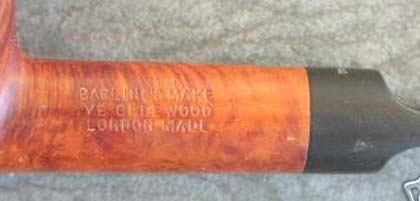
Barling1 Older Pre-transition nomenclature, probably 1900 or after. Date can be determined by silver hallmarks.

Barling2 Late 40’s – 1962 Typical Pre-Transition nomenclature

Barling3 Used only for the Guinea Grain US distributed pipes

Barling4 Typical Pre Transition nomenclature, M in Make is under the R. Shape number is three digits or four digits beginning with a 1 (for UK distributed pipes).

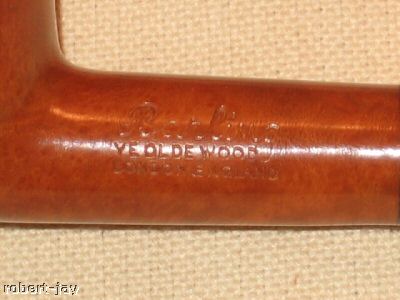
Barling5 Barling Early Transition Example: Ye Olde Wood remains but shape number is now four digits not beginning with a 1. First digit indicates size of pipe with 6 being “very large” and 7 being the largest. Pipes marked this way are thought to be late 1962 or 63’.

Barling6 Next version of early Transition Nomenclature: Ye Olde Wood is gone and shape number is four digits not beginning with a 1. First number of shape indicates size. Notice that the M in Make is now under the A.

Barling7 Typical Transition Barling Nomenclature, Barling is now in script.

Non Conforming Examples of Barling Nomenclature
Barling8 Probably a fake stamp

Barling9 Note Ye Olde Wood is present, with spaces between the words, but Barling is in script and London England. This is an error stamp probably done by factory worker not paying enough attention, or a stamp that was not used for very long. This is the only example of this stamp I have ever seen.

Barling10 The word London exists on a few examples only. This is a rare stamp that was used for a brief period, probably just before the company sold in 1962 or just after.

My Tobacco Classification / Touchstone Blends – by Eric Boehm


I remember when Eric originally posted this piece on Smokers Forums and I appreciated the work he did on it. I find it a helpful way of explaining tobaccos to newcomers and to refresh my own understanding of the tobaccos that I enjoy. I wrote and asked him if I could reproduce the article for the rebornpipes blog and he graciously consented. Here is Eric’s article on Tobacco Classification.

There are as many ways to classify pipe tobacco blends as there are pipe smokers, and then some. However, I have found the following list suits me. I see tobacco blends for the pipe smoker divided into 16 categories. An alternative, earlier, classification was provided by the Pipe Club of Norfolk UK, from which some of the categories originated. However, since this early list, a number of new categories have arisen, such as the Cigar Leaf Blends. Also, a number of pipe smokers have advocated against the terms “English Blends” and “Balkan Blends”, as many tobacco blends actually span the two and there really exists a continuum of sorts. So the terms “English Blends” and “Balkan Blends” have been dropped by many, in favor of the more descriptive terms “Latakia Mixtures”, which in turn is divided into “Light / Medium” and “Medium / Full”.

I am aware that this is a highly subjective exercise. And it is to be expected that everyone will have a different take on what constitutes a Touchstone Blend. Also, there will be “lumpers” and “splitters” – that is, those who feel there are too many categories and those who feel the need to split even more. What I hoped to do here, for myself really, was to set up a series of benchmark blends that I could later use as “standards” by which to judge future blends within a category. It is hoped that these lists will provide a jumping off point to begin exploring the wonderful world of pipe tobaccos for others as well.

1. Straight Virginias (non-flake, -rope etc.).
2. Virginia Flakes (Light).
3. Virginia Flakes (Full).
4. Virginia Plugs.
5. Virginia Ropes and Twists.
6. Lakeland Style.
7. Virginia / Kentucky Blends.
8. Virginia / Burley Blends.
9. Burley Blends.
10. Virginia / Perique Blends.
11. Virginia / Perique / Burley Blends.
12. Virginia / Oriental Blends.
13. Light / Medium Latakia Mixtures.
14. Medium / Full Latakia Mixtures.
15. Cigar Leaf Blends.
16. Aromatics.

1. Straight Virginias – non-flake, non-plug, non-ropes & twists.
Bulk No. 5100 Red Cake. McClelland Tobacco Company, USA. “This blend is a style of English Virginia that has seldom been seen in the United States. A sweet, exceptionally soft, fully rubbed matured cake”. Fire Cured Virginia. Cut: Ready Rubbed. Bulk.

Old Belt Ready Rubbed. W.O. Larsen, DK. “A blend of mature Orange Virginia tobaccos from the Old Belt in Virginia and North Carolina. The blend is lighted pressed into tobacco cakes, which are stored for aging. After cutting, the tobacco is rubbed out to facilitate easy filling of the pipe and an even burn. The tobacco burns exceptionally well with a cool smoke and a well-balanced and supreme natural taste”. Air Cured Virginia. Cut: Ready Rubbed. 100g Tin.

Red Ribbon. McCranie’s, USA. “A beautifully aged Red Virginia like no other. Brimming with rich, mellow flavor as only nature can provide. A special allotment of prime 2000 crop North Carolina leaf has been secured for our discriminating pipe smokers. The softest, most enjoyable straight Virginia we’ve ever smoked. With a light vacuum seal, the tobacco will continue to mellow with age”. Air cured Virginia. 50g tin.

Virginia No. 1. Mac Baren, DK. “A ready rubbed tobacco, manufactured from a selection of choice, ripe Virginia tobaccos, which gives Virginia No.1 a mild, sweet smoke”. Air cured Virginia. Flavoring: Sweet / sugar. Cut: Ready rubbed. 50g pouch, 100g tin, bulk.

Old Gowrie. Charles Rattray, DE. “This blend is a Virginia (with a hint of Perique) tobacco, rubbed-out for a finer cut”. Blender: Kohlhase, Kopp und Co. KG. Air cured Virginia, Perique. Cut: Ready Rubbed. 50g tin, 4oz tin, bulk. Note: Placed here rather than as a Virginia /Perique Blend because of the minor component of Perique.

2. Virginia Flakes (Light) –
Bulk No. 2010 Classic Virginia. McClelland Tobacco Company, USA. “This is a blend of Eastern and Middle Belt lemon, orange, and orange-red Virginias. A sweet, smooth, and zesty smoke”. Curing Group: Flue Cured. Contents: Virginia. Cut: Broken Flake. Packaging: Bulk.

Capstan Medium Navy Cut. Capstan, UK. “A medium to mild blend of carefully selected Virginia tobaccos with a natural aroma enhanced by a subtle flavour”. Curing Group: Air Cured. Contents: Virginia. Cut: Flake. Packaging: 50g Tin.

Hamborger Veermaster. Dan Tobacco, DE. “Classic sailor`s flake tobacco made from rich Golden Virginias, sweet and mild.. Curing Group: Air Cured. Contents: Virginia. Cut: Flake. Packaging: 50g tin.
Matured Virginias, No. 24. McClelland Tobacco Company, USA. “An unusual form of Flake tobacco, its deep chestnut color results from the extended aging of full flavored Old and Middle Belt leaf very lightly seasoned with Drama. A smooth, robust tobacco good anytime for those who prefer the darker Virginia flavor. Is is especially well suited for outdoor smoking”. Curing Group: Air Cured. Contents: Virginia, Oriental (Drama leaf). Cut: Broken Flake. Packaging: 50g & 100g tin.

Hal O’ the Wynd. Charles Rattray, DE. Blender: Kohlhase, Kopp und Co. KG. “A pure Virginian tobacco of a most unusual share of strength. This is a strong, sharp aged red Virginia blend that will perk you up quickly”. Curing Group: Air Cured. Contents: Virginia. Cut: Broken Flake. Packaging: 50g & 100g tin. (Note: The homepage Kohlhase & Kopp says “Kentucky-Virginia-Perique”. Flake rubbed by hand). Note: Many consider this at the top end of the light Virginia Flake Blend, rather than as a full.
Fog City Selection: Union Square. G. L. Pease, USA. “A blended, sliced cake of high-grade flue cured leaf, from beautiful, sweet brights to deep, earthy reds, without the added sugars and flavorings common to many Virginia flakes. It’s rich on the palate, evolving in layers with the clean, natural sweetness of pure tobaccos. It offers a pleasant room note, and a delightful finish. For those seeking the pure Virginia experience, try Union Square”. Curing Group: Flue Cured. Contents: Virginia. Cut: Flake. Packaging: 2oz & 8oz tins. Released in May, 2009. Note: Many consider this at the top end of the light Virginia Flake Blend, rather than as a full.

3. Virginia Flakes (Full) –
Full Virginia Flake. Samuel Gawith, UK. “Samuel Gawith Full Virginia Flake is for lovers of pure pressed Virginias. Created in the heart of Lakeland, the hot-pressed blended Virginias take on a delicious and distinctive dark colour that creates a pipe smokers dream, a feeling of calm, serenity and anticipation of the next pipeful. A “must have” for all Virginia lovers. Medium strength”. Curing Group: Air Cured. Contents: Virginia. Cut: Flake. Packaging: 50g tin.

Best Brown Flake. Samuel Gawith, UK. “A firm favourite for the pipe smoker looking for a medium strength, gentle and slow burning tobacco. Manufactured using hand-stripped flue cured Virginias with no flavours added, Best Brown will reward with a cool, sweet smoke with a delectable aroma and good sidestream. Mild to medium”. Curing Group: Flue Cured. Contents: Virginia. Cut: Flake. Packaging: 50g tin.

Personal Reserve: Blackwoods Flake. McClelland Tobacco Company, USA. “The characteristic, natural sweetness of mellow, Red Virginias mingles inextricably with the richness and inherently spicy aroma of Black Stoved Virginias in this doubly aged red and black all-Virginia cake mixture. An artistic achievement in tobaccos for the pipe, this beautiful mottled flake is incomparable in smoothness, balance and refinement”. Curing Group: Air Cured. Contents: Virginia. Cut: Broken Flake. Packaging: 50g & 100g tin.

Personal Reserve: Dark Star. McClelland Tobacco Company, USA. “Years before tinning, this tobacco begins as bright yellow, sugary top grade Virginia and Carolina leaf. Through careful triple aging, pressing and stoving, it becomes rich, cool and dark. A seductively spicy aroma develops during the extended maturing process to complement the complex flavor of this concentrated, smooth broken flake, which is easily rubbed out to suit any occasion”. Curing Group: Air Cured. Contents: Virginia. Cut: Broken Flake. Packaging: 50g & 100g tin.

Marlin Flake. Charles Rattray, DE. Blender: Kohlhase, Kopp und Co. KG. A companion to Old Gowrie. A shade darker, greater strength, different aroma, but otherwise a tobacco in the same tradition”. Curing Group: Flue Cured. Contents: Virginia. Cut: Flake. Packaging: 50g & 100g tin, Bulk.

4. Virginia Plugs –
Cut Virginia Plug. Fribourg & Treyer, DE. “ A full bodied, medium to full strength pressed flake. Very complex from start to finish with a well balanced taste that both boldly spicy and subtlety sweet”. Curing Group: Air Cured. Contents: Virginia. Cut: Flake. Packaging: 50g tin.

New World Collection: JackKnife Plug. G. L. Pease, USA. “JackKnife Plug – dark-fired Kentucky leaf and ripe red Virginia tobaccos, with their deep, earthy flavors, are layered on a central core of golden flue-cured for a hint of bright sweetness, then pressed and matured in cakes, and finally cut into 2oz blocks. Slice it thick and rub it out for a ribbon cut, thin for a shag, or chop it into cubes. The choice is yours”. Curing Group: Flue Cured. Kentucky, Virginia. Cut: Plug. Packaging: 2oz tin. Introduced in January, 2011.

New World Collection: Triple Play. G. L. Pease, USA. “Ripe red and bright flue-cured tobaccos are joined by piquant Acadian Perique and a balanced measure of smoky dark-fired Kentucky. The leaf is pressed and matured in cakes before being cut into 2oz bars, resulting in a bold blend for Virginia and Perique fans”. Curing Group: Flue Cured. Contents: Kentucky, Virginia, Perique. Cut: Plug. Packaging: 2oz bar. Introduced in May, 2011.

Peterson’s Perfect Plug. Peterson, IE. Blender: Kohlhase, Kopp & Co. “This excellent plug tobacco comprises selected Virginia leaf from Africa and Brazil blended with Burley leaf from Malawi. The tobaccos are lightly cased before drying and pressing and then are heated and stored for 2 weeks before cutting. The result is a full bodied yet fruity blend, sure to appeal to the experienced pipesmoker”. Curing Group: Air Cured. Contents: Burley, Virginia. Cut: Plug. Packaging: 50g tin.

Kendal Plug. Samuel Gawith, UK. “Whoever knows Samuel Gawith knows their famous Kendal Plug. The tobacco has a naturally sweet smell, and when burning it produces a very pleasant aroma. The taste tends to be sweetish, particularly at the beginning, and then slowly the sweetness gives some way to a whole range of taste variations, all very pleasant. It burns so slowly and evenly. A very satisfying smoke”. Curing Group: Flue Cured. Cut: Plug. Note: This may be better placed in the Lakeland category.

5. Virginia Ropes and Twists –
Black Irish Twist. Gawith, Hoggarth, & Co., UK. “All our twist tobacco varieties are manufactured by the same spinning process using dark fired wrapper leaves. The filler is again, predominantly dark fired leaf with the addition of a small percentage of dark air cured Indian leaf. They are therefore strong tobaccos. Black Twist, because the cooking process removes some of the stronger tar and nicotine elements, provides a milder smoke than the brown twist”. Curing Group: Flue Cured. Contents: Virginia. Cut: Rope. Packaging: Bulk.

Black XXX Rope. Samuel Gawith, UK. “This tobacco is not for the faint of heart. Strong and robust smoke”. Curing Group: Air Cured. Contents: Virginia. Cut: Rope. Packaging: Bulk

Brown Rope No. 4. Samuel Gawith, UK. “Twisted forms of aged dark brown leaf. Enormous flavor aroma and strength tamed with slow puffing”. Curing Group: Air Cured. Cut: Rope. Packaging: 50 g tin or Bulk.

Sweet Rum Twist. Gawith, Hoggarth, & Co., UK. “This is a twist made from the same ingredients as the Black and Brown Irish X. It has additional Rum flavoring added during manufacture. Again, this is a very strong tobacco as it does not undergo the pressure cooking process”. Curing Group: Air Cured. Contents: Virginia. Flavoring: Rum. Cut: Rope. Packaging: Bulk. Note: This could well be placed as a Lakeland.

6. Lakeland Style –
Best Brown Flake. Samuel Gawith, UK. “A firm favourite for the pipe smoker looking for a medium strength, gentle and slow burning tobacco. Manufactured using hand-stripped flue cured Virginias with no flavours added. Best Brown will reward with a cool, sweet smoke with a delectable aroma and good sidestream. Mild to medium”. Curing Group: Flue Cured. Contents: Virginia. Cut: Flake. Packaging: 50g Tin.

Broken Scotch Cake. Gawith, Hoggarth, & Co., UK. ”A very mild blend, using predominantly flue-cured Virginia, but with the addition of some sun-cured both to cool and sweeten the smoke. A rough-cut into very coarse pieces also contributes to cooling the smoke”. Curing Group: Flue Cured. Contents: Virginia. Cut: Coarse Cut. Packaging: 50g tin & Bulk.

Dark Birdseye. Gawith, Hoggarth, & Co., UK. “Manufactured from Dark tobacco ‘whole leaf’ rather than strips, the mid-rib (or stem) gives the ‘birds eye’ effect when cut. A strong smoke which was particularly favored by the fishermen as the finer cut meant the tobacco was easier to light and to keep-in on board ship when the weather was bad”. Curing Group: Flue Cured. Contents: Virginia. Cut: Ribbon. Packaging: Bulk.

Ennerdale Flake. Gawith, Hoggarth & Co., UK. “Our best selling flake by a wide margin. Predominately virginia leaf from Brazil, Zimbabwe and Malawi (86%) but with the addition of sun cured Malawi (10%) to add sweetness, strength and to cool the smoke and Malawi Burley (4%) to “carry the flavour” in addition to its cooling and strength qualities. (Burley is very good at absorbing casings and flavours) A background flavour of Almond is enhanced with the addition of fruit flavours, vanilla, and the special ‘English type’ flavours which give this tobacco its distinctive, yet typical ‘English’ Aroma associated with the UK best selling brands such as Condor, St Bruno and mellow Virginia”. Curing Group: Air Cured. Contents: Burley, Virginia. Flavoring: Fruit / Citrus, Almond, Vanilla. Cut: Flake. Packaging: 50g tin, Bulk.

Bob’s Chocolate Flake. Gawith, Hoggarth, & Co., UK. “The main characteristics of this flake come from the 8% Latakia included in the blend and the smooth chocolate aroma. Brazilian, Zimbabwe, Malawi virginia leaf make up 82% of the blend providing a mild/Medium smoke cooled with the addition of 8% Malawi sun cured and 2% Malawi Burley. The latakia cools but does also add strength and aroma. The cocoa casings and chocolate top flavours are rounded off with vanillas and other flavours providing sweet notes”. Curing Group: Air Cured. Contents: Burley, Virginia, Latakia. Flavoring: Alcohol /Liquor, Cocoa / Chocolate, Vanilla. Cut: Flake. Packaging: 50 tin & bulk.

Rum Flake. Gawith, Hoggarth, & Co., UK. “The ‘Christmas cake’ of all our tobaccos. A very rich, sweet fully flavoured blend. The main feature is the high proportion of naturally sweet sun-cured tobaccos in the blend – over 40% Only 30% Virginia leaf, with the rest of the blend coming from burleys and Dark-air cured contribute to a strong, but rewarding smoke. The whole blend is cased in maple sugars to further enhance the natural sweetness of the sun cured leaf and then rounded off with a dash of rum”. Curing Group: Air Cured. Contents: Burley, Virginia. Flavoring: Rum, Maple. Cut: Broken Flake. Packaging: 50g tis & bulk.

7. Virginia / Kentucky Blends –

660: Silver Flake. Solani, DE. Blender: R.L. Will. “An incredible blend of premium dark red and sweet Virginias from the “border belt”, light yellow Virginia from South Carolina and dark-fired, spicy Kentucky. Slow burning and because no flavoring has been added, this blend has a real tobacco taste”. Curing Group: Air Cured. Contents: Kentucky, Virginia. Cut: Flake. Packaging: 50g & 100g tin.

Three Nuns Original. Bell’s. Blender: Orlik Tobacco Company A/S, DK. “A blend of dark fired and sun cured tobaccos mixed with the finest Brazilian Lights to produce the unique flavour and mellow smoking characteristics for which Three Nuns is famous”. Curing Group: Flue Cured. Contents: Kentucky, Virginia. Cut: Curly Cut. Packaging: 50 or 100g tins. Note: In the original formula, from Imperial Tobacco, Three Nuns was a VA-PER mixture.

Original Mixtures: Cumberland. G. L. Pease, USA. “Robust and possessing a subdued sweetness, Cumberland is a delightfully orchestrated suite of American tobaccos, featuring a rare and exquisite mahogany Kentucky, aged in bales for twenty years. Red and matured Virginias establish a theme; the Kentucky and a pianissimo of Perique create the variations. Pure, natural tobacco flavors are harmonized by delicate arpeggios and underscored by deep, resonant tones. The coda is lovely and lingering – a perfect finish to a rich performance. Best savored slowly”. Curing Group: Flue Cured. Contents: Kentucky, Virginia, Perique. Cut: Coarse Cut. Packaging: 2oz & 8oz tin. Introduced in April, 2002. Note: An unusual blend that is not really a touchstone for this category.

8. Virginia / Burley Blends –
Golden Sliced (Red). Orlik Tobacco Company A/S, DK. “A delightful blend of golden and full body Virginibesta tobaccos with a touch of Burley. A fine natural sweetness in taste and aroma characterizes Orlik Golden Sliced. The cut is the traditional Navy Cut Flake i.e. pressed tobacco and cut into slices. Rub the tobacco slices gently before filling your pipe”. Curing Group: Flue Cured. Contents: Burley, Virginia. Cut: Flake. Packaging: 50g Pouch, 50g & 100g tins.

Long Golden Flake (No. 71). Reiner, DE. Blender: R.L. Will. “A very special blend of golden Virginias, a little “white” Burley, and a touch of Perique to make things interesting. Pressed into long flakes, sliced, then rolled in the tin in long strips”. Curing Group: Flue Cured. Contents: Burley, Virginia, Perique. Cut: Flake. Packaging: 100g tin.

University Flake. Peterson, IE. Blender: Kohlhase, Kopp & Co. “Originally manufactured in Ireland by Murray, and now manufactured in Germany by Kohlhase & Kopp. The new tin description reads “An easy smoking blend of fine Virginias and Burley tobaccos, made the traditional way.” Curing Group: Air Cured. Contents: Burley, Virginia. Flavoring: Plum. A light, berry-like top dressing applied that is evident in the smoke. The K&H website describes it as “pflaume” which is the German word for plum. Cut: Flake. Packaging: 50g Tin.

Original Mixtures: Barbary Coast. G. L. Pease, USA. “The finest cube-cut Burley, chosen for its deep, nutty flavors, forms a robust foundation for this sophisticated blend. Rich, red Virginia tobaccos are added for their subtle sweetness and complexity, while the unique spice of Perique provides added dimension. A delicate kiss of Brandy polishes the blend to a perfect finish. Barbary Coast is delightfully satisfying, with hints of black walnut, dark chocolate, and dried fruits. The perfect “all-day” smoke”! Curing Group: Sun Cured. Contents: Burley, Virginia, Perique. Flavoring: Brandy. Cut: Cube cut. Packaging: 2oz & 8oz tin. Introduced in March, 2001. Note: The addition of a brandy casing and a component of Perique make this an unusual blend – a type of aromatic burley.

Stonehaven. Esoterica Tobacciana, J.F. Germain & Son, UK. “A marriage of air-cured leaf and Burley with selected dark Virginia. Hard pressed and aged to produce brown flakes with dark undertones. A traditional English flake favored by experienced pipe smokers”. Curing Group: Air Cured. Contents: Burley, Virginia. Cut: Flake. Packaging: 8oz bag. Note: A highly atypical blend -definitely not a touchstone blend for the category. Included here to illustrate the absolute limits of the style. An oddball and an “envelope pusher” – but worth trying when available.

9. Burley Blends –

Carter Hall. John Middleton, Inc., USA. “Burley blended smoking mixture”. Curing Group:Air Cured. Contents: Burley, Virginia. Cut: Ribbon. Packaging: 1.5oz Pouch.

Prince Albert. John Middleton Inc., USA. “Crimp-cut, mild smoking mixture. Made in the USA”. Curing Group: Air Cured. Contents: Burley, Virginia (minor). Cut: Ribbon.

Half & Half. Pinkerton Tobacco, USA. “Burley based pipe tobacco. Made in the USA”. Heavy casing of Anise. Curing Group: Air Cured. Contents: Burley, Virginia. Flavoring: Anise. Cut: Ribbon. Packaging: 50g Pouch, 100g Tin. Note: Originally from an American Tobacco 19th century formula. Originally, it was a local Virginia favorite for both cigarettes and pipe tobacco.

Burley London Blend. Mac Baren, DK. “Introduced in 1965 and consists mainly of carefully selected Burley tobaccos. Just a little Virginia has been added to give the blend a natural sweetness. You will notice the slight natural chocolate note, which is found in all good Burley tobacco. The very special top flavor in combination with the tobaccos gives you a very distinct smoking pleasure”. Curing Group: Sun Cured. Contents: Burley, Virginia (minor). Flavoring: Cocoa /Chocolate. Cut: Ribbon. Packaging: 100g Tin.

Navy Flake. Mac Baren, DK. “A mild flake blended from the finest Burley tobaccos with added ripe Virginias and Cavendish. Navy Flake is light burning, making the lighting of the pipe very easy”. Curing Group: Air Cured. Contents: Burley, Cavendish, Virginia, Flavoring: Rum. Cut: Flake. Packaging: 50g Pouch, 100g tin. Introduced in 1965.

Wilke Nut Brown Burley. Pipeworks & Wilke, USA. Blender: Carole Burns. “A distinctive blend of aged cube cut Burley. An old fashioned slow burning tobacco with a naturally pleasant aroma, and no added sweeteners”. Curing Group: Air Cured. Contents: Burley, Virginia, Turkish. Cut: Cube. Packaging: Bulk.

10. Virginia / Perique Blends –
Escudo Navy Deluxe. Peter Stokkebye, DK. “A combination of full bodied Virginia from North Carolina and Virginia blended with Perique from Louisiana are the cornerstones in Escudo. The blend is pressed and matured before it is spun and cut into coins. This process ensures the unique character of Escudo. Produced by the Cope brothers from 1870 to 1936, at which point they were bought by Gallaher. Gallaher produced Escudo until 1994. A&C Petersen began production in 1997, with the original presses. Now blended by Peter Stokkebye, imported and distributed by Villager Stokkebye International”. Curing Group: Air Cured. Contents: Virginia, Perique. Cut: Curly Cut / Coins. Packaging: 50g tin.

St. James Flake. Samuel Gawith, UK. “A sumptuous blend of Virginias and Perique, this big, bold British style flake incorporates a generous proportion of St. James Parish, LA perique”. Curing Group: Flue Cured. Contents: Virginia, Perique. Cut: Flake. Packaging: 50g Tin.

Luxury Bullseye Flake. Peter Stokkebye, DK. “A blend of ripe Virginia tobacco spiced with pure Louisiana Perique. The distinctive aroma of Perique combined with the natural sweetness of Virginia tobaccos provides a wonderful characteristic taste. The center of mellow, fermented Black Cavendish serves to smoother the general impression and rounding the taste. It is all a handcrafted process from selecting the best tobacco, blending, rolling, cutting, and packing. The result is an unparalleled smoking experience”. Curing Group: Air Cured. Contents: Black Cavendish, Virginia, Perique. Cut: Curly Cut. Packaging: Bulk.

633 Virginia Flake with Perique. Solani, DE. Blender: R.L. Will. “A matured virginia, pressed flake, with premium perique”. Curing Group: Air Cured. Contents: Virginia, Perique. Cut: Flake. Packaging: 50g tin.

Bayou Morning Flake. Cornell & Diehl, USA. Blender: Bob Runowski. “Bayou Morning Flake is a much different tobacco from original bayou Morning. This is a very dark brown crumbly flake. To my taste it is very mellow and smooth with just the right amount of Perique”. Curing Group: Flue Cured. Contents: Virginia, Perique. Cut: Broken Flake. Packaging:50g tin.

Fog City Selection: Fillmore. G. L. Pease, USA. “A thick-sliced, broken flake in the Scottish tradition. Ripe red Virginia tobaccos are combined with a generous measure of fine Louisiana Perique, and then pressed to marry the components and deepen the flavors. The cakes are sliced and gently broken before tinning. Fillmore presents an elegant sweetness and delightful piquancy, enhanced by a creamy richness that develops throughout the bowl. Sit back, and enjoy a lovely,leisurely smoke”! Curing Group: Air Cured. Contents: Virginia, Perique. Cut: Broken Flake. Packaging: 2oz tin. Released in June, 2006.

Bulk No.2015 Virginia Flake. McClelland Tobacco Company, USA. “This tobacco is made from rich, orange and Red Virginias to which enough St. James Perique has been added to create a refreshing smoke”. Curing Group: Flue Cured. Contents: Virginia, Perique. Cut: Broken Flake. Packaging: Bulk.

Luxury Navy Flake. Peter Stokkebye, DK. “Very mature Old Belt flue-cured Virginia’s spiced with Louisiana Perique”. Curing Group: Flue Cured. Contents: Virginia, Perique. Cut: Flake. Packaging: Bulk.
Personal Reserve: St. James Woods. McClelland Tobacco Company, USA. “A highly sophisticated broken Flake of matured Red and Black stoved Virginias pressed with the finest Louisiana Perique. This beautiful, mottled tobacco has an especially deep, rich character with that mysterious and compelling aroma that is Perique’s alone. A truly satisfying delight for natural Virginia pipe tobacco”. Curing Group: Fire Cured. Contents: Virginia, Perique. Cut: Broken Flake. Packaging: 50g & 100g tin.

11. Virginia / Perique / Burley Blends –
Original Mixtures: Haddo’s Delight. G. L. Pease, USA. “Haddo’s Delight is a stout blend of several Virginia tobaccos with a generous measure of long-cut Perique. Unflavored Green River black Cavendish and a little air-cured white Burley ribbon provide fullness, body, and a bit of extra strength. Finally, an exclusive process darkens and marries the mixture, and gives the blend a subtle tin aroma of cocoa and dried fruit. The flavor is full on the palate, earthy, slightly sweet and intriguingly piquant, with overtones of figs and raisins. A wonderful blend for the Perique lover”! Curing Group: Air Cured. Contents: Burley, Black Cavendish, Virginia, Perique. Cut: Ribbon. Packaging: 2oz, 8oz & 16 oz tins. Introduced in August, 2000.

126: Old Joe Krantz. Cornell & Diehl, USA. Blender: Bob Runowski. “Ribbon and coarse cut burleys, perique and red virginia. Shades of brown with the characteristic mustiness of perique”. Curing Group: Air Cured. Contents: Burley, Virginia, Perique, Cut: Coarse Cut. Packaging: Bulk.

Exhausted Rooster. Cornell & Diehl, USA. Blender: Toney / Tarler. “C&D’s annual blend for the 2008 Chicago Show. A tasty flake of Virginias, Dark Fired Burley and a dash of Perique”. Curing Group: Air Cured. Contents: Burley, Virginia, Perique. Cut: Broken Flake. Packaging: 2 & 8 oz tins.

107: Haunted Bookshop. Cornell & Diehl, USA. Blender: Bob Runowski. “A predominantly Burley mixture with a touch of red Virginia and Perique”. Curing Group: Air Cured. Contents: Burley, Virginia, Perique. Cut: Ribbon. Packaging: Bulk. Note: some may place this blend in the Virginia / Burley Blend category on account of the heavy influence of the burley, but the inclusion of Perique brings it here.

12. Virginia / Oriental Blends –
Original Mixtures: Cairo. G. L. Pease, USA. “Cairo is a wonderfully complex mixture of red, orange and bright Virginia tobaccos, exotic oriental leaf, and just a whisper of Perique. The flavor is naturally sweet, slightly nutty, delicately spicy and rich. Subtle citrus-like notes harmoniously support the more robust flavors of the darker Virginias. A medium-bodied tobacco with a delicate aroma, Cairo will satisfy Virginia lovers and the connoisseur of oriental mixtures alike”. Curing Group: Air Cured. Contents: Virginia, Perique, Oriental. Cut: Ribbon. Packaging: 2 & 8 oz tins. Introduced March, 2000. Note: Due to the presence of Perique, some may wish to acknowledge this as a Virginia / Perique Blend, however to my palate the Perique is a very insignificant component to this blend.

Fog City Selection: Embarcadero. G. L. Pease, USA. “Rich, ripe red virginias are combined with top-grade Izmir leaf, pressed and aged in cakes, then sliced into flakes and tinned. The result is a wonderfully fragrant, natural blend with subdued sweetness, more “brut” than “demi-sec”, delightful toasty flavors, and hints of nuttiness and roasted coffee. Satisfying and refreshing; a comforting smoke, with enough complexity to keep it interesting”. Curing Group: Air Cured. Contents: Virginia, Turkish (Izmir Leaf). Cut: Coarse Cut. Packaging: 2 & 8 oz tins. Introduced July, 2007.

Dunhill Early Morning Pipe. Orlik Tobacco Company A/S, DK. “Sweet Oriental carefully blended with Bright and Red Virginias, pressed and lightly stoved. Great as the `first pipe` arousing the palate for the further pleasures of the day”. Curing Group: Air Cured. Contents: Virginia, Oriental. Cut: Ribbon. Packaging: 50g. Tin, 100g Tin. Previously released by Murray’s and Sons, UK.

Bulk No. 2045 Oriental Mixture. McClelland Tobacco Company, USA. “This is a soft and sweet, rich in light Orientals and Carolina tobaccos with less Latakia than No.2040. Curing Group: Flue Cured. Contents: Virginia, Latakia (slight), Orientals. Cut: Broken Flake. Packaging: Bulk.

Oriental No. 14. McClelland Tobacco Company, USA. ”Dark with Latakia and Black Virginias, deeply seasoned with Orientals, this is the classic full Scottish smoke”. Curing Group: Air Cured. Contents: Virginia, Latakia, Oriental. Cut: Ribbon. Packaging: 50g Tin, 100g Tin.

Grand Orientals: Drama Reserve. McClelland Tobacco Company, USA. “The famed Drama leaf is sweet and subtle with a natural olive oil fragrance. It is grown on the Southern slopes and foothills of the Rhodope Mountains, the Classic Drama Basma District in Greek Eastern Macedonia, and includes the renowned Mahalia. It is refreshing, delicate, intriguing. This blend is designed to demonstrate just why the classic top-grade Drama leaf is so celebrated”. Curing Group: Air Cured. Contents: Virginia, Oriental. Cut: Ribbon. Packaging: 50g & 100g tin.

Campanile. James Fox, DE. Blender: Planta. “A blend of Virginian and flavoured with pure Turkish leaf. It embodies absolutely no black tobaccos and is a blend which is delightfully smooth and sweet down to the last shred”. Curing Group: Air Cured. Contents: Virginia, Turkish. Cut: Ribbon. Packaging: 50g Tin.
Oriental. Robert McConnell, DE. Blender: Kohlhase, Kopp und Co. KG.”A century old formula, traditional mixture of Oriental and Virginia tobaccos. The formula contains a big fatty amount of Macedonia, Virginia Bright, Red Virginia and Cavendish added for even more sweetness”. Curing Group: Air Cured. Contents: Cavendish, Virginia, Oriental. Cut: Ribbon. Packaging: 50g Tin.

Oriental No. 40. Peretti, USA. “A blend entirely made of tobaccos from the Near East. It has richness and full flavor”. Curing Group: Air Cured. Contents: Virginia, Oriental, Turkish. Cut: Ribbon. Packaging: Bulk.

13. Light / Medium Latakia Mixtures –
Original Mixtures: Caravan. G. L. Pease, USA. “Rich, smoky Cyprian Latakia and a variety of wonderful Oriental tobaccos set the stage for the blend. Lemon and Red Virginias provide support, while adding a hint of sweetness. Finally, just a touch of air cured leaf is added for body. Caravan is full and exotic; rich and spicy. A classic Balkan style blend with our own special touch”. Curing Group: Fire Cured. Contents: Burley, Virginia, Latakia, Oriental. Cut: Ribbon. Packaging: 2 & 8oz tins. Note: Because of the presence of Latakia, GL Pease’s Caravan is placed here in the “Light / Medium Latakia” category, however, to my palate, the Latakia presence is subservient to the Virginias and Orientals which predominate, which could lead some to place this as an “Virginia / Oriental Blend”.

Fog City Selection: Ashbury. G. L. Pease, USA. “An alluring assortment of exotic oriental tobaccos is generously blended with bright and red Virginia leaf. Finally, just enough Cyprus Latakia is added to provide an alluring smokiness, resulting in a tobacco that can best be described as a light-medium Balkan mixture. This is the blend for gentlemen with a Bohemian spirit and a sense of adventure”. Curing Group: Air Cured. Contents: Virginia, Latakia, Oriental. Cut: Coarse Cut. Packaging: 2oz Tin. Released in October, 2005.

Old London Series: Chelsea Morning. G. L. Pease, USA. “Sweet red and bright Virginias, fragrant orientals, a bit of rich Cyprus Latakia, and just a pinch of Perique. The leaf is blended in layers, briefly pressed, then sliced and tumbled into ribbons. Lively and engaging, with a subtle fruitiness, and an elegant, creamy texture, it’s a great bowl to accompany the morning cup”. Curing Group: Flue Cured. Contents: Virginia, Latakia, Perique, Oriental. Cut: Ready Rubbed. Packaging: 2oz & 8oz tins. Introduced in October, 2009.

Classic Collection: Blackpoint. G. L. Pease, USA. “Blackpoint is a luxurious blend of red and lemon Virginias, Cyprian Latakia, exotic oriental tobaccos, and a perfect measure of Louisiana perique for a lively, piquant finish. The smoke is creamy and lingering, engaging the palate with a mouth-filling array of wonderful flavours. Reminiscent of raisins and stewed figs, fireplaces in the fall, walks in the forest… Perhaps the most complex in the collection. Perfect for evenings”. Curing Group: Flue Cured. Contents: Virginia, Latakia, Perique, Orienta. Cut: Ribbon. Packaging: 2oz & 8oz tins. Released in March, 2003.

Classic Collection: Kensington. G. L. Pease, USA. “Kensington is a Balkan style blend with restraint. Bright and red Virginias are combined with richly flavoured leaf from the orient and Cyprian Latakia in perfect measure for a wonderfully balanced smoke. Slightly sweeter than Charing Cross, and not quite as full due to a more delicate hand with the Latakia. Spicy, with an occasional suggestion of orange blossom. Complex, but never ponderous. A slightly lighter variant of the classic style”. Curing Group: Flue Cured. Contents: Virginia, Latakia, Oriental. Cut: Ribbon. Packaging: 2oz &, 8oz tins. Released in March, 2003.

Dunhill London Mixture. Orlik Tobacco Company A/S, DK. “Skillfully blended Latakia with Virgina and Turkish. Pleasant aroma and a flavor never tiring”. Curing Group: Air Cured. Contents: Virginia, Latakia, Turkish. Cut: Ribbon. Packaging: 50g Tin. Previously released by Murray’s and Sons, UK.
Dunhill Standard Mixture Medium. Orlik Tobacco Company A/S, DK. “Latakia, Orientals, East Carolina and Georgian, all lightly toasted. A slightly heavier companion to DUNHILL’s Standard Mixture Mild. Traditional English”. Curing Group: Flue Cured. Contents: Virginia, Latakia, Oriental. Cut: Ribbon. Packaging: 50g Tin. Previously released by Murray’s and Sons, UK.

And So To Bed. Esoterica Tobacciana, J.F. Germain & Son, UK. “Finest grade Virginia and Maryland type tobaccos are carefully aged and blended with Greek Oriental” leaf and top-grade Cyprian Latakia. The blend is then specially processed and additionally matured to produce a mellow full strength smoke with rich flavor and unique aroma”. Curing Group: Air Cured. Contents: Burley, Virginia, Latakia, Oriental, Maryland. Cut: Ribbon. Packaging: 50g Tin.

Margate. Esoterica Tobacciana, J.F. Germain & Son, UK. “A classical English mixture done in the “old style” of many of the fine tobaccos that have now disappeared from the market place. Choice Orientals and generous quantities of premium Cyprian Latakia keynote this rich, full bodied blend. A well balanced, robust and eminently satisfying smoke”. Curing Group: Air Cured. Contents: Latakia, Oriental. Cut: Ribbon. Packaging: 50g Tin, 8oz. Note: This blend could just as easily be placed in the “Medium / Full Latakia Mixture”, however, to my palate, the Orientals ride over the Latakia here.
Squadron Leader. Samuel Gawith, UK. “Bright and Dark Virginias blended together with Latakia and Turkish leaf to make this a cool medium bodied smoke”. Curing Group: Air Cured. Contents: Virginia, Latakia, Turkish. Cut: Ribbon. Packaging: 50g Tin. Note: I have placed this blend here, rather than under Virginia / Oriental Blends, because of the presence of the Latakia component.
Bald Headed Teacher. 4noggins, USA. Blender: Rich Gottlieb. “The old-fashioned burley taste comes through in full form, nutty and brisk, hitting on tangy notes along the way as the Virginia components catch on. There’s just enough Latakia to provide no more than perhaps a seasoning effect”. Curing Group: Air Cured. Contents: Burley, Virginia, Latakia. Cut: Ribbon. Packaging: Bulk. Note: Some may place this blend in the Virginia / Burley Blend category, however, the presence of Latakia suggests a Light / Medium Latakia Mixture placement.

101: Morley’s Best. Cornell & Diehl, USA. Blender: Bob Runowski. “This is a combination of three Burleys (rough cut, white & cubed), Virginia flake and Cyprian Latakia”. Blend Notes: Reminiscent of old original Blue Boar blend. Curing Group: Air Cured. Contents: Burley, Virginia, Latakia. Cut: Coarse cube cut. Packaging: Bulk. Note: Some may place this blend in the Virginia /Burley Blend category, however, the presence of Latakia suggests a Light /Medium Latakia Mixture placement.
Frog Morton. McClelland Tobacco Company. “An exceptionally dark, rich and full Latakia Mixture designed for those who desire really satisfying Latakia flavor but want a pipe tobacco soft enough to smoke anytime. It took Frog Morton four years designed for smoking in quiet serenity. It is his proudest achievement”. Curing Group: Air Cured. Contents: Virginia, Latakia. Cut: Ribbon. Packaging: 50g Tin, 100g Tin.

Frog Morton across the Pond. McClelland Tobacco Company, USA. “Remarkably cool-smoking, delightfully fragrant. Frog Morton journeyed far across the pond to find the exotic components for this rich, smooth pipe tobacco blend enhanced with rare Syrian Latakia. He says it was worth the trip”. Curing Group: Air Cured. Contents: Virginia, Latakia, Oriental. Cut: Ribbon. Packaging: 50g Tin, 100g Tin.

Frog Morton on the Town. McClelland Tobacco Company, USA. “Frog Morton formulated this exceptionally mellow blend, fragrant with Basma, smooth and rich with Latakia, for his evening at the opera. This is an elegant companion to the original, soft, full Latakia blend. Curing Group: Air Cured. Contents: Latakia, Oriental, Turkish. Cut: Ribbon. Packaging: 50g Tin, 100g Tin.

Esoterica: Penzance. “A wonderful complex secret recipe of the finest Virginias, choice Turkish and Orientals and Cyprian Latakia, all hand blended together, hard pressed and broad cut into thick flakes. Long matured and easily crumbled to facilitate pipe filling. This is one of the finest traditional English Flakes available anywhere”.

14. Medium / Full Latakia Mixtures –
066. Star of the East. Cornell & Diell, USA. “One half Latakia with a generous portion of Turkish and sweetened with stoved red Virginia”. Curing Group: Air Cured. Contents: Virginia, Latakia, Turkish. Cut: Ribbon. Packaging: Bulk.

Captain Earles: Ten Russians. “Ten Russians is a true delight for lovers of Latakia. Rich and full bodied, it is pressed to deliver a perfectly balanced blend to the true aficionado of full English tobaccos”.

Heirloom Collection: Westminster. G.L. Pease, USA. “The very essence of the traditional English mixture; rich, elegant, refined, and exquisitely balanced. New World red Virginias are enhanced with a gentle caress of bright leaf, then lavishly seasoned with rich oriental tobaccos and generous measures of noble Cyprus mountain Latakia. Westminster is a satisfying blend, presenting layers of flavor to delight the senses and develop in the bowl. A perfect everyday English mixture. Full-bodied”. Curing Group: Fire Cured. Contents: Virginia, Latakia, Orientas. Cut: Ribbon. Packaging: 2oz & 8oz tins. Introduced in January, 2007. Note: A detailed review of the blend has been posted at Luxury Tobacco Reviews.

Original Mixtures: Odyssey. G.L. Pease, USA. “Odyssey is huge – the biggest of the Pease blends. It’s loaded with Latakia and harmonized by exotic Orientals. Wonderful red and jet-black stoved Virginias provide a perfect counterpoint”. Curing Group: Fire Cured. Contents: Virginia, Latakia, Oriental. Cut: Ribbon. Packaging: 2oz & 8oz tins. Released in January, 2002.

Classic Collection: Abingdon. GL Pease, USA. “Abingdon is the fullest Balkan style blend in the range. It is rich and robust, powerful and forthright, yet still possessing subtlety and finesse. Dark flavors of wood and leather mingle with delicate undercurrents of sweetness, and deep earthy notes, while the oriental tobaccos provide hints of their verdant, sometimes herbaceous character. A big Balkan blend, reminding us once more of what these blends used to be. Because of the high percentage of dark and oriental tobaccos, it’s recommended to pack Abingdon a little less firmly than you might a lighter blend”. Curing Group: Fire Cured. Contents: Virginia, Latakia, Oriental, Turkish. Cut: Ribbon. Packaging: 2oz & 8oz tins. Released in July, 2003.

Classic Collection: Charing Cross. G.L. Pease, USA. “Charing Cross is a traditional Balkan style blend of fine Virginia leaf, richly seasoned with smoky Cyprian Latakia, and spiced with the exquisite and exotic tobaccos of the orient. This is the one for Latakia lovers. Hints of roasted cocoa beans, orange zest, green pepper and campfires. This is the big one – fuller than Blackpoint, and a little less sweet”. Curing Group: Flue Cured. Contents: Virginia, Latakia, Orienta. Cut: Ribbon. Packaging: 2oz & 8oz tins. Released in March, 2003.

Commonwealth Mixture. Samuel Gawith, UK. “Tin Description: 50% heavily steamed Virginia & 50% Cyprus Latakia.

Cornell & Diehl: Pirate Kake. “A smooth, robust blend with LOTS of exceptional Latakia accompanied by Turkish and cavendish cut Burley. This is the blend for the Latakia lover. No Virginias. Latakia at 70%”.

15. Cigar Leaf Blends –
GL Pease. Key Largo. “Deep, Earthy and Creamy. A distinguished broken flake of Red Virginia tobaccos, small leaf orientals, and a measure of Cyprus Latakia, spiced with velvety cigar wrapper leaf. Key Largo develops throughout the bowl, offering a satisfying and sturdy smoking experience, with beautifully balanced, richly textured layers of cocoa, dark roasted coffee, leather, and a lively, lingering finish”.

Cornell & Diehl: Habana Daydreams. “A flavorful blend of Virginias with Perique and unsweetened Black Cavendish. The mixture also features a dash of Latakia and a spoonful of cigar leaf”.

Cornell & Diehl: Billy Budd. “A heavy Latakia blend with rough-cut burley, bright Virginia flake and a good amount of rough-cut cigar leaf”.

16. Aromatics –
Lane’s 1Q Pipe Tobacco. “Lane’s 1Q Pipe Tobacco is amazingly popular. Void of any factory packaging and very unremarkably named, it’s surprising that Lane 1Q pipe tobacco easily ranks among the best-selling pipe tobacco in the world. But just a few puffs in, you’ll realize why. The tobacco selection consists of a perfectly proportioned blend of Golden Cavendish complimented by a touch of fire-cured Cavendish. Mellow in body, but big on flavor, this smooth, aromatic tobacco delivers a rich, sweet, and smooth experience that’s layered with notes of vanilla, oak, and fruit”.

Mac Baren: 7 Seas Regular. “Black Cavendish and Golden Burleys. A soft and exceptionally mellow smoke combined to create a delightful, aromatic taste”.

Captain Black: Regular (White). “The Captain Black blends are a line of aromatic Cavendish concoctions that enjoy an immensely widespread popularity the world over. This, the original mixture, combines rich black Cavendish with mellow Burleys”.

Cornell & Diehl: Autumn Evening. “A Red Virginia cavendish cased with a delicate maple flavor. An exceptionally smooth aromatic”.

Boswell’s Aromatic Blends. Berry Cobbler. “Hints of spice in the aroma that reminds me of a berry cobbler just out of the oven. Intense fruit aromas with a taste that is smooth the whole time. A light smoke and definitely a crowd pleaser”.

Boswell’s Aromatic Blends. Christmas Cookie. “Very mild blend which Dan has created by hand to maintain each tobacco’s individual characteristics. Christmas Cookie, tempts the most discriminating palate. Creates a delightful aroma. The name says it all. Created Nov. 2002. Here is an ideal tobacco for a Christmas gift, a tobacco that every pipe smoker will enjoy as a real Holiday Treat”!

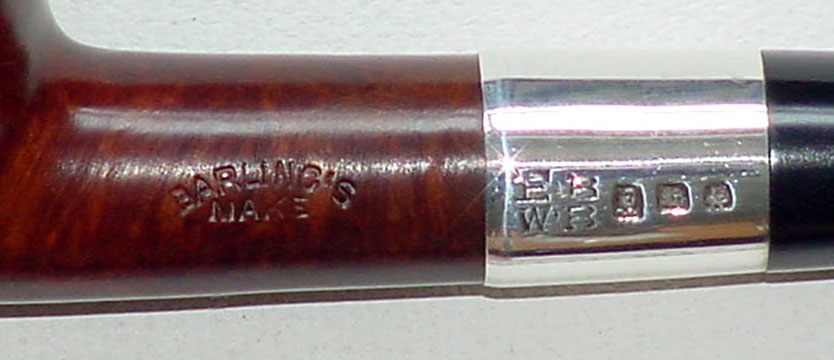
Stanwell Shapes – Compiled by Bas Stevens


Blog by Bas Stevens

In my experience Bas Stevens is one of the foremost authorities on Stanwell pipes. Whenever I find a shape I need information on or a pipe that I need help identifying the shape or the carver I email Bas and he has the information readily at hand. I picked up this shape listing from him some time ago and it identifies the shape by number and by designer. I found it extremely helpful so I wrote Bas and asked if I could post it here. Bas granted gracious permission and below is what Bas has provided.

1. Stack, straight shank; canted or angled rim, l-r;
a) Freehand, straight, angled rim, named Nefertite, by Sixten Ivarsson – late 1950s.
b) Freehand, Pick Ax, push mouthpiece, by Sixten Ivarsson. (1975)
2. Two versions of this shape number
a) Freehand, oval bowl and stem, by Sixten Ivarsson.
b) Bent, egg-shaped bowl, sloping top, full mouthpiece.
3. Billiard medium size, full mouthpiece.
4. Two versions of this shape number
a) Lovat with long stem.
b) Freehand, push mouthpiece, by Sixten Ivarsson. (Golden King)
5. Bulldog, oval shank
6. Two versions of this shape number
a) Dublin style by Sixten Ivarsson – 1951.
b) Freehand, large bent sitter, saddle mouthpiece.
7. Panel Free Hand, Free Hand w/panel or rectangular shank.
a) Slight bent, oval stem, full mouthpiece, by Sixten Ivarsson.
b) Bent, triangular stem, saddle mouthpiece.
8. Bent with push mouthpiece by Sixten Ivarsson.
9. Freehand, slightly bent, triangular bowl, special design mouthpiece, by Sixten Ivarsson.
10. Two versions of this shape number
a) Tulip bowl, oval stem, special design mouthpiece, by Sixten Ivarsson.
b) Bent with push mouthpiece by Sixten Ivarsson.
11. Two versions of this shape number
a) Billiard bowl, slightly bent, oval stem, by Sixten Ivarsson.
b) Large pot, slightly bent, saddle mouthpiece, by Sixten Ivarsson.
11R. Bulldog, bent, with long shank and long full mouthpiece by Anne Julie. Billiard w/saddle stem, Canted Pear by Sixten Ivarsson.
12. Large billiard, full mouthpiece
13. Two versions of this shape number
a) Pear-shaped bowl, oval stem, saddle mouthpiece, by Sixten Ivarsson.
b) Large billiard, saddle mouthpiece.
14. Large billiard, saddle mouthpiece.
15. Bent, triangular stem, saddle mouthpiece. (large 07-2)
16. Billiard, long stem, full mouthpiece.
17. Small billiard, rounded rim, saddle mouthpiece, by Sixten Ivarsson.
18. Pear-shaped bowl, slightly bent, oval stem, saddle mouthpiece, by Sixten Ivarsson.
19. Bent, triangular bowl, saddle mouthpiece.
20. Two versions of this shape
a) Freehand, boat-shaped, special design mouthpiece, by Sixten Ivarsson.
b) Freehand, large bent, saddle mouthpiece, by Sixten Ivarsson.
21. Bent, triangular bowl, saddle mouthpiece.
22. Two versions of this shape number
a) Billiard, oval stem, full mouthpiece.
b) Bent, flat bottom, saddle mouthpiece.
23. Freehand bent, rounded rim, saddle mouthpiece, by Sixten Ivarsson.
24. Two versions of this shape number
a) Freehand, slightly bent, oval stem and mouthpiece, by Sixten Ivarsson.
b) Freehand, push mouthpiece, by Sixten Ivarsson.
25. Two versions of this shape number
a) Same as 24a but larger, by Sixten Ivarsson.
b) Freehand, slightly bent, oval bowl, rounded top, saddle mouthpiece.
26. Freehand, slightly bent, oval, by Anne Julie.
27. Billiard, slightly bent, stem with metal ring, push mouthpiece.
28. Apple, full mouthpiece.
29. Billiard, medium size, full mouthpiece.
30. Freehand, bent, “Strawberry”, saddle mouthpiece, by Sixten Ivarsson.
31. Two versions of this shape number
a) Bulldog, saddle mouthpiece.
b) Freehand, large shape 30, by Sixten Ivarsson.
32. Two versions of this shaper number
a) Bulldog, saddle mouthpiece, Stanwell’s first pipe shape from 1942.
b) Freehand, bent, saddle mouthpiece, by Sixten Ivarsson. Redesigned by Tom Eltang in the early 1990s.
33. Two versions of this shaper number
a) Bulldog, full mouthpiece.
b) Bulldog, bent, push mouthpiece.
34. Two versions of this shaper number
a) Bulldog, slightly bent, sloping bowl, full mouthpiece, by Sixten Ivarsson.
b) Bulldog, slightly bent, push mouthpiece, by Sixten Ivarsson.
35. Two versions of this shaper number
a) Freehand, bent, saddle mouthpiece, by Sixten Ivarsson.
b) Freehand, bent, oval stem and mouthpiece, by Anne Julie.
36. Two versions of this shaper number
a) Freehand, slightly bent, oval stem and mouthpiece, saddle mouthpiece, by Sixten Ivarsson.
b) Freehand, bent, oval stem and mouthpiece, by Anne Julie – 1975.
37. Freehand, bent, sitter, oval stem and mouthpiece, by Sixten Ivarsson.
38. Two versions of this shaper number
a) Lovat, short saddle mouthpiece.
b) Small bent, short saddle mouthpiece.
39. Freehand, egg-shaped bowl, long saddle mouthpiece, by Sixten Ivarsson.
40. Small billiard, oval stem, saddle mouthpiece..
41. Medium billiard (bowl29), metal ring, push mouthpiece, by Sixten Ivarsson. Last produced in 1980.
42. Two versions of this shaper number
a) Billiard, slightly bent, long saddle mouthpiece, by Sixten Ivarsson.
b) Freehand, full bent, rectangular stem and mouthpiece.
43. Freehand, full bent, large ball-shaped bowl, saddle mouthpiece.
44. Two versions of this shaper number
a) Small billiard, full mouthpiece.
b) Freehand, slightly bent, oval stem, short saddle mouthpiece. (1975)
45. Pot, medium size, full mouthpiece.
46. Prince, medium size, full mouthpiece.
47. Small freehand, slightly bent, oval stem and mouthpiece, by Anne Julie – 1950s.
48. Freehand, egg-shaped bowl with rounded rim, long saddle mouthpiece, by Sixten Ivarsson.
49. Two versions of this shaper number
a) Dublin, slightly bent, oval stem and mouthpiece.
b) Freehand, bent saddle mouthpiece.
50. Billiard, large size, oval stem and mouthpiece.
51. Small billiard, full mouthpiece.
52. Small billiard, full mouthpiece.
53. Medium size billiard, saddle mouthpiece.
54. Two versions of this shaper number
a) Freehand, large bent, saddle mouthpiece, by Sixten Ivarsson.
b) Medium size billiard, saddle mouthpiece.
55. Two versions of this shaper number
a) Oval bent Dublin, oval stem, saddle mouthpiece, by Sixten Ivarsson. Designed and introduced in the late 1950’s to early 1960s.
b) Freehand, slightly bent, saddle mouthpiece.
56. Canadian, full mouthpiece.
57. Small billiard, full mouthpiece.
58. Small billiard, full mouthpiece.
59. Freehand, slightly bent, saddle mouthpiece, by Sixten Ivarsson.
60. “Chimney, saddle mouthpiece.
61. Small billiard, long 75mm full mouthpiece.
62. Two versions of this shaper number
a) Liverpool, medium size.
b) Freehand, Plateau top, saddle mouthpiece, by Sixten Ivarsson.
63. Freehand, Plateau top, saddle mouthpiece, by Sixten Ivarsson.
64. Two versions of this shaper number
a) Freehand, Plateau top, saddle mouthpiece, by Sixten Ivarsson.
b) Bent billiard, medium size, full mouthpiece.
65. Dublin, full mouthpiece.
66. “Chimney”, saddle mouthpiece.
67. Small oval bowl, slightly bent, full mouthpiece.
68. Poker, saddle mouthpiece.
69. Two versions of this shaper number
a) Dublin.
b) Same as shape 67 but larger.
70. Two versions of this shaper number
a) Freehand, slightly bent, sitter, oval stem and mouthpiece, by Sixten Ivarsson – 1967.
b) Canted Billiard with pencil shank.
71. Freehand, rounded rim, oval stem, saddle mouthpiece, by Sixten Ivarsson.
72. Billiard, medium size, full mouthpiece.
73. No shape
74. Canadian, medium size.
75. Freehand, slightly bent, oval stem & mouthpiece, by Sixten Ivarsson.
76. Liverpool, medium size.
77. Two versions of this shaper number
a) Freehand, slightly bent, saddle mouthpiece, by Sixten Ivarsson.
b) Freehand, oval bowl, saddle mouthpiece, by Sixten Ivarsson.
78. Freehand, oval bowl and stem, saddle mouthpiece, by Sixten Ivarsson – 1950s.
79. Dublin, slightly bent, saddle mouthpiece, by Sixten Ivarsson.
80. Two versions of this shaper number
a) Small billiard, saddle mouthpiece.
b) Large bent billiard.
81. Two versions of this shaper number
a) “Chimney”, saddle mouthpiece.
b) Large billiard, saddle mouthpiece.
82. Pickaxe
83. Two versions of this shaper number
a) Large Pot, full mouthpiece.
b) Bent Billiard, medium size, full mouthpiece.
84. Two versions of this shaper number
a) Dublin, slightly bent with oval stem.
b) Large bent, saddle mouthpiece by Tom Eltang.
85. Two versions of this shaper number
a) Freehand, bent, saddle mouthpiece by Sixten Ivarsson – late ‘50’s to ‘60’s (info rec’d from Tom Eltang).
b) Bent Billiard saddle mouthpiece. (discontinued – 2006 and replaced with shape 246).
86. Two versions of this shaper number
a) Freehand, slightly bent, full mouthpiece by Sixten Ivarsson.
b) Large billiard, full mouthpiece.
87. Four versions of this shape number
a) Large billiard, full mouthpiece.
b) Large “Chimney”, full mouthpiece.
c) Freehand, conical bowl, long saddle mouthpiece by Sixten Ivarsson.
d) Large ball, full mouthpiece.
88. Three versions of this shape number
a) Large “Chimney”, full mouthpiece.
b) Billiard, medium size, very short, full mouthpiece.
c) Billiard, full mouthpiece.
89. Two versions of this shaper number
a) Freehand, oval stem, short oval saddle mouthpiece, by Sixten Ivarsson.
b) Large pot, thin, long saddle mouthpiece.
90. Freehand, ball shaped, saddle mouthpiece by Sixten Ivarsson – 1951.
91. Freehand, large flat bowl, saddle mouthpiece, “Ukulele” by Sixten Ivarsson.
92. same as shape 91 but smaller by Sixten Ivarsson.
93. Two versions of this shaper number
a) Small Dublin, saddle mouthpiece.
b) Large Canadian.
94. Two versions of this shaper number
a) Egg-shaped bowl with oval stem.
b) Freehand, straight, oval bowl and stem – 1950s.
95. Two versions of this shaper number
a) “Chimney”, full mouthpiece.
b) same as shape 86 but larger by Sixten Ivarsson.
96. Freehand, oval bowl, long saddle mouthpiece by Sixten Ivarsson.
97. Two versions of this shaper number
a) “Chimney”, saddle mouthpiece.
b) Liverpool.
98. Two versions of this shaper number
a) Pot, saddle mouthpiece.
b) Lovat.
99. Liverpool
100.
101. “Elegence”. Push mouthpiece with a plastic connector. Small No. 48.
102. “Elegence”. Push mouthpiece with a plastic connector, bent oval bowl.
103. “Elegence”. Push mouthpiece with a plastic connector, small billiard.
104. “Elegence”, Push mouthpiece with a plastic connector. Small No. 86 by Sixten Ivarsson.
105. “Elegence”. Push mouthpiece with a plastic connector. Small No. 08 by Sixten Ivarsson.
106. “Elegence”. Push mouthpiece with a plastic connector. Small No. 79 by Sixten Ivarsson.
107. Small Billiard, full mouthpiece.
108. Freehand, sloping bowl, sadle mouthpiece by Tom Eltang.
109. Flat, ball-shaped bowl, slightly bent, full mouthpiece.
110. Freehand, oval bowl, slightly bent, saddle mouthpiece by Sixten Ivarsson.
111. Freehand, bent, saddle mouthpiece.
112. Freehand, slightly bent, short saddle mouthpiece.
113. Canadian with conical bowl.
114.
115. Same as shape 111 with push mouthpiece..
116. Pot with oval stem.
117.
118. Freehand, slightly bent, saddle mouthpiece by Sixten Ivarsson.
119. Freehand, oval bowl, slightly bent, saddle mouthpiece.
120. Large bent, conical bowl, full mouthpiece.
121. Large ball-shaped bowl, full mouthpiece.
122. Small Billiard, oval stem.
123. Small bent Billiard.
124. Freehand, long conical stem, short saddle mouthpiece by Sixten Ivarsson.
125. Freehand, slightly bent, saddle mouthpiece by Tom Eltang.
126. Same as shape 125 but with plateau top by Tom Eltang.
127. Freehand strongly bent, saddle mouthpiece, similar to shape 39, by Sixten Ivarsson.
128. Freehand, slightly bent, ball-shaped, long saddle mouthpiece by Tom Eltang.
129. Large, ball-shaped, strongly bent, long saddle mouthpiece by Tom Eltang.
130. Freehand, bent with push/long saddle mouthpiece.
131. Ball shaped with long stem, short saddle mouthpiece by Tom Eltang.
132. Large Billiard.
133. Bent, ball-shaped with saddle mouthpiece.
134. Freehand, slightly bent, with push mouthpiece by Tom Eltang.
135. Freehand, slightly bent, saddle mouthpiece by Tom Eltang. .
136. Bent, sloping bowl, saddle mouthpiece by Tom Eltang.
137. Small Dublin, sloping bowl by Tom Eltang.
138.
139.
140. Small freehand, slightly bent, full mouthpiece by Jess Chonowitsch.
141. Billiard, medium size, conical bowl, full mouthpiece by Jess Chonowitsch.
142. Freehand, bent, saddle mouthpiece by Jess Chonowitsch.
143.
144. Freehand, large bent, plateau top, long saddle mouthpiece by Jess Chonowitsch.
145. Freehand, sloping bowl, long stem, short saddle mouthpiece by Jess Chonowitsch.
146. Freehand, oval stem saddle mouthpiece by Jess Chonowitsch.
147. Small pot, oval stem, short saddle mouthpiece by Jess Chonowitsch.
148. Canadian, short saddle mouthpiece by Jess Chonowitsch.
149.
150. Special series, “Junior”, small shapes, filter only.
151. Same
152. Same
153. Same
154. Same
155. Same
156. Rhodesian by Jess Chonowitsch.
157. Freehand, slightly bent, full mouthpiece by Jess Chonowitsch.
158. Freehand, oval bowl, slightly bent, saddle mouthpiece by Jess Chonowitsch.
159. Large Billiard, conical bowl by Jess Chonowitsch.
160. Large bent, conical bowl by Jess Chonowitsch.
161. Large bent Bulldog, saddle mouthpiece by Jess Chonowitsch.
162. Calabash, with brass ring by Jess Chonowitsch.
163. Freehand, “Facet”, hexagonal, with brass ring by Jess Chonowitsch.
164. Freehand, “Trio”, with brass ring by Tom Eltang.
165. Large bent, full mouthpiece.
166. Large bent, “sitter”, saddle mouthpiece by Jess Chonowitsch.
167. Freehand, “Omega”, with brass ring by Jess Chonowitsch.
168. Freehand, “Golf”, with brass ring by Jess Chonowitsch.
169. Large Billiard, conical bowl, full mouthpiece by Bang – 1986.
170. Large “Rhodesian”, with brass ring, saddle mouthpiece by Bang.
171. Freehand “Hexagon”, large bent, with brass ring by Bang.
172. Freehand “Viking”, with brass ring by Jess Chonowitsch.
173. “Rhodesian”, with brass ring, full mouthpiece by Bang.
174. Liverpool.
175. Medium “Chimney”, full mouthpiece.
176. Small ball-shaped bowl, oval stem, short full mouthpiece.
177. Billiard, oval stem, short saddle mouthpiece by Tom Eltang.
178. Billiard, conical bowl, oval stem with panels, full mouthpiece by Bang.
179. Same as shape 178 but slightly bent.
180. Freehand, conical bowl, oval stem, short saddle mouthpiece by Tom Eltang.
181. Same as shape 180 but with Plateau top by Tom Eltang.
182. Same as shape 179 but larger and with filter only by Bang.
183. Large bent, oval stem with panels, saddle mouthpiece.
184. Large conical bowl, oval stem with panels, slightly bent, saddle mouthpiece.
185. Large bent, full mouthpiece.
186. Freehand, large bent, egg-shaped bowl, saddle mouthpiece.
187. Freehand, conical bowl, square stem, saddle mouthpiece.
188. Large bent Bulldog, saddle mouthpiece by Bang.
189. Freehand, “Rhodesian bowl”, oval stem with panels, saddle mouthpiece by Bang.
190. Billiard with hexagon stem, brass ring, full mouthpiece by Tom Eltang – 1992.
191. Small Rhodesian by Tom Eltang.
192. Large Pot with short saddle mouthpiece.
193. Apple, slightly bent, short saddle mouthpiece.
194. Freehand, “Facet” with panels, brass ring, full mouthpiece.
195. Large but short Billiard, full mouthpiece.
196. Large but short Apple, full mouthpiece.
197.
198. Freehand “Boa” with brass ring
199. Featherweight, Billiard with hexagon stem and brass ring by Tom Eltang.
200. Featherweight, Freehand, small shape 86.
201. Featherweight, Canadian.
202. Featherweight, Lovat.
203. Freehand “Diamond.
204. Freehand, slightly bent, square bowl and stem, saddle mouthpiece.
205. Freehand “Lotus” with brass ring.
206. Freehand “Lilje” with brass ring.
207. Poker.
208. Sixtus, with hexagon stem and mouthpiece, brass ring, Billiard by Tom Eltang.
209. Sixtus, with hexagon stem and mouthpiece, brass ring, Apple by Tom Eltang.
210. Sixtus, with hexagon stem and mouthpiece, brass ring, Pot by Tom Eltang.
211. Sixtus, with hexagon stem and mouthpiece, brass ring, Freehand by Tom Eltang.
212. Sixtus, with hexagon stem and mouthpiece, brass ring, Freehand by Tom Eltang.
213. Sixtus, with hexagon stem and mouthpiece, brass ring, Freehand by Tom Eltang.
214. Freehand, slightly bent, square stem and mouthpiece.
215. Freehand, slightly bent, triangular stem, saddle mouthpiece by Poul Ilsted.
216. Cutty.
217. Freehand oval Horn by Jess Chonowitsch.
218.
219.
220. Liverpool.
221.
222.
223.
224.
225. Freehand with oval shank.
226. Tulip.
227. Trim bent Dublin with saddle mouthpiece by Tom Eltang.
228. Dublin by Tom Eltang.
229.
230.
231.
232. Bent Billiard, sits on flat shank by Tom Eltang.
233.
234. Billiard with oval shank by Poul Winslow.
235. Island Pipe, FANO.
236. Island Pipe, BORNHOLM.
237. Island Pipe, SJAELLAND.
238. Island Pipe, FYN.
239.
240.
241. Featherweight by Tom Eltang – 2005.
242. Featherweight by Tom Eltang – 2005.
243. Featherweight by Tom Eltang – 2005.
244. Featherweight by Tom Eltang – 2005.
245. Featherweight by Tom Eltang – 2005.
246. Slimmed-down shape 86 – 2005.
247. Spring, by Poul Winslow – 2005.
248. Summer, by Poul Winslow – 2005.
249. Fall, by Poul Winslow – 2005.
250. Winter, by Poul Winslow – 2005.
251.
252.
253.
254.
255.
256. Statement Series by Tom Eltang.
257. Statement Series by Tom Eltang.
258. Statement Series by Tom Eltang.
259. Statement Series by Tom Eltang.
260. Statement Series by Tom Eltang.
291. 1/8 bent Apple
482. Pickaxe
1240 Pot, slightly bent, saddle mouthpiece by Sixteen Ivarsson.
2606. Sitter by Sixten Ivarsson.
POY 1985 by Jess Chonowitsch.
POY 1986 Straight Apple by Tom Eltang.
POY 1987 by Tom Eltang.
POY 1988 by Tom Eltang.
POY 1989 by Bang. (info from J.G.)
POY 1990 by Tom Eltang.
POY 1991 by Jess Chonowitsch.
POY 1992 by Tom Eltang.
POY 1993 by Sixten Ivarsson.
POY 1995 Modified Dublin/Horn by Tom Eltang.
POY 1996 Billiard w/ Saddle Stem by Tom Eltang.
POY 1997 by Tom Eltang.
POY 1998 by Tom Eltang.
POY 1999 by Tom Eltang.
POY 2000 by Tom Eltang.
POY 2001 by Tom Eltang.
POY 2002 Pot/Billiard by Tom Eltang.
POY 2003 Billiard w/oval shank by Tom Eltang.
POY 2004 Bent Apple w/oval shank by Tom Eltang.
POY 2005 Straight Apple/Brandy by Tom Eltang.
POY 2006 Bent elongated Peewit by Tom Eltang.

© Basil D. Stevens

Tobacciana – Gifted a PIPE Lighter


I was gifted a pipe lighter – no I mean really a Pipe lighter. A friend gave me this Pipe shaped lighter because he knows that I appreciate the quirky pipe ephemera that are a part of our hobby. I collect the oddities along with the pipes, so this fit right into my collection. There is a part of me that supposes it was a hoax but it is never the less actually very unique. It is a heavy lighter as the bowl is made of metal and painted to look like wood. The stem is cast plastic and the end; the button is metal as well. The oval slot in the button is where the flame comes out. The bowl cap is a plastic button, spring loaded so that when it is depressed the butane is released and the igniter in the button sparks and the flame is sent out the button. The lighter is butane and is refillable on the bowl bottom.

IMG_1728

IMG_1729

The lighter works quite well. The first time I used the lighter the heat of the flame melted the stem in front of the button and there is a “bite through” now. I may have to do a repair with the superglue and build it up so that the hole no longer is present. On the other hand it looks kind of well used the way it is. In the slot there is an igniter that sparks when the cap is depressed. The lead of the igniter is slanted toward the tube that carries the butane and when the spark hits the butane the flame leaps out as can be seen in the last photo below.

IMG_1730

IMG_1731

That is it for the quirky PIPE lighter – truly an interesting addition to my collection of tobacciana ephemera. I usually have it on the desk or in the pipe cabinet. It is quite heavy and makes a great decorative piece. Anybody else have one of these?

Courtesy of Choice – an Unheard of Option Today


My wife and I flew into Budapest and caught a ride to our hotel – the Hotel Budapest. It was a great cylindrical building on the Buda side of the Danube. We checked into our room and after unpacking set out to explore the hotel a bit. We needed some dinner and were interested in checking out the pub at the back of the hotel.

We looked through the gift shop, enjoyed the amazing embroidery and jewelry that were on display. Picked up a few postcards for the kids and then made our way back to the pub. Being from Canada we had no expectations about firing up my pipe but I had it in my coat pocket anyway. We went into the pub that first night and were quite astonished at what we saw and smelled! There were folks smoking pipes and cigars in half the room and the other half was non-smokers. The laughter and conversation was lively and loud. The two groups seemed to be quite oblivious to each other and were enjoying their evening.

The bar was in the middle of the room. So we picked our drinks and made our way to the smoking area – literally over half of the room. We put our drinks on the table and our coats on the chair backs and sat down. Sitting in the middle of the table there was a great card – I liberated one as I expect it will be a thing of the past – if it isn’t already! I read over the words below and enjoyed the sensibility of them. They were printed in Hungarian and English. Certainly very Canadian sounding to me – but certainly very foreign to the Canada I knew.

Choice2

Choice1

Here is what the card said on the inside in English:

Courtesy of Choice
The concept and symbol of Courtesy of Choice
reflect the centuries-old philosophy that
acknowledges differences while allowing
them to exist together in harmony.

Courtesy of Choice accommodates the
preferences of individuals by offering both
smoking and non-smoking areas in the
spirit of conviviality and mutual respect.

International Hotel & Restaurant Association

I packed my pipe and lit it while I settled back with my wife for a quiet evening before we headed up to our room for the night. Needless to say we spent nearly every evening in the pub during our 17 day stay in Budapest. The spirit of conviviality was alive and well in the pub with a courtesy of choice.

A Peterson Dating Guide; a Rule of Thumb – Mike Leverette


Blog by Mike Leverette

Many years ago now, Mike Leverette sent me a copy of this document. I have had it on the hard drive since sometime late in 2006. I am sure there are newer iterations of the material but I have found this little piece very helpful. I am looking forward with expectation to the book that is being worked on now by Mark Irwin and others. It will certainly be a definitive work on Peterson Pipes. Until then I use the Peterson forum and refer to this article by Mike.

A Peterson Dating Guide; a Rule of Thumb

This guide first appeared in pipelore.net on August 26, 2006 by: Mike Leverette

Introduction

The history of Ireland is an old and honorable one; steeped in warfare, family, racial and religious traditions. No other country can compete in comparison. However, the first couple of millennia of Irish history have no relevance to this dating guide. Should you wish to read more on the history of the Irish, I recommend “The Story of the Irish Race” by Seumas MacManus who gives a very vivid, and near as we can tell an accurate portrayal of their history.

History pertinent to our purposes began in the year 1865; the year Charles Peterson opened a small tobacco shop in Dublin. Later in 1875, Charles Peterson approached the Kapp brothers, Fredrich and Heinrich, with a new pipe design and with this, a very long-lived partnership was formed, Kapp & Peterson. This new pipe design is the now famous Peterson Patented System Smoking Pipe. By 1890, Kapp & Peterson was the most respected pipe and tobacco manufacturer in Ireland and rapidly gaining followers in England and America. In 1898 another of Peterson’s remarkable inventions became available, the Peterson-Lip (P-Lip) mouthpiece, also known as the Steck mouthpiece. So for the purpose of this dating guide, we will study Irish history, relevant to our pipe dating needs, from 1870s until now.
Before we start with this Peterson dating guide, an observation; the Kapp Brothers were making pipes as early as the 1850s and in many of the shapes we now associate with Peterson since the Kapp Brothers simply took their existing shapes and incorporated Charles Peterson’ s patented design into them. From their inception, Kapp & Peterson’s goal was to make a good smoking pipe that the ordinary, common working man could afford and we believe they have, very admirably, lived up to this.

Explanation of Title

The vagaries of Peterson’s processes do not allow for an accurate dating guide so this guide is a ‘rule-of-thumb’ guide only. For example; Peterson did not take up the old Country of Manufacture stamps as new ones were issued so depending on which one the various workers happen to pick up, the stamps can and do cross over the boundaries of the various Eras. Some of the pipes of the Sherlock Holmes Series of the 1980s have pre-Republic stamps, as well as other pipes produced in 2000. However, there will not be too many of these missed stamped pipes. For silver anomalies, see the section on silver marks.

Stamping of Bowls

During the years of Kapp and Peterson’s business operations, the country of Ireland has undergone several name changes and K&P’s stamping on their pipes reflects these changes. Knowing these changes, a Peterson pipe can be roughly dated and placed in “eras.”
• The Patent Era was between the years of K&P’s formation until the expiration of the patent; 1875 through approximately 1910. Though for our purposes we will list this era as 1875 through 1922. Peterson pipes made during the majority of this period had no “Country of Manufacture” (COM) stamped on them. However, later in this period, say around 1915/16, Peterson began stamping their pipes “Made in Ireland” in a block format.
• The Irish Free State was formed on 15 January 1922. So the Free State Era will be from 1922 through 1937. Peterson followed with a COM stamp of “Irish Free State” in either one or two lines, either parallel or perpendicular to the shanks axis and extremely close to the stem.
• Eire was formed on 29 December 1937. The Made in Eire Era will be from 1938 through roughly 1940? or 1941?. For dates with ?’s, see below. Peterson now stamped their pipes with “Made in Eire” in a circle format with “Made” and “Eire” in a circle with the “in” located in the center of the circle. This COM was used during the years of 1938 – 1940?/41?. Later they stamped their pipes with “Made in Ireland” in a circle format (1945?-1947?) and still later with “Made in Ireland” in a block format (1947?-1949). The “Made in Ireland” block format came in either one line or two lines.
• The Republic Era is from 1949 until the present. The Republic of Ireland was formed on 17 April 1949. From 1949 to present the stamp for this era is “Made in the Republic of Ireland” in a block format generally in three lines but two lines have been used with or without Republic being abbreviated.
•English made Peterson pipes actually spans between the pre-Republic and Republic eras. In 1895, Peterson opened a shop in London England that lasted until the late 1950s or early 1960s. So the English Era, for a simplified date, will be from 1895 through 1959. The stamps Peterson used in London and that we have seen are:
Made in England – block format
Made in England – circle format
Made in London
Made in London England
Simply, London England
Great Britain

Though there are a couple of more, the above will give one the general idea. We believe the earliest stamp of this era was the “Made in England” in a block format since Peterson was using the “Made in Ireland” block format at about the same time on their Irish production pipes. The “Made in England” circle format was used during the same time frame as the “Made in Eire” and “Made in Ireland” circle formats.

As one can see this is pretty straightforward but there have been inconsistencies within this method of stamping. Peterson was never very energetic in removing their old stamps from the work stations so the older stamps can and did cross-over into the newer Era’s.

The explanation for the question marks in the 1940’s dates is, during the Second World War briar was hard to come by for obvious reasons, so no one can say for sure what years Peterson produced briar pipes and how many briar pipes were produced in those years. Why the switch from “Made in Eire” to “Made in Ireland” is anyone’s guess since the country was still technically Eire until 1949. As a point of interest and due to the shortage of briar, Peterson did make clay and Bog Oak pipes during the war years though they had ceased clay pipe production in the Patent Era and Bog Oak production back in the early 1930s.

P1 The “Made in Ireland” block format (above) can be another headache in dating Peterson pipes since this stamp was used in the late Patent Era as well as the late 1940s. So for a guide we must take into consideration the style of lettering Peterson used on their pipes. From the start of the Patent Era until somewhere in the early 1930s, Peterson used the “Old Style” lettering that used a forked tail “P” in Peterson.

P2From then until now, Peterson used the more familiar script “P” (above) intermixed with a plain block letter “P.” Later in the 1970s, Peterson began production of “commemorative” pipes, often referred to as “replica” or “retro” pipes and these will also have the old style lettering but according to the pipes that we own and have seen, most of these will have a small difference in the original forked tail “P”. Again, there appears to be a cross-over with the old style forked tail and the later forked tail P’s(below). However, these commemorative pipes generally have a silver band with hallmarks so one can date these pipes by the hallmark.

P3Also, we must address the stamp “A Peterson Product.” During the last few years of the Pre-Republic era and throughout the Republic era, Peterson began stamping their other lines, such as Shamrocks and Killarneys, with “A Peterson Product” over the COM stamp. So a pipe stamped thusly will have been made say from 1948 to the present with the COM stamp identifying it as a pre-Republic or a Republic pipe.

Silver Band Dating

Silver hallmarks are placed on the silver after an assay office, in Peterson’s case, the Dublin Assay Office, has verified that the silver content is indeed sterling, in other words 925 parts of silver per 1000 parts of the metal. The silver hallmarks on Peterson pipes are a group of three marks, each in an escutcheon; the first is a seated Hibernia denoting Dublin Ireland, the second is a harp denoting the silver fineness, and the third is a letter denoting the year. The style of letter and the shape of the escutcheon the letter is in, will determine the year in which the assay office stamped the metal band and not necessarily the year the pipe was made. Peterson orders these bands by the thousands and sends them to the assay office for hallmarking. The assay office will stamp the date of the year in which they received the bands and it may be a year or two or three before Peterson’s employees happen to place one of these bands on a pipe though generally the bands are placed on a pipe in the year they were stamped. The Dublin hallmarks can be found in any book on silver markings or on one of several websites.

For the one year, 1987, the Dublin Assay Office added a fourth mark to commemorate the City of Dublin’s founding in 988. However, the Peterson pipes we have and have seen with silver dates of 1987 and 1988 generally do not have this fourth mark.

Here again, we must add a “maybe” to the above hallmarks. On 1 June 1976, certain countries attended an international conference on silver markings and decided to adopt an entirely different mark for sterling silver. This mark is an Arabian numeral, 925, located between the scales of a balance beam and in Peterson’s case may or may not have the Hibernia and Harp marks to either side. These particular pipes can only be said to date between 1976 and the present, and were stamped as such for shipment to the different countries involved in the conference. For pipes shipped to all other countries, Peterson still uses the old style hallmarks. Peterson pipes with a sterling silver band that does not have hallmarks could have been made for the United States market since the United States only requires sterling silver to be stamped “sterling silver” or “sterling.”

Before we close this section on silver hallmarks, we must address the marks that many people refer to as hallmarks. Peterson uses three marks on some of their pipes that are not silver hallmarks but are rather another Peterson logo (below). These marks are:
• A Shamrock for the many shamrocks found in Ireland
• A Prone Fox representing the famous fox hunts in Ireland’s history, and
• A Stone Tower for the many hundreds of stone towers spotted throughout Ireland
P4 Again these are not genuine silver hallmarks: Also many of the newer pipe smokers think that Kapp & Peterson’s official logo of “K&P,” each in a shield shaped escutcheon, are hallmarks but, of course, they are not. They are simply Kapp & Peterson’s initials.

Dating by Series

Dating by series or numbers is an area in which we are having a difficult time of establishing. For instance, the 300 series are all shapes used during the Patent Era and we believe Peterson started using this number system when the original patent expired. In the case of the 300 series and without looking at the COM stamp or silver hallmark, one can only say that they were made between 1910 and today. The 300 series was not in Peterson’s 1905 catalogue.

Though we are still trying to find the start dates of many series, here are some that we are pretty positive about:
• Centennial Edition – 1975 (for K&P’s Centennial)
• Great Explorers Series – 2002
• Harp Series – 2002
• Mark Twain Numbered Edition – 1979 (numbered 1 through 400)
• Mark Twain 2nd Numbered Edition – 1981 (numbered 1 through 1000) Mark Twain Un-numbered Edition – 1983 to c1989 (There must be a fourth production of Mark Twain pipes for there a couple of men who own Mark Twain pipes with a silver date of 1998; we are still trying to pin down the dates of this fourth production.)
• Emerald – c1985 to 2003
• Millennium Edition – 1988 (for the City of Dublin’s founding)
• Sherlock Holmes Series – 1987 to c1989
• Return of Sherlock Holmes Series – c1991
• Sherlock Holmes Meerschaums – 2006

Peterson Clay, Bog Oak and Cherry Wood Pipes
Peterson Clay, Bog Oak and Cherry Wood pipes were offered in the Patent Era with or without a formed case, as also offered with their briar and meerschaum pipes.

Peterson made clay pipes during the Patent Era with only two shapes being offered and depicted in their 1905 catalogue. During this period their clay pipes were stamped/molded “Peterson Patent” and could be purchased with either a silver or nickel band. How long and in what years Peterson made these clays is not known but as stated above two shapes were offered in their 1905 catalogue. Then during World War II, Peterson again made clay pipes due to the understandable shortage of briar. The clays of this period are stamped “Peterson System” and were only offered with nickel bands. This later production of clay pipes ended with the closing of Peterson’s London Shop in the late 1950s or early 1960s.

Also during World War II, Peterson again made bog oak pipes and again, this was due to the shortage of briar. They had previously ceased production of bog oak pipes in the 1930s during the Irish Free State Era. On the subject of bog oak pipes, Peterson’s bog oaks will always have a metal band with either amber (early production only) or vulcanite stems and will have the appropriate COM stamp. As with their clay pipes, Peterson offered a silver or nickel band on their early bog oak pipes of the Patent Era and just a nickel band on their WWII bog oak pipes.

Peterson made pipes of cherry wood during their Patent Era in both the smooth finish and the bark-left-on finish; and as with their clay pipes, Peterson used both amber and vulcanite stems and choice of silver or nickel bands. And like their clay pipes of the Patent Era, the introduction and termination dates are not known. Peterson Cherry Wood pipes were offered with or without a meerschaum lining.

Metal Ferrules of Military Mounted Pipes

As pipes get older, wear will, with all the handling, cleaning and polishing, take its toll on the nomenclature which will eventually disappear, thus, making it harder to determine the age of your Peterson. A good thorough cleaning of old hand oils, dirt and ash will sometimes bring out a faint outline of the nomenclature but sometimes the nomenclature has completely worn away and even this cleaning will not bring it back. So where do we go from here to determine the pipe’s age? The shape of the metal ferrule on Peterson pipes with the military mount will give you some hint though not a precise date.

During the Patent Era, the metal ferrules of Peterson military mounts will have a more ‘acorn-ish’ shape, that is, the bend will have a larger radius as it turns down to meet the stem. This larger radius gradually(?) changes to a smaller radius, more abrupt bend, during the Irish Free State Era and even more abruptly after World War Two when the bend takes on the modern day shape.

The metal ferrules on Peterson clay pipes during the Patent Era are angular while their clay pipes of World War Two will have the bend shape as do most of the Peterson pipes from then until now.

As with everything pertaining to the dating of Peterson pipes, this method can only give us a hint to the age of the pipe but it is better than nothing at all. The years of these changes in the metal ferrule shape are, we are sure, lost to the ages. However, someone with a larger number of Peterson pipes than we may be able to check the silver dates for more precise age boundaries. Well, this is a very short dating guide and we hope that you will be able to date more accurately your favorite Peterson with this information.

When Mike sent this to me it had the following addition at the bottom of the page:
This guide was first posted in Pipe Lore on August 26, 2006 by Mike Leverette. Should you have a correction or addition to any of the above, please do comment.

Why I Chose the last Ebay lot of bowls to restem and refurbish


I just finished restoring and restemming the last of the Ebay lot that is pictured below. I thought it might be helpful to reflect on what I look for when I pick a lot of pipes like this on Ebay. There are many lots that I pass over in my hunt for estate pipes but there are some commonalities to what draws me to them and why I bid and win most of the ones I choose.

bowls1

bowls2

When I came across this listing there was no information available as to brands, makers or stampings. I always look for certain shapes or designs that catch my eye and then save the photo and enlarge it to see if I can see clearly any issues with the pipes. I also enlarge the side views to see if I can read any of the stamping that may be present on the pipe. In this lot the stamping was unreadable in the photos so it made me wonder if I would be able to identify them once they arrived. The most I could do was to judge by experience what was present. The seller of this lot included several photos showing both sides and the top of the bowl. Upon examining them carefully in the enlarged pictures I can be relatively certain of the issues that I will find and minimize any unexpected ones.

In this lot there were several there that I thought I could identify, or at least reduce my guesses to two or three possibilities for that shape of pipe. Knowing what I had learned from my examination of the photos I entered a bid for the lot and won. I decided to write down my guesses as to what the pipes were in the photos. I don’t always do that but in this case I wanted to see how close I could come to identifying brand/make and/or country of origin. I looked at the shape, design and finished to make some “educated” guesses as to what they would be when I saw them in person upon their arrival here in Vancouver. The pipes are arranged in three columns in the side photos and each of the top view photos take a column and photograph the group. So I divided my guesses into the same three columns as to what the brands are and see how close I can come once they arrive. In the chart below the left column records my guesses as to the pipes.

ebay lot1

I have included the remainder of the photos that came with the EBay listing so that you can see the same things I saw as I decided to bid on this lot. For a little challenge, try to identify the maker of the pipe before you look at the next chart. I have been working on my ability to identify either country of origin or maker by the shape and finish of the pipe. I find it really helps when I am scanning through EBay to look over pipes there or also when I scan flea markets or rummage shops. It quickly sorts potential pipes I am considering purchasing. I have listed what actually came in the chart below. There were some great old pipes in the lot. All of them have been restemmed and refurbished. All of them have been written up on the blog.

ebaylot2

ebay lot 5

ebay lot 6

ebay lot 7

Maximizing Your Use of the articles on rebornpipes


rebornpipes is over a year old and currently there are over 450 articles on the blog. The site continues to grow as the nine blog writers and additional guest writers share their refurbishing work in articles on the blog. The original vision of rebornpipes being a place to share ideas and processes of refurbishing continues to come to fruition as those who read the blog contribute their comments and also write ups about their own refurbishing work. The collection of tips, tricks, use of tools and processes continues to grow over time. As it grows and deepens I am becoming more and more aware of how easily the good tips and tricks will become lost in the sheer volume of material.

With that in mind I am working on several ideas that will help to maximize your experience with the blog. The first of these involves encouraging users to utilize the search feature on the home page. It is a great help as you seek to find information on whatever topic that you are looking for on the blog. The data here is truly a gold mine of ideas and as it grows I can see it becoming an expanding source of know how information to address the needs of anyone who wants to either refurbish their own pipes or those of others. The search feature is a definite help.

search

But the search engine is only as good as the systematized organization that accompanies the articles on the blog. The underlying structure needs to be seamlessly integrated in a way that makes wealth of materials easily accessible to the viewer/user. To make the search feature even more robust I am in the process of reworking the tags on the articles to facilitate this process. WordPress allows blog writers to set up tags for every article that is written on the blog. Tags are the key ideas or concepts that are covered by the articles. It is the tags that make the data more easily searchable. These tags not only work for the search engine on the blog but also for Google and other online search engines.

An example of how tags work may help illustrate this. If on a pipe restemming article the tag was simply restemming a pipe it would bring up a multitude of articles on restemming that may or may not have the information you are searching for. However, if that tag was broken down into multiple tags such as – using a Dremel to shape a stem, turning a tenon, tenon turing tools, shaping a button, cutting a slot, you could search under any of the parts of the work of restemming that might interest you for further details that are involved. I am working on systematizing the tags so that readers of the blog can easily search for what they are looking for on each topic of interest. As I read through the various articles again on the blog I have found that each has the potential to have unlimited numbers of tags that help to organize the topics covered in that article. But there is a need to standardize these tags to make the connections between articles easy to find.

A reader should be able to put in a word, term or group of terms in the search box on the opening page of the blog and find a listing of all the articles on that idea as well as articles that use parts of the idea in the work on a particular pipe or process. This should include not only the main article on it but also every other article that mentions that particular topic. To help visualize this process I used screen capture to show an example. In the first picture below I entered a search for BBB pipes and the search came back with several pages of articles on the blog on that topic. The picture below shows the first page of the list. I could specialize that search to a specific model of BBB or a repair on a BBB pipe and have a smaller list of specialized information. You can see that the process can greatly facilitate finding material on the blog.

search2

To make the search even more specific and usable I am in the process of entering tags for every article on the blog that breaks down the specifics to include the make of the pipe, the model, the work done on it, stem repairs, restaining the bowl, etc. The addition of the multi-tags should make searching more easily done. I have included an outline below of the tag systematization that I am working from in the process. I want to seek to develop continuity among all of the articles. When I am finished with it the search feature will be more precise and helpful in yielding the information that you might be searching for.
I would encourage you to give the search feature a try while I continue to work on the tags for all of the articles. Type in a topic of choice and see what is present in the blog archives. Check back often as I continue to refine the tags and make the search more functional.
Here is the outline for the tags that I am working on presently. It is still in development so I am confident that new sub categories will be added in the process of entering these tags for the articles now present.

1. Stem work

a) Shaping a stem with a Dremel
– Shaping a saddle stem
– Shaping a diamond stem
– Shaping a taper stem

b) Shaping a stem with files and sandpaper

c)Using a tenon turner to cut a new tenon on a stem blank
– PIMO tenon turning tool
– PME tenon turning tool
– Lathe

d) Replacing a broken tenon
– Using a threaded tenon replacement
– Using a Delrin tenon replacement

e) Fitting a stem to the shank

f) Polishing the stem
– With a buffer
– Without a buffer
– Micromesh sanding paper/disks
– Polishes and compounds

g) Removing oxidation from the stem
– Bleach
– Oxyclean
– Bic Lighter

h) Cutting a new button on the stem
– Cutting a new button with needle files
– Shape a button with needle files and sandpaper

i) Opening up the airway in the stem

j) Shaping the slot in the button

k) Orific openings in the button

l) Using estate stems to restem pipes

m) Using stem blanks

n) Repurposing stems – saddle to diamond shaped, billiard to lovat

o) Lifting tooth marks – using heat – heat gun, boiling water, Bic lighter

p) Repairing bite throughs/holes with superglue

q) Repairing holes with vulcanite dust and superglue

r) Repairing holes with vulcanite dust and epoxy

s) Filling dents with superglue – clear/black

t) Filling dents with vulcanite dust and superglue/epoxy

u) Drilling and setting a Delrin replacement tenon

v) Cleaning the inside of the stem – tools

w) Protecting stem logos and stamping

x) Bending stems with heat – heat gun, oven, flame, boiling water
– Bending acrylic stems
– Bending vulcanite stems

y) Repairing P-lip stems

2. Bowls – Refinishing

a) Removing a finish
– An alcohol bath
– Acetone washes
– Sanding

b) Refinishing a bowl
– Sanding with micromesh
– Sanding with wet dry sandpaper

c) Staining a bowl
– Applying the stain
– Aniline stains
– Flaming the stain
– Lightening a stain – diluting, washing
– Matching stains

d) Rusticating a bowl
– Rustication tool options
– Finishing a rusticated bowl
– Staining a rusticated bowl
– Polishing a rusticated bowl
– Waxing a rusticated bowl

e) Sandblast bowl
– Cleaning a sandblast finish with Oil soap and a toothbrush/tire brush
– Polishing a sandblast
– Staining a sandblast
– Waxing a sandblast

f) Topping a bowl
– Sanding the rim
– Sanding setup
– Staining the rim
– Polishing/waxing the rim
– Beveling the inner edge of the rim

g) Steaming out dents
– Tools needed for steaming dents
– Process of steaming dents

h) Replacing fills
– Removing old putty fills
– Replacing old fills with a mix of briar dust and super glue

3. Bowls – Internals

a) Reaming bowls
– Different types of reamers
– When to ream

b) Bowl Coatings
– Removing bowl coatings
– Making and applying bowl coatings

c) Sweetening a bowl
– Salt and alcohol treatment
– Cotton bolls and alcohol treatment
– Activated charcoal

d) Pipe Retorts
– What is a retort
– How to use a retort
– How to make your own retort

e) Repairing cracked bowls

f) Chamfering the rim

g) Repairing an over reamed or over drilled bowl
– Making and using pipe mud

h) Repairing an out of round bowl

i) Cleaning bowls and shanks
– Pipe cleaners and cotton swabs
– Sanding paper
– Pipe retorts

j) Alcohol bath – how to make one and use it

k) Opening an airway

l) Coping with an off centre airway

4. Bands

a) Repairing a cracked shank
– Delrin/stainless insert
– Glue
– Bands

b) Pressure fitting a band
– Heating the band – heat gun, flame
– Pressing the band in place
– Removing dents and dings in a band

c) Polishing a band/ removing tarnish and scratches
– Silver polish
– Polishing cloths
– Micromesh sanding pads

d) Shank Extensions and banding

e) Repairing a broken shank
– Shortening the shank
– Regluing a broken shank
– Adding a shank extension

5. Documents

a) Historical documents

b) Catalogues – shops and brands

c) Patent information

d) Brochures

e) Instruction manuals

6. Stories and Essays

a) Father Tom stories

b) Short stories

c) Pipe reviews

d) Tobacco reviews

e) Book reviews

f) Pipe related topics

g) Pipe Shop visits

7. Self-carved pipes

a) Carved from kits

b) Carved from briar blocks

c) Reimagined pipes

If you come up with additional topics that should be added as you read this please post them in the comments and I will add them to the list. This is a work in progress and will take time to fully implement but I think it will be an aid to finding materials here.

I raise my pipe to the humble pipe cleaner


BJLongBulkBox It seems that every time I make a trip to a pipe shop I inevitably pick up some bags or bundles of pipe cleaners. It seems that I can never have enough of them around. Thin, fluffy, regular or bristle I buy them every single time. I use them for my own pipes and go through many of them as I work on estate pipes. They are an indispensable tool of my hobby and craft. There was a time in the past when I ran out of pipe cleaners and had to go hunting for them. The nearby shops did not have them. The craft shops wanted way too much for inferior ones and I did not have a vehicle available to run down to the local pipe shop to pick up a bunch. When that happened I decided I would never let it happen again. So to this day I have a case of pipe cleaners like the one in the picture on the left that I am constantly refilling.

The other day I was checking my supply of pipe cleaners and adding the new bunches I had purchased to the case. It has become a habit to check it regularly. But this time I paused for a moment and wondered about the invention of this amazingly simple device. Where did the idea come from? When was the pipe cleaner invented? Who came up with the idea for the design? Why? This wondering always leads me to “Google” the information and research for the answers to my questions. For me this is as much a part of the hobby as the pipes themselves. The questions lead me to interesting discoveries and information in the process.

I have heard for many years that in times past pipe smokers used chicken feathers (and I suppose other feathers as well) to clean out their pipe stems and shanks. This makes perfect sense when you think about the stiff feather shank and the soft “bristles” of the feather. They function well as a brush when turned inside of the pipe. I am sure many a pipeman used them and threw them away until they needed another. I can almost envision them going out to the henhouse in the yard and either plucking a feather or picking one up, wiping it off and thrusting it into the stem to clean up before or after a smoke.

I discovered through my research several things that were fascinating to me. There is no end to the different tools that inventive pipe smokers have come up with to clean out their pipes. Some of them seem way too complicated to my mind to be a tool that I would use. Others are quite simple but in my life I have never seen them. Pipemen seem to continually come up with ideas for a better pipe cleaner. The have bent and twisted wire, made creative twists and turns of metal, and designed tools that looked like cutting saws for the purpose of cleaning a pipe bowl. I came across many patents for unique designs. A quick Google search for tobacco pipe cleaners will give you ample opportunity to have a look at the wild creativity of designs for a simple tool. I have included two of the more recent patent diagrams from the 1980s that show that the search for the perfect cleaner continues to go on. I am convinced that pipemen will always be looking for a better tool and thus there will always be new inventions that flood the patent office.

pipe cleaner 1

Pipe cleaner 2

There are many more unique and quirky versions of pipe cleaners that have been on the scene for a long time. I have several in my collection that are quite unique but nonetheless no longer made as they did not gain a following. For example, people have put spring cutting blades inside Bakelite cups to collect the scrapings of the blades. But there are also ones that have a growing following. These include such items as small shank brushes that can be washed and reused and also small barrel brushes like those used in cleaning firearms that can be run through the shank and the stem to clean out the debris left behind by the combustion of tobacco. Each of these two tools work quite well and have their place in the refurbishing kit.

IMG_1348 But even with all this creativity and inventiveness churning out new and “better” pipe cleaners none of them have displaced the fuzzy cotton pipe cleaner. For its band of supporters it will never be replaced by any manner of new-fangled notions. It is to the pipe cleaner alone that title of “old pal” has can be given. If you come across a pipe smoker in your travels you will inevitably find pipe cleaners near at hand.

But what triggered the design. I cannot prove this assumption on my part but it seems to me that the idea of the pipe cleaner came as a spinoff of the chicken feather. Its design is kind of a modern art version of the feather. It works in the same way as the feather – a central shaft with brushes attached that can fit in the stem and shank doing exactly what the feather did for those who used it in their pipes. Can’t you imagine it as a “modern” manmade feather?

But who invented it? After a bit of research on the web I found that they were invented by John Harry Stedman (b. 1843, d. 1922) & Charles Angel in Rochester, New York in the early 1900’s. Stedman was a creative inventor who throughout his life invented not only the fuzzy pipe cleaner but also the streetcar transfer ticket in 1892. He sold the pipe cleaner rights to BJ Long Company who has continued to make them for over 60 years and still makes them today. A quick look at their website shows the expansion of the pipe cleaner’s uses to include medical and craft areas. Their product has wide uses and diverse purchasers. To me this brand epitomizes the pipe cleaner. I am sure many of us are familiar with it as most pipe shops in North America sell BJ Long pipe cleaners in bundles and they are sold across the World Wide Web in online shops and on EBay as well.

bjlong

912

Pipe cleaners are normally made from some absorbent material, usually cotton. Bristles of stiffer material like nylon\plastic are added to the bristle version of the cleaner to enable the pipeman to scrub out the shank and stem of their pipes. Typically the cleaner is used by pipemen after a smoke of their pipe or when cleaning their pipes. It is used either dry or it is dipped in alcohol or is wetted with the tongue before it is inserted into the airway. The cleaner absorbs the moistures and oils from the stem and shank. It can also be folded and used in the bowl to knock out debris left behind once the dottle has been dumped. Some pipe cleaners are tapered so that one end is thick and one end thin. The theory behind the design is simple – the thin end is for cleaning the smaller airway of the stem and the thick end for the shank. Some are thin and some are fluffy. The designs are made for different sized airways and stem designs. Pipe cleaners are designed to be thrown away after use though there are many tales of them being washed and reused.

001-545-0102

The construction of pipe cleaners is simple and involves two lengths of wire, called the core, twisted together trapping short lengths of fibre between them, called the pile. Pipe cleaners are usually made two at a time, as the inner wires of each pipe cleaner have the yarn wrapped around them, making a coil; the outer wires trap the wraps of yarn, which are then cut, making the tufts. Chenille yarn is made in much the same way, which is why craft pipe cleaners are often called “chenille stems”. Some pipe cleaner machines have actually been converted into chenille machines. The pipe cleaners produced vary from machine to machine type. Some machines produce very long pipe cleaners which are wound onto spools. The spools may be sold as-is or cut to length depending on the intended use. Other cut the pipe cleaners to length as they come off the machines. The pipe cleaners used by pipe smokers and refurbishers are usually 15 – 17 cm (6 – 7 inches) long while the ones used for crafts are often 30 cm (12 inches) and can be up to 50 cm (20 inches). I have found that these longer pipe cleaners work well in cleaning church warden pipe stems so I have a few always on hand.

I have no idea what you might think about the pipe cleaner or if you even do. It may well be a silent partner in your smoking/cleaning regimen but to me the history and manufacture of them is an interesting piece of our hobby. So to the humble pipe cleaner I raise my pipe!