Category Archives: Pipe Related Essays

Short and not so short essays on pipes and tobacciana

The Pipe Hunt – Rule #3: Check out every tobacco tin


Blog by Steve Laug

This third rule is one that I have learned through a lot of trial and error. I have walked through and entire shop and found nothing, only to ask at the counter if there are any pipes or tobacco items available and be taken back to a shelf of tins. The shop owner took the lid off several to reveal pipes and pipe items to me. They went back to their till and I went through the shop with new eyes. I not only found pipes in the tins but also found old tobacco that was smokable as well.I have found tins of Dobie Four Square Green, Prince Albert, Half and Half, Flying Dutchman, MacBarens Scottish Mixture, Amphora Brown and Red and others too numerous to mention all available for little cost. In every case, a little hydration and even the open tins provided enjoyment for me. It was these finds that keep me looking through old tins. I have looked and found them in antique malls, thrift shops, rummage sales, thrift shops and even garage sales. There does not seem to be any rhyme or reason to what I may find in the hunt.

This particular rule has, since that lesson from the shop keeper, played out quite naturally for me. I now always shake every tobacco tin or open each one when I come across it on the shelf. I dig through the piles of tins in the displays – not just tobacciana displays but also collectible tin displays, removing cookie tins, oil cans, spice tins etc. to hand pick every tobacco tin I can possibly check. The only way I am certain they are empty is if I can see the shiny or rusty bottom of the tin through the open lid. I take each of them down and if open, remove lid and look inside. If the tin closed I shake it and see if the contents are still inside and solid. I can often tell by the weight when I pick it up that it has something inside. I have also learned to not get my hopes up too soon as I have opened seemingly full tins with great expectancy and found button collections or nails and screws. Nonetheless I continue checking them out.

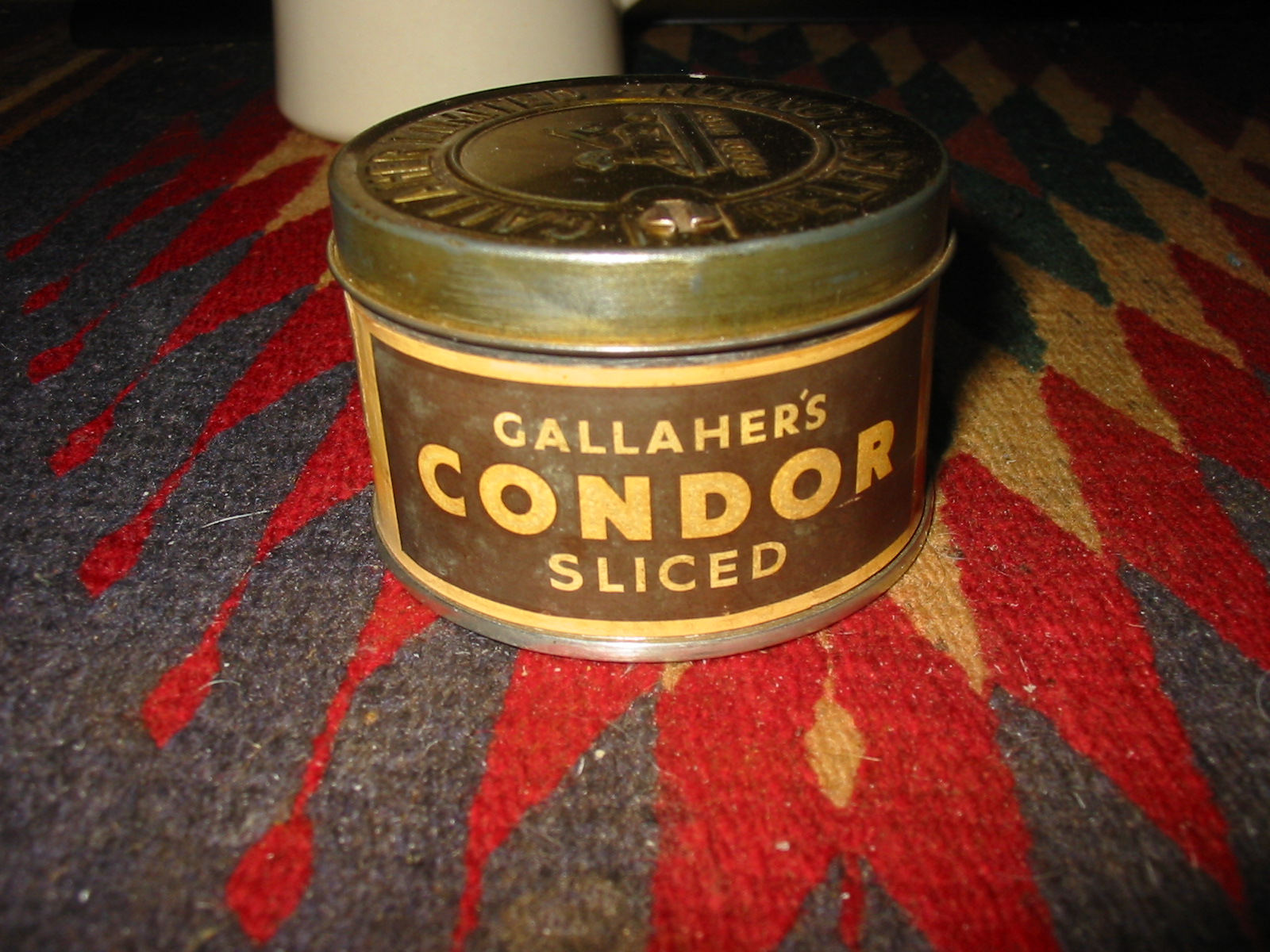
The wisdom of following this rule while I am on the hunt was proved to me twice in the last month of pipe hunting. I found two older tins of tobacco that I enjoy and which are no longer available in their original renditions. The first one was an unopened cutter tin of Gallaher’s Condor Sliced. (I wrote about finding this tin earlier on the blog https://rebornpipes.wordpress.com/2013/10/11/tobacciana-dating-an-old-cutter-top-tin-of-condor-sliced/ ) I am not entirely certain regarding the age of the tin but the seal in unbroken and the tin shows no sign of rust on the outside or at the bottom or top edges of the tin. All of which leads me to believe that the tobacco inside is still in great shape. It also does not rattle around when it is shaken which is great news to me. I have found that the rattling inside a tin is a bad sign and can mean that the seal has been broken and the tobacco may be dry and dusty. However, the point is that clearly Rule #3 was proved true once again. I reached for a tin of tobacco on display in an antique mall and came back with this old unopened tin of tobacco. The bonus for me is that it is a blend I enjoy!I am still in the process of deciding whether to smoke it or keep it in the collection for display. The verdict is still out on that decision.
IMG_1940

IMG_1945

IMG_1941

The second tin that I found this past weekend when my son-in-law and I were wandering through some antique malls and shops. As usual I was on the prowl for pipes and tobacciana. This old tin was situated deep in the back of the display case that made up the front sales counter of the antique mall. It was well enough hidden that I had missed it the first two times I scanned the display looking for pipes and tobacciana. When I was settling my bill for a pipe I had found I looked down for just a moment at the case. And out of the corner of my eye I saw the tin. It was well hidden behind some other items – poker chips, lighters, decks of cards and pocket knives so it was easy to pass over. I paused in my paying the bill and asked the clerk if I could see the tin. As she moved the other pieces away from it I could see the tin still had a lid on it and seemed like it also had something inside from the way she handled it as she gave it to me.

I took the tin in my hand and found it had a bit of weight to it – it was not empty. I gave it a light shake to see if the items inside rattled – if it was tobacco it would have a different kind of rattle than nails or screws or even buttons. It sounded like tobacco to me. I checked the lid and could see that it had been opened. I twisted it off and found that when I opened it there was a slight whoosh of air meaning that there was still a seal on the tin. When it was open, I could see that the tobacco inside was a broken flake and was not dried out too much. I picked up a small piece and found that it still had some bend and play in it rather than crumbling in my fingers.

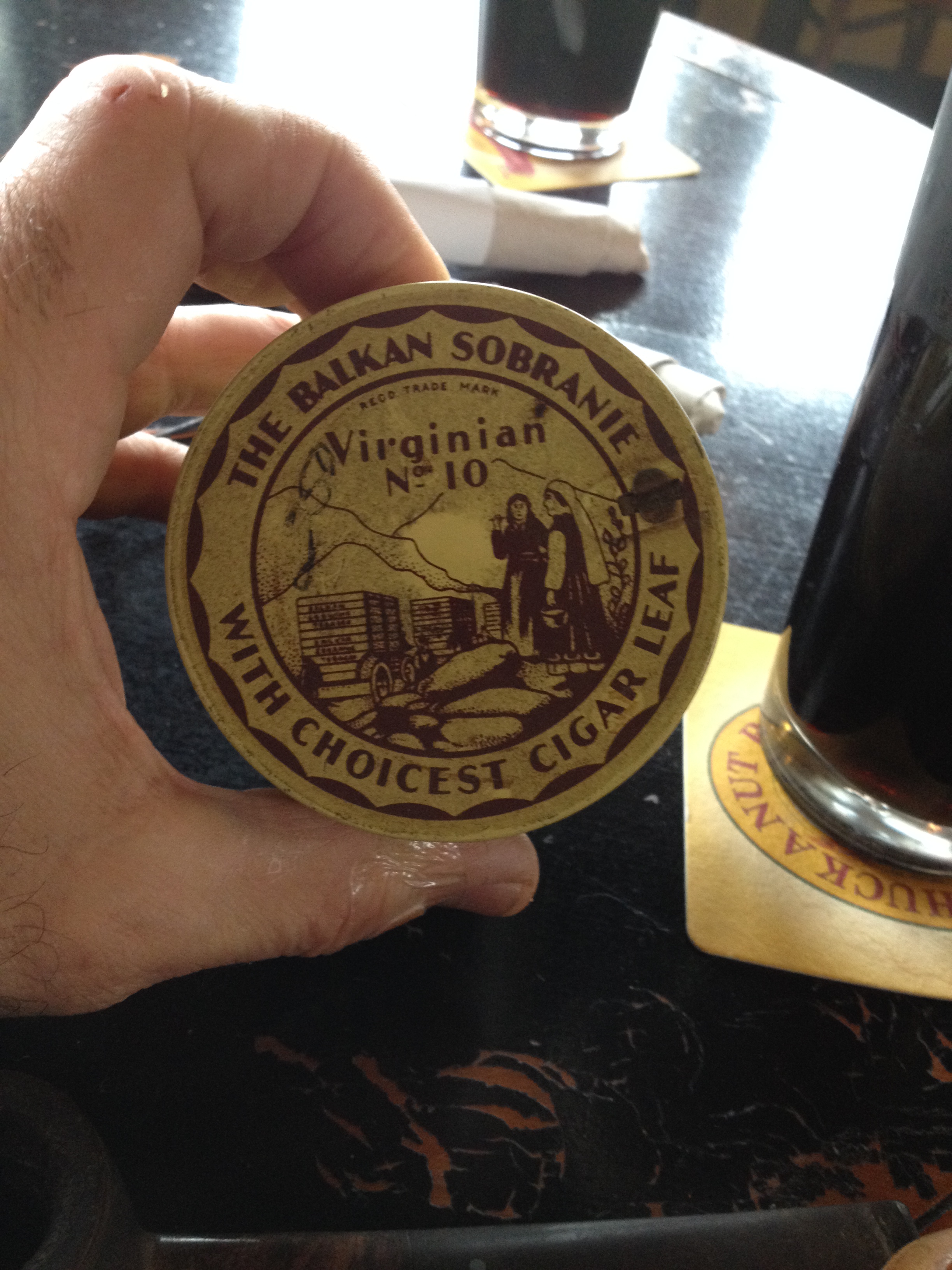
This tin was an old cutter top can of Balkan Sobranie Virginia No. 10. I have smoked this blend in the past and thoroughly enjoyed the taste of it so I was sold on it before I knew the cost. I looked on the backside of the can and saw that they were selling it for $4 – a full four ounce tin of very mature and smokable Virginia. It smelled heavenly and the low price for a tin of this age made my heart skip a beat. That fact that it was full was a bonus to me no matter what the clerk thought. She apologized for the “inconvenience” of the tobacco still in the can, but I was excited about it. I decided to play it cool though and settled my accounts – a pipe and the tobacco and left the store having spent just under $15 US. Once outside to the car, I explained what I had found to my son-in-law and then opened the tin and took a deep whiff. This tobacco smelled divine and the moisture content was perfect for smoking according to my liking. It sits on my desk waiting for me to fill a pipe this evening and give it a smoke.
IMG_0486

IMG_0488

Both of these finds illustrate the point of Rule #3. It is worth checking all old tobacco tins for potential finds. Some will have tobacco that you can smoke and others will have pipes, tampers, lighters or pouches that can still be used. The list of finds that I have come across leads me to continue to shake and check out all the old tins that I come across on my journeys. I know that each and every tin I pick up could potentially have something worth keeping inside its confines. Whether that find be a pipe related item or just some good smoking tobacco really does not matter to me for both are part of the potential that keeps me picking up old tins and checking them out.

The Pipe Hunt – Rule #2: Look Inside ALL Small Boxes, Cupboards and Drawers


Blog by Steve Laug

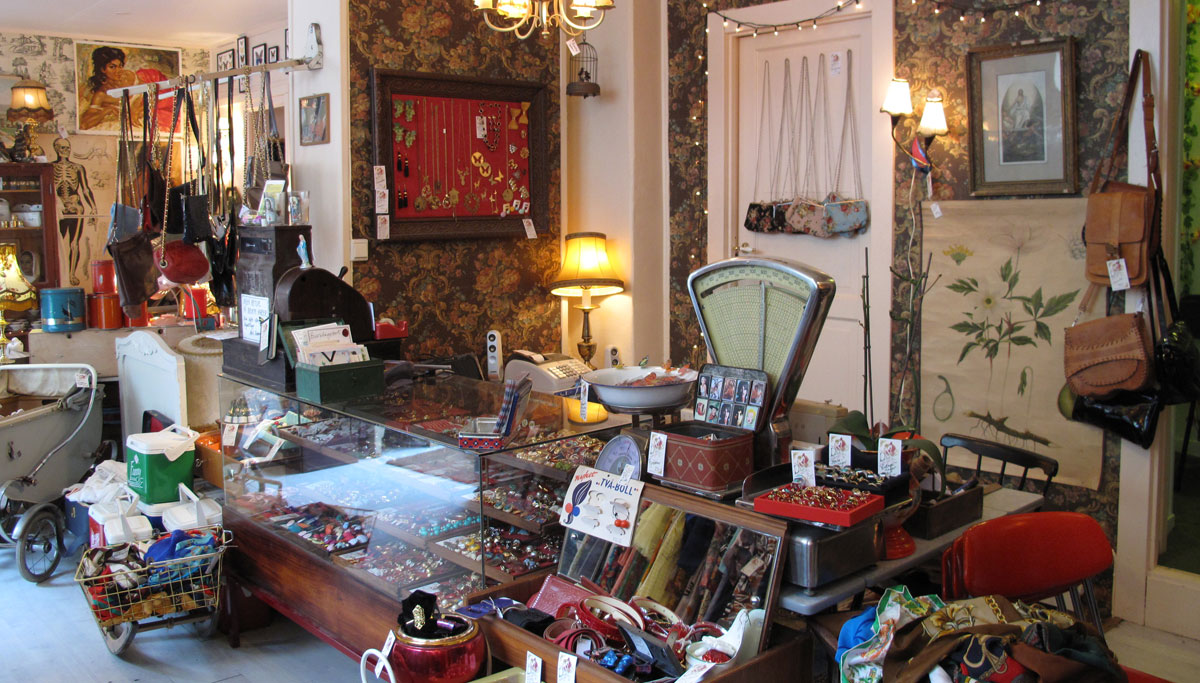
A second rule of the pipe hunt that I have learned over the years is that not all pipes and tobacco related items are in plain view as I walk around a shop. This took time to learn and by and large I learned it by asking sellers if they had any old pipes or tobacco items for sale. I used to do this after an initial walk through but now ask as soon as I enter a shop. It saves time and generally is a way of engaging in a conversation that may lead to more pipes. When the answer was affirmative I followed them to the stall or spot in the shop and watched where they had placed the items. This quickly taught me where to look. But they would also often have pipes or items at home or in the back room and they would gladly bring them out for me. I have learned that it never hurts to ask.

As a result I quickly look through a shop (I know quickly is a relative term but to me it is quicker than it used to be and way more focused). I walk through after my initial scan and open small drawers, cupboards, cigar boxes, and look inside revolving display cabinets. This may seem intrusive but trust me, it is not (well at least in my mind it isn’t). Small typography cabinets can hold pipes and tobacciana. Revolving display cases can hold pipes, tampers, lighters and other pipe related objects. I have found wind caps, tampers, Baccy Flaps, Bakelite stems, pipe holsters and other items too numerous to list by just going through these revolving cases slowly looking for tobacciana. Coffee cans, tobacco tins and old cigar boxes can often hide old pipe paraphernalia in their interiors. Don’t hesitate to have a look. Here is a tale of an old pipe I picked up by doing what I am suggesting – a nice older bent billiard for $20. I can tell you it was well worth opening drawers and digging deeper.

My wife Irene and I love doing an antique mall crawl on our days off. We generally visit as many as we can fit in before lunch and then have a good lunch at a neighbourhood pub before finishing the day with visiting a few more shops on our way home. Over the years one of our favourite spots is found not far from Vancouver. Just across one of the many bridges and upriver it is a spot with several antique shops and several larger antique malls. On the day of this tale we had visited several of them in the morning and so far had struck out on any significant finds of pipes or tobacciana for me or anything of interest for her. We had stopped for a great lunch at the local pub and were now visiting the last of the shops. We were almost finished looking and still empty handed. I had passed by some very high priced drugstore pipes – no deprecation intended here as I have many of them in my collection but I am not willing to pay the exorbitant prices that sellers mark these – $50 or more is an unacceptable price in my opinion.

I turned down the last aisle. It was lined from floor to ceiling on the right side of the aisle with display cases. These cases had drawers underneath that were labeled with different key items that resided inside. I did a quick walk by of the display cases checking them out. In one I found a couple of older Brighams that I noted. I would need to get the sales clerk to open the displays for me so that I could look at them more closely. That could wait. I turned my attention to the drawers beneath the cases. In the middle case I opened a drawer labeled miscellaneous collectibles and dug through it. There in the middle of the drawer, nestled among lots of unrelated items such as linens and doilies I found an older looking pipe that captured my attention. I stopped for a minute before picking it up. (I have a habit of trying to guess what the pipe might be before I actually look at. Quirky I know but it is what it is.)
1938 Dunhill Shell

I made my guess (a Dunhill of some sort) and then I picked it up. It was a sandblast bent billiard. I turned it over in my hands and noted a slightly darkened white spot in the top of the stem and then read the stamping on the underside of the shank. It read Dunhill Shell Made in England 8 and underneath that it was stamped Patent No. The number itself was obscured in the dirt and grime that accompanied the old pipe. It was caked with a heavy carbon buildup and the stem was oxidized and had several small tooth dents on the top and bottom of the stem. Other than that it was a good clean find. To say that I was excited is to understate the case. Here in the drawer under the display cabinet I had found not just a Dunhill pipe for $20 but a Patent Era Dunhill pipe with fairly clear stamping and in a condition that would easily be refurbished. I was ecstatic. I called my wife over to show her the cause of my ecstasy and she just shook her head – another pipe. Big deal. She wandered off and I was left standing there.
I almost totally forgot the Brighams and just stood there basking in the joy of discovery! This is what I always dreamed of finding one day in my pipe hunts. And now here it was in my hands. I could hardly believe my good fortune on finding it. I shook myself and carefully cradled the old pipe while I went and found the sales clerk. She brought the keys with her and opened the case so that could add the two old Brighams to the lot. I carried the three pipes to the counter and paid for them before they disappeared in my dreams. The clerk carefully wrapped them in tissue paper and placed them in a bag for me. She handed me receipt for my purchase and I went looking for Irene. I had my haul and I was finished. I just wanted to get home and do some research on this lot.

When I got home I went to my basement work table and used my jeweler’s loupe to check out the stamping more clearly. I had read the majority of the stamping correctly at the shop. I was also able to read the patent number on the bottom of the pipe. I looked up the information on John Loring’s Dunhill dating site and found that I had a 1938 Patent Era Dunhill Shell bent billiard. I could not have been more pleased. I cleaned up the old timer carefully and gave it several coats of wax. Here are a few pictures of the restored pipe.
IMG_2083

IMG_2084

IMG_2088

IMG_2086

It is this kind of find that keeps me pulling out the drawers and looking in the boxes and behind tins and displays. I am confident that there are other hidden treasures out there. So Rule #2 will always be right up there next to the first rule I posted about earlier. I will look in every nook and cranny while I am working my way through a shop looking for “treasures”. Will you join me in following this rule of the hunt?

Finding an Old Parker Super Briar Bark Cherrywood


Whenever I visit Edmonton there are three places I always visit in old Strathcona – two Antique Malls and Burlington on Whyte Tobacconists. My last trip I visited all three and one of the Antique Malls yielded a couple of treasures while the other was a bust. You never know which place will yield something but generally I don’t walk away from both with nothing to show for the stop. This time I found two items in the same display case in the mall (this is truly a Mall – it is large, two stories of things to look at, many stalls and many sellers). The first was a beautiful older Parker Super Briar Bark Cherrywood and the other was the old cutter top tin of Condor Slices I have already written about earlier. Let me tell you the story of that find.
IMG_1865

The shop is full of antique hunter’s eye candy and what astonishes me is that things I played with as a child and used in my dad’s garage have now become antiques. (Hmmm, I wonder what that makes me. Ah well that is another story, back to the walk about.) As I walked through the shop there were many displays that had pipes – older Brighams, Dr. Grabows, Yello Boles, Whitehalls, Medico’s and new Meerschaum pipes. The place had a lot of old pipes and each of them warranted a good look. To complicate things and I suppose to give a modicum of security in a world of shop lifters, I had to hunt down a store clerk to get a key to open the locked displays before I could look at any of the pipes. Because of that I was very selective about the ones I looked at more closely. The mall was full of people that day and they were milling about looking at everything – everything but pipes in this case. I made my way through the shop and noted case numbers that I would need to have opened for a more thorough look. My method in this kind of shop is to get two or three case numbers in my head before I get help from a clerk. Why two or three? Well, simply put – that is the most numbers I can remember in my head these days! With that limitation the hunt in a mall that size can take me awhile. Ask my wife and children how long it can take and they will tell you, I have no sense of time when I am on the prowl for old pipes.

I checked out some Mario Grande pipes – new ones – that were in one display and several other brands that looked promising but none of them grabbed my attention. I am getting more particular than I was when I first started picking up old pipes in shops like these. I think it was on the second or third set of case numbers that I took back to the main desk to get a clerk with keys to open that I found the little Parker. I know that it was in the back portion of the mall, in the far right corner of the shop. It was a small display case, upright glass with internal lighting. When I saw the case it caught my eye. There were quite a few pipes on the shelves of the case, arranged to attract attention. On the second shelf was a little sandblast cherrywood shaped pipe sitting in a pipe rest that caught my eye. The stem was slightly bent and the blast was craggy and deep – kind of like the blast you find on early Dunhill Shells. The size was diminutive but looked like it would sit well in the hand. Even though it was only one case number in my head this time, because of the beauty of this pipe, it was time to go and get the clerk and the keys.
IMG_1863

I went back to the front of the shop and got the clerk and we headed back to the case. I am always in a bit of a rush in this phase of the hunt in an Antique Mall because I am paranoid that someone else has spotted the object of my desire and will beat me to the punch. So I made my way back to the case in a hurry by the most direct route. There was no fooling around along the way. I saw other pipes in other cases as I hurried to the back corner but I merely glanced at them and noted their location for later looking. I was a man on a mission and nothing would deter me from reaching my goal.

We made it back to the case and no one was bent over an open door fondling the little pipe when we arrived. Whew, I beat all contenders (I know, probably no one else in the mall cared about the little pipe, but let me have my delusion). The clerk fiddled with the keys until he had the correct one in the lock and the door opened. He stepped back and let me pick up the pipe that had caught my eye – the little cherrywood sandblast. I turned it over in my hands checking it out for cracks and damage. The thin shank looked fine, the stem had some small tooth marks and was oxidized but in good shape. The finish and blast were very nice. It was in excellent shape and there was even a wad of tobacco still in the bowl – almost as if the old pipe man had laid it down while he went out to check the mail or eat dinner… It would clean up very nicely. I checked out the stamping on the underside of the shank. It read Parker over Super in a diamond over Briar Bark. I had a nice older Briar Bark in my hands – the equivalent of a Dunhill Shell in my book. It was also stamped Made in London England and had the shape number of 283. It sported a 4 in a circle stamp was well, which was the group number (Dunhill based sizing system). This surprised me a bit as it is pretty tiny for a group 4 pipe but that was its stamping. Up close the stem also bore a faded and worn stamping of the P in the Diamond of the Parker line. At the low price of $15 it was a keeper and it was definitely going home with me.
IMG_1864

The clerk took it in hand, as they have a policy to carry items to the front and hold them for you until you are done shopping. He was just locking the case when I looked at the shelf a last time before he closed the door and there in the back of the display case was an old tin with the label Gallaher’s Condor Sliced. I stopped him and reached into the case and picked up the old tin. It was full! I turned it over in my hands and noted that it was a cutter top tin – probably WWII vintage. It was two ounces of old tobacco, unopened and pristine. The tin itself was in great shape. I added this to my lot. Not a bad find for an afternoon – an older Parker sandblast cherrywood and an old tin of Condor Sliced. Since I am one of the few who actually like Condor Slices this was a great find for me.
IMG_1862

I followed the clerk back to the front of the shop to pay for my purchases with the satisfaction of a well spent afternoon. I had a tin of old tobacco – cost $10 and a Parker – cost $15 – all totaled a $25 hunting spree. Not bad at all and to top it off when I got to the till a young clerk commented on the pipe. He too was a pipe smoker and collector. (In this case I believed him rather than cynically assume more sales hype. To date I have not received many comments from sales clerks on old and dirty pipes I buy so odds are he was telling the truth.) He commented on how he did not know how he had missed seeing those two. Before I settled the bill he offered to give me a walk-through of other potential pipes that he had scoped out. He spoke of some of the great finds he had scooped while working at the mall. He told me he had Burlington on Whyte do his restorations on the pipes he found and asked who did mine. I told him that part of the fun of the hobby for me was restoring my own. He laughed and said one day he would venture into that part of things. During our walkabout nothing else caught my eye so we went back to the till and I paid up. I walked out of the mall satisfied with the hunt and with two pieces of tobacco history. I couldn’t have asked for more. Now off to find a pub and celebrate the finds and examine them more closely.

By Steve Laug 14 October 2013

The Pipe Hunt – Rule #1: Never Drive by Small Nondescript Antique Mall Without Stopping for a Look


Over the years I have added another hobby to my refurbishing one. I have been crafting a set of simple rules of the pipe hunt. A rule does not make the list until it is tried and proven to be a truism repeatedly. These rules are elastic in that they continue to grow as time goes on and my pipe hunting becomes more refined. But, I try to follow these whenever I am on the prowl looking for pipes and even when I am not. I have decided that any trip I take will end up with me stopping and hunting for pipes. My wife and kids can tell you that this is a fact. Over the years I generally end up finding a pipe or two. These rules have worked well for me over the past 20 plus years. The tale below illustrates how well this first rule works for me.

I was coming back into town from a long meeting in the countryside about a half hour away. It was getting late and our host had planned a dinner for us so I was aiming on getting “home” and not really paying attention to the buildings as I came into town. But as I got closer to town and drove by the nondescript buildings on my right, out of the corner of my eye I caught a small sign that said Antique Mall. It was located on the outer edge of a small town, across the railroad tracks from the town centre. It was five o’clock in the afternoon and the sign said the shop was still open so I decided to pull over, park the car and have a look. By the time I got to the front door it looked dark inside so I figured the owner had evidently closed up shop. However, the door was still open, the sign still said open, but the lights were out in the back portion of the shop. I decided to chance it, opened the door, called out and asked if they were still open and a gruff voice called out from a room off to the left, “Well you are inside the shop aren’t you so I guess it doesn’t matter or not if we are open.”

I shrugged off his gruff manner and asked if they had any pipes and tobacciana. He turned on the lights and said he would quickly take me to the cases in the shop that had “what little they had available”. He was not a friendly shop clerk anxious to make a sale and it seemed that the my presence did nothing to change his otherwise grumpy attitude. I had a friend with me and he gave me the “we should probably just leave” look but I ignored it and kept up a steady flow of “yak” to diffuse the situation a bit. I figured if I found anything I would make his day and it looked like the place could well yield some interesting old pipes. It was pretty dusty and looked like it had not had many folks picking through the stock of “antiques”. (I made a mental not to come back here for a visit on my next trip through but I would do so in the early part of the day and give it a good walk through at that time.)
second

He walked us toward the back part of the shop (calling it an antique mall was an overstatement of epic proportion as it was not much bigger than a small convenience store. I suppose that it may have had multiple vendors gathered under the roof but still mall was overstating the case). There was a lot of clutter in the aisles and the accumulated detritus of junk stores that I have come to appreciate for their potential. It is in shops just like this, passed by quickly by the antique hunter and having a grumpy proprietor that have often yielded a veritable treasure trove of pipes and tobacco items. Many times I have found that these nondescript out-of-the-way shops can be rich with old pipes and tobaccos all to be had at very reasonable prices. There used to be way more of these little shops, but there are still a few where you can find some good stuff if you keep your eyes open.

I began to get excited as we made our way to the first display case. It was a crowded glass case with lots of dust and fingerprints. On the shelf next to the case were old packets of tobacco that looked like ancient drugstore blends, long past their shelf life even with all of humectants. There was also the standard collection of old Edgeworth and Prince Albert tins piled on the top shelf of the case. I bent down to get a closer look at the second shelf as it had a collection of about ten pipes piled on it. (So much for the shop owner’s “what little we have” comment.) I sorted through the lot and among the collection there I found three older pipes that caught my eye. I was attracted to them because of their shapes and finishes. They were all well used and dirty but I examined them showed no real damage under the dirt and oxidation.

This threesome included a Douwe Egbert Billiard, an Amphora Pot and long sandblasted Canadian stamped Birkdale Superb, Made in London England. None of these had show stopping names but the shapes all reflected an older European look. When I first saw the Canadian my heart nearly skipped a beat, it had the look of an older Dunhill Canadian. The white dot was missing in the stem but the hole was clearly there where it had been. I gingerly picked it up and saw that it was a Birkdale – a brand I knew nothing about. (I later found out as I researched the brands and stamping on these pipes on the internet that the Birkdale was probably a Comoy’s brand.) I left behind some older, worn pipes on the shelf that I may have to go back and pick over again when I get to the area in the future. But these three were to my liking. I happily added the first additions to my purchase – three pipes in my hand.

The owner had said nothing as I picked over the pipes and carried them with me. No comments or questions were asked as he locked up the first display case. Once locked, he hurried on to the second display case. I was feeling good about this stop on the road. It was already a great place and I had added three nice pipes to my collection so it did not really matter what I found in the second case. But who can stop looking and hoping for more after that kind of find in the first display case. We rounded the corner in the shop to the second case. On the middle shelf there were more interesting pipes to look over. I could not believe the luck I was having in this old shop. I sorted the 8 or 9 pipes on the shelf and settled on three nice looking older pipes – a Hardcastles Jack ‘O London Billiard, an African Meer Prince stamped Tanganyika with a shape stamp or 27 on the shank and an Old Pal diminutive Barling like pot with a pencil shank. I added this threesome to the lot in my hand. I now had six old pipes for refurbishing. All would clean up very well and be good additions to the collection or be sellable to help fund future purchases. Not too bad a find for a quick stop that could have easily been overlooked.

The grumpy shop owner led us to the counter at the front of the shop where he tallied what I owed him for the six pipes. I had noticed that several were marked $10 and some were $11. He said nothing as he scribbled out the bill and peeled off the stickers recording the display cases they each came from. Once he had finished his scribbling he pushed the bill my way. I could not believe my eyes – the total was $60 plus a bit of tax thrown in. What do you know; the old gent had given me a deal of sorts. He took my cash, put the pipes in an old grocery bag and handed me the change and the pipes. He then followed us to the front door and locked the door as we went out. He had probably spoken a total of three words – no more, no less in the entire time he had walked us around the shop. But I did not go there for the wit of the seller or the ambience of the shop but for exactly what I had come out with – six “new” old pipes that would be a welcome addition to my stock at home.

I guess it goes to show you, keep your eyes open when you are driving through the outskirts of the small towns you pass through on your travels. It is the nondescript shops that often are full of surprises. But then again, don’t bother to look too hard. It will leave more of them for me to find on my journeys.

Tobacciana: Dating an Old Cutter Top Tin of Condor Sliced


On a recent trip in Northern Alberta, Canada, I visited an antique mall and came across this old unopened tin of Condor Sliced made by Gallaher’s. Once I saw the old tin I had to have it and the price was only $10 so it is now in my collection. I am still not sure if I will open it and smoke it or just leave it as is for its collectible value. The tin is in excellent shape as can be seen in the photos below. The label reads Gallaher’s Condor Sliced on the front and back of the tin.
IMG_1940

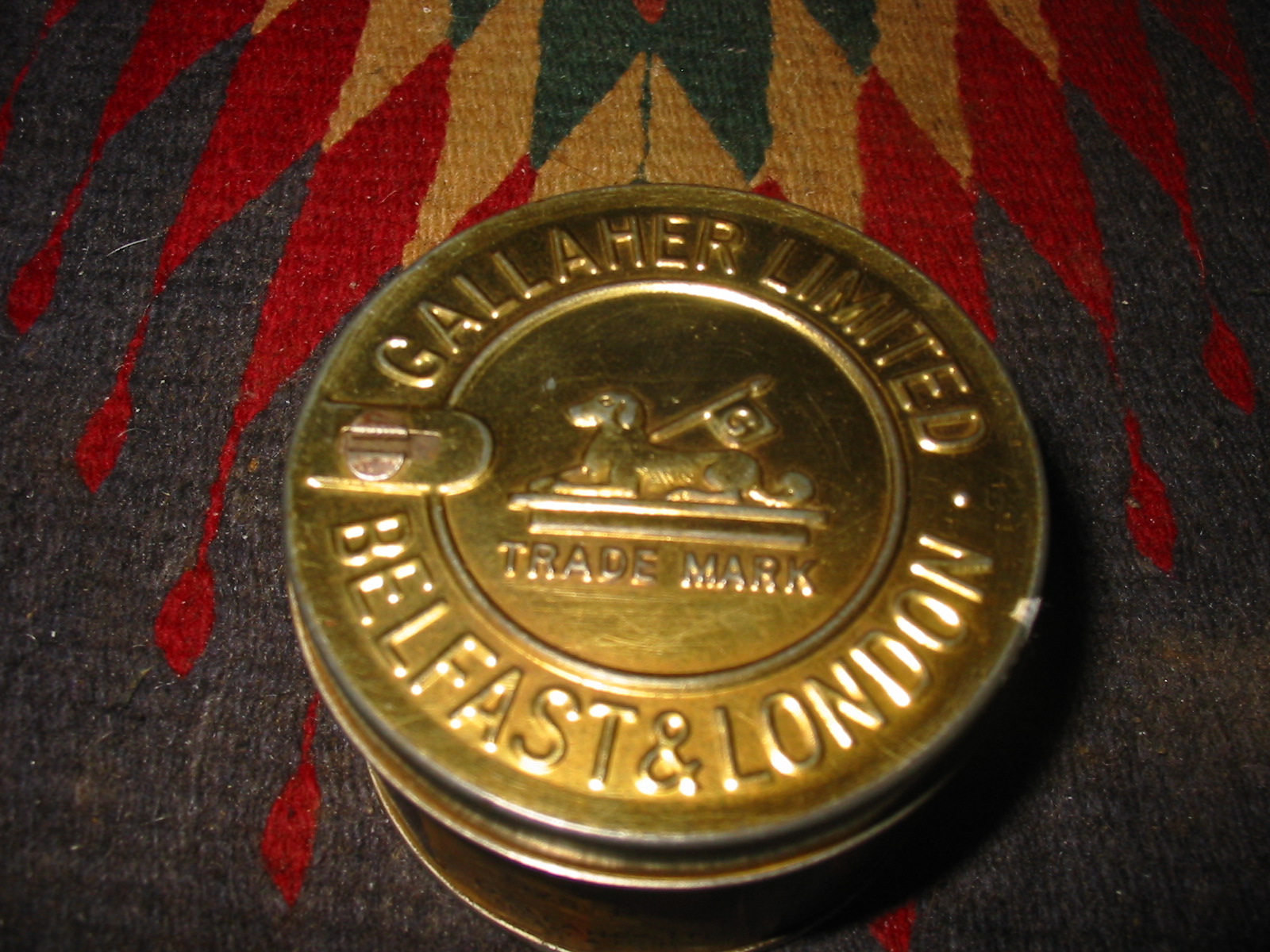
The lid is embossed and reads Gallaher Limited Belfast & London around resting Lion holding a flag over Trade Mark. The lid can be seen in the photo below. There is also a portion of the lid that is to be used to open the tin; it is visible on the left side of the lid.
IMG_1941

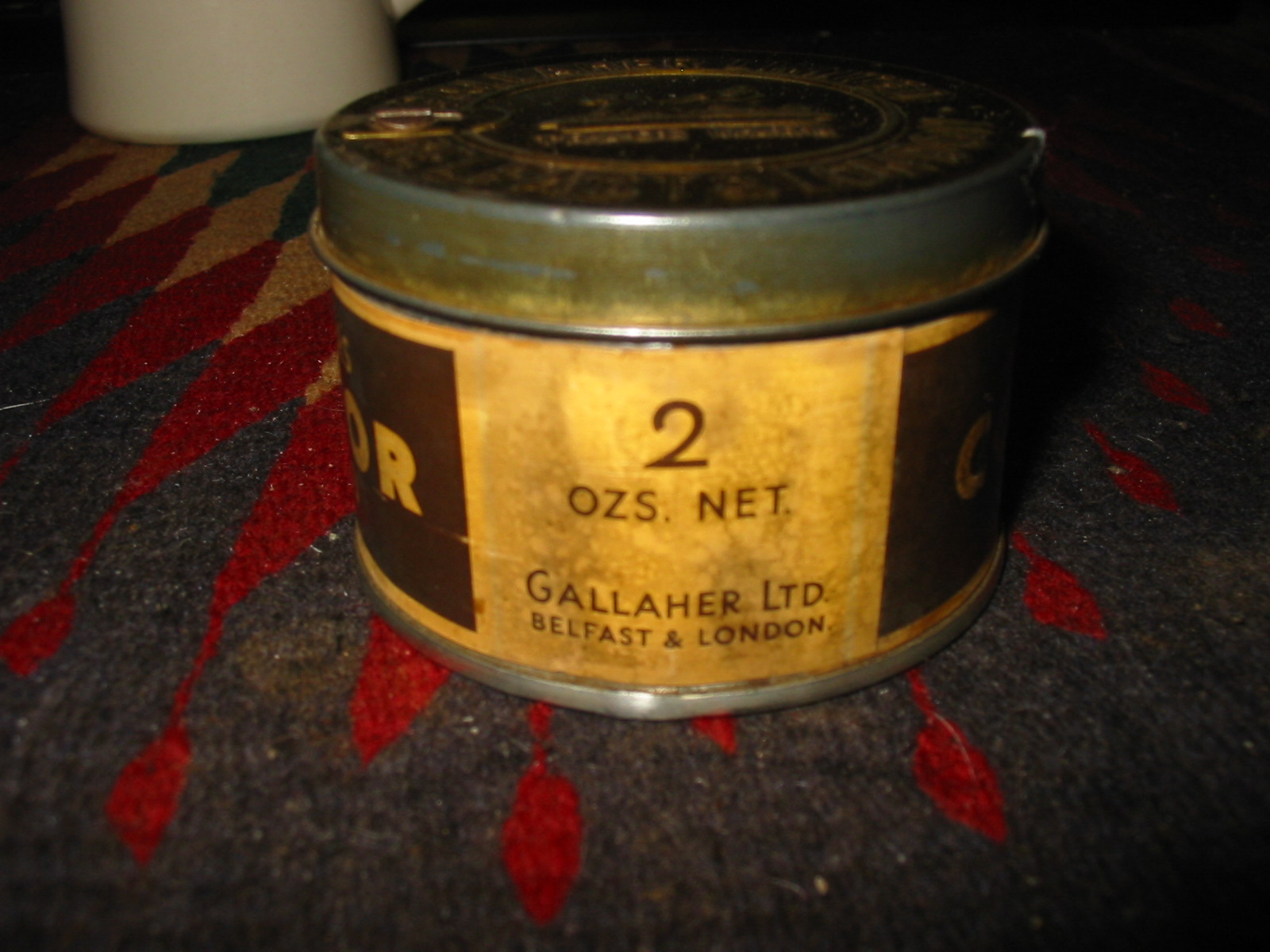
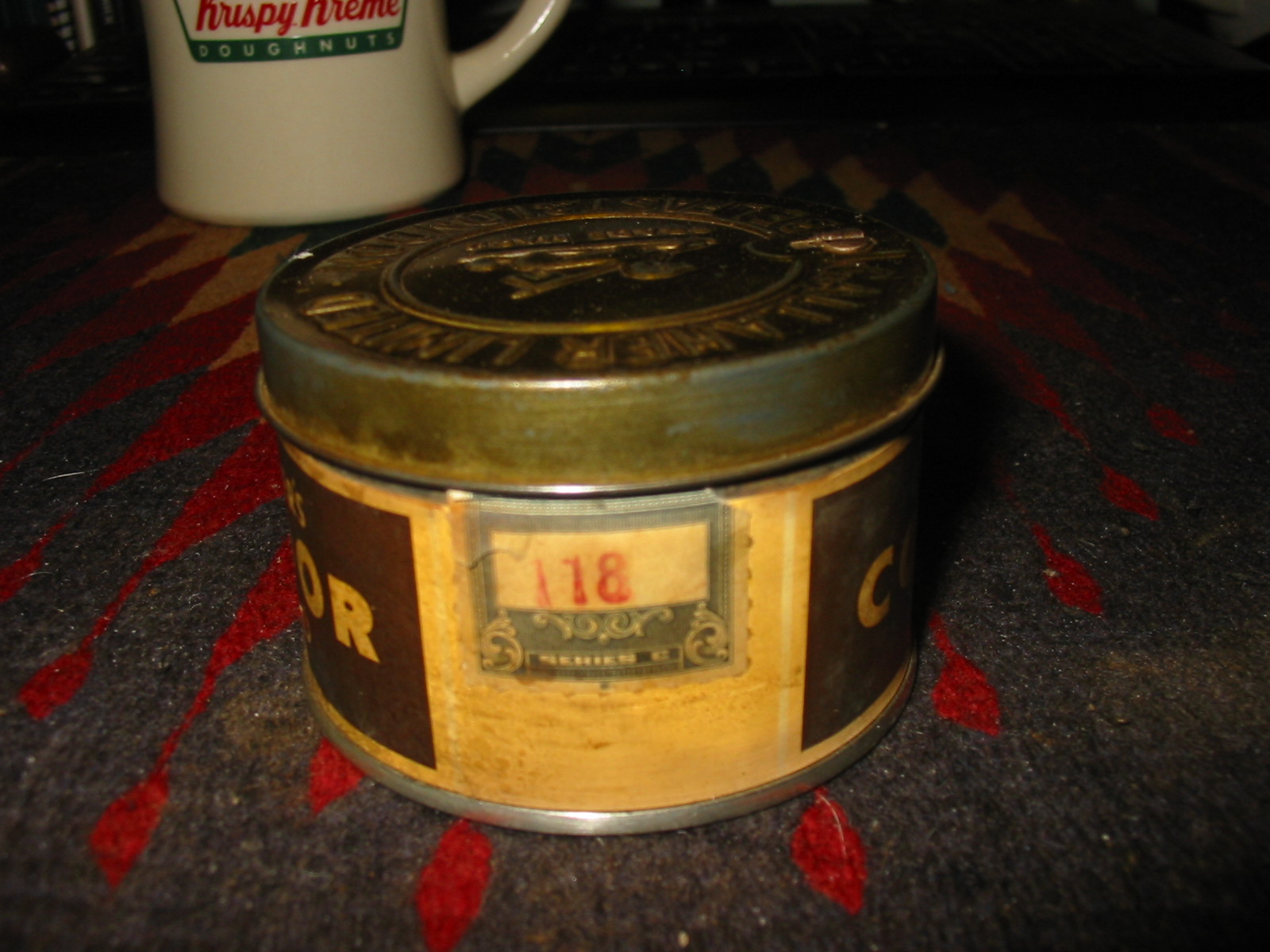
One side of the label is printed as can be seen in the photo below: 2 Ozs. Net. over Gallaher Ltd. Belfast & London. On the other side is a portion of the tax stamp that reads 118 in a box and Series C. This is visible in the next two photos.
IMG_1942

IMG_1943

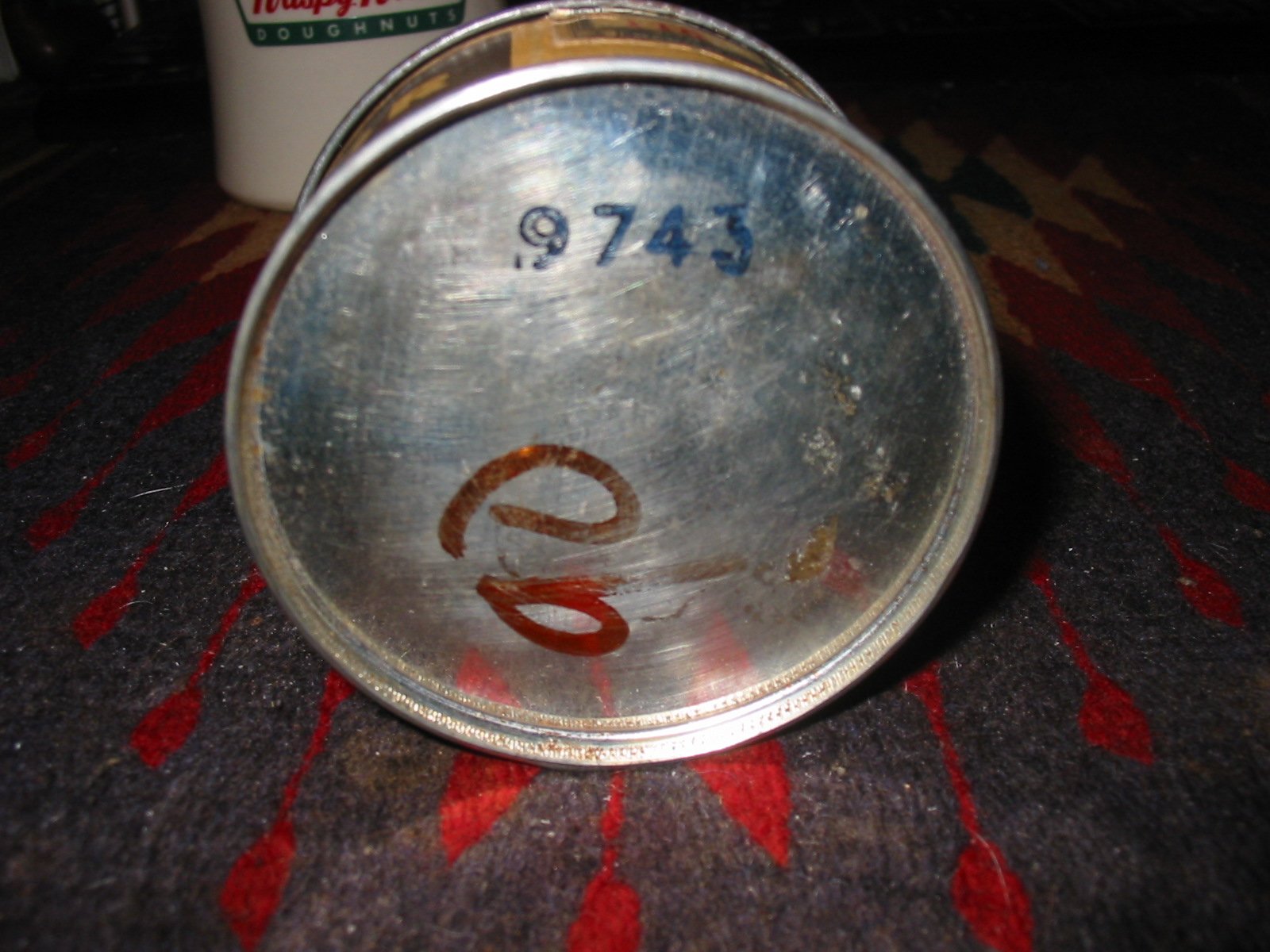
On the bottom of the tin it is stamped 9743. At this point in the search I am surmising that it is a code that can give a clue to the date of the tin. (See photo below)
IMG_1944

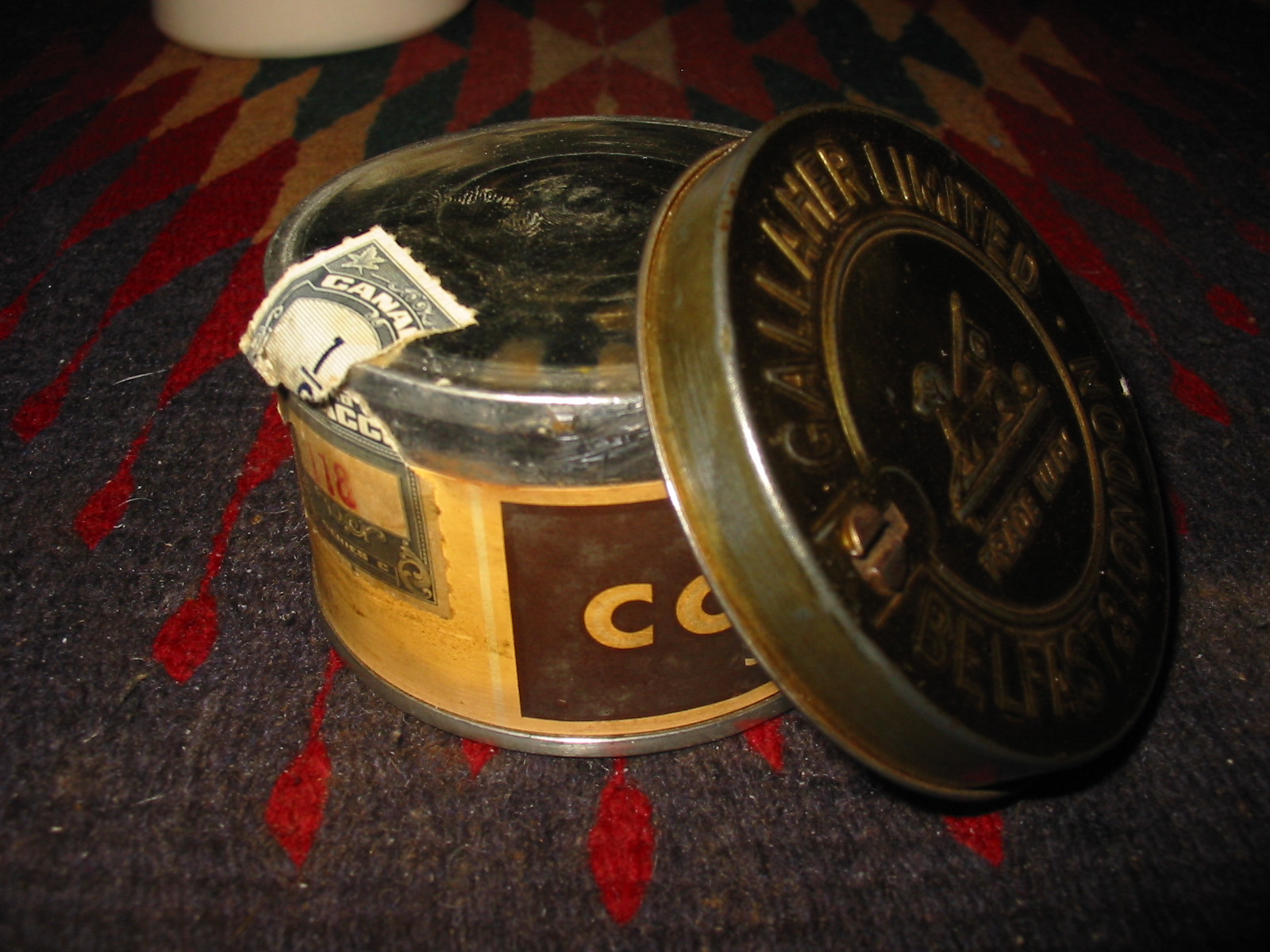
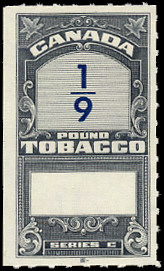
Upon removing the lid of the tin the remainder of the tax stamp can be seen clearly. It is slightly torn but the stamping is readable. The top banner of the stamp reads Canada and in the box it is stamped 1/9 Pound Tobacco. Now I wanted to know when this tin of tobacco was made. Armed with the information on the tax stamp and the numbers stamped on the tin bottom I began my research to see if I could narrow down the date of manufacture. I began with a search on Google to find information on Canadian Excise stamps or tax stamps. That seemed like a good place to start in the search to date the tin.
IMG_1945

The first thing I found in my Google search was a site that offered unused tax stamps for sale. They had the exact stamp for sale to collectors in an unused condition. The stamp catalogue said that this particular black stamp was rare. As can clearly be seen in the photo below it is a match to the torn stamp in the photo above.
3558

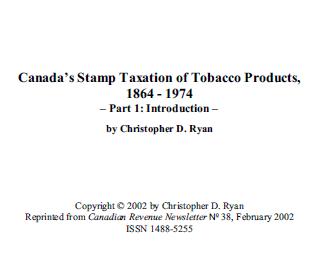
From there I did more research into the tax stamps and found several articles that are available in PDF format by Christopher Ryan. Ryan did an amazing booklet on Canadian Tax Stamps in terms of meaning and history. The photo below is of the cover page of the first part of his booklet on Canada’s Stamp Taxation of Tobacco Products. I read through much of it and in Part 6, I found the pertinent information that I needed. I will summarize what I found out in the paragraphs below.
stamps

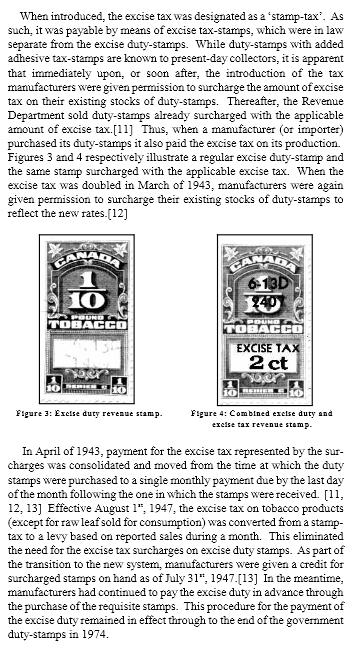
Tax stamps were issued in rolls of prepaid amounts to the manufacturers of the tobacco products. These pre-stamped amounts were then put on the tins, plugs or packages of tobacco. The stamp I have on my tin predates the doubling of the excise tax in March 1943 when the stamps were over-stamped with a new value allowing purchasers of rolls of stamps to continue to use the older stamps until they were gone. This over-stamping continued until in 1947 the stamps were taken out of circulation and the excise stamps were no longer used. In the clip from the article pictured below there are pictures of the original stamp (Figure 3) and the over-stamped stamp (Figure 4).
Dating stamps

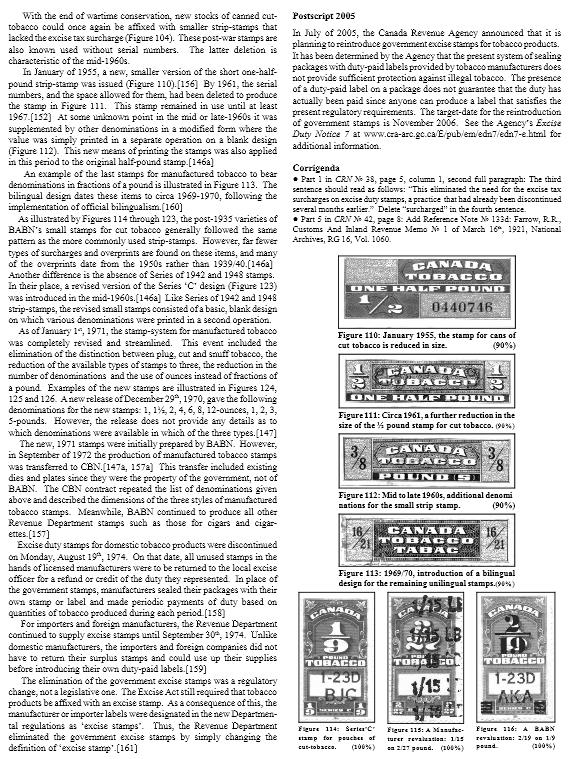
Later in the article from part 6 of Ryan’s work I found that the stamps on the tin that I have were made after 1935. With that new information I was able to narrow the field of time to a seven year window. That would place the tin I have to a period of time between the years of 1935 to March of 1943. This information definitely narrowed the field as I tracked down the research. In the next clip from the article there was more information given in terms of the changes in the taxation system used for tobacco. The photos included in the article are similar to the stamp on the tin I have.
tax stamps

Knowing that time line I began to work on the stamping on the bottom of the tin. Remember that is was stamped 9743. With the information I had found I believe that the stamping is a date code put on by the manufacture of the tobacco and it leads me to confirm that the date is indeed 1943. Knowing that the stamps were over-stamped after March 1943 the tin I have would thus have to be pre-March of that year. I think that overall it is not a bad find for a few minute hunt in an antique mall. I have a tin of 70 year old Condor Sliced in my collection. Now I only have to make a decision of whether to smoke it or save it.

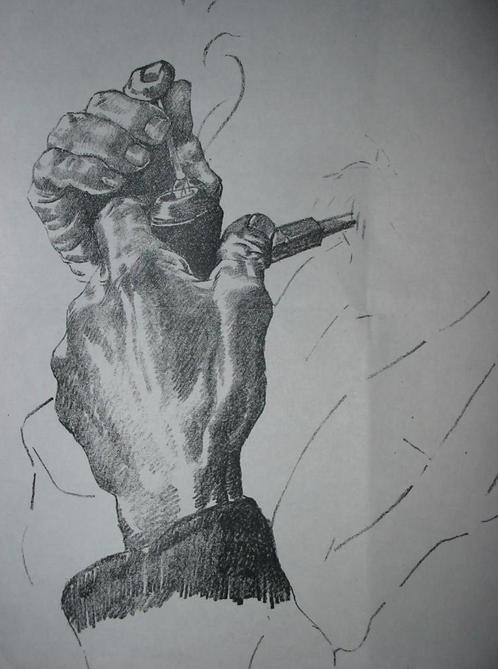
Tamping a Well Lit Pipe – a drawing by Bill Cumming


Yesterday (9 October 2013) I came home after officiating at the funeral of a dear friend to find a package waiting for me in the mailbox. During the service the postie delivered a package from good friend Bill Cumming. It included an older Lorenzo Oom Paul with a Capri like finish that I will refurbish and post photos of later. There was also a nice bent bulldog stem from an Edwards pipe that will take up residence in my can of pipe stems. Curled around the inner contents of the box was an amazing drawing of the moment of lighting a pipe. I love the illustration and am assuming it is a piece of Bill’s work. He has done a fine job capturing the moment. Bill sent a letter along with his drawing and asked that I post this as a thank you to the members of Smokers Forums for their generosity toward him. I have posted it here to give exposure to his talent. I find it an amazing drawing. My plan is to have it framed for my study. Enjoy. You can click on the photo and save it as a file to your computer.

I have since learned that the drawing has resided with Bill for a long time. He did not draw it but rather it was something that he found. Whoever did the drawing it is well done!

IMG_1869

The pipe in the drawing is amazingly like one I have posted about here – an old WDC bulldog.
IMG_0718

Another Piece of Tobacciana – A Silver Match and Stamp Safe


Blog by Steve Laug

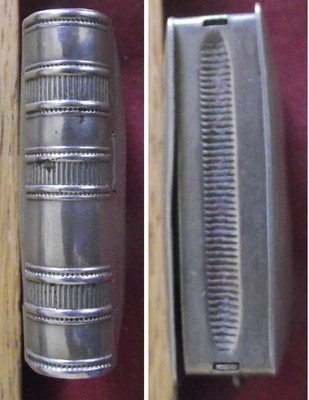
I have always been on the lookout for unique pieces of tobacciana that come from a time in history when pipes and tobacco were not just hobby items but items of a quieter and more reflective life style. I love adding them to my collection. These have included interesting pieces of Bakelite and trench art that were fashioned into objects of use. When I came across the listing for this little silver piece I could not pass it up. It is a little match safe for Swan Vestas that can hang on a key chain for easy access. It is a silver book shaped item and loved the look of it when I saw it. It combines two of my hobbies in one – books and tobacciana.

Match case

Match case2

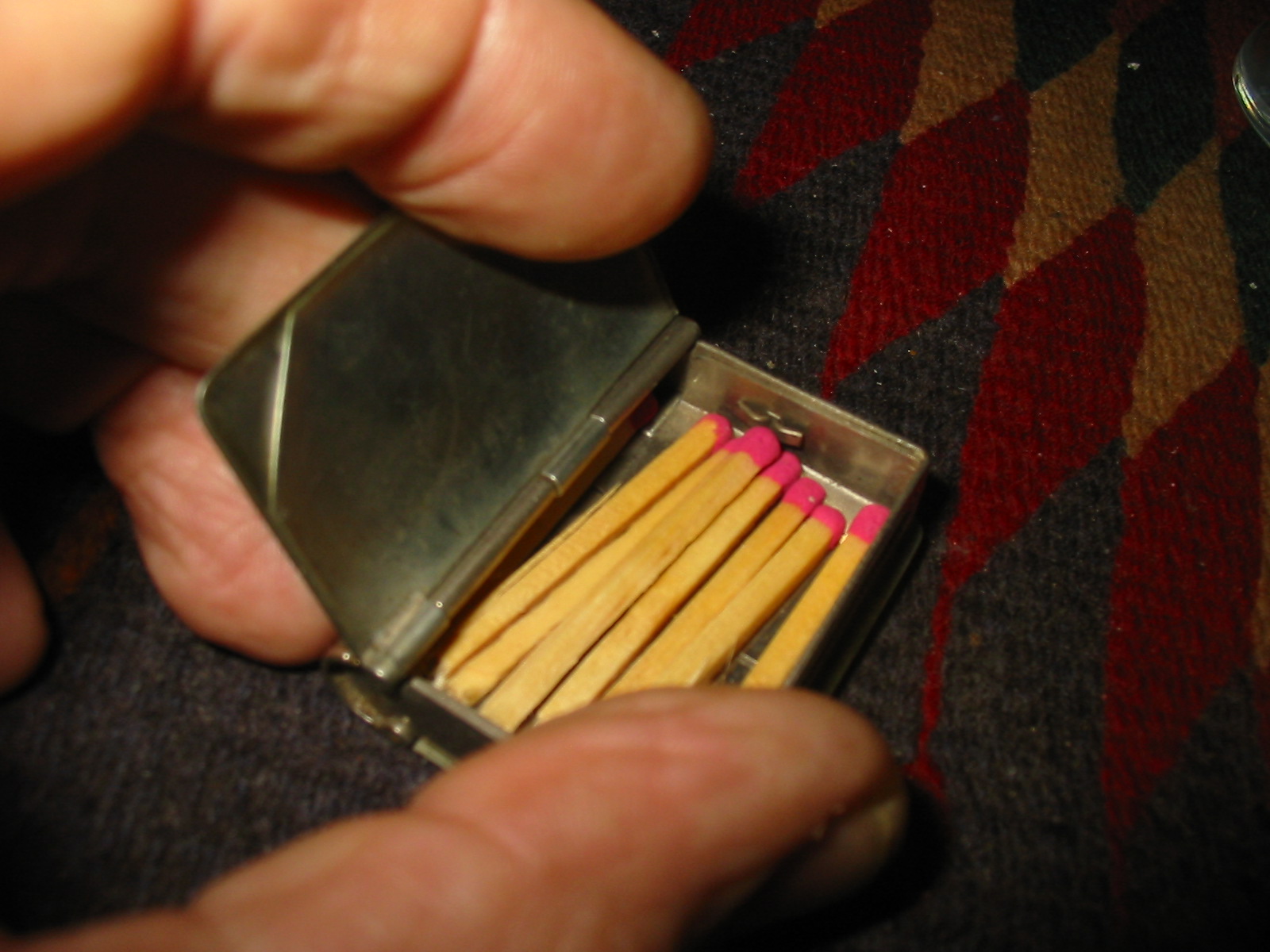
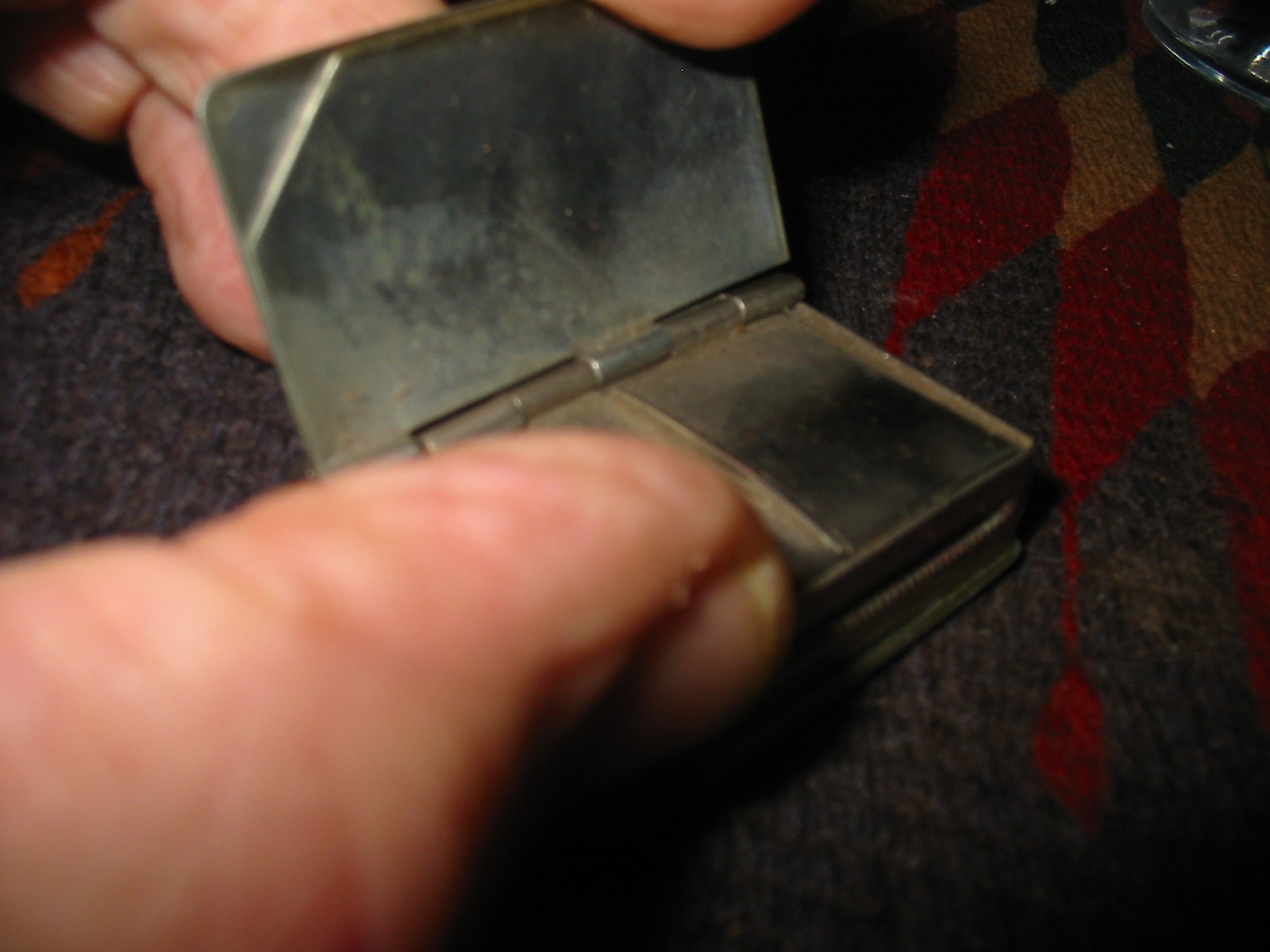
The match safe arrived and I examined it carefully. It was shaped like a book. The front and the back cover were originally painted with a red paint and remnants of that remained on the centre portion inside the corners. On the spine of the book the smooth portions also show remnants of red paint. The notched spine and the page area of the book were striker areas on the book. The book itself measures 1 7/8 inches tall by 1 3/8 inches wide. The closed book is ½ inches thick. The front and back covers are spring loaded. The front cover when opened contains the area to store the matches. I filled it with some wooden matches to enable you to have an idea of what it looked like. The back cover when opened contains two spots for stamps to be stored.

IMG_1858

IMG_1860

I have polished the match safe with silver polish and cleaned up the dust and buildup from the years. It is now on display with my other tobacciana in my pipe cabinet. It fits nicely with other pieces of pipe and tobacco history that reside there. Do you collect pipe and tobacco pieces besides your pipes? How about posting a response about your collection here?

A Gift Pipe Stand from Greg Wolford


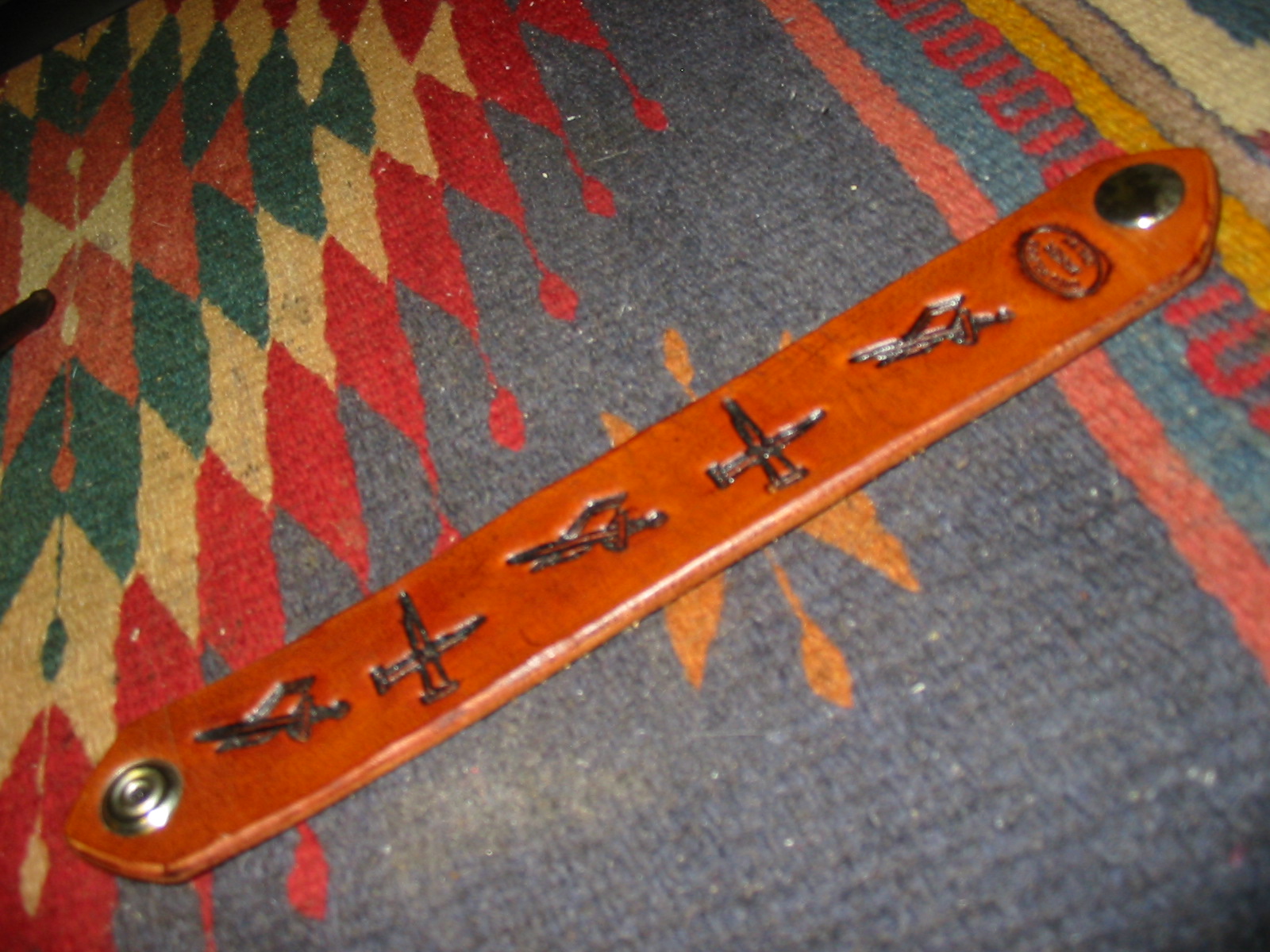
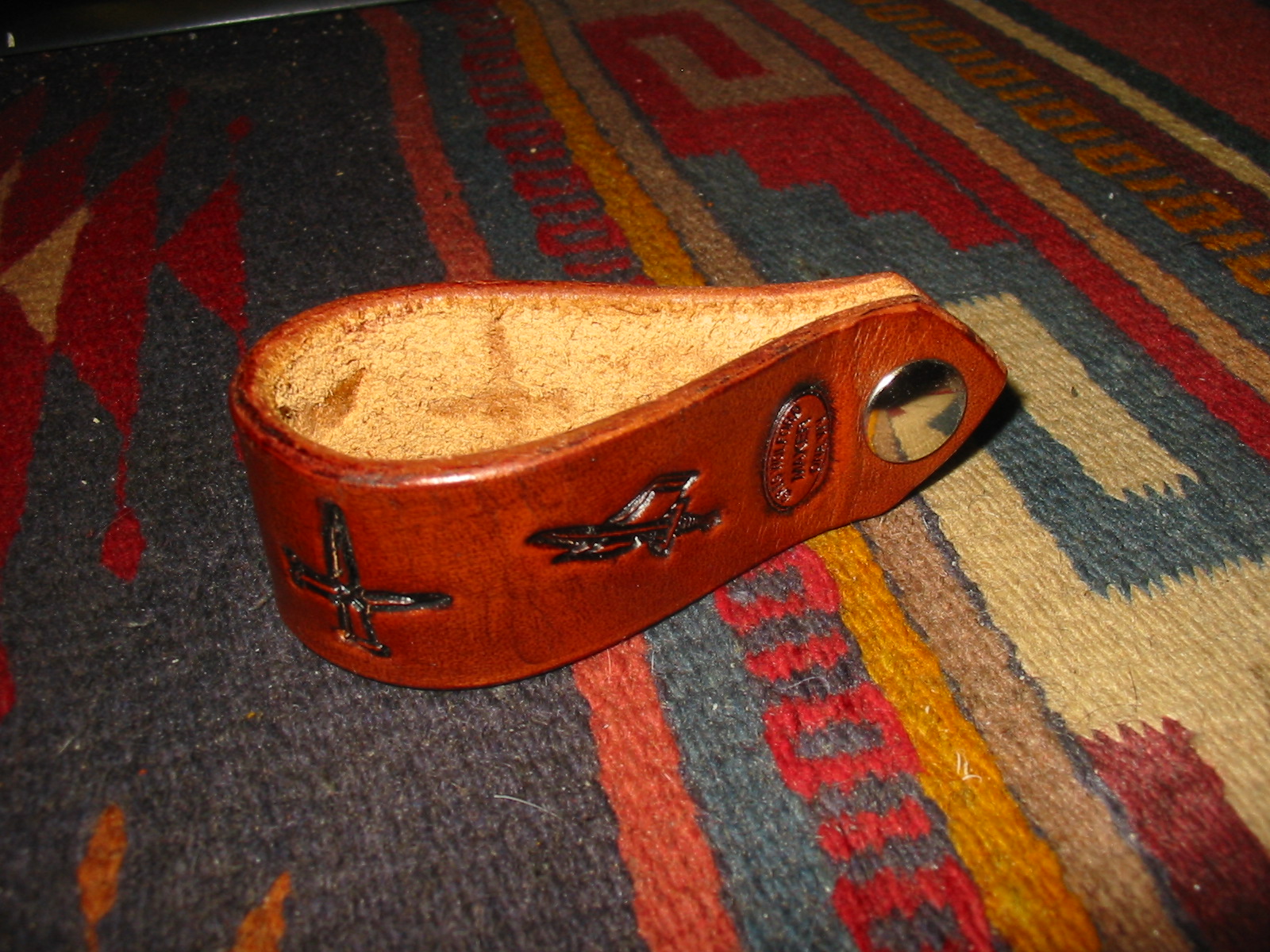
I have looked at Greg’s leather work for quite a while now. If you follow the links from the bottom of his posts here on the blog you will see some of the work that he does. He also has an Etsy Store where he sells his leather goods http://www.etsy.com/shop/WolfysLeather?ref=search_shop_redirect . He always has a great assortment of pipe stands and pipe holsters that he fashions from leather that he shapes, stamps and stains. He also does custom leather work to order and has a website that has contact information http://my.sociopal.com/wolfysleathe . This week I was gifted a pipe stand by Greg. It is a generous piece of leather that Greg stamped with a cross made of nails and a Bible with a sword across it. It is stained a rich dark brown colour with silver/nickel snaps on the ends. The edges are beveled and the antiquing in the stamps and on the edges give the leather a rich aged look.

IMG_1795

When the snap is connected the leather forms a tear drop shaped pipe stand. It fits easily in a pipe bag or a coat pocket and is readily accessible for a pipe stand on the go. Greg did a great job on it. The size of the stand is pretty much one size fits all as a variety of pipes of different sizes and shapes fit the stand with room to spare. The stand is snapped into place in the photo below.

IMG_1796

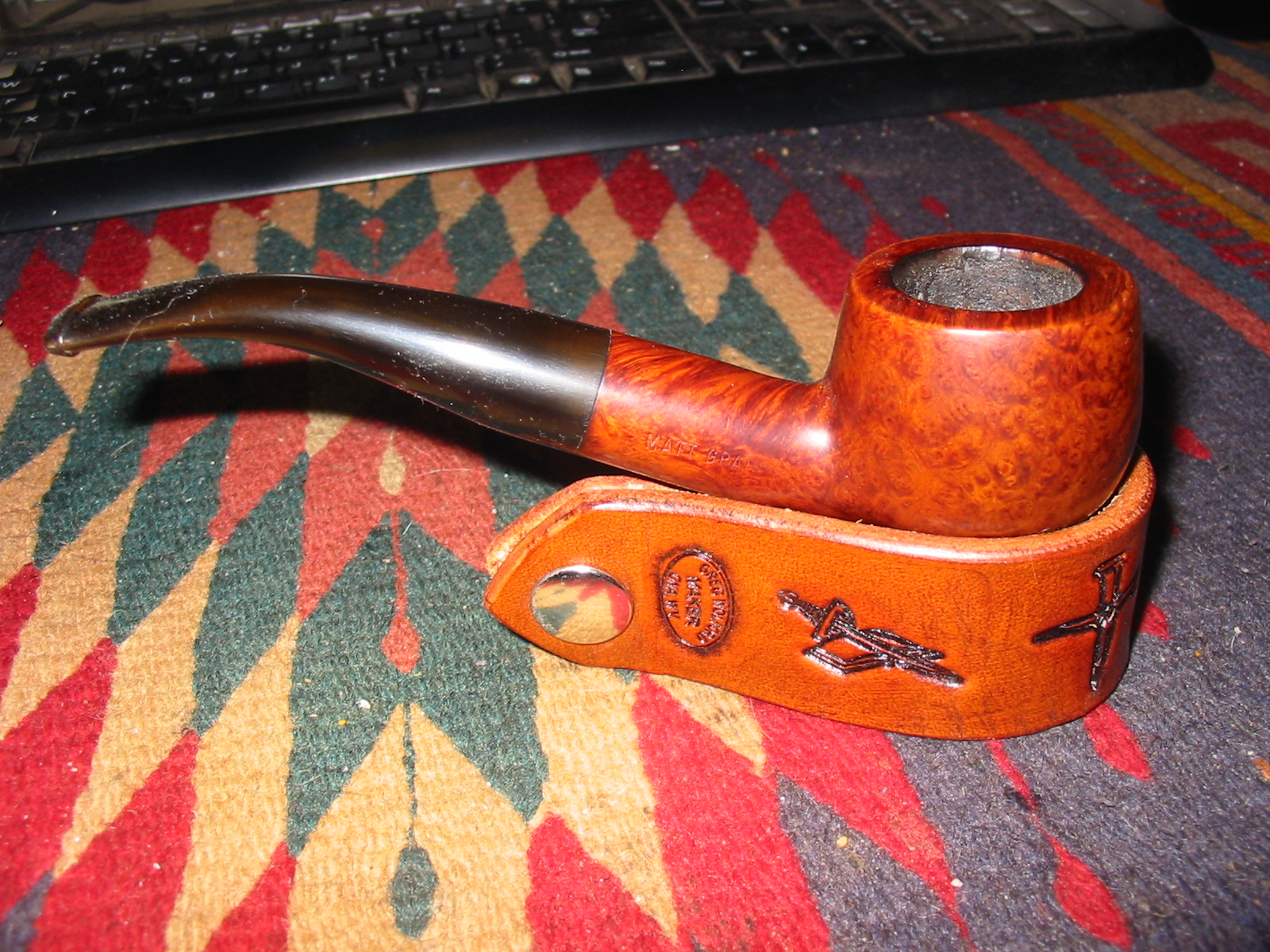
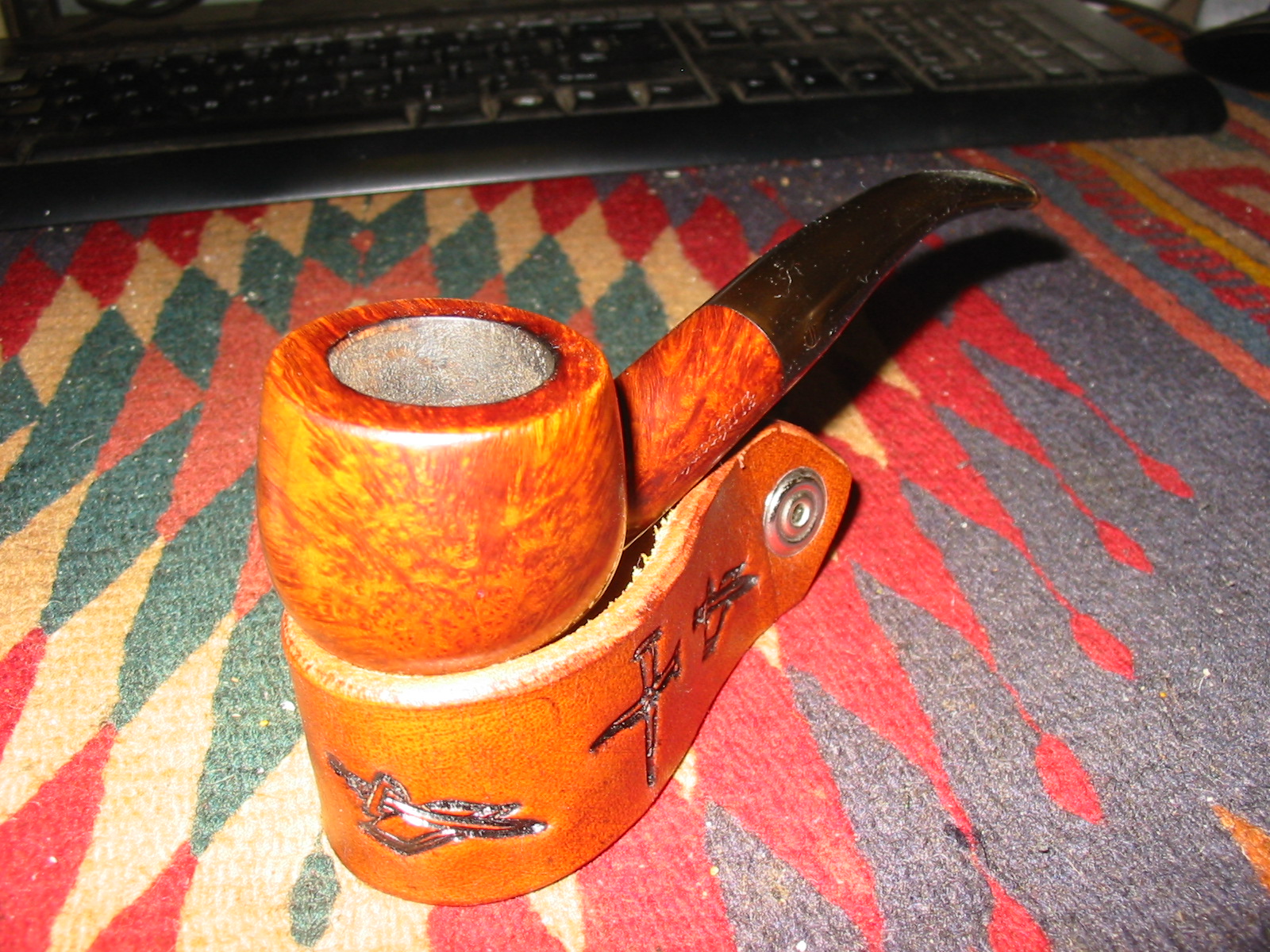
In the last photos below I have my Churchill’s pipe resting in the stand. It is a wide bottomed pot shaped bowl and it fits easily in the rest. It is one I plan on keeping in my pipe bag for my travels as it is easy to pack, takes up little room and quickly provides a resting spot for my pipe.

IMG_1797

IMG_1798

Greg also included some care instructions with the stand that are very helpful and certainly something that I would not think of had he not included them in the package. I am including them in this post to show the craftsmanship and customer care that Greg provides with his leather products. In Greg’s words:

“I recommend that you wax it every few months, 2-6, depending on how you use it, with Kiwi shoe polish. This will help it to stay water resistant by protecting the top coat over the dye and the antiquing in the stamping. You can use neutral or brown if you want to add to/enhance the color. I have made a short YouTube video on the how, why and what to use for this process which can be viewed in the YouTube video below.

Thank you Greg for the great pipe stand. I am enjoying using it as a part of my pipe smoking routine. It sits on my desk where it is accessible when I am at home and goes in the pipe bag when I am traveling. It is a perfect accessory for me. I would encourage any interested pipemen to contact Greg about getting a custom made pipe stand from him. You will not regret your decision.

THANK YOU For an incredible year at rebornpipes


rebornpipes has been operating the blog since the end of May 2012. For the remainder of 2012 the site had 39,646 views. Since January of 2013 we have had double the views with 79,026 views. There are 492 different posts on the blog written by myself and 11 individuals who have posted about their refurbishing work. I have included the list of contributors from the Thanks to Contributor’s page. Have a look at their credentials and their posts. You can search the blog by author name now and select those you want to read. In addition there are guest articles written by another 7 individuals.

1. Al Jones – Al was the first to contribute his writings and photographs to the blog under the name upshallfan. Al does incredibly nice refurbs and adds a nice touch of class to the blog.

2. Fred Bass – Fred is the Meer Guru in my opinion and to have several of his pieces here on the blog is incredibly helpful. Fred brings a love of the meer and years of experience in cleaning, breaking them in and caring for them to the table.

3. Gan Barber– what can I say about Gan? Over the years we have fired emails back and forth with ideas and suggestions and insight into our joint hobby. I am thankful to have Gan posting here as in many ways he has been a mentor to me in this hobby.

4. Chuck Richards – Chuck, like Gan, has been someone with whom I bounce ideas and methods back and forth. Chuck also keeps the challenges in front of me and I learned much from him.

5. Kirk Fitzgerald – Kirk is a relative newcomer to the refurbishing craft but he has an amazing talent with a chisel and carving knife. His contributions on his method of rustication have been well received and it is a pleasure to have him contribute here as well.

6. Piet Binsbergen – I have corresponded with Piet for awhile now and we connected over Keyser Pipes. A mutual friend on the forums – Muddler – connected us when I was searching for Keyser stems. Piet is an artist at heart and by profession. His love of the briar and restoring it comes out in his work and his words. It is great to have added him to the pool of contributors.

7. James Gilliam– I asked James to contribute from the perspective of a pipe maker what it was like to do refurbishing. James makes some amazing pipes and has done a great article on his perspective on our craft. His website is JSEC Pipes at http://jsecpipes.com/ I appreciate James willingness to contribute to the blog and it is a pleasure to have him contribute.

8. Al Shinogle – I contacted Al Shinogle and received his permission to post his article on opening the airway on a pipe. Al continues to do some great refurbishing work on estate pipes that he revives and passes on to old timers. I look forward to future articles by Al.

9. Greg Wolford – is one of the blog’s readers and comments often on various posts. He contacted me with several articles on the pipes he has refurbished and the methods he has used. Greg writes well and is a fine photographer in his own right as well. I look forward to reading what he contributes in the days ahead.

10. Robert Boughton – Robert is one our newest contributors to the blog. He is a new practitioner of the refurbishing art being tutored by Chuck Richards in the finer points of refurbishing. It is a pleasure to have him writing for the blog and adding a new voice to the posts. His research and his work are well done. Thanks Robert.

11. Brian Devlin – Brian is a 62 year old retired electronic manufacture and design company owner living in Blairgowrie, Scotland. He is a stroke survivor (I like him already as I too am a stroke survivor) having survived 3 major strokes 7 years ago. He loves his new home, pet rabbit and morning ritual with pipe and rabbit in his garden. He frequents EBay to hunt for pipes that he buys and skillfully refurbishes to smoke. It is great to have Brian writing about some of his refurbs on the blog. Enjoy his work.

Added to that list of regular contributors there are also articles that have been written by the following individuals:

1. Bas Stevens – Bas is the go to person for information and history on Stanwell pipes. He has one of the most beautiful Stanwell collections that I have ever seen. I appreciate Bas’ willingness to have his piece on Stanwell shapes available on the blog.

2. Mark Domingues – Mark is another reader of the blog and has lately contributed some of his work. Mark collects Peterson pipes and his work is a pleasure to read about. Mark seems to never shy away from trying things that are daunting at best and certainly some that others would consider futile. Thanks you Mark for writing for us.

3. Eric Boehm – Over the years on the forums I have read Eric’s posts with interest. He has collated and collected some great information that it is our privilege to be able to share here on the blog. I thank Eric for his willingness to pass on his writing through the blog.

4. Les Sechler – Les graciously gave permission to put his article on Barling pipes on the blog. Les possesses a wealth of information on Barling’s and Dunhill pipes. He has always been gracious when I contact him for help on various projects. Thanks Les for being a willing and able correspondent.

5. Martin Farrent – Martin graciously gave permission to put his article on Dating Loewe Pipes by Period on the blog. I look forward to reading more of Martin’s work in the future. His knowledge of Loewes pipes is incredibly helpful and insightful. Thank you Martin.

6. Mike Leverette – Mike was a very good friend and the consummate pipeman. He was a fountainhead of information on all things Peterson and also one who shared a common interest with me regarding alternative woods used in pipes. He knew and loved the older historical alternative woods used by American pipe makers. All of Mike’s articles on the blog are published posthumously from pieces he sent to me over the years before his death. Mike I miss the chats and the ready wit that characterised you so much.

7. Alan Chestnutt – Alan is a professional pipe refurbisher doing work on the web as Reborn Briar ( http://www.estatepipes.co.uk/ ). His work is extremely well done and his website also has a wealth of information and some of the pipes he refurbishers are for sale through the site. Thanks Alan.

Including the articles that I post we thus have 19 different writers on the blog. I am so thankful for the willingness of others to add articles on their expertise and experiments in the art of refurbishing pipes.

The spread of the blog is quite extensive now, covering 150 different countries. It is remarkable to go to the various Referrers to the blog and read articles there that have been translated into other languages. I have also read newsletters, emails, forum posts from many of the different countries pipesmokers and found them referring favourably to the blog. All of this more than meets the expectation I had when I started rebornpipes. I wanted it to be a place to share our collective learning regarding the work we do as hobby refurbishers. It has been a pleasure to receive emails and also comments on the articles from many of you with your additions and helpful information that sits in the comments below each article and in some cases have been integrated into the material for a more complete compendium.

I think as we move into our second year at rebornpipes I would encourage others of you who read the blog and practice some of the tricks learned here to comment on the posts and to also submit articles and photos of the pipes you have been refurbishing. Share the tips and tools you have learned and developed as you have worked on the pipes at your table. Your articles are always welcome and the list of authors is wide open for additions.

Again I want to take this opportunity to say thank you to the pipe smoking community for your reception of the work of rebornpipes and your continued readership. I do not take it for granted in this busy world in which we live that you would take time to read the articles we post here and share them in your circles of pipesmokers. Thank you.

Steve Laug
rebornpipes

Why I smoke a pipe – Eric Boehm


Blog by Eric Boehm

Here is another of Eric’s pieces – this one is a great essay on why he smokes a pipe. I love the ideas that he has collected in this essay and his straightforward answer to those who question his pipe smoking. Thanks Eric for letting me post this here.

I routinely use this missive as a broad sheet to answer the question of “Why I smoke a pipe”. A question so often asked by many of my anti-tobacco friends. Friends, I might add, that give me a hard time whenever I light up my tobacco pipe. You see, I’m a reader, and my heroes are those I read about. And usually they involve men who smoked a pipe.

Run your eyes down the list below of names and see how many you recognize. Collectively, I would argue, these men actually made the 20th Century, both literally and figuratively. To a man, all avid pipe smokers, each and every one. Moreover, many lived well beyond the average lifespan of their day, many passing in their mid to late-eighties.

Albert Einstein, Mark Twain, William Faulkner, John Steinbeck, Norman Rockwell, Orson Wells, JRR Tolkein, CS Lewis, Douglas MacArthur, Admiral Arleigh Burke, Stanley Baldwin, Neville Chamberlain, Bing Crosby, President Gerald Ford, Carl Sandburg, Harold Macmillan, Konrad Lorenz, Errol Flynn, Edgar Rice Burroughs, John D. MacDonald, Warner Baxter, Thomas Selfridge, Charles Nelson Reilly, Ossip Zadkine, Max Frisch, Paul Casals, Jack Lynch, Patrick Moore, Anthony Hulme, Ronald Colman, Alexander Kent, Jacques Brel, Lino Ventura, Alfred Wainwright, Rudolph Bultmann, Philippe Sollers, Jean Gabin, Leo Malet, G.E. Moore, Gilbert Ryle, Edmund Husserl, J.L. Austin, Lalo Schifrin, James Whitmore, Anthony Quayle, Ralph Richardson, Bernard Grebanier, Jean-Paul Sartre, Stanley Holloway, Carl Jung, Paul Kruger, Curd Jurgens, Gerard Walschap, Trevor Howard, Tony Benn, Rod Hull, Trevor Baylis, Joss Ackland, Frank Muir, Manny Shinwell, Jack Hargreaves, Warren Mitchell, Rupert Davies, Russ Abbot, Van Gordon Sauter, Walter Cronkite, Robert Fulghum, Milorad Pavić, Glenn Ford, Erwin Shrodinger, Moustapha Akkad, Evelyn Waugh, Harold Wilson, Bertrand Russell, Alf Landon, Edgar Buchanan, Dean Jagger, Edward G. Robinson, Rudyard Kipling, Aaron Spelling, P.G. Wodehouse, Allen Dulles, Otto Klemperer, Henry Fonda, Lee Van Cleef, Jack Lemmon, Peter Cushing, Barry Fitzgerald, Hume Cronyn, Graham Chapman, Nigel Bruce, Bennet Cerf, Raymond Chandler, Alexander Graham Bell, Arthur Frank, Richard E. Byrd, Gregory Peck, Albert King, Clarence “Gatemouth” Brown, Edward Abbey, Juan Trippe, Frank Sinatra, General George S. Patton, Jacques Derrida, Hurbert Hoover, Sid James, Fred Trueman, Vincent Schiavelli, Eric Morecambe, Stephen Fry, Fred Thompson, Roscoe Dickinson, Guy N. Smith, Gunter Grass, Sean O’Casey, A.A. Milne, Sir Compton Mackenzie, Laurie Lee, W. Somerset Maugham, J.B. Priestly, Andre Dubus, Gordon Parks, F.A. Mitchell-Hedges, W.W. Denslow, William Conrad, William Gillette, Edwin Hubble, Rober Oppenheimer, Niels Bohr, Robert Young, Clark Gable, Fred MacMurray, Ralph Bellamy, Cary Grant, David Ogilvy, Sir Winston Churchill, King George VI, Arthur Miller, Ernest Hemingway, John Ford, Shelby Foote, Herschel Burke Gilbert, Thomas Johnston Taylor, Theodor Geisel (Dr. Seuss), Sir John Mills, Owen Barfield, Alan Christopher “Al” Deere, Elliot Harold Paul, Healey Willan, Harold Tucker Webster.

After perusing such a list, I ask: Can it be that the greatest minds of the 20th Century were all common miscreants, who did not fully fathom “what they were doing to themselves”? Are we, with all our advances of modern science, more intelligent than they were? How many men today can you count that can measure to the list above? I am hard pressed to find a handful, if that.

We current tobacco pipe smokers actually represent the historical legacy of a community of world pipe smokers, a community which, in the not too distant past, encompassed some 35% of the adult males in the United States. Lest it not be forgotten, these anonymous pipe smokers were our grandfathers, and allowed for the freedoms many of us enjoy today. Although far fewer in number today, we nevertheless still hold the candle to the memory of these men and the deeds they accomplished, with, of course, a pipe in hand.
__________________
Thanks everyone for your positive comments. Whenever I catch flack from anti-tobacco folks, friends, wife & children included especially those do-gooder “soccer moms” driving minivans, who quickly shield their children’s eyes when they see me – I go to length to point out just exactly who historically smoked a pipe. If Albert Einstein saw the sense to smoke a pipe, just to name one – or Shelby Foote, one of my favorites – then who in blue blazes are they to question my choice to smoke a pipe in public? (I started this thread after coming home from a 4th of July picnic, where it was clearly intoned to me that pipe smoking was not allowed in a NJ public park! On account of the kids).

Everyone says they miss the America depicted by Norman Rockwell, or reminisces fondly on the “greatest generation” who fought against fascism in the Second World War. Well, nearly all those joes smoked a pipe! And I don’t mean hidden away in their man caves, but out on the street, holding their kid’s hand, or carrying groceries home. That’s why I like reading Marc Munroe Dion so much. Smoking a pipe in public puts the brakes on society’s mindless, head-strong rush into an uncertain future. In short, it puts the mute button on our infotainment world. Which is something I like. Thanks for letting me rant. I’ll get off the soap box now.
______________________________________
If I’m ever in London, I think I’ll go to the Speaker’s Corner – that point where Oxford Street and Hyde Park meet, in the shadows of Marble Arch – and carry on an oral tradition that is becoming somewhat lost to a modern culture of email and online chat rooms. For over 150 years, Speaker’s Corner has been one of London’s most eccentric attractions. Soapbox central! There, with a large clenched Dunhill group 6 billiard, containing smouldering Pirate Kake, and reeking of 70% Latakia – my chest festooned with a large placard bearing the likeness of Alfred Dunhill – there I shall read out the proclamation entitled “Why I smoke a pipe”. Should be able to get through the first several paragraphs before the Bobbies cart me away in a white coat!
____________________________________
Parting thoughts –
My comments were: “Wow! I am dumbfounded. Personally I don’t give a hoot how pipe smokers are perceived by the wider society. I smoke a pipe throughout the day because I am a pipe smoker. Period. I smoke in private and I smoke in public. I also smoke in the can. If someone has a problem with it, they can contact my lawyer. Really, I could care less what others think of me and my pipe. Life is short enough as it is to worry about what the neighbors think. Get a life. Smoke a pipe. And let’s try not to think too deeply about it. Eh?”