Category Archives: Pipe Reviews

Over the years as I have bought pipes from Pipe Makers I have written reviews of those pipes. While they do not deal with the theme of pipe refurbishing, they give me some great help in the area of mechanics of the pipe – airways, drilling, stem shapes, button shapes and the shape of the slot in the button. I have learned much from these pipe makers whose pipes I buy – both from their work and from them personally.

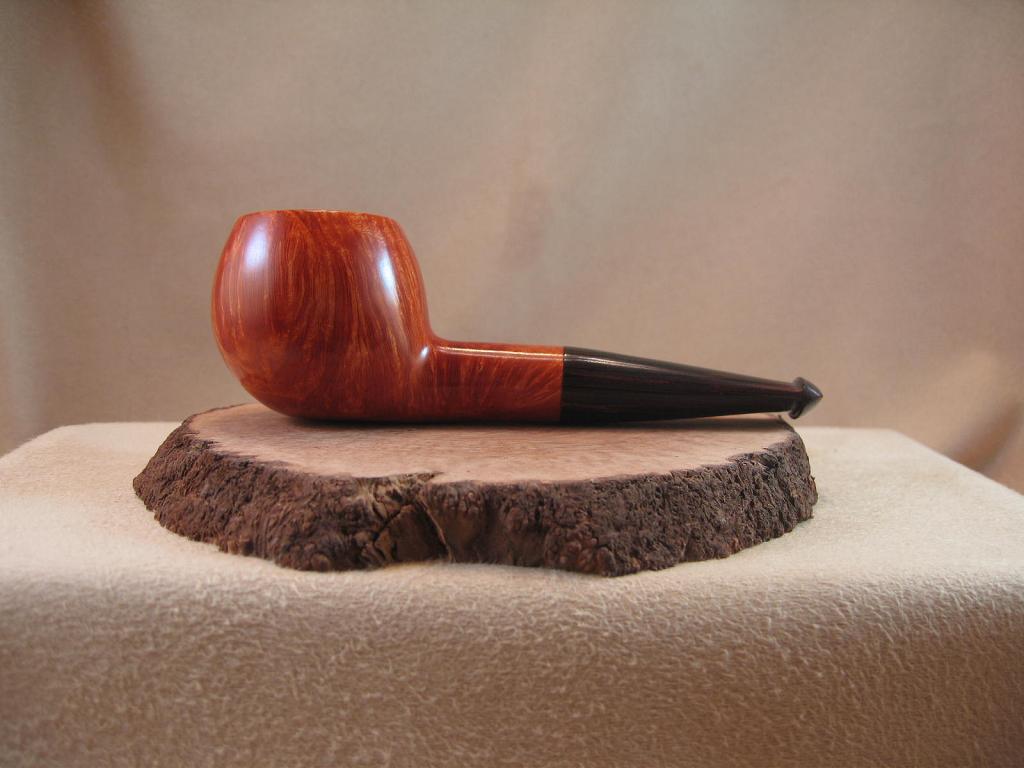
A Review – A Commissioned Alan Stevenson Hand Made Apple


For those who are unfamiliar with Alan Stevenson, a pipemaker from Wisconsin, I am including some information regarding him taken from Pipedia. I think it will be helpful for you to get a feel for the pipe maker before you read my review of his pipe.

“Alan Stevenson is known for his high quality handmade pipes in classic shapes. His trademark hand cut Cumberland stems are a favorite among those who own one or more of his finely crafted pipes. His pipes have a reputation for being some of the best smoking pipes available and their quality is well above their selling price. Alan is a rather modest individual when it comes to his pipe crafting skills, as evidenced from his quote below.” – Pipedia

Quoted from the Alan himself: “My Name is Alan Stevenson and I live in Wausau, WI. I am a very late bloomer for a pipe maker. Have been smoking a pipe since college in 1966. I have always wanted to try making a pipe, so after 30+ years in industry I have retired to my little corner of the garage. Pipemaking for me has really involved a steep learning curve which I have only begun to climb. My background is math, physics and chemistry; I had never touched a wood or metal lathe in my life. Starting at nearly 60 is tougher than most would think.

In 2004 I had tried my hand at a couple of kits from Mark Tinsky and enjoyed working on them. So I paid the kindly Mr. Tinsky a visit in Helena. Mr. Rad Davis was there at that time as well and for a few days I had the privilege of learning a little about pipemaking from these two gentlemen. I left Helena with a couple of pipes, a bunch of briar and some stems and returned to finish working on them in my shop. About 2 years ago I got my nice metal lathe and set about learning how to hand cut a stem. If I ever learn to do that correctly then I might consider that I am a pipemaker. Till that time I am still learning.” – Pipedia

Several years ago I contacted Alan regarding a commissioned pipe that I wanted him to make for me. Earlier I had been gifted one of Alan’s rejects and had stemmed it myself and I loved the finish and feel of that pipe. He had done a great job in laying out the cut of the pipe with the grain of the briar on the reject stummel I had so I wanted to see his magic on a full pipe. I gave him a call and asked if he would carve a pipe for me. My request was pretty simple in that what I wanted was roughly an apple shaped pipe that had a smooth finish. I did not specify colour or finish or even the lay of the grain. I also did not specify a shank extension or the wood that he would use in it. I pretty much left all of the artistry up to Alan to work his magic.
Stevenson1

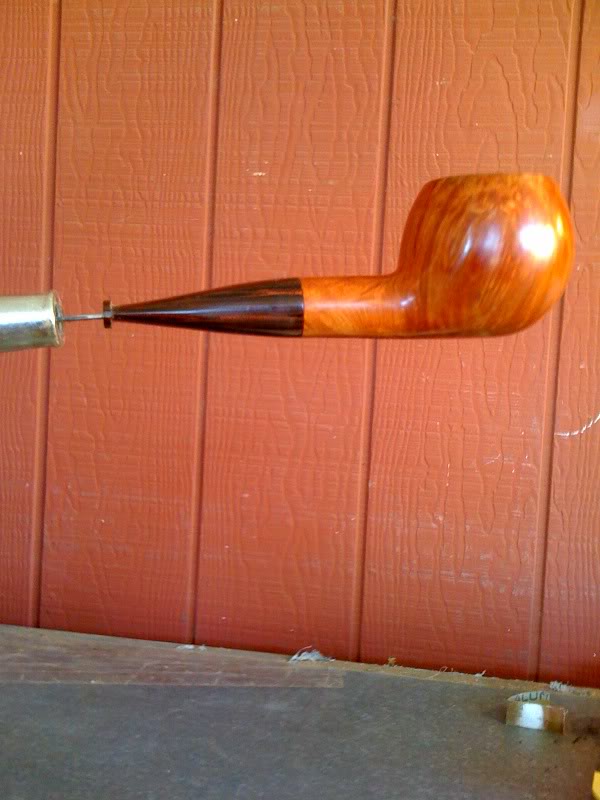
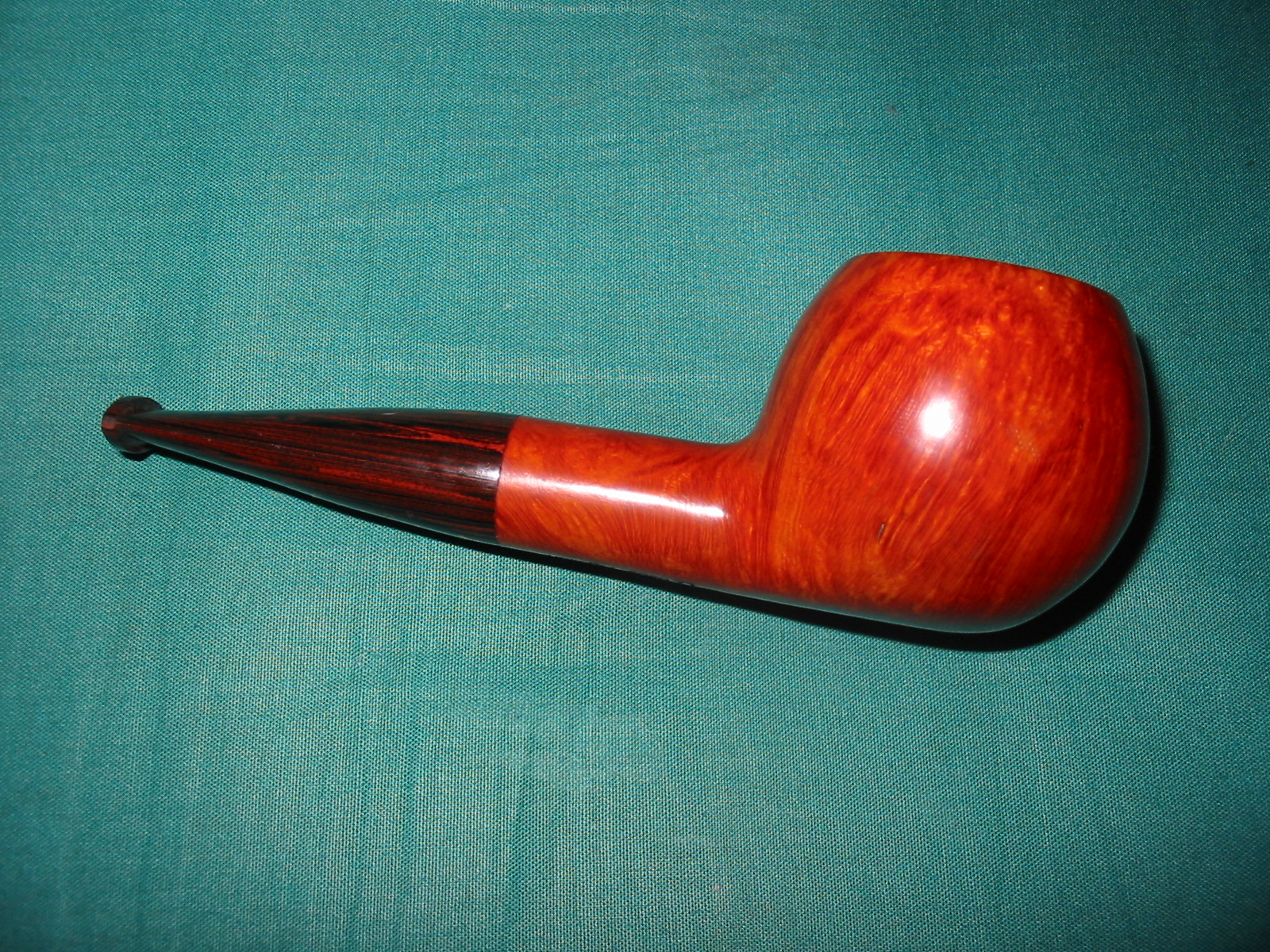
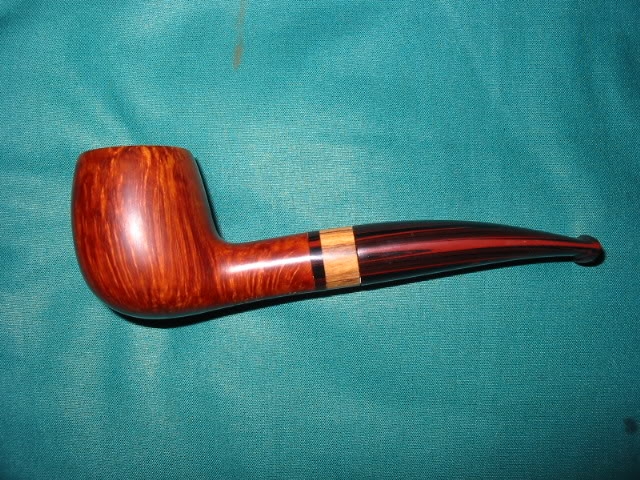
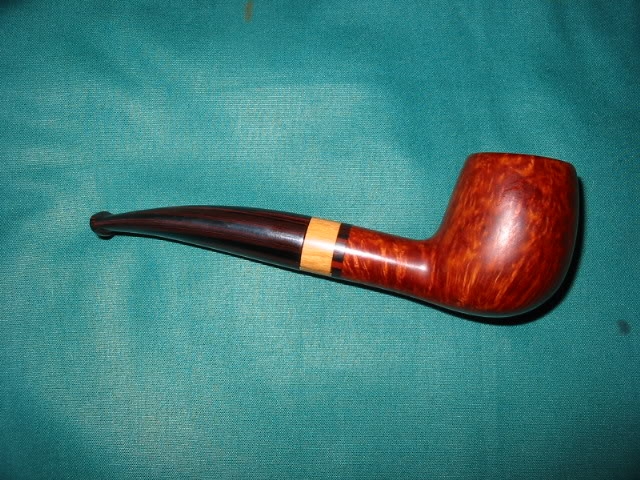
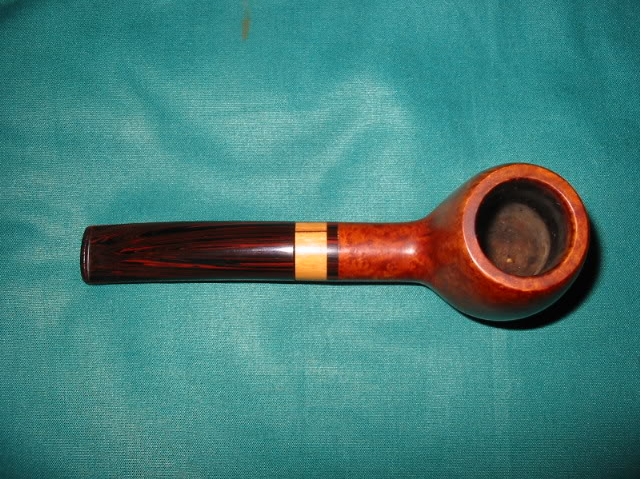
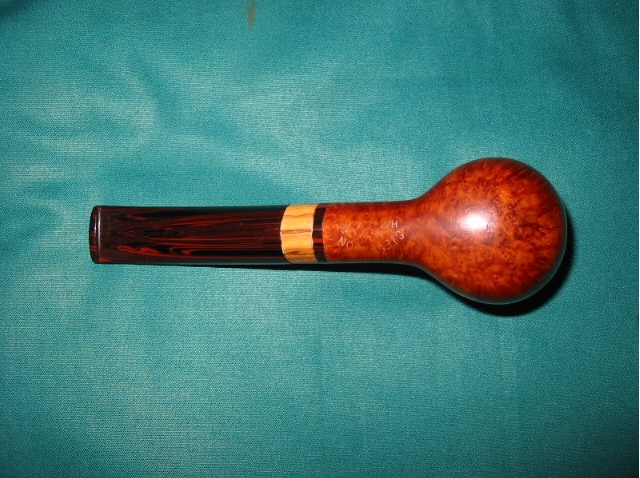
When the pipe arrived and I have to tell you the shape and finish went beyond what I had in mind when I commissioned it from Alan. It was and is beautiful. The length of the pipe is 5 inches and the bowl height is 1 5/8 inches. The bowl diameter is 1 1/4 inches. The chamber diameter is 7/8 inches and depth is 1 1/4 inches. The lay of the shape to the grain is superb. The sides bear a mix of straight grain and flame. There are spots on the front and back of the bowl which have mediocre grain but Alan did a good job of working that into the finish. The rim, the bottom of the bowl and the top and bottom of the shank have some nice birdseye grain. There is one slight flaw in the briar at the front toward the bottom of the bowl that he blended into the grain of the briar nicely. It looks to me that he used a dark brown stain on the undercoat to highlight the grain and then a tan or light brown stain to cover that and give the pipe a warm hue. He made a shank extension that combines a thin band of Cumberland and a wider band of olive wood. The olive wood is also stained with the tan stain and looks good. The stem is Cumberland and matches the band. The overall flow of the bowl and shank is brilliant and the colours are beautifully matched from rim to the end of the shank.
Stevenson2

Alan did an excellent job on the inner mechanics of the pipe with drilling that is perfectly executed from the shank and into the bowl – coming out exactly centre in the bottom of the bowl. The airway and the inside of the bowl were very smooth with no rough spots left by the drill bit in the bowl or shank. There was no bowl treatment or coating so just a good smooth briar. He had sanded the inside of the bowl and there were no hidden flaws or surprises.

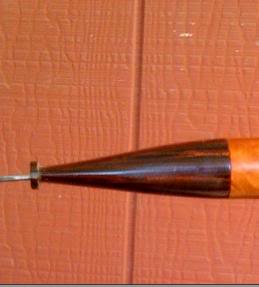
The stem itself is hand cut out of Cumberland. It has a gentle taper from the shank to the button. It has a slight bend to it that gives it a stylized look. Alan did a great job shaping the stem and capturing a shape that really works with this pipe. The stem is nicely finished with no marks or scratches in the Cumberland. The tenon is integrated with the stem and cut into the Cumberland. The fit in the mortise and against the shank is snug. He countersunk the end of the mortise to make for a snug fit of the stem to the shank. There appears to be a slight gap where it meets the shank but as I examine it with a light I think that it is a problem with the stem being slightly larger in diameter than the shank. The end of the tenon is funneled slightly for a smooth transition from the mortise when it is in place. There is a very minimal gap between the end of the tenon and the base of the mortise. The airway is smooth from the entry of bowl airway all the way to the button. The draught is unrestricted and open from the bowl to the tip of the stem. The button is perfect to my liking and very comfortable in the mouth and teeth. The edge is narrow and well shaped. The slot in the mouthpiece is fanned out and is oval in shape. The airway is thus consistent in size from the tenon to the slot. There is no whistle or noise when the air is drawn through the pipe.
Stevenson3

The overall construction of this pipe is very well done. It is light in the hand and in the mouth. It is well balanced and has a shape that fits well in my hand. There are some slight details in the finish of the pipe that in no way affect its smoking ability. They are truly cosmetic in nature. I list them at this point only because to me they are there and others will see them. The first involves the shank extension. There are some spots on the underside of the shank where the epoxy squeezed out between the Cumberland and the olive wood. The second involves the fit of the stem being slightly off. There appears to be gap at the junction as noted above. However, in examining the stem and shank and measuring the diameter of each it is clear that the problem is not a gap but that the stem is slightly larger in diameter than the shank. This could easily be corrected but I have not done so yet. The third issue may appear to be a finicky one to be sure, but it is there nonetheless. The Cumberland of the band and the stem seem to come from different pieces of stock and thus the lines/striations do not line up. This issue does not bother me but some would find it troublesome. Apart from those very simple cosmetic issues the pipe is well made and is a smoking machine.

I have been smoking it for a few years now and after breaking it in with what has become my first love in tobacco, McClelland’s 5100 it has become a great Virginia smoking pipe. It has always delivered a good smoke from the first smoke to the present. It draws well; the lighting has never been a problem. It seemed to take very little time to break it in and continues to be an effortless smoke.
Stevenson4

Thanks Alan for delivering a well made pipe at a great price. It remains a very good smoking pipe through the years since I purchase it. I do not know whether Alan continues to craft his fine handmade pipes but if he does they are worth considering. I see them come up on EBay periodically and one day I will pick another one up. If anyone knows if he continues to make pipes I would love to hear from them. You cannot go wrong with a Stevenson Handmade Pipe.
A Review – A Steve Morrisette Tomato


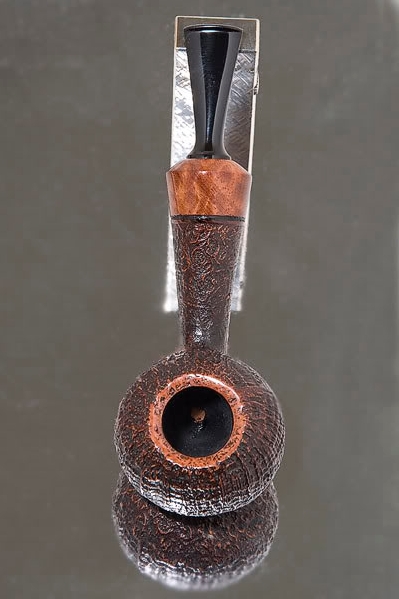
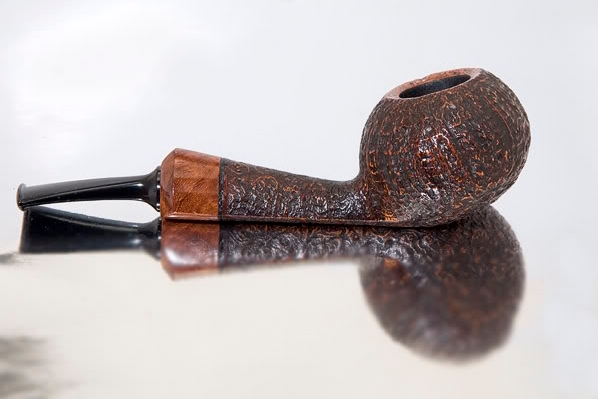
I commissioned this pipe from Steve and had a great time working with him as he designed and executed the work. The pipe is a beauty. Its length is 5 ½ inches and the bowl height is 1 3/8 inches. The bowl diameter is 1 ¾ inches. The chamber diameter is 3/4 inches and depth is 1 1/8 inches. It sports a hand cut acrylic stem. The pipe is a small squashed tomato shape with a ¼ bent stem that fits well in the hand. The shank is shaped like a shield with the right and left sides curving up to a rounded point on the top of the shank. The underside of the shank is a flattened peak with centre ridges that runs the length of the shank. The lower edges of the right and left side are sharp and straight lines that run the length of the shank. From the top the shank flares wider as it moves toward the stem. It has band of black acrylic and then an amboyna shank extension. The stamping is an older Steve Morrisette stamping.
Morrisette4

The finish on the outside of the pipe is a sandblast that is visually very pleasing. It is not too deep a blast but highlights the ring grain on the sides, front and back of the bowl and on the bottom edge of two angular sides of the shank. On the bottom of the bowl and shank is a beautiful sandblasted birdseye that highlights the pattern of the grain. The rim was sandblasted and then sanded smooth leaving a few small birdseye grain visible under the smoothed out blast. There is a thin smooth band between the acrylic band and the shank that was also sandblasted. The mortis is countersunk so that the stem sits into the shank extension. There is a very tactile feel to the sandblast on the bowl and shank that feels great as the bowl warms during a smoke.
Morrisette2

The bowl is stained with a dark brown or black under stain that goes deep into the grooves of the blast and highlights the deeper parts of the blast and the rings and whorls on the birdseye. The higher parts of the blast are stained with a medium brown stain that is a perfect match to the colour of the shank extension. The medium brown is relatively smooth on the rim and on the thin band just ahead of the acrylic band on the shank. In contrast to the bowl and shank Steve cut a black acrylic stem that picks up the thin black band on the shank. The blacks/dark brown stain on the sandblast also provides contrasting highlights to the total package of the pipe. Steve did a great job on the stain and finish of the pipe.
Morrisette5

The stem itself very nicely worked. It is an acrylic stem that is cut at the same flared angles as the shank. The shank extension is crowned and the stem is inset into the crown giving it a very delicate look. The delicate look and feel of the stem deceptive for it has strong lines that form the smooth flat sides of the stem and taper toward the button on both sides. Steve did an amazing job shaping the stem. The short blade of the stem is thin and has a good even tapered flow from the saddle to the button. It is matched in terms of angles on the top and the bottom and on the left and right side of the stem. The design along with the slight bend makes it fit very comfortably in the mouth. It also rests well enough that it can be clenched quite easily. The Delrin tenon has been set into the acrylic of the stem and is the same length as the mortise. The fit is snug. The end of the tenon has been funneled for good airflow.
The button is very thin in width but is elevated above the surface of the stem so that it gives a good edge for holding behind the teeth. It is thinner on the edges with a gentle rise at the centre top and bottom. The slot in the end of the button is inward at the same angles as the exterior of the stem to deliver a mouthpiece that has the same diameter from start to finish. It is also wide open and oval with the same distance from the outer edge of the button to the inner edge of the slot all the way around.
Morrisette6

The mechanics of the pipe are well done. The bowl chamber came with a bowl coating that seemed to be a combination of carbon and a neutral binder. The bowl is drilled at an angle back toward the shank in order to maximize the depth of the bowl with the thin profile of the bent tomato shape. It is also a conical bowl. Steve did a great job with that alignment. I removed the bowl coating before I smoked it and there were no pits or checking in the bowl. The draught hole is centered at the bottom of the bowl and seems to have a slight slope from the bottom to the top of the airhole. There is a very easy and open draw to the pipe. The fit of the stem in the inset shank extension is smooth and tight. The tenon sits deep in the mortise – if not exactly the same length then impressively close! The fit of the tenon is also smooth. The drilling of the draught in the shank is centered in the end of the mortise. The tenon on the stem is drilled to match it and there is no misalignment to the two. The air pulls clearly through the pipe with no whistling at all. Using a light to shine through the various airways reveals smoothly executed airways on the inside. Very nice work on the drilling Steve it is extremely well executed.
Morrisette3

I have been smoking it since I received it and am very happy with it. I have smoked Virginia flake and broken flake tobaccos in it and it packs easily and stays lit. Smoking it is a pleasure and is uncomplicated and effortless. I purchased this one quite awhile ago before Steve moved south to work in a new shop. I have been pleased with it from the start as it has always smoked smooth with none of the new pipe break in woes. Thanks Steve for a well-made pipe that smokes as good as it looks! I am not sure you remember making this one for me but it is one of my favourites.

A Review – A Penguin Briar Straight Apple


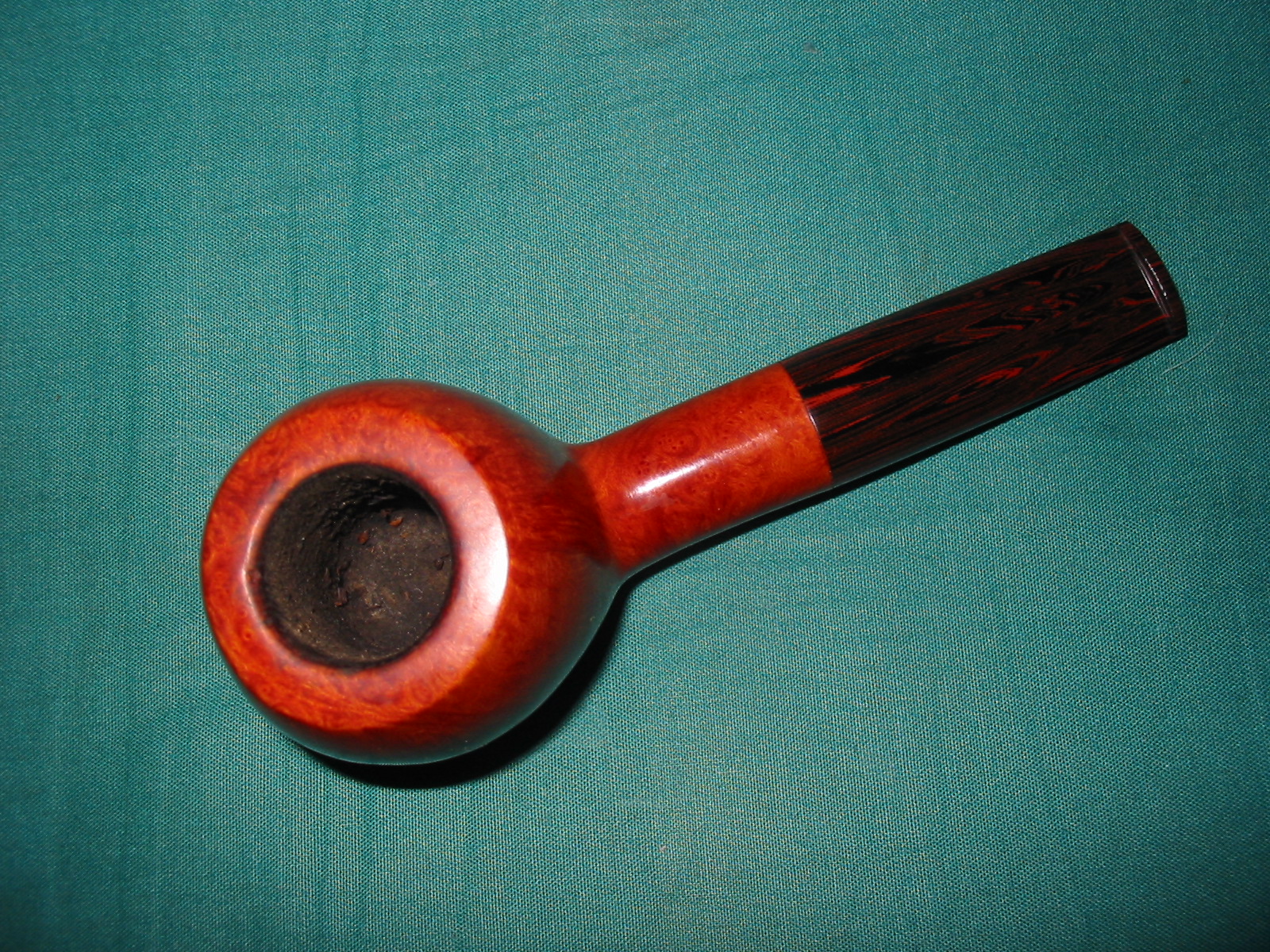
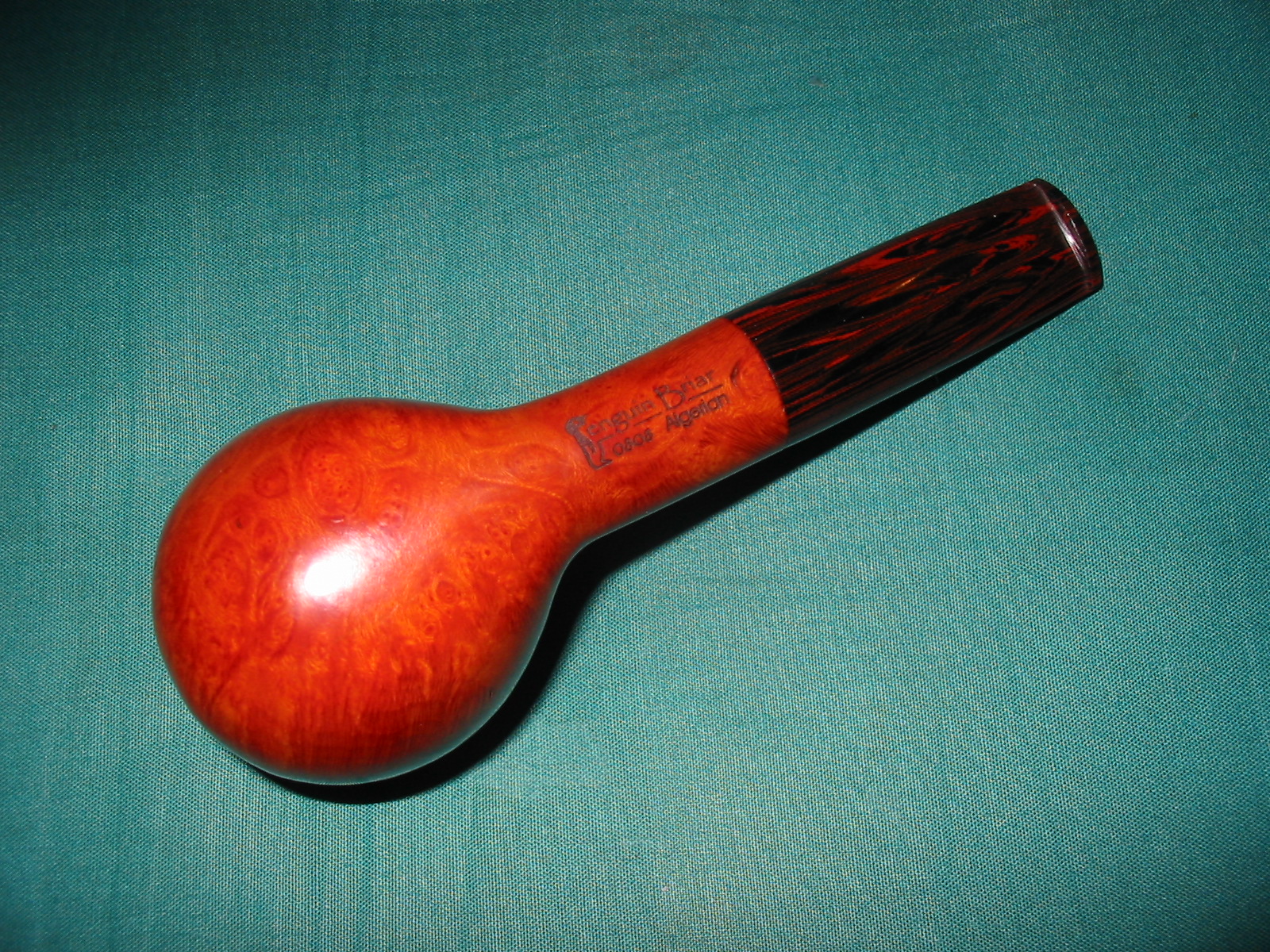
I commissioned a straight apple pipe from Kim Kendall of Penguin Briar in August of 2008 and I have had the years since to enjoy it now. It is a beautiful little straight apple sporting a hand cut Cumberland stem. It is stamped with laser cut lettering – Penguin Briar with the emblematic Penguin over 0808 Algerian. It was cut from Algerian briar that was well cured and had been in Kim’s shop for a while getting acclimated. The briar has one small flaw on the bottom of the shank between the stamping and the stem on the underside of the shank and a small one on the right side low on the bowl. Otherwise it is a very clean piece of wood. I don’t have the weight of it. But the measurements are as follows. The tobacco chamber is drilled ¾ inches by 1-3/16 inches deep. The pipe itself is 1 5/8 inches wide and 1 5/8 inches tall.The overall length of the pipe is 5 inches.
Penguin1

Kim did a great job laying out the shape on the briar. The grain is a mix of flame and straight around all sides, front and back of the bowl and the sides of the shank. There is birdseye on the rim, bottom of the bowl and the top and bottom of the shank. The pipe has a smooth finish and is stained with a 2-step process to bring out the grain. The bowl is round and an apple shape. It was Kim’s take on a Dunhill 3101 shape. The grain is decent on the pipe. I am not sure which stain Kim used first but the understains appear to be darker and serve to make the grain stand out. The overstain is almost an orange red. The combination gives a dimensionality to the finish and matches the Cumberland stem colour well.
Penguin2

The stem is a hand cut Cumberland taper that angles back to the sloped button where it flares to the same width as the shank junction. It gives the pipe a stubby look like a nose warmer even the pipe is five inches long. It is made of quality material as it has not oxidized in the years I have had it. The tenon is an integral part of the stem and is chamfered inward to form a dished end that is well-polished. The button is the size and shape that works for me–an oval that curves from the edges with a rise to the centre top and bottom, forming an eye shaped end view. It is also slanted from the front of the button to the slot giving it a slightly pointed look.The lip on the button fits well behind the teeth for a comfortable feel. The slot in the end of the button is also funneled and flattened to deliver a mouthpiece that has the same diameter from start to finish. Kim also rounded the ends of the slot giving it a finished look. It is a comfortable and well executed pipe. A pipe cleaner passes easily through the pipe with no obstruction.
Penguin3

Kim has well-crafted airflow dynamics in his pipes. The draught is clean and easy with no whistling or tightness. It has an easy draw that makes smoking it a pleasure. The bowl chamber is drilled to 3/4 of an inch diameter. The tobacco chamber was uncoated and sanded smooth. The cake built up on the bowl very easily. The draught hole is centered perfectly above the bottom of the bowl and seems to have a slight funnel leading into the shank and stem. The fit of the stem to the shank is excellent – smooth and tight with no light showing at the joint. The tenon fits well in the mortise and sits deep in the mortise against the bottom. The airway is in the centre of the mortise and aligns with the airway in the tenon. The edges of the tenon have been polished and rounded and the airhole countersunk so that it meets the airway in the mortise. Looking at the airways with a flashlight it is clear to see that they are smooth and polished with no rough edges. The interior of the pipe is smooth and polished from the button to the bottom of the bowl.

I broke this pipe in, as is my custom, with some aged McClellands 5100. I have kept it as a dedicated Virginia pipe and it has always delivered a good tasting smoke. It continues smoke cool and dry and deliver good flavor with the Virginias that I choose to smoke in it.

I had been smoking the pipe for some time and was quite pleased with the craftsmanship of Kim’s work. Then out of the blue Kim contacted me with an apologetic request to be given the opportunity to rework the stem and button area on the pipe. He said he had refined his stem and button work and really wanted to bring the one he had made for me up to date with a refined stem and button. I shipped the pipe back to him for his reworking. He sent me the following two photos of the stem work while the pipe was in the mail.
Penguinafter-1

Penguinafter2

When it arrived it was clear to me that he had changed the taper on the stem making it thinner and thus more comfortable in the mouth. He also thinned down the button itself making it less chunky and more defined in its overall look and feel. The angles of the junction of the taper and the button were cut sharper and cleaner. The overall comfortableness of the stem was greatly improved and the feel in the mouth was superb. Though I am not a clencher, the pipe was now easily clenched behind the teeth. Here are some pictures of the pipe after Kim’s stem work.
IMG_3064

IMG_3065

IMG_3066

IMG_3067

Kim has provided me with a great smoking pipe, light weight and comfortable in the hand and mouth. If you have not given Penguin Briars a look, here is the link to the website http://www.penguinbriar.com/ . I don’t think that you can go wrong with his pipes.

Kaywoodie 5183B – 75 Year Old Briar


By Al Jones

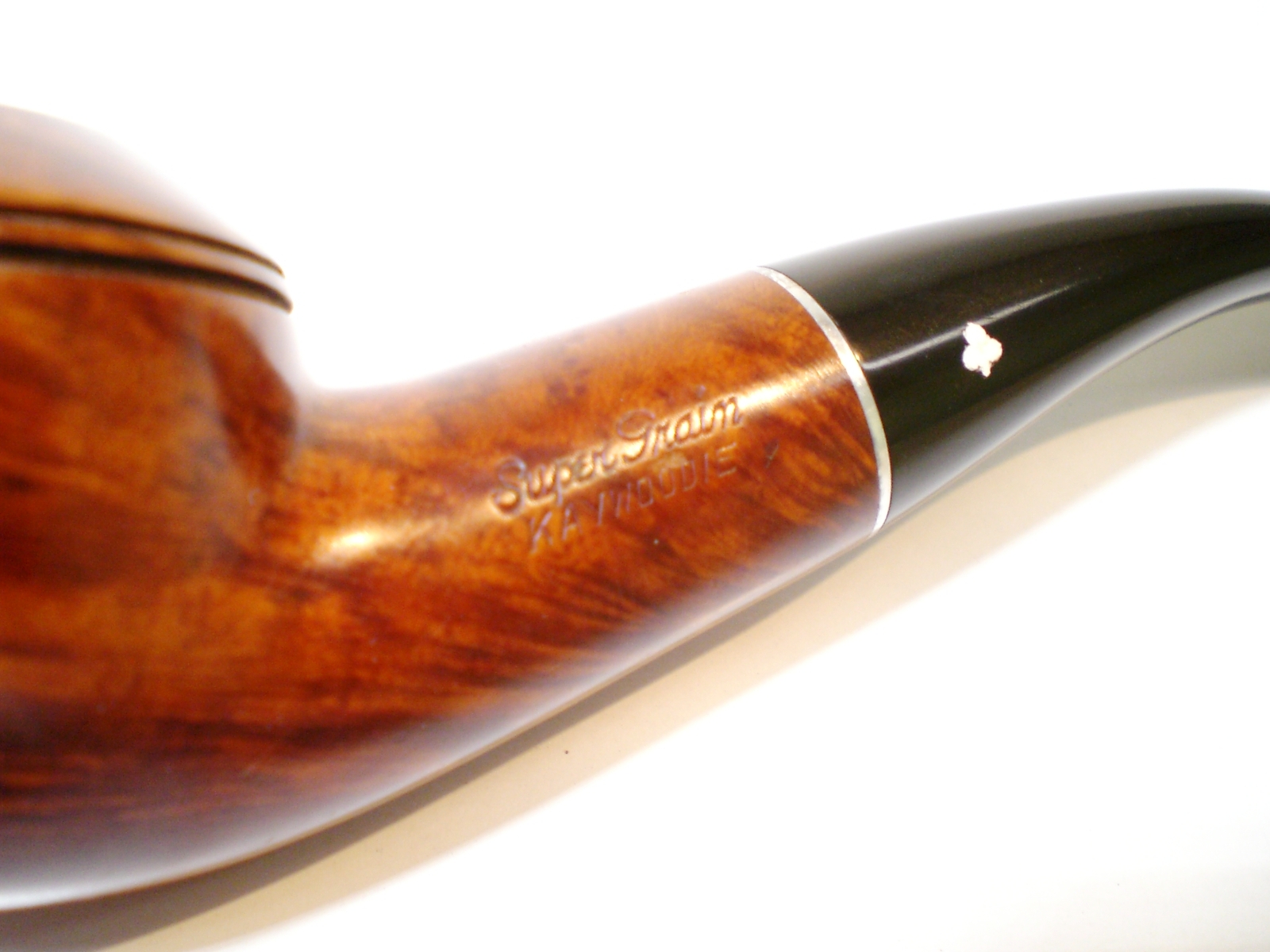
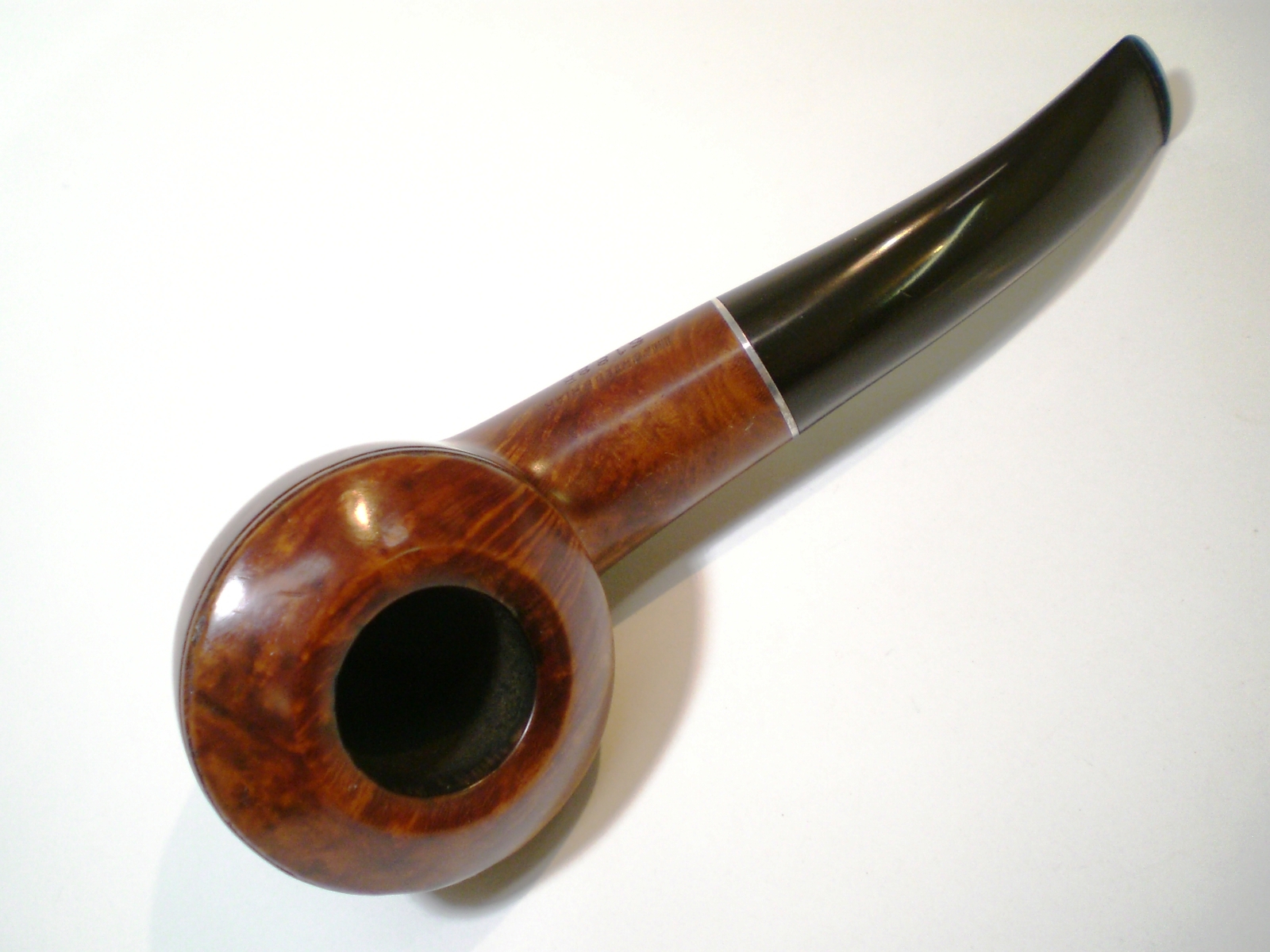
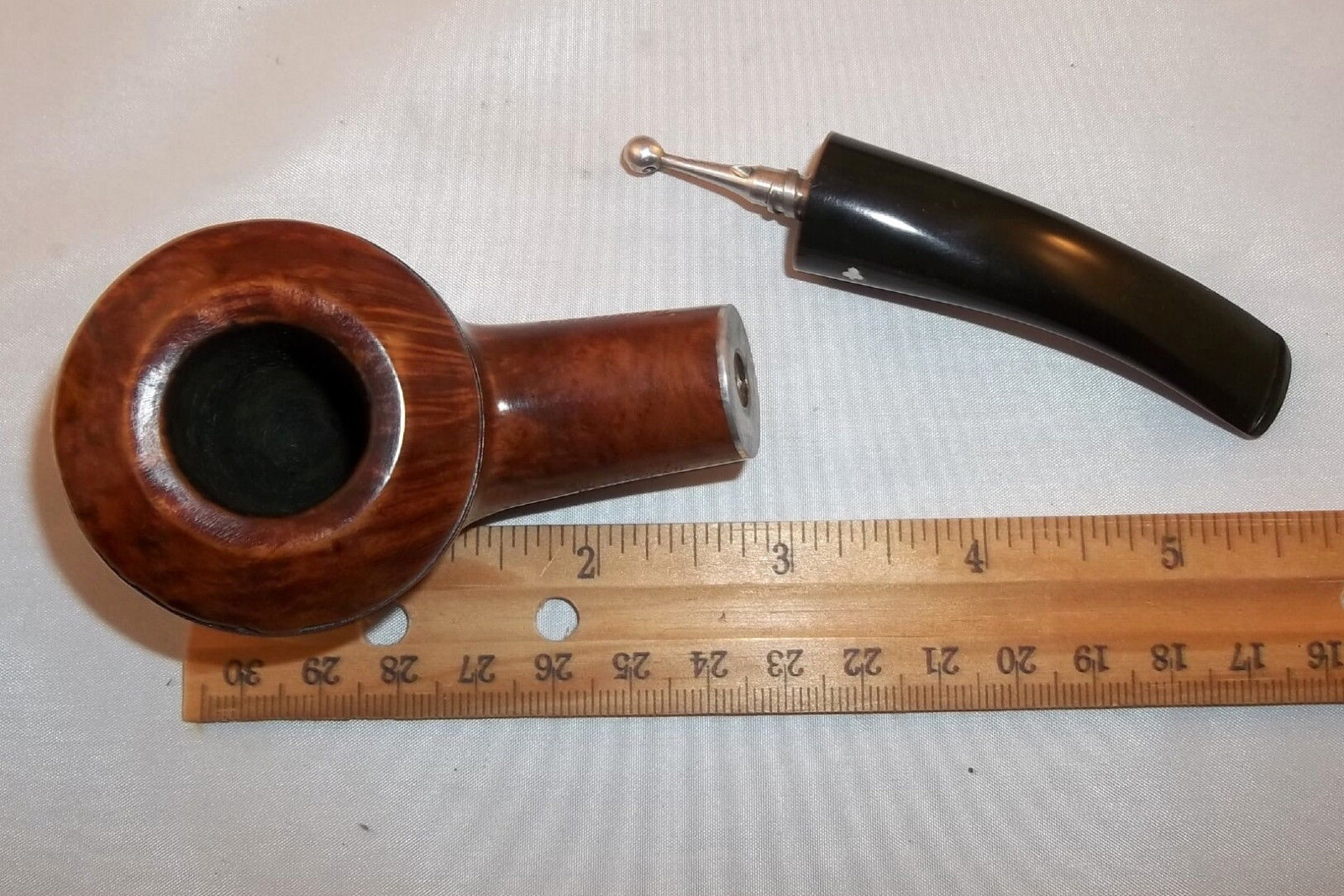
I love the tapered Rhodesian shape and have been keeping an eye out for a Kaywoodie 5183B. The four digit Kaywoodies with “Drinkless” stamped stingers were made in the 1930’s.

I found this one on Ebay last week. It was sold by Dave Whitney. Dave is the contributor to “The Pipe Collector” (NASPC newsletter) and has written a book on estate pipe restoration called “Old Briar”.

Dave has this pipe listed as being made in 1938. From my research, and comments from other collectors, it seems a 1937-1938 is correct. The pipe is stamped “Imported Briar”.

The pipe was in overall excellent condition. Dave tells he found it in a box lot and the tobacco chamber was completely with cake build-up. The screw-in stem has the four-hole stinger intact. The beading on the bowl is degraded somewhat. There was one dent on the bowl top, which had colored darker than the rest of the briar. I was able to steam that dent out. I heat the tip of an old kitchen knife (OK, don’t tell my wife, it’s not that old..) with a propane torch and use a wet piece of cotton cloth. I double the cloth over as not to scorch the wood. The steam generated by the wet cloth causes the wood to rise to its original position. After the wood has been steamed, I buff the area with white diamond to bring back the shine and then with several coats of carnuba wax to protect it.

Kaywoodie_5138B (3)

Kaywoodie_5138B (2)

Here are some other pictures of the pipe. This is my first vintage Kaywoodie (I have a 2005 POY Rhodesian) and only “stinger” pipe in my collection. I smoked it today and found it smokes quite well. The bowl requires a light pack and the draw doesn’t feel restricted in any way. It does seem to like a slow puffing cadence. This is a rather large pipe, weighing approximately 60 grams and very close in size to the GBD 9438

Kaywoodie_5138B (4)

Kaywoodie_5138B (7)

Kaywoodie_5138B (6)

Kaywoodie_5138B (5)

Kaywoodie_5138B (8)

Kaywoodie_5183B_Ebay4

A Review – Ozark Mountain Briars, Craftsman Series, Straight Egg


Blog by Steve Laug

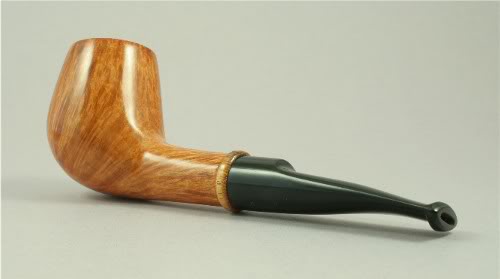
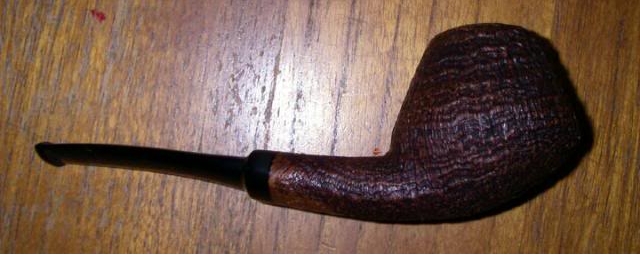
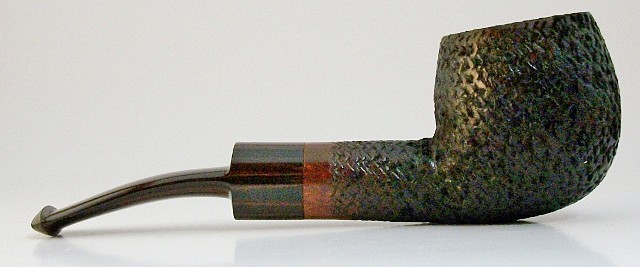
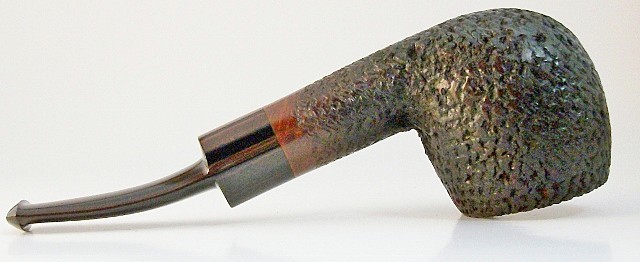
I am fairly certain that many of you have not heard of either Ozark Mountain Briars or of the carver, David Johnson. I have had two of David’s pipes in my collection since 2007 and have found that both of them are well made and aesthetically beautiful. The first one I purchased was a rusticated ball or apple shape. The second is this straight egg shaped smooth that I am reviewing today. Both were reasonably price and promptly delivered. I am not sure if David is still making pipes, I hope so. I see his pipes appearing on EBay periodically so if you have the opportunity to get one I don’t think you will be disappointed.

He carved this pipe as one of his higher lines, the Craftsman series, in 2007 and I picked it up at a discounted price because of some very small sand pits on the bottom of the shank. When it arrived in the mail I opened the package and took out the suede leather pipe glove that the pipe was placed in for protection and storage. I was amazed at its beauty. As I held it in my hand I could not believe how light it was. The 1.32 ounces / 37.4 grams make it light enough to be a comfortable clencher. The length of the pipe is 5.45 inches / 138.4 mm. The chamber diameter is .80 inches / 20.3 mm and the chamber depth is 1.50 inches / 38.1 mm. It is comfortable to hold in the hand.

cantedegg101

The pipe has a smooth finish and is stained with a 3-step process to bring out the grain. The bowl is egg shaped but slightly canted forward with elements of a Belge shape. The grain is decent on the pipe. I am not sure which stain David used first but the understains are darker and serve to make the grain stand out. The overstain is almost a yellow. The combination gives a dimensionality to the finish that is fascinating. The trim bead on the end of the shank is made of Marblewood and adds a nice finishing touch. The unique grain and shape of the bead is distinctive and feels great in the hand when held during a smoke.

cantedegg102

The stem is a hand cut Ebionite half saddle or half taper depending on your point of view! The top half is saddle and the bottom is tapered. The saddle portion is well done. It is soft cut on the saddle and then tapers back to the button. The saddle is rounded and has a very gentle cut to it. On the underside the stem blade tapers gradually back to the button where it flares to the same width as the flare on saddle. It is just the right thickness at the portion that rides in the mouth – not too thick or too thin. It is made of quality material as it has not oxidized in the years I have had it. The tenon is an integral part of the stem and is chamfered inward to form a dished end that is well-polished. The button is the size and shape that I really like – thin at the edges with a very slight rise to the centre top and bottom, forming an eye shaped end view. The lip on the button is very not to thick and fits well behind the teeth for a comfortable feel. The slot in the end of the button is also funneled and flattened to deliver a mouthpiece that has the same diameter from start to finish. David also rounded the ends of the slot giving it a finished look. The attention to detail shows the love of his craft that is transmitted into each of his pipes. It is a comfortable and well executed pipe. A pipe cleaner passes easily through the pipe with no obstruction.

cantedegg103

I have two Ozark Mountain Briar pipes and both are identical in terms of internal mechanics. David has well-crafted airflow dynamics in his pipes. The draught is clean and easy with no whistling or tightness. It has an easy draw that makes smoking it a pleasure. The bowl chamber is drilled to slightly over 3/4 of an inch with a .80 inch diameter. The tobacco chamber was coated with what David calls a Pre Carbed coating. It was neutral in taste and did not distract from the tobacco that was smoked. The cake built up on the bowl very easily. The draught hole is centered slightly above the bottom of the bowl and seems to have a slight funnel leading into the shank and stem. The fit of the stem to the shank is excellent – smooth and tight with no light showing at the joint. The tenon fits well in the mortise and sits deep in the mortise against the bottom. The airway is in the centre of the mortise and aligns with the airway in the tenon. The edges of the tenon have been polished and rounded and the airhole countersunk so that it meets the airway in the mortise. Looking at the airways with a flashlight it is clear to see that they are smooth and polished with no rough edges. The interior of the pipe is smooth and polished from the button to the bottom of the bowl.

cantedegg104

I broke this pipe in with some aged McClellands 5100. It is a dedicated Virginia pipe and always delivers a good tasting smoke. I have found that David’s other pipe also is a Virginia machine. It also smokes cool and dry and deliver good flavor with the Virginias that I choose to smoke in it.

A Review – Frank Axmacher Sandblasted Volcano Variation


Blog by Steve Laug

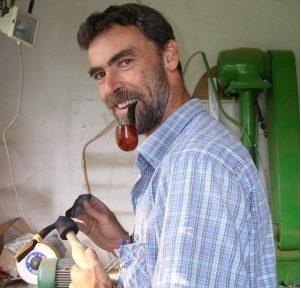
Axmacher4 Frank Axmacher is one of the rising stars of German pipe making. A stonemason and sculptor by trade, Frank began making pipes under the watchful eye of Bertram Safferling. Later, he was able to further hone his skills while working with such pipe luminaries as Rainer Barbi and Tom Eltang. Using only the finest briar and handcut stems, Frank carves elegant sculptural pieces with flawless craftsmanship.
Axmacher5
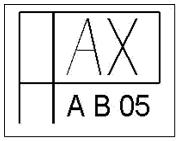
All Axmacher pipes are stamped with his stylized logo and a custom grading and dating system. The first letters in the grading system (ascending from F to A) indicate the objective qualities of the pipe (grain, flaws, finish, etc.). The second letter indicates Frank’s own personal subjective judgements about the pipe (again rising from F to A). The last two digits refer to the year the pipe was created. (Picture and opening information came from the Iwan Ries website http://www.iwanries.com/frank-axmacher-C1472.cfm )

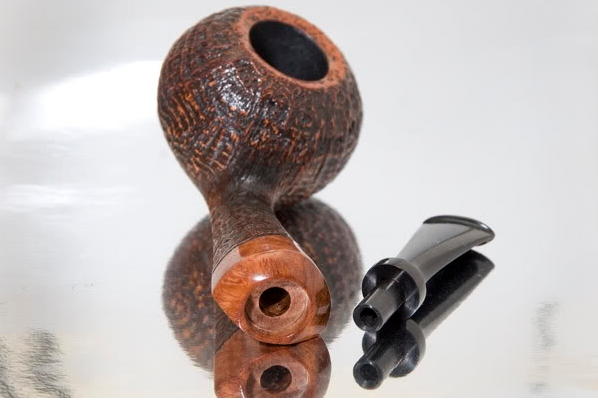
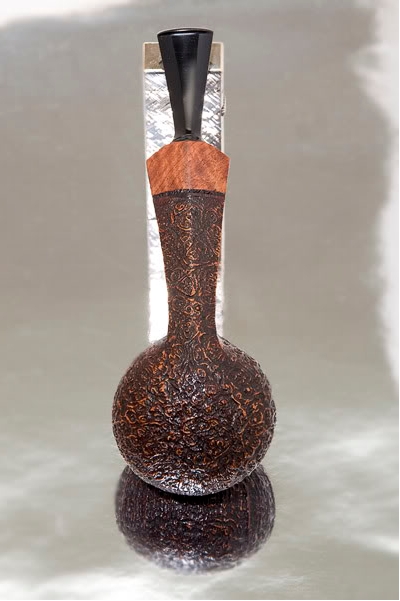
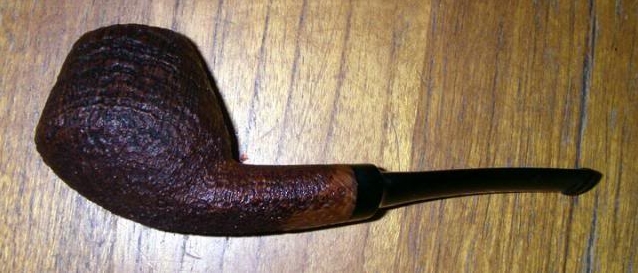
The pipe I purchased from a friend on Smokers Forums is a beautiful sandblasted pipe. Describing the shape is an interesting process. I would have to say it is somewhere between a brandy and a volcano shaped variation. In other ways it reminds me of a Danish style bulldog. The stamping on this pipe does not match the description of the stamping explained above. Rather it is stamped F.AXMACHER in an arch at the top and GERMANY in an arch at the bottom. In the centre it is stamped 03B. The description above leads me to believe that it was made in 03 and that it is either a B grade or it is B for blasted. Not sure which at this point. The vitals are as follows: length 6 inches, height 1 ½ inches, bore of the bowl 5/8 inches, outer diameter at the widest point 2 inches and depth of the chamber 1 ½ inches.

Axmacher3

In this review I want to look at the pipe from a more technical side and walk through its construction, feel and delivery of the smoke to me. The pipe came in a leather pipe sock that is stamped with a sketch of the pipe inside on the leather (a nice touch). The leather pipe sock came with a leather draw string and a nice chunk of briar on the end. When the pipe arrived in the mail I was excited to see and hold one of Frank’s pipes. I had read reviews and scrolled through many pictures of his work but had never held one in hand. In taking this out of the sock I have to say that it is more than I expected from the photos that I had seen before I bought it. The shape was unique and I liked it immediately. The blast was beautiful and the stain perfect. The weight of the pipe is light, I can only wish I had a scale because it is lighter in weight than I expected in a pipe of this size.

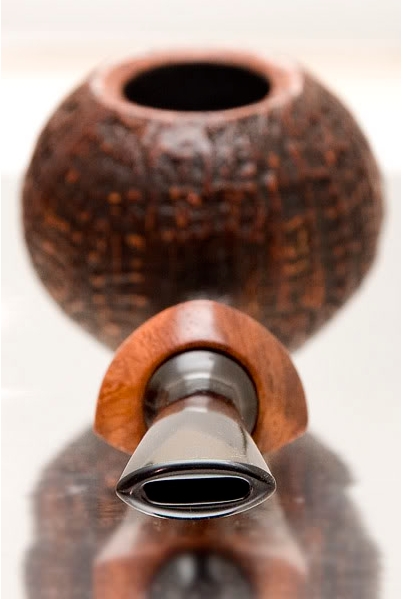
Looking at the externals of the pipe. Frank seems to have used several stains to give an undercoat that shows through the contrasting top coat. Depending on the light and angle of the pipe the colour highlights look different. They are a variety of browns and blacks that come through with the light and the angles. The crevices and valleys in the blast are a dark brown in some lights and black in others. The sandblast is gorgeous. There is both a ring grain and vertical lines in the blast. The ring blast is stunning and the vertical lines run at an angle through the blast like wind driven rain. The bottom of the bowl is blasted birdseye grain. The centres of the eye are dark in colour and the ridges surrounding the eye are brown. It is a unique and well done blast that is quite unique among my sandblasted pipes. There is a small band of smooth around the shank where it meets the stem and continuing around the shank of the pipe. On the bottom of the shank there is a smooth patch where the circular stamping is applied. The shank is oval flowing at a slight angle upward from the bottom of the bowl. The flatness of the bowl bottom and shank allow the pipe to sit upright on a flat surface. The hand cut ebonite stem is very well done and comfortable in the mouth. There is a small saddle that sits tightly against the shank that quickly tapers into a thin blade. The taper of the blade is subtle and sporting a 1/8 bent to the stem. It has a thin oval shaped button that is sharply cut and catches well on the back of my teeth. The slot in the button is oval shaped and there is a smooth V slot that facilitates the movement of smoke across the mouth. The polish and smoothness of the finish is like glass. The overall appearance of the pipe and stem is beautiful and it fits my hand very well. The tactile feel of the blast is great whether the pipe is lit or unlit.

Axmacher1

Axmacher2

Moving from the externals of the pipe to the internal mechanics. The workmanship on this pipe is well done. The angle of the drilling is done in such a way that the bowl is of a uniform thickness throughout. The bowl bottom is relatively the same thickness as the walls of the pipe. The bowl is drilled at the same angle as the exterior of the pipe. The draught hole is precisely where it should be – centred at the back side bottom of the bowl. As the pipe came to me pre-smoked I cannot speak to whether Frank uses a bowl coating. Holding the bowl to the light revealed a clean and smooth airway with no impediments. The drilling in the mortise is clean and smooth. The only area that is bothersome to me is that the angle of the drilling made it necessary to leave quite a deep divot in the bottom of the mortise that makes the wall at the bottom of the mortise very thin for the first ¼ inch. As the tenon goes straight into the mortise this should not be problematic. It is however a potential problem area. The tenon appears to be an inset Delrin piece. It is chambered or funneled to aid in airflow into the stem airway. The inside of the stem is very smooth. There is no roughness or constriction where the Delrin tenon ends and the stem material begins. This transition is smooth. The airway flattens out like a squeezed drinking straw so that the diameter does not change but is flattened and opened.

IMG_0858

I have been smoking this pipe repeatedly since it arrived and it smokes very well. The bowl was already broken in and there was a thin cake already forming in the bowl. The pipe smokes dry and clean with no moisture build up or gurgle during the smoke. The ash and any remnants of tobacco in the bottom of the bowl are dry and easily dumped out at the end of the smoke. The draught on this pipe is very smooth – no whistling sound and no sense of having to suck or work to get the air to move through – it is effortless as it should be. It has been and will continue to be a pleasure to smoke, exactly what I look for in a pipe that keeps its place in my rotation.
I would highly recommend that you have a look at the pipes Frank crafts. They are available through several online retails such as Iwan Ries, Scandia Pipes, Al Pascia and others. Frank’s work shows him to be a fine craftsman. I believe this is one of his earlier pipes. His newer pipes are amazingly beautiful. The shapes and designs are unique to him and give the impression of pieces of art. They are beautiful to look at and explore. Have a look at the beautiful work that he does. Frank’s own website provides links to many of these online pipe sellers. http://www.axmacher-pipes.com/

A Review – A Fillenwarth Rusticated Apple


I don’t remember the exact date in 2009 when I purchase my Fillenwarth Apple from Tony Fillenwarth but I have been on his mailing list for quite a few years now. I love the signature rustication that Tony does and have been following his work for a long time. I am on his email list and so I get notification of any new pipes he puts up. Tony describes his pipes on the opening page of his website as follows: “A combination of precise engineering and a unique sense of design allow me to make pipes that are visually striking and that give a smoking experience second to none. All pipes are hand crafted from plateau briar of the finest quality that has been properly aged to provide a superb smoke. Stems are handmade from either top quality German vulcanite, cumberland, acrylic, or bakelite and feature a nice open draw that gives the best possible smoking characteristics.”

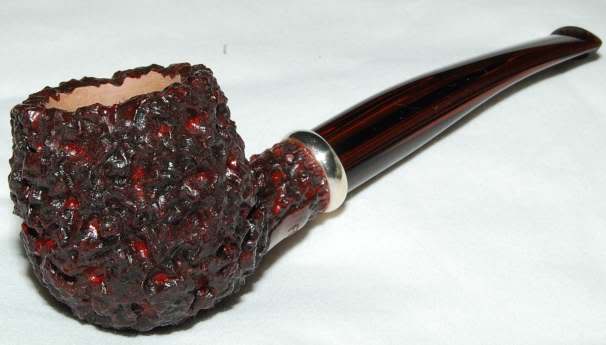
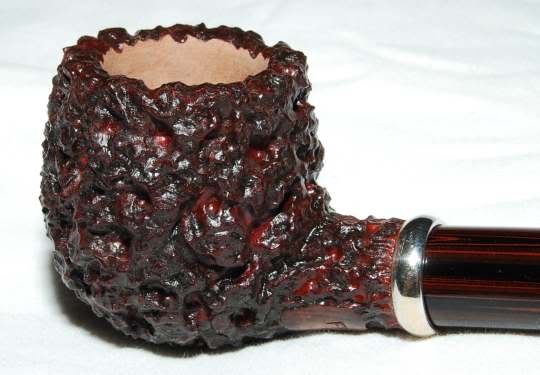
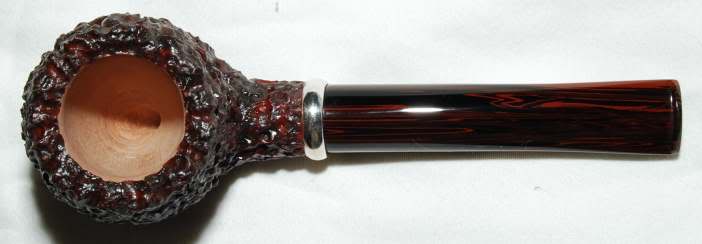
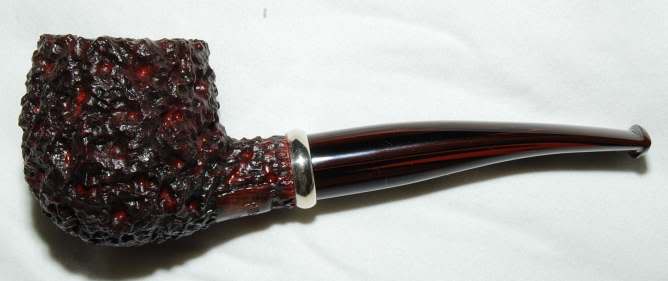
I am a sucker for apple shaped pipes so when this one came out on his email it met the bill for me – it had his unique rustication and it was an apple shaped pipe. The pipe is 5 1/2 inches long and weighs 52 grams. The tobacco chamber is 1 3/8 inches deep and 7/8 inch across. The shank band is sterling silver and adds a delicate and refined touch to the crater like rustication. It sports a handmade Cumberland stem with Delrin tenon and has a slight bend to it.
Fill1
When the pipe arrived it was far more impressive than even Tony’s pictures led me to believe. I was stunned at the workmanship of the pipe and colour and feel of it in my hand. I remember just sitting at my desk after opening the package and sliding the pipe out of the sleeve that it came in and being speechless with the look and feel of this pipe. It was and is beautiful. No one even comes close to duplicating Tony’s rustication and the way in which his staining of the bowl highlights the rustication and gives it a special dimensionality that is almost uncanny. Holding his pipe in my hand is like holding a piece of lava rock with all of the nooks and crannies and colours emanating out of the crevices and holes and changing in the light that pipe is held in. The rustication is very sharp and rough in the hand but a very cool finish in terms of the feel in the hand when it heats up during smoking. The bowl is rusticated up and over the rim and ends in a craggy inner rim edge that looks great to me. The overall flow of the bowl and shank is brilliant and the colours are beautifully matched from rim to the end of the shank and on into the reds and blacks of the brindle/Cumberland stem. To separate the bowl and stem Tony handmade a sterling silver “wedding ring” band and gave it a high lustre polish. It adds a nice touch of bling to the look of the pipe and dresses it up.
Fill2
Tony did a masterful job on the inner mechanics of the pipe with drilling that is perfectly executed from the shank and into the bowl – coming out exactly centre in the bottom of the bowl. The airway from the bowl into the mortise is centred. It is smooth in its entrance to the mortise and the mortise itself is also smooth with no rough spot left by drill bit. The bowl itself is U shaped and smooth from sides to bottom. The air way enters the bowl and is smooth and clean. There was no bowl treatment or coating just a good smooth briar.
Fill5
The stem itself is hand cut out of a red and black Cumberland. It is well tapered with good even angles top and bottom progressing from the shank to the button. The portion of the stem that is put in the mouth is thin and comfortable. It has a slight bend to it that gives it a stylized look. Tony did a great job shaping the stem and capturing a shape that really works with this pipe. The way the silver band breaks up the flow is brilliant. I personally love the way the striations of black and red run the length of the stem. The choice of material for the stem matches the stain that Tony used on the bowl. The tenon is Delrin that has been inserted into the Cumberland stem for durability and ease of use. The airway is funneled slightly for a smooth transition from the mortise when it is in place. There is a very minimal gap between the end of the tenon and the base of the mortise. The transition where the Delrin meets the Cumberland of the stem is seamless. There is no lip or rough spot at that junction. The draught is unrestricted and open from the bowl to the tip of the stem. Draught is effortless. The fit of the stem to the tenon is very well done. The button is cut to my liking with a good sharp inner edge and tapered to the tip. The slot is opened and funneled to deliver a uniform airway from bowl to button.
Fill3

Fill4
The overall construction of this pipe is very well done. It is light in the hand and in the mouth. It is well balanced and has a great tactile feel when it is cool and as it warms up during the smoking of a bowl. I have smoked for over four years now and after breaking it in with some McClellands 5100 that had some age on it the pipe has become a good Virginia smoking pipe. It delivered a good smoke from the first smoke and continues to do so. It draws well; the lighting has never been a problem. It seemed to take very little time to break it in and continues to be an effortless smoke.

Thanks Tony Fillenwarth for delivering a well-made pipe that remains a very good smoking pipe to this day. Tony continues to make unique and interestingly shaped pipes – both smooth and rusticated that have a distinctive and readily recognizable look to them. They are available on his website at http://fillenwarthpipes.com/ Stop by for a look, order one for yourself, you cannot go wrong with his work.

A Review – A Bill Boyle Small Bent Rustic Apple


I received my third Bill Boyle Pipe in the post from Bill several weeks ago. I have two other pipes that he made for me during the past several years and I have watched the progress in Bill’s craftsmanship and work in these pipes and through watching the variety of pipes that appear on his website and through the reviews others have made. Bill and I have talked about pipes since the days that he started making modified cob pipes. He has come a long way through the years and this new pipe reflects a huge step up in his work in my opinion. The previous two pipes are amazing smoking machines but his stem work was not perfected and was a bit too thick to my liking (See the comparative pictures below). The taper of the stems on the early ones was more abrupt while this one is very smooth and flowing. His internal mechanics have always been spot on but it was the finish work on the stem that needed to be refined. This new pipe is a step up in every way. It is a beauty to be sure. The length of the pipe is 5 inches and the bowl height is 1 5/8 inches. The chamber diameter is 3/4 inches and depth is 1 3/8 inches. It weighs 40 grams or 1.4 ounces. It is carved from Italian block according to Bill’s website and sports a hand cut Cumberland stem. The pipe is a small apple shape with a ¼ bent stem that fits well in the hand.The stamping reversed B and B and is one of the last of this stamping that will be used as Bill has stepped up his production and has a new stamp for Bill Boyle Pipes.
Bill Boyle 1
The finish on the outside of the pipe is rusticated in a finish that is quite different from the other two rusticated pipes I have purchased from Bill. It is not a heavy deep rustication on this pipe but more of a rustication pattern that has the appearance of strands of a rope. There is a still a very tactile feel to the rustication on the bowl and shank but it does not really have the look of randomness that was in his more heavy rustication. It is a nice variation and I think that it adds to the overall appearance.
Bill Boyle 5On the rim of the pipe Bill rusticated it over the curve and then almost countersunk the bowl. The rim thus forms two levels and a bit of step down from the rusticated edge to the smooth edge that is below and then drops into the bowl. The rustication where the shank and bowl meet is a bit heavier than what is on the rest of the bowl and a bit rougher but does not detract from the other rustication. It is merely a variation that makes me wonder if there is not a flaw or sandpit in this area of the pipe (indeed Bill confirmed this is so in a later email). The staining on the briar appears to be a blend of darker/medium brown/black with an oxblood over stain that is a nice contrast. In the light it appears to have a dark oxblood tinge that comes out well in contrast to the browns in the under stain. It really goes well with the Cumberland stem. Bill has matched the colour of the Cumberland stem with his choice and combination of stains. Great work on the finish Bill.
Bill Boyle 3
The stem itself is the best of the three stems my BB pipes. His stem work has really developed and this is by far the most well executed of the three. It is a nicely cut saddle stem. The saddle is well cut and the finish on the 90 degree angles of the saddle is smooth and polished. There are no machine or file marks. He has done a great job shaping this part of the stem. The blade of the stem is thin and has a good even tapered flow from the saddle to the button. It is matched in terms of angles on the top and the bottom and on the left and right side of the stem. The design along with the slight bend makes it fit very comfortably in the mouth. It also rests well enough that it can be clenched quite easily. The tenon is cut from the stem material and is funneled at the end for good mechanics. The button is exactly the way I like them – thinner on the edges with a gentle rise at the centre top and bottom. The edge of the button is a good sharp angle to the stem and looks sharp. It fits well behind the teeth for a comfortable feel. The draught hole/slot in the end of the button is also funneled to deliver a mouthpiece that has the same diameter from start to finish. Comfortable and well executed. A pipe cleaner passes easily through the pipe with no obstruction. I have posted photos below of my other two of Bill’s pipes so that you can see the progress and development in his stem work.

My first one is the Christmas pipe I had him make for me. The rustication is great and the shape is well done. Note the thickness of the stem from the saddle to the button and also the thick button on the end of the stem. I reworked this stem when I received it. I thinned it down, flattened it out and thinned the button as well. I worked it until it was comfortable for me.
OLYMPUS DIGITAL CAMERA
The second is an apple that caught my eye on one of his email updates. It was made later than the first one. The stem work is definitely improved. Note that the stem is thinner than the one above but there is a definite crown on the stem. It is almost oval in shape from an end view with thin edges and a rise/crown toward the middle of the stem. There is also an abrupt drop from the stem to the button area. The angle is quite sharp. He has also thinned down the button and made it more comfortable. The stem work is getting better and the feel in the mouth is better but it is still not quite there.
Boylesmooth2
The next photo shows the same view of the newest (the third) Boyle pipe that is in my rack. Here the improvement on the stem is marked. Note the thinness of the stem from the saddle back to the button, the flatness of the stem from side to side and the improved shape of the button. To me the development and improvement can be traced in these three photos. All three pipes smoke exceptionally well. Each one is well made. But each one represents a step in Bill’s development as a pipemaker and particular in the way he fashions his stems.
Bill Boyle 4
The mechanics of this new pipe are well done. The bowl chamber came without a bowl coating and the wood was sanded very smooth. There were no pits or checking in the bowl. The countersunk inner edge of the rim gave a distinctive look to the pipe that I was not sure about at first. Since I have been smoking it the briar is darkening (not char or tar) just the natural darkening of heat and oils and it looks great.The draught hole is centered at the bottom of the bowl and seems to have a slight slope from the bottom to the top of the airhole. There is a very easy and open draw to the pipe. The fit of the stem to the shank is very good. Smooth and tight. The tenon sits deep in the mortise – if not exactly the same length then impressively close! The fit of the tenon is also smooth. The drilling of the draught in the shank is slightly high in the end of the mortise. It is not in the middle of the mortise. The tenon on the stem is drilled to match it and there is no misalignment to the two. The air pulls clearly through the pipe with no whistling at all. Using a light to shine through the various airways reveals smoothly executed airways on the inside. Very nice work on the drilling Bill. Your matching the airway in the mortise to the tenon end was well executed.
Bill Boyle 2
I have been smoking it since I received it and am very happy with it. I have smoked Virginia flake and broken flake tobaccos in it and it packs easily and stays lit. And I have to say that like all three of Bill’s pipes that I have the draught on the pipe is superb. Smoking it is a pleasure and is uncomplicated and effortless. I found that without exception Bill’s pipes smoke smooth from the get go with none of the new pipe break in woes. Thanks Bill for a well-made pipe that smokes as good as it looks! If you are interested in Bill’s work check out his website and look at the gallery – he does commissioned pipes as well. Here is the link: http://www.billboylepipes.com/

Review of a Nachwalter Dublin


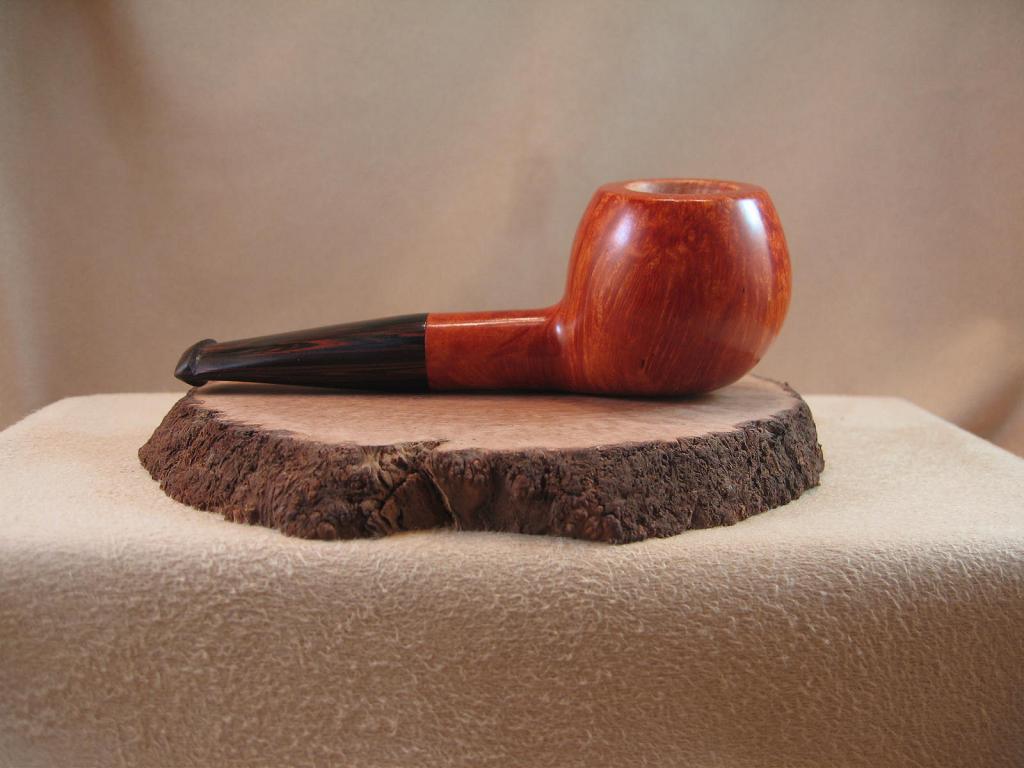
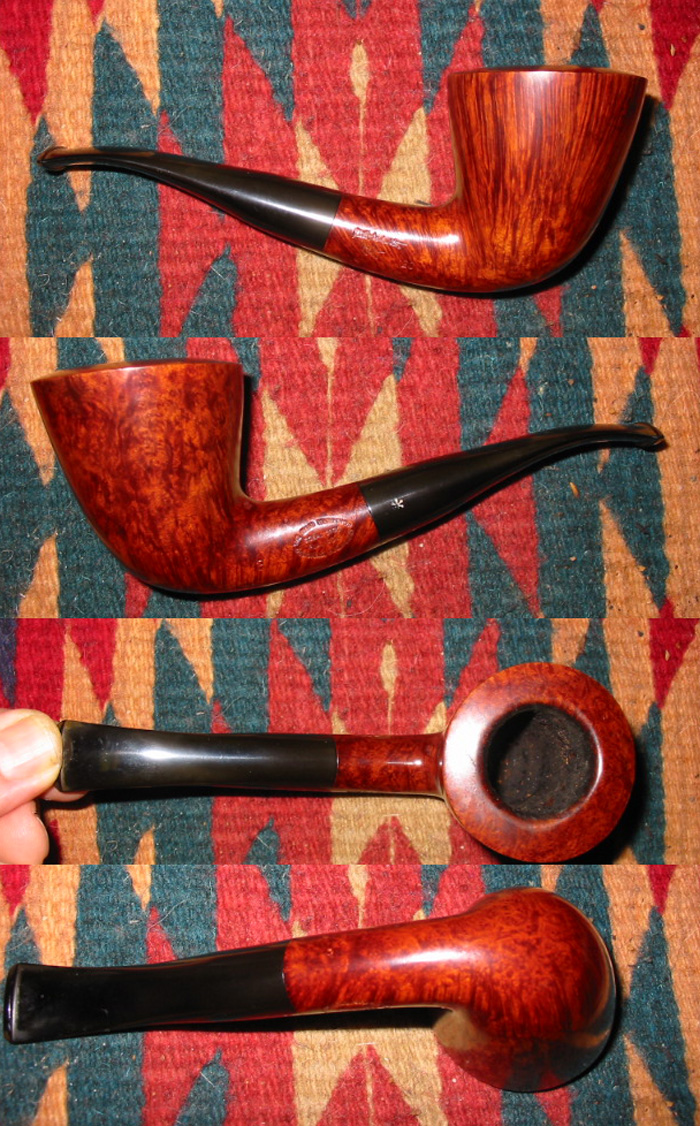
I picked this Nachwalter pipe up for a good price from Mike at Briar Blues many years ago now. It seems that the older I get the faster time seems to spin. It is a nicely shaped Dublin. The pipe came with a cloth pipe sock in black velevet. (I am not sure this was one Mike threw in or whether it came that way from Nachwalter). The workmanship on this pipe is very nice. I have smoked it quite a bit over the years since I got it. It has been through at least two moves during that time and has survived both of them with a time of storage between them both. This is a third review I am writing today since I had the day off. The length of the pipe is 5 3/4 inches and the bowl height is 2 ¼ inches. The outer diameter of the bowl is 1 ¾ inches. The chamber diameter is 1 inch and depth is 1 1/2 inches. It is a large bowled pipe and is light for its size. It sits well in the nook of the hand formed by the thumb and index finger on either hand. The stamping is on both sides of the shank. It is stamped on the left side in an oval. The outer ring of the oval is stamped THE BRIAR WORKSHOP on the top of the oval and DESIGNERS/PIPEMAKERS on the bottom side of the oval. In the centre of the oval it is stamped CORAL SPGS over FLA. USA. On the other side of the shank it is stamped in script Elliot Nachwalter and under that is stamped his signature.

Image

The pipe has a smooth finish and the staining choice highlights the great grain. The bowl is surrounded by flame grain/straight grain. The top of the bowl cap and the bottom of the bowl and shank has some beautiful birdseye grain. This pipe is larger than it looks and with the 1 inch diameter bowl, holds a lot of tobacco. Regardless of the size it fits well against the thumb and rests comfortably in hand. The stain appears to be made up of several coats. There seems to be a dark understain that makes the grain stand out. Over this is a coat of reddish brown, it is not an oxblood but more of a mahogany looking stain. The rim is crowned, almost a reversed chamfer. The inner edge is beveled into the bowl and the out edge is sharp to the sides. The crowned top gives the pipe slightly curved top look from the side.

The stem is a well-made taper crafted from ebonite or vulcanite. It is a softer feel in the mouth and on the teeth than acrylic. The stem tapers gradually back to the button and is just the right thickness at the portion that rides in the mouth – not too thick or too thin. It is also durable and is made of quality material as it has not oxidized in the years I have had it and appears to have remained black for the previous owner as well. The snowflake logo that is on Nachwalter pipes is faded slightly but the impression is still visible on the left side of the stem. The tenon is an integral part of the stem and is chamfered/ countersunk and well-polished. The button is well shaped – thin at the edges with a very slight rise to the centre top and bottom, forming an eye shaped end view. The lip on the button is very slight but still fits well behind the teeth for a comfortable feel. The draught hole in the end of the button is also funneled to deliver a mouthpiece that has the same diameter from start to finish. Comfortable and well executed. A pipe cleaner passes easily through the pipe with no obstruction.

Internally, the pipes made by the Briar Workshop that I have had over the years, have all had exceptional mechanics. The bowl chamber on this one is large – drilled to a 1 inch diameter. The inner edge of the bowl us beveled to the rim. The outer edge is sharp and clean. The outer edges are slightly sanded so that the edges where the top and sides meet are not sharp but gently rounded. This pipe was purchased as an estate but I don’t believe that the bowl was coated with any bowl coating. When I bought the pipe it was still barely smoked and the walls on the lower part of the bowl were still clean briar. The cake built up on the bowl very easily. The draught hole is centered at the bottom of the bowl and seems to have a slight funnel leading into the shank and stem. There is a very easy and open draw to the pipe. The fit of the stem to the shank is excellent – smooth and tight with no light showing at the joint. The tenon fits well in the mortise and seems to sit deep in the mortise against the bottom. The airway is in the centre of the mortise and aligns with the airway in the tenon. The edges of the tenon have been polished and rounded and the airhole countersunk so that it meets the airway in the mortise. The pipe does not whistle or gurgle when smoked. Looking at the airways with a flashlight it is clear to see that they are smooth and polished with no rough edges.

I have smoked this pipe many times since I received it from Mike at Briar Blues. Because of the large bowl I do not reach for it as often as I used to because I tend to favour smaller bowls at present. I have found that it is a good flake pipe. It is one I used when I folded and stuffed flakes. It smokes cool and easily and delivers good flavor with the Virginias that I choose to smoke in it.

Review of a Ronson Centenary Bulldog


Blog by Steve Laug

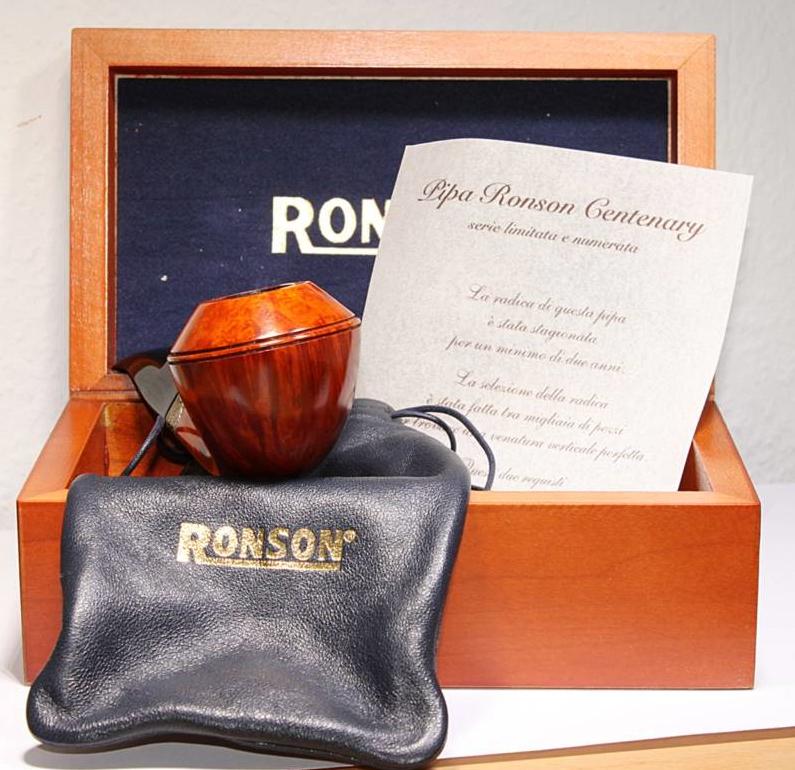
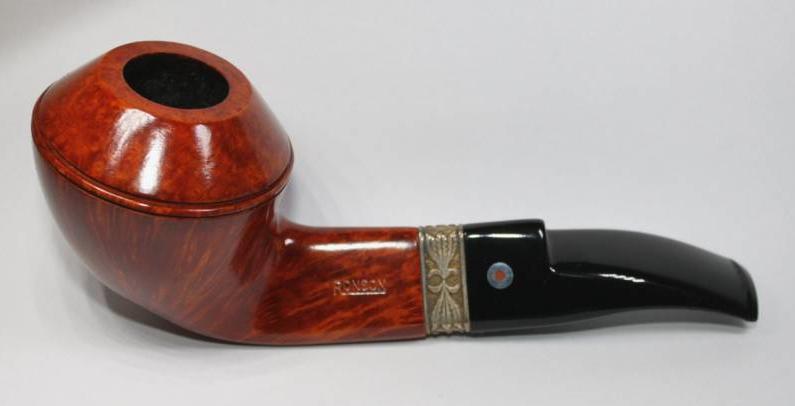
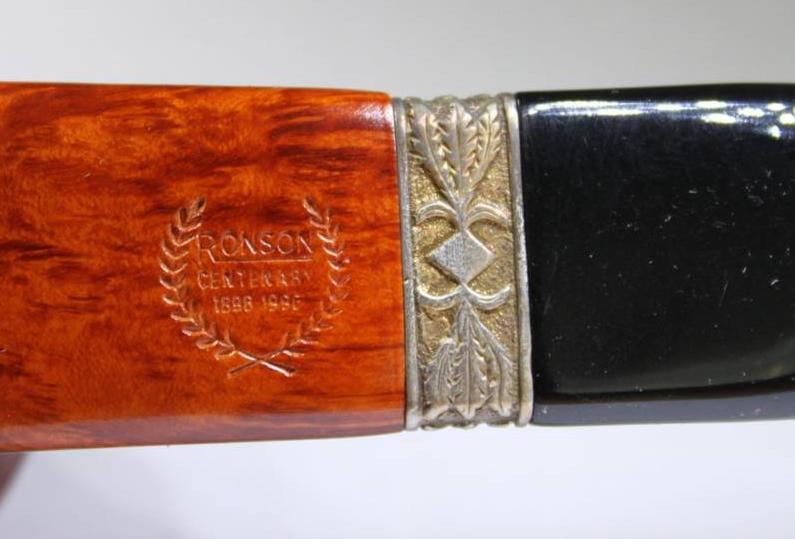
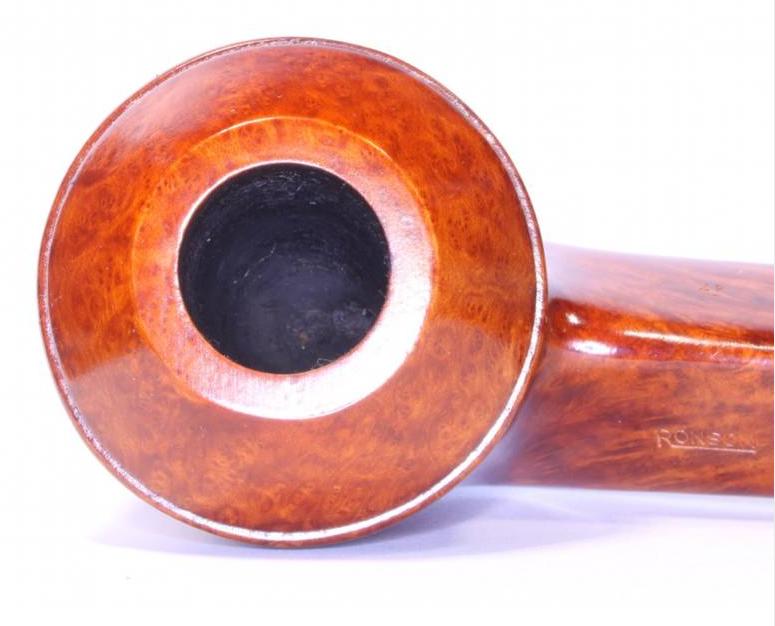
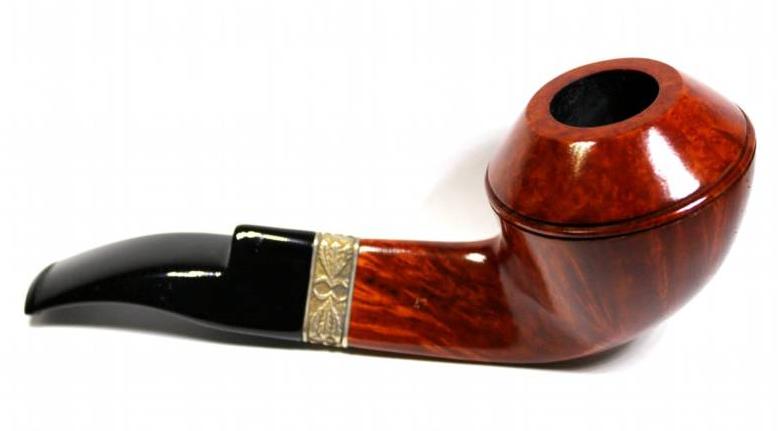
I picked this pipe up for a really cheap price on EBay. It came in a beautiful handmade wooden box lined with dark blue velvet on the inside of the box and the lid. The lid also has the golden Ronson logo. Ronson is famous for the lighters that they make but after receiving and smoking this beauty I would also say they make a fine pipe. The pipe came with a leather pipe sock and a certificate of authentication for the Centenary version of the pipe. The workmanship on this pipe is very nice. I have smoked it quite a bit since that time and it is a great smoke. Since I had the day off today I decided to also write a review on this one. The length of the pipe is 5.8 inches and the bowl height is 2 inches. The chamber diameter is .8 inches and depth is 1.8 inches. It is a large pipe but weighs 78 grams. It is a good fit in the hand. The overall shape is something like a bent bulldog. There is a sterling silver band on the shank with sheaves of laurels. The stamping is on the sides and the bottom of the triangular shank. It is stamped on the left side Ronson using the Ronson logo type and on the right side 47. On the underside of the shank it is stamped RONSON over CENTENARY over 1896-1996 and surrounded by Laurels. That dates the pipe to 1996. It came to me unsmoked.

Image

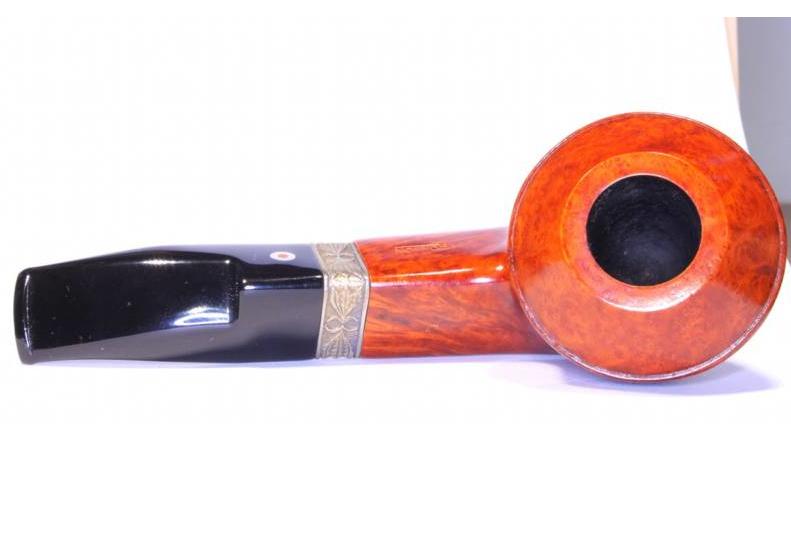
The finish on the outside of the pipe is smooth and has some great grain. The bowl is surrounded by flame grain/straight grain. The top of the bowl cap and the bottom of the bowl and shank has some beautiful birdseye grain. This is a big looking and feeling pipe but it is comfortable in the hand. The carvers have achieve a carving that fits equally well in both the right and the left hand. The double rings turned into the bowl to separate the bowl from the bulldog cap are really nicely cut. The band is integrated into the shank and has a smooth band on the shank side and the stem side with sheaves of laurels cast or carved into the centre space of the band. The stain appears to be multilayered with a black understain to highlight the beautiful grain on the briar and then topped with a light brown and possible an orange over stain. I believe it is also topped with a shellac coat to give it a great shine.

ImageImage

The stem is a well made half saddle stem handcrafted from acrylic. The blade of the stem is well tapered, quite short and thin without sacrificing durability. The saddle meets the blade on the top surface at a 90 degree angle and has been polished to a shine. The logo insert on the stem is a steel circle with an orange centre that matches the stain on the briar. The triangular shape of the stem to the saddle is nicely done and almost pinched looking where it sits against the band.Image

Interestingly the shank and stem are the same dimensions on all three sides. From the 90 degree saddle the blade is flattened and curved toward the edges giving it a very refined look. It tapers very gradually back to the button. It is a comfortable bit in the mouth. The tenon is an integral part of the acrylic stem and is chamfered/countersunk and well polished. The button thin at the edges with a very slight rise to the centre top and bottom, forming an eye shaped end view. The lip on the button is very slight but still fits well behind the teeth for a comfortable feel. The draught hole in the end of the button is also funneled to deliver a mouthpiece that has the same diameter from start to finish. Comfortable and well executed. A pipe cleaner passes easily through the pipe with no obstruction.

ImageImage

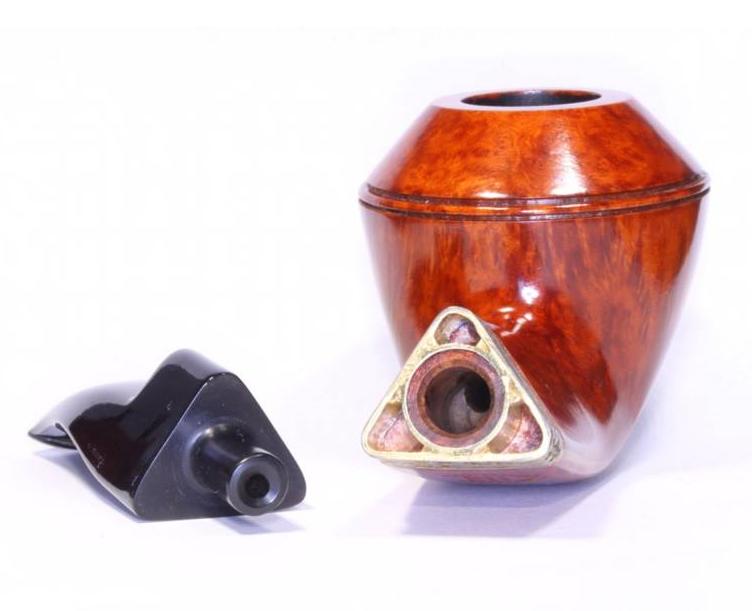
The internal mechanics of the pipe are very well executed. The bowl chamber is drilled to a ¾ inch diameter. The inner edge of the bowl us straight and clean to the rim. The outer edge is sharp and clean. The top rim is smooth and nicely covered with birdseye. The side of the cap taper perfectly to the double rings carved into the bowl. The sides taper up to meet the double rings. The bowl was coated with what appeared to be a carbon coat not sure if it is water glass or an organic coating. I do recall that the first smoke did not have any residual taste coming through from the bowl coating. The cake built up on the bowl very easily. The draught hole is centered at the bottom of the bowl and seems to have a slight funnel leading into the shank and stem. There is a very easy and open draw to the pipe. The fit of the stem to the shank is excellent – smooth and tight with no light showing at the joint. The band is applied in a unique way as can be seen from the picture below. It is cast with a centre ring that encloses the mortise area and then truss like sides leading out to the edges of the band. The look leads me to think that it is a strongly made connection. I really like the way the shank was cut to house the banding structure. The band is thus an integral part of the shank rather than just an appliqué. The tenon sits deep in the mortise against the bottom. The airway is at the top of the mortise rather than centered in the middle of the mortise but does not seem to inhibit the use of a pipe cleaner during the smoke. The fit of the tenon is smooth and tight. The edges of the tenon have been polished and rounded and the airhole countersunk so that it meets the airway in the mortise. The pipe does not whistle or gurgle when smoked. The airways are smooth and polished with no rough edges.

ImageImage

I have smoked this pipe many times since I received it from EBay. It was nice to be the one who smoked the inaugural bowl in this pipe. I chose to smoke English blends in it as it delivers a very full and flavourful smoke that allows the intricacies of Latakia to really come through. I really like smoking Blue Mountain in this pipe as I get to taste the dimensions of that tobacco really well with the pipe. The tobacco packs easily and burns well after the second light. It ends up being a pipe that I sit and enjoy on the porch. It is heavy in my mouth so I sit and hold the bowl and enjoy the sights and sounds of the neighbourhood as smoke it. The draught on the pipe is superb delivering a smoke that is uncomplicated and effortless. The Italian carver who made this pipe for Ronson did a superb job and delivered a beautiful Centenary pipe for the company to sell to its customers. I am glad to have acquired this beauty.

Image