Category Archives: Pipe Reviews

Over the years as I have bought pipes from Pipe Makers I have written reviews of those pipes. While they do not deal with the theme of pipe refurbishing, they give me some great help in the area of mechanics of the pipe – airways, drilling, stem shapes, button shapes and the shape of the slot in the button. I have learned much from these pipe makers whose pipes I buy – both from their work and from them personally.

A Review – A Brad Pohlmann Dublin with a Bakelite Stem


Blog by Steve Laug

I met Brad Pohlmann at the Chicago Pipe Show many years ago now. Being a resident of Oregon for many years I was intrigued that he was a Oregonian and a pipemaker. I looked forward to meeting him as I saw in the adverts for the show that he would have a table there. I looked at his pipes at the time but could not afford one and none of them really grabbed me so I passed on from there to thinking that one day I would find a Pohlmann that caught my eye.

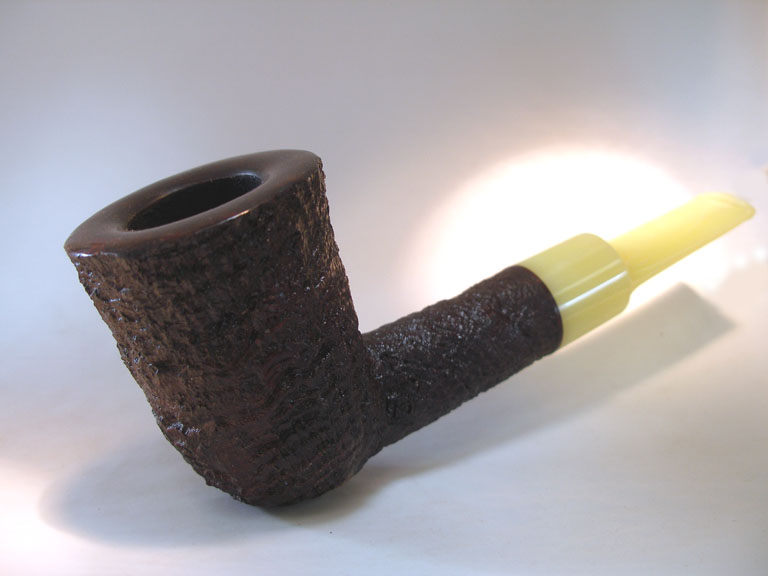
Then low and behold, one day at work while I was on a break I checked in on Smokers Forums and a seller had just posted a Pohlmann in the classifieds. The photo and price hit the front page of the site while I was reading over the latest posts. I actually don’t remember the date when I picked up this pipe but I remember buying it from a fellow on Smokers Forum. The pipe had a oxblood stain on the deep sandblast bowl that highlighted the craggy grain of the pipe. The rim was slightly crowned and smooth and fit well with the shape of the pipe and contrasted well with the sandblast finish on the rest of the pipe. The yellow retro Bakelite stem added a touch of class and distinction to the craggy blast of the pipe. The seller had listed it with a very reasonable and I fell in love with it the moment I saw it. I clicked on the buy it now button, emailed the seller regarding shipping costs to Canada then quickly paid the price and waited for it to arrive.OLYMPUS DIGITAL CAMERA I have always enjoyed learning about the carver when I buy a handmade pipe. I like to read about his philosophy of pipe making and some of the history of the brand. I find that learning this background information gives me a feel for the pipe that adds another dimension to the smoking experience. In terms of information on Pohlmann pipes, I googled his to his website and found the link http://www.pohlmannpipes.com/contact.php. On the site under the ABOUT tab I found the information I was looking for. Brad had posted a well written article regarding the history of his pipemaker and a bit about his pipes. I have included the following from his site as it set the stage for me in terms of enjoying this pipe. I quote in full from Brad’s own words:selfportrait_lg “This story begins in June of 1975; the place was New York City. I had just returned from a “pipe pilgrimage” to England, where I had visited all the great old shops of London, as well as a trip north to Perth in Scotland to visit the venerable firm of Rattray’s.”
“While on my rounds to the pipe shops of NYC, I chanced upon a Dane making pipes in a store window. The gentleman’s name was Finn Meyan Anderson, and he claimed to have worked in the Larsen workshop in Copenhagen. We had a friendly chat about pipes and I remember being favorably impressed with his pipes, and the fact that these freshly minted specimens were being sold in the same store as their manufacture.”
“A year later, at home in San Diego, California I decided my real desire was to operate my own Tobacconist store, stocked with pipes of my own design – not amateurish creations but pipes of quality and design. But how to make them?”

“I poured over several copies of The Pipe Smoker’s Ephemeris and made notes of the locations of all pipemakers between the West Coast and New York. Armed with this information, I mapped out my route, loaded my backpack, walked to the onramp of Interstate 5, and extended my thumb. One of the memorable moments along the way was a visit to Travers LaRue on Whidbey Island in the Puget Sound, off the coast of Washington state. I might have apprenticed with him, but his new son-in-law had just acquired that position – Geezzz, what some people will do to become a pipemaker!”

“With far too many stories in between, I eventually made it to Manhattan but Finn had left and was reported to be working in Vermont. I had the names of two makers there – Andrew Marks in Middlebury and the The Briar Workship in Stowe. Finn had indeed been working in Stowe, but was gone by the time I arrived. However, Elliot and Jorg were making some very attractive pipes and after some fancy confabulation on my part, I joined in their work. A year or two later we had Jim Cooke join our team. It was a great five years altogether, working in Stowe & Hyde Park in Vermont, and Coral Springs in Florida. In 1980 I moved back to California, where I completed a 4 year Tool and Die apprenticeship to round out my machining skills in the pipe shop. Fate had other plans for the future, which led to a 16-year career in the computer industry and only a little time to make pipe for friends and the odd pipe repair.”

“Finally, in 2003 it was time to begin making Pohlmann Pipes, combining the skills learned at the Briar Workshop with the tool and die training, and now incorporating the newest trends in the internal construction of the pipe.”—Brad Pohlmann

My initial impressions of the pipe really include what drew me to this piece of pipe art enough to want to add it to my collection and make it a part of my pipe journey. It is a medium or group 4 sized pipe. Its dimensions are a well-balanced 5 inches long and 2 inches tall. The tobacco chamber is 1 1/2inches deep and 3/4 inches in diameter. There is a narrow band of briar that separates the shank from the stem and provides a smooth transition from the sandblast to the smooth finish of the Bakelite. The dark oxblood stain of the sandblast finish and the same colour smooth band and rim work well with the shape of the pipe. The stem is a handmade saddle shape from a yellow coloured Bakelite. The stem shape and colour work well with the oxblood stain of the sandblast and smooth portions of the bowl. The button on the stem is thin and comfortable.OLYMPUS DIGITAL CAMERA When the pipe arrived it was an impressive piece. The workmanship of the pipe, the deep and craggy sandblast ring grain around the entire bowl and radiating across the shank gave it very tactile feel that captured me. Some pipes like this one and the Roush leave a lasting impression in my mind. I still remember sliding the pipe out of the sleeve and enjoying the look and the way it sat in my hand. Brad had made a very beautiful pipe that was now mine. It had the faint aromas of the Virginias that its previous owner had smoked and the bowl had no cake at all. In fact it did not even look to have been smoked to the bottom of the bowl. The smooth rim has some swirling grain on it and the arched appearance gives it a touch of class. Examining it up close it is obvious that it is blasted with a master hand.
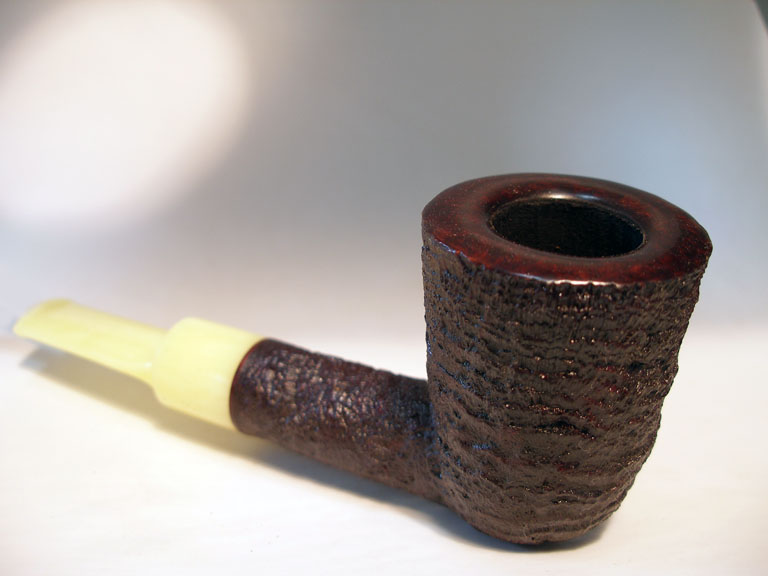
There is a smooth, oval medallion of briar on the bottom of the shank that provides a spot for the stamping. On the underside of the stem it is stamped with an arced Pohlmann over USA. The symmetry of the pipe is easy on the eyes. The balance between the height of the bowl and the length of the shank is perfect. The stain has variation and almost a sparkle when moved in the light. The yellow Bakelite stem stands in stark contrast to the oxblood stain on the bowl and together give the pipe a dressy and classic look.OLYMPUS DIGITAL CAMERA The inner mechanics of the pipe are perfect. The drilling is perfectly executed from the shank and into the bowl – coming out exactly centre in the bottom of the bowl. The airway from the bowl into the mortise is centered. It is smooth in its entrance to the mortise and the mortise itself is also smooth with no rough spot left by drill bit. The end of the shank is sanded smooth and is finished. There is a bevel in the shank end to accommodate the tenon and provide a snug fit against the shank. The bowl itself is U shaped and smooth from sides to bottom. The air way enters the bowl and is smooth and clean.The draught on the bowl is wide open and effortless.
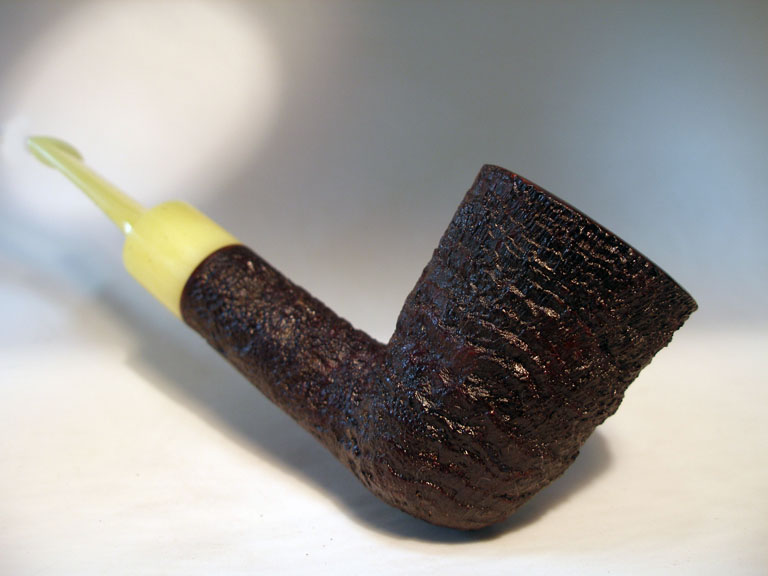
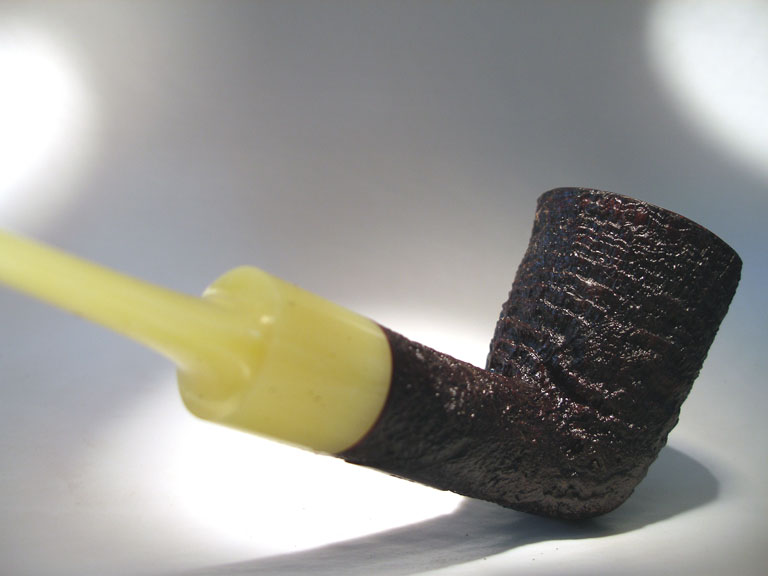
Looking at the Bakelite stem one is struck by the retro look of the old stem material. The saddle shape works well with the material and the Dublin shape of the pipe giving it a classic style that works with just a little flair of modern. It is hand cut out of a piece of Bakelite. From the saddle back it is well tapered with good even angles top and bottom progressing to the button. There is a slight wavy pattern to the Bakelite that makes it have an amberlike look in the light. The blade of the stem that is put in the mouth is thin and comfortable. Brad did a great job shaping the stem and capturing a shape that really works with this pipe.

The tenon is white Delrin that has been inserted into the stem for durability and ease of use. The airway is funneled slightly for a smooth transition from the mortise when it is in place. There is a very minimal gap between the end of the tenon and the base of the mortise. The transition where the Delrin meets the Bakelite of the stem is seamless. There is no lip or rough spot at that junction. The draught of the stem is unrestricted and open. When the pipe is put together the draught is effortless. The fit of the stem to the shank is very well done. The button is cut to my liking with a good sharp inner edge and tapered to the tip. It is a thin button with material enough to provide an edge that fits behind the teeth. The slot is rectangular with rounded edges and deeply funneled to deliver a uniform airway from bowl to button. The inside of the slot is sanded smooth and polished. The airway is absolutely smooth from slot to tenon.OLYMPUS DIGITAL CAMERA The overall construction of this pipe is very well done. It is light in the hand and in the mouth. The shaping of the stem is exactly what I like in terms of the feel in my mouth. The blade from the button to the saddle is deep enough to give room for how it sits in my mouth. It is well balanced and tactile feel of the deep blast as it warms up during the smoking of a bowl is very pleasant. Like others in my American carver collection, I smoked the pipe at specific times in my life. It is a pipe I enjoy smoking when sitting on my porch or in my recliner. It is not one that I carry with me as an everyday pipe. That being said since I got it I have smoked it enough to have a good thin cake developed in the bowl. It is one that I have dedicated to Virginia and Virginia Perique tobaccos. It delivered a good smoke from the first smoke I had in the bowl and continues to do so to this day. It draws well; the lighting has never been a problem and continues to be an effortless smoke. Now that I am writing this review up, I have moved the pipe out of the cupboard and set it aside to enjoy Sunday afternoon. Thanks Brad for delivering a beautiful, well-made pipe that remains a very good smoking pipe to this day.
If you can acquire a pipe made by Brad Pohlmann I can assure you that it will not disappoint you and you will find that it will become a favourite in your rack. One of the things I love about pipes is that they live far longer than the original owner. I hold it in trust while it is in my care. The craftsmanship of this pipe gives the certainty that it will continue its journey well beyond the years that it is my companion.

A Review – A Larry Roush Bent Apple


Blog by Steve Laug

roushlogo For a lot of years I wanted a Roush pipe. The chunky style and look of Larry’s pipes is instantly recognizable. There is no one who makes a pipe like his. His take on classic shapes always goes a different direction and to me there was always something about them that made me want to own one. Quite a few years ago now, I was in Chicago for the Chicago Pipe Show and was talking with a fellow pipe who had a Roush that he was selling. It was lightly smoked and was in great shape. We struck a deal and the pipe was mine. The previous owner had smoke Virginias in the pipe – good aged Virginias that he collected as a hobby. He gave me a bowl of Balkan Sobranie Virginia No. 10 for my inaugural smoke in the pipe. I sat and enjoyed that bowl for a good long time while sipping some dark roast Costa Rican coffee. From that moment I fell in love with that pipe. It delivered an amazing smoke. The first two photos of the pipe come from Larry’s site.OLYMPUS DIGITAL CAMERA I enjoy learning a bit about the carver and his philosophy of pipe making of my handmade pipes. I find that learning this background information gives me a feel for the pipe that adds another dimension to the smoking experience. In terms of information on Larry’s pipes, I turned to his website and was pleased to find a well written article regarding his pipes. I have included the following from Larry’s site that set the stage for me in terms of enjoying this pipe. The link to the page itself is: http://roushpipes.com/About.aspx
larryroush Larry writes the following:

“The following words are those of a pipe maker of course, but in essence they are those of an artist – myself. I think most pipe makers view themselves as artists akin to those who sculpt in stone or wood, but confining their work to a single subject: pipes.”

“For myself, what I’m interested in, and what I think other skilled pipe maker are interested in, is quality wood. The reason is quite simple – I am searching for the two primary qualities in a pipe: beauty and smokability. My primary source for Briar at the present time is Italy, and I am very pleased with its esthetic value and smoking qualities. Of course different wood from different growing areas appear different insomuch as grain is concerned. Regardless of the source, when briar is aged and air cured properly the smoking qualities will be the same.”

“Every pipe maker sets his own standards and I have to look at the piece of briar to determine whether it will be a smooth pipe or not. Just because it is clean (without pits) doesn’t mean it will become a smooth ROUSH. For a carved pipe, I select a block that will support the size pipe I want to make, position the template and draw the outline. In contrast, the crafting of a smooth pipe is unique in character and requires a substantial amount of time. Grain is a primary consideration, and the point beyond shape is where the eye of the artist is critical. I don’t tell the briar block what I want, the block tells me. It’s the grain that determines the shape not the template. I have always done all my own Gold and Silver work and use only solid Silver and 14k Gold. I really like the combination of wood with silver and gold. I think it gives a very unique touch. Sometimes I use fossilized Walrus tusk or Mammoth tusk for inlays. This comes predominantly from Alaska and is found as a by-product of mining operations there.”

“I have always been demanding when it came to the pipes I smoked personally. As a result it took many years to perfect my finishing, curing, and carving techniques. I keep that in mind when I make a piece. If the finished pipe is not one I would keep for myself then it is just not good enough for sale. Being my own worst critic, not wanting to settle for less, has always been the most difficult part of pipe making.”

“As a pipe maker I make every effort to turn out a quality pipe, regardless of shape or finish. This often involves painstaking and meticulous work, unknown to the buyer, but incorporates features (see link below on expectations from a Roush pipe) that make the ROUSH pipes what they are today. Mike Butera and I once had a discussion on this very topic and determined that these many things we do relating to fit and finish, and attention to detail are simply the standards we set to make quality pipes. To short cut or deviate from these standard would not only be cheating the smoker and collector, but cheating ourselves. On a personal note, I feel fortunate to have this gift, this ability to see deeper than the surface of a fine piece of briar and respond by creating pipes that are shared and appreciated by others. I’m eternally grateful for three things: the insight to recognize in myself a talent and the courage to develop it; secondly, for the assistance and direction of Mike Butera, and third for the opportunity to take an idea, a simple thought, and turn it into something beautiful and useful. It is my hope and wish that you enjoy smoking and owning my pipes every bit as much as I enjoy making them. –Larry Roush” OLYMPUS DIGITAL CAMERA

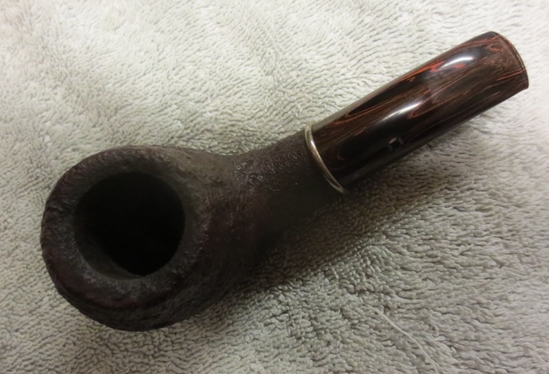
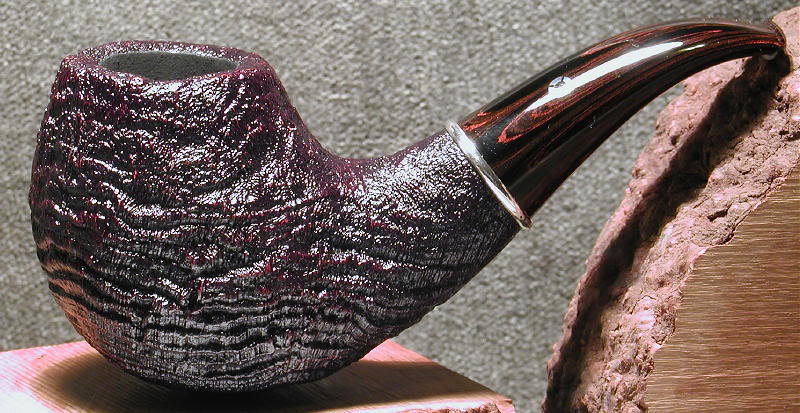
larryroush1aMy initial impressions of the pipe really include what drew me to this piece of pipe art enough to want to add it to my collection and make it a part of my pipe journey. It is a short, squat 5 inches long and 2 inches tall. The tobacco chamber is 1 1/2 inches deep and 3/4 inches in diameter. The silver band is smooth, narrow, handmade ring that adds a simple contrast to the dark oxblood sandblast. It is integrated into the shank. The stem is handmade from Cumberland and its short taper has a typical Roush look. On the left side of the top of the stem there is a silver Roush logo inlay.

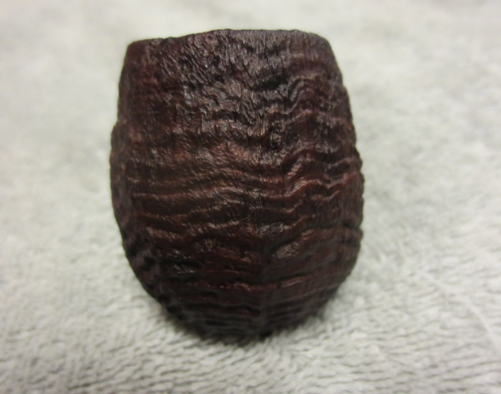
When I picked up the pipe it was an impressive piece. The workmanship of the pipe and colour and feel of it in my hand captured me. I remember sliding the pipe out of the sleeve and enjoying the look and feel of this pipe. It was and is beautiful. It had the faint aromas of the Virginias that its previous owner had smoked, yet it was clean and ready for me. The sandblast is deep and rugged giving the bowl a tactile feel in the hand. It is a tight ring pattern that travels horizontally around the bowl with sandblasted birdseye on the top of the rim and the shank. Examining it up close it is obvious that it is blasted with a master-hand.

There is a smooth, oval medallion of briar on the bottom of the shank next to the silver band that provides a spot for the stamping. It is stamped S2 over an arched Roush. Under that is the stamp 1154 over Hand Made over U.S.A. The final stamp in the oval is 2006. The overall flow of the bowl and shank is brilliant and the colours are beautifully matched from rim to the end of the shank. There appears to be a black stain under the oxblood that adds contrast in the rings of the blast. Combined with the swirls of black and red in the Cumberland matches the colour of the stain on the bowl and gives the pipe a dressy look. The silver band on the shank not only separates the texture of the bowl and stem but gives focal point that draws the eye to take in the taper of the stem and the texture of the bowl.Rousha The inner mechanics of the pipe are perfect. The drilling is perfectly executed from the shank and into the bowl – coming out exactly centre in the bottom of the bowl. The airway from the bowl into the mortise is centered. It is smooth in its entrance to the mortise and the mortise itself is also smooth with no rough spot left by drill bit. The end of the shank is sanded smooth and is finished. There is a bevel in the shank end to accommodate the tenon and provide a smooth fit against the shank. The bowl itself is U shaped and smooth from sides to bottom. The air way enters the bowl and is smooth and clean. The draught on the bowl is wide open and effortless.Roushb

Roushc Looking at the stem one is struck by the very typical Roush look. Larry’s stem are easily recognized from a distance. The shaping and flow are typical. It is hand cut out of a Cumberland. It is well tapered with good even angles top and bottom progressing from the shank to the button. The portion of the stem that is put in the mouth is thicker than I normally like but it is still very comfortable. Larry did a great job shaping the stem and capturing a shape that really works with this pipe. The tenon is Delrin that has been inserted into the stem for durability and ease of use. The airway is funneled slightly for a smooth transition from the mortise when it is in place. There is a very minimal gap between the end of the tenon and the base of the mortise. Roushd

Roushe

Roushf The transition where the Delrin meets the Cumberland of the stem is seamless. There is no lip or rough spot at that junction. The draught of the stem is unrestricted and open. When the pipe is put together the draught is effortless. The fit of the stem to the shank is very well done. The button is cut to my liking with a good sharp inner edge and tapered to the tip. It is a thin button compared to most of my pipes but is enough to provide and edge that fits behind the teeth. The slot is oval and funneled to deliver a uniform airway from bowl to button. The inside of the slot is sanded smooth and polished. The airway is absolutely smooth from slot to tenon.Roushg The overall construction of this pipe is very well done. It is light in the hand and in the mouth. It is well balanced and has a great tactile feel when it is cool and as it warms up during the smoking of a bowl. I have smoked the pipe a lot since I got it and enjoyed the fact that it had previously been a Virginia pipe and had been well broken in. That fact made it a very simple pipe to make my own. The shape of the bowl has kept this a good Virginia smoking pipe in my rotation. It delivered a good smoke from the first smoke and continues to do so. It draws well; the lighting has never been a problem and continues to be an effortless smoke. Thanks Larry for delivering a beautiful, well-made pipe that remains a very good smoking pipe to this day. If you can acquire a pipe made by Roush it will not disappoint you and you will find that it will become a favourite in your rack. The craftsmanship of his pipes will make this pipe continue its journey well beyond the years that it is my companion.

Chris Askwith “Hand Finished”


Blog by Al Jones

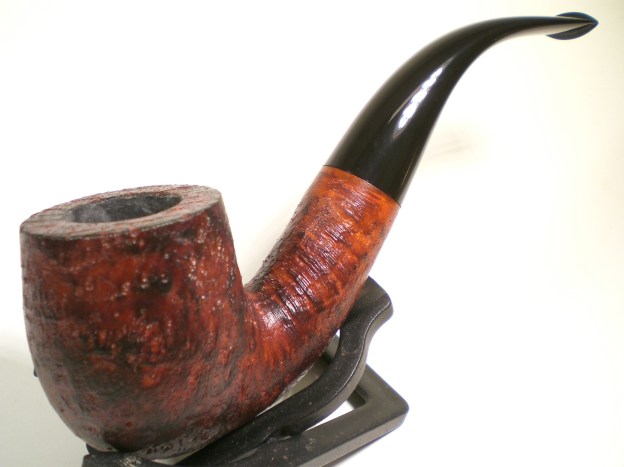
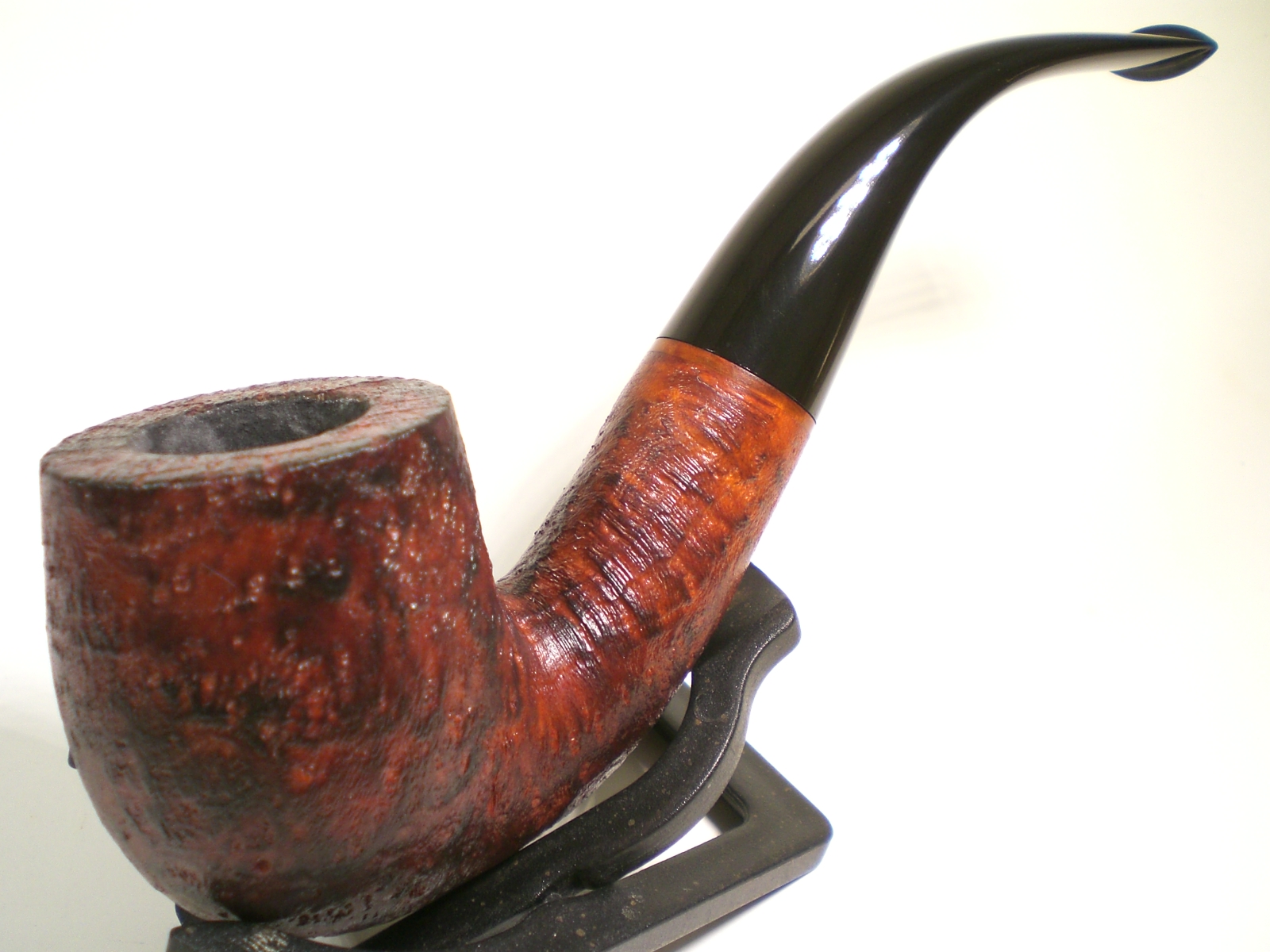
I have admired the work of British pipe artisan, Chris Askwith work for some time now.  He recently released a new line called “Hand Finished” pipes, at very reasonable prices.   This new line came up on a SmokersForum.uk thread and this bent Billiard caught my eye.  It had that classic British profile that I love.

I’ve had the pipe for about six weeks not and thought that I would share my observations.

Chris makes the “Hand Finished” line from a stock of old English briar. The stem material varies, and this one is vulcanite.  This was also from some old German stock that he found. The stem fitment is perfect.  The slim, fish-tail button, is sublime and just to my liking.  The shape and feel is similar my older Sasieni pipes.  The stem has a great mouth feel and Chris reports it doesn’t oxidize in use (one concern that I had).  I find the blast work and stain to be very appealing.

I was a little concerned as the pipe will not pass a cleaner. As I suspected, Chris said the strummels were pre-drilled, so he had to work within those shaping confines. I am happy to report, that after two smokes, the pipe was dry as a bone and cool. The wall thickness is also just to my preference.

Chris uses a bowl coating, but I found it to be flavor neutral and the pipe broke in almost immediately.  This is my second new pipe purchased this year with a  bowl coating.  I now consider myself a fan of bowl coatings, if they are created in this manner.

Ordering was smooth and easily completed via email. It was pleasant to have some interaction with the maker.   In email communications, Chris tells me that he is still learning to work with this supply of strummels and was appreciative of my feedback.

I’ve been smoking this pipe fairly regularly (2/3 times per week) and it is quickly becoming a favorite.  I had it with me at the recent Richmond CORPS show and several pipe club meetings.  The folks I’ve shown it to seemed impressed.  In fact, this pipe seems to end up in my bag for the various pipe club nights I attend.  The draw is open, but it is not fussy about the way it needs to be packed.   Typically, a bowl is a one match affair with no moisture, so a cleaner is not required.  The way it smokes, the shape and weight all conspire to make a pipe that really works for my needs.  This pipe has definitely whetted my appetite for a future Chris Askwith “Hand Made” pipe.

Chris_Askwith_Hand-Finished_Gallery Chris_Askwith_Hand-Finished (4) Chris_Askwith_Hand-Finished (3) Chris_Askwith_Hand-Finished (6) Chris_Askwith_Hand-Finished (5)

A Review – A Julius Vesz Shape 76 Zulu


Blog by Steve Laug

Pipedia gives good background information on Vesz. The picture and the material is taken from this link: http://pipedia.org/wiki/Vesz_Pipes
aboutpg“Born and raised in Hungary, Julius Vesz was first exposed to pipe making through his grandfather. Although his grandfather died when Julius was only 9 years old, he can still picture his grandfather making pipes. It made a lasting impression that matured years later.

After immigrating to Canada at age 23, Vesz worked as a mechanical draftsman, but ever since a child had wanted to do something on his own. Remembering his grandfather’s pipe making and repairing, he thought perhaps he should try his hand at that also. He sought out Charlie Dollack, who had a repair shop in downtown Toronto, but while Charlie encouraged the young Vesz, he did not offer any help or instruction.
Julius continued on his own, setting up a modest shop in his own home, and was soon fixing and making pipes for several department stores, as well as United Cigar, which later turned into his main source of work. He discovered he had a unique skill, which he practiced and nurtured on his own. Like his grandfather, Vesz is motivated by a desire to create pipes that approach perfection.”

Over the years I have followed Julius Vesz’ pipes and kept an eye out for one that caught my eye. Julius Vesz is a Canadian pipe maker who has been controversial in his claim to use dead root briar. Many have argued about his choice of terms regarding the briar that he uses. But regardless of your take on that issue he makes beautiful pipes that smoke exceptionally well. His unique raindrop shaped pipes may be how many people know him. He has a shop in the Royal York Hotel, 100 Front Street West in Toronto.

His Handcut pipes are crafted from his oldest and finest blocks of aged briar. They come in a variety of shapes and styles and no two are the same. Often personalized with beautiful ornamentation such as bone, silver and gold, these pipes have long been sought after by collectors all over the world. Julius has customized pipes for dignitaries and clients worldwide.

His early pipes bore the Craft Briar stamp, and though his company still is registered as Craft Briar his pipes are now stamped Julius Vesz. He carved every pipe that bears his name and though they may bear similarities to others that he has carved each one is one of a kind. His site says that “Every pipe is meticulously crafted from his personal supply of aged briar that he has been accumulating since the 1960s. The extremely old briar gives each pipe the exceptional smoking characteristics found only in a world famous Julius Vesz pipe.”

I have since picked up two of Julius’ pipes and found them to be very good smoking pipes. The first one I found was a beautiful little shape 76 Zulu Hand Made while the second was a Craft Briar shape 86 Volcano. In this review I will address the Zulu.IMG_2469My first Vesz is stamped on the left side of the shank Julius Vesz Hand Made Canada with a circle 4 stamp. I learned from correspondence with Julius’ son Rob that his dad’s Hand Made pipes were graded (in ascending order): 2 – 4 and this one is a grade 4 stamped pipe. It also bears a shape number of 76 which is the Zulu shape. The stem bears a white circle inlay that is common on his pipes. The vitals are as follows: length 5 ½ inches, height 1 7/8 inches, bore of the bowl 3/4 inches, outer diameter at the widest point 1 1/8 inches and depth of the chamber 1 1/4 inches.

In this review I want to look at the pipe from a more technical side and walk through its construction, feel and delivery of the smoke to me. The pipe came in a cloth pipe sock with no stamping. When the pipe arrived in the mail I was excited to see and hold my first Vesz pipe. I had read reviews and scrolled through many pictures of his work on his website but had never held one in hand. In taking this out of the sock I have to say that it is more than I expected from the photos that I had seen before I bought it. The shape was well executed and I liked the shape of the bowl, its cant and finish immediately. The finish was well done and the stain highlighted the beautiful grain. The weight of the pipe is light, I can only wish I had a scale because it is lighter in weight than I expected in a pipe of this size.IMG_2470Looking at the externals of the pipe. Julius use of stains makes the grain stand out on the pipe. The rich brown tones pick up both the birdseye and cross grain and makes them stand out against the back ground colour. He has laid out the cut of the briar to take advantage of the grain patterns. The top and bottom of the shank and the front and back of the bowl are predominantly cross grain. There are some slight mixed grain portions on the front and back of the bowl. The crossed grain pattern on the bowl is set slightly to the left of the bowl center. But the look of these portions is gorgeous. The birdseye grain on the sides of the bowl and shank are lovely to look at. I get lost in the grain patterns while I hold it in my hand. The centres of the birdseye are dark in colour and the ridges surrounding the eye are lighter. The bottom of the bowl is cross grain that flows up to the front of the bowl. The cross grain on the top of the shank also flows up the back of the bowl to the rim.IMG_2471The stamping on the pipe is on the left side of the shank. The shank is round, sitting at a 90 degree angle to the bowl. The hand cut ebonite stem is very well done and comfortable in the mouth. The saddle of the stem sits tightly against the shank that gently tapers into a thin blade. The taper of the blade is subtle and sporting a 1/8 bent to the stem. It has a thin oval shaped button that is sharply cut and catches well on the back of my teeth. The slot in the button is oval shaped and there is a smooth V slot that facilitates the movement of smoke across the mouth. The polish and smoothness of the finish is like glass. The overall appearance of the pipe and stem is beautiful and it fits my hand very well. The smooth finish gives the pipe a simple elegance that is a pleasure to look at while I smoke it.IMG_2473Moving from the externals of the pipe to the internal mechanics. The workmanship on this pipe is well done. The angle of the drilling is done in such a way that the bowl is of a uniform thickness throughout. The bowl bottom is relatively the same thickness as the walls of the pipe. The bowl is drilled at the same angle as the exterior of the pipe. The draught hole is precisely where it should be – centred at the back side bottom of the bowl. As the pipe came to me pre-smoked I cannot speak to whether there was a bowl coating originally. Holding the bowl to the light revealed a clean and smooth airway with no impediments. The drilling in the mortise is clean and smooth. The airway is centered in the back of the mortise. The tenon goes straight into the mortise and sits against the back of the mortise. The airway in the stem and in the mortise line up perfectly. The tenon appears to be integral to the ebonite stem material it is not an insert. The airway is not chamfered or funneled on the end of the tenon but is flat and centered in the end of the tenon. The inside of the stem is very smooth. There is no roughness or constriction from the tenon end to the slot in the button. The airway flattens out like a squeezed drinking straw so that the diameter does not change but is flattened and opened.IMG_2481 IMG_2482 IMG_2483I have been smoking this pipe for several years now and it smokes very well. Whenever I load a bowl of a favourite Virginia tobacco it delivers a flavourful and cool smoke. When I received the pipe it was already broken in and there was a thin cake already forming in the bowl. The pipe has always smoked dry and clean with no moisture build up or gurgle during the smoke. The ash and any remnants of tobacco in the bottom of the bowl are dry and easily dumped out at the end of the smoke. The draught on this pipe is very smooth – no whistling sound and no sense of having to suck or work to get the smoke to move through – it is effortless as it should be. It has been and will continue to be a pleasure to smoke, exactly what I look for in a pipe that keeps its place in my rotation.
I would highly recommend that you have a look at Vesz pipes. While many are quite high end his Handmade line still offers affordable pipes at a lower price. His pipes are available through Julius himself and through other online retailers such as Uptown’s Smoke Shop and Smokingpipes.com. Julius’ fine craftsmanship can be seen in the beauty of the pipes that are available on these sites. He carves both classic shapes and designs that are uniquely his own like the raindrop. His silver work and ornamentation are also beautiful additions to his pipes and give them look of fine art. They are beautiful to look at and explore. Have a look at the beautiful work that he does on his own website at http://www.juliusvesz.ca/. He can also be contacted directly at his shop at the Royal York Hotel in Toronto or by phone at 416-362-0581, fax at 416-306-9908 or email at juliusvesz@rogers.com.

Royal Oak Briars “Huntsman” Review


Blog by Al Jones

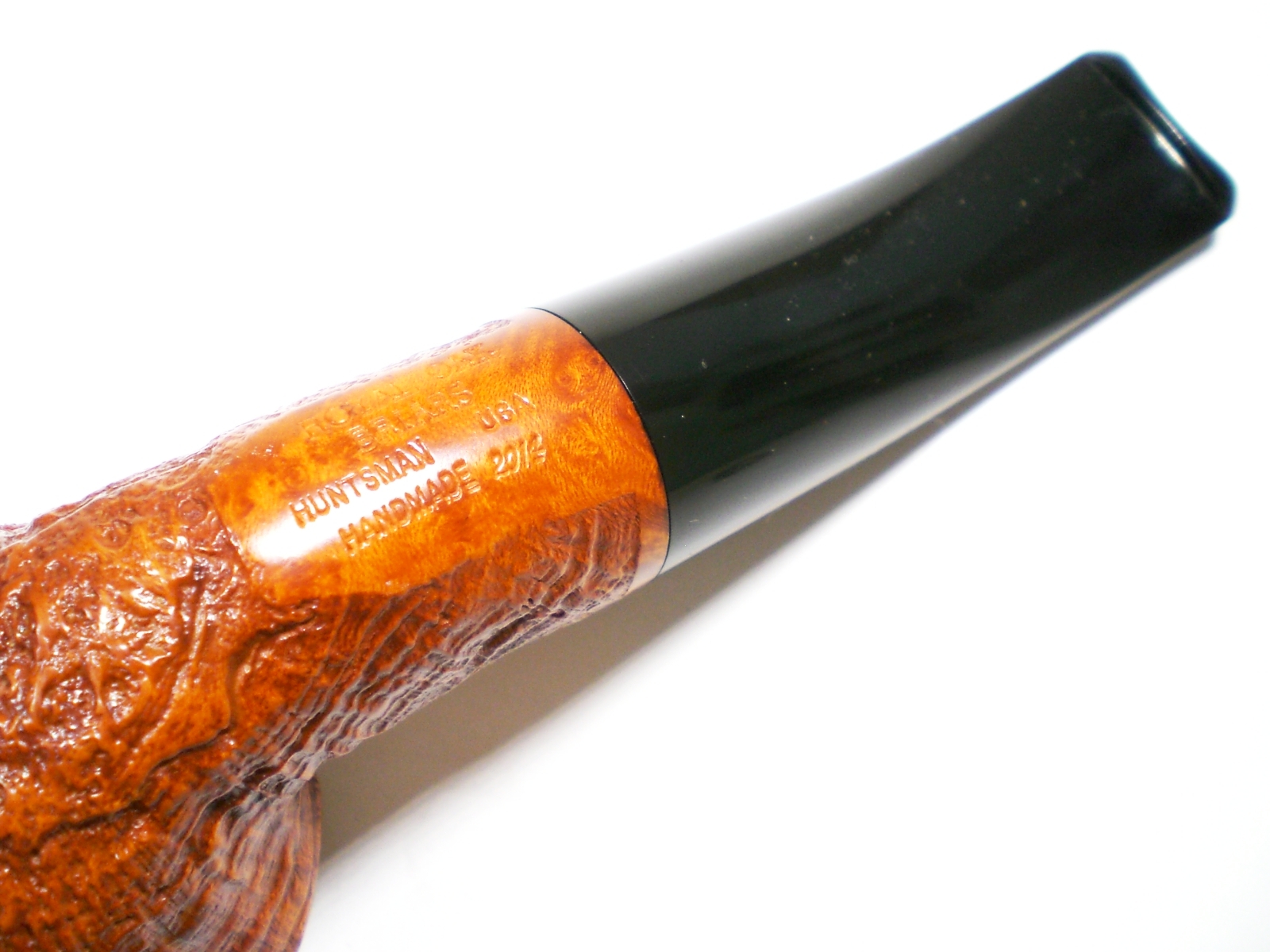
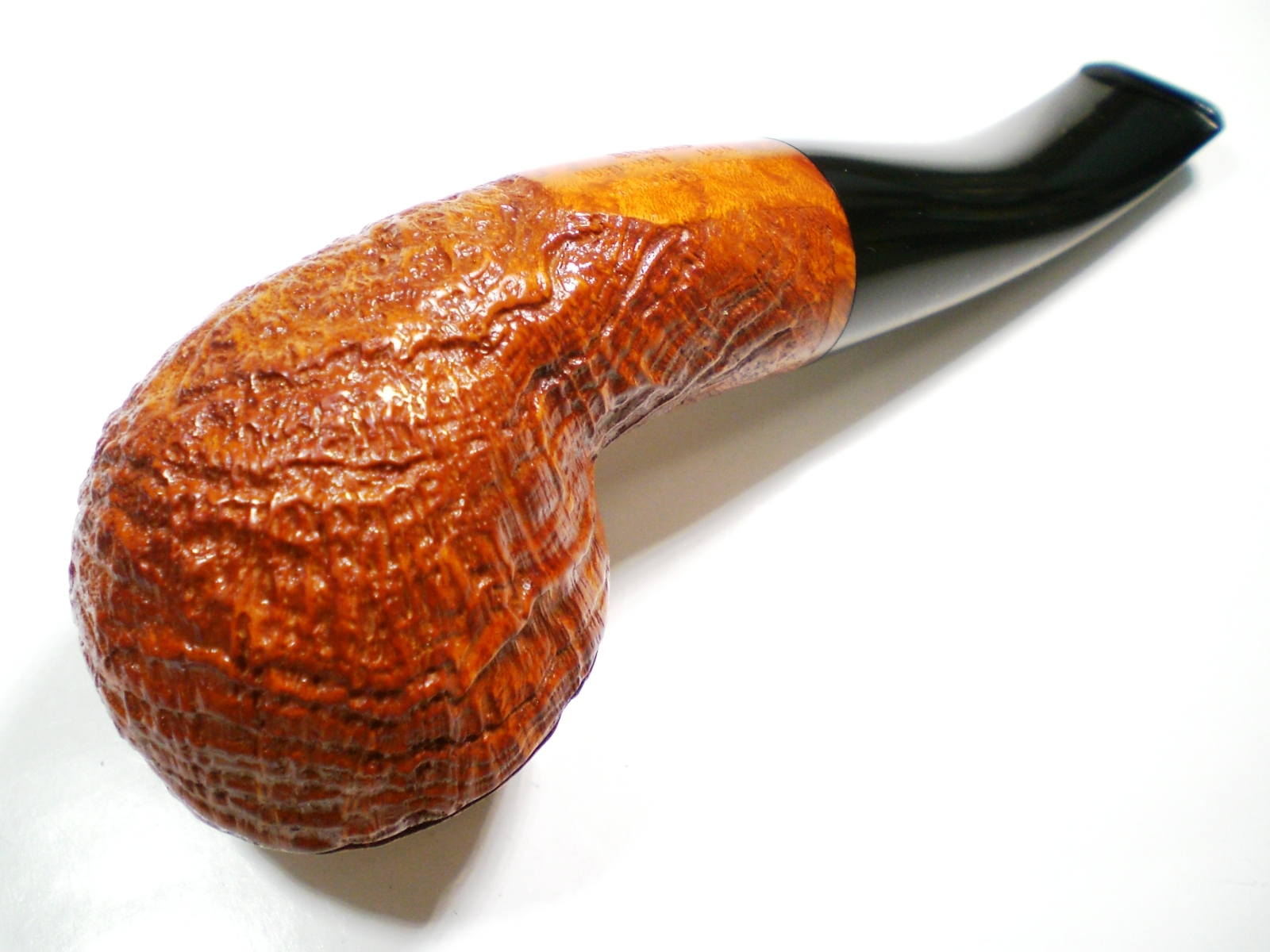
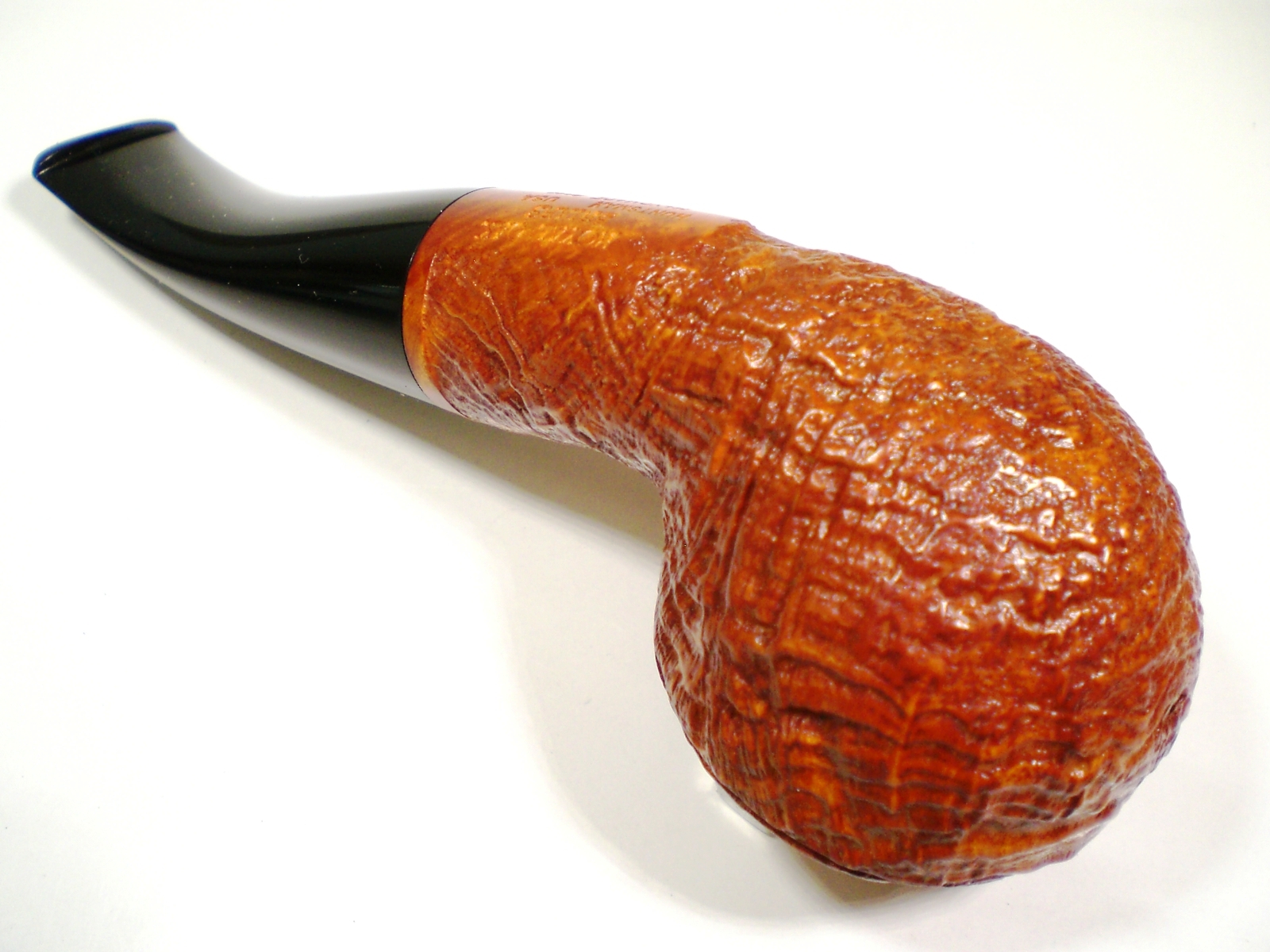
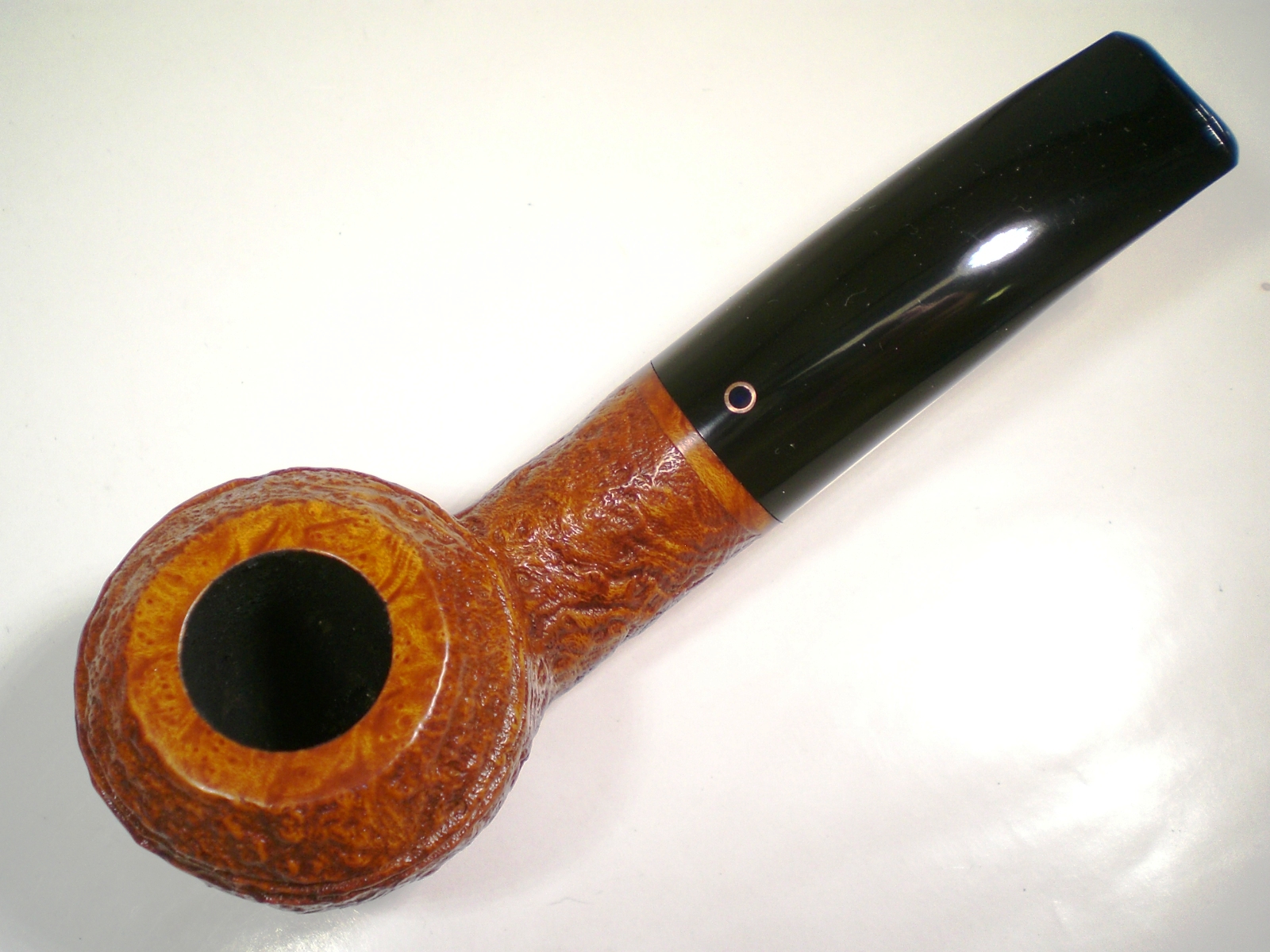
I completed my first pipe commission this week with, working with  James Aydlott, who makes “Royal Oak Briars”.  James has been showing his creations on the Bulldog Lovers Facebook page for several months.  I was very impressed with his shaping and stems, particularly with the classic shapes.   Initially I didn’t realize his pipes were branded “Royal Oak Briars”, which I had seen advertised on Micheal Lindners site, “The Pipe Rack”.  Micheal Lindners pipes are very highly regard and I met him last year in at the NYC show.  James has been working in Micheal’s shop, and in the past two years started his own line.    The connection to Micheal Lindner gave him was definitely a factor in the project, as to that point, I had not yet seen a Royal Oak pipe in person.  Thru Facebook and several pipe forums, I was able to communicate with folks who owned Royal Oak Briars and all were quite pleased and encouraged me to proceed.  James was very upfront with me and he was clear that if I didn’t care for the final product, I was under no obligation to complete the purchase.  As you will read, I was completely thrilled with the finished pipe.

James had made and shown a Comoys 498 Extraordinaire recreation (straight Chubby Rhodesian) that was sold thru The PIpe Rack.  I complimented James on his shaping and thru subsequent messages, I learned he was starting on a pipe that would be an homage to the Comoys 499 Extraordinaire.  Since I am fortunate to own that model Comoys, that immediately piqued my interest.  I let James know that I was interested and I was able to see the pipe unfold and offer some personalization along the way.   The pipe would be blasted and I requested a polished bowl top.  The last decision was the golden tan stain, which I thought turned out magnificently.

One very important detail to me on any pipe purchase is the weight of the pipe.  My 499 Extraordinaire weighs 68 grams.  I asked James if he could create the shape under 60 grams.  James nailed that request and the pipe weighs 59 grams, which coincidentally is exactly what most of my GBD 9438’s weigh, one of my benchmark shapes.

Below are some pictures of the pipe in the early and latter stages.

Royal_Oak_Briars_Rhodiesian-1 Royal_Oak_Briars_Rhodiesian-2 Royal_Oak_Briars_Rhodiesian-3 Royal_Oak_Briars_Rhodiesian - 4 Royal_Oak_Briars_Rhodesian-5

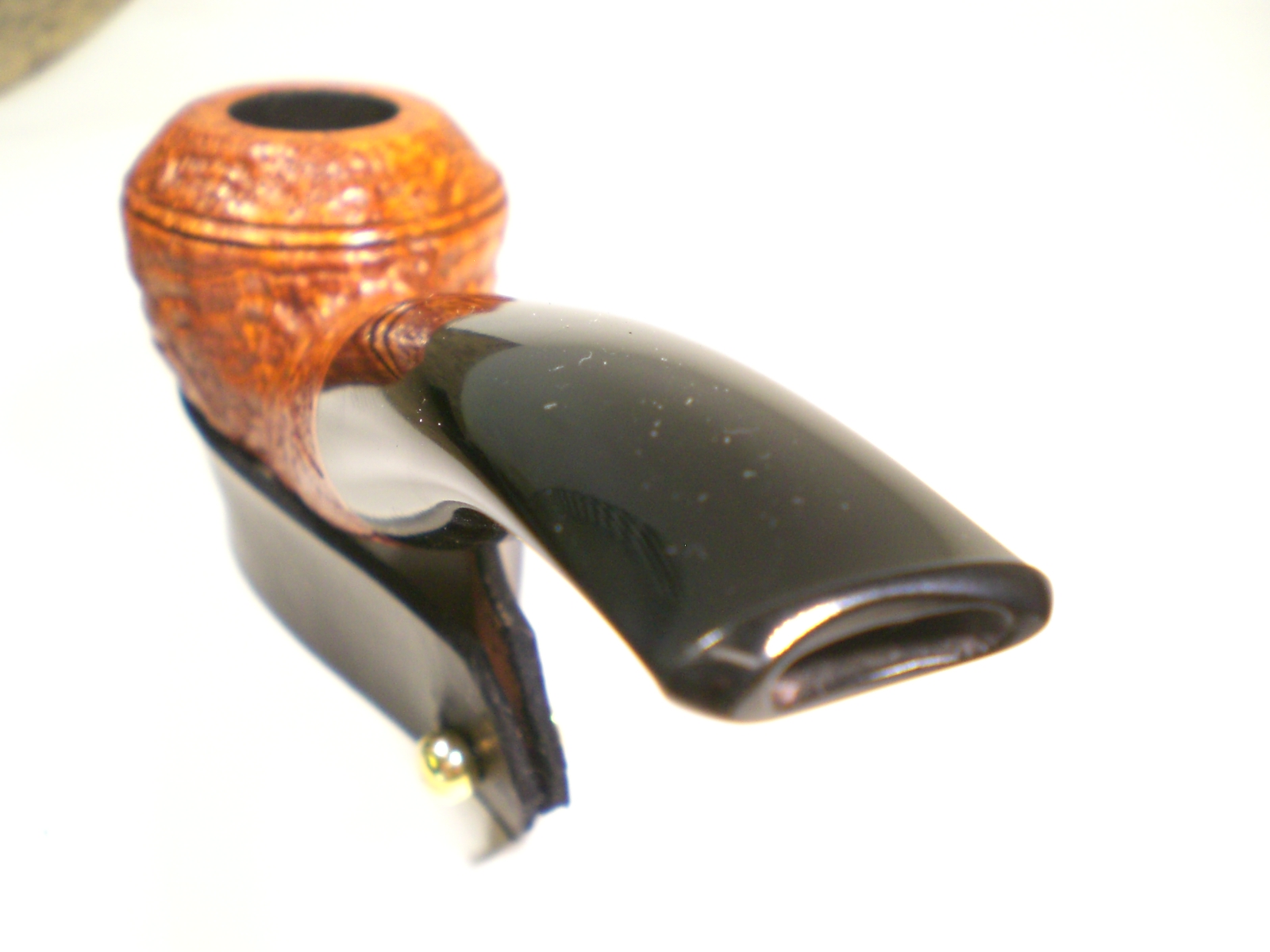
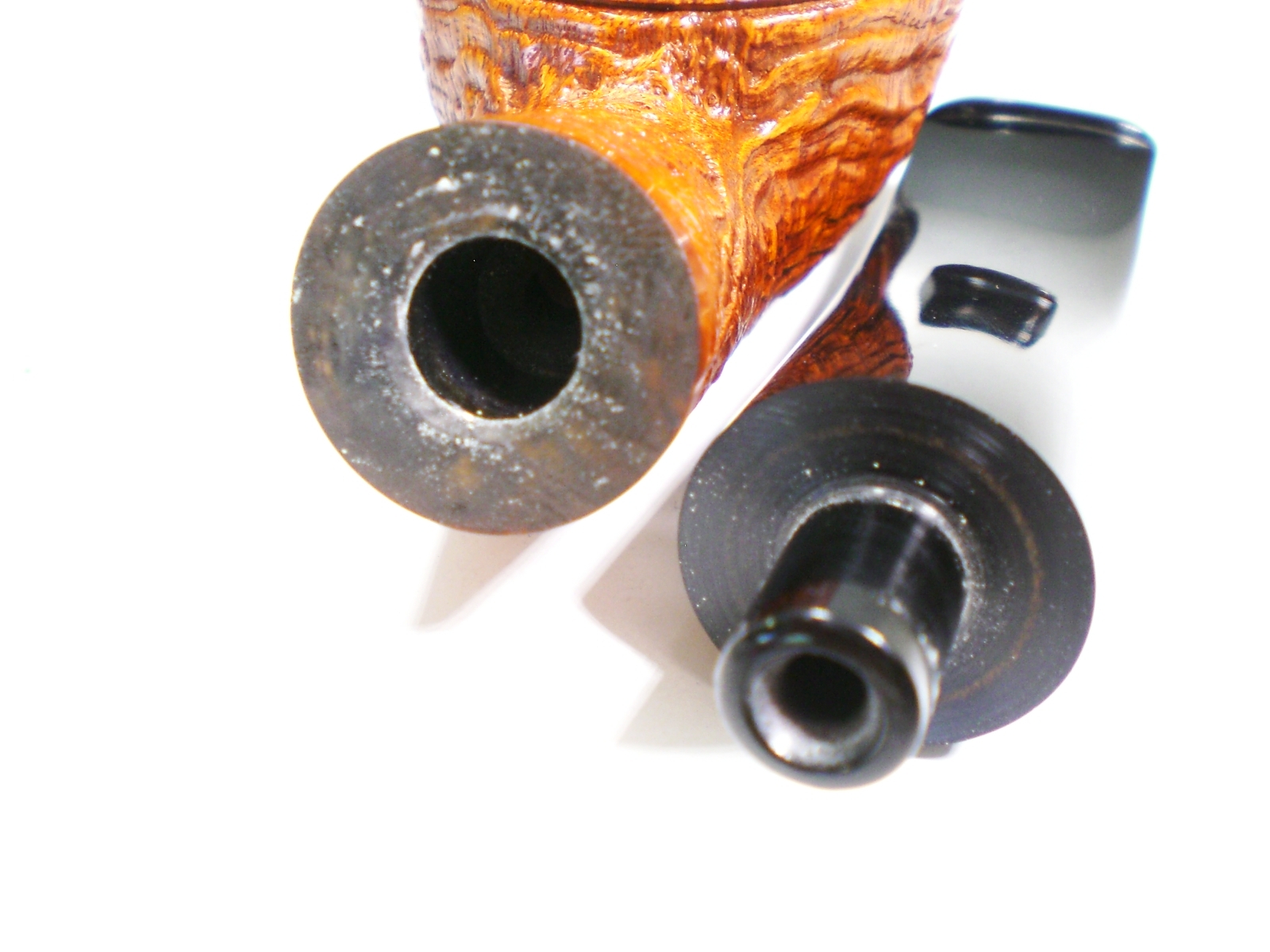
The pipe is drilled perfectly with an open draw. James tells me that the draft hole is drilled with a 5/32″ bit and tapering to 1/8″ in the stem.  The pipe smokes wonderfully, with an excellent draft and no moisture.  It also packs easily, not something I always find with a pipe with an open draw.  I am very impressed with the stem work, it seems James has learned his lessons well from Micheal Lindner. The button end is beautifully funneled and the tenon also has a concave detail that I like.  James feels the funneling on the tenon helps minimize moisture buildup in the pipe.  On the button end, the height is just right for holding without being uncomfortable.  I also like how the button has a concave feature.   James uses briar from a variety of sources.  For this pipe he used briar from Mimmo that had been aged for four years.  James feels this briar made it possible for him to achieve my weight goal.  The blast is nice and craggy, which is also my preference.  We mulled over several stain choices before deciding on the golden tan.  I think it gives the pipe a wonderful glow.

James uses a bowl-coat on his pipes, made from a gelatin/activated charcoal substance.  As someone who primarily purchases estate pipes, I hate breaking in new pipes. This is my second pipe with a bowl coating of this nature, and I’m now a big fan of this process. James assured me the product was neutral and in use, I agree completely.  Smoking the new pipe, it felt like an old friend from the get-go.

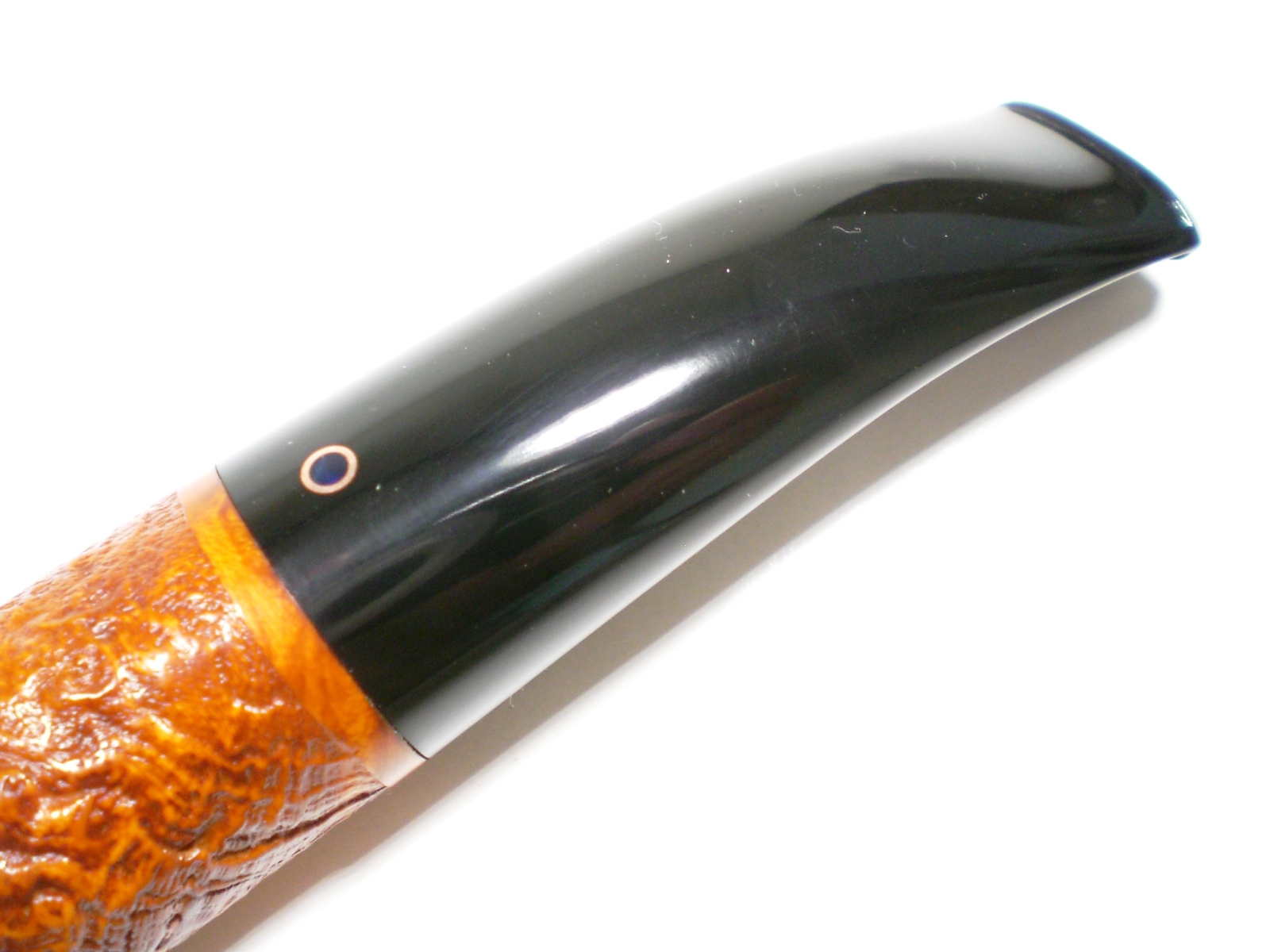
Another unique aspect of a Royal Oak Briar is the stem logo, which is a blue acrylic dot in a copper ring. As an Ashton fan, I love that detail. Many artisan pipes lack a stem logo.  To me, that was another appealing aspect of the Royal Oaks Briars line.  A member of the PipesMagazine forum commented on the stem logo that “it was like the cherry on top of a sundae”.

James work combines classic shaping, solid mechanicals along with quality briar and ebonite materials.  He was easy to communicate and work with and I enjoyed our conversations.  Hopefully, we’ll meet some day at a pipe show.  I’m looking forward to having this one in a solid rotation and I can highly recommend Royal Oak Briars.

Royal_Oak_Briars_Huntsman_Gallery Royal_Oak_Briars_Huntsman_2014 (2) Royal_Oak_Briars_Huntsman_2014 (1) Royal_Oak_Briars_Huntsman_2014 (3) Royal_Oak_Briars_Huntsman_2014 (4) Royal_Oak_Briars_Huntsman_2014 (5) Royal_Oak_Briars_Huntsman_2014 (6) Royal_Oak_Briars_Huntsman_2014 (7)

Royal_Oak_Briars_Huntsman_2014 (8)

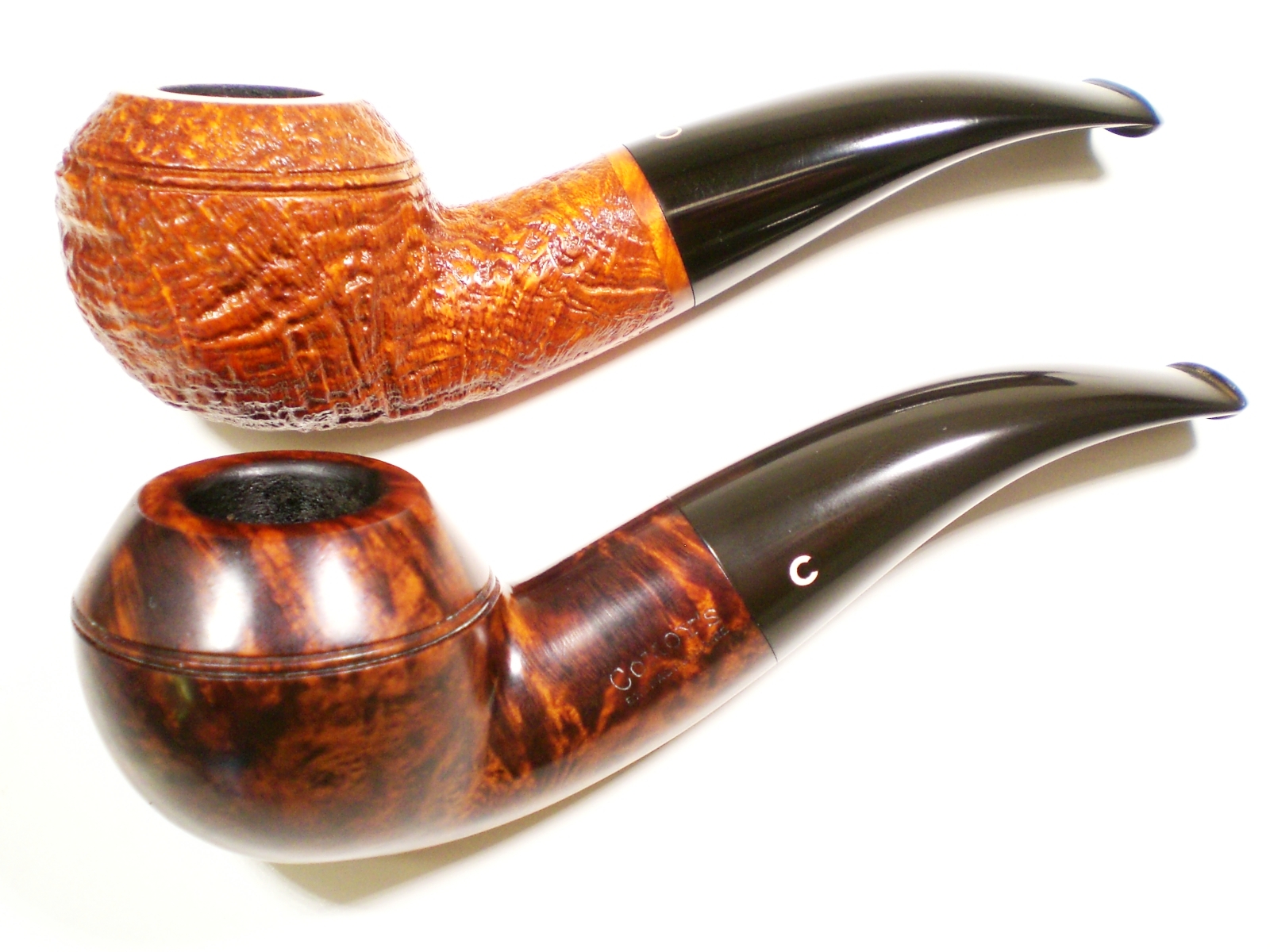
Below is a comparison picture with my 1930’s Comoys 499 Extraordinaire, the inspiration for this pipe.

Royal_Oak_Briars_Huntsman_2014 (9)


A Review – A Benner Rusticated Oval Shank Pot


Blog by Steve Laug

I was drawn to this little rusticated estate pot when I saw in on Keith/Exile’s estate pipe site, http://exilesplace.dk/. I had not heard of Benner before so it was not the name that drew me but rather the look of the pipe that called out to me. Keith sells Benner’s pipe new as well, but in looking at them I still wanted this one. I emailed Keith and soon the pipe was on its way to me from Denmark.
003 (2)
While I was waiting for it to arrive I did some research on who Benner was in terms of the realm of Danish pipe carvers. Keith had this information:

“His real name is Bent Nielsen but the world knows him as Benner. Benner has been making pipes for a long time. He once worked with the late and great Karl Erik Ottendahl and did some design work for Stanwell at one time. He has exported to the US, Germany and, lately, to Russia. These days Benner runs his workshop as the mood takes him and he says he is looking forward to retirement. If I know Benner, that retirement won’t be a permanent thing.”
http://thepipesmoker.wordpress.com/2011/04/10/benner/

I found this picture of Benner on the web and also found information on Pipedia http://www.pipedia.org/wiki/Benner
2978_m
“Considering his reputation among some connoisseurs Bent Nielsen, nicknamed Benner, didn’t leave too much usable traces. He is sometimes mentioned as a nephew of Viggo Nielsen, but in fact he’s no relative of Viggo’s clan.

Starting around 1970 he worked for Karl Erik some years and later for Stanwell, where he sketched a number of new models. Around the climax of enthusiasm for Danish freehands he started to release pipes under his own name. Not too many at all, which stuck more closely to classical models.
He later worked under the synonym Benner. His German distributor however advised him against using his nickname for sales in Germany, because Benner didn’t sound really Danish. Benner, as a Danish pipester recently told, “dared” to carve some more fancy styled pipes than Bent Nielsen did before and every now and then he made some pipes of olive wood, too.

Still he’s supposed to make a few pipes every once in a while selling them to a few local shops in Denmark and a limited number of enthusiasts all over the world.”

I don’t remember the exact date when I purchased my Benner pot from Keith but I have been a frequent visitor to his website and his blog for a long time now. I frequently scan through his listings to see if anything in particular catches my eye. The particular day I found the Benner listed I am not sure what captured me – the shape, the gentle taper of the sides of the oval shank, the rugged rustication, the walnut band. I am just not sure. I am typically not attracted to pot shaped pipes. I have a few in my collection but they are minimal and I am rarely drawn to them when I reach for a pipe. But I remember seeing this one and being captured by it. I left the site, went to work and later that evening I bought the pipe.

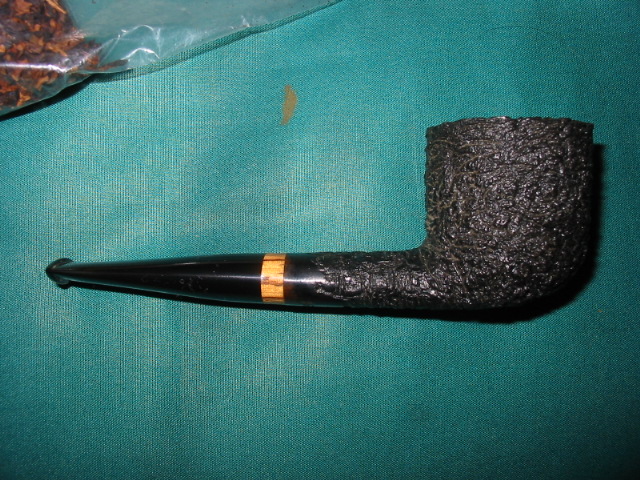
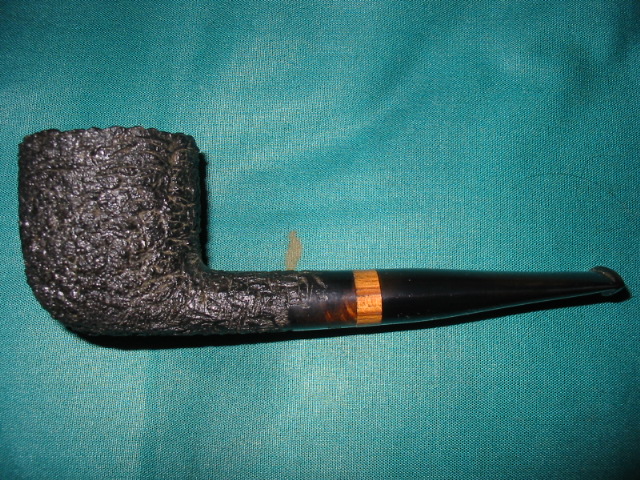
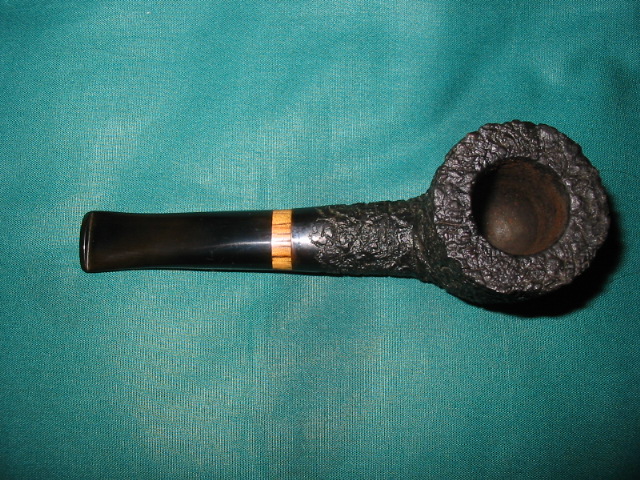
The pipe is small, almost a nosewarmer at 4 3/4 inches long and 1 ½ inches tall. The tobacco chamber is 1 1/8 inches deep and 3/4 inches in diameter. The band is smooth, naturally finished hardwood (walnut or oak?) and adds a contrast to the dark stained rustication. It is integrated into the stem. The stem is handmade from vulcanite and has a gentle taper.
BennerWhen the pipe arrived it was far more impressive than Keith’s pictures had led me to expect. The workmanship of the pipe and colour and feel of it in my hand just captured me. I remember opening the package and sliding the pipe out of the sleeve and enjoying the look and feel of this pipe. It was and is beautiful. It had the faint aromas of the Virginias that its previous owner had smoked, yet it was clean and ready for me. The rustication is tactile yet is not sharp or jarring. It is a tight pattern that almost looks like it was sandblasted after rusticating. Examining it up close it is obvious that it is not blasted but that a master-hand rusticated it very well. The bowl is rusticated up and over the rim and ends at the inner rim edge. There is a smooth band of briar at the shank end that is narrow on the top and sides of the oval shank and slightly wider on the bottom of the shank to provide a spot for the stamping. The overall flow of the bowl and shank is brilliant and the colours are beautifully matched from rim to the end of the shank with a contrast of black stain and the underlying colour of the briar. Combined with the black of the vulcanite it gives the pipe a dressy look. The natural wood band that is part of the stem that not only separates the texture of the bowl and stem but gives focal point that draws the eye to take in the taper of the stem and the texture of the bowl.
005
The inner mechanics of the pipe are perfect. The drilling is perfectly executed from the shank and into the bowl – coming out exactly centre in the bottom of the bowl. The airway from the bowl into the mortise is centred. It is smooth in its entrance to the mortise and the mortise itself is also smooth with no rough spot left by drill bit. The bowl itself is U-shaped and smooth from sides to bottom. The air way enters the bowl and is smooth and clean. As the pipe was an estate when it came to me it was impossible to tell if it originally had a bowl coating but my guess would be that it would have been smoothly sanded briar.

The stem itself is hand cut out of a vulcanite. It is well tapered with good even angles top and bottom progressing from the shank to the button. The portion of the stem that is put in the mouth is thin and comfortable. Benner did a great job shaping the stem and capturing a shape that really works with this pipe. The hardwood band is integral to the stem and is seamless in its flow with the vulcanite. The tenon is Delrin that has been inserted into the vulcanite stem for durability and ease of use. The airway is funnelled slightly for a smooth transition from the mortise when it is in place. There is a very minimal gap between the end of the tenon and the base of the mortise. The transition where the Delrin meets the vulcanite of the stem is seamless. There is no lip or rough spot at that junction. The draught is unrestricted and open from the bowl to the tip of the stem. Draught is effortless. The fit of the stem to the tenon is very well done. The button is cut to my liking with a good sharp inner edge and tapered to the tip. The slot is opened and funneled to deliver a uniform airway from bowl to button.
004
The overall construction of this pipe is very well done. It is light in the hand and in the mouth. It is well balanced and has a great tactile feel when it is cool and as it warms up during the smoking of a bowl. I have smoked the pipe since I got it and enjoyed the fact that it was previously smoked and well broken in. The shape of the bowl has kept this a good Virginia smoking pipe in my rotation. It delivered a good smoke from the first smoke and continues to do so. It draws well; the lighting has never been a problem and continues to be an effortless smoke. Thanks Keith for introducing me to this maker and to Benner for delivering a well-made pipe that remains a very good smoking pipe to this day. If you can acquire a pipe made by Benner (they are hard to come by as he makes just a few) it will not disappoint you and soon become a favourite in your rack.

Reflecting on my collection of Tinsky Pipes


Blog by Steve Laug

I don’t recall when I bought my first Tinsky pipe. But I do know which one it was – a nice Coral finish Billiard with a taper stem. It has a contrast stain on it – a dark brown and a walnut combination. The rim and a band around the top of the bowl and the end of the shank are smooth and sport the walnut finish. I have had the pipe at least 15 years or more and have thoroughly enjoyed smoking it. In fact it was the pipe that got me buying Tinsky’s pipes over the years. I have bought maybe two of them directly from Mark and the others have come through EBay or from friends. I have fourteen of Mark’s pipes to date with one new one on the way. These all vary in shapes and styles but all are fine smoking machines. Only one of the pipes in this collection remains unsmoked. I really can’t tell you why, but I will break it in one day in the near future.

I thought it might be interesting to give a brief history of the brand for those on the blog who may still be unfamiliar with Mark’s work. Most of this material is taken from his website http://www.amsmoke.com/ and from Pipedia which has an article on the brand and quotes many of Mark’s own words.

The American Smoking Pipe Co. was formed in 1978 by Mark Tinsky and Curt Rollar. Both started making pipes for Jack Weinberger (JHW Pipes) while in high school and throughout college. Determined to blaze their own path, they formed their own company – its goal to create unique pipes, lightweight and comfortable, where attention to detail was the rule not the exception. Exulting in their new freedom, they carved out new shapes that were balanced between the radical freehand era of the 70’s and the board pipe look of other conservative companies. Hungry for recognition, they stormed the Eastern and Southern shops looking for markets to sell their pipes. Many hidebound retailers refused to try something new; preferring to sell, well, what has always sold before. However, their pipes did take root in many shops and the business thrived.

They continued expanding their pipe making capabilities, adding employees to help finish the pipes. In 1990, over a disagreement over how much to expand, Curt Rollar left the company. This put a break on expansion and coupled with a U.S. recession and rising anti-smoking fervor served to limit production to supplying existing retailers, thus ending a decade of growth. With pipes sales in decline, we turned to pipe repair as a way to supplement revenues. Finding that we liked fixing things, American concentrated on pipe repair. While working hard at repair and manufacture American is ready once again to expand its markets through its existing network of shops serviced by pipe repair.

With the advent of the Internet, we are exploring marketing pipes directly to consumers in markets not covered by retail accounts. Feel free to e-mail us at MT@MT.NET

Mark can also be reached by mail at:
American Smoking Pipe Co.
PO Box 13
Wolf Creek, MT 59648

Over the years I have collected quite a few Tinsky’s. I have pipes from the time he and Curt Rollar set off on their own and others that are singularly Mark’s from his time in New England and then newer ones from his workshop in Montana. All the pipes I have are made by Mark other than one that was a collaborative work of Mark and Curt. The rest of this article will be a short reflection on the Tinsky pipes in my collection. Looking them over this afternoon as I photographed them I am again struck by the workmanship in Mark’s pipes. They are all exceptionally well made with fits and finishes well done. From the Coral finishes, the Blasts, the Black and Tans and the Smooth finished pipes I have come to expect nothing but the best smoke. They are truly bread and butter pipes in my collection. They are well made utilitarian pipes that have provided many years of service to me and if the oldest in the collection (a 1984) is any reflection on the whole lot they will last far longer than I will.

The first part of the collection that I want to visit with you is the Cauldron and Dublin shaped pipes. I have three pipes in this lot. The first pictured below is from 1988 and is a smooth cauldron that is stamped American in an oval over Reg. No. 88.CR-MT over The Berkshire over the number 37. If my read of these stampings is correct the pipe was made in 1988 and is a collaborative effort between Mark and Curt. The Berkshire is the name of the finish on this pipe. The familiar logo on Mark’s pipe stems has always been a five point star – in this case it is white star surround by a briar circle set in a clear acrylic and inlaid in the stem.
IMG_5554

IMG_5556
The second cauldron is a slightly older pipe. It is from 1984. It is stamped Sandblast over American in an oval over Reg. No. 0184/*7 and a 5 in a circle. Interpreting these stampings the pipe is from possibly January of 1984. I am not sure of what the *7 means but the 5 in the circle is the size – thus a group 5. It is the same size as the Berkshire above. The blast covers the bowl and shank. The rim is smooth and circumscribed with a ring mid rim. There is a smooth band around the end of the shank and a smooth area for the stamping. The stem has a white five point star set in clear acrylic inlaid into the surface.
IMG_5558

IMG_5560
The third pipe in this lot is a Dublin and was the first Christmas pipe I was able to purchase. I believe I bought or traded it from a fellow on one of the online forums that I frequent. It is a nice sandblast pipe. The Dublin shape has an oval shank with a slight forward cant to the bowl and slight bend to the stem. It is a comfortable pipe to smoke. It is stamped Tan Blast over Christmas 2004 and a single star. This pipe has the customary metal inset star in a circle set in the stem.
IMG_5562

IMG_5564
The next group of Mark’s pipes in my collection are Coral finish pipes. In the photo below I have grouped this lot together. There are five Coral finish pipes and one with a Black and Tan finish.
IMG_5566
The first of these is a Christmas pipe. It is a square shank billiard that is stamped with Mark’s signature (Mark Tinsky) on the smooth panel on the left side and on the underside smooth area Christmas 2005 over Coral. The stain on this one is a contrast between a dark brown deep in the grooves of the finish and a reddish stain on the high points of the finish. The contrast is well done. The smooth portions of the shank are also a dark brown in colour. It bears the same metal star in a circle inset into the stem as the logo. It is probably a Group 5 size pipe but does not have a size stamp.
IMG_5581

IMG_5582
The second Coral finished pipe in the above group photo is a thick shank apple. It is probably one of my favourite shapes that Mark makes. I have three of this shape – two Coral finished pipes and a Sandblast. It is stamped American in an oval over Coral with 5 in a circle. The finish feels great in the hand and as it heats up the tactile feel is comfortable. The smooth rim and band around the end of the shank are attractive additions. The underside of the shank is also smooth and provides a place for the stamping. The stain on this one is a combination of dark brown and walnut. The grooves are dark and the high points and smooth portions are a walnut stain.
IMG_5571

IMG_5573
The third Coral finish that I picked up was also my first Tinsky pipe. It is a beautiful group 4 sized billiard with a dark brown and walnut contrast stain. There is a smooth ring around the top of the bowl and a smooth rim. There is also a smooth band and area for the stamping at the end of the shank. It has been with me for a long time now and is one that I have smoked again and again. It never disappoints in delivering a great smoke. I use it for only Virginias and it literally makes them sing. It is stamped American in an oval over Coral over 4 in a circle. On the smooth left side of the shank it is stamped with the Mark Tinsky signature. The stem bears the metal star in a circle inset.
IMG_5576

IMG_5583
The fourth Coral finish is another thick shanked apple. I traded for this one and when it came the finish was virgin though it had begun to darken. Through the years the darkening has continued and it shows a lightening in the grooves and the high spots are darkening. It has a rusticated rim and the only smooth portion of the pipe is a thin band around the end of the shank and a smooth patch on the underside of the shank for the stamping. It bears the stamping Coral over Christmas 2003 and the customary metal star in a circle inset in the stem. There is a part of me that wants to give this bowl a good coat of stain to even things out a bit and make it look cleaner. I have restrained myself from doing that until now but who knows what the future holds in that regard.
IMG_5585

IMG_5586
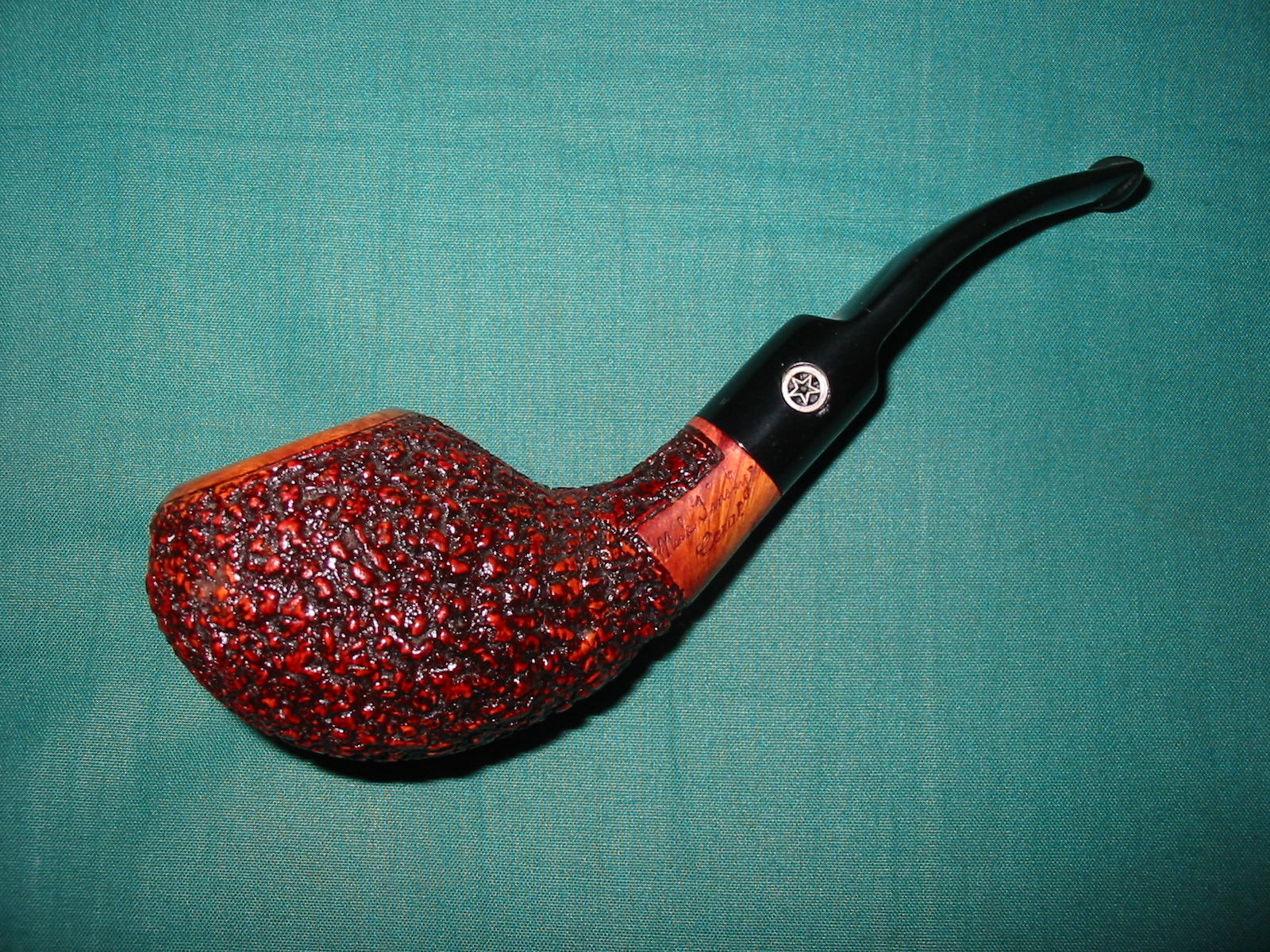
The final Coral finish pipe is kind of a tadpole shaped pipe. It has the same stain combination on it as the first Coral Christmas 2005 pipe. It is the only pipe of Mark’s that I have that I have yet to smoke. I am not sure why but it sits in my pipe cupboard waiting for the right moment. It is stamped Mark Tinsky in script over Coral over American in an oval. It also bears a 5 in a circle for it size. It is quite a large pipe. The rim is smooth and crowned and there is a smooth band around the end of the shank and patch on the underside of the shank for the stamping. The stem bears the metal star in a circle inlay but it is slightly different from my other Tinsky’s in that the star is pewter coloured rather than the brass that is characteristic of the others.
IMG_5587

IMG_5588
The final pipe in the group photo above is the only Black and Tan finished pipe that I have of Mark’s. It has almost a Danish flair to the Rhodesian shape. The crowned bowl top is set apart by two concentric rings and the finish is a tan smooth. The rim is slightly rounded. There is also a thin smooth band around the shank end and a smooth plate on the bottom of the shank. It is stamped American in an oval over Black & Tan over Christmas 2000. The stem has the characteristic brass star in a circle inset.
IMG_5589

IMG_5590
The third group of pipes in my Tinsky collection is the Sandblast finished pipes. I have three Sandblasts. The first of these is probably my favourite Tinsky. I have carried it around the world with me on various trips. It has been smoked quite globally in all of my travels. It is a custom-made pipe that I bought as an estate from Mike Glukler of Briar Blues. It is a bent apple of sorts with a vulcanite ring on the end of the shank. The stem is a faux stick bit with a saddle. The grain on this one must have been a flame grain and the blast flares up evenly from birdseye on the bottom of the bowl. The rim is smooth as is a band around the end of the shank and a panel on the bottom of the shank for the stamping. It looks to me like Mark used a fine rustication pattern around the band and the panel to give it a more defined shape. It is stamped American in an oval over the Mark Tinsky signature over Blast with a 4 in a circle. Each line of the stamping is separated by a finely cut rustication. The stem does not have the typical star inlay as there is not a surface that would hold it.
IMG_5591

IMG_5592
The second Blast is a thin shank apple or ball. It has a deeper more craggy blast than the previous pipe. It is smaller in terms of the bowl and size though it is still a group 4 bearing the 4 in a circle stamping. The rest of the stamping reads Mark Tinsky in script over Tan Blast on the side of the smooth patch on the left side of the shank. On the underside of the shank it is stamped American in an oval over 4 in a circle. The bowl ascends to the rim leaving a thin rim that is also blasted. There is a smooth band around the end of the shank and a smooth patch that runs up both sides and on the underside of the shank. The stem bears the customary brass star in a circle inlay.
IMG_5593

IMG_5595
The third Blast is a Rhodesian that I also really like as it has become almost a signature shape for me. It is a thick shank Rhodesian with a dark and medium brown stain over the blast. The darker brown has settled into the grooves of the blast and the medium brown on the high parts of the blast. The majority of the bowl is covered with a blasted birdseye that is really interesting. There are a few spots where there are small portions of flame grain. The fascinating part of this blast is that you can also see the rings of grain under the top blast. It is a beautiful pipe. The twin concentric rings setting apart the crown on the bowl were cut before the blast and the centre between the rings also shows the blast well. The stamping on this one is on the smooth patch that runs up the sides and underside of the shank. It is stamped Mark Tinsky in script on the left side of the shank and on the underside it is stamped American over /6 in an oval over Blast and 5 in a circle.
IMG_5597

IMG_5598
The last two pipes in my Tinsky collection have smooth finishes. The first is a beautiful pipe that is by far the largest of my Tinsky pipes. I was gifted this by a good friend one evening while we were at his apartment in downtown Vancouver enjoying a fine cup of tea and smoking aged tobaccos together on his 7th floor balcony. It has some stunning straight grain all around the bowl and birdseye on the underside of the bowl and the shank. The medium brown stain really sets off the grain. The shape is a thick shank brandy. It is stamped on the left side of the shank with the Mark Tinsky signature. On the underside it is stamped with American 2/ in an oval over Sunrise over a 6 in a circle and a single five point star.
IMG_5599

IMG_5608
The second smooth finished pipe is an older Liverpool shape. I picked this one up on EBay for an amazingly low price as it did not have a stem on it. The bowl was in good shape but the finish was shot. It looked like it was not worth buying from the photos that the seller included in the advert. Because of that I got it for cheap. When it arrived I reamed and cleaned it. I polished the bowl and then called Mark to see if he would be willing to restem it for me. He agreed and I sent off for restemming. I expected Mark to use a current stem and brass star in a circle logo inset on the new stem but he did not. When it returned it had the appropriate aged inset of a star in a briar ring inset in acrylic. The difference between this inlay and my other early Tinsky is that the star inside the acrylic is brass in colour rather than white. The pipe is stamped on the underside of the shank American in an oval over Reg. No. over 7/93 – MT thus dating the pipe to July of 1993. The MT stamping differentiates it from the pipes made by Curt Rollar in that period which bore the stamping CR after the date stamp.
IMG_5603

IMG_5606
Looking over my collection of Tinsky pipes this afternoon I have been struck yet again by their beauty and by the good quality work that Mark does in his pipe making. My pipes cover a time period of thirty years and the quality remains impeccable. The finishes remain constant. The Coral finishes of the early years are almost identical to those of the more modern era pipes that I have. The sandblasts are consistently the same and the Black & Tans remain constant. The smooth finished pipes are consistent from the early 90’s pipe I have to the more modern 2000’s era Sunrise. I am impressed by that fact. It is not often that in the evolution of a craft that the craftsman maintains his signature finishes even as he progresses in his skill. Thank you Mark for creating these fine pipes that I have taken great pleasure in owning and smoking. I look forward to adding more to my collection.

A Review – A Commission for a Briar Sweat & Tears Rhodesian


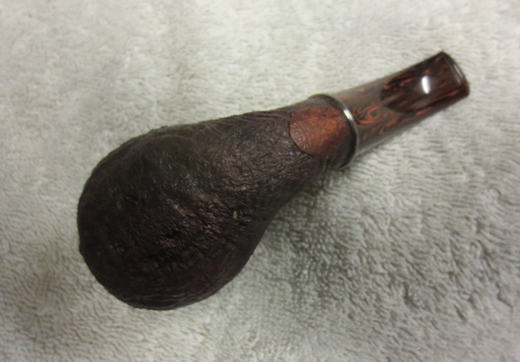
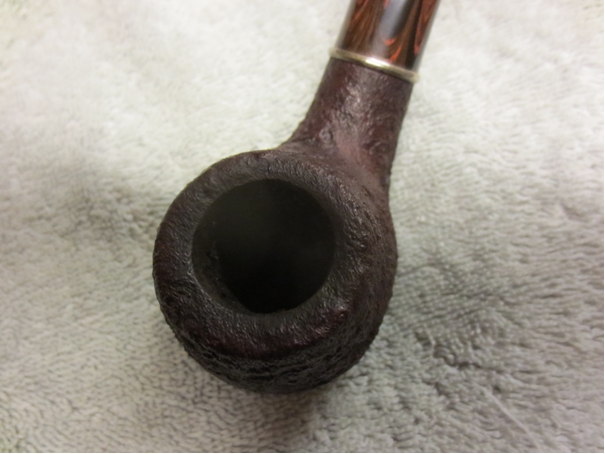
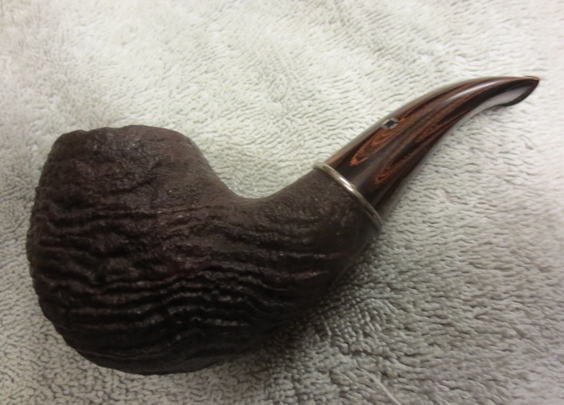
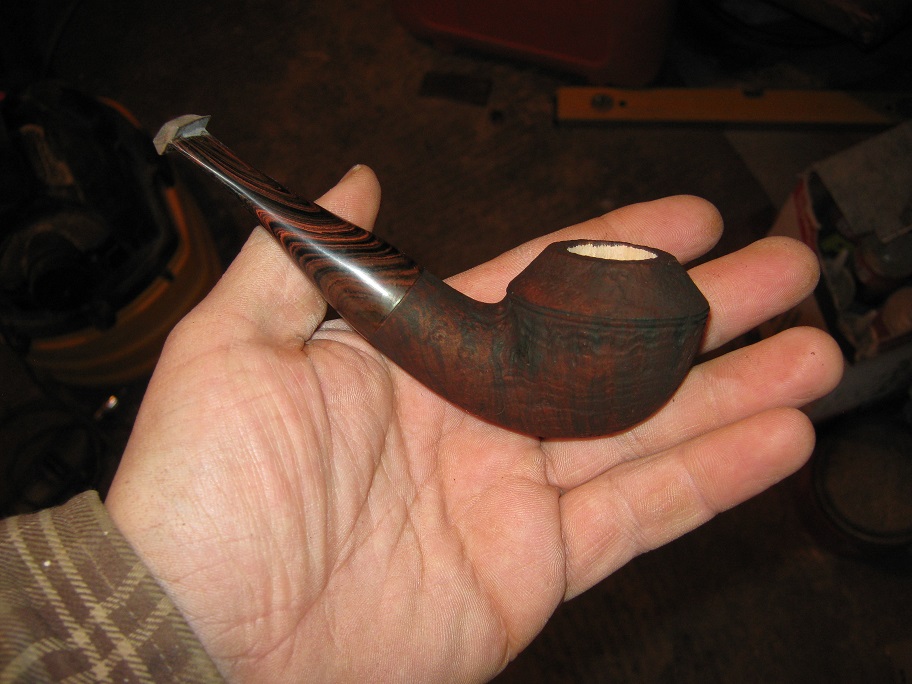
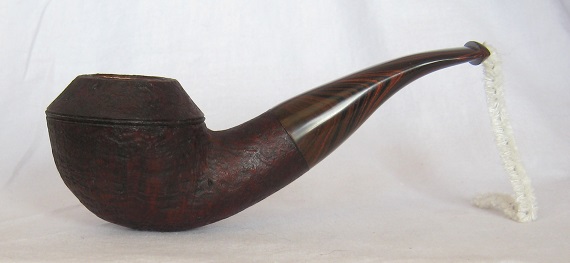
I spoke with Todd Bannard of Briar Sweat and Tears last fall when I visited his shop about the possibility of him crafting a pipe for me. We talked in generalities with no particular focus in mind other than that I wanted a chubby apple or Rhodesian shaped pipe with a Cumberland stem. As I looked at the pipes he had on his table I really liked the sandblast finish that he was doing on those pipes so I decided that it would be sandblasted.Later in the fall I was gifted some birthday cash and also knew that some Christmas cash was coming so I called Todd and the process began. Through our emails back and forth we came to the conclusion that the shape would be his take on a Comoy’s 499 – a chubby shanked Rhodesian. With that shape in mind and the Cumberland stem I left it to his discretion regarding stain colours and the details. I was excited to see what he would come up with. There is something about having been in a pipe maker’s shop and seeing his tools and craftsmanship firsthand that gives another dimension to process of a commission that is not present through phone and emails conversations.I thoroughly enjoyed working with Todd on this pipe.

Those of you who have commissioned a pipe before will understand the excitement I had when I turned on the computer and found I had received an email from Todd regarding the pipe. When I saw the title and return I thought maybe it was more details regarding the pipe he was working on. But it was more than just details. It was a quick note about where he was at with the pipe and a photo of my pipe! I was thrilled with the look of the pipe at this stage. I have included that photo as a bit of a teaser to give you an idea of what it looked like at this stage in the process. The shape was perfect – it was exactly what I had wanted. The stain contrast was also very nice to my eye. The chunky shank and stem were also on target. And truly what can I say about the horizontal striations on the Cumberland stem. Wow. He still had work to do but wanted me to have an idea of what was coming.
Sasquatch1

With the arrival of that photo my impatience grew. I did not bug Todd because I hate having that done to me but I could not wait. Not long after the first photo another email arrived with the photo below of the finished pipe. We emailed back and forth a bit about it and I asked if he could do a bit more of a bend in the stem. Otherwise it was perfect.
Sasquatch2

He bent the stem slightly as I had asked and then later sent me the next photo of the pipe.
Sasquatch3

I answered Todd’s email and told him the pipe looked perfect except for the fact that it was not in my hands yet ;). The only thing that would have been better in this deal in my mind would have been for me to have been closer to the shop so that I could have driven over and picked it up. But such as it was I would have to wait for it to be shipped. I paid the bill and Todd packed it up and sent it to me via Canada Post. He packed a couple of samples of tobacco with the pipe so that when it arrived I would have something new to try out.

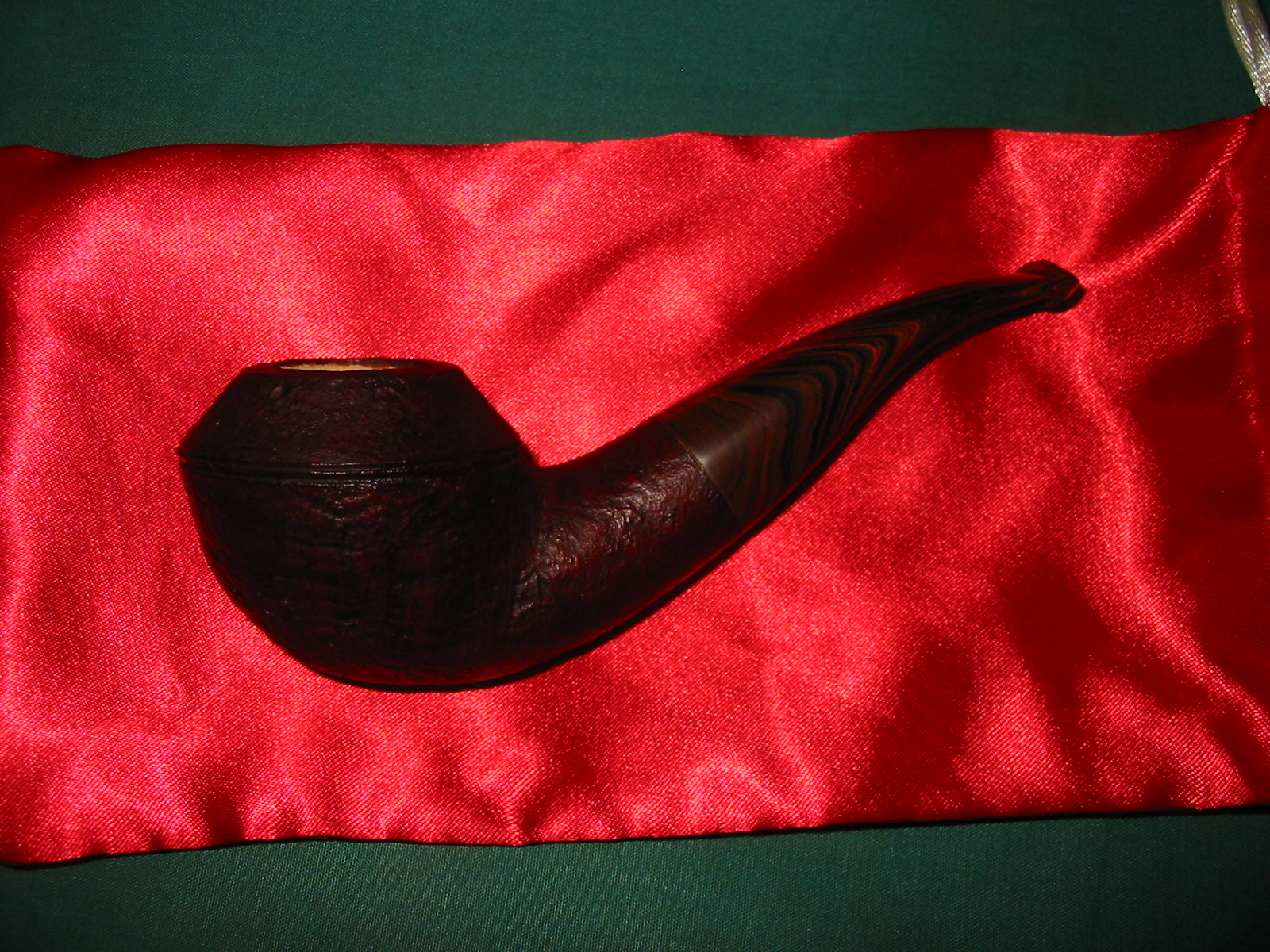
It did not take long before it arrived. I came home from work one afternoon to find the box sitting on my dining room table with a lot of other uninteresting mail. I opened the box, pushed aside the packing material and took out the two samples of tobacco. There, in the middle of the material sat a bright red pipe sock. It was here. I took the sock out of the box, opened it and took out my new pipe. My daughters laughed at my excitement. I was like a kid opening a present that held the gift he was waiting for inside of the wrappings. Once it was out I turned it over and over in my hands taking in its beauty. It was exactly as I had imagined it as Todd and I had talked about it. He had captured it well. I had to take a photo of it as it looked it when it arrived. The red of the pipe bag picked up the red in the stain on the pipe.
IMG_4176

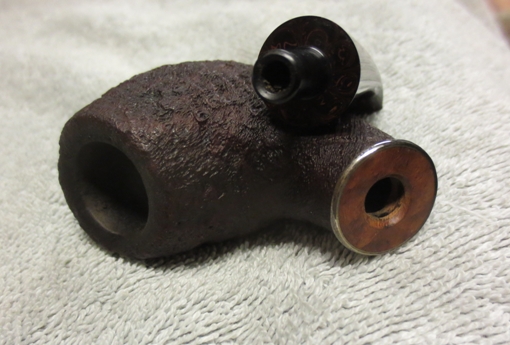
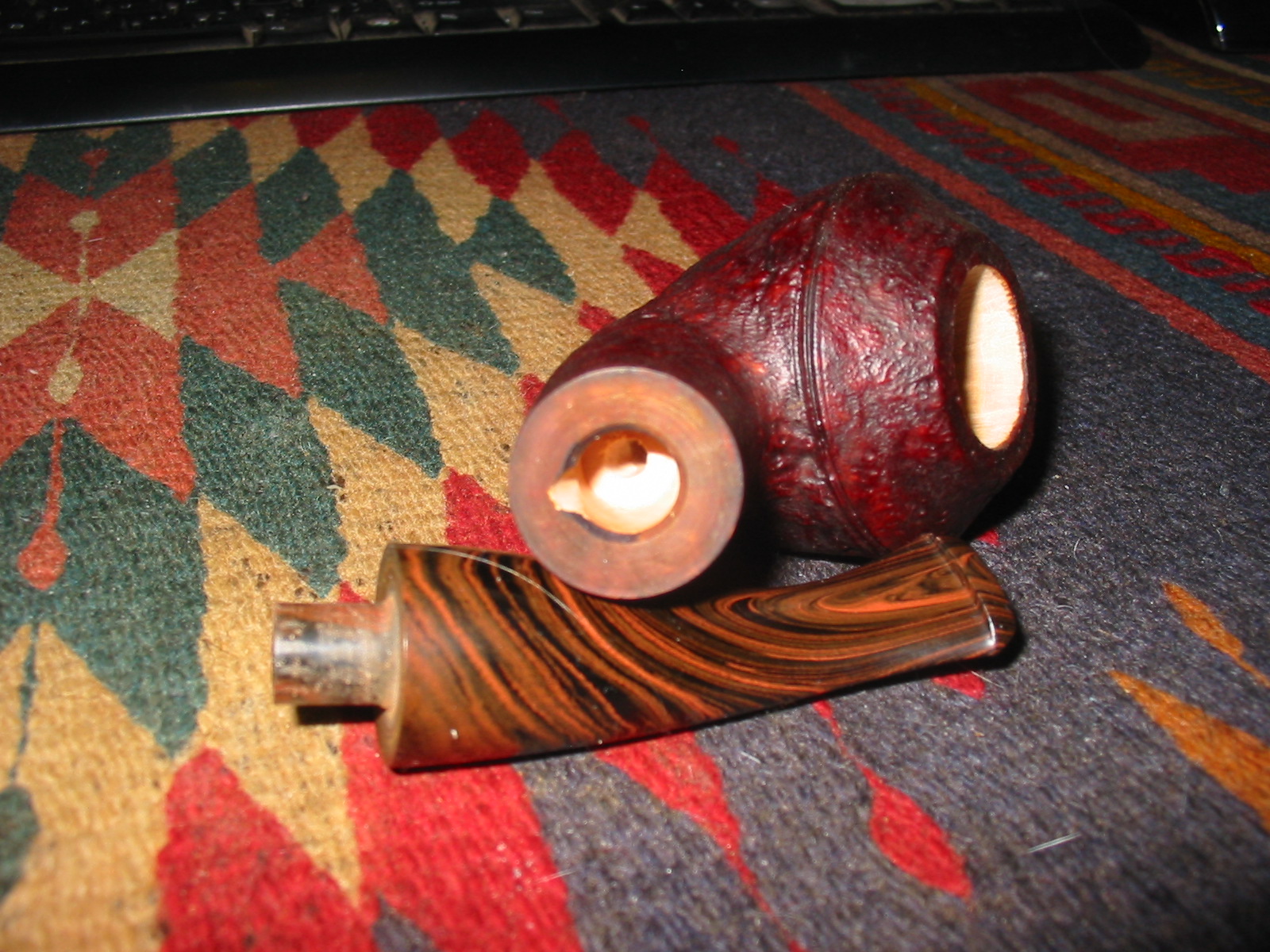
I took the pipe apart, because it is my nature to see how things are made. The drilling was perfect and the stem airway lined up perfectly with the opening in the end of the mortise. The slight divot on the bottom of the mortise is from the drilling of the airway into the bowl. That drilling is a straight shot that comes out in the center of the back wall at the bottom of the bowl. I noticed that Todd had funneled the end of the tenon for good airflow. The tenon was very short – something I had not seen before on a handmade pipe. There was plenty of length for a good seat in the mortise as it too was also drilled more shallowly than I had seen. The fit against the end of the mortise was snug with no gap between the tenon end and the end of the mortise. Nicely done Todd. The drilling in the stem was clean and smooth. There were no rough edges in the tenon or stem. The tenon is an integral part of the Cumberland stem and not a Delrin tenon. The button was just the right thickness for me as I like it with a slight shelf to hold behind my teeth but not too thick. The slot was well made and a flattened oval at the end of a flared airway – thus keeping the airway consistent diameter from the bottom of the bowl to the end of the slot. The draught was easy and quiet. To pull air through the stem was effortless. This always bodes well for a new pipe.
IMG_4402

IMG_4403

I wrote Todd and asked about the short tenon and mortise and received this reply:“A short, fat (3/8″ rather than 1/4 or 5/16″) tenon allows a guy to have the same surface area for the mortise tenon fit (so the same “stiffness” of fit) but allows you to drill the airway dead center in the mortise (you can tip the drill more than if the mortise is an inch deep). So the integrity of the airway is not compromised, the pipe passes a cleaner, etc.” Interesting concept and one that seems to work well on this pipe.

I took the pipe to the worktable to look it over and just enjoy the craftsmanship before I loaded it up to smoke the inaugural bowl. I have to tell you the shape and finish went beyond what I had in mind when Todd and I talked about it. It is beautiful. The length of the pipe is 5 1/8 inches and the bowl height is 1 3/4 inches. The bowl diameter is 1 3/4 inches. The chamber diameter is 3/4 inches and depth is 1 1/2 inches. The lay of the shape to the grain is superb. The blast reveals that the grain on the sides of the bowl are nearly identical and the birdseye grain on the top and bottom of the bowl and shank are very nice. Todd did a shallow blast that revealed some of the intricacies of the briar but did not make the blast craggy or deep. The parallel rings around the cap on the Rhodesian are nicely done and close enough together to give the cap a classic look. The angle of the cap is perfect in my mind and captures the Comoy’s shape nicely.It looks to me that he used a dark brown stain on the undercoat to sit deep in the nooks and crannies of the blast and then an oxblood stain to cover that and give the pipe a warm hue.Whatever the combination, in real life it is a perfect match to the colours in the Cumberland stem as shown in the photo below.
IMG_4175

Earlier last year Todd cut a Cumberland stem for me from some material he had in the shop that had a horizontal flow to the Cumberland. I really liked the look of the stem then and asked him to use the same material here. Todd stained the pipe to match the colour of the stem. The overall flow of the bowl and shank is brilliant and the colours are beautifully matched from rim to the end of the shank. It has a gentle taper,both on the sides and the top and bottom, from the shank to the button. It has a slight bend to it that gives it a stylized look. Todd did a great job shaping the stem and capturing a shape that really works with this pipe. The stem is nicely finished with no marks or scratches in the Cumberland. The tenon is integrated with the stem and cut into the Cumberland. The fit in the mortise and against the shank is snug. He countersunk the end of the mortise to make for a snug fit of the stem to the shank. The end of the tenon is funneled slightly for a smooth transition from the mortise when it is in place.
IMG_4174

The overall construction of this pipe is very well done. It is light in the hand and in the mouth. It is well balanced and has a shape that fits well in my hand. There was one slight detail in the blast of the pipe that bothered me but it in no way affects its smoking ability. It was truly cosmetic in nature. It involved the shank/stem junction. When it first came it appeared that the stem diameter was bigger than that of the shank on the left side. It seemed that the stem was larger. It bugged me and my daughter who knows her father well suggested that I measure the diameter of both as it probably was an Illusion. I did that and upon closer inspection I found that there was a slight ridge on the shank itself and Todd had matched the stem to the ridge. I decided to fire him an email and ask him about it. I wrote this to him:“The stem fits very well against the shank – no light! Cool. When I first looked at it, it seemed like the left side of the stem was a bit larger in diameter as was the top of it… then when I took it off I found that there was a slight ridge in the briar from the blast and went aha!! How do you do the blast on the shank?”

Todd wrote back and replied: “The blast, going right to the stem, is something that I’m trying to work out, rather than have a band of smooth wood and then a “cutaway” where the blast starts. I’ve been told to “fake” the blast and sort of rusticate that part, but I think what I did worked pretty good, not perfect but next time! As for the rings, I taped them off, blasted the top, taped that off and blasted the bottom. I can’t stand fudgy blast work, and I’ll sacrifice depth of blast to keep the integrity of the shape. I have a Castello with a lovely blast but it’s just a molten lump of no real shape because of what they did to it.” Once I had done the work and received Todd’s response that solved the question for me.
IMG_4172

IMG_4173

For its inaugural smoke I loaded a bowl of McClelland’s Blue Mountain. I am not sure if I will make it a Virginia or an English tobacco pipe but for this smoke I chose this blend. I went for a walk along the river near my work and enjoyed a rare sunny day in Vancouver. The pipe draws well; lighting was not a problem and it delivered a smooth dry smoke. When I emptied the bowl the briar had coloured inside but not burned! That is always a fear of mine in breaking in a new pipe. I enjoyed the day and the dry cool smoke and I watched the ducks on the water. It seems like this pipe will take very little time to break it in as it already delivers an effortless smoke.

Thanks Todd for delivering a well-made pipe at a great price. It was great to work with you on the commission and I enjoyed the communication during the process. I am looking forward to this pipe being one of my favourites in the years ahead.It is certainly made to outlive me! If you have not tried one of Todd’s pipes they are worth purchasing. He makes a great pipe and is a pleasure to work with. Check out his work on his website http://briarsweatandtears.com/ If you don’t see something you like send him an email or give him a call. He can certainly carve a pipe for you that will exceed what you have in mind. You cannot go wrong with a Briar Sweat and Tears Handmade Pipe.

A Review – Michael Parks Pencil Shank Cutty


I have had this pipe around for a while now, in fact long enough that I don’t remember when I bought it. I believe I purchased it from another member on Smoker’s Forums a few years ago. After reading about the Vancouver Pipe Club Christmas Party which featured Michael as the guest speaker I decided to take this pipe out of the cupboard for a smoke. I am not sure why but I have often forgotten I had it there. It has just escaped my notice. I remember smoking it quite a bit when I got it but have not picked it up for a long time. I do remember that it delivers a good cool smoke and that I used it for English and Balkan blends.
IMG_3073

It truly is a beautiful and delicate feeling pipe. It is very different from most of the other pipes in my collection. Many of them are fat and stubby with thick shanks and Rhodesian or billiard bowls. This one is nothing like those. The finish is a striated rustication that follows around the bowl and down the shank to the stem. It is stained with an oxblood coloured aniline stain that really sets of the pipe and matches the Cumberland stem very well. The shank is the delicate part of the pipe – it is a pencil shank that extends with a very gentle taper from the bowl to the stem. The rim is smooth as is a small oval on the bottom of the shank that sports the stamping PARKS over 1. While the pipe is delicate looking it is a fairly large pipe. Its length is 6 inches from the tip of the bowl to the end of the button. The height of the bowl is 1 ¾ inches and the diameter of the bowl is 1 3/8 inches. The tobacco chamber’s diameter ¾ inches and the bowl depth is 1 1/8 inches.
IMG_3074

The stem is hand cut from Cumberland rod stock and the fit to the shank is impeccable. The red lines in the Cumberland match the colour of the stain of the pipe perfectly. The stem tapers from the junction at the shank to a thin comfortable bit at the end. The button is thin and comfortable and the oval slot in the end of the stem. Michael’s finish on the stem is like glass. My photos do not do the fine craftsmanship of the stem proper justice. It is very well done. The tenon is turned from the Cumberland and is a clean and tight fit to the shank. There is no funnel at the end of the tenon but it lines up precisely with the airway in the end of the mortise.
IMG_3076

The internal mechanics of this pipe are very well done. The airway enters the bowl at the bottom and is centered. The drilling the shank is straight and centered in the mortise. The inside of the shank is smooth and there is nothing to impede the airflow from the bowl to the stem. The drilling the stem is also clean and smooth. The slot is oval and funneled into the stem, flattening out the airway leaving it consistent from the tenon back to the slot. The bowl is drilled at the same angle as the slope of the bowl. The pipe came to me pre-smoked so I do not know if the bowl had any bowl coating when it was new. It does not appear to have had any.
IMG_3077

The pipe is very light – I do not have a scale so I am not certain of its weight. It is comfortable to hold in the hand and the mouth. The rustication gives it a very tactile feel as it heats up during a smoke. It delivers a flavourful and effortless smoke with a free and open draught just as I had remembered. When the pipe came to me it had been dedicated to English and Balkan blends and I have continued to use it for those blends. It is a great pipe that I will not let sit as long between the next smokes. Michael is a master at pipemaking and delivers a superior product in terms of fit and finish. Have a look at his website, http://www.parkspipes.com/ and I am sure you will enjoy the artful pipes that he has carved and continues to carve.

A Review – An Oliver Camphausen Paneled Horn


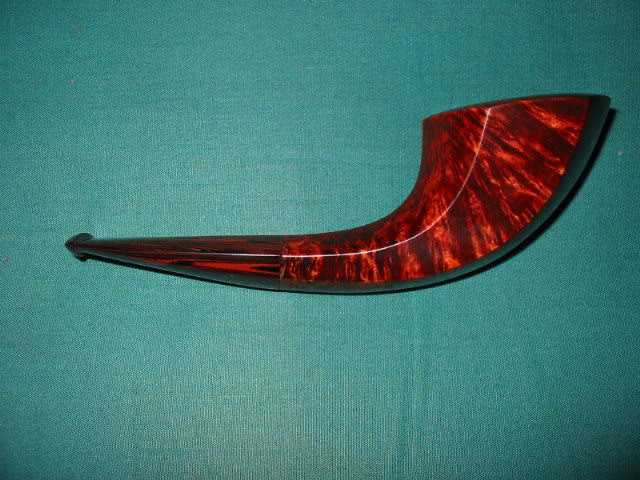
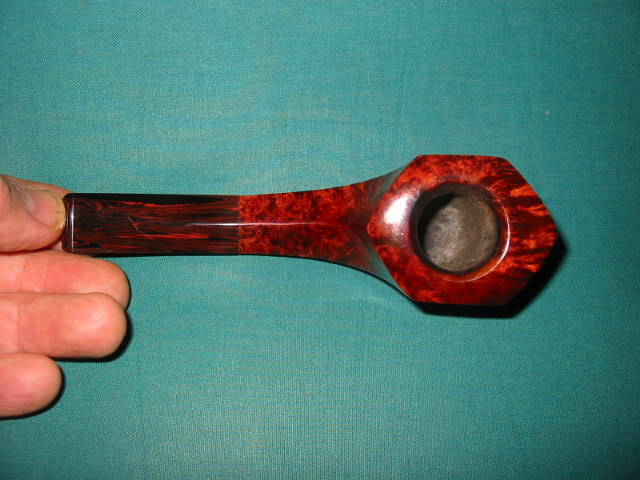
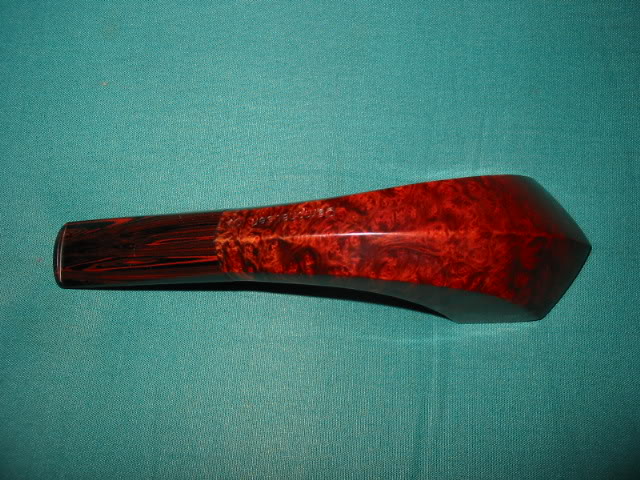
A while ago I worked a trade with a fellow pipe smoker on one of the online forums for this beautiful cross-grained horn-shaped pipe from German pipe maker Oliver Camphausen. I had heard of Oliver’s work but had not held one in my hands before. When I received the pictures of the pipe and the offer for a trade I was struck by the shape and the grain. Though I am not a big fan of horn-shaped pipes there was something about this beauty that just grabbed my attention. With little ado the deal was done and the pipe was on its way to Canada.

I did a bit more digging into information about the carver while I waited for the pipe to arrive. There were various European sites that listed a few of his pipes, there were several on EBay available from some of the high-end sellers but I could not find a web site on the carver. I found that. Oliver Camphausen is considered one of the bright new stars to emerge from Germany’s pipe carving scene. His work bears strong resemblance to that of Karl Joura, yet his designs are totally different. I also found out that Pipes and Tobaccos Magazine did a report on him in the Spring 2006 issue.

This particular pipe is gorgeous and gracefully shaped and displays a beautiful “sunburst” cross grain pattern that runs down the sides of the bowl and the shank. The symmetrical grain is terminated with a panel of dense birdseye grain that flows down the front panels and the top and bottom of the shank. It is very comfortable in the hand and the balance is about perfect.The overall length is 5 3/4″. The bowl height measures about 1 3/4″. The tobacco chamber is 7/8″ in diameter and an angled inner depth of 1”. To give an idea of the size I photographed it with a Group 3 sized billiard. The bowl height and the length of the pipe match the billiard very closely.
Camphausen1

The finish on the pipe is very well done. There is a dark understain, either black or dark brown that brings out the cross grain on the side panels and the rings of the birdseye on the front and the back panels. The red oxblood stain serves as a top coat and matches the red in the Cumberland stem. The finish is smooth and there are no sanding marks or scratches in the bowl. It is definitely well finished. The six sides of the panels line up very well and the slightly crowned top on the bowl gives fullness to the look of the rim and top. The curves and angles all are aligned and there is a flow and grace to the lines of the pipe. The inner edge of the rim is chamfered inward and stained to give a finished look to the top of the pipe. The end of the shank is countersunk to give a tight fit for the stem against the shank.
Camphausen2

The stem is hand carved out of Cumberland and matches the colour of the stain well. The stem is six-sided to match the panels on the bowl at the shank end and then all panels blend into a taper from the middle of the stem back to the button. The tenon is Delrin and is perfectly installed into the stem. The tenon fits perfectly against the end of the stem. The tenon is countersunk on the end to give a funneled end where it sits in the mortise. The inside of the stem is smooth with no roughness in the transition between the Delrin tenon insert and the Cumberland stem. Shining a light down the airway in the stem shows a smooth shiny surface with nothing to impede the airflow in the stem.The finish on the Cumberland is glass like and smooth. The fit against the shank is tight three-quarters of the way around the pipe. There is a slight gap on the right side where it does not sit tightly and light can be seen when it is held up to the light. It is not too problematic in that it is only visible against the light.
Camphausen3

The mechanics are excellent. The airway in the shank is centered in the end of the mortise and the tenon sits neatly against the end of the mortise. The curve of pipe made drilling a straight airway a slight challenge. There is a small divot out of the bottom of shank end of the mortise that allowed for a straight shot to the bowl. The end of the airway where it enters the bowl is slightly opened and flared give a smooth transition for the smoke to travel to the mouthpiece. The inside of the mortise and airway is also smooth with no roughness. There is nothing in the airway of the pipe from stem to bowl that would cause impedance in air flow. A fluffy pipe cleaner easily slides the length of the pipe with no snags along the way.
Camphausen4

The pipe came to me pre-smoked so there was no need to break it in as a new pipe. There was already a light cake forming on the walls of the bowl. From what I can see there was no bowl coating used on the inside of the bowl. The cake is hard and smooth on the walls. The previous pipeman smoked English/Balkan tobaccos in the pipe so I have continued that tradition with some aged Rattrays Red Raparee that I have. It smokes very well and is truly an effortless smoke. I was concerned that the walls of the bowl toward the bottom might heat up during smoking as they are not as thick as the upper portion of the bowl. However, I have smoked it for quite a while and the heat is not an issue. The bowl is warm to the touch but never hot.

I am well pleased to have one of Oliver’s pipes in my collection. It is a good smoking pipe and certainly one that is well finished. It remains a pipe that I pick up again and again and turn over in my hands to enjoy the grain – both cross grain and birdseye. The beauty of the colours and subtle shifts in the way the light dances off the grain make it ever-changing and delightful to me. I would gladly purchase another one of Oliver’s pipes should one come by that catches my eye. If you have not had the opportunity to try one I would encourage you to find one and give his work a try. I don’t think you will be disappointed.
Camphausen5