Category Archives: Pipe Related Essays

Short and not so short essays on pipes and tobacciana

Wow! – How Sublime


Blog by Norman Skiba

In a way, this is a tale of 2 pipes.  A somewhat synchronous event possibly.  At the outset, I must say that this is based on my experiences, observations, and opinions.  Others will have theirs.  I am a huge Preben Holm fan.  Period.  I have owned more of his pipes than any other pipe maker.  I also have had a number of Celius and P. Holtorp fan pipes – also from the Danish School.  To me, there is just something about the old briar that Preben used that offers this warmth and taste that so many other pipe makers cannot come close to.  What kind of briar and the age of what he used I have no clue, and maybe his old workers and Poul Winslow may know.  But to me, there is just something about that ‘gestalt’ if you may, that just makes it for me.  I also love meerschaums and have had a number of nice meers over the decades.  It turns out that I now own 2 briars and 3 meers  – nowhere near as extensive as in the past, but just a perfect number for my later years’ needs.  I now have more meers than briars.  I love meerschaums more now than ever before, but I love the briars too, so I am not exclusive.  I sincerely believe that they both have a ‘warmth’ in their own unique way – and I do not mean ‘heat’ – I mean a personal, almost friendly or intimate sort of dimension to their smoking Quality.  Some pipes have that Quality and others do not.  That is a main characteristic, to me, of a great smoking pipe and experience.

Yesterday morning I had 2 bowls in a new estate Preben Holm that is ghosted with possibly a Virginia of some sort.  Nothing I would smoke and there is a taste I am not into, so I wanted to smoke a couple more bowls to try to get that taste out of it.  I think maybe another 20 bowls of a heavy Latakia blend and that will start to evolve to what I like.  I tend to smoke more meers than the Preben, and they too are new pipes, so that is the reason I am still working on that extra taste in the pipe.  Well despite a bit of that extra taste from a previous owner and tobacco – I had 2 really nice bowls in that Preben and the smoke was great – it smoked nicely and the taste generally was nice.  No re-lights and just a smooth smoke.  2 bowls back-to-back was an extremely pleasurable experience.  I then proceeded (after about a 10 minute break to swap out the pipes and make another pot of coffee) to smoke 2 bowls in a new meerschaum Bacchus that I have smoked more than the Preben.  So it is going through the ritual christening, if you may.  It has been smoking quite nicely and sometimes really nicely.  However; today, both bowls were just wondrous!  What a smoke!  What a taste and aroma.  An interesting note was that I did notice that I got more taste and more aroma that was more true to the tobacco when I smoked the meer right after the briar than what the briar had to offer.  And as I just stated, the smokes out of the 2 bowls of the briar were also wonderful.  Just different in many ways.  Getting back to the meer – the experience was so beautiful that it was hard to believe that 2 different pipes – 4 bowls – back-to-back – and they were all wondrous!  What are the chances?  The 2nd bowl also had another rather unique experience: toward what was normally the end of the bowl – it just kept smoking and smoking and smoking.  I thought – man this should have finished a while ago – when will it be done?  (Not that I wanted it to end; one just kind of knows the bowl and the length of a pipe and tobacco.)  Anyway, this just seemed like the never-ending bowl.  I got easily an extra 20′ smoke on that 2nd bowl of the meer.  Again, as in the briars, no re-lights were needed.  The experience I had yesterday morning was just so magical I was in awe of the experience.  Maybe unconsciously I was transported to the magical world of The Shire and puffing on Longbottom Leaf or Old Tobey of the Southfarthing.  How Sublime Indeed!

Meerschaum Care and Cleaning


Blog by Fred Bass

This article is a combination of various posts and emails that Fred wrote on the topic. He combined them into this piece and sent it to me for safe keeping. With his death I think it is important to make this articles available to the community. — Steve

For me, I believe that Steve has hit upon the root of the issue in regards to an earthy taste. To deliver a smoke’s full potential, a clean pipe is best. Before I smoke a new Meerschaum, I clean it with Everclear, a shank brush and pipe cleaners. There will be a lot of dust in the pipe from the milling of both the block and the bit, if it is hand cut. The first few smokes will burn off the wax. Many find this brief period not to their liking. This same event occurs after a pipe has been rewaxed. I guess I’ve done it so many times that it no longer bothers me.

The next part to this issue is to follow up every smoke with the proper cleaning. By doing this, I have no need to dedicate a pipe to a blend as I experience little to no taste carry over. It is best to be diligent in preventing any cake build up. A sharp, blunt tipped knife is best used to scrape this off. This is just the opposite of Briar pipes, where cake build up is good. The problem is that Meerschaums will develop a black tar like plaque that can impart a bitter taste to the smoke. There is much difference of opinion on the points I’ve touched on. I can only speak to what works for me. My observations suggest that by keeping the Meer clean, you stand a better chance of having the by products of combustion contribute to the coloring that many Pipesters seek with their Meers. When I reclaim an estate Meer that has been abused, it takes several cleanings between smokes for the pipe to flush itself and finally deliver the best smoking experience. The pipe is a filter. Like any other filter, it can become saturated and not be able to function effectively.

Again, I do not consider myself an authority on Meerschaum pipes. I’m as much a student as the next… All I can offer are my own observations and experiences. To this end, I hope that this helps other Pipesters, so that some benefit may be gained.

Back in my undergraduate days, I saw a pipe in the window of a luggage shop that I just could not get out of my mind. It was an Andreas Bauer from Turkey, after A. Koncak acquired the trademark. It was a simple Smooth Bent Paneled Block Meerschaum that had the lines of the paneled bowl continue into the Amberite plastic bit. It was the first pipe I’d seen with the Delrin mortise-tenon push/pull joint and came in it’s own fitted leather case. Before this my only other Meer had come in a cardboard box. This was no holds barred PAD, so I saved up my $40.00 and caved in.

Things soon started to go wrong. I dropped it. This resulted in a few nicks in the block’s surface, which I thought as obvious as a train wreck, but others did not seem to notice. Not having much experience with Meerschaum, I proceeded to char the rim to where it might seem that a booster rocket had been used to light it. Down at the local pub, things got spilled on it and it seemed like every drunk that came in just had to pick it up when I had it resting in it’s case. Matters got so bad that I became ashamed of how the pipe looked, so I put it in a drawer for many years.

A couple of years ago, I decided that I would put the lessons I’d learned to good use with the resurrection of this pipe. It has been a slow process, involving much Everclear, a shank brush, more than a few pipe cleaners and the patience to repeat the process until the old ghost of blends I’d just as soon forget were exorcised. This did not help the finish nearly as much as the pipe’s smoke. Today, for the second and hopefully the last time, I took the block to task with 600 grit wet sanding in Everclear followed by a rewaxing using Halcyon II. It is starting to look passable. It will never return to it’s original state but it is no longer a pipe I keep in a drawer. With enough time and determination, even an abused pipe can regain some of it’s radiance. Just don’t beat it up too bad.

It is very interesting to read about the use of Murphys oil soap in restoration of a Meerschaum. One of the things I enjoy about pipesters is the ingenuity and diversity of problem solving methods. I guess that my approach is more of an ‘old school’ technique… I use Everclear for both routine maintenance & cleaning. In restoration, I’ve experienced positive results using it on the exterior surfaces. Where serious abuse has left a Meer with rim burn and other finish problems, Everclear used with fine grit wet/dry sandpaper will get results. Even if it looks as though Grandad used a space shuttle liftoff to light up with, with a little time it will resolve. After the cleaning, I’ll use Halcyon II. It does not have the durability of Bee’s Wax but is much easier to buff, so I will do my maintenance in a more timely way. For cake buildup, I use a sharp, blunt tipped knife and scrape it down to the stone surface. For restoration, the use of Everclear, a shank brush and lots of pipe cleaners will help flush the pipe. It may take 6 to 12 cleanings after every smoke to help the Meer unload old ghosts, but it will happen. Restoration of estate Meers is more of a labor of love than anything else. It takes time and effort. In addition to the use of paper shims to correct an overturned bit, I’ve used clear finger nail polish with good results. Some of my older Meers have a Kaywoodie type metal screw joint. A sparing application of clear nail polish, left to dry for a couple of days with the bit in the desired rotation will form a temporary bond that will last for awhile before becoming necessary to repeat. I hope these observations serve to provide good information to pipesters.

These paragraphs offer information on this topic of care and is by no means exhaustive. As we evolve, so does our knowledge & while some things we do remain the same, some things will change. There is plenty of room here for diversity, and it is welcome.


Briars vs. Meerschaum:  Right Brain – Left Brain – I Choose the Middle Way!


Blog by Norman Skiba

I have seen this discussion and argument in the past and even in the present on various pipe smoking forums.  New threads, old threads – they are all the same.  Personally I am kind of bored with the various arguments.  I have smoked both briar and meerschaum’s pretty much from the start.  In the 60’s and 70’s there was a lot of myth about pipes, briars, tobacco, and meers.  And there still is a whole lot of myths about these various things.  Many people that contributed to this plethora of facts, and opinions, and just downright incorrect information were either ignorant of the information, ego-driven to show their pedanticism, opinionated with an enough-to-be-dangerous knowledge, and people that in this case never smoked either briars or meerschaums, or smoked briars or meerschaums that were of decent smoking Quality to even begin to make a comparison as to the briar or meerschaum discussion at a credible level of discourse.  The creation of myths and biases still continue to this very day.

As stated earlier, I have been fortunate to have smoked both briars and meerschaums pretty much from the beginning of my pipesmoking journey.  Most people, if not all of the people around me were briar smokers and briar master pipe makers.  Most probably never smoked or owned a meer, and if they did, they never smoked it enough to make an educated opinion – just an opinion.  A lot of the myths and information that I learned, and I bet, most people in similar situations have learned are biased and twisted information,  some true – some partially true, and some just off the wall in any sense of possible truth.  As neophytes – how do we know what is credible.  The blind leading the blind.

As an old guy who has been around this journey into pipes and tobacco, I have to say that I have worked hard and went broke to have 3 nice pipe collections in my life.  2 of the collections were extensive and the last in my close to the end of life is extremely modest, but exquisite.  The first 2 collections had both briars and meers, but the predominant pipes were briars. (The types and kinds of pipes are a whole ‘nother story that may be pursued in another little blurb.)  I have always loved the meers – for aesthetical reasons, smoking Qualities, and the artistic carving and coloring experience for example. (Just like the shape and finish and grain of briars) They were nice pipes and smoked wonderfully.  I did notice a difference, yet I could not at the time explain it as such.  Again being surrounded by briar people I may have had some slant on that – i.e. an opinion or observations of this briar vs. meerschaum dynamic of the smoking Qualities that they offered.  This last tiny collection is predominantly meerschaum at the moment – 4 meers and 2 briars (I may get 1 more briar in the future due to my love of pipes and the briar made by a deceased famous pipemaker.)  But that would still make:  meer 4 and briar 3.  I have understood late in life during my sannyasin period as espoused in Hinduism, that 5 pipes are nice – 6 – 7 OK – and No More.  Now you may ask – ‘Why do you go from 5 – 6 or 7 pipes?’  Due to my love of Latakia and a wife who has asthma – I am forced to have to smoke outside and when raining or cold/very cold in my cold small shed.  I need some briars to smoke in the freezing cold where meers are technically possible to crack or shatter so the need for an extra briar or two.  I must say that the briars that I do have are wonderful pipes and wonderful smokers so I love them and do smoke them in the summer too.  Even if I lived in Bali where the weather is pleasant all year, I still would own my briars.  I love wood and I love grain.  But I have fallen deeply, in my old age like never before, for the White Goddess!  I have always had, and smoked, and loved meers; so this is nothing new; however, the Passion is just so Intense at this stage I cannot explain.  The meers I am smoking more during the summer/warmer weather because I love smoking them, and not just because of the weather.  Today for example, I had 3 bowls in the morning in a meer and later on when I took a break after working all morning outside, I smoked an old relatively conservative Preben Holm.  It was wonderful.  There is a difference, in a sense, in the briar experience and meer.  I have struggled to define it for decades and I just cannot.  However, the difference is not ‘a one is good and the other bad’ sort of difference that one thinks exists.  Maybe the term is characteristic(s)?  Maybe it will always be elusive and not definable.  It is so abstract – yet one knows it when it is understood/experienced.  It may just not be graspable in an ideational way or in word play.  It just must be experienced and appreciated each for what they have to offer.

In a post I made on an old thread on a forum recently regarding the briar vs. meer argument (edited and expanded here):

I do say that the meers do smoke drier and cleaner in many respects. I have had some meers that were sweet as in smooth and easy to smoke and enjoy and a few that were maybe a bit brutal if that be the word. Some had a warmth and a dimensionality to the smoke and the taste. I have had some briars that were – yech!  I have also had some briars that have that warmth that I mentioned for the meers.  Again – maybe the meers take a few bowls of a tobacco when new to achieve a warmth that is inherent in it – the pipe itself.  Even briars need to be broken in as such.  Again, each pipe, whether briar or meer can be special or a loser. I find the more I smoke the meers and they develop and are good in their way – the warmth and the taste of the tobacco opens up and improves tremendously.  Funny – similar analogies to briars.  No real answers here, just observations.  It boils down to a good pipe is a good pipe and one that isn’t may not ever be!  Briar and meer!

I choose the Middle Way of Buddhism.  Briar AND Meer.  Enjoy!


Flow Dynamics in Meerschaum Coloring – A Theory


Blog by Fred Bass

Here is another reflective piece by Fred Bass that I had in the files saved on my computer. I think it is time to resurrect this discussion. Anyone with contributions, thoughts or comments please note them below… thanks. – Steve

I’ve been giving some thought to the issues of flow dynamics as they relate to Meerschaum coloring. With little else but the most rudimentary exposure to scientific thought on flow principles long ago, my grasp of this concept is weak. Still, it seems a topic of interest to both myself and others. I offer these thoughts in the hopes that others will take some interest. The combination of burning tobacco and beeswax cause Meerschaums to color over time. OK, so what’s going on? It seems that heat will cause the wax to migrate into the Block. Continued heating/cooling cycles will cause the wax to migrate in a progressive manner, but at some point, the wax evaporates. This process works like a wick to the by-products of tobacco combustion and draws them into the Block, where they accumulate, in a progressive result of color, that changes character over time. If I understand it, this is the process that results in the patina that Meerschaum smokers prize. Is this what’s going on? Do I have a cogent theory in this line of thought?

An interesting observation to add to this is that Meerschaums that have been smoked for long periods of time, without rewaxing, may not demonstrate a well developed patina. When such a Pipe is rewaxed, it will quickly display colors. Like all coloring in Meerschaums, the repetition of rewaxing in concert with smoking the Pipe, will eventually produce coloring that does not quickly fade.

I believe that I’ve addressed the path of wax dissipation. Continued heating/cooling cycles will cause the wax to migrate in a progressive manner, but at some point, the wax evaporates. This process may account for wax loss, but certainly some will also be lost to friction on the Pipe’s surface. I’ve not taken any additives that the Carver may choose to mix in with the wax or the porosity of the Block into account.

Smoke from the tobacco smoking is giving the brown color, that is certainly a factor. The heat and the moisture of the tobacco are also involved. The Pipe’s shank usually starts to color first, as it is the site of major condensation via cooling, of the tobacco being smoked.

I agree that the wax protects the outer surface of the Pipe, which is not to say that it doesn’t migrate into the Block. As I understand it, the Carver blocks off the Pipe’s draft & the bowl, so that the wax does not get into the Pipe, but this is done to avoid having the first few smokes taste like burning wax. I also agree with you about the wax not being the coloring agent for the Block, but instead, it serves to wick the by-products of the smoke along it’s migration routes. The point that has me stumped, is the quick color shown by waxing Pipes that have not been rewaxed, but have been smoked. This suggests that some part (or all) of the nicotine, tars & moisture are already in the Block from smoking, but do not display this coloring as fast, if left without rewaxing. Even if the wax’s role is to wick and protect, how does it contribute to the Pipe’s color. Your idea of the wax serving to seal the Block from loss of these smoke by-products may be a demonstration of this idea. It is an interesting puzzle.

I’ve been turning this bit of a puzzle over in my mind, as it seems that it will not let me rest. Perhaps the wax, the heat and the burning tobaccos also interact chemically. This would explain how rewaxing a Pipe, that has been smoked for a long period of time, will produce coloring with a rapid permanence more dramatically than a Pipe that has been smoked less that has been rewaxed. It is also quite possible that the Meerschaum itself plays a part in this chemical interaction. I suspect that this has all been thought of before, and tested by Carvers. Such knowledge would enable a Carver’s work to stand apart from the competition, and not likely to be widely known, as with anything in the Meerschaum trades. So much is lost to us in the guarded history of the Carver’s art. 😉

Why Do We…?


Blog by Norman Skiba

Norman is a new contributor to rebornpipes and I welcome him to the blog. He is a member of the Meerschaum group on Smokers Forum UK and trying to add fresh life to it since the death of Fred Bass. I have enjoyed our emails back and forth over the past week and when he sent this I thought it would be a great intro to him and a thought provoking piece of writing. Thanks Norman. – Steve

I have smoked a pipe for about 50 years now and have had a few hiatuses over this lengthy period. In addition, I have been fortunate to have had a rather extensive pipe collection over these years and various periods of my life. The collection transformed and morphed into a new set of pieces turning into a somewhat different collection over these many years, and which has morphed again. Basically – zero – to a small nice little handful of a collection, mostly meerschaum. I have always had and smoked meers and I find them fascinating and beautiful to see the exquisite carvings transform over time in their coloring and the actual smoking Quality – chronotransduction – change over time. I have spent a small fortune for briars and very fine briars and commissions. I am a huge old Danish fan, especially Preben Holm. Many of the pipes were gorgeous; however, a lot of them smoked great. Some smoked OK. Some were terrible – even the high end pipes and commissions. No offense to the fine pipe makers that made them; but some were a waste of money. I always kept that to myself and never hurt anyone’s feelings or reputation. I also bought a number of so-called ‘Estate’ pipes that were by major makers mostly Danish, that had issues with the smoke – could not get a pipe cleaner through it, and tons of gurgle. I realized ‘late’ that in most cases instead of someone chalking the pipe up to experience and maybe just trashing it or trying to get it properly fixed, they passed on the problem to someone else – me the sucker. I am not a neophyte, but these are chances one takes. Aesthetically, they were beautiful and unique in my eyes. The maker was reputable. But the pipe was what it was – sometimes wonderful and sometimes sour/bitter, and just plain funky.

I have spent decent money on meers too in the past and most were from reputable carvers. a few unknown, yet nice – carving and block and smoke. I was fortunate early on to have one briar master pipe maker and his son who had some nice meers at a reasonable price. Then, for me, it became harder to find. Most meers were bad block quality and the carvings nothing to write home about. Even after years – not knowing about certain carvers or especially the sellers – left me in a quandary about purchasing a nice pipe. I know people who deal on eBay and craigslist with stories about scams locally and within the U.S., let alone, other countries, and in this case Turkey. I also saw some of the prices that were more than I was used to paying for some nice meers long ago, and the combination of dynamics – price, seller, country, etc. made me wary about taking the chance. As I grew older I learned more and acquired more meers. I never could drop a huge sum on a nice meer that was high, high end; however I did try to find amazing carvings that spoke to me and that were more than I could afford. But recently I started asking myself – why do we spend so much on a briar pipe ,and some people I know spend 5x the amount for 1 pipe almost weekly, than I could on 1 pipe? Why did I not go the same route for meers and just know at the end of my life finally ‘Get It!’ The answers are varied, and factual/real, and also speculative. The answers themselves seem a bit amorphous even. I still have more questions than answers. I do find that few briar people do not want to try or never liked smoking a meerschaum because they too – did not get it. They never had a good pipe, or they never gave it a chance to achieve the warmth that a nice one offers after it is smoked for a bit. Initially the meer can seem cold and sterile and that initial dynamic makes people run to their briars. But once the White Goddess speaks to the Soul and the Being and the Spirit within- then one Gets It! But, Why Do We…?


Reflections on Turkish Block Acquisition


Blog by Fred Bass

The following was an article that Fred Bass sent me to hold in my files for him. The idea was that he was going to use it some time in the near future for a book he was working on Meerschaum pipes. Sadly that book was not completed to my understanding. It is an interesting short article that also became the base of a discussion on Smoker’s Forum All thing meerschaum group. RIP Fred, you are missed. Give the article a read!

February 1, 2009

This is about general considerations that have served me in decisions about purchases. It’s not an exhaustive guide, but more a line of thought brought by Buyer’s experience in the Meerschaum trades. I buy Pipes to smoke, so I don’t buy antiques.

I’ll start with new Turkish Block Pipes. Going from the starting point of looking at the works of favored Carvers, I’ll look at Pipes until one calls me. The best Carvers use the best block, which is the most important point of judging a Pipe’s quality. High grade Turkish Meerschaum is light in weight, is very porous, has no inclusions or deficits and has a pearl like translucent quality. It does not look like chalk. High grade Block will provide a cool and dry smoke, in addition to coloring well. Lesser grades will produce smoking experiences of less quality…, which is not to say that this is bad since a cheapie Meer will provide a better smoke than many other materials.

You are more likely to encounter Pressed Meerschaum (a composite of Meerschaum chips & epoxy) with No Name Meers and products of disreputable Carvers & Name Brands. High Grade Carver specific Pipes cost more, but you will have a Pipe that the Carver will take care of, should anything go wrong. This is an important consideration since Meerschaum is a product of nature and can possess flaws that become noticed only after the Pipe is smoked. These are Pipes that mean less to the Carver than the importance of his reputation, so you get a Pipe that is the best the Carver can produce. Bad news travels fast and reputation is everything in this cottage industry.

Other considerations, such as size, artistic merit and how well the Pipe fits into your world are worth consideration. The established Carvers will want premium price for their work, but there is never a question of quality. It’s a good idea to confirm that the picture you see is that of the Pipe that you want and whether a Case exists or is yet to be made. If the Pipe & Case are yet to be made, then determine how long it will take to be shipped to you. These same issues are best understood by both Buyer & Seller on commissioned Pipes as well. You can establish the quality of the Block and the color & material of the bit prior to payment.

When I’m evaluating a Pipe from an upcoming Carver, an estate Pipe or from a Retailer that I’ve not dealt with before, I first try to establish dialogue. No dialogue, no deal. If the estate Pipe Seller has little knowledge about his/her Pipe, I’ll still try and get information on the Pipe’s condition, type of connector joint and dimensions. The estate Seller should discuss the Pipe in the pre-sale encounter or I don’t bid. Sometimes, I discover that the Seller doesn’t know that the Pipe is a fraud, which is frequently the case with ‘Andreas Bauer’ and ‘Paul Fischer’ Pipes, in my experience. If you watch the Meerschaum markets, you will find promising Carvers who have yet to become well known. These Carvers will discuss their art with you and the prices can be very reasonable, as many will have just severed ties with Retailers and have started selling direct to Buyers. If there is something that you don’t see, then ask questions. Since I buy Meerschaums from the internet,

I ask a lot of questions. If the photos are poor quality and/or the Seller’s not answering your questions, then don’t put the coin down. I’ve touched on some of the major considerations involved in my own experiences, which are not offered as expert information. Instead, I’ve started this dialogue for all to share and participate in. I know little about the Antique market and just a bit about the African Block Pipes.

Another aspect of purchasing new Meerschaum Pipes, where some real bargains can be found, is the upcoming source of new Carvers. These are artisans that have been selling to Retailers and have established a degree of excellence, that promises to continue improving with time. At some point, they decide to break out on their own and start selling direct. They are trying to create a name for themselves and will use top quality Block as they attempt to establish a reputation with their art. The Pipes that are posted for sale will be the best effort that the Carver can produce and the prices will be lower, as there is no middleman to pay. Customer satisfaction will be the primary concern for these Carvers as they attempt to increase their market. This is a good time to get in on the action, since in time, as their work becomes more widely acknowledged for it’s superior quality, the prices will increase. This market is apparent to those who follow the Meerschaum trades. For the inexperienced, it is best to seek direction from more seasoned Pipesters and those that have access to the current markets. If you know what to look for, you can find some outstanding quality Pipes that appeal to your individual tastes, at very reasonable prices.

The Estate Meerschaum market is related to this in many ways, but there are differences. The first consideration that should be taken into account is the Pipe’s condition, and how much $$ it will cost to bring it into a smokable condition. This is not about Antiques, as they are more for Collectors than they are for those who buy Pipes to smoke. You should consider the cost of repair as the hidden total cost of the Pipe. If repairs have already been done on the Pipe, are they professional quality (?) and are they effective (?) are questions you should find out prior to purchase. Does the Seller know the Pipe’s legacy. Is the Pipe indeed what the brand designation on the case claims it to be, or is it a mediocre Pipe that has been put in a case of known reputation, in order to sell it for a higher price? If your plan is to continue to develop the Pipe’s Patina, does it look like the Pipe has been taken care of or did Uncle Charley use a blow torch to light it? Abused Meerschaums can be brought back to part of their former glory, but this takes time and the Patina is the most difficult to preserve and/or restore.

These are the basics, but by no means are they the whole story of either the Estate market or the newly initiated Carver direct seller. It is a good start on these issues and leaves room for the contributions of others, which is welcome.


I can’t believe it – rebornpipes is seven years old…


Blog by Steve Laug

One morning toward the end of May I was greeted by an Anniversary message from WordPress stating that rebornpipes was 7 years old. I was surprised that it was that had been that long to be honest. I have long since forgotten the exact year when the blog started and had no real idea of how long it has been going. I know that I started it in May and put up the first posts throughout the month. I had no recollection of the year I had done that. I find that the older I get the more quickly one year slides into the next and I lose track. With all that I am doing with work and home, remembering that kind of thing is not one of my priorities. I explain it to my wife and kids that it is like forgetting addresses but not forgetting locations. You ask me for an address and I typically don’t remember it but ask me how to get there and that is a different story. Ah well, it is good to have computer generated reminders of this kind of thing for folks like me.

After reading this reminder I have been thinking about the seven years that have passed. If I look at just the many pipes have re-entered the smoking rotations of people that alone is amazing. I looked at the stats on the Admin page and was a bit surprised to see that there are over 2800 individual blogs on rebornpipes. That means that we have recorded the restoration or refurbishing of over 2000 pipes from all levels of pipe craftsmanship. There are blogs on high-end pipes and on low end manufactured pipes and everywhere in between. These are solely the pipes belonging to folks who write blogs for rebornpipes or have sent us write-ups of their work. When you think about it in terms of pipes put back in use after being refurbished it is a lot of pipes.

That does not even begin to take into account those who have started their own blogs. Charles Lemon of DadsPipes and Dal Stanton of ThePipeSteward are two that come to mind. Those gentleman are doing great work and are bringing pipes back into service. (I know that Dal submits his work here and then reblogs it on his own site. However, when you consider he also lists pipes that can be commissioned for restoration it adds even more to that number.) I know that there are others who have also started their own blogs and pipe restoration businesses from our number that add to the mix. It is exciting to watch this community expand. The impact of rebornpipes continues to grow and develop and it is hard to know where it will go in the years ahead.

On top of those known individuals within our community are also the unknown ones. I cannot begin to give you numbers for the individuals – male and female who have entered the hobby after reading the blog. I know there are many because of the emails that I receive in thanks and with questions. There is rarely a day that goes by that I do not receive several emails from blog readers who have questions about restoration procedures or brands. This an exciting part of the blog for me because it is the outcome that I had hope for when I started. I remember when I started restoring pipes there was little information available online. I had to reach out to kind and helpful pipemen who answered my questions willingly. I know that rebornpipes fills a niche that has contributed to making pipe restoration and refurbishing accessible to anyone who wants to give it a try.

Another part of the over 2800 blogs is that of making information available on brands and makers. I have scanned dozens of pamphlets, catalogues and brochures that have been sent to me and added them to the information that it available. I have also received many scanned documents as gifts to be added to the blog. The beauty of this is that there is a lot of research that has been done on brands pulling together information from a variety of sources online – Pipedia, pipephil, pipemaker websites and Patent sites. This is easily accessible to anyone searching for information. There is a repository of booklets, brochures and pamphlets that have been made available on a lot of different brands. rebornpipes blogs and materials are often high on the Google searches that folks do and for that I too am thankful. It has been a process to get here but it is also something grand to celebrate as it is also an outcome I had dreamed of when I started.

Finally rebornpipes also includes other pieces of pipe information such as reviews of books, tools, supplies and pipes. These are brief and experiential reviews to enable the readers to peruse them prior to investing in them personally. I have also included some of my own contributions to pipe lore through Father Tom stories, short stories and personal reflections on the art and craft of pipe refurbishing. This was also an outcome I had dreamed of when I started the blog. rebornpipes really does have a broad range of information available to the reader who uses it. Sometimes I forget the breadth of material that is stored on the blog.

As I close these reflections I want to thank each of you readers for faithfully being part of our community and also submitting your work to be included. It is great to be a part of this community of people that really make distance quite irrelevant. I realized that seven years is a remarkable time for a blog to be active and growing. Each year is marked by growth of daily readership and also materials. It surprises me that the readership continues to grow with people following us from around the world. I had no idea when I began of the reach the blog would have nor of the community of refurbishers that would be built. For that I am truly grateful.

Here’s to the next seven years and more….

I am the happy owner of an unsmoked pipe by the late John Calich


Blog by Steve Laug

Not too long ago there was a benefit auction on TLOC (Tobacco Lovers of Canada) Facebook Group in support of the son of one of the members son was diagnosed with cancer. There were tobaccos and pipes up for auction with all proceeds going to a fund for the family. I decided to enter an auction for one of the pipes – an unsmoked smaller group two sized Calich pipe. I put in repeated bids for the pipe both because I actually wanted the pipe and because I wanted to try to drive the price up so others would bid more in support of the family. I entered bids up to the last minute, even bidding against myself and ended up winning the pipe. I was pleased to have won the pipe in that it was a double win for me – first it gave me the chance to help out a family and second it gave me the opportunity to add another Calich to my collection. I have loved John Calich’s pipes for over 25 years now and have collected a few of them. When John was living I spoke with him several times via phone and had him make some new stems for some of his pipes that I picked up off eBay. He was a very kind gentleman and was always helpful when I spoke with him. He was always ready with encouragement and when I needed to know how to do something when I was first learning to repair pipes he was willing to help. He was one of the old guard of Canadian Pipe makers. I miss him.

John Calich, courtesy Doug Valitchka

John Calich was one of Canada’s finest carvers. He died in July 2008. John was a full time pipe maker for the last 40 years. Calich pipes were mostly traditional shapes. His signature style is rustication and smooth on the same pipe along with his unique skill to stain a pipe in contrasting colors. He used only top quality Grecian and Calabrian briar. The mouthpieces are hand finished Vulcanite “A”. Each pipe was entirely made by hand. John Calich was featured in the summer 2005 issue of Pipes & Tobacco. His pipes are graded 3E – 7E. Retail prices range from$ 145.00 to $ 500.00 Each pipe is stamped “CALICH” 3-8E, his earlier pipes were graded from 3-14, and a single, tiny silver dot is applied to the top of the stem (https://pipedia.org/wiki/Calich).

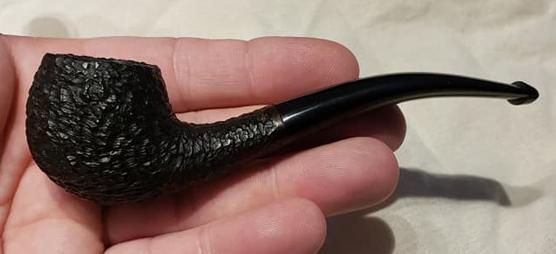
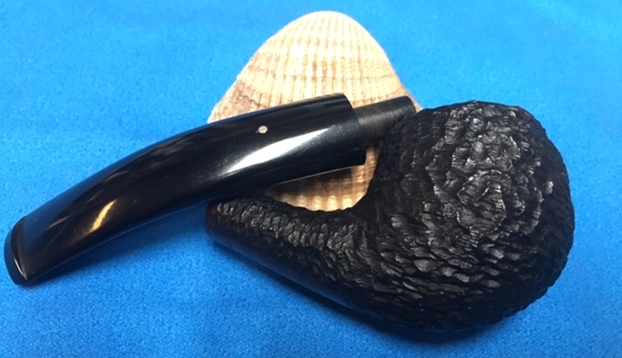
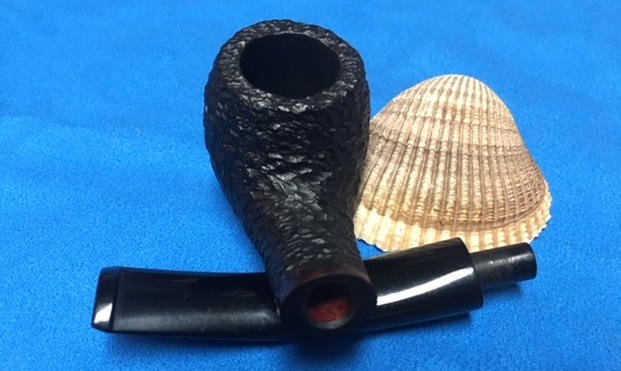
The first two photos were from the auction itself and show the shape of the pipe that caught my eye. The third photo was sent to me in response to a question I asked about the size of the pipe. You can see from that photo that it is a petite pipe. The rustication on the pipe is rugged and tactile and should feel good in my hand when it heats up. John Calich always puts a silver dot on his stems as is visible in the second photo. The colours in the third photo are more accurate in terms of capturing the dark brown colour of the stain.The next photo shows the stamping on a smooth panel on the underside of the shank. It reads Calich 00 over Hand Made. Under that it reads Made in Canada followed by the letter E. Both that photo and the one that follows it show the rustication pattern on the bowl and shank.The pipe arrived about two weeks ago and the box was quite large. It made me wonder what was inside. When I opened the box I found that the fellow handling the auction had included a tin of McClellands #22 Virginia. I am thinking of breaking in the pipe with that tobacco as it is one of my favourites and it is no longer available. I took the following photos to show what it looked like. The pipe is small but will be a great Virginia pipe. The dimensions are as follows – Length: 5 inches, Height: 1 3/8 inches, Outside diameter of the bowl: 1 1/8 inches, Chamber diameter: 5/8 of an inch. Like the other pipes that have, made by John Calich this is bound to be a very good smoking machine. John’s pipes are comfortable in the hand and the mouth and have an effortless draught. I am truly looking forward to loading up the first bowl of Virginia and enjoying the pipe on the weekend. Thanks for looking.


A BRIEF HISTORY OF FLAME: THE STORY OF THE EVERYDAY LIGHTER


The article was produced and shared by Sharrow Mills and sent to me to see if I would be interested in posting this history of lighters on rebornpipes. We corresponded and the long and short of it is that I am posting it here now. The original blog piece can be read on the Sharrowmills site at the link below. Thanks to the folks at Sharrowmills for sharing this with us.  — Steve

https://sharrowmills.com/pages/the-story-of-the-everyday-lighter

“It’s not the order in which things are invented that makes them the most impressive, it’s the importance they have to humanity. So my number one is this: fire with a flick of the fingers.” – Stephen Fry

 Some items have been around for so long, and have become so embedded in the modern world, that it’s hard to imagine a world without them; the lighter may be one of these. Even Stephen Fry, as part of Channel 4’s 100 Greatest Gadgets documentary, named the cigarette lighter as the greatest invention in human history.

From the iconic Zippo lighter and disposable plastic varieties, to the obscure contraptions of old, the history of the lighter is a fascinating one, so we thought we’d tell you some more about it.

1823 – DÖBEREINER’S LAMP

In 1823, Johann Wolfgang Döbereiner, a German chemist and professor at the University of Jena, invented one of the earliest lighters; however, it looked nothing like a modern-day lighter.

Also known as a ‘tinderbox’ (or “Feuerzeug”), the lamp was an exceptionally popular item, reportedly selling over a million units in the 1820s.

The bizarre looking contraption worked by reacting zinc with dilute sulphuric acid in order to produce hydrogen. To use, a valve was lifted, firing the hydrogen towards a porous form of platinum known as ‘platinum sponge’. This then reacted with the atmospheric oxygen, heating the platinum and igniting the hydrogen – the result was a steady flame.

1903 – THE ADVENT OF FERROCERIUM

Ferrocerium is a synthetic alloy that produces very hot and bright sparks when struck. Often incorrectly referred to as ‘flint’, ferrocerium is a different substance completely; the naming similarity stems from flint’s previous usage as a producer of sparks.

Invented in 1903 by Austrian chemist Carl Auer von Welsbach, ferrocerium revolutionised the lighter, as it made creating necessary sparks for ignition easy, and was also a relatively affordable material.

1910-12 – THE RONSON PIST-O-LITER AND WONDERLITE

One of the most well-known classic lighter designs was the Pist-O-Liter, manufactured by Ronson in 1910.

Designed to closely resemble a long-barreled pistol, the trigger released a file-like component which rubbed against a flint-like surface contained in the barrel. This produced sufficient sparks to ignite flammable substances. The long barrel made the Pist-O-Liter a practical choice for applying sparks to harder-to-reach places, such as motor vehicle engines.

Shortly after this in 1912, Ronson developed the Wonderlite, a metal cased lighter more closely resembling modern    varieties, known as a ‘permanent match’ style of lighter.

1914-18 – WORLD WAR I: IMPROVISED LIGHTERS

Life in the trenches during the First World War was notably difficult, particularly on the front lines, where resources, tools and general supplies were extremely limited.

Soldiers therefore started to improvise and created everyday tools by hand using whatever discarded items they could find. One of these was a handmade lighter fashioned from an empty bullet cartridge; it even included a holed chimney cap to better protect the flame from wind.


1926 – RONSON BANJO

Image Source: http://ronsonlighters.blogspot.co.uk/2013/05/rarevintage- unique-ronson-lighters.html

Ronson went on to refine their design with the Banjo lighter in 1926. Developed in New Jersey, USA, the Ronson Banjo was a huge success thanks to its simple usability and attractive design.

The world’s first automatic pocket lighter, the Ronson Banjo required only the press of a button to generate the flame.

It cost $5.00 at the time, but mint condition versions are worth many hundreds today as collectables.


1933 – THE FIRST ZIPPO LIGHTER

Inventor George G. Blaisdell introduced what would become the world’s most famous lighter in 1933. The design of the original Zippo proved so popular that it is still popular today, with only small changes.

Early Zippos were made of brass; however, during the Second World War they were manufactured from black crackle steel due to metal shortages. Zippos during wartime were commonly emblazoned with unit crests and other military symbols, a trend which is still popular today.

1945-55 – POST-WAR ZIPPOS BECOME AN ART-FORM

The inner mechanisms of Zippo lighters have barely changed since their introduction; however, following the Second World War, they developed into a popular fashion accessory with a huge variety of artistic designs and metals used.

The Zippo quickly became a cultural icon and was widely used in movies, television and advertising. Even today, vintage designs (such as the Venetian brass model pictured) are hugely popular with collectors.


1955-75 – ZIPPO & THE VIETNAM WAR

The Zippo lighter developed into a symbol of the American armed forces during the twenty years of the Vietnam War.

American soldiers fighting in Vietnam would often have their Zippo lighters engraved with a variety of personal mottos, slogans, icons and individual designs, commonly reflecting the emotions, beliefs and values of the soldiers themselves during the now infamous conflict.

Vietnam war lighters are now valuable collectors’ items, some fetching huge amounts in auctions.

1962 – PIEZOELECTRIC LIGHTER

The piezoelectric lighter was introduced in the 1960s and was developed as an alternative to fuel burning lighters. Instead of a naked flame, the mechanism here used a small, springloaded hammer to hit a quartz crystal. This created voltage when deformed, resulting in an electrical discharge, which served as the ignition.

While still in use today, the piezoelectric lighter’s popularity was relatively short lived, fading out of mainstream use during the 1970s. While not used by smokers, variants of this technology remain in use for more practical purposes such as barbecue lighting.

1973 – THE BIC DISPOSABLE LIGHTER

Bic introduced a new disposable variety of lighter in 1973 with the intention of rivaling the popular but relatively expensive metal cased Zippos at the time. Typically, the cheapest lighter on the market, the Bic disposable lighter was extremely popular and remains widely used to this day.

While lacking the artistic or fashion appeal of the Zippo, disposable lighters were perfect for a fast-moving, money conscious society, as they did not require refills and could be easily discarded.

SO, WHAT IS THE FUTURE OF THE LIGHTER?

Despite the recent decrease in the number of smokers in both the UK and the USA, traditional lighters have managed to maintain popularity.

This is thanks in part to their status as a fashion accessory alongside its practical uses. To capitalise on this, Zippo’s brand has expanded in recent years to include a whole range of apparel, accessories and other gadgets. This is not dissimilar to the expansion made by Harley Davidson Motorcycles, who to this day are a significant fashion brand, as well as motorcycle manufacturer.

It’s unsurprising, then, that Harley Davidson and Zippo have collaborated to produce some of the most iconic and popular examples in the Zippo range.

We believe classic metal lighters have a brighter future than disposable varieties due to their long lifespan, individuality and vintage appeal. Of course, only time will tell…


Do Higher Priced Pipes Smoker Better?


Blog by Joe Gibson
(© J. Gibson Creative, April 19, 2018)

The topic keeps resurfacing on pipe smoking forums. Do the higher priced, premium pipes really smoke better than less expensive pipes?

There are some pipe smoking snobs who claim the more expensive pipes do smoke better. But how does that explain the thousands of pipe smokers who collect and swear by the smoking qualities of Kaywoodies and Dr. Grabow’s for example?

My test pipes:

Pipes used in my test

I decided to test some of my pipes to see if I found a difference. My one Dunhill is a 3/4 bent billiard made in 1926, so I chose bent pipes for this test. I smoked the following for the test:  Dunhill 151 Inner Tube, Rinaldo Triade YYY 1, Stefano Santambrogio (not a full 3/4 bend, but close), Stanwell Hans Christian Anderson Smooth Dublin, a Savinelli Dry System 2622, an Italian briar with the only stamping being Christmas 1988 and a Borkum Riff pipe.

The tobacco for the test? Dunhill My Mixture 965 so there was no variance because of the tobacco blend. I measured out 2 grams for each bowl, straight from the tin without any additional drying time. I packed and smoked each bowl using the same technique.

Four of the pipes were new when I received them (One purchased, two contest prizes, one included in an on-line tobacco purchase deal).  Two pipes I rescued and the last was a gift to me.  All seven are in good smoking condition.

Part of the premise that more expensive pipes smoke better, is that the engineering and quality of workmanship makes a difference. I settled for examining the drilling of each pipe and stem as a comparison in engineering. A perfectly drilled pipe should smoke better than a poorly drilled pipe, in my opinion. To check this, I performed a “pass a pipe cleaner” test on each pipe. By “pass a pipe cleaner,” I mean I can insert a Dill’s pipe cleaner through the bit and it goes all the way into the bowl.

What makes a perfectly drilled pipe:

In my opinion, a perfectly drilled pipe has three things: 1. Draught hole dead center in the mortise, 2.  Hole and airway in the stem perfectly aligned (will pass a pipe cleaner), and, 3. Draught hole and airway the same diameter.

If the draught hole is not perfectly centered in the mortise, then the airway in the stem will not line up properly. It won’t necessarily prevent the pipe from being a decent smoker, but it won’t be a great pipe until you get it re-drilled. If the airway in the stem is larger than the draught hole, you may hit briar when inserting the pipe cleaner and must wiggle the cleaner to get it into the draft hole of the bowl. Conversely, if the draught hole is bigger than the airway, it should pass the pipe cleaner more easily.

When setting up for my test, I shined a bright LED light into the mortise of each pipe I used. Surprisingly, none of my pipes were what I would call perfectly drilled. The drilling on my Savinelli Dry System 2622 looks more like the drilling on a Cavalier. For example, the draught hole is drilled into the top of the airway and there is a space at the bottom of the mortise where moisture can collect. This is part of the engineering design of a Dry System pipe. It’s a very good smoker and I’ve never notice it gurgle.

On the other hand, the Borkum Riff bent pipe is just badly drilled. A cleaner inserted into the mortise bottoms out in briar. Shine a light in the mortise and you don’t see the draught hole. Run the cleaner along the top of the mortise and it does slide into the draught hole.  Of all the bent pipes I tested, this was the worst in my opinion.

My unscientific method of measuring the size of the airway and draught hole was equally as simple. A single pipe cleaner fits into the draught hole and the stem airway. Five of the pipes did this. The Savinelli and the Dunhill have larger bores. The Savinelli is a balsa filter pipe and the Dunhill originally came with an aluminum inner tube (hence the name, Inner Tube). I don’t use either. I can easily insert 2 pipe cleaners at one time in both pipes.

The pipe test:

I used My Mixture 965 for the test.

For the testing I loaded two grams of Dunhill My Mixture 965 in each pipe.  I weighed the tobacco on my kitchen scale.

Stanwell HCA:

Passes a pipe cleaner with some wiggling. Draft hole off center high. Avg. size airway in stem.

Good, easy draught – like sipping a fountain drink through a plastic straw. Bowl was warm but comfortable to hold. Session lasted 55 minutes with no relights. Ash and minimal tobacco bits left at the end of smoke. Good flavor from the tobacco throughout the smoke. (Acquired as a prize give-away from This Pipe Life pipe forum. MSRP listed as $250. The pipe came with both a regular stem and a churchwarden stem.)

Christmas 1988 pipe:

Does not pass a pipe cleaner. Draft hole drilled high and the airway in the stem seems smaller than Stanwell.

Decent draught, open and unrestricted (probably because of gap between the tenon and bottom of mortise. The bowl got warm but not hot. Session lasted just over 50 minutes with some dottle in the bottom. Relit once around the 41-minute mark. Good flavor from the tobacco throughout the smoke. (Used pipe found at antique/collectible shop for $15.  Probably sold by Tinderbox originally)

Stefano Santambrogio

Doesn’t pass a pipe cleaner. Even with the draught hole drilled high of center it’s very good smoker.

I have won two long smoke competitions with this pipe. My record is 1 hr. 27 minutes with this pipe. The bowl got warm but still comfortable to hold. Session lasted 67 minutes with no relights. Good flavor to the end with a minimal amount of dottle remaining. (Bought new, unsmoked off eBay for $80.)

Borkum Riff Bent

– Does not pass a pipe cleaner. Draught hole drilled into the top of the airway. Gurgles. Smoked the worst of the pipes tested. To my eye, the airway seems smaller than the rest and the draught feels more restricted, like sipping a drink through a cocktail straw. Bowl gets hot while smoking. Session lasted 43 minutes and required 3 relights. Approximately 1/8th of a bowl left at the end. Flavor didn’t seem as developed in the other pipes. (Acquired new as part of a package special from an only retailer) I find myself wondering why I still have this pipe.

Savinelli Dry System 2622

Smoked without the Savinelli Balsa Filter. Draught hole drilled into the top of the airway, probably by design.

Because of the design, the airways in the stem and the mortise are large enough to fit two pipe cleaners at the same time. However, the pipe cleaner does not go through the bit because it is a P-lip design. As I smoke it with no filter, the draught is wide open (like using a jumbo drink straw). The session lasted 49 minutes with only ash left. It seemed to produce more smoke than the rest. The bowl got warm but doesn’t get hot. From a flavor standpoint, the tobacco started tasting “ashy” just before it went out. (Used pipe found at an antique/collectible store. Paid about $20 for it.)

Dunhill “Inner Tube” 151”

Even this Dunhill is drilled a little off center.

Produced in 1926 according to the markings, this pipe originally came with an aluminum “Inner Tube.” Mine doesn’t have the tube. The airways and draught hole are big enough to fit 3 pipe cleaners into them at one time. It passes a single pipe cleaner from the lip or button into the bowl with no effort.

With the openness of the airway and draught hole the draught was like drinking through a jumbo size straw. I expected this pipe to smoke faster, but I found myself smoking slower. Flavor was good, tobacco burned evenly and required less tamping than I expected. Bowl gets warm but not as warm as some of the other pipes. Session lasted 71 minutes with no relights and just ashes left. Unlike the Savinelli Dry System, I did not get the ashy taste at the end though. (Used. A gift from a friend after he learned I didn’t have a Dunhill.)

Rinaldo Triade YYY 1

Easily passes a pipe cleaner. Instead of a perfect circle, the draught hole is elongated and reaches from the top of the mortise to the bottom.

Good, even draw like a plastic fountain straw. Bowl gets warm but not as warm as some of the other pipes. Session lasted 59 minutes without a relight. Very minimal dottle at the bottom of the bowl and good flavor throughout.  (New. Won in a long smoke competition.)

Linkman Hollycourt Special 7023 (Bonus addition)

Produced between 1938 – 1943. Threaded stinger but looks like the end of the tip of the stinger cut off. Easily passes a pipe cleaner to bowl.

After the Dunhill, this is the oldest pipe I own, so I decided to include it in the test. The bowl gets hotter at the bottom than I expected but it can still be held. Bowl is deep, and 2 grams only fills about half of it. Very open draught. Tobacco burns evenly and I noticed more flavor at the start. Where the tobacco was medium strength in previous test, it was stronger at the end of this bowl. Session lasted 50 minutes. (Used. Acquired at antique/collectible shop for $25.)

My Conclusions…

After conducting my smoking test and talking to several expert pipe carvers and restorers, I decided the answer is so subjective for a yes or no answer. What makes a pipe a quality smoker depends on the definition of a quality smoker by each pipe smoker. I have several hypotheses and a theory.

First the theory.

The reason more expensive pipes are considered to be better smokers is because more time, money and effort go into producing the pipe and the quality control is better. In other words, high-end manufacturers usually have strict quality control guidelines. If at the end of the manufacturing process, the pipe doesn’t meet those guidelines, it is either destroyed or sold as a second or basket pipe. This doesn’t mean that every high-end pipe is perfect but the chance of it being a bad smoker is less.

This also apply to Artisan pipes carved by people like Mark Tinsky, Walt Cannoy, Ryan Alden, Rad Davis, et al. Artisan pipes are more likely to be great smokers because they are going to make sure it is a perfect pipe before selling. If for some reason, the pipe has problems, they tend to stand behind their work and fix it.

Now for the hypothesis.

After the engineering, the most important part is the quality of the briar itself. I believe artisans and companies always buy the best briar blocks that they can afford. They don’t call up a dealer and send me 1,000 lbs. of whatever is on the shelf. They ask about the aging, curing and grading.

After harvesting, cutting, boiling and air drying for two years minimum, the briar is ready to sell. The longer the briar is aged, the more it’s worth.  In some cases, the blocks are aged for decades before selling. Briar dealers inspect each block and assign it a quality grade. Carvers and manufacturers make their purchases based on the length of aging and the grading. The more money they spend, the chances of better blocks increases.

Conversely, there is the old saying that “even a blind squirrel occasionally finds an acorn.” By that I mean even carvers/manufacturers on the lower end of the pay scale can and do occasionally find and produce a pipe worth more than what the end user pays.

Good smoking, low cost pipes…

Wait! What about Kaywoodie, Dr. Grabow, Wally Frank and other mass-produced pipes from the mid-20th century? My hypothesis is there weren’t as many high-end artisan carvers back then, so it was easier for them to get better grade briar. Also, despite not being “hand-made” the engineering on the pipes was very good. Large collecting communities for Kaywoodie and Dr. Grabow will attest to this.

Finally…

The book every pipe smoker should read.

While pipe smokers will continue to argue this question no matter what I say, I want to turn to one I consider an expert – Dr. Fred J. Hanna. His book, “The Perfect Smoke” published in 2012, is a collection of his essays about pipe smoking

I recommend the essays in Chapter Three of his book. “Choosing the Great Briar Pipe: Factors to Consider (Pages 91-102) discusses the 24 factors Hanna considers important for choosing a great briar pipe. These include the draught hole location and the size, the length of the tenon, the thickness of the bowl wall, etc.

The third essay in the book, “The Myth of Brand and Maker in Pipe Smoke and Tasting” (pages 111 – 124) is also very enlightening as he explains that “a great-smoking pipe is not the same as a great-tasting pipe.” (page 112) I also found his comment that, “The brand myth has the potential to harm our hobby. It can lead us to believe that only the wealthy collectors of high- and ultra-high-grade pipes can enjoy the truly sublime, superlative smoking and taste experience.” (page 124)