Category Archives: Pipe Related Essays

Short and not so short essays on pipes and tobacciana

IMHO (in my humble opinion): The purpose of the online forum community


I have been thinking quite a bit about the purpose of online communities and forums. I have been on the road for three weeks with no internet access and decided when I got home I would finish writing this piece. Part of this comes from being involved in two of them with regard to pipe smoking and another part comes from what I do for work in training leaders on a global basis and utilizing an online forum for that process as well. So I have been involved in online forums for the better part of 12 years. I have had experience as a participant, moderator and a forum operator/administrator. On the positive side, I’ve learned and shared many great ideas, made valuable new contacts and friends and was able to communicate quickly and efficiently with a wide scope of people in all different parts of the world. On the negative side, I found that it was easy to fall into excess participation and a huge time drain and if not disciplined in my usage – very addicting as well.

As I reflected on the concept of forums I came to the conclusion that it would be helpful for me to put pen to paper with regard to what I am expecting from these forums and what they can provide for me. This kind of writing exercise helps me keep perspective on the waxing and waning life of the online community.

What an online community/forum is

  1. Pipe Forums are a place of intellectual exchange. They are a safe environment for sharpening ideas and skills and reflecting on common and new experiences with other individuals who share the same hobby and passion.
  2. They are a place where one can learn new ideas and refine old ones. Through the sharing of ideas and experiences new ideas, skills and aspects of the hobby can be learned and explored and earlier ideas and thinking refined.
  3. A place to enjoy community – though this is at some levels artificial, it does open the door to ongoing enjoyment and sharing with some of the individuals I seek to know more fully through phone, emails, private messages and often through personal visits and the exchange of gifts.
  4. Influencing the forum’s evolution by becoming an involved member. The beauty of being positive contributor to the shape and form of the community.
  5. Contributing to the learning and experience of others and reciprocally receiving from them in like measure.
  6. Making new friends and contacts – this often comes as follow up work is done and relationships are worked on through the various channels mentioned in number 3.
  7. A way of keeping up with current events that relate to the field of interest. A broad spectrum of forum readers makes for a broad reporting on events of interest.
  8. A place that always has new opportunities to learn and develop a broader and deeper understanding of the hobby.

What an online community/forum is not:

  1. The Forums are not my real life. I do have a significant social life apart from the forums and usually use the forums as a bit of escape from the normal stresses and strains of my life. Because they are not my life I do not expect them to do for me what the folks around me real time provide in terms of support and care. I expect them to provide a haven, a respite from the nonsense of people issues that I deal with every single day.
  2. The Forums are a place for sharing opinions and ideas and as such they can be a bit volatile. People cherish their opinions and have a hard time dealing with disagreement. But it must be remembered the point is not to create a monochrome community where we all say nice things and always agree. Rather they are a place to sharpen one another and learn new skills.
  3. The Forums are not a face to face community. They do not provide a real life context and people join by and large because of common interest or shared hobby. They cannot provide the information needed to make a full orbed assessment of and connection with another person without each individual taking time to deepen that outside the online community. In many ways they provide an artificial sense of community based on perceived shared interests. Outside of that limited setting those on the forums may have little else in common.
  4. The Forums do not provide a vehicle to facilitate understanding the tone and emotions of those who post. Because they are limited to written communication (Though some have chat rooms that seem to have some users) there is no real way to know the feeling behind words that another is writing to you. It is easy to misread emotion and feeling into what is written that was never intended. Thus we can easily be sucked into drama that is unnecessary because it is not based on any reality.

Many of the ideas and thoughts were found as I researched this topic online. The next part of this article has been adapted from an article by Steve Pavlina on Effective Online Forums Usage http://www.stevepavlina.com/articles/effective-online-forum-usage.htm

He lists some of the potential negative side effects of excessive forum usage that I found helpful reminders for me in learning and maintaining moderation in my participation in the online community.

  1. Reduced concentration and focus
  2. Reduced productivity
  3. Chronic procrastination
  4. Increased pessimism and/or apathy
  5. Being distracted by endless debates and idle gossip
  6. Gradually substituting tribal group think for your own intelligence
  7. Impaired social skills, neglected relationships, and a weakened social circle (a consequence of substituting online socialization for face-to-face conversations)
  8. Reduced energy (forum participation is sedentary compared to more active social outlets)
  9. Reduced self-esteem
  10. Career and income may suffer (including loss of employment)
  11. Forum addiction

From that point the article gives some suggestions that I thought were helpful in using forums effectively and avoiding the negative side effects. I am not sure I agree with all of his suggestions but I found them thought provoking and worth passing on to those of you who are reading this piece.

1. Take a Forum Fast  – First, if you’re currently active on any forums, go on a forum fast. Stop visiting all forums for a while; don’t even lurk. I recommend a fasting period of 30 days, with a bare minimum of 14 days. This will help you break any unconscious habits and regain your perspective, so you can intelligently evaluate the role forums should play in your life. Otherwise, you may be coming from a place of unconscious habit and will likely overestimate the value of continued participation. If you’re currently a forum moderator, take a forum vacation, and enlist someone to temporarily assume your moderation duties. Redirect the time you would have spent in online forums to something positive like exercising or reading books. If you don’t think you have the discipline to do this, simply make a post in each forum explaining that you’ll be taking the next 30 days off, and if any forum member catches you online, you’ll pay the first person that emails you about it $100. This should give you enough leverage to stick with your fast.

2. Reassess Your Forum Usage HabitsOnce you’ve completed the initial fasting period (and not before), take a fresh look at your forum participation habits. Imagine that you just discovered each forum today for the first time. What are the pros and cons of participation? Is this the best use of your time, or can you imagine something better? If you’re using forums to get specific information, would it be better to simply read books, articles, or blogs? If you’re using them as a social outlet, would it be better to join a local club and meet people face-to-face? Looking back on your previous pattern of behavior, would you say you were addicted? Did your usage pattern become unconscious? If so, how do you intend to prevent that from happening again?

3. Clarify Your ExpectationsIf you decide to participate in online forums, clarify your expectations. Whether you intend to use forums for market research, to make new contacts, or as an outlet for your humorous wit, get clear on why you’re there.

4. Establish Reasonable BoundariesTo limit the risk of forum addiction, set clear boundaries for yourself and write them down. You can limit the number of times per week you check each forum, the total amount of time you spend participating, or the number of posts you’ll allow yourself to make each week. Track your weekly usage on a scrap of paper to keep yourself consciously aware of your participation habits. Don’t go dark and succumb to unconscious habituation. Establish clear boundaries such that if you cross them, you know you’re at risk of falling into a pattern of addiction. And if that ever happens, it’s time to immediately begin a new fasting period.

5. Let It GoIf you find yourself repeatedly succumbing to forum addiction or other negative usage patterns, you may decide it’s best to simply do without. At the time of this writing, I no longer regularly participate in any online forums or message boards. When I clarified my intentions, I realized my #1 reason for participation was to contribute and to help people. But using forums as a contribution outlet was inefficient, since it would too often lead to lengthy (and mostly unproductive) debates. I found that sticking with one-to-many outlets like writing articles and maintaining a blog were a much better use of my time. Blog comments still allow some interactivity, but the time required to manage them is reasonable and the personal relevance of most blog comments is extremely high.

6. Replace Online Socialization with Face-to-Face ContactRegarding the social aspect, online forums are a poor substitute for meeting people in person. While there’s certainly some social benefit to forums – many people have met their spouses in online forums, including me – it’s important to physically spend time with human beings instead of via a computer screen. If you need a new social outlet, join a local club or association, especially one that meets weekly. I found that when I joined Toastmasters International and began attending meetings and competing in speech contests, my interest in socializing via online forums fell dramatically. Even the best online communication pales in comparison to face-to-face, belly-to-belly contact.

7. Be a Dabbler, Not a FixtureAnother tip is to treat forum participation as temporary. If your goal is to make new business contacts, then dive in and participate actively for a while, maybe 30-90 days. Make new friends and contacts, collect private contact info, and then abandon the forums. Continue to develop your new relationships via one-to-one communication like email, phone calls, and if possible, face-to-face meetings (such as at industry conferences). Temporarily dabbling in many different forums is a more effective way to build contacts than pushing a single forum far beyond its usefulness.

You can also use the dabbling method to gather general information on a subject. Seek out a number of relevant forums and bookmark them. Then spend a few hours scanning each forum once every six months to soak up the current wisdom. Whenever you have a specific question, pop in and search the forum archives. If searching turns up a blank, feel free to post a new message, harvest the answers, and disappear.

8. Avoid AddictionOnline forums are tricky beasts. At the time of this writing, my feeling is that ongoing daily participation in any single forum for more than a few months is almost invariably unproductive. Eventually the initial benefits like gaining knowledge and making new contacts produce diminishing returns. And then the negative effects like forum addiction set in. Regular participation (even from unconscious habituation) will still provide some benefits, but the longer you participate, the less efficiently those benefits are realized.

Close cousins of forum addiction include online gaming addiction, web surfing addiction, blog addiction, email addiction, and news addiction. The common pattern is that unconscious habituation overrides conscious, clear-headed decision-making. If you ever find yourself with such an unproductive habit, take steps to reassert conscious control. Use a period of fasting to regain your perspective, reexamine your motives, set clear boundaries, and find alternative outlets. Manage your forum usage consciously to serve your goals, and avoid the trap of addiction.

Online forums can be a powerful productivity tool, but self-awareness and discipline are required to prevent them from becoming a pitfall of procrastination.

I look forward to hearing your thoughts on the use and abuse of Forums. They are a great tool for making our world much smaller and a way for us to reach out to others who share a common interest in the pipes and tobaccos we love. Let’s have your responses.


What Happened to Santa’s Pipe?


I love the look of old Santa Claus carvings, especially when they include the pipe in his mouth or hand. To me they are a part of the image and mystique of the jolly, old gent. I can almost smell the aromas in the wreath of smoke that encircles his head. Whether you call him Sinterklaas, Saint Nicolas or Father Christmas, it is getting harder to find Santa with a pipe in the politically correct climate of the world in which we live. If you are like me, you have seen endless Santas with apples and oranges, dolls and toys in his hands or a finger next to his nose but rarely a pipe in his mouth. Over the years I have collected a few older figures that I put out each Christmas as part of our celebration and decoration. I also have some older Christmas books from the time I was a child (somehow the books are getting older every year!). These picture him with a pipe in his hand. I remember telling my kids stories of Santa and his pipe. But these days he is sans pipe! Every Christmas I am on the lookout for some of these old Santas – either carved or cast, in photos or cards to add to the collection. Here is an old one that I have in my collection.

Image

With that information as a back drop for this blog post I want to talk about a discovery my wife and I made last week. Over the past three weeks we were travelling in Alberta, Canada for my work. It is a fall routine for me, having done the same trip five times now. This time we drove over 3000 kilometres and visited many of the towns in the province from the south along the US border to the northern part of the province. We met with individuals, businesses, churches and groups who were, or might be, interested in the work of the Foundation that I work for. We stayed in homes of friends and supporters in each city. It was a great trip for us; the first time my wife has joined me on this jaunt. Each small town and city we visited we made it a point to take some time to walk through small antique malls and second hand stores to look for estate pipes and pipe related items (ostensibly this was my reason).

On this trip I found several older pipes but what was really interesting was a find in a little shop called Holly Berries we visited in Grande Prairie, Alberta. It was a Christmas shop. Maybe it was the snow storms we drove through and the quiet prairies of the North Country that put us in a Christmassy mood but we were in that mood. We went through the front door of that great little shop and walked through the normal assortment of Christmas decorations and ornaments, looking and commenting on what we were seeing. They had the usual ones available for purchase – angels, stars, Christmas slogans. The place smelled very inviting with a mulled cider and fresh baking scent throughout the shop. The garlands of fir and pine – artificial but nice nonetheless – added to the festive spirit. Christmas carols and songs were playing in the background and we easily slipped into the nostalgia of Christmas past, present and future. We wandered around the shop picking up and looking at small and large pieces – crèches, shepherds, wise men, and Santa Claus. It had all the trinkets and adornments that decorate homes during the Christmas season. It was an interesting place to spend some time.

My wife turned toward the tree ornaments while I went off on my own to look at some of the carvings. In the centre of the shop I came across a display of carved and cast Santas that were different from the run of the mill Santas that are on the market today. This display was full of carved Santas smoking a pipe! I could not believe it and commented to the shop keeper that it was a pleasure to see the Santa Claus of my youth with his pipe and not in the new and politically correct pipeless posture. She laughed and said that the works were highly collectible (the prices on them would agree, though I see that on the website they are considerably cheaper). The figures are carved by Jim, then artisans produce clay molds, cast the figures in Polyresin and then they are hand painted and finished by artists using folk art techniques developed by Jim Shore. The attention to detail and ensures that the figures look and feel like real wood and have a quality that is unique to each piece. Here is his website with more information on his work http://www.jimshore.com/content/

I took a few pictures with my iphone so that I could keep a memory of what I saw. Below are the two figures that I really liked. To give you an idea of the size of these figures I have included the measurements. They are 10.25 inches tall, by 5.5 inches wide, by 6.5 inches long. By no means small, these figurines each have a personality that is unique and timeless. It is great to know that in this day and age there are some who still maintain the old memories and images of our folk story figures. There is nothing like seeing the merry twinkle in the eye of Santa and a puff of his pipe to remind you of the days of your youth and memories of seasons of family and friends.

ImageImage

Waiting for Paradise – Fred Bass


The overwhelming majority of meerschaum pipes perform well, regardless of whatever blend you choose to smoke in them. Indeed, this has been one of the big attractions of these white pipes for me. I can avoid having to dedicate pipes to blends, except for some blends like St Bruno Flake, which will ghost any pipe.  Keeping the pipe clean is all that needs to be done to enjoy the clarity of smoking experience they provide and be able to smoke nearly any blend, without a concern for ghosting. This is the general experience for the greater number of meerschaums that you will encounter over a lifetime. This essay is about the rare, finicky pipe that calls to you, like the sirens did to Odysseus. These are the ones that smoke all but the one paradise blend with underwhelming results. Whether it is the result of an association the block used to carve the pipe formed with the clay it was mined from, or the curse of some pipe muse, this will be the most demanding pipe you will encounter. The odds are that you may never encounter one of these pipes, but if you do, then this article will serve you with good counsel. It is a quest that demands patience and firm resolve, beyond that of most Pipemen. The rewards of the successful quest are a smoke of such character and pleasures that words to describe it simply do not exist. 

ImageThe first time I saw this pipe in auction, there was no amount of will power that I could summon to resist the desire to acquire it. The Koncak Meerschaum trademark logo has been an indication of quality in materials and craftsmanship that is found only and infrequently in the vintage and estate pipe market these days. The Koncak dynasty of carvers, which also employed some of the better carvers of the day in their workshop, made and sold pipes to target populations from the frugal to the extravagant. It is wise to elicit any information that the seller can provide, but typically little is known by sellers today about the pipe and its provenance. This Smooth Pot with 925 Silver Faux Spigot is one of the better pipes that I’ve seen that the Koncaks produced. Ephraim and Sedat Koncak infrequently signed their work, while Battal and others who carved for the Koncaks frequently did sign their work. This pipe isn’t signed. Fortunately, I was able to win this pipe, as the sole bidder, which surprised me, as I thought it would attract a lot of attention. Later, others who complimented me on this acquisition admitted that they saw the auction but did not bid because they thought the bidding would go too high for them. Sometimes you just get lucky.   

In a few days, when the postman delivered it, I began to clean it up. It had not been smoked a great deal, which surprised me, considering that it is a quality pipe and meant to provide decades of service. I wasn’t going to complain. The pipe has been carved from heavy, dense block, which is typically what intricately carved pipes are made from. Likely, this choice was made by the carver to give firm foundation to the silver collar on the shank and provide durability for the wet smoker. The patina that age brings meerschaum is something that I find attractive in a pipe, so just a light wipe down with Everclear easily removed the surface grime. Polishing up the bit and the silver collars on the bit and shank was easy work as well.  There was a moderate bit of cake in the chamber and it looked like the pipe had never been smoked to the bottom of the chamber. Again, I wasn’t going to complain. There was no indication that any cheap aromatic had been smoked in it, which gave me reason to be grateful. After replacing the delrin push/pull connector, and giving it a good scrubbing with Everclear, I let the pipe rest overnight to dry from the cleaning. The next day, after smoking the first pipe of the day, to get started, I loaded this pipe with 1776 Tavern blend. My habit is to smoke estate pipes with heavy English blends, until they start smoking with clarity, mostly because they will mask most ghosts and residuals of past fires, while I flush the pipe.  Curiously, this pipe lent a musky aftertaste to the smoke, which I reasoned was because the pipe had never been smoked to the bottom of the bowl. By the tenth or twelfth bowl, I found that this musky taste was still in the smoke, when I would have expected it to be smoking with clarity. My theory about this taste being easily purged from this pipe had been overly optimistic. What did I know anyway? I smoked another half dozen bowls, using Hal O’ the Wynd this time, reasoning that the hotter burning blend would exorcise this musky character in the smoke.  Then I tried a succession of blends from Burley, Orientals, Balkans and Scottish mixtures, with no success of purging the pipe of this ghost. By this time, I began to understand why the pipe had not been smoked to the bottom of the bowl before. It had to be the musky flavor. The experience had become frustrating and my determination began to falter.

The pipe sat in its case for a couple of weeks before I became interested enough to resume my purge of the pipe. Frankly, I was a bit put off with my lack of success in exorcising the musky quality of the smoke delivered by the pipe. At least there was no remnant of any past fires with a nasty aromatic, like some of the pipes I had cleaned up in the past. I began to consider that maybe the block itself was the culprit. Had the sepiolite leached minerals from the surrounding clay that it had been dug out of? Had the pipe been mistreated or neglected in some way by a previous owner? Could the pipe be capable of providing the smoking pleasures I wanted from it? I found fresh conviction from these questions and became recommitted to my mission of getting this beauty to smoke well, even if it had never done so, which I suspected might be the case. I became convinced that the previous owner must have been lacking in strength of conviction. I was determined to succeed where he had failed. My politically incorrect assumption that the former owner was a man is a logical assumption from knowing that the majority of pipe smokers are men and the fact that I’m an old guy. The adage is that if you want to make a pipe smoke well, then smoke the blazes out of it. I would burn the defiance out of this rogue pipe and bring it into submission. After a week of smoking this pipe almost exclusively, while allowing myself the exemption of smoking another pipe as the first smoke of the day, I no longer suspected that it had been found at the crossroads after midnight, left behind by Robert Johnson while running from the hounds of hell. It was smoking wet by this time, which I reasoned was because of the high density of the block that it was carved from. At this point, I set the pipe down, with the intention of letting it dry out for a week or two, which is what I did after a good scrub, just as I had been doing during the time of purging I put it through.  Again, it sat in the handmade case that had been provided for it after the carver was finished. I had been successful in my work to get it to provide a smoke that no longer had the musky character to it. Whether the musky taste had happened because the pipe had never been smoked to the bottom of the chamber or it had been in the block before it was carved was no longer important. The pipe was smoking with clarity now.   

Another week went by before I loaded the pipe with Our Best Blend, from Smoker’s Haven, which is a full and rich blend of good character, similar to an early incarnation of Balkan Sobranie. This blend has always been a stellar performer for me, but this time, even though the pipe smoked with clarity, it was a lackluster performance, at best. Past experience had taught me that the majority of meerschaum pipes smoke well with just about anything you choose to burn, but a few pipes had been temperamental, performing well with certain blend types, like English, Balkan, Burley or Virginia blends. This pipe had served notice that I would need to continue my quest to find out what it was destined to incinerate.

ImageThe search was started for blends that would perform best in this pipe. I keep a fairly large open rotation of blends, so I put the pipe into my lineup of frequently smoked meerschaum pipes, hoping to solve the mystery through the process of elimination. The low key aspect of this quest became somewhat mythical in character, as I was only smoking the pipe about once every seven to ten days, while I worked through my open tobacco blend rotation, that is somewhere between twenty to thirty different mixtures. After a couple of months, I was no closer to solving this mystery than when I started. Then I opened a tin of Reiner Long Golden Flake, a favorite of mine that I usually kept an open tin of in the rotation, but had simply overlooked, while trying out some new-to-me blends. Throwing caution to the wind, I loaded a bowl in the Koncak meerschaum and fired it up. It was a stellar experience of mystical proportions. Everything came together as only a peak experience can and I hoped that this wasn’t a fluke. I loaded a second bowl and picked up where I had left off with the first bowl. This was it – the big payoff for my work!  I can only speculate as to why a small number of meerschaum pipes are this particular in their smoking demands. I suspect that there are a good many of them sitting in a drawer for the lack of a determined pipe smoker who will discover what will be the pipe’s choice for paradise for the lucky man who finds the right blend to smoke. The important thing is to make the commitment to discover what the pipe performs best with by smoking it, and not be one of the guys who put it in a drawer. Just be prepared to wait for paradise. 


Another Bakelite Pipe Gadget – Tobacco Jar


Blog by Steve Laug

I seem to be drawn to Bakelite Pipe Gadgets. When this one came up on EBay I could not pass it up. I put in the bid that I was willing to live with and “won” this piece with no other bidders on the table. I have no idea what the age is on it but it is in great shape. The threads on the lid and the jar are undamaged. The Bakelite is a nice dark, mottled finish – almost the colour of a stoved Virginia leaf. The script on the lid looks great and the rusticated surface surround the script is really a nice touch. I believe that it was done to provide a surface to strike a match on once the pipe was loaded with the tobacco. There is a cast pattern of tobacco leaves that form a border on the lid and on the bottom of the jar. There are no dents or cracks in the bowl and it is flawless. I polished it with White Diamond and gave it a light buff with carnauba wax. The jar purports to be airtight but is not. It keeps tobacco fairly well for about a week and then it begins to dry out. It holds a place in my pipe cupboard and is a nice piece of tobacciana. ImageImage

Do I need to ream my pipe?


Blog by Steve Laug

I don’t know how many times I asked this question in the past as I was new to smoking a pipe. Nor do I know how many times I have read this question on the various online forums that I frequent. When I think back to the responses I got when I asked the question and when I read the responses given on the forums I have found that generally the answers that are given fall equally between yes and no. There are proponents of the “never ream” school, the “no” answers, who would argue that if a pipe is properly cared for after each smoke the necessity of reaming is removed. Just fold a pipe cleaner and swish it around the bowl to knock of remnants of tobacco and smooth out the bowl sides and you are good to go. This is the method that I have used for years and I have found that it allows a slow and steady build-up of the cake. But there are also just as many proponents of the “ream often” school, the “yes” answers, which seem to ream at the slightest build-up of cake.

As I consider the question today I have to reflect on whether or not the two schools have made things too black and white. I understand why folks would argue for never reaming. For when I think of the many pipes that have crossed my table that have suffered at the hands of the ream often folks I too want to say, “Never ream your pipe”. The pipes that come damaged are pretty close to ruined – at least when you consider that the bowls are out of round and often too deeply reamed. It takes some creative shaping and reshaping to repair the damage caused by overzealous reaming. To me the “ream often” school of thought seems too often to cause more damage than a little cake build-up would ever cause.

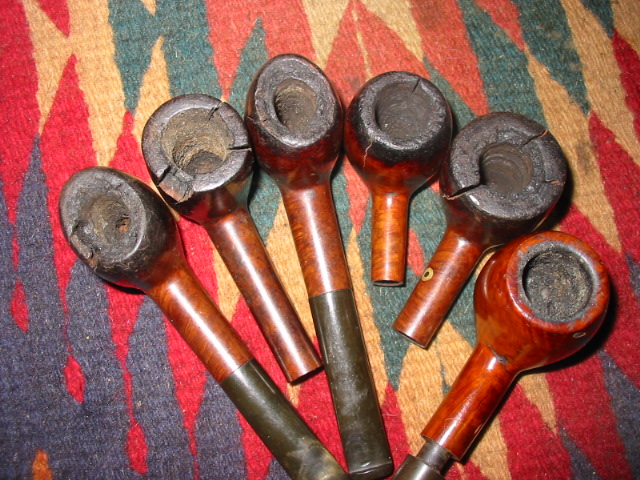
However, that being said there are pipes that have come across my desk over the years that could have clearly used some of the “ream often” care. They were badly caked pipes, neglected to the point that the cake over fills the bowl and the pressure from the different expansion of the cake and the briar cracked the bowls. In the photo below the five pipes on the left show these signs of neglect. The first and the third bowl were so caked that my little finger would not fit in the bowl. The second, fourth and fifth pipes in the photo have had a bit of the cake carved away to make room for more tobacco but to little was removed too late and the bowls are cracked and ruined. My old uncle could easily have owned any of these pipes. I clearly remember, from the times I road with him on his dry cleaning route, that his pipe always looked like this. In fact for years I kind of figured this is what they were supposed to look like! There were times when I would pick up the pipe off the console of the VW Bus and look at and wonder how he could get tobacco in the bowl. One day as I was holding the pipe and checking it out with my little finger, he came back to the van and chuckled at what I was doing. So I asked him about how he got tobacco in his pipe and why he didn’t clean out the hard stuff.  I still remember his response – “when it holds no more tobacco I throw it away and get a new one”. And with that he took the pipe from my hands and packed some more tobacco in the bowl and fired it up. As I look at these old cracked pipes and others I have seen, so caked that they hardly hold anything, I wonder if the previous owners shared my uncle’s view of the disposability of the pipe. They may well have been part of the “smoke it until it is dead” philosophy and then set it aside and started on the next pipe.

Image

So that leaves me with a question that others have asked as well. What is the proper reaming method? Should you never ream or always ream? I think that like most things in life the answer to this question negates the always and never choices. It is not a black and white issue. To me I have learned that there are times that I need to ream my pipe. Mind you, some of my pipes have never been reamed. Others I have had for over 20 years and smoked a lot and have had to ream once or twice in that time. There are only a few times that I ream a pipe. I am basically a proponent of the “never ream” school – daily maintenance keeps my pipes in order and never looking like the ones above.

Here are three occasions that I have found that I ream a pipe without any hesitation. I know others may well disagree with my choices, but here they are nonetheless. I have the freedom to exercise these choices as I see fit and my opinion is just that, my opinion. Read them over and if you agree, that is fine. And if you disagree, well that is fine as well. Let’s fire up a pipe and enjoy the fellowship of the briar.

  1. I only ream when the cake exceeds the thickness of a dime – a thin coin. I want to maintain that thickness as I have found that it works best for the style and process of my smoking. I use a Pipnet reamer or a Senior Reamer to keep the cake at this thickness only because I have learned that they are easy to keep vertical in the bowl and not tilt to one side and cause the bowl to become out of round. I actually have rarely had to ream my pipes.
  2. I also ream when I by estate pipes. I remove all of the cake so that I can minimize the potential for ghosting tobaccos from previous owners. This is my preference and I know others who ream them back to the amount mentioned above. I like starting over and building a good hard cake of my own making.
  3. I have also reamed pipes that I smoked in my early days with aromatics. I have found that they are almost impossible to get out of a bowl without removing a cake. Again this is my opinion but I have found it works for me. I like to have a clean surface to work from. I know others just load it up with the new tobacco and smoke it into submission!

Pipe Gadgets: A Bakelite Pipe Cleaner Ash Tray


by Steve Laug

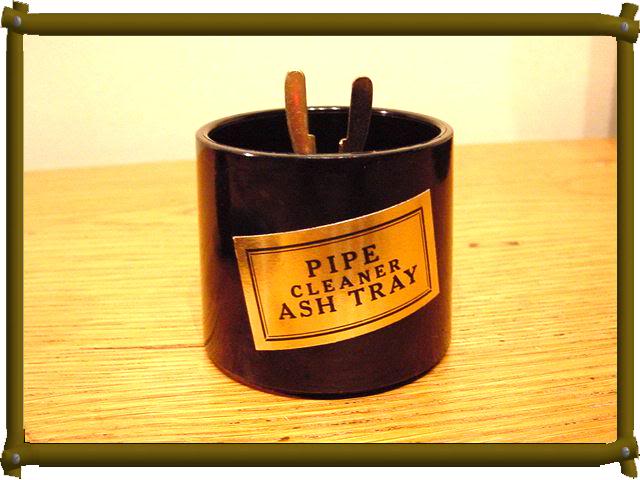
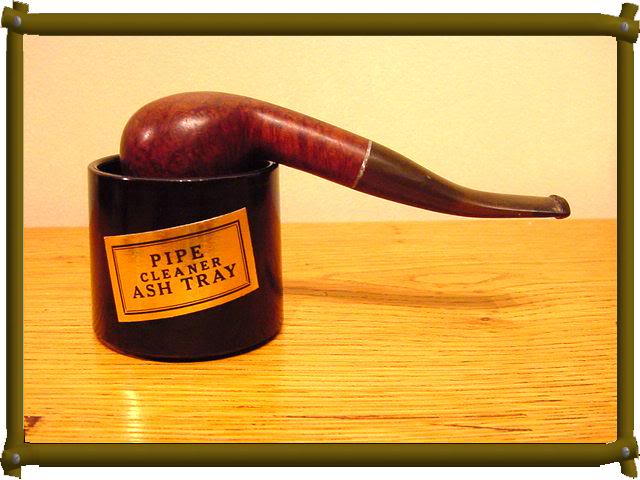
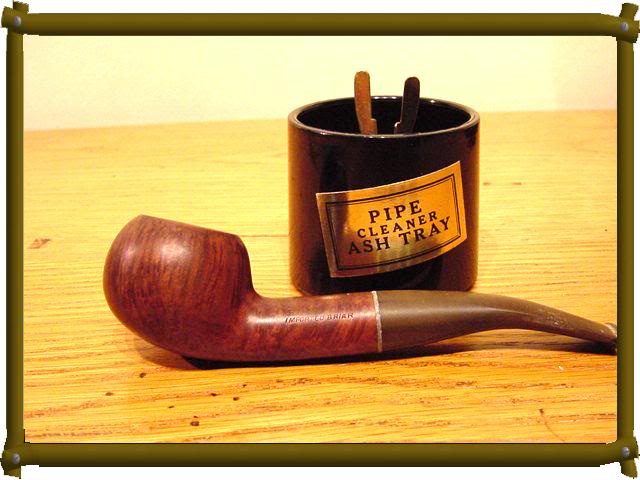
One of the side hobbies that comes with being a pipe smoker and pipe accumulator is the collecting of pipe smoking ephemera. I am always looking for old pieces that go along with pipes whether they be Bakelite pieces such as Wunup Baccyflaps, ash trays or tobacco jars or other interesting pieces of pipe paraphernalia. Something about these old pieces brings to mind quieter times. It makes me wonder if I am just an old soul born in a wrong era! Ah well, I continue to pick up interesting pieces along the way and enjoy having them in my pipe cupboard in my office. The one that I wish to show you all today is a great little piece – a Pipe Cleaner Ash Tray made out of Bakelite.

Image

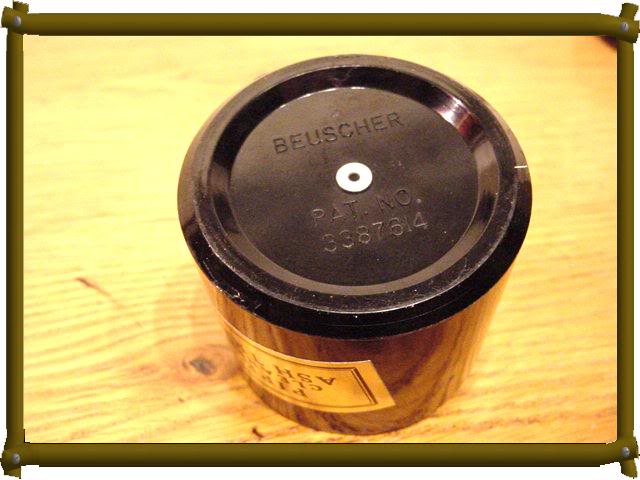
On the bottom of the ashtray there was a patent number cast in the Bakelite. I used that number to research the patent information on this interesting piece of ephemera. One of the beauties of the internet is that you can quickly do a patent search of the United States Patent Office Database. This website is your entry to a world of historical information on some of the pieces that you may have in your pipe cabinet or on your desk. http://www.uspto.gov/patents/process/search/ Once you are on the site you can search for information either by patent number or by the company name that is on the product. Quite quickly you are taken to a Quicktime picture of the patent information. It is there for you to read on line or you can copy it and save it for later reference. Image

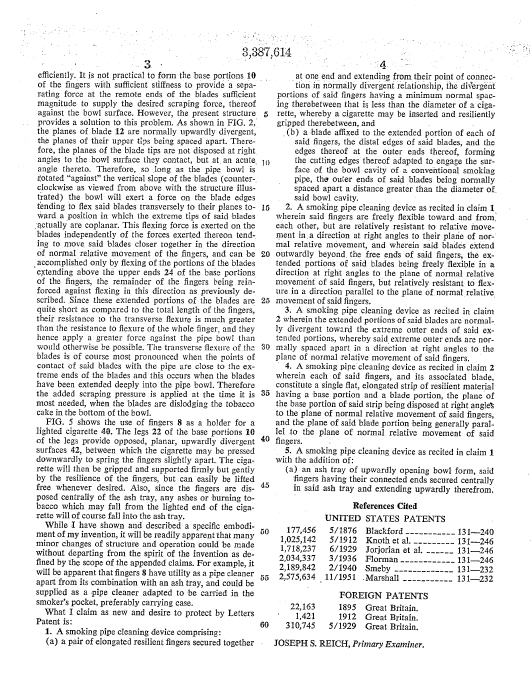
In this case there was indeed a patent taken on the piece by W.B. Beuscher. The patent information included drawing of the invention and also a great verbal description of the piece. I have included them below because they are fascinating information to have at hand for these old pieces. I have used that US Patent Office database for a lot of different patent information from pipes to reamers and always am intrigued by the inventiveness of pipe smokers who are on the hunt for the best tools of the craft for cleaning and smoking their pipes! Have a look at the drawings and the description of this 1966 item.  ImageImageImage

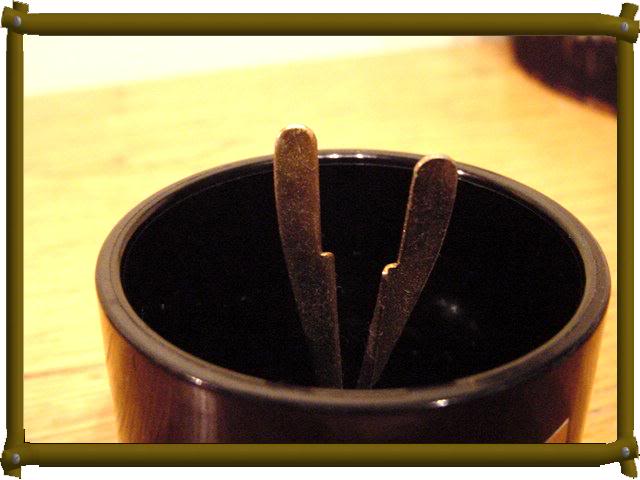
The particular piece that I have is a Beushcer and it is about the size of a coffee or tea mug. It is different from the drawing above only in terms of the ash tray itself. In mine it is a cup and anchored to the bottom of the cup are the patented pair of blades that can be squeezed to adjust to the width of a pipe bowl. The picture below shows the inside of the bowl and the blades a bit more clearly so that you can see the details. Image

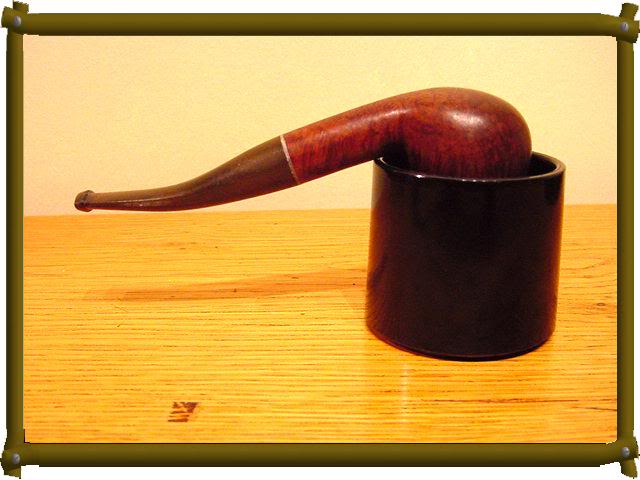
The next series of photos show the ash tray with a pipe that has been fit on the blades. The basic concept of the gadget is that after smoking a bowl of tobacco you turn your pipe over on top of the blades and give it a twist or two and the dottle and remainder of your tobacco is quickly removed into the ash tray for easy disposal. Then is a folded pipe cleaner is used to give the bowl a quick swab, another is run through the shank and stem and you are ready to reload your pipe for another enjoyable bowl in a clean pipe. ImageImage
Image

The inventiveness and creativity seen in these gadgets never ceases to amaze me. I don’t think I will ever use this one but it is a great piece of pipe history to have around. The patent data gives a intimate glimpse into the mind of its creator. It gives me the ability to see what the basic idea was and what the inventor hoped to achieve with his invention.

I Guess I Collect Pipe Reamers


Blog by Steve Laug

One of the side hobbies that came with collecting pipes was the collection of pipe reamers. I love the creativity and inventiveness that went into each one in my collection. I use many different reamers in the process of refurbishing pipes. It seems like I always need one that is shaped a bit differently than the one I am using so I reach into my box of reamers and almost certainly I will have one that fits the bowl size and shape.

Image

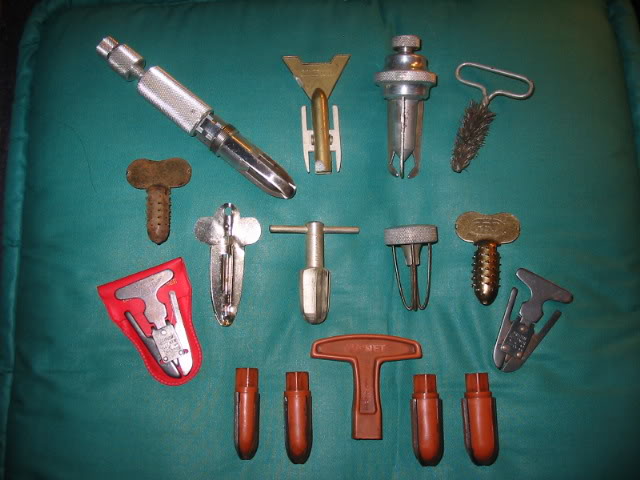
In the top row from left to right – a KleenReem reamer, an Atlas Rocket, A Rogers Rocket, and bristle brush on a handle. The KleenReem is one of the reamers that I use almost all of the time. It is adjustable and has a built in drill bit that work well in cleaning out the shank. The Atlas Rocket is spring loaded and work in both conical bowls and U shaped bowls. I use it on lightly caked pipes that I am cleaning. The Rogers Rocket is a bit of overkill but works well on U shaped bowls as the blades are adjustable. The steel bristle brush is very good for just knocking off lightly coated bowls and as a finish to bowls that I have reamed.

The second row from left to right – A Hedgehog Reamer, a no name folding reamer, a Dunhill T handle reamer, a spring steel blade adjustable reamer, a GBD reamer. The Hedgehog and the GBD reamer are similar – they are a steel bullet shaped end with a key top that has sharp metal spikes all around it. These two I rarely use as they just seem too brutal. The no name reamer is really nice for narrow conical bowls and reaches to the bottom of the bowl. The spring steel bald reamer is great as an initial field ream of the pipe. The Dunhill T handle reamer I have used to finish a reaming of many pipes. It seems to be sharp and is capable of smoothing out the cake and bowl walls to a nice finish. The spring steel blades adjust to fit any bowl size or shape.

The bottom row from left to right – In the red package is a British Buttner reamer and on the far right bottom is a second one. These two I generally have with me when I am travelling and on the prowl for estate pipes. They work great on pretty much any pipe bowl to give me a good cleaning before I bring them home to the shop. Care must be exercised as they can easily make a bowl lose its round shape if you do not hold it vertically when you turn it. In the centre at the bottom is my favourite reamer – a PipNet reaming set. It includes a T handle and four heads of different sizes that each has four blades embedded in the plastic. These can quickly be changed from size to size and any bowl is easily reamed. They do work best on U shaped bowls.

I think since I took this picture I have picked up several more reamers for the collection but these give the basic idea of what I use in the process of a refurbishment. Keep an eye open for reamers while you are out and about in the shops looking for estate pipes or on EBay looking for pipe lots. You never know what kind of great tool you are going to find. If you have some that are not in the picture above and want to part with them drop me a line or comment on this post. We can work something out!

Reflections of an amateur refurbisher


This week after seeing George Dibos’(of Precision Pipe Repair) three part post on cutting a stem from rod stock that he shared on Smokers Forums I have to say that I am left to confess that I am truly an amateur refurbisher. I am not downplaying the work I do or the pleasure I get out of my craft but only wish to acknowledge that there are true masters of the craft. George is truly a master at what he does. His careful attention to minute details of repairing pipes makes his refurbishments some of the best in the business. He is able to replicate stems that are incredibly matched to the originals. I am in no way negating the value of doing the work ourselves but it is acknowledging those who are leading the craft and creating beautiful work. I stand in awe of him and others like him who make this work look so easy. I must say that in comparison to them I feel a lot like a bush mechanic in the company of truly gifted mechanics.

I have no trouble acknowledging the fundamental difference between the work I do and what these gifted individuals in the pipe restoration/repair community do. It is truly no different than recognizing the difference between artisans who carve pipes as a livelihood and those who do it as a spare time hobby. Both are artists in their own right. To a varying degree there is a difference in the skill level, if not by natural gifting, certainly by sheer volume of practice. The same is true with pipe refurbishment. Those who have well developed shops, days focused on the process of pipe refurbishment, and skill and gifts in using the tools that they have will certainly have more carefully honed skills than the armchair or weekend hobbyist. This in no way makes light of either one. Both are integral parts of the hobby we enjoy.

I don’t have the tools, the space nor the skill set to do the kind of work that George and others like him do. I will probably never be the kind of individual who does what they do because, bottom line, to me it is a hobby and something I do for relaxation and not a vocation. I use what I have to do what I can and invent what I need as I go along. Part of the joy of the hobby for me is not just doing the work in the best way I can, but always learning new and better ways of doing things. I am a committed lifelong learner who has a hungry mind that is never satisfied with what I know and is always looking for new ways and new information. I love the creative process of refurbishment in that I can continually be challenged to work “magic” on new pieces that come across my desk. But another important part of the joy for me is the task that I have taken on willingly and freely to pass on what I learn to others in our hobby. It is a joy to see others take what I have learned and surpass me in their skill and expertise. To learn tricks from those who have learned from me is part of why I started the reborn pipes blog. I don’t just want to share what I have learned, I also want others to pass on what they have learned and their own refinements on the processes they experiment with. That is why I invite others like Al, Chuck, Fred, Rob, Ed, Bryan and more who share the love of reclaiming old briar and giving it new life.

For me the blog is a way we all can continue to learn from one another, share common ideas and issues and seek to understand how to address them as we work on the pipes on our desks. We can write about what we do and have others try it, refine it and pass on their knowledge. Thus, we create a living “school” in which to continue to develop our craft. It is a place for those of us who are amateur refurbishers, who love to tinker, love the process and the pipe, to continue to learn from each other. Lately I have been using Skype, an online web communication tool, to meet with individuals and work on pipes together. It is quite amazing to talk and work real time with another person on a pipe that they have on their work bench. It works with video and audio so that you can literally look at the pipes you are talking about. Worst case scenario Skype has an instant messaging component that you can type communications between several who are working on pipes. In my work I have used it with groups to have virtual meetings and can see that working really well to have a shop time gathering. I have written an article on one such experience and Part 1 of it was printed in the August issue of Pipe Smoker Unleashed Magazine – http://www.pipesmokerunleashed.com/magazine/august2012.html and is on the blog as a post. The second half of the article will be in the September issue and will soon follow on the blog. Skype provides a real time tool that we can also use to consult with each other on pipe repairs before and as we do them. This is a venue for us to use that is rich with possibilities. I am aware that others use “You Tube” and make videos of their work, but I am reticent to venture into that arena. I don’t know why, as I am sure it is helpful, but it just is not something I am interested in doing. Others may want to do videos and I can easily add them to the blog or they can start their own blogs.

As I close these reflections I have to say that when I look ahead at the future of pipe restoration and refurbishment I am excited to think of all the possibilities and all that there is yet to learn from one another. I also remain in awe of the calibre of work and craftsmanship of those like George. I delight to see the product of their skills and observe so that I can learn as much as I can in the process from them. I will always have to personalize their methods to work on my smaller scale of refurbishing but that too is part of the process I enjoy. I tip my hat to the masters and know that I will probably not live long enough to even come close to that kind of workmanship. However, I take my place proudly in the company of those who tinker at refurbishing and share their love of all things pipes with one another. My plan for the near future is quite simple, I will continue in my tinkering until I am no longer able. Why? Because it gives me pleasure!

Image

History of BBB Pipes


Blog post by Fiona Adler, translation Steve Laug

I have been doing some research into BBB pipes for sometime now because of my own interest in the brand and I found an online article in French. (The original article was produced with the assistance of Fiona Adler. I want to thank Guillaume Laffly for giving me this new information on the origin of the material in French.) I have adapted the article below from a google translation that I did of the article on http://www.fumeursdepipe.net/artbbb.htm (I alone am responsible for the English translation and any errors probably are the result of my poor translation!)

Origin and history of Adolph Frankau and Co. Ltd.

Adolph Frankau arrived in London in 1847 and quickly grasped the opportunities which the enlarging tobacco market introduced. He started “Adolph Frankau and Co.” and began importing meerschaum pipes and tobacco supplies. The Company took a young 14 year-old boy, Louis Blumfeld under its wing. The Company quickly thrived and did so until the untimely death of Adolph Frankau in 1856. His widow decided to sell the company.

Thomas Carlyle (1795-1881), author of “Hero and worship of the heroes” came on the scene at this point. He recommended that the widow Frankau not sell, but rather that she should entrust the future of the company into the hands of young Louis Blumfeld, then 18 years old. Carlyle had to have had a very high opinion of the young Louis to make this recommendation, and his trust proved to be justified as Blumfield took care of the company with enthusiasm and bottomless energy. Louis quickly realized, as others had before him, the potential of the newly acknowledged pipes made of briar.

Louis Blumfeld developed important international trade relations from the beginning, and had particular success in Canada, Australia, New Zealand, India, Europe, as well as Switzerland and Denmark. The USA had never been an extraordinary market for the company, but nonetheless a subsidiary was opened in New York. His commercial strategy focused on the countries of British Empire. Just prior to 1914, Frankau & Co. was the sole agent for Ropp Cherry Wood pipes in the United Kingdom and its colonies.

While BBB is the most widely known of Frankau & Co. pipes the company also produced several other brands of pipes: Capt. Kidd, Fairway (” F ” in white; FAIRWAY / LONDON MADE / ENGLAND), Frankau’ s (London Made in England), Glokar, Major Daff, and Snap-Fit. It also seems that Ultonia and Nec Plus Ultra must be considered to be brands in full measure, in spite of the fact that they were introduced as being product lines under the label BBB. It would explain their absence in many of the BBB catalogues.

The necessity of making briar pipes in London became more urgent, that’s why, at the turn of the century, Frankau & Co. opened a warehouse and offices at 121 Queen Victoria Street, an export service at Upper Thames Street and a plant in 1898 at Homerton, High Street 112 (then 154). The Homerton plant lasted into nineteen-eighties when Cadogan regrouped its manufacturing activities to Southend-on Sea.

In those days, Frankau & Co. also produced calabash pipes. They used calabashes that came originally from Southern Africa. Supply of the calabashes became more difficult to maintain due to the growing demand for them. BBB set up a special department to make calabash pipes. They used meerschaum to make the bowl while some of their rivals used asbestos or plaster of Paris. The manufacture of calabash pipes survived until the war in1914/1918. The war destroyed the supply of calabashes from South Africa.

The 1920s were not an easy decade for pipe producers. Frankau & Co was purchased by “Oppenheimer and Co. Ltd1”. Also during this decade Comoy’ s of London, Dr. Plumb and Loewe & Co. came under the control of Oppenheimer. The purchase of all of these various brands pushed the company to create “Cadogan Investments Ltd.2” at Cadogan Square, London, in the 1930s, to manufacture and sell its pipes. The plant at Homerton passed under the control of “Marechal Ruchon & Co.” (In 1970s, the plant took the name of “Fairfax Traders”), and continued producing BBB pipes in a traditional way. They finished pipes with a silver ring and stampings. However, BBB continued, as an independent company within the Cadogan Group. BBB concentrated on making a certain number of system pipes and on new finishing processes.

Richard Esserman thinks that Dunhill subcontracted the manufacture of stummels to BBB for the Bent Magnums until 1923. In fact, when the companies within the Cadogan group argued with one another, a new plant was established in Stratford, Carpenters Road. They also bought machines from Zuckerman as they were more efficient. The finishing workshops were closed, and pipes were finished in Aldershot and sometimes also in Shoeburyness.

In this era, it was a current practice in trade to give surplus stummels to other companies at agreed upon prices. Cadogan sold Rank I stummels to Dunhill, and bought Rank II, III and IV stummels from Dunhill. But they did not finish pipes for other companies: to sell Rank I stummels to Dunhill was more beneficial than making them into pipes!

Image

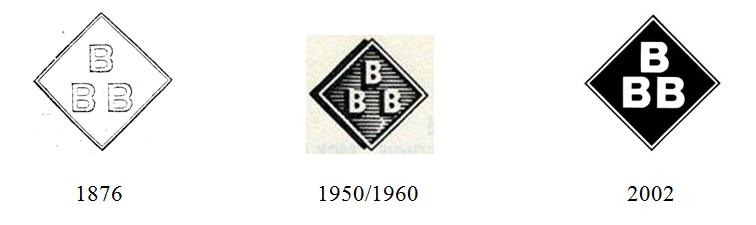
The BBB Logo

The initials BBB in a rhombus were quickly used as a symbol for the company, and that trademark was the first to be recorded when “Trade and Marks Act” took effect in 1876. Rather strangely, BBB registered under two numbers, numbers 39 and 40. In number 39, the acronym BBB in the rhombus (dates from deposit: January 1st, 1876; published on May 3rd, 1876 in page 21 of the Trade Mark Journal) for the class 341 (Tobacco, raw or fabricated and cigarettes), in number 40, a simple B for which no picture is available (the same references of store and publication) for the class 50 (fabricated Property from ivory, in bone, wooden, substantially plant or animal, pipes with tobacco, cigars and cigarettes (cigar and cigarette tubes). Note that Oppenheimer registered BBB again (number 39) for a new logo under the number 2288663 (December 20th, 2001; published on February 13th, 2002 in page 2634 of the Trade Mark Journal) for classes 14 (cases with cigar and cigarettes, soft packages of cigars and cigarettes, doors-cigars and cigarettes, all in precious metals) and 34 (Tobacco and products of tobacco, articles for smokers, pipes, tobacco pouches, door – pipes, lighters, equipment of cleaning for pipes, doors-cigars and cigarettes, cases with cigars and cigarettes, humidors). At the European level, Oppenheimer registered BBB under the number 002100907 (February 22nd, 2001, date of recording: October 7th, 2002), for classes 14 and 34 and under the number 0863111 for the class 34 (October 20th, 2005).

BBB Production

Some think that the first BBB pipes were imported, and that initials were intended to stand for Blumfeld’s Best Briars. Later these initials came to be understood as standing for Britain’s Best Briars.

At first, BBB produced two qualities of pipes. The one, BBB Own Make, became BBB Best Make, other pipes simply being stamped BBB. There are reasons to think that the Own Make was produced in fact in London (Reject pipes were stamped R). While simple BBBs were imported until the beginning of the 20th century. It is probable that the regular line of BBB pipes were imported from Saint-Claude, France.

The BBB collection followed along similar lines as other pipe producing companies during the second half of the 19th century. Shapes were similar to the popular models in vogue during that time with a predominance of bent pipes. Some of them had a silver ring. At the same time, BBB continued to deliver meerschaum pipes.

BBB was probably the first to offer pipes made to accommodate a paper filter. The Mackenzie, which was available in two qualities (Mackenzie, second brand of BBB, could have been produced in Republic of Ireland. Pipe stems were made of vulcanite). This technique dates from around 1900 as is stated in a letter dated from August 27th, 1891 from Mr. Morrel Mackenzie (1837-1892) in which he suggest that they make models with a longer stem. The Mackenzie brand survived into the 1960s.

It is thought that BBB was one of the first to call the pipes they had conceived with a long shank for a cooler smoke a “Lovat”. However, “Friedlands” could have adopted this name at the same time. Lovats appeared long before 1914 and were offered for sale by BBB in four different sizes, of which a series were stamped Highland. Colonel Henry Francis Fraser (1872-1949), Lord of Lovat, must have enjoyed the advertising of this shape made in his honour. It is still a popular shape at present. While BBB briar pipe shapes were similar to those of other brands, their models developed a very sought-after distinct character by the collectors. BBB earned the gold medal at the French-British Exposition in London in 1908 (Frank Bowcher, on 1864-1938) and at the World Fair and International in Brussels in 1910, the Medal of Godefroid Devreese (1861-1941). You can find pictures of these medals, notably on the advertising brochures of the 1950s and 1960s.

In this era the common practice was to set a pipe’s value by the material the stem was made of: ebonite, horn, amber, ambrolith etc. Also, price varied according to the size of the pipe. For instance, in 1914, the wholesale price of a simple billiard varied between 15 shillings and 22 shillings and 6 pence because of the size of the pipe and flock (no screw or tenon). Though this generally was true it seems that there were exceptions; for instance a Liverpool of five inches long with a stem in genuine amber had a wholesale cost of 12 shillings in larger quantities; the same pipe with a stem of ambrolith cost 19 shillings. BBB made different special series of pipes such as Chubby, Golfer, Dreadnought (probably named after different warships), Bellerophon (sic) and Cutty (small models). BBB offered some 20 lines of pipes that had different clever combinations of stems, finishing and decoration. Some of them had a silver ring. Around 1910, BBB Own Make pipes sold for 2£ 10 shillings while pipes only stamped BBB were sold for 5-6 shillings.

In the 1930s, the top pipe of the line was “BBB Best Make” with variants such as “Great Dam” and “Ultonia Thule”. The BBB Carlton, sold retail in 1938, was endowed with a complicated stinger system; the same system was also used on the BBB London Dry. The Blue Peter was not stamped BBB but BBB Ultonia, and BBB Two Star (**) was the stamping on lesser quality pipes. The calabash pipe was removed from the catalogues at this time, but some pipes with cases and some meerschaum pipes were still produced. Shapes of BBB pipe were typical of other companies pipes made in this era: half were billiards, some princes and bullcaps, bulldogs and some bents. It is also in this period that the inlaid metal BBB was put on more upscale pipes, while series of lesser quality had only the stamped BBB on the stem.

During the middle of 1950s and 1960s, BBB lines were comparatively stable. The top pipes of the line were stamped Own Make “Rare Grain”, followed by Own Make “Virgin”, Own Make “Walnut” and finally Own Make “Thorneycroft”.

Today, Cadogan uses Spanish briar for most of its pipes, and reserves the Moroccan briar for the production of high quality pipes. Before being sent to them for manufacture into pipes, the briar has been dried and cured for a time period of between 6 and 12 months.

To avoid any confusion about the ranking systems of their pipes in the Cadogan Group brands the company adopted a system of eight common ranks for all of its brands. Rank A is briar with nice grain, without any visible imperfections. Rank B has nice grain, but with some small black points and maximum of three sand pits which will be filled. Rank “Best Make” also has nice grain, with maximum of five small sand pits. The stummels with grain of variable quality and maximum six sand pits are ranked MB. The second rank pipes are of briar of mediocre grain but without defects or of nice grain but with up to eight fills or two big sand pits. The third, fourth and fifth ranks are given to pipes whose quality decreases proportionately.

1Adolph Oppenheimer started an import/export company in 1860, and his brother, Charles, joined the company later that year. Adolph retired in 1870 and moved to Germany, where he became British Consul then Consul general, letting Charles take the control of business. Louis Adler, who was the brother-in-law of Oppenheimer, became a colleague when Adolph left the company. Both brothers did not have heirs, so the ownership of the company passed to the family Adler. By 1870, the company imported GBD pipes into Great Britain from Paris. The association of Oppenheimer with GBD was such a success that in 1897, Oppenheimer became the sole agent of the French company. Five years later, the French owners of GBD, Marechal Ruchon and Co., merged with A. Oppenheimer.

2Cadogan’s slogan, “Pipemakers Since 1825” refers back to the first clay pipe which Francois Comoy fabricated in 1825. Cadogan’s pipes were fabricated in numerous places disseminated around London and to Saint-Claude, but with the purchase of Orlik Pipe Co. In 1980, Cadogan regrouped the entirety of its manufacture in the new plant of Southend-on-Sea, plant especially constructed for pipe making industry. Cadogan continues to fabricate GBD, Comoy’s of London, BBB, Dr. Plumb, Loewe and Orlik pipes (since 1980). They also make Kaywoodie pipes for the British market and have recently agreed to make Sasieni pipes for James B. Russell.
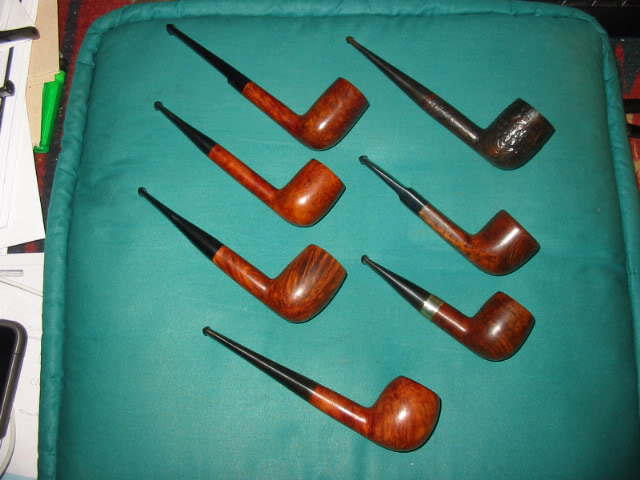
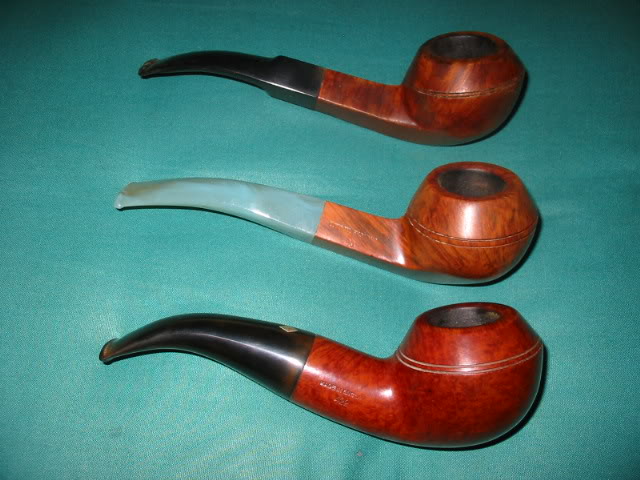
I have attached a few pictures of some of my BBB’s. I love these old pipes and have quite a few.

Another Gift from my Binner Friend


I was going through older files tonight cleaning out some old materials and came across this note regarding another gift of tobacco from my friend Don, the homeless binner that I wrote of earlier in A Surprise Gift Awaited Me at the Door (https://rebornpipes.wordpress.com/2012/05/30/a-surprise-gift-awaited-me-at-the-door/).  In Vancouver, where I live, there is a subculture of folks that makes a living out of the refuse of others who discard things, instead of repairing them. You can see them working their routes across the city diving into dumpsters/waste cans or picking through them with sticks to reclaim “valuable” throwaways. They are called dumpster divers or binners and work daily from sunrise till after dark. Over the years I have known Don, he has come by to visit often after a successful day, having found recyclables of glass, metal, wire, etc. He has shown me art work, stereo systems and televisions that still work with a bit of fiddling, which he repairs and sells in shops around the city. In the last piece I wrote about Don I told the story of a box of tobacco he brought me from his finds. He swore he got these from a pipe smoking friend but I don’t know whether to believe him or not. Actually it does not matter. The last time he left me a gift of many of GL Pease’s tobacco and others that I had not smoked before. This note describes the next gift tobacco he brought me.

Here is the piece I wrote on May 16, 2008… Man I miss Don and his mystery gifts.

I had not seen my homeless friend Don for about a month and today he came by for a visit. He walked up pushing a shopping card piled high with treasure he had found on his binning route. I could see clothes, shoes, electrical items, flashlights, coats, and other cast off items that looked to be almost new. Around and on top of these were his bags of recyclables. Tied to the push bar of the cart was his little terrier Spaz. Spaz was his partner and everyday companion. I don’t think in the years that I have known Don I ever saw him without Spaz. When Don came to eat Spaz came with him. When he came to Christmas and other holidays Spaz came with him. When I was pastoring a church here in Vancouver, he and Spaz came to church. Spaz would guard the shopping cart of treasures while Don relaxed and visited. He would always ask for some water for Spaz and would give him some treats from his pocket before taking care of himself.

Today he came by to tell me that he is heading home to Ontario and spending the summer with his Dad. He was going to hitchhike across Canada to get there. He brought me another surprise gift of tobacco to use as fuel for negotiating a ride to the edge of town on Monday morning. He had a bit of twinkle in his eye as he spoke of the swap. You have to imagine what Don looked like. He was a midsized skinny man in his late 40’s. He had lived on the street and in the bush for the past ten years so he had a weathered face and features. He had crow’s feet at the corners of his eyes that crinkled when he grinned. He had a toothless smile as most of his teeth had been pulled and he hated wearing his dentures. He had his day pack on the ground as he talked to me. He took out his trade to hand to me and watched as I took it from him. I figure he wanted to see if my reaction would be the same as it was the last time he handed me a gift.

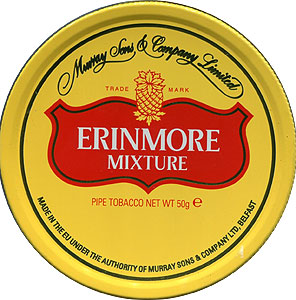
Imagine the surprise when I opened the bag he handed me and looked inside of it. I must have registered that surprise all over my face from big eyes to an opened mouth ooooohhh. I reached into the bag and pulled out six 50 gram tins of Erinmore Mixture – the old Murray and Sons tins from Ireland – five of them in a sealed carton and one extra tin for good measure. All of them but one was unopened. That one in the sealed carton had popped open and was spilled inside the box. The smell of the tobacco was amazing. I probably started salivating like Pavlov’s dogs about that time. Don started laughing as he watched me. He winked and said, “I guess that means you can take Spaz and me on Monday?”

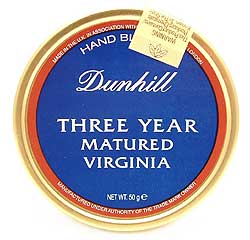
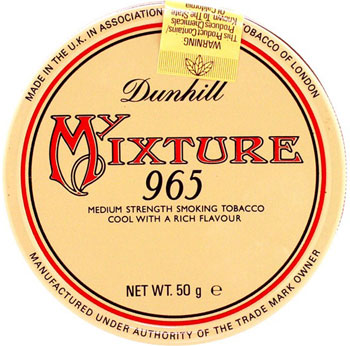
I just shook my head, too amazed to speak. Don told me to dig deeper in the bag as there was some more there that he was sure I would like. I moved the Erinmore carton and under that to sealed plastic bags of tobacco – a pound and 1/2 of Dunhill 965 and a pound and ½ of Dunhill 3 Year Matured Virginia. These were double sealed in two freezer bags and labelled with the name and the year. These tobaccos were dated 1995. Needless to say I would have given Don and Spaz a ride to the edge of town anyway but this more than sealed the deal. I have no idea where Don came by this tobacco any more than I knew where he had found the last lot he brought me. He never would tell me, just laugh and say, “I have my sources!”

ImageImageImage

What a gift. I just shake my head at my friend’s thoughtfulness. I will miss his visits this Summer.”

The note ended there and today as I read it over again, I still shake my head at my friend’s thoughtfulness. I miss his visits.  It has been four years since I have seen Don and Spaz. I have looked for them in their favourite spots without result.  I don’t know what happened to him.  I know that about two years ago he called to tell me he had found an apartment and give me the address and phone number. I called and went there but he was not to be found. I don’t know if he is still around or even still alive. But I know that he has made an indelible mark on my life and memory.

Those who have so little seem so much more giving and generous than those of us who have much. I lift a pipe of MM965 to you my friend where ever you may be. I will always remember your kindness to me and my family. Thank you!