Category Archives: Book Reviews

I have quite a few books on Pipes and tobaccos. In this section of the blog I will review the books i have read and reread on this topic. If you have some that you have read and wish to share them this is the place ot put them.

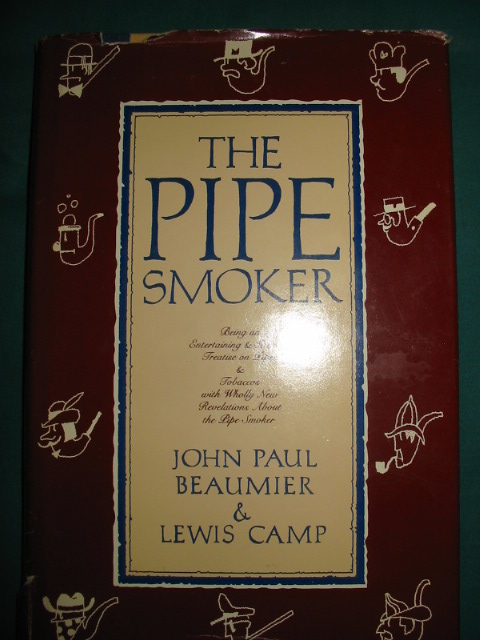
The Pipe Smoker – John Paul Beaumier & Lewis Camp


Image

A Review – The Pipe Smoker
John Paul Beaumier & Lewis Camp

The sub title sums up the purpose of this book very well: “Being an entertaining and scientific treatise on pipes and tobaccos with wholly new revelations about the pipe smoker.” If you have you ever really thought about why you smoke a pipe or why some people smoke pipes and others just cannot be bothered, then this is a book you could have written given the time and thought… or at least one that you should read

The Pipe Smoker was written from a different slant according to the authors in the introduction. Their names on this book are pseudonyms for two northern California psychologist/authors. One is a scientific consultant to a leading American pipe manufacturer, the other is an expert on mind-body relationships and a long time pipe smoker.

Almost all other books written about pipes and tobacco focussed on that topic. This one has taken the tact of focussing on the pipe smoker. It is a study into what make a pipe smoker different from other humans. The argument is that once we have come to know some of the compelling reasons for this difference we will better understand why the infinite varieties of tobaccos and pipes have such special meaning to this special person.

With that purpose in mind the authors set out to look at us – the pipe smokers. The outline of the book illustrates this clearly. Each chapter in the five major sections is introduced by a pipe smoking quote from famous and anonymous pipe smokers that illustrate the content of the chapter. They add an interesting dimension to the book and to its overall direction – they give voices to the person of the pipe smoker. The five major sections are organized as follows:

Section 1:The personality of the pipe smoker – in which the authors look at the aspects of the collective and individual personality of the pipe smoker. They discuss masculinity, social image, extraversion vs. Introversion and what they say is the penultimate pipe smoker – the healthy introvert.

Section 2: What the body says – here the authors look at the pipe as a means of relaxation, sex and the pipe smoker, meditative mindset and pipe smoking. This is a fascinating section of the book and contains reflections that I have never read elsewhere.

Already you can see the different direction of this book takes. It was a hard book to put down without finishing the last pages.

Section 3: A sensual guide to the art of pipe smoking – Here the authors discuss the sensuality of the pipe and its effects on the smoker. They discuss the odour and taste of tobacco, the look and feel of the pipe, the caking, filling and lighting of the pipe, the exquisite pleasure of puffing and finally the care and feeding of the pipe. Here they capture for me in a way few have, the pleasure of the ritual of the pipe. Each chapter in this section captures what goes on in my senses and feelings as I savour a pipe. Well written.

Section 4: The Grand world of pipes – This section finally gets to the normal pipe book topics – it is the shortest section of the book. It covers what pipes are made of and the geometry of pipes – how they are made. Even this mundane section is written in a captivating manner.

Section 5: The book closes with a section on the religious and symbolic aspects of pipe smoking – but lest one get confused that somehow they are merely talking about sacred smoke the chapters in this section discuss the sensuous symbolism of pipe smoking the sacred and the profane in pipe smoking. It is a delightful ending to a wonderful treatise on the person who smokes a pipe.

I found that this book was a great read and thoroughly engaging. It is unique in pipe smoking literature. It treads some of the ground that lately Gary Schrier does in his Confessions of a Pipeman and does it as uniquely and interestingly as Schrier does. The book gives one much to think about – whether you agree or disagree with any one piece of their premise. Worth the read!!

The Pipe Smoker’s Tobacco Book – Robert Winans


Blog by Steve Laug

Book Review

The Pipe Smoker’s Tobacco Book

Robert F. Winans

Winans’ book on tobacco is just that a book on tobacco. He says in his introduction that the focus of his book is to concentrate on the subject of tobacco as it relates to pipe smoking consumers. Winans says it this way in his introduction, “It is a paradox that of all the people concerned with tobacco, the consumer is probably the most poorly informed about the content of a tobacco blend and its quality. There are some practical reasons for this. Foremost is his preoccupation with the end result. As long as a pipe tobacco blend delivers a smoke which produces the desired taste sensation and pleasure, the details surround the growing process, chemical analysis, type of tobacco, flavouring process are secondary.”  Yet many of us are interested in the details of what it takes to produce a quality smoke.

If you are one of those who want to know those details, like I am, then this book is a gold mine of info that walks you through the process of tobacco production from the seed, the growing area and conditions to the processing and the marketing. Winans includes many charts and tables to help facilitate understanding tobacco. The tables and charts are worth the price of the book. These include maps and charts of regions where various types of tobacco are grown and how the climate, geography and soil conditions impact the chemical make up of the tobacco. There are tables of percentages of tobacco varieties produced and where within the US they are produced. There are rating scales and diagrams to help understand which part of the plant is used for what particular tobacco product. All are well drawn and composed to aid in understanding.

The book is divided into three main parts after the brief introduction that justifies the book. Each part picks up a piece of the picture of the tobacco product. Part one is about the kinds of tobacco. This section was a bit surprising to me as he argues that there are only three kinds of tobacco: flue-cured, Burley and Oriental. From these he works through the variations under each of those broad categories. For 57 pages he works through the makeup and composition of each of the kinds of tobacco. He looks in depth at the conditions they are grown under, the impact of that on the taste and the curing methods. This section of the book is very interesting and has many helpful charts, drawings, graphs and maps to help explain the processes and the chemical composition of each of the tobaccos. In it he also shows the impact of climate change on the sugar and nicotine content of tobacco. He compares a normal growing season, a wet season and a dry season in terms of the output of sugar and nicotine percentages in tobacco. Each of the varietals of tobacco are looked at in terms of their classifications – class 1: flue-cured, class 3(a): light air-cured burley, class 3 (b): dark air-cured, class 2: Dark fire-cured, class 3 (a) Light air-cured Maryland, class 7: Perique. He then turns to a discussion of Turkish tobacco and Cavendish. Part one closes with discussion on the importance of sugar in tobacco.

Part two of the book is approximately 8 pages in length and has reflections on tobacco and what makes a quality tobacco. This section focuses on what a pipe smoker wants from a tobacco. This includes such things as tobacco bite and the coolness of a smoke. He discusses the relationship of temperature and time at the point the smoke enters the mouth. In this section he talks of the relationship of puffing cadence to temperature. This section, though brief, is fascinating. The charts and graphs on temperature and cadence are helpful in explaining why things work the way they do in a smoke. The final part of this section seeks to lend some objectivity to the concept of what makes up a quality smoke. Part two is a great read full of helpful information delivered in short pithy explanations.

Part three of the book is short as well and is packed with tobacco statistics and bibliographic materials. He has statistics on the amount of tobacco grown and where it is grown globally. There are also statistics on the kinds of tobacco grown and what percentage they make up of the total global tobacco crop. These tables are dated in that they reflect the world in 1975 but they still give a helpful glimpse of things to those of us who are interested in such things. These graphs and charts are clear in their presentation of the state of tobacco production, the values of tobacco in percentages to type, and the geographic regions that produce the most tobacco by kind. The final chart in the book is a graph predicting tobacco use in terms of rise and decline.

The book is a great read. It is well written and well documented. It is a short book (80 pages of information) but it is packed with great information. The facts are very clearly presented and substantiated. There is little left to personal opinion or argument by the method which the author chooses to present the material. This is a concise handbook on tobacco that enables the pipe smoking reader to intelligently look at the “leaf” he/she is stuffing into their pipes to smoke. I highly recommend it. I purchased the book at http://www.pipes2smoke.com