Category Archives: Book Reviews

I have quite a few books on Pipes and tobaccos. In this section of the blog I will review the books i have read and reread on this topic. If you have some that you have read and wish to share them this is the place ot put them.

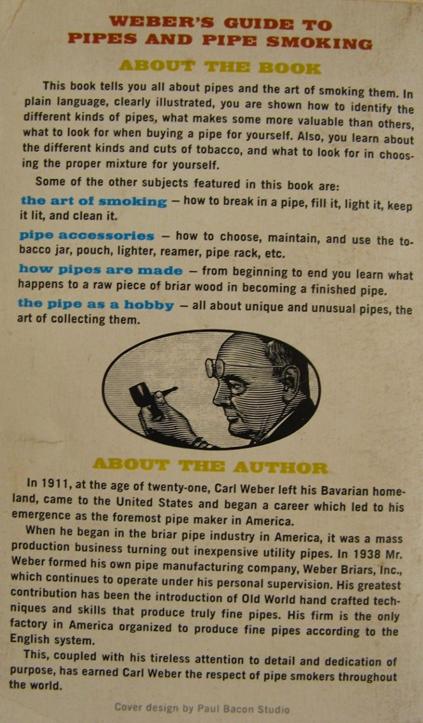
A Book Review – Weber’s Guide to Pipes and Pipe Smoking by Carl Weber


Blog by Steve Laug

13139507 Probably one of the first books I picked up for my pipe library was Carl Weber’s Guide. It has a price tag on it from a used bookshop that I frequented in those days that dates it to June of 2002 and I paid a princely total of $4 for it. My copy is noted on the cover and the cover pages as An Original Edition though I am not sure what that means. It originally came out in 1963 ad copy is one that was reprinted in 1967 by the Cornerstone Library, New York City. Carl Weber was the Founder of Weber Briars, Inc. a company whose pipes have passed through my collection for the past 20 years. I remember finding this book in the book shop – way back in the far left corner of the shelves in the area of collectibles and hobbies. I had read of it but not seen a copy so I snatched it up and made it mine.

The table of contents is very straightforward as to what is covered by the book and as is true of most well written books it gives an outline of the topics covered between the covers of the book.
Table of Contents:
Forward
1. What is a pipe?
2. The Briar and the Meerschaum: The King and Queen of Pipes
3. Pipe Varieties
4. Selecting Your Pipe
5. Selecting Your Tobacco
6. The Art and Science of Pipe Smoking
7. How Briar Pipes are Made
8. Pipe Accessories
9. The Pipe as a Hobby
10. Questions and Answers About Pipes

To begin this quick review I want to quote three portions from Weber’s Forward to this little handbook. The first one sets the stage for his proposition that pipe smoking is a most pleasurable pastime. He writes:

“No one really knows why men smoke. Yet long before the discovery of tobacco, smoking had become the abiding joy of many peoples. Since tobacco’s discovery, smoking has truly become one of mankind’s most pleasurable pastimes.” – page 7

The next quote I find particularly poignant in a handbook on smoking. It calls the pipeman to treat his pipe well and it will treat him well. Oh how I wish that many of the owners of the old pipes I refurbish had read these words. He writes:

“The real pipe-smoker soon learns that pipe smoking is both an art and a science. The pipe responds to its owner with exactly the same treatment that it receives from him. The man who masters the techniques of pipe smoking is repaid by a satisfying smoke, a joy which he created for himself with his own hands.” – page 8

The last quote gives the stated purpose of the book in Weber’s own words: “The sole purpose of this book is to help the smoker achieve these rare moments of serenity, which are increasingly hard to come by in the accelerating pace of the modern world.” – page 8

Weber’s Guide can be divided into four major sections – each covering several chapters. These section divisions are my own and are not found in the book. I find that they help to organize and locate material for my quick reference.

Section 1: Chapters 1-3
The first three chapters cover the topic of the pipe. Chapter 1 begins by discussing what a pipe is in terms of constituent parts and what it is used for. It gives a brief history of pipes and tobacco that is truly no different from any other pipe book I have read over the years. It is written in Weber’s inimitable style and is a very accessible quick read. In Chapter 2 compares briar and meerschaum pipes which he calls the King and Queen of pipes. He gives a brief history of the development of both. He concludes this section in Chapter 3 by giving a survey of different types not found in the two main categories already covered: calabash, corn cobs, water pipes and clay pipes. The chapter ends with a brief survey of the field of pipes and concludes with these words; “Whatever your style of smoking, chances are that somewhere you’ll find a pipe to match it.” (page 42)
Throughout each section of the text there are line drawings and sketches to illustrate the point the Weber is making in that section. They break up the text and add interest to the reader.

Section 2: Chapters 4-5
The next two chapters are about how to select a pipe (Chapter 4) and a tobacco to smoke (Chapter 5). The selection of a pipe is very individual. As Weber says, “…it must first of all, fit your personality and character.” He adds another line that has fueled much discussion. He says that the pipe should “enhance” the appearance of the pipe smoker and not detract. He gives examples of how this works in his opinion. He goes on to discuss flaws in briar with helpful insights in how to understand these natural parts of the briar. He discusses pipe shapes and gives three pages of drawing of the various shapes of pipes that is very helpful. He includes a page of stem drawings to accompany his paragraphs on the type of stem that is used. Chapter 4 concludes with a discussion of filter, the personality of the piper and the prices that pipes are selling for. The paragraphs on pipe and personality are interesting and entertaining. He suggests standing in front of a mirror and trying to match the shape of the pipe to your own shape – this idea has also engendered much derision and discussion.

Chapter 5 on Tobacco Selection is a succinct and helpful tool to a person trying a pipe for the first time as well as to the seasoned veteran needing a quick refresher. It begins with a quick botany lesson on tobacco plants before going on to discuss the types of tobacco that are smoked and their taste to the smoker. He has descriptions and information on Burley, Virginia, Cavendish, Maryland, Latakia, Perique and Turkish tobacco. He discusses and offers a diagram of the four basic cuts of tobacco – cube cut, cut plug, long cut and granulated. He ends this chapter with two paragraphs on the art of blending tobacco to suit the tastes of the smoker.

Section 3: Chapters 6-7
The third major section of the book is about the use of the pipe and the manufacture of a briar pipe. Chapter 6 covers what Weber calls the Art and Science of Pipe Smoking and is a good general introduction to our hobby. It covers packing, lighting, and smoking a pipe. It talks about breaking in a pipe, enjoying it and maintaining it. Chapter 7 gives an overview verbally on the birth of a briar pipe from burl to finished product. That is followed by a pictorial spread showing the making of a pipe illustrating what has been said in the first portion of the chapter. It concludes with paragraphs on stem making and finishing the pipe before it leaves the factory to be held in the hands of the pipe smoker.

Section 4: Chapters 8-10
The final section picks up all of the extraneous details of pipe smoking that have not been covered in the rest of the book and are necessary to proper enjoyment of the hobby of pipe smoking. Chapter 8 covers accessories – pipe cleaners, sweeteners, humidors, tobacco pouches of various styles and layouts, pipe racks, ash trays, wind caps, pipe tools and other useful gadgets that fall outside of these wider categories. Chapter 9 on the pipe as hobby cover the pipe collecting aspect of the hobby and addresses the types of pipes that are collected from high-end to oddities – the better mouse trap version of pipes. It ends with a short treatise on how to evaluate pipes that are collected.

Chapter 10 is a Question and Answer section. It covers a wide range of topics that somehow capture many of the first questions that new pipe smokers ask. It is set up in a question and answer format and covers such topics as how to tell the difference between block meerschaum and pressed meerschaum, rehydrating tobacco, sweetening a pipe, repairing broken stems, tongue bite, the meaning of stampings such as Real Briar and Imported Briar, mixing tobacco blends, shapes and their effect on coolness of a smoke, proper moisture levels in tobacco, directions for reaming a pipe and the life expectancy of a briar pipe.

I believe that Weber did an admirable job of meeting his purpose as stated in his Foreward. While the book is not an exhaustive treatment of the topic it is comprehensive. His style of writing is inviting and makes this a very accessible and readable book. Copies of it are readily available online through such sources as Amazon.com and Abebooks. A quick search of the title will give you access to a wide range of copies and prices to match your budget. It is well worth the read and is a great book to have on hand for new pipemen you introduce to our hobby.

From the back cover.
back cover

A Book Review – Tobacco, Pipes and the Pleasures of Pipe Smoking


IMG_5918 This beautifully illustrated little book was produced in Canada to be given as a gift to pipe smokers by the – Turmac Tabakmaatschappij Canada Ltd. In their introductory preface they declare their intent to give it as a gift to be enjoyed as much as they enjoyed collecting all the stories and anecdotes about pipes and pipe smoking. They end their paragraph with the words; “We hope that it will add new pleasure and meaning to your pipe smoking”.

On the inside fly page there are these words: “I keep a friend in my pocket… my pipe. When I sit out on the porch at the cottage and the evening is quiet, I like to take my friend out of my pocket, tamp in bright, golden shreds of tobacco, and light up.

Then, when the bowl glows red in the dusk, when the bit tastes warm, and fragrant wisps of smoke trail in the still air, peace comes to me and my friendly pipe.”

The book is a short 35 page overview of the field of pipes, tobaccos and pipe smoking itself. It is not divided into chapters but rather into sections. Virtually every page is filled with beautiful photos, engravings and pen drawings of pipe history. A wide variety of photos of pipes grace the pages – from ancient clay to modern clay, from briar to meerschaum.

The book begins with a brief history of tobacco and the art of smoking it. It development is traced across the continents on both sides of the Atlantic, or Pacific as the case may be! There is a quick walk through Columbus and the discovery of tobacco and its use among the indigenous population of the Americas. The name tobacco comes from what these people called their smoking tubes – Tobaga. It later morphed into our now well known term tobacco. The text quickly moves to Sir Walter Raleigh’s impact on the use of tobacco in the British Isles. The entire history is brief and well written. It moves through 8 pages and covers a broad scope of history in a way that is a pleasure to read – interspersed with quotations from early journals and drawings and photos from the time periods discussed.

From there the book turns to the history of the pipe itself. In a section entitled “From Coconut to Seafoam”, the authors give a brief introduction of the materials that have been used in making pipes. The section moves through the materials in quick order in a compact and entertainingly written piece. It begins with the coconut used in Nargilehs in the orient to clay, porcelain, iron, steel, bone, stone, silver, copper and bamboo and finally to the meerschaum and then the briar. The section then develops longer treatments on each of the major materials – clay, porcelain, meerschaum and finally briar.

I found it particularly interesting to read the well written discovery of the meerschaum pipe. A Budapest Shoemaker named Carl Kovac was the first man to carve a meer pipe. This section reads like a well written short story.

There is a short section on Pipe Smoking and Fine Art in which the writers quickly summarize the presence of the pipe in fine art. Again it is not the breadth that gives the subject its interest but the choice of what to cover. In a short paragraph the Dutch masters, Rembrandt and Honore Daumier are all mentioned.

The section on the pipe ends with a description of the briar pipe and its development from burl to pipe. In a succinct section the process of pipe making is delineated with enough information to be entertaining and informative.

From the discussion of the pipe the book turns to discussing what we smoke in our pipes. IN very short and descriptive sentences tobacco growth and processing is covered with a brief glimpse of Virginia, Burley and Oriental tobaccos and how they are processed to the leaf we smoke.
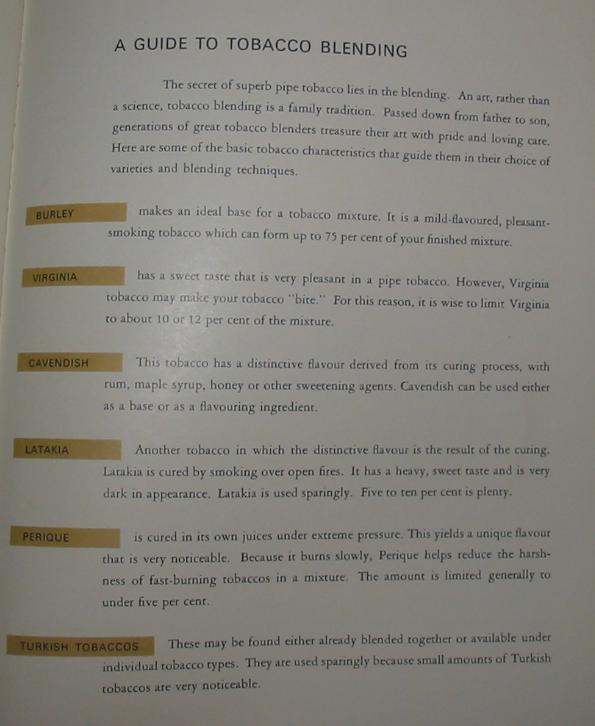
The next section is pictured below and is entitled “A Guide to Tobacco Blending”. The descriptions are well written and concise. I don’t think I have ever read this kind of compact and clear writing that is also entertaining and direct.
IMG_5919
Once the details on various blends are explored the text turns to the art of choosing a tobacco. I had to laugh when I first opened the book and found the tobacco placard below inserted at this point in the story. It was almost like a bookmark and of course is one of the blends that gifter of the book manufactures.
IMG_5923
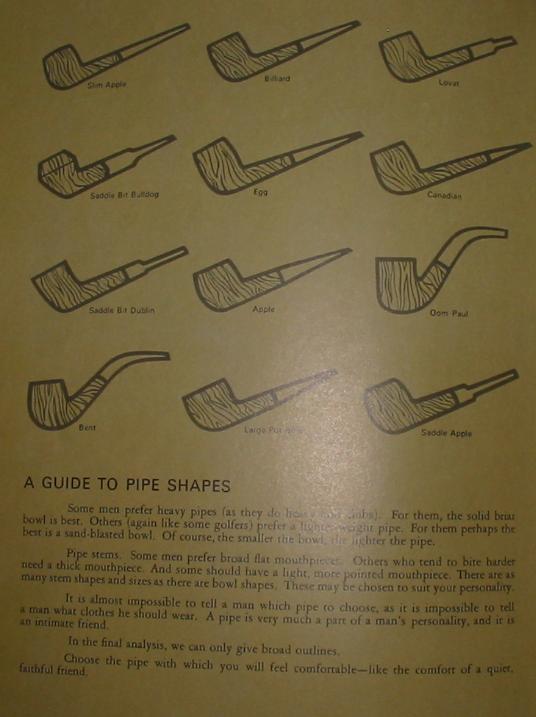
The section on choosing a pipe was fascinating reading. Again in the style of English that is clear and pointed the authors give the major things to keep in mind when choosing a pipe of a particular shape and finish. They provided the following diagram as a part of the book that is helpful.
IMG_5920
The last sections of the book can be summarized as tips for pipe smokers and includes all the information necessary to load and light a pipe as well as what is necessary to take care of it as you use it in the course of your life. There are tips on how to have and maintain a dry smoke, how to care for the cake in your pipe – proper reaming procedures etc are diagrammed to help the pipe smoker visualize how to keep their pipe functional and delivering the best possible smoke that it is able to deliver. It also includes a section on accessories that are necessary for having a great smoke. These include pipe cleaners, liquid pipe cleaner, humidors, tobacco pouches, ash trays, pipe tools, pipe racks and of course the pipe collection!

The closing paragraphs of the book bear quoting. They give both a great conclusion to the book and a clear picture of the writing style of the book. It is that which captured me the first time I read it and that which keeps me coming back. I quote:

“ A day can never be completely without brightness as long as there is a glowing pipe in hand, nor can a man be alone, for in a good pipe there is companionship, its warmth is like a glowing hearth where in there is deep understanding and peace.

You like the friendliness of a man with a pipe and what better compliment to a friendship than for a man to offer you some of his own special tobacco. Just this one simple act will tell you he is gracious, reliable, unselfish and, above all, considerate.

A good pipe and a good tobacco say good things of a man. And the good things that it does are many: it gives heart to the man at work, it accompanies his leisure hours and brightens his fireside at night.

His cares, his worries drift away in the air, weariness floats away and disappears, it brings hope for the days ahead and the contentment of well-being. It is a brightener of conversation, the maker of friendship.

In its aroma there is comradeship, and in the goodness of its taste there is unending pleasure.
Indeed a simple pleasure with deep satisfaction, and priced so that a man may enjoy the contentment of hours, if he has but two silver quarters.”

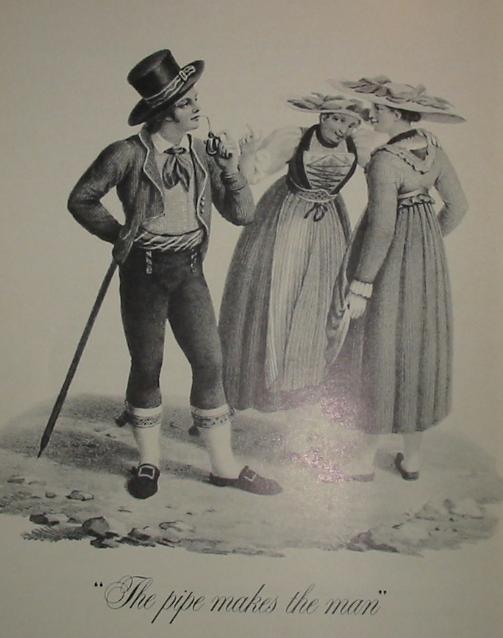
I think that well summarizes the beauty and pleasure of this small book. If you can find a copy you will not do wrong to buy it whatever the cost. It is a treat to read and has the ability to lift you from the mundane of your days. The following drawing in on the end piece of the book.
IMG_5922

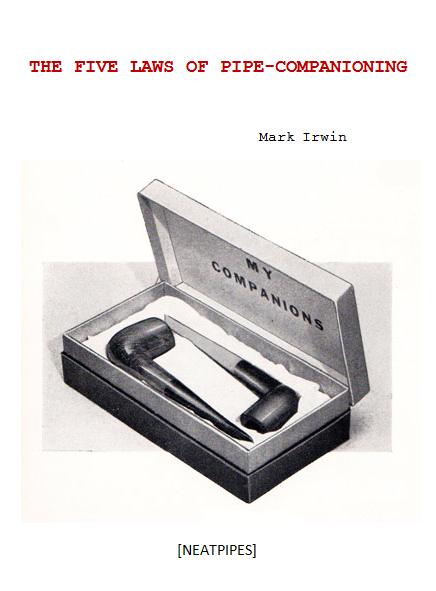
A Book Review – The Five Laws of Pipe- Companioning by Mark Irwin


Blog by Steve Laug

Several weeks ago now I received a cryptic email from Mark telling me to keep an eye out for a small package coming from Luca at Neatpipes. Knowing Mark’s proclivity for pipes – Irish and Italian I was not sure what to expect. But I also know he writes a blog for Luca Neatpipes http://www.neatpipes.com/blog/list/diary-of-a-mad-padster/&id=1 so I wondered if there was not a new book on its way to Vancouver.
coda-companions
On the blog was a series of blog articles on what Mark called the Five Laws of Pipe-Companioning. I had read them earlier and enjoyed his writing and what he was proposing. Sure enough when the package came it contained a copy of Mark’s book on the subject. I was thrilled to be able to give it a read. It was published by Luca of Neatpipes and is a small pocket sized book. I know it is pocket sized because I have had it in my pocket several times over the past week and have taken it out for a read at lunch hour, coffee breaks, while standing and waiting in various queues. It is the perfect size for this kind of subterfuge. I am one of those guys who always has a book in the pocket of his jacket so regardless of where I have to wait I have something to make the wait endurable – bank lines, grocery lines, transit lines, you get the picture. Mark’s little book is perfect for my habit.

The Table of Contents gives a short version of the Five Laws and is a great summary of the content of the chapters that follow. I have learned a habit garnered from Mortimer Adler’s How to Read a Book many years ago now, of reading the Table of Contents and Preface of the book to get a feel for the author’s focus and purpose. Doing so this time around did not let me down. The chapters in this little book are as follows:

Preamble 7-9

Pipes are for use 11-17

Every pipeman his pipe 19-25

Every pipe its pipeman 27-33

Preserve the pipes 35-41

Your pipe community is a growing organism 43- 49

Afterword 51-57

Coda 59-67

While Mark writes the book from the Preamble to the last chapter, Rick Newcombe writes the Afterword and Luca Di Piazza writes the Coda.

As can be seen above the book is a brief 67 pages long and can be read in one sitting, but I have found myself reading and rereading the chapters and reflecting on the concepts that Mark proposes in them. It is not so much the profundity of the concepts as the turn of phrase that I have come to associate with Mark’s writing that brings me back again and again. It is a good read for that reason alone in my opinion. But certainly there is more grist for the mental mill than just the turn of phrase in this book – whose concepts go beyond the scope of the short 67 pages. They open a world of reflection for those with that bent. So, load a pipe, find a quiet spot and delve into the words and ideas of the Five Laws of Pipe-Companioning.

In his Preamble Mark spells out what he means by the use of the word, “laws”. Rather than explain it myself I will let Mark do it in his own words. The following comes from the Preamble: “I need to be clear that what follows aren’t “laws” in the sense of something we need to debate, argue about and legislate according to majority rule. They’re universal principles, viz., underlying operative conditions of our hobby…You’ll see beliefs and opinions – mostly mine – but these are not about the laws themselves, but about the way the laws can best be practiced (or observed), something always open to interpretation.” With those introductory words the Five Laws are applied and examined. The layout of the book is well done and draws the reader into the work. There is lots of white space making it easy on the eyes and some beautiful pipe photos inserted between chapters to add colour and “eye candy” for a break to ponder to the words that have just been read in the previous chapter. It is a beautiful little book.

As can be seen above the book is a brief 67 pages long and can be read in one sitting, but I have found myself reading and rereading the chapters and reflecting on the concepts that Mark proposes in them. It is not so much the profundity of the concepts as the turn of phrase that I have come to associate with Mark’s writing that brings me back again and again. It is a good read for that reason alone in my opinion. But certainly there is more grist for the mental mill than just the turn of phrase in this book – whose concepts go beyond the scope of the short 67 pages. They open a world of reflection for those with that bent. So, load a pipe, find a quiet spot and delve into the words and ideas of the Five Laws of Pipe-Companioning.

In his Preamble Mark spells out what he means by the use of the word, “laws”. Rather than explain it myself I will let Mark do it in his own words. The following comes from the Preamble: “I need to be clear that what follows aren’t “laws” in the sense of something we need to debate, argue about and legislate according to majority rule. They’re universal principles, viz., underlying operative conditions of our hobby…You’ll see beliefs and opinions – mostly mine – but these are not about the laws themselves, but about the way the laws can best be practiced (or observed), something always open to interpretation.” With those introductory words the Five Laws are applied and examined. The layout of the book is well done and draws the reader into the work. There is lots of white space making it easy on the eyes and some beautiful pipe photos inserted between chapters to add colour and “eye candy” for a break to ponder to the words that have just been read in the previous chapter. It is a beautiful little book.

The first chapter looks at the First Law, Pipes are for use. At first glance the concept seems clear to those of us who smoke pipes but in the chapter Mark puts folk on a continuum that extends from “absolute pipe smoker to absolute pipe collector. Most of us he says fall in between the poles in a broad field. He suggests that we are called pipe companioners – those who enjoy the company of their pipes. This is a concept that Mark and I have written to one another about as we discuss our love of the pipe. It views the relationship of the pipeman and the pipe as almost sacramental in nature. The pipe has the ability to lift the pipeman to a different plane and provide a connection to a separate reality. This particular chapter is chock-full of concepts that take time to ponder and savor. The ideas in this chapter alone are well worth the meager price of the book.

The second chapter looks at the Second Law, Every pipeman his pipe. This law acknowledges the diverse range of likes and dislikes of pipemen. Another way of saying this could be, “to each his own”. The idea developed in the application of this law is simply to build tolerance for another pipeman’s tastes. Each of us is drawn to the pipes that become our companions and generally move out those that do not fit our criteria. Tolerance and pleasure in the passions of another keep us from becoming elitist in our hobby. Life is far too short to not take pleasure in the joy of another’s discoveries.

The third chapter looks at the Third Law, Every pipe its pipeman. The idea here is that every pipe was made to be smoked by someone at sometime in its life. Mark explores the application of this law to the companioning of pipes (BM – Before Mark: collecting). This law shows the breadth of the room on the continuum between Absolute Pipe Smoker and Absolute Pipe Collector. I have never ceased to enjoy the wide variety of pipe collections that I have seen on my travels when I connect with other pipemen. I love to hear the stories they bring forth from their companioning to regale the beauties and joys of their particular pipes that have found a home with them. To me this is profundity of the application of the Third Law.

Chapter four looks at the Fourth Law – Preserve the pipes. This law is a pleasure for me to read. As a hobbyist pipe refurbisher I have come to believe that all of my pipes will certainly outlive me. All of the ones I have reclaimed and renewed will go on to the next generation of pipemen and give them the same pleasures that they have given me. Not only is there integrity in the pipe companioning in my cupboard but there is also an integrity that is cross generational as the pipes pass through my hands and experience into the hands of the still unknown next generation. Thank you Mark for your reflections on this. He covers the topic beyond my brief excursus above and looks at the application of the law in several different ways. Give it a read.

Chapter five reflects on the Fifth Law – Your pipe community is a growing organism. Mark looks at the idea that every pipe has a story and the fact that you too have a pipe story. To me this is a natural followup to the Law Four. My trust of a given pipe adds another layer to the story of the pipe and to my own pipe story. I am still pondering all of the implications of the application of this law in Mark’s book.

The Afterword by Rick Newcombe really gives the reader Rick’s take on the Five Laws and one can see in it the truth of what Mark mentions in his Preamble, “You’ll see beliefs and opinions – mostly mine – but these are not about the laws themselves, but about the way the laws can best be practiced (or observed), something always open to interpretation.” I appreciated Rick’s words as he walked through each of the Laws and gave us a look at pipe companioning through his eyes. The inclusion of this piece actually does exactly what the book purports to do. Thanks Rick.

The Coda by Luca is yet another application of the Laws from his perspective. He takes us into the world of his companions and we seem how he applies the laws. This too is a great inclusion and a good way to round out the concepts set forth in The Five Laws of Pipe-Companioning.

I certainly appreciated the work Mark has done in putting his thoughts on paper regarding a topic that has always been rattling around in my brain. The concepts explicated by these Laws have been something that I have explored in my own Father Tom stories and the various pieces I have written on the rebornpipes blog. If you are interested in reflecting on your own pipe “collection” and broadening your perspective on it or just interested in all things pipe related then by all means contact Neatpipes to purchase a copy of this great little companion.

A Book Review – Our Family Business by Mary Dunhill


Blog by Steve Laug

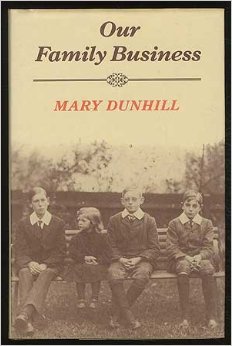
9dca8450e349c2007078376e9fa56ebdI just finished reading Our Family Business by Mary Dunhill (pictured to the left). The book is written in the style of personal reminiscences of the author. It is quite engaging. She starts with her memories of the family from birth and moves through the various business developments as they happened and as she saw them in her growing up years. She gives a brief glimpse at the history of the Dunhill family and their settlement and house building efforts that ran parallel to the family business. It is an inside glimpse of the making of the Dunhill business groups and the people and family behind the development.

After reading the book I believe that the words written on the fly-leaf of the cover summarize the book really well: “At the age of seventeen Mary Dunhill joined her father’s pipe making and tobacco business, starting at the bottom as an assistant cashier. 38 years later she became the chairman of the Dunhill group of companies, a job she held through fourteen years of international expansion. Her book demonstrates the demands that a professional career make on a woman as well as the skill that women can bring to the problems of management. Yet this is more than a career story, more than a history of an enterprise unlikely to be rivalled in the economic conditions of today. It is a candid portrait of the Dunhill family, of their beginnings as harness makers and of the very different personalities that went into the building of a rare quality and character.”

Like most books or reminiscence the book does not have a table of contents. There are no simple headings on the chapters to give the reader an idea of the content of that chapter. It is written in a flowing style that proceeds from the early years to the later years of the writer. It is as if the reader is taken inside the head of the writer and given an intimate glimpse of her life. Mary had done a masterful job in being transparent about what she when through in a way that I have seldom seen in personalities of this ilk.

To help potential readers make a decision on whether to purchase and read the book, I have summarized the content of each chapter below.

41Xh2VfDTLL._SY344_BO1,204,203,200_ Preface – pages 5-7 – a note from Mary Dunhill on the flow and content of the book as she tells the story of her life within the Family Business.

Chapter 1 – pages 9-13 – Mary’s birth into the Dunhill family in Edwardian London. The development of her father’s move into the tobacco business is introduced. The opening of the shop in Jermyn and Duke Street stocked with pipes, tobaccos and cigars.

Chapter 2 – pages 14-21 –The early history of the Dunhill family and the related trades and businesses they engaged in. The development of the Dunhill Motorities. The chapter ends with a description of the early work of Mary’s father prior to opening his tobacco shop.

Chapter 3 – pages 22-29 –The life of Mary’s family in Harrow before the WWI. The hard times of the tobacco business on Duke Street. Her father began to make a name as a blender of the My Mixture blends. She also introduces the reader to her mother.

Chapter 4 – pages 30-38 – The life in the new house in Woodlands with a look at her school and social events. She met Rex, the man she married forty years later. Inserted into this chapter are a collection of family photos. Each is labelled and gives a clear picture of life in those times.

Chapter 5 – pages 39-46 – The development of the Dunhill pipe and the rise of that pipe to fill the need for pipes that did justice to Alfred’s blends of tobacco. A brief history of briar pipes and the way Dunhill pipes were made and the number of pipe makers employed to meet the demand.

Chapter 6 – pages 47-54 – The prosperity of the Dunhill’s is explored and their move into a life of maids, cooks and butlers is described.

Chapter 7 – pages 55-61 –Mary’s life in boarding school and how it led her to leave school and enter the family business as a junior clerk.

Chapter 8 – pages 62-72 – Her work at the Notting Hill Gate factory. Notting Hill factory turned out several thousand Dunhill pipes per week. The history of the Dunhill lighter is introduced toward the end of the chapter.

Chapter 9 – pages 73-83 – Another move to another house – the “Barn” is described and detailed. Mary explains the start of her own small cosmetics business that introduced her to customer service and business management (later it became a lucrative part of the Dunhill label).

Chapter 10 – pages 84-92 – A second photo section. The details of business development in US, Canada, France and England are mentioned and some of the famous clients of Dunhill products. The chapter ends with the birth of her first daughter, Kay.

Chapter 11 – pages 93-102 – Beginning with the birth of her second daughter, Tessa and exploring the development of the Dunhill Company during Hitler’s rise to power in Germany and the war years. She describes the bomb damage to the Jermyn Street frontage of the Duke Street shop and the destruction of much stock. Reflections on how they survived the war years.

Chapter 12 – pages 103-109 – Post war growth of the Dunhill Company. The global developments of the business are detailed. The changes in the family are also noted with the deaths of many of the older Dunhill family members of Mary’s first husband Geoffrey.

Chapter 13 – pages 110-119 – Mary’s growing involvement in the work of the Board. Her responsibility of management of the struggles of the Company in the late 50s is detailed. Her line of Mary Dunhill cosmetics had expanded across the US. The chapter ends with her marriage to Rex.

Chapter 14 – pages 120-126 – Mary’s role as Chairman of the main Dunhill board beginning in 1961. This chapter details her role on the board and the changes and developments that occurred in the early years.

Chapter 15 – pages 127-133 – The Far East marketing of the Company with significant development in the Japanese Market added to a Far East boom period. The company was also in a boom in Europe and the US. As Dunhill continues to develop, Mary’s daughter Tessa killed herself in hospital.

Chapter 16 – pages 134-140 – Summarizes the business of the Dunhill Company from 1912 through 1975 when her nephew, Richard took over the company – pipes, tobacco, lighters and accessories, jewellery, leather goods, watches, writing instruments. A diversified portfolio of products was sold.

Chapter 17 – pages 141-146 – Summarizes some of the lessons learned in her life in the family business. She describes the happiness that she experienced in leading the company during its growth years.

This book is autobiographical in nature but at the same time given the length of Mary Dunhill’s involvement in the family business it gives an intimate picture of the history of the Dunhill Company with all of its constituent parts. The inner workings of the company and the development of the tobacco blending and later pipe making aspects are rich with history for the pipeman who loves to understand the ins and outs of his/her hobby. Well worth the read. The style and manner of the writing is clear, concise and also full of revelations about Mary’s own feelings and struggles both in life and as the head of a large company.

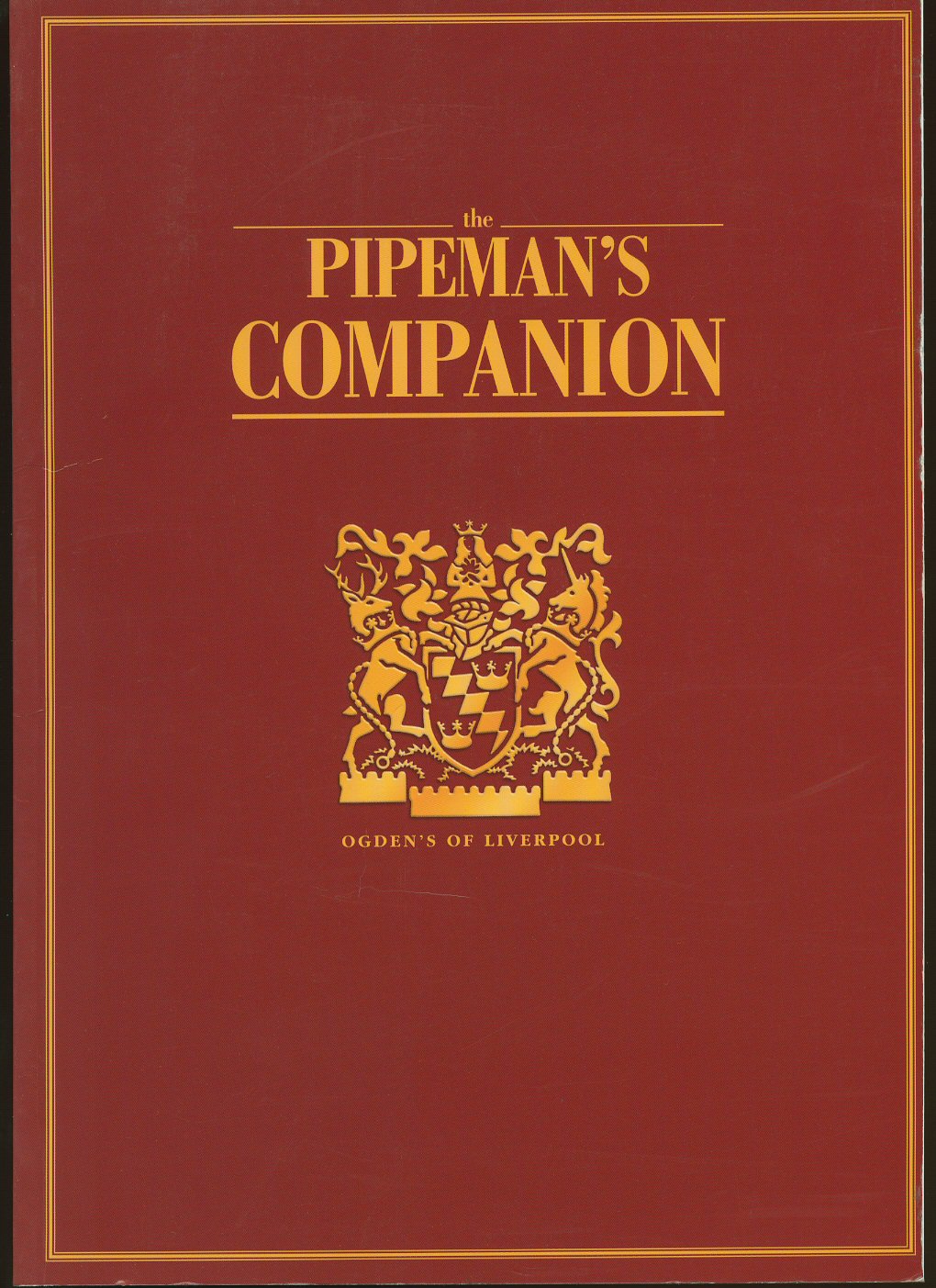
A Book Review – The Pipeman’s Companion by Ogden’s of Liverpool


74522My copy of this book was published by Interfocus Publishing, Bristol, England. It is marked a First Edition and dated 2000. The cover of this of my edition is seen to the left and is the publisher’s original illustrated card wrap cover [softback]. It contains 59 printed pages of text with colour illustrations and photographs throughout.

On the inside cover there is a dedication that reads: To Pipe Men Everywhere from Ogden’s of Liverpool.
Across the page from the dedication is a Welcome from the editors that reads as follows:

“The Pipeman’s Companion is an unashamed celebration of the pleasures of the pipe and pipe smoking. It is brought to you by Ogden’s of Liverpool – Britain’s leading pipe tobacco manufacturer, whose world renowned brands include Gold Block, Amphora and the best-selling St. Bruno. The Pipeman’s Companion is also an invaluable reference work that all discerning pipe men will want to return to time and again. We have attempted to cover every fascinating facet of the history and practice of pipe smoking, with the aim of enhancing every pipe smoker’s understanding and enjoyment of this most satisfying of pastimes – be they experienced by pipe men, or eager new recruits. Ogden’s of Liverpool, with its distinguished past, looks forward to remaining a trusted companion to pipe men for many years to come.”

A brief glance at the table of contents gives a clear idea of what is included in the pages of the book.
Chapter One – pages 2-11 – The Smoking Story, Five Hundred Years of Pipe Smoking
Chapter Two – pages 12-20 – The Tobacco Story, Blended to Perfection
Chapter Three – pages 22-33 – The Pipe Story, Crafted with Devotion
Chapter Four – pages 34-39 – The use and Maintenance Story, A Friend for Life
Chapter Five – pages 40-47 – The Ogden’s Story, Sweet Smell of Success
Chapter Six – pages 48-53 – The Antiques Story, Bringing the Past to Life
Chapter Seven – pages 54-57 – The World Story, Pipe Smoking Across the Globe
The Glossary – pages 58-59 – Pipe Smoking, Tobacco and Pipe Terminology

The book is a beautiful table top sized book filled with highly readable text and many photos of pipes, etchings, artwork and photos of antique pipe and tobacciana. The sidebars of each page are filled with historical pictures and short notes on all things pipe and tobacco related. These side bars run next to the main body of the text and are a pleasure to read by themselves. In Chapter Three there is a great photo spread and short side bar expanded over several pages about Bill Ashton Taylor and his Ashton pipes. It has some great photos of Bill turning bowls, filing stems and flaming stain on newly made pipes. Include are charts of pipe shapes and the anatomy of a pipe etc. The pipe chapter includes not just briar but also Clay and Meerschaum with some great photos of carving and shaping Meerschaum pipes.

Chapter Four on pipe maintenance is well written and includes material on pipe lighters, matches, pipe reamers and tampers. This chapter has charts on reaming correctly and on common pipe problems solved. It is interestingly written with a great wealth of information in the space of a few pages generously interspersed with colour photos of pipes and pipe tools.

Chapter Five is a history of Ogden’s of Liverpool from its beginning to the early years of the 2000’s. It is again richly written and there are some amazing photos included of tins from the Ogden Tobacco line as well as great photos of the factory and production floor. The side bars in this section continue the tradition of the previous chapters in including tidbits of information and historic photos and artwork. For instance there is a full page of advertisements and posters for St Bruno. These alone are fascinating.

Chapter Six is on Antique Pipes and gives a collection of photos of all kinds of pipes. There is a front spread of carved Meerschaum pipes that is beautiful. Some of the pipes are huge while others are delicate and unusual. There is for instance a cased set of a Victorian couple lying in bed – two pipe bowls inserted under the “Covers” with stems set in the cover of the pipe case.

Chapter Seven is a quick world tour through word and photographs of the state of pipe smoking. It is well written and captures the universal appeal of the pipe and tobacco.

The book ends with a useful glossary of terminology. It covers pipe shapes, pipe anatomy, pipe repairs and types of tobacco and cuts of tobacco. It also covers pipe accessories and how they are used. It is a helpful list with short definitions.

The Pipeman’s Companion is a well written book that is a great read and visual display of all things pipe related. It is easily a book that could be read as you smoke your favourite bowl of St. Bruno’s or as you sit and read by the fire on a cold winter’s evening. It will provide hours of enjoyment and is a great refresher to the long time pipeman as well as important information to the new pipe smoker. It truly welcomes us into the world of pipemen throughout history. Well done Ogden’s of Liverpool for a well crafted book on the world of the pipe. Thank you for your work in producing this book.

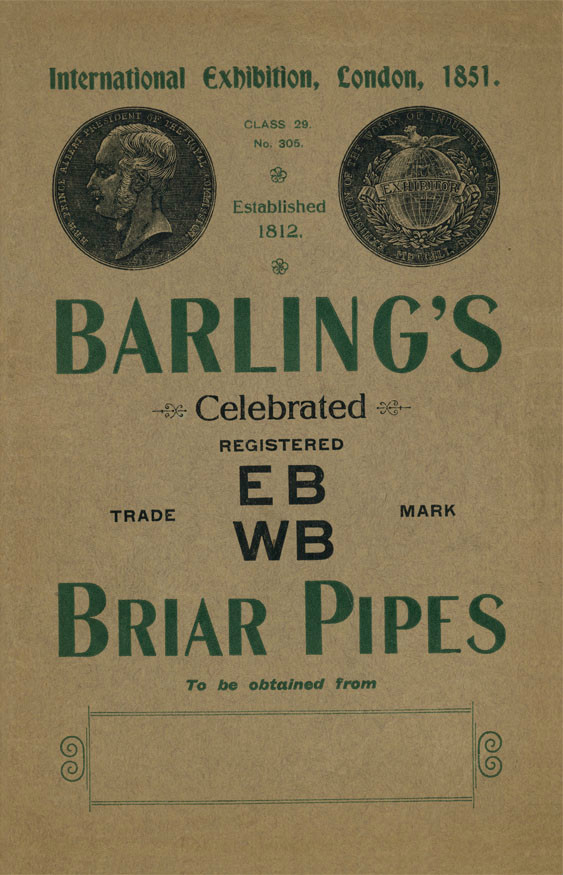
A Book Review – Barling’s International Exhibition, London 1851 Pipe Catalogue


Blog by Steve Laug

Barling Catalogue
I purchased this facsimile/reproduction catalogue of 28 pages on EBay a bit ago. It cost approximately $20 USD and the seller had quite a few available at the buy it now price.

They printed a run of 200 copies and this one is 010 of 200. It is copyrighted by Jesse Silver. There is an email address included inside the cover should you want to order a copy of the catalogue noblebrush53@yahoo.com

Included with the catalogue is a print of the Barling’s Factory. The inside is nicely done and indeed looks vintage. The type is in two colours – a reddish brown and a black. There are also nice etchings of the various pipes. Each page shows four pipes, each one number and named. The names are quite catching. Here are a few for interest sake: The Goodwood, Birkenhead, Savernake, Aberdeen, Nymph, Bent Army, Corinthian, Sydney, Elegant, Trojan and Victorian. The names don’t always reflect the shape of the pipe but sometimes do as in the Bent and the Straight Army. Some of the short chubby pipes also have unique names: The Gordon, Sporting, Hunt, Jap are just a few of the names. The overall feel of the book is like a trip back in time to a simpler and quieter era. The catalogue opens with the words: these are just a few of the many shapes that are available in Barling’s Celebrated Pipes.

I wanted to include the opening page of the catalogue for your reading pleasure. It is a note from B. Barling & Sons, London and reads as follows:

“We have much pleasure in presenting our New Catalogue illustrating some of the principal shapes and specialties in our celebrated EB/WB Briar Pipes.

Our pipes being so well and universally known (without artificial aid of advertisements), we will not here dwell on their perfection, but would ask you to kindly peruse this book, which will no doubt introduce to you some new patterns.

If you are not already a smoker of our pipes, we hope that it will lead to your giving them a trial and thus testing their quality and workmanship, we ourselves being confident of your ultimate judgment and satisfaction.

Every department of our factory being under our own practical and personal supervision, ensures every pipe turned out by us coming under our direct notice. This fact, coupled with the excellence of the materials used in their manufacture, has given our pipes a reputation second to none in the smoking world, a reputation we firmly intend to maintain and strengthen.”

I find the introduction to the catalogue a fascinating read and one that has proven to be true even in our day over 150 years later. Barling’s Pipes are still seen as quality pipes that deliver a great smoke. I have Pre-transition, Transition and Post-transition pipes and though there are certainly differences in quality of workmanship in the later pipes they nonetheless are good smokers. The pages of the catalogue are full of information both in the form of the photos and shape names and numbers but also in the stampings on the pipes and the linking of certain shapes to others with a note on the size. For instance, the Hunt, No. 344 a diamond shank billiard, is a parallel shape to shape #324 which is larger and shape #566 which is smaller.

After the main shapes portion of the catalogue the pages turn toward specialty items such as Crocodile and Morocco cases which are noted to be “unsurpassed for durability and finish” and can be obtained for any Barling pipes as a Single or a Companion case. There are several pages o of pipes with unique covers – with shapes from flat to domed, with hinges and with chains holding them in place. These are truly beautiful looking pipes. Something I was unaware of was that Barling’s made Meerschaum lined pipes as well. They show three examples with a note that they can be made for any shape of Barling’s pipes. I had to laugh at the note (so contrary to much I read today on the forums regarding meer lined pipes) that “Our Meerschaum Lined Pipes we can recommend for cool and sweet smoking. They are suitable for hard smokers and also for those who do not like briar…”

The catalogue ends with what for me has become a bit of a wish book – Specialties in Companions and Cased Amber Briars. These are the beautiful cased singles and pairs of pipes – one with a vulcanite stem and one with an amber stem on matching pipes. Others have a bent pipe and straight pipe with a military bit with two sets of stems – vulcanite and amber. Some have stem extensions made out of albatross wing bone and others have three pipes in a case. These cases are the Crocodile and Morocco cases spoken of above. The economy of size and shape make these great pocket cases for the pipes they contain. I am forever on the prowl for a set like these to add to my collection.

If you want to have a piece of history in the form of a catalogue that gives you a real feel for a time long gone you could not do better than pick up a copy of this facsimile. It is a treat for the Barling’s pipe collector and smoker and would also be a great piece for anyone who wants a nostalgic glimpse at the past.

A Book Comparison: Confessions of a Pipeman – 2nd Edition by Gary Schrier


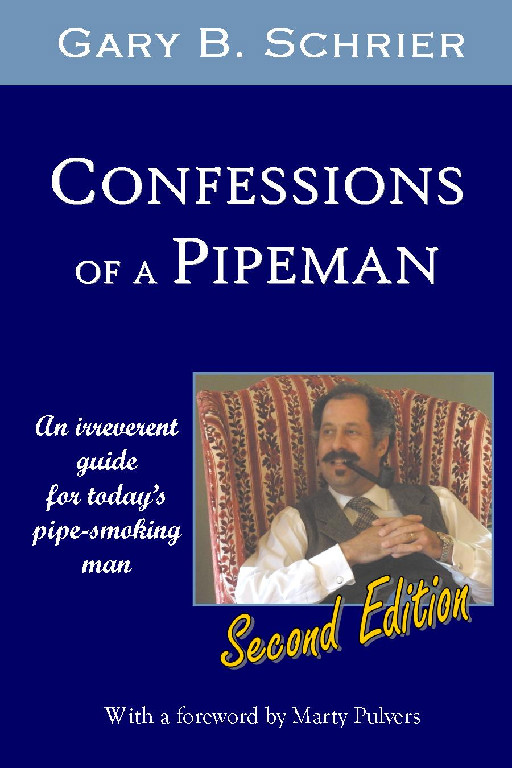
Confession of a Pipeman CoverThis is not as much a review as a comparison of the first edition to the new second edition of the Confessions of a Pipeman by Gary Schrier. I have reviewed the Confessions, first edition on the blog previously and the review still stands. The book is truly a good read and will provide you an opportunity to pause and reflect on the hobby and lifestyle of being a pipeman. I enjoyed the second edition as much as the first. The link below will take you to the review of the first edition. https://rebornpipes.wordpress.com/2012/05/30/confessions-of-a-pipeman-first-edition-gary-b-schrier/
Gary released the second edition of his book, Confessions in September 2010. According to the advertisements on his site this edition has 50% more content than the first, 24 chapters and more illustrations, now all in color. This new, expanded edition, Schrier gives the pipeman more of that irreverent, much-needed counsel on being a better pipe smoker. I decided to do a bit of comparison for the sake of deciding if the purchase of the second edition would be worth the cost.

I checked out the website to see how Gary was marketing the book and how much that would help in explaining the additions and justify purchasing the new edition. The site has the following quote: “Not a “how to” book, but a lifestyle guide. As a cautionary note, I will warn the easily-offended and politically-correct person that this little book throws punches, though I believe all of them are above the belt. I hope you find my views amusing and thought provoking and that you enjoy reading my words as much as I enjoyed struggling to cobble them together professional-like. This book is unlike anything the pipeman has seen written about his treasured passion of the pipe, tobacco, and how he is to get on with it. For the beginner and knowledgeable alike.With a foreword by Marty Pulvers.”
The book sells for $20 and can be ordered directly through Briar Books Press. The web address is http://www.briarbooks.com/

I read the original edition of the book when it first came out and thoroughly enjoyed it. It delivers exactly what Gary promised. It is a book of essays that is interesting, amusing and provocative. Gary has no qualms about stating his opinions on the topic at hand regardless of whether he is the only one holding them. I find his approach refreshing and stimulating. I laughed as I read the book and more often than not found myself agreeing with his assessment of things. There were points in the book I found thought provoking even if in the end I did not agree. It is a great read. So after reading the press and doing some research on the two editions I decided to pick up a copy.

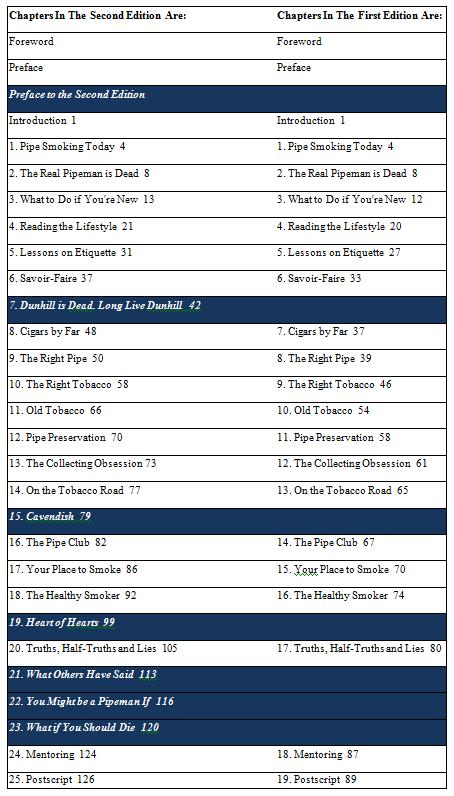
I made the chart below to compare the two editions and to clearly show the additional material and give you an idea of what is in the book. The first column is the material in the second edition while the second column is that found in the first edition. I know it is the opposite of what you would expect but that is why I am noting it for you. I further highlight the new material by the blue cells on the chart. These show the essays that were added in the second edition. These include the new Preface and the following essays/chapters: Dunhill is Dead – Long Live Dunhill, Cavendish, Heart of Hearts, What Others Have Said, You Might Be A Pipeman If and What If You Should Die. These chapters and the edits to the previous chapters make the purchase of the second edition worth the price – especially if you enjoyed the first edition.

Thanks Gary for the work you are doing making pipe books available and accessible to the well read pipeman. I for one greatly appreciate the work you are doing.

COMPARISON OF THE SECOND AND FIRST EDITIONS OF CONFESSIONS OF A PIPEMAN by Gary Schrier
Pipeman

A Book Review – The Smoker’s Guide – Philosopher and Friend


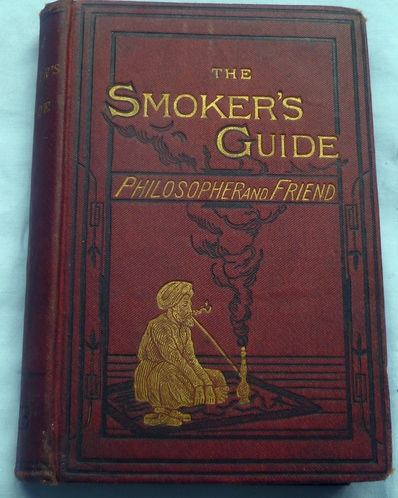
Smokers Guide 1 I picked up this old book on eBay after I came across it a few months ago. I was the only bidder so I got it for a good price. It is subtitled What to Smoke –What to Smoke With – And the Whole “What’s What” of Tobacco, Historical, Botanical, Manufactural, Anecdotal, Social, Medical, Etc. The author identifies himself as A Veteran of Smokedom. The book was originally published by Hardwicke & Bogue, 192 Piccadilly, London in 1877. The cover is stamped and embossed with gold leaf and shows a Turkish pipe smoker sitting on a carpet with his water pipe putting out a cloud of smoke. The spine of the book is stamped in gold leaf with the title, The Smoker’s Guide at the top of the spine and a line with H&B at the bottom of the spine.. The back cover is embossed with a rosette. The entire book is in great shape for its age with the only detracting feature being that the binding is a bit shaken and the corners of the cover and the top and bottom of the spine are slightly worn.

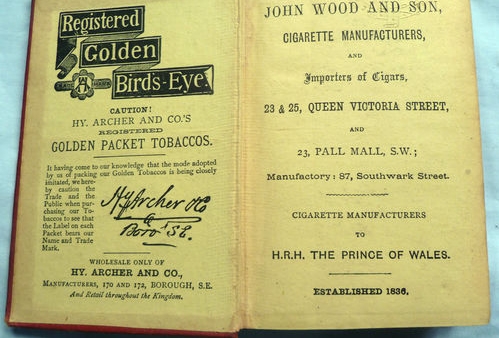
Like many of the books from this era the end papers on the front and the back of the book bear advertising broadsides. Inside the front cover is one for Registered Golden Bird’s-Eye Tobacco a product of the HY Archer and Co. The advert warns of others who have imitated their product and cautions the buyer to beware. Across t he page is an advert for John Wood and Son, Cigarette Manufacturers and Importers of Cigars. The content of these adverts is great to read.
smokers guide 2
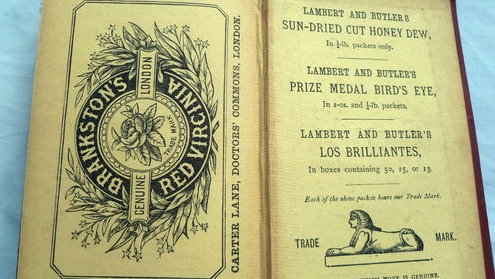
Inside the back cover is an advertisment for Lambert and Butler’s Sun-Dried Cut Honey Dew tobacco. Across the page is one for Brankston’s Red Virginia Tobacco. All of these advertisements make my mouth water and create a desire to try out these old time tobaccos.
smokers guide 4
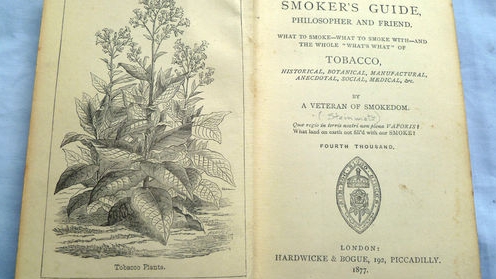
Turning the pages from the front one is taken to the title page of the book with an engraving of a tobacco plant on the opposite page. It appears that someone has written the name Steinmetz in brackets under the author’s title “A Veteran of Smokedom”. I am not sure if this is a guess of the original author’s name or a factual statement of the writer added by a librarian or previous owner of the book.
smokers guide 3
The book begins with a note to the reader that reads as follows: “The adoption of Pope’s memorable words addressed to Lord Bolingbroke for the title of this little work inspired the entire design, and made it incumbent upon the Author to do his utmost to render it worthy of so comprehensive a designation.

In the attempt he has been largely assisted by his innumerable predecessors in Tabacology, and almost every other “ology.” But, whilst drawing from every available source, he has taken nothing without striving to adorn it – after the good example of Virgil, Milton, Byron, and all the most enduring writers of ancient and modern times, who have thereby secured immortality – simply because so many other worthies have contributed to, and can vouch for, their excellence.

In like manner, whilst thankful to all the gods of Literature and Science for the gifts they have showered into his casket, the Author trusts that he has fashioned and set their gems in a new light, for livelier appreciation.”

After the note to the reader the Table of Contents shows the brief and broad categories of the chapters of the book. The Table of Contents also gives a brief description of the content of each chapter. I find this helpful in being able to look for particular topics that are covered in the book.

I have included a copy of the table of contents for you to have a look at. It will show you the flow and development of the book over the course of the pages.

A few words to begin with
Chapter 1 – The curious history of the Weed
Chapter 2 – The cultivation, manufacture and consumption of Tobacco
Chapter 3 – He who smokes dines
Chapter 4 – What Tobacco shall we smoke?
Chapter 5 – Of the Cigar and Cigarette
Chapter 6 – Of the qualities of a good pipe
Chapter 7 – Of Tobacco in the religious point of view
Chapter 8 – Of Tobacco and ‘Les Miserables,’ or as the comfort of the afflicted
Chapter 9 – Tobacco in the artistic point of view
Chapter 10 – Of Tobacco in the medical point of view
Chapter 11 – Tobacco a mine of gold to trade and government
Chapter 12 – Tobacco the firmest support of constitutional government
Chapter 13 – Smoking compared with other extravagances
Chapter 14 – Tobacco and its enemies
Chapter 15 – Words of the wise on Tobacco
Chapter 16 – Tobacco in the literary point of view
Chapter 17 – Tobacco and the Franco-German war
Chapter 18 – Of Tobacco in the poetic point of view
Chapter 19 – Tobacco and the fair sex
Chapter 20 – Of Tobacco in the ruminant or Quid point of view
Chapter 21 – Of snuff and snuffers
Chapter 22 – Useful hints to smokers
Chapter 23 – A word of advice to our young friends

Each chapter is written in a very clear and easy to read style. It is written in the period of the style of the age. The author uses language well and in a very picturesque way describes each of the topics at hand. The author also makes use of quite a few contemporary authors as well as ancient ones to substantiate his work. The quotes are well footnoted in the text of the book.

The first two chapters give the background information regarding the history and manufacture of tobacco. These provide the base from which he will develop the rest of the book. Chapter 1, the longest chapter in the book, gives a quick overview of the history of tobacco and traces it through various countries and kingdoms in terms of acceptance and rejection. I appreciate the way in which the author covers the history on both sides of the pro and anti camps. He traces the argument through each time period he covers. His method in looking at the history is a unique and fascinating read of the times. Chapter 2, also a long chapter looks at the various countries which produce tobacco and the amount and variety of the tobacco produced. After covering these bases the author steps aside from the background information and looks at the use and enjoyment of tobacco.

In the remaining chapters he intersperses what he call the various points of view from which he views tobacco. He develops chapters on the religious point of view, the use of tobacco for the suffering individual, the artistic point of view, the medical point of view, the literary point of view, the poetic point of view and from the point of view of the ruminant. Each of these chapters cites various authors and authorities in the particular field that is being viewed from both the positive and negative point of view. In between these chapters he covers a wide variety of topics. He has an essay on each of the following topics: the choice of tobacco that we use and the means of that use whether pipe, cigarette, cigar, snuff or chew. There are also topics on the economics of tobacco for governments – in other words taxation and its benefits to the government, on the enemies of tobacco and on the friends of tobacco – those he calls the wise. He writes about smoking in comparison to other extravagances, tobacco and women and even a chapter on tobacco and the Franco-German war. He concludes the book with two chapters in which he applies the information of which he has written. The first is written as hints to the smoker and the final he entitles advice to our young friends.

I appreciate the candour and thoroughness of the treatment he gives to tobacco. The older style of writing is not beyond our modern aversion to old and flowery language. He writes in a clear and entertaining fashion about the hobby we love. If you can find a copy of the book I highly recommend it for your reading pleasure. There is a quaint and delightful sense of being transported back in time as you turn the pages of chapter after chapter.

A Book Review – Tobacco Leaves – Being a Book of Facts for Smokers


The cover of the book

The cover of the book

I picked up a few tobacco and pipe books from Project Gutenberg as EBooks that I am reading on my iPad. The first of these is a fascinating read. It is written in a very modern and readable style that belies the fact that it came out in 1915. It is called Tobacco Leaves – Being a Book of Facts for Smokers – W.A. Brennan 1915. Brennan’s states his purpose in the paragraph’s below copied from the introduction to the book.
“This little book is intended for the man who uses tobacco. While there is a very extensive literature concerning tobacco, yet it is surprising how few books there are written expressly for the smoker. Much has been written concerning culture, production and manufacture; the historical and anecdotal aspects have been catered for; pamphlets and books abusing and denouncing the use of tobacco are plentiful; but the smoker will find it difficult to get a book just giving him the facts concerning tobacco and smoking, which he ought to know, and omitting matters, which, although interesting, are not necessary. This little book is an attempt to fulfill that purpose; and it is felt that no apology is needed for its appearance. (My emphasis) If the average user of tobacco is questioned concerning the matters treated in the following pages, he will be found ignorant of them. This ought not be so. The custom of tobacco smoking is so general and so intimate a part of the daily life of the great majority of men that a better acquaintance with the plant, its qualities, uses and effects should be cultivated and welcomed.

No claim is made for originality. The facts here stated have been gathered from various sources and the only credit claimed is for putting them together in a concise and consecutive form. The object aimed at is to give information. Whether the custom of tobacco smoking is desirable, whether in any individual case it would be beneficial or otherwise to smoke—these and similar questions are left to the reader’s own judgment from the facts and opinions presented, as well as from his own observations. The man who uses tobacco daily should know what he is doing. If statements are made either verbally or in print concerning the custom he should be able to verify them or show that they are incorrect. It is trusted that the information given in these pages will enable him to form a clear judgment whatever the judgment may be.

It may be felt that many aspects of the use of tobacco and matters connected with it have either not been touched on, or only referred to very briefly. The reader who may desire further information will find it in the bibliographical references given throughout the book. These references have generally been consulted by the author and his indebtedness is acknowledged here.” Tobacco Leaves – W.A. Brennan, page 5.

I have divided the book into three parts for ease of reference for me as I write this review and as a way to classify the material found in each part of the book. What I have labeled as Part 1 covers all of the material regarding cultivation, production, processing and sales of the product. Brennan begins the book with a short history of tobacco and its place in the botanical world as he calls it (Chapter 1). From there he covers cultivation, production and curing of tobacco both in the US and in Europe. He talks in a clear and non-confusing way about the chemical composition of tobacco (Chapters 2-6). All of this material serves as a backdrop to the marketing, manufacture and processing of tobacco into the products that smokers imbibe (Chapters 7-9).
Part 2 (Chapters 10-16) looks at the various tobacco products available and talks about their history, manufacture and use. It is this section that covers the products that are manufactured from the processed tobacco. He covers cigars, pipe tobacco, chewing tobacco, cigarettes and snuff. Each chapter gives the details in production and use of the product. I found the material interesting to read and also very informative. I learned things about each product that was new information to me. He begins three chapters on cigars. He is not as concerned with various brands that are available but is looking at the historical and general facts about cigars, their quality and their making (Chapters 10-12). He combines the chapter on Pipe smoking and chewing tobacco into a brief and concise description of preparation of the tobacco and the products themselves. He covers such topics as Qualities required–Description of kinds–Perique tobacco—and Statistics (Chapter 13). He gives a brief description of cigarettes and their manufacture and use as well as domestic and imported brands (Chapter 14). Chapter 15 is a very good description of the use of snuff and it making. He concludes the part of the book I call Part 2 with a brief discourse on Tobacco pipes. I found this chapter interesting even though there was no new information. I enjoyed his way of talking about the subject. He gives a brief history of pipes and how they are made as well as the materials used in making. He speaks of Meerschaum, briar, and the materials used for the stems. He gives a brief discourse on special kinds of pipes and ends the chapter with a few pointers on the care of pipes (Chapter 16).

Part 3 (Chapters 17-19) develops several chapters on the effects and benefits of tobacco us. Chapter 17 is a brief chapter on the physical effects of tobacco smoking on the human system and gives medical opinions on tobacco use and discusses the merit of the opinions. Chapter 18 discusses the beneficial effects of tobacco. This section is one that never would have been printed in today’s politically correct climate. He speaks of the disinfecting action of tobacco as protection against infectious disease and ends this chapter with an interesting piece on the psychological effects of smoking. Chapter 19 concludes the book with topics that really do not fit anywhere else within the scope of the book but are interesting nonetheless. These cover such topics as revenue, taxation, etc., in connection with tobacco, the insect pests which attack tobacco and tobacco flavoring fluids, etc.

The book is very readable and the style is fresh and enjoyable. The author has met the objectives that he spelled out in his purpose statement early in the book. I heartily recommend this book to fellow pipemen. I don’t know about you but there is always something to learn or be refreshed on in the arena of our pipes and tobaccos.

I have included a short version of the table of contents for you to have a look at. It will show you the flow and development of the book over the course of the pages.

Chapter 1 – Historical and Botanical
Chapter 2 – The Cultivation of the Tobacco Plant
Chapter 3 – Production of Tobacco
Chapter 4 – Production of Tobacco in the United States
Chapter 5 – The Chemical Composition of Tobacco
Chapter 6 – The Curing of Tobacco Leaf
Chapter 7 – The Marketing and Sale of Tobacco Leaf
Chapter 8 – Rehandling and Fermentation of Tobacco Leaf Prior to Manufacture
Chapter 9 – Manufactured Products of Tobacco in the United States
Chapter 10 – Cigars: Historical and General Facts
Chapter 11 – Cigars and Their Qualities
Chapter 12 – Cigar Making
Chapter 13 – Pipe Smoking and Chewing Tobacco
Chapter 14 – Cigarettes
Chapter 15 – Snuff
Chapter 16 – Tobacco Smoking Pipes
Chapter 17 – Effects of Tobacco Smoking on the Human System
Chapter 18 – The Beneficial Effects of Tobacco
Chapter 19 – Miscellaneous

The book is available as a free e-book from the Gutenberg Project. It can be downloaded in a format the works on iPads or Kindles etc. It is also available in PDF format or can be read online. Here is the link: http://www.gutenberg.org/ebooks/37388

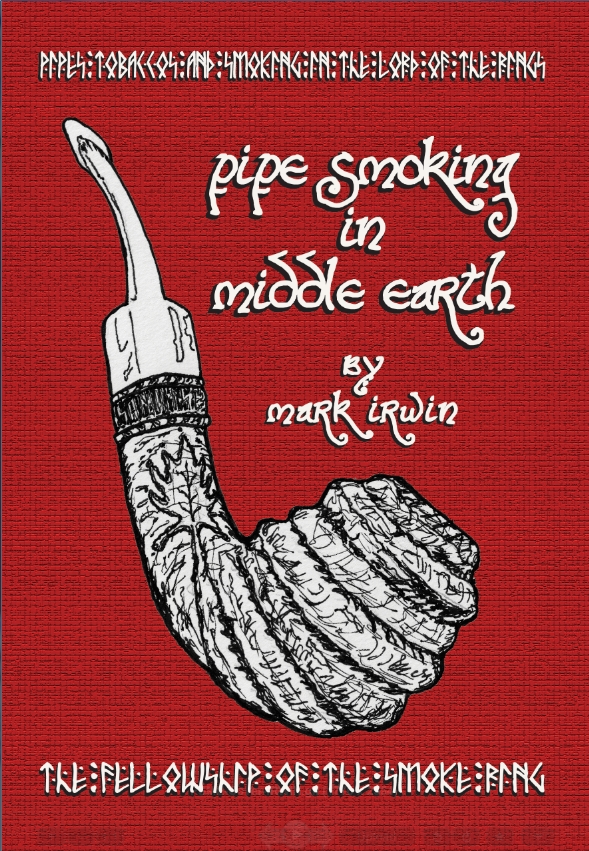
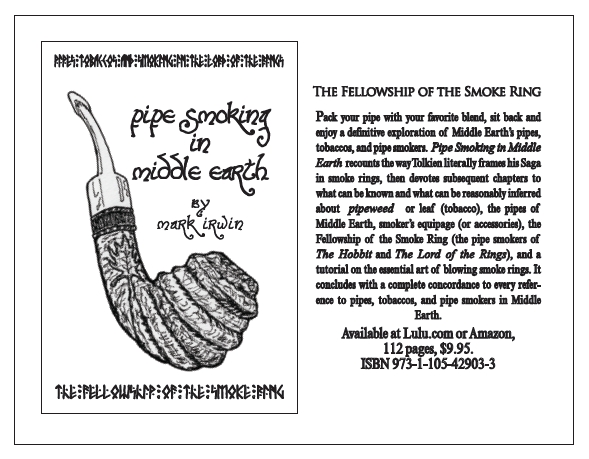
A Book Review: Pipe Smoking in Middle Earth – Mark Irwin


Blog by Steve Laug

Image

I have been putting off reviewing this book for quite awhile now. I ordered it from Mark at the end of May and read it the first time in June, soon after it arrived. The reason I put it off is because I have also been rereading The Hobbit and The Lord of the Rings. I don’t know what read this is – I have been reading and rereading it for over 50 years probably. Each time I do I learn more and get more lost in its brilliant images and the magnificent tale. Well, since this is not a review of the LOTR but of Mark’s book I better get on with it.

Mark has done a masterful job in describing the pipes and tobaccos as he imagines them from many years of reading and rereading the books. His own book is filled with descriptions of the tobacco and the pipes of Middle Earth. He has hand drawn illustrations of the pipes of each of the pipes from a combination of his imagination and the descriptions provided by Tolkien of both the individual and their pipes in the pages of the Hobbit and the LOTR. He draws both his words and illustrations in marked contrast with those seen in the movies by Peter Jackson.

The book is divided into two major sections for ease of reading. The first is a series of essays on the pipes, tobacco and smokers of Middle Earth. The second is an annotated concordance or all of the occurrences of pipes, tobaccos and smokers in the Hobbit and the LOTR as well as other books of Middle Earth. Each of these two major divisions is further broken down. The first is broken into an introduction and six essays/chapters on a variety of topics pipes and tobacco as seen in Tolkien’s books. This section is illustrated with pen and ink drawings by Mark. The second is broken into two parts – a concordance on the books (Hobbit, LOTR and other relevant Middle Earth books) and a concordance on the extended version of the movies by Peter Jackson. It also has a variety of pen and ink drawings. The book closes with end notes worthy of the scholar Mark is.

The little book opens with an essay entitled Charring Light in which the direction of the book is delineated. The essay poses two problems that face the pipeman as he deals with the pipes, tobaccos and smokers of Middle Earth. The first is diminishment, or downplaying the role of pipes and tobacco in the books. He sets out a convincing argument that this is what Peter Jackson does in the movies. The second is enlargement, or over emphasizing the role pipes and tobacco play in the books and neglecting the larger purpose of the saga and its author. Mark is convinced that Tolkien shows us the middle way between diminishment and enlargement. To illustrate this he cites “an apocryphal but probably authentic letter” where Tolkien writes that basically he has said all that needs to be said about pipe smoking and Hobbits in the prologue. Mark’s purpose is to strive to stick with the text and set out the facts regarding what the books say about pipe smoking and what can be inferred from the text. He seeks to leave behind his own opinions and ideas and search what is on the pages of the books.

The details of the first six essays/chapters need not be mentioned at this point, as you can purchase the book and have a read yourself. But it is enough to say that they cover a variety of topics pipes and tobacco such as pipeweed or leaf, the pipes of middle earth, smoker’s accessories and how to blow smoke rings. Mark covers each of these and other topics relevant to Tolkien and pipe smoking in the chapters of this part of the book. I was repeatedly amazed at what he lifts from the books in his descriptions and drawings. For example take this section from the chapter entitled “Tolkien’s Smoke Ring”:

The Hobbit begins with Bilbo’s smoke, continues through the narrative with another nine evenly-spaced references to the art of smoking (smoke-rings in particular), then ends as Bilbo hands Gandalf the “tobacco jar” – which are the last two words of the story. And let us never forget that Bilbo’s finding of “the precious” – the One Ring – is precipitated by his search in Gollum’s dark cave for another treasure, albeit one much less perilous – his pipe.” PSME pg. 13.

Mark goes on to note the number of references in each of the three divisions of the Lord of the Rings to show that the pipe smoking concern that is evident in the Hobbit is repeated in the LOTR. Each volume of the three part division has numerous references to the pipe and tobacco. In fact Tolkien considers it important enough to include a section entitled, Concerning Pipeweed in the middle of his tripartite prologue of the book. Mark writes in a clear and captivating style and demonstrates a grasp of the middle way that Tolkien set forth in the “letter” referenced above.

In each of the chapters of the first section he uses the same clear and forthright style to show the type of pipes the characters may have smoked according to their personality and style as described in the story and how they used the pipe in their lives. The section on the tobaccos of Middle Earth is entertaining and probably the best explanation of the kinds of tobacco that may have been in Tolkien’s mind as he wrote about them in his books. Well done Mark.

The second major section of the book is devoted to a concordance of citations about pipes, tobaccos and pipesmokers as I mentioned above. Mark has done a stellar job of cataloguing these quotations in an annotated presentation. He works through each – the Hobbit, the Lord of the Rings and other Middle Earth related books gathering the quotes and references. Each citation is complete with reference notes to the page, chapter and section of the book cited. He continues the same process with an annotated concordance to the Peter Jackson movies (extended version) and quotes the scene and segment of the movie where the quotation was used.

The book is a short 112 pages of interesting and imaginatively written material on what has to be one of my all time favourite author’s books. Thank you, Mark for a job well done. I only have one serious complaint for you – why didn’t you extend the book, and like Peter Jackson make and extended version for those of us who cannot get enough.

Image