Tag Archives: Stories and Essays

Mark Twain on Nicotine Nannies – The Moral Statistician


I came across this old file on my computer and thought I would pass it on to you all. I always enjoy Mark Twain and here he takes on the nannies who would tell us how to live our lives. Incredibly refreshing to read!

Originally published in Sketches, Old and New, 1893

Image
I don’t want any of your statistics; I took your whole batch and lit my pipe with it.
I hate your kind of people. You are always ciphering out how much a man’s health is injured, and how much his intellect is impaired, and how many pitiful dollars and cents he wastes in the course of ninety-two years’ indulgence in the fatal practice of smoking; and in the equally fatal practice of drinking coffee; and in playing billiards occasionally; and in taking a glass of wine at dinner, etc. etc. And you are always figuring out how many women have been burned to death because of the dangerous fashion of wearing expansive hoops, etc. etc. You never see more than one side of the question.

You are blind to the fact that most old men in America smoke and drink coffee, although, according to your theory, they ought to have died young; and that hearty old Englishmen drink wine and survive it, and portly old Dutchmen both drink and smoke freely, and yet grow older and fatter all the time. And you never try to find out how much solid comfort, relaxation, and enjoyment a man derives from smoking in the course of a lifetime (which is worth ten times the money he would save by letting it alone), nor the appalling aggregate of happiness lost in a lifetime by your kind of people from not smoking. Of course you can save money by denying yourself all those little vicious enjoyments for fifty years; but then what can you do with it? What use can you put it to? Money can’t save your infinitesimal soul. All the use that money can be put to is to purchase comfort and enjoyment in this life; therefore, as you are an enemy to comfort and enjoyment where is the use of accumulating cash?

It won’t do for you to say that you can use it to better purpose in furnishing a good table, and in charities, and in supporting tract societies, because you know yourself that you people who have no petty vices are never known to give away a cent, and that you stint yourselves so in the matter of food that you are always feeble and hungry. And you never dare to laugh in the daytime for fear some poor wretch, seeing you in a good humor, will try to borrow a dollar of you; and in church you are always down on your knees, with your ears buried in the cushion, when the contribution-box comes around; and you never give the revenue officers a full statement of your income.

Now you know all these things yourself, don’t you? Very well, then what is the use of your stringing out your miserable lives to a lean and withered old age? What is the use of your saving money that is so utterly worthless to you? In a word, why don’t you go off somewhere and die, and not be always trying to seduce people into becoming as ornery and unlovable as you are yourselves, by your villainous “moral statistics”?

Now, I don’t approve of dissipation, and I don’t indulge in it either; but I haven’t a particle of confidence in a man who has no redeeming petty vices. And so I don’t want to hear from you any more. I think you are the very same man who read me a long lecture last week about the degrading vice of smoking cigars, and then came back, in my absence, with your reprehensible fire-proof gloves on, and carried off my beautiful parlor stove.

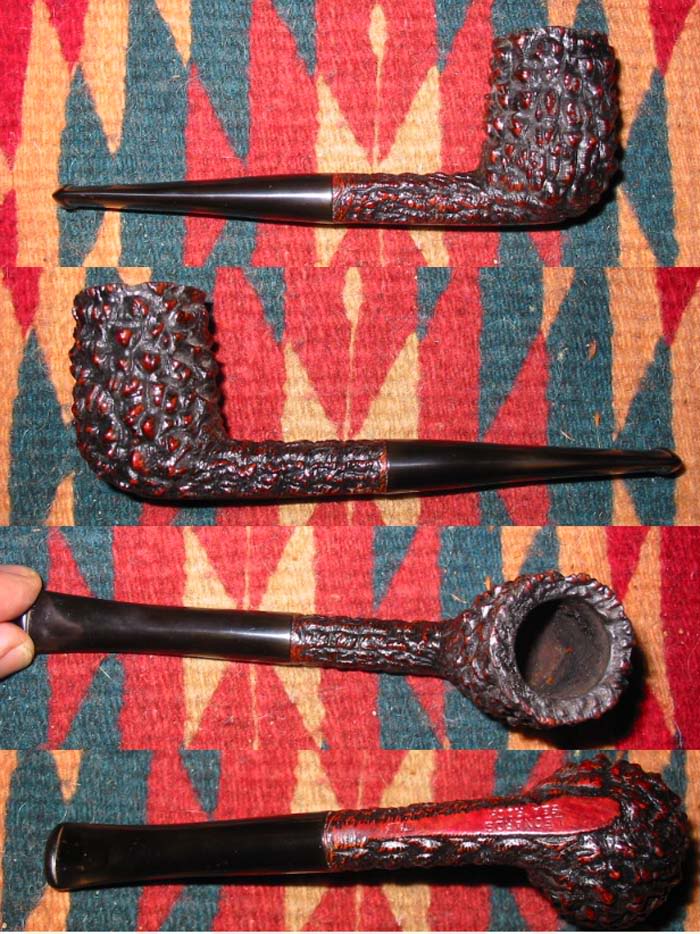
Leonard’s Pipe Shop – Portland, Oregon.


Blog by Steve Laug

When I bought this old Leonard’s Sea Rock billiard on EBay I did a bit of hunting around the web to find out what I could about the brand. There was not a lot of information available but this is what I found out. I have edited it and added and adapted the material that I found on the web. I am unable to find who originally wrote this material. If anyone knows please leave a comment and I will acknowledge the work that person has done on gathering this helpful information.

Leonards

The pipe I purchased is a shop pipe that came from one of America’s great old pipe shops – LEONARD’S PIPE SHOP which was located in Portland, Oregon, USA.The shop and the brand never was as famous as Peretti’s, Ehrlich’s, The House of Robertson, Bertram’s, Garfinkel’s, Drucquers or some of the other great names from the past, possibly because of its’ location. But in terms of stature among the world’s greatest pipe makers, Leonard’s had no equal. While some pipe shops catered to the rich and famous, served politicians or visiting emissaries,or made pipes for actors, entertainers or stars in one field or another, Leonard’s catered to the other end of the pipe chain – the all-important source of supply! The shop was founded by Arthur Leonard in 1936 who worked hard to establish close relationships with the world’s biggest and best pipe maker’s — Charatan, Barling, Sasieni, Kaywoodie and others.

In 1936, Kaywoodie was the most important name in pipes producing top-quality pipes and the most expensive pipes then available. So, it was natural for Arthur Leonard to establish a relationship with the makers of Kaywoodie. It is fairly recent that some of the greatest Kaywoodie’s ever made returned to the marketplace. For example the Leonard-owned Kaywoodie Magnums dated from the late 1930s which were displayed and ultimately sold by the family at the Chicago Pipe Show a few years ago. It will always be a question how they wound up in Portland, Oregon rather than New York, Chicago, Washington DC or the “hometown” of any of the other great pipe shops in America. The answer must lie in the relationships that Arthur Leonard established with pipemakers!

Another huge “GROUP 6” or “ODA” sized KW billiard also came on the market. It no doubt originated from a special order placed by Arthur Leonard. But the question with this pipe and others that Leonard’s had was who made it? As many collectors who visited his shop know (as well as those who have met the last generation owners, Lou and Betty Leonard) this was once one of America’s greatest pipe shops! It operated on the same corner location from 1936 through 1983 before moving to an uptown location for another six years. On display the Leonard’s had the longest and largest Kaywoodies ever made, unsmoked Dunhill Magnums and a host of pre-1900 Barlings! Arthur Leonard had established a powerful relationship with the great pipe maker’s of the last century and his shop retained the bounty of those relationships.

It is interesting that when the Barling family sold out, they called the Leonard shop and Arthur Leonard responded- – -buying every single Barling on hand at the time of sale so no inventory was acquired by the new owners (ending speculation that “Transition” Barlings were really older pieces acquired by the new owners)! Leonard did the same thing for the Sasieni family when they sold out! The Leonard’s Shop was perhaps the most well-known American smoke shop in Europe! The Leonard Shop ONLY carried high grades, so when the craze for meerschaum pipes occurred in the 1950’s and early 1960’s, (and the Turkish government restricted the exporting of raw meerschaum) the Leonard shop placed an order with Charatan for 50 meerschaum-lined Charatans! (At that time, the Supreme was the top-of-the-line Charatan! Imagine meerschaum-lined Selected’s and Supreme’s! Lou Leonard says that only about 35 were ever delivered and Charatan said they would make no more!)

I read that those who saw the Leonard’s display pipes at the Chicago Show a few years ago marveled at the quality of the uncirculated, unsmoked pipes. He had acquired the original Barling Meerschaum’s from a company that made Meerschaum pipes before making Briar pipes! The Dunhill Magnums were unsmoked in their original cases. The Kaywoodie Magnums were displayed in a specially made case. And the Sasieni’s, Charatan’s, Comoy’s and all the rest were pipes of historical importance. You see, Arthur Leonard nurtured his relationship with the supplier’s rather than the movie stars and politicians who bought pipes. In fact, Betty Leonard told stories about the vast inventory of pipes kept out of the public eye in a back room from which they were produced on an occasional basis to meet the needs of a specific customer’s request.

Like the other great American pipe shops, Leonard’s is gone. They closed their doors in 1989. Their inventory was slowly liquidated by the last family owners of the shop. It is sad that yet another piece of American pipe history is gone. It would be grand to have seen that back room filled with a huge inventory of beautiful old briars of renown. Ah well, we have to use our imaginations to enter that room now. As I go there in my mind, I load a bowl of good tobacco from Drucquer’s (another American Pipe Shop that is gone) in my Leonard’s Sea Rock and lift it in both of their memories.

ADDENDUM & CORRECTION: Please read the response below by Pete. He has added some great information that focuses and corrects some of the information above. Thank you Pete.

What’s the Story to be told by 3 Old Unsmoked Pipes without Stems?


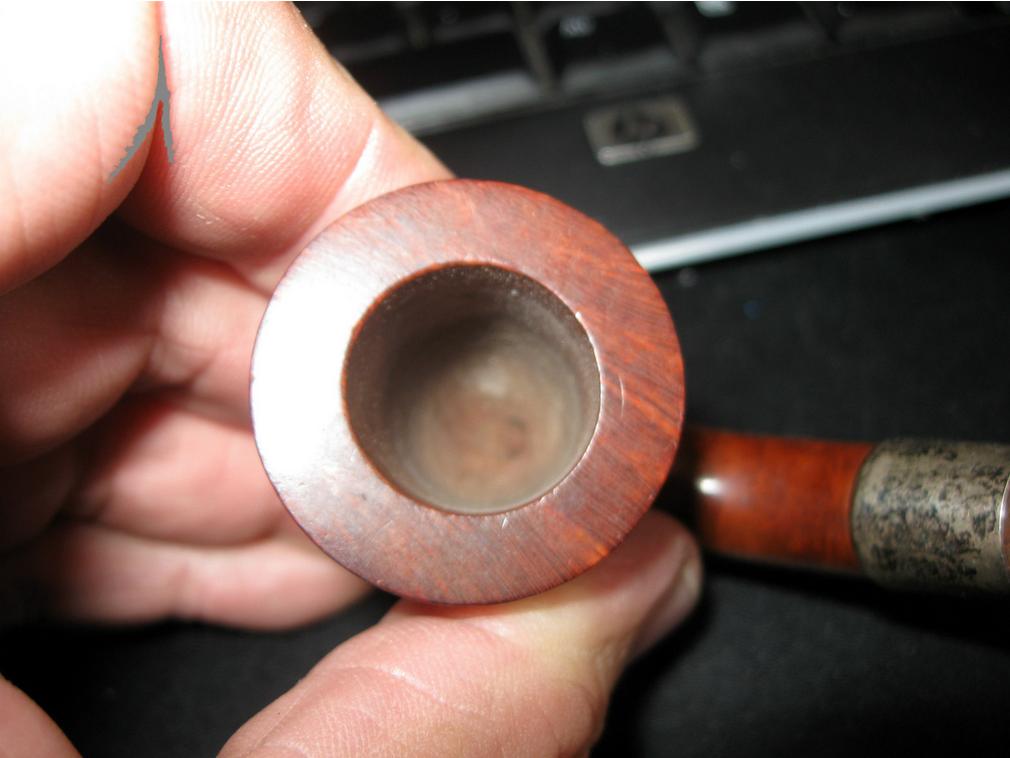
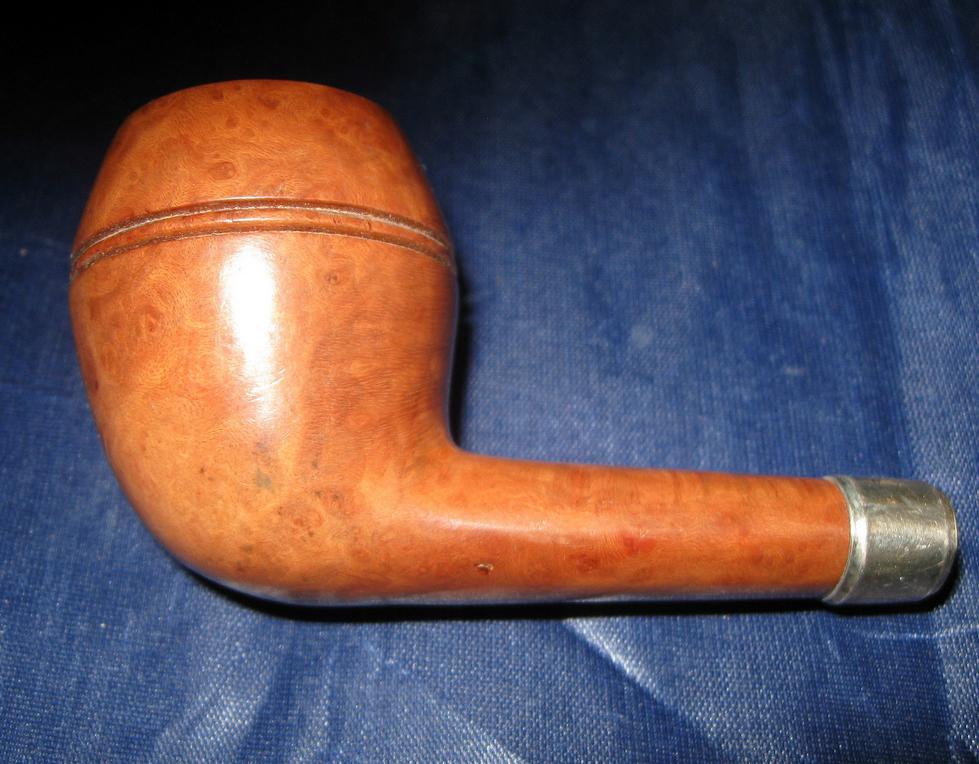
I bid on these three pipes on Ebay based on the pictures I have included in this post. They were two different lots from the same seller in California. They were unsmoked according to the seller and as best as I could tell from the photos they looked at least very clean if not unsmoked. They arrived yesterday in the post and they are amazingly clean. All three are unsmoked and what I would label as New Old Stock. I am curious as to how they were separated from their stems and when this happened. They all came from the same seller and I asked what happened to the stems and was told that they were that way when they bought them. That is not a problem as I can easily restem them. They are all older pipes – my guess for the second and third pipe is that they came from the early 1900’s. Not sure about the BBB.
The first is a BBB Hand Made Dublin shape with an oval shank. In the photos the bowl looks dark, but upon examination it is unsmoked. It may have stain in the bowl that I will have to remove before it is smoked. The finish is very good with no fills. There are a few small scratches and dings that come from sitting unused for so long. I am guessing but I would say that the three and several others that the seller had all must have been kept in the same box for years. This one has a very clean shank mortise area so it should be fairly easy to match a stem to it. I am waiting on a BBB stem but in the mean time I have fit it with a vulcanite stem. I have to clean the stem up and finish the fit and the polish but it looks good.

BBB1

BBB2

BBB3

BBB4

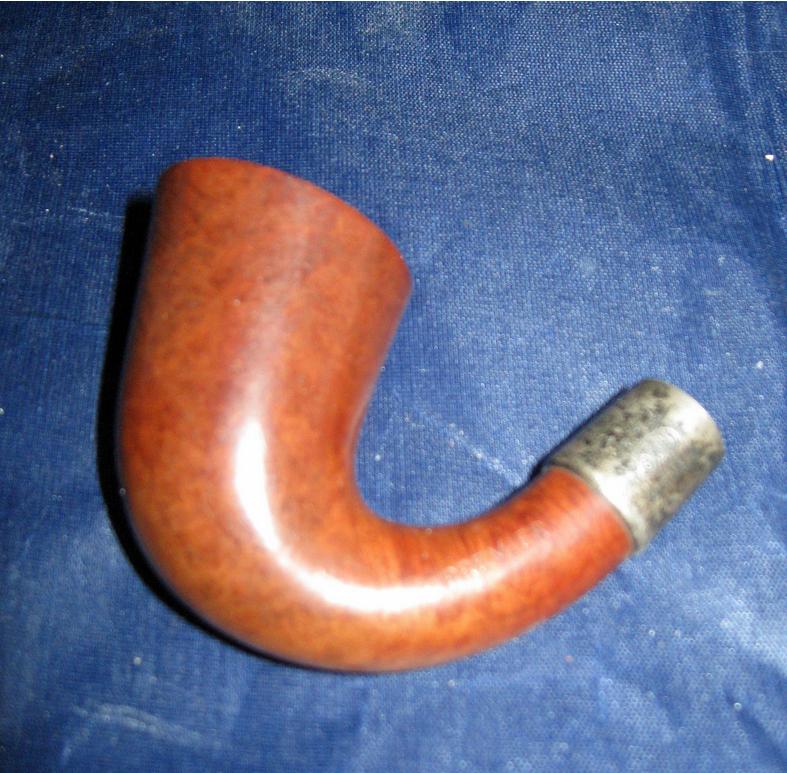
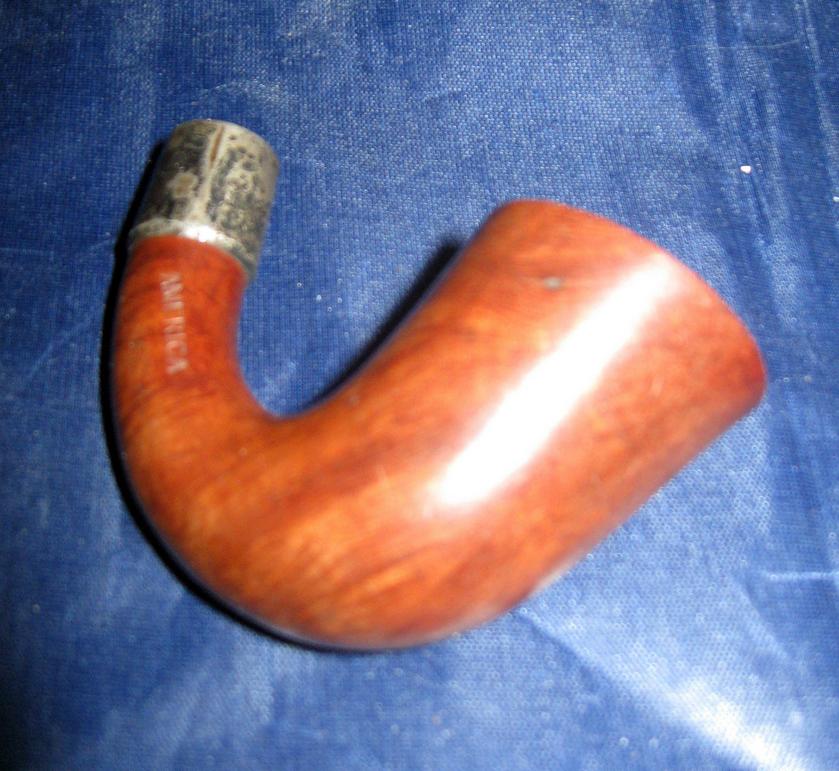
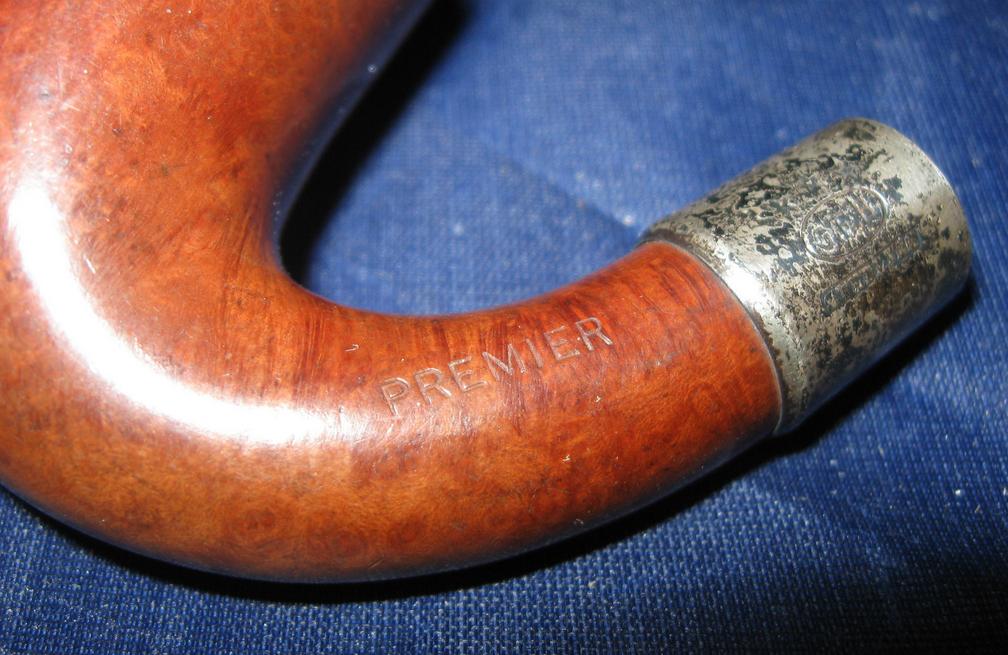
The second pipe is a GFB calabash. It is stamped Premier on the left side of the shank and America on the right side. The band says GFB in an oval with 3 stars above that and Sterling underneath. The band was loose when it came. The photos made it a bit hard to tell what the size of the pipe was and also what the grain was like on it because of the lack of focus. When I took it out of the package I was glad to see that it was smaller than expected. The finish is great and the bowl is pristine. The shank and bowl are raw smooth briar. The silver was tarnished but the pipe was unsmoked. Like the one above it has some small scratches and dings from sitting in a box for so long. I am pretty sure this is an early 1900’s pipe. It is identical in shape to a 1912 BBB calabash I have here. The beauty is that I will get to break in this ancient old pipe. It is incredibly light weight. I worked on a stem for it last evening and have it fitted and the first stage of sanding and polishing finished. I will write it up when I am finished on the weekend.

GFB1

GFB2

GFB3

GFB4

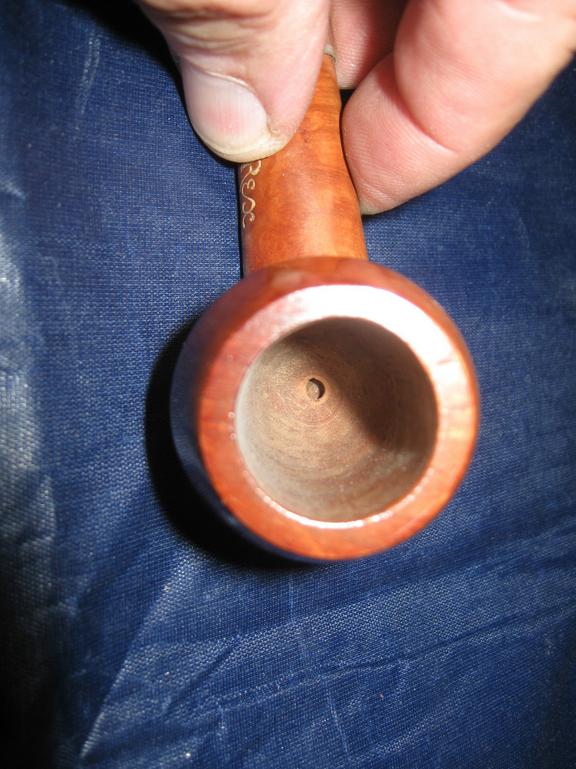
The third pipe was a bit of a mystery to me. It is stamped with a gold filigree – REX in a script on the right side of the oval shank. It has a long shank and a factory fit silver band that is also stamped REX and Sterling. It too is unsmoked and very clean. Again like the others it has a few dings and scratches but otherwise is in good shape. There are several very small sandpits on it but they do not detract from the look and finish. I tried several lengths of stems on it before settling on an oval stem that would go on a Canadian. It looks right on this old guy. I can find out nothing regarding the REX stamping though my guess would be that it is an American made pipe. The seller noted that this one is an early 1900’s pipe as well but I got no response on how they know that. The look and feel of the pipe, the size and shape, the silver band all would argue for that age but there is no way to know for sure that I can tell. Do any of you recognize the brand? Some thought it might be an early Barclay-Rex pipe but I cannot find any back story that would make that certain. So for now the mystery remains. I will finsih polishing and shaping the stem over the weekend and then do a write up on the threesome. They are all beautiful examples of well made bowls.

Rex1

Rex2

Rex3

Rex4

With these three in hand from the same seller I am very curious as to their stories. Where did they come from? Who had them? Were they always without a stem? Were they purchased and set aside for a special time and then got separated from their stems? Did their stemless condition guarantee their not being smoked? Or maybe they came from a shop somewhere and the stems just were never put in place after they arrived from their makers. Who knows? All I know is that they will soon be put to the use they were intended for. I wish they could tell their stories. I for one would love to sit and listen. Wouldn’t you?

I just finished the initial work of restemming them. Here is a photo of the three bowls with their new stems inserted. A lot of work remains in terms of fitting the stems but the idea is clear from these photos.

IMG_0974

A Review – Ozark Mountain Briars, Craftsman Series, Straight Egg


Blog by Steve Laug

I am fairly certain that many of you have not heard of either Ozark Mountain Briars or of the carver, David Johnson. I have had two of David’s pipes in my collection since 2007 and have found that both of them are well made and aesthetically beautiful. The first one I purchased was a rusticated ball or apple shape. The second is this straight egg shaped smooth that I am reviewing today. Both were reasonably price and promptly delivered. I am not sure if David is still making pipes, I hope so. I see his pipes appearing on EBay periodically so if you have the opportunity to get one I don’t think you will be disappointed.

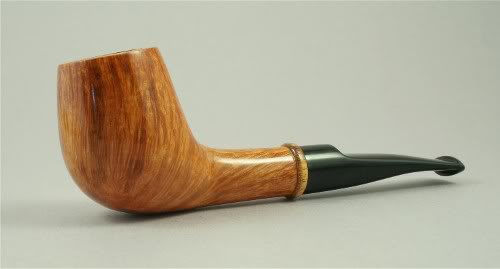
He carved this pipe as one of his higher lines, the Craftsman series, in 2007 and I picked it up at a discounted price because of some very small sand pits on the bottom of the shank. When it arrived in the mail I opened the package and took out the suede leather pipe glove that the pipe was placed in for protection and storage. I was amazed at its beauty. As I held it in my hand I could not believe how light it was. The 1.32 ounces / 37.4 grams make it light enough to be a comfortable clencher. The length of the pipe is 5.45 inches / 138.4 mm. The chamber diameter is .80 inches / 20.3 mm and the chamber depth is 1.50 inches / 38.1 mm. It is comfortable to hold in the hand.

cantedegg101

The pipe has a smooth finish and is stained with a 3-step process to bring out the grain. The bowl is egg shaped but slightly canted forward with elements of a Belge shape. The grain is decent on the pipe. I am not sure which stain David used first but the understains are darker and serve to make the grain stand out. The overstain is almost a yellow. The combination gives a dimensionality to the finish that is fascinating. The trim bead on the end of the shank is made of Marblewood and adds a nice finishing touch. The unique grain and shape of the bead is distinctive and feels great in the hand when held during a smoke.

cantedegg102

The stem is a hand cut Ebionite half saddle or half taper depending on your point of view! The top half is saddle and the bottom is tapered. The saddle portion is well done. It is soft cut on the saddle and then tapers back to the button. The saddle is rounded and has a very gentle cut to it. On the underside the stem blade tapers gradually back to the button where it flares to the same width as the flare on saddle. It is just the right thickness at the portion that rides in the mouth – not too thick or too thin. It is made of quality material as it has not oxidized in the years I have had it. The tenon is an integral part of the stem and is chamfered inward to form a dished end that is well-polished. The button is the size and shape that I really like – thin at the edges with a very slight rise to the centre top and bottom, forming an eye shaped end view. The lip on the button is very not to thick and fits well behind the teeth for a comfortable feel. The slot in the end of the button is also funneled and flattened to deliver a mouthpiece that has the same diameter from start to finish. David also rounded the ends of the slot giving it a finished look. The attention to detail shows the love of his craft that is transmitted into each of his pipes. It is a comfortable and well executed pipe. A pipe cleaner passes easily through the pipe with no obstruction.

cantedegg103

I have two Ozark Mountain Briar pipes and both are identical in terms of internal mechanics. David has well-crafted airflow dynamics in his pipes. The draught is clean and easy with no whistling or tightness. It has an easy draw that makes smoking it a pleasure. The bowl chamber is drilled to slightly over 3/4 of an inch with a .80 inch diameter. The tobacco chamber was coated with what David calls a Pre Carbed coating. It was neutral in taste and did not distract from the tobacco that was smoked. The cake built up on the bowl very easily. The draught hole is centered slightly above the bottom of the bowl and seems to have a slight funnel leading into the shank and stem. The fit of the stem to the shank is excellent – smooth and tight with no light showing at the joint. The tenon fits well in the mortise and sits deep in the mortise against the bottom. The airway is in the centre of the mortise and aligns with the airway in the tenon. The edges of the tenon have been polished and rounded and the airhole countersunk so that it meets the airway in the mortise. Looking at the airways with a flashlight it is clear to see that they are smooth and polished with no rough edges. The interior of the pipe is smooth and polished from the button to the bottom of the bowl.

cantedegg104

I broke this pipe in with some aged McClellands 5100. It is a dedicated Virginia pipe and always delivers a good tasting smoke. I have found that David’s other pipe also is a Virginia machine. It also smokes cool and dry and deliver good flavor with the Virginias that I choose to smoke in it.

What’s Inside The Cupboard?


This beautiful oak cabinet sits on top of my pipe cupboard in my office at home. This cupboard came to me as a gift when I was the president of the Vancouver Pipe Club from a member down on Whidbey Island, Washington. It came as a bit of a surprise and one that was very welcome. It is well made with brass knobs for handles and inset brass hinges on the inside of the doors. The joints are well done and the nails have been hidden well behind putty in a subtle way to make them less visible. The back of the cabinet is also finished and smooth. It is fastened to the back with nails or staples and the holes are filled and the back stained to match the rest of the cupboard. The detail done even on the back side of the cupboard speaks to the fine craftsmanship of the piece. The top of the cupboard is set off with a crown moulding that makes it look far older than it is. The paneled doors also give it an air of antiquity with the decorative beaded moulding around the inside panel. The flat base extends beyond the width and length of the cupboard making a very stable base for the piece. It is designed to be either a free standing piece or to be hung on the wall. Inevitably when people visit me in my office they ask about the cupboard and what might be in it. The closed doors seem to hide something that must be important. Some folks ask right away what it contains while others glance at it throughout the visit and then either in the midst of things or at the end as they are about to leave. It seems that they just have to know. I love the fact that the design is unique enough and secretive enough that it calls forth questions.

Cupboard 002

Once the doors are opened the quality workmanship continues to be evident. The way the craftsman organized the inside is pretty simple. It is designed to hold 24 pipes facing bowl out toward the front and has two drawers at the bottom for holding other accessories or in my case some of my pocket pipes. The slotted bar at the top third of the first half and the top third of the second half of the cabinet is made up of twelve U shaped cuts in each one that hold stems easily without them turning or being damaged. The U’s are sanded smooth and given a coat of Varathane or varnish so they are well done. The two bases below the slots are also scooped out with a router and sanded smooth for the bottom of the bowl to sit in without damage. The U cut and the scooped base hold the pipes securely. The top base and the bottom one are set into grooves that have been cut into the side walls. The case is very stable and has no side to side play. The drawers are designed to slide easily into the slots cut and polished for them. In my case I use the top shelf for six of my Dunhill pipes (left side of the top) with two others laid behind them, three of my John Calich pipe and one Ashton, one Steve Weiner and a Tinsky Dublin. The second shelf houses the rest of my Tinsky’s. All but one of them has been smoked. The unsmoked pipe in the picture came at a time when I was drawn to smaller bowls. It is being reserved for a time that may not be true!

Cupboard 001

Once I succumb to the curiosity of my visitors and open the doors on the cupboard all of the ones who are pipemen love looking at the pipes and the workmanship of the cupboard. The non-pipesmoking guests just shake their heads, unable to figure me out. I don’t say anything that would enable them to figure it out. I just reach for a pipe and polish it while they stand looking at me and the cupboard with what appears to be a growing incredulity. One day when I get my shop set up I want to use this cupboard as a pattern and make a few more for my other pipes. I love the way the doors protect the pipe stems from oxidizing in the light and keep the pipes looking pristine. The bottom drawers are a great place to stow away folding pocket pipes that I do not use very often and other pipe paraphernalia that I seem to continue to accumulate.

Whatever Happened to the Orific Button?


While I was sitting at my desk, looking over my pipe cabinet the other evening, it suddenly came to me that I could divide my pipes into two distinct groups – all grouped by the shape of the airway in the end of the button or stem – either round/orific or a slot. I have often wondered about the transition between the two types of airways as they each seem to come from two different time periods. What happened to the rounded one and when did the slotted airway begin to have ascendancy? I am not sure I can answer that question with any definitiveness but I want to look at both types and surmise what may have transpired to bring about the end of the orific button.

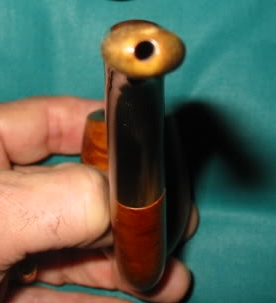
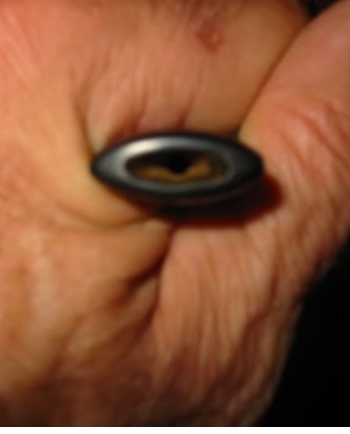
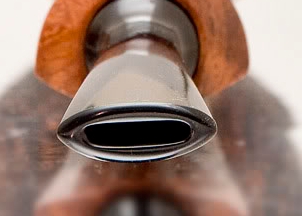
The pipes I would place in the first group are all older pipes with stems made of a variety of materials – amber, vulcanite, Bakelite and horn. In this group there are 45-50 pipes with this type of airway. All of them come from the mid to late 1800s and the early 1900s, literally another time and place. For some of them I can identify the time period they were manufactured and for some I have only the faintest idea of the era. The earliest dateable pipe I have is from 1912 – this is knowable from the hallmarks on the silver band on the shank of the pipe. The earliest ones in my collection appear to come from the 1850s and possibly earlier as far as I can tell. They have the filigree decorations, stampings and shapes of that earlier time. The stems, regardless of the time frame within this lot, all have a round/orific opening or airway in the end of the stem. The orific opening is a hole shaped like an O and is sometimes tapered into the airway from the outside. But often it is a straight shot into the airway with no variation in size. The button is generally oval/or round in all of them and the stem coming into the button is also thicker and more oval as well. There is not one thin stem in the lot. As a rule they are thicker and more rounded on the top so they are harder to clench. The two photos below show two different pipe stems from pipes that are in my collection. The first picture shows a horn stem with the orific or “O” shaped opening. The button on this one is quite oval and rounded. The stem itself is also oval and shaped similarly to the shape of the button. The second photo shows the same orific opening on a vulcanite stem. The shape of the button on it is an oval with pointed ends, like an American football. This stem is on a bulldog with a diamond shaped shank and stem. The blade or flat portion of the stem is crowned terminating in the button. The crown on the top and bottom of the stem matches the oval shape of the button both having pointed edges on the right and the left side.

Orific button1

Orific button2
I spent some time examining all of the pipes that I have with this kind of stem to observe similarities and differences. In looking at them I have found some interesting observations. First, it can be generally stated that when I received these pipes as estates that they did not have bite marks or tooth marks in the stem itself though there were marks/dents in the button surfaces on many of them. All had tooth chatter or tooth scratches on the surface of the stem regardless of the material. A second observation I made is that in the straight stems the airway is the same size from front to back or at the most minimally tapered from the tenon to the opening in the button. Holding the stem up to light and looking down the stem the airway is uniform. I would assume that the same would be true for the bent stems that are in my collection. Third, all take a pipe cleaner very easily. Fourth, all of them are thicker than my stems with slots. Fifth, at one level all are less comfortable than the thin stems. I say at one level, in that I find them uncomfortable when I am smoking them on the go or in the car as they are hard to clench. However, if I am sitting in my office or on my porch with one I find that the thickness is no detriment as I tend to hold them in my hand.

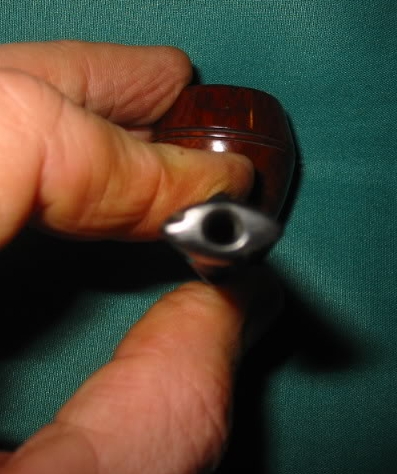
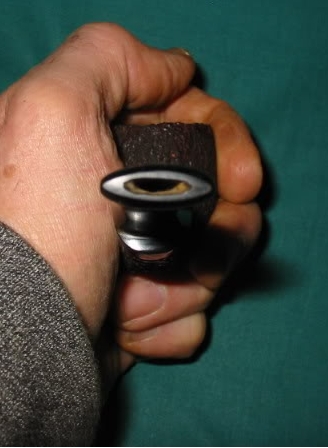
The second group of pipes in my collection is “newer” in age as a whole. As I observe this group of pipes I can make the following generalizations. I know that they are generalizations but that is my point in this article, I want to look at broad commonalities of each group. The buttons are thinner on the pipes throughout this group. They are flattened on the top and the bottom edges, which reduces the thickness of the button. The airway on the end of the stem is either a flat slot or a flattened oval that flares inward toward the airway in the stem. This slot becomes a funnel shape from the slot to the airway in many of the pipes. The drilling is also tapered and the airway flattened in the button end of the stem so that the stem can be significantly thinner. This is true in all of the pipes in this group regardless of the material that is used for the stems. In this group of pipes the stems are made out of vulcanite, Lucite, Bakelite and acrylic. All of the tapered stems have a more flattened profile, with more gentle angles to the taper from either the saddle or the taper from the shank to the button. The higher end pipes and handmade pipes all show a customization of the button slot. The machine made pipes generally have a straight line slot. Some of the machine-made pipes have slots that are very thin/ tight and will only take a thin pipe cleaner with effort. Others are wider and accommodate pipe cleaners easily. In my handmade/artisan pipes the slots are all of various shapes and adaptations. The one overarching theme in all of them is the flare on the inside of the slot that tapers back to the internal airway. The next three photos show a customized slot on three different pipes in my collection. Both pipes have vulcanite stems and both have oval shaped buttons and slots.

Slot 1

Slot 2

Slot 3

What have I learned from this comparative observation of both kinds of buttons/stem? What generalizations can I take away as I try to understand why the orific button was replaced with the slotted button? I can say unequivocally from my observations, that it seems the quest for ever thinner stems and the advent of “new” ideas regarding internal engineering of the airway from the bowl to the tip of the stem have brought about the end of the old orific button. I don’t know if anyone ever questioned its disappearance or mourned its demise. It almost seems to me that it just disappeared slowly and like the dinosaur left behind a few “fossil” remains to remind us of its presence.

Reflections on the Historical Background on CPF Pipes


Blog by Steve Laug

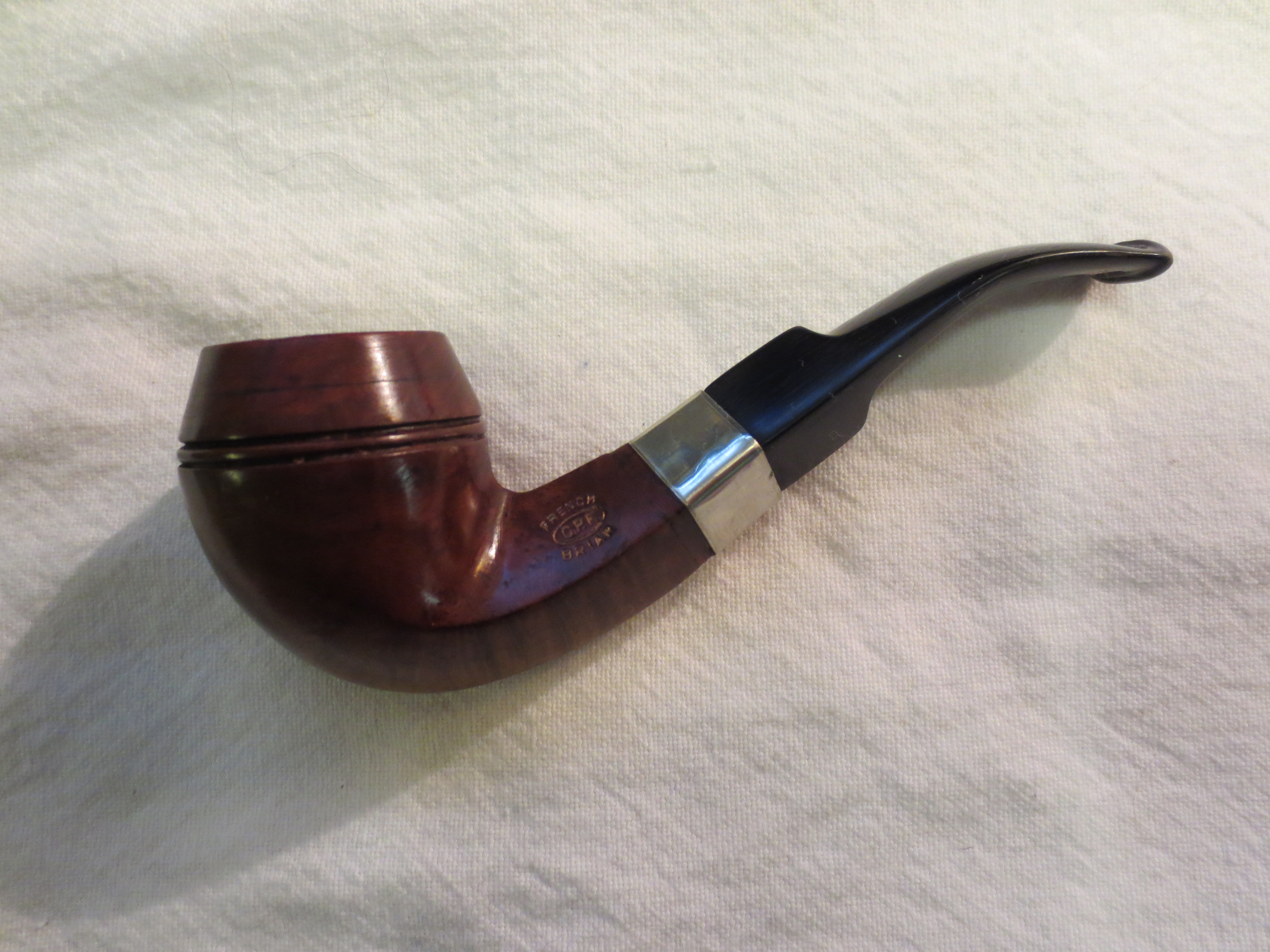
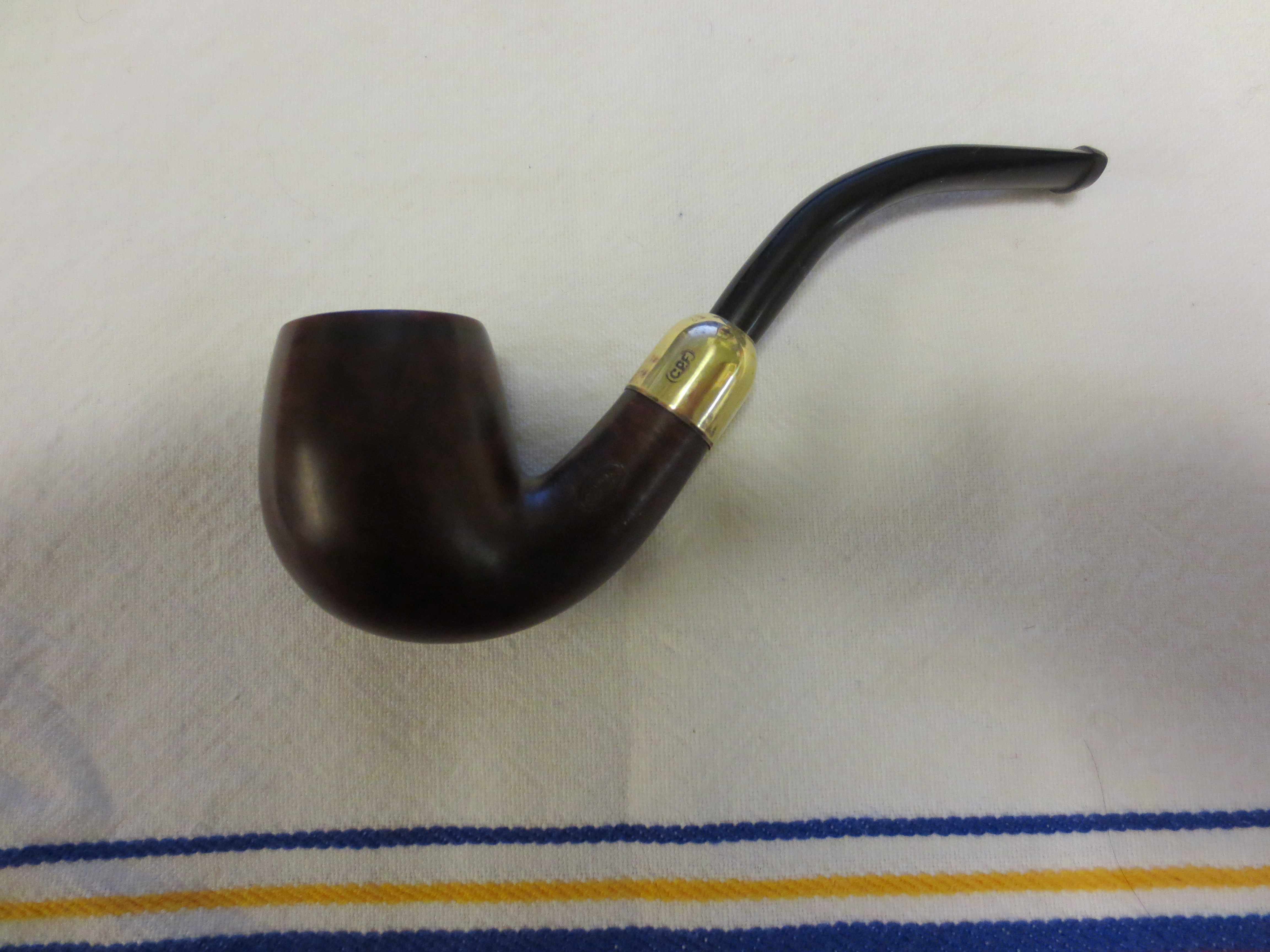
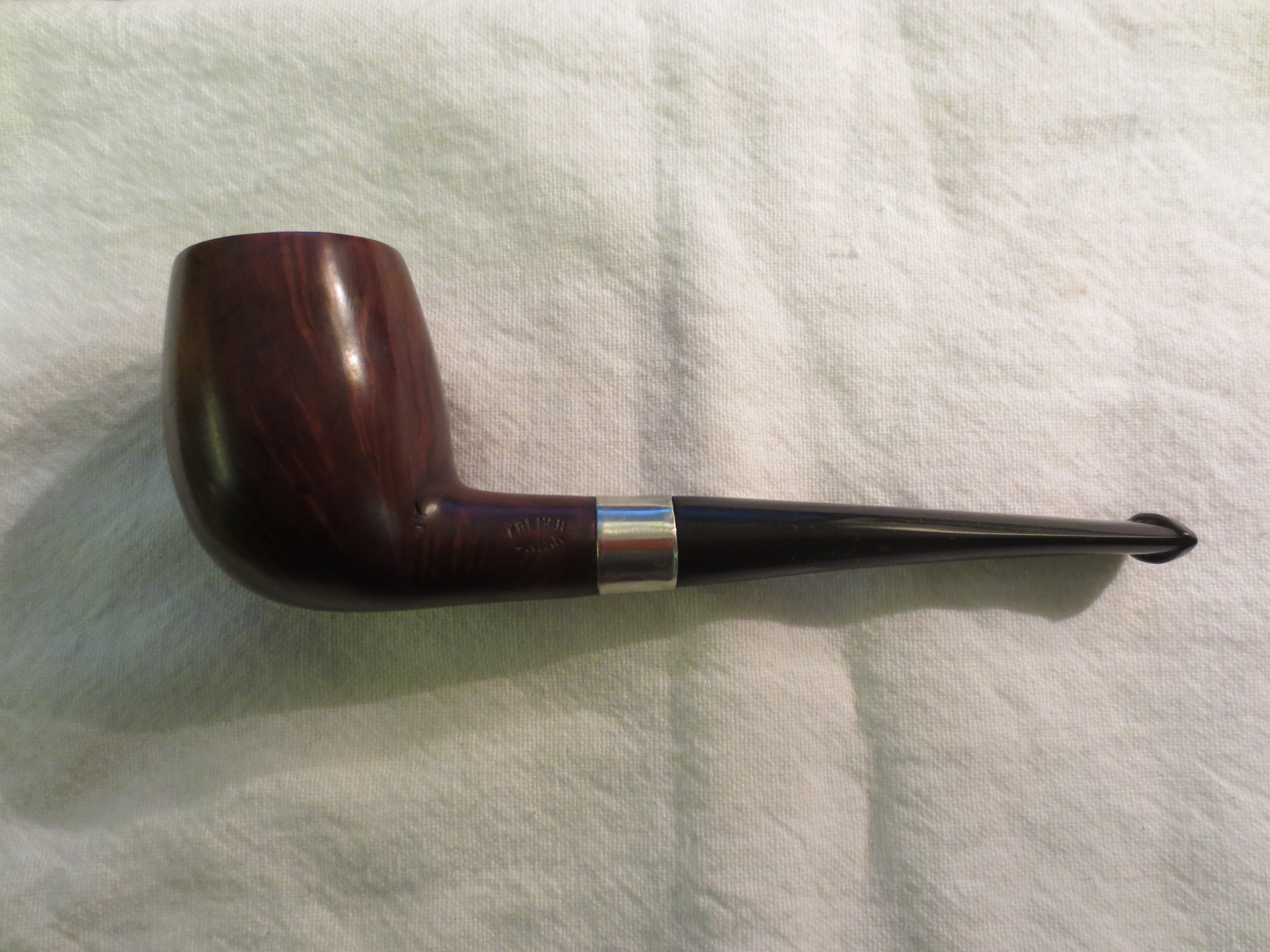
One of the secondary hobbies to pipe refurbishing that I enjoy doing is to research the history of a particular brand or make. In a recent EBay lot I bought there were 3 pipes that were stamped with the CPF logo – CPF in an oval with the word FRENCH stamped in an arch above the oval and the word BRIAR stamped in an arch below the oval. I had heard that the CPF stood for a variety of names from Consolidated Pipe Factory to Colossal Pipe Factory and even Chesterfield Pipe Company. There was a wide range of conflicting information available on the websites and forums that I looked read while looking into the brand. One evening while I was talking with Chuck Richards about the lot (I know that over the years he has seen quite a few old CPF brand pipes) he suggested that I ask Robert Boughton about it. Chuck said that Robert had done some work on the brand when he was given an old Meerschaum to refurbish. I contacted Robert and he sent me a variety of links that he had found. He had looked into the history and background of the CPF brand stamp. He wrote that he had found in his research that “…CPF definitely stands for Colossus Pipe Factory, a late 19th and early 20th century American venture that in its short, happy life created some of the most beautiful briar and Meerschaum pipes ever made”. He sent me a link to the stampings and logos site (1) http://pipephil.eu/logos/en/logo-c1.htmlbelowwhere he had found photos that showed the curved circular printing of French Briar around the CPF oval as well as some with a space between where the customary CPF mark was stamped within an oval enclosure. He had also looked into a variety of EBay offerings of CPF pipes and also on Worthpoint.com. He found some amazingly beautiful pipes for sale.

Throughout this article I have inserted photos of some of the CPF pipes that I have refurbished as examples. All of them showed the marks of having originally had rim caps and shank caps. Some of the older ones that I have seen have had beautiful filigree decorations in these areas.
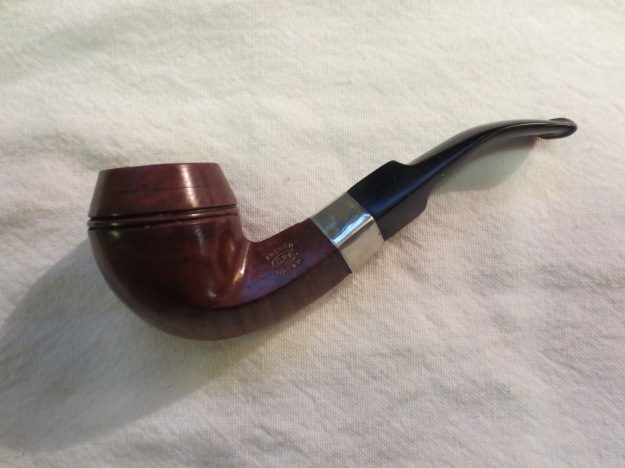
Figure 1 CPF Bulldog - restored by Steve Laug

Figure 1 CPF Bulldog – restored by Steve Laug


Armed with the information that Robert sent I decided to do some more digging into the brand. I found information on the CPF brand that verified his findings on the meaning of initials. CPF stands for Colossus Pipe Factory. There is not much known about the Colossus Pipe Factory. I learned that by the mid 1890’s CPF was owned by Kaufman Brothers & Bondy (KB&B). They operated the factory at 129 Grand Street, in New York City, New York. I had a faint memory of some connection between CPF and Kaufmann Brothers & Bondy. But was unsure where I had heard or read that. In the process of reading information I came across this post by Bill Feuerbach on the Kaywoodie Forum: “About 10 years ago I picked up two original invoices from KB&B. One is dated February 5, 1884 and the other December 9, 1898. Both have the address as 129-131 Grand Street, which is in Soho, adjacent to the Bowery in New York City. The 1898 invoice has in the upper left hand corner the initials CPF and Trademark. So by 1898 KB&B was making it known to the trade that they owned the CPF trademark. The 1884 invoice does not have CPF on it. Therefore I think we can assume KB&B acquired or started the CPF line sometime between 1884 and 1898.” (2)
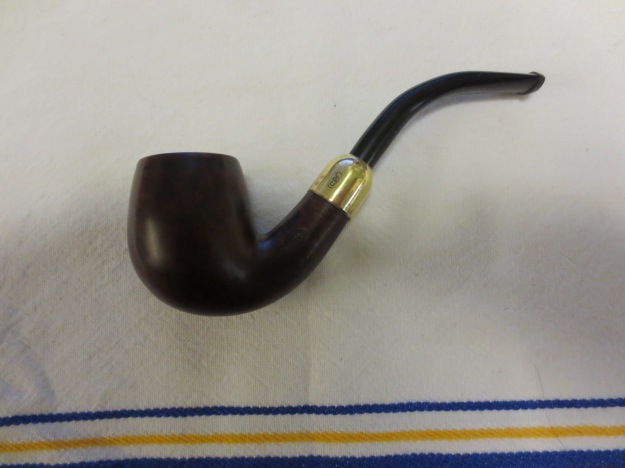
Figure 2 CPF Bent Billiard - restored by Steve Laug

Figure 2 CPF Bent Billiard – restored by Steve Laug


Robert Boughton also provided a link to a scan of a page from a trade magazine called “The Jeweler’s Circular”, dated August 23, 1899.(3) http://pipedia.org/index.php?title=C…s_Pipe_Factory In scanning through it I found that at the bottom of the center row of the clip a question sent in by a reader as follows, “Please inform as who manufactures briar pipes with the trademark, CPF?” The answer that was given in the article was, “These letters stand for Colossus Pipe Factory, the business being conducted by Kaufmann Bros. & Bondy, 129 Grand Street, New York.” I did a bit more digging as I wanted to find out the source of the Pipedia clipping. I found that the original source of this information was also Bill Feuerbach. He wrote the following on the Kaywoodie Free forum, “Now as for what CPF means. About 5 or 6 years ago Gary Schrier, pipe book author/publisher and pipe collector from Seattle sent me a copy of page 30 from the Jewelers’ Circular dated August 23, 1899. I assume this was a publication for the jewelry trade. On this particular page they have questions for the editor. One question is “Editor of the Jewelers’ Circular: Please inform us who manufactures briar pipes with the trade-mark rude cut: C.P.F. Thank you in advance for your trouble and kindness”. The answer was “Those letters stand for Colossus Pipe Factory, the business being conducted by Kaufmann Bros. & Bondy, 129 Grand St., New York.”

The address in the scanned document referred to above is the same address as the one on the invoices that Bill referred to in the quoted post in the previous paragraph. This industry/trade magazine, published at the time the CPF brand was being made, reports that the C in the CPF brand means Colossus rather than Consolidated or Chesterfield. To me that answers the question quite definitively.(4)
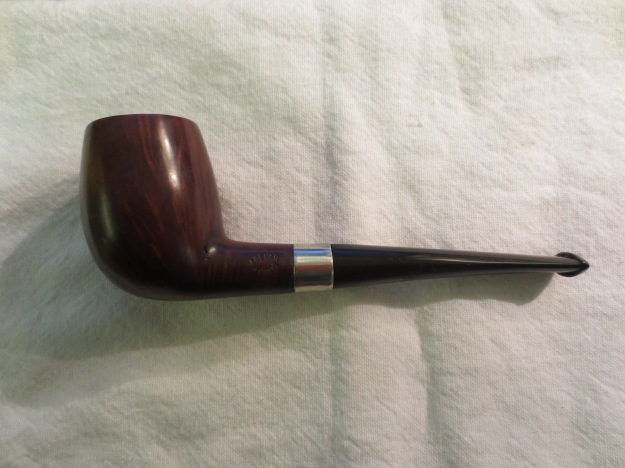
Figure 3 CPF Billiard - restored by Steve Laug

Figure 3 CPF Billiard – restored by Steve Laug


Even with that clear information from Bill, in both the invoices and the article in the trade jounal there still is some disagreement among pipemen as to the meaning of the letters in the brand. In my research I came across a few divergent opinions on the brand and I thought it important to cite them. The following information comes from Samuel Goldberger of Finepipes Estate pipe website as referenced below. On the page on his site dedicated to CPF pipes Sam wrote, “I have not found any clear history of CPF, but I have developed some ideas about them, based upon my study of early American made pipes. By the turn of the last century, a number of small pipe making factories had collected in and around New York City, including the William Demuth Company (WDC) and Kaufman Brothers and Bondi (KB&B), later to become Kaywoodie. From the design and quality of execution of these pipes, I believe the factories must have been staffed by European immigrants, probably Jewish, who had been trained in the older traditions of pipe making in France, Germany and Austria. The pipes they produced were in a similar style. They were expertly cut from very old, air-cured Algerian briar in classical shapes or from the finest grade of Turkish meerschaum; they sometimes rather small; they often had amber or Bakelite mouthpieces, gold or silver fittings. It’s my suspicion that pipes from these small makers were at one time sold or marketed under the name “Consolidated Pipe Factory.” Alternatively, CPF may have been the name of the distributor.” (5) Personally, not to disparage Sam’s ideas, I find the information provided by Bill Feuerbach in the paragraphs above to be conclusive that CPF stands for the Colossus Pipe Factory.

Further, in my research I found that others commented on the fact that they had seen pipes with both the CPF logo and KB&B logo on them that date to pre-1900. I too have seen, refurbished and sold some that bore both stampings/logos. This has led me to wonder if the dual stamping may have been a way to let pipe smokers of the time know that the companies were affiliated. From my reading and research it seems to me that CPF brand was discontinued sometime in the 1910-1920 range. Again, turning to Bill Feuerbach I found that he notes the following, which pins down the time frame of the discontinuation of the brand more specifically, “I have a CPF Chesterfield in our office display that has a nametag from way before my time that says 1900 CPF Chesterfield. It looks like most other Chesterfields you’ve seen, including the military type push stem, except this stem is horn and not vulcanite. As far as I have gathered the CPF brand was phased out sometime around 1915.” (6) Interestingly, he noted that the Chesterfield name and style was later introduced in the KB&B, Kaywoodie and Yello-Bole lines. He says that the 1924 KB&B catalog shows KB&B Chesterfields.

I also came across the following photo that comes from Bill Feuerbach which shows the dual stamping of the logo on this display placard for CPF pipes. Note the familiar KB&B logo and cloverleaf at the bottom of the placard. (7)
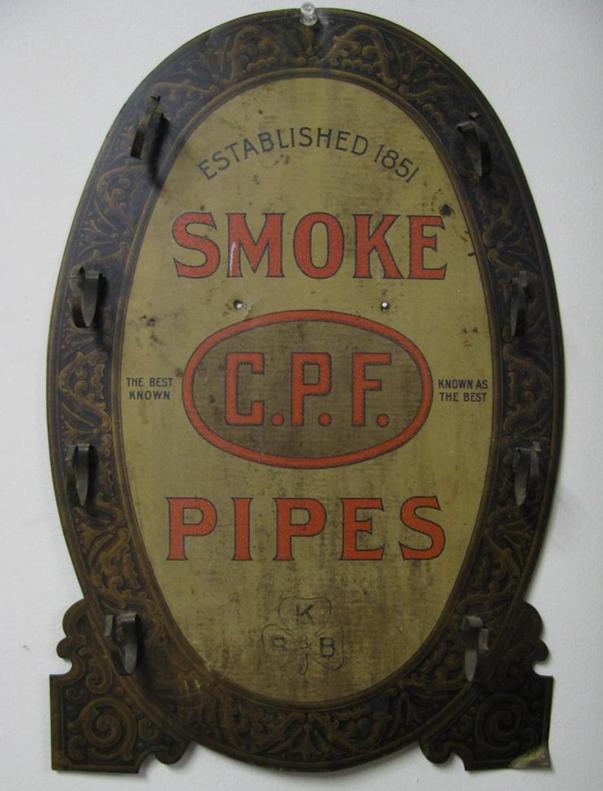
Figure 4 From the collection of Bill Feuerbach

Figure 4 From the collection of Bill Feuerbach


From my research I believe that we can definitively assert that the CPF logo stands for Colossus Pipe Factory. The brand was purchased by KB & B sometime between 1884 and 1898 and that it continued until 1915. That time frame gives help in dating some of the older CPF pipes you or I might find. It can be said that prior to the dual stamping it is fairly certain that the pipe is pre-1884 to 1898. After the dual stamping it can be placed post 1898 until the closure of the brand line in 1915. CPF made beautiful pipes. I believe Sam Goldberger was correct in his assertion of the potential carvers that made the pipes being of European training and the classic shapes and well aged briar. That coincides with all the CPF pipes that I have come across.
_____________________________________________________________
End notes
(1) http://pipephil.eu/logos/en/logo-c1.htmlbelow
(2) http://kaywoodie.myfreeforum.org/archive/cpf__o_t__t_161.html
(3) http://pipedia.org/index.php?title=C…s_Pipe_Factory
(4) http://kaywoodie.myfreeforum.org/archive/cpf__o_t__t_161.html
(5) http://www.finepipes.com/pipes/american/consolidated-pipe-factory-cpf
(6) http://kaywoodie.myfreeforum.org/archive/cpf__o_t__t_161.html
(7) http://kaywoodie.myfreeforum.org/viewtopic.php?t=161&start=0

An Interesting Old Piece of Dunhill Tobacciana – Dri-Pipe Tubes


Blog by Steve Laug

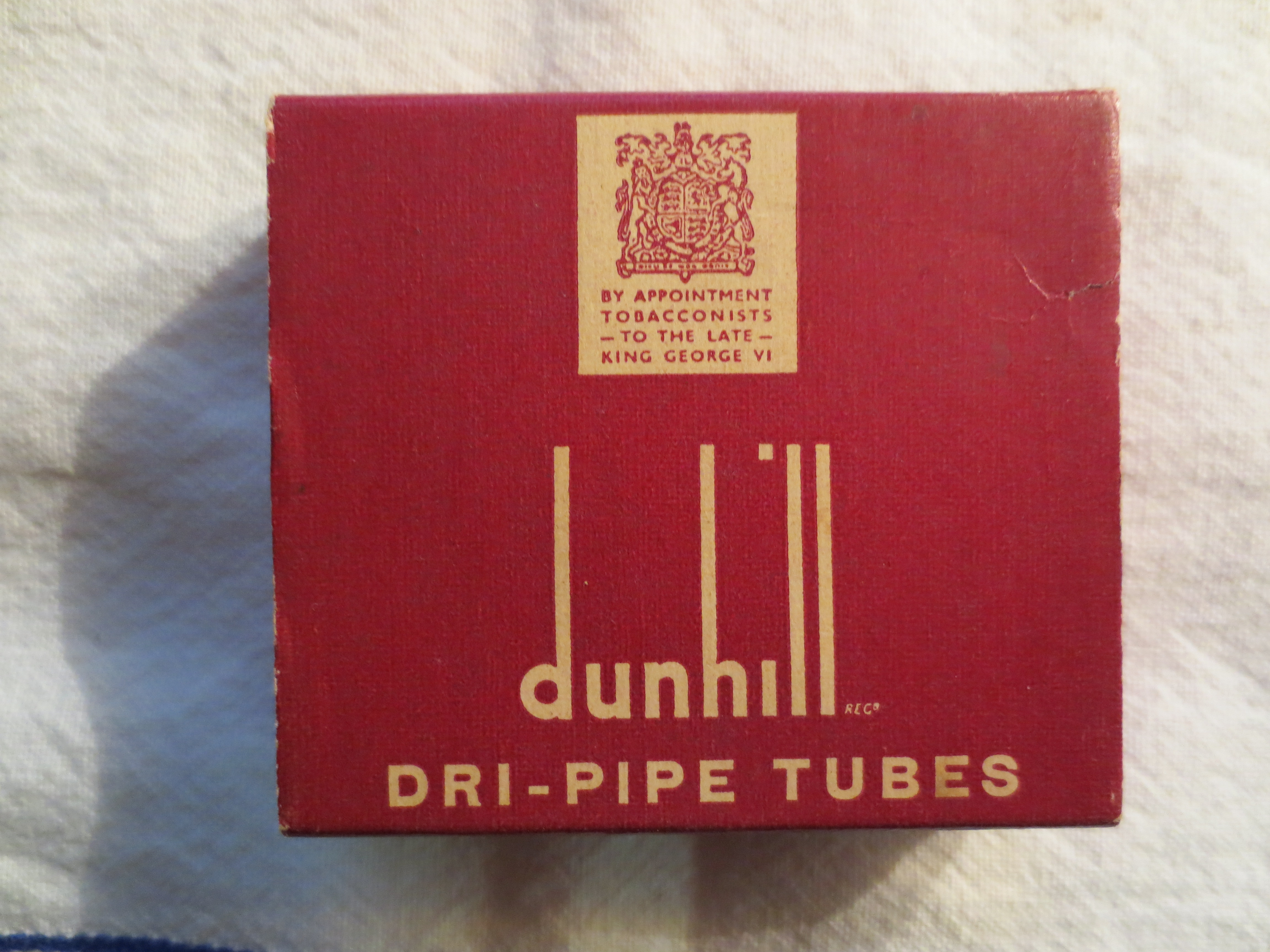
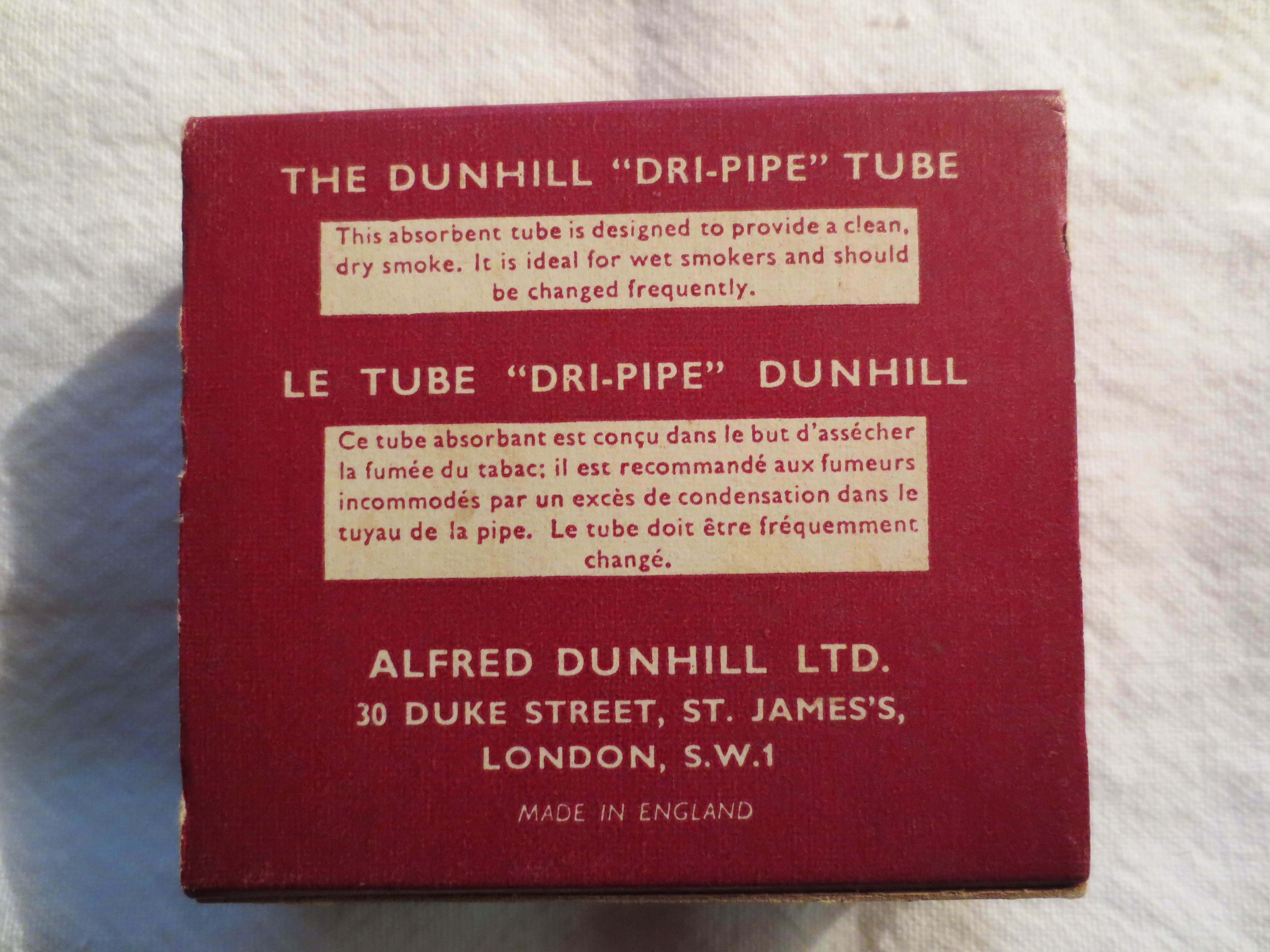
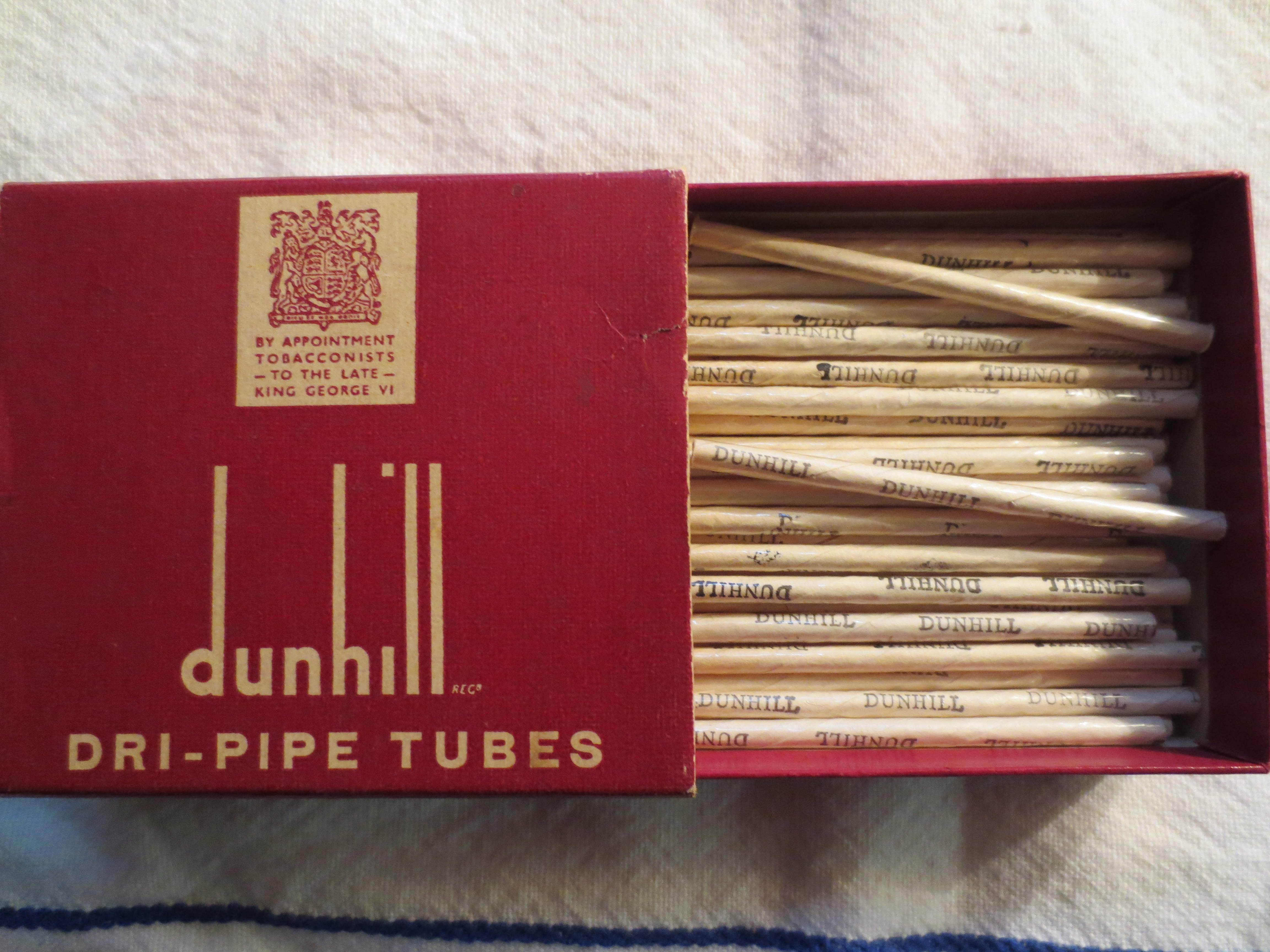
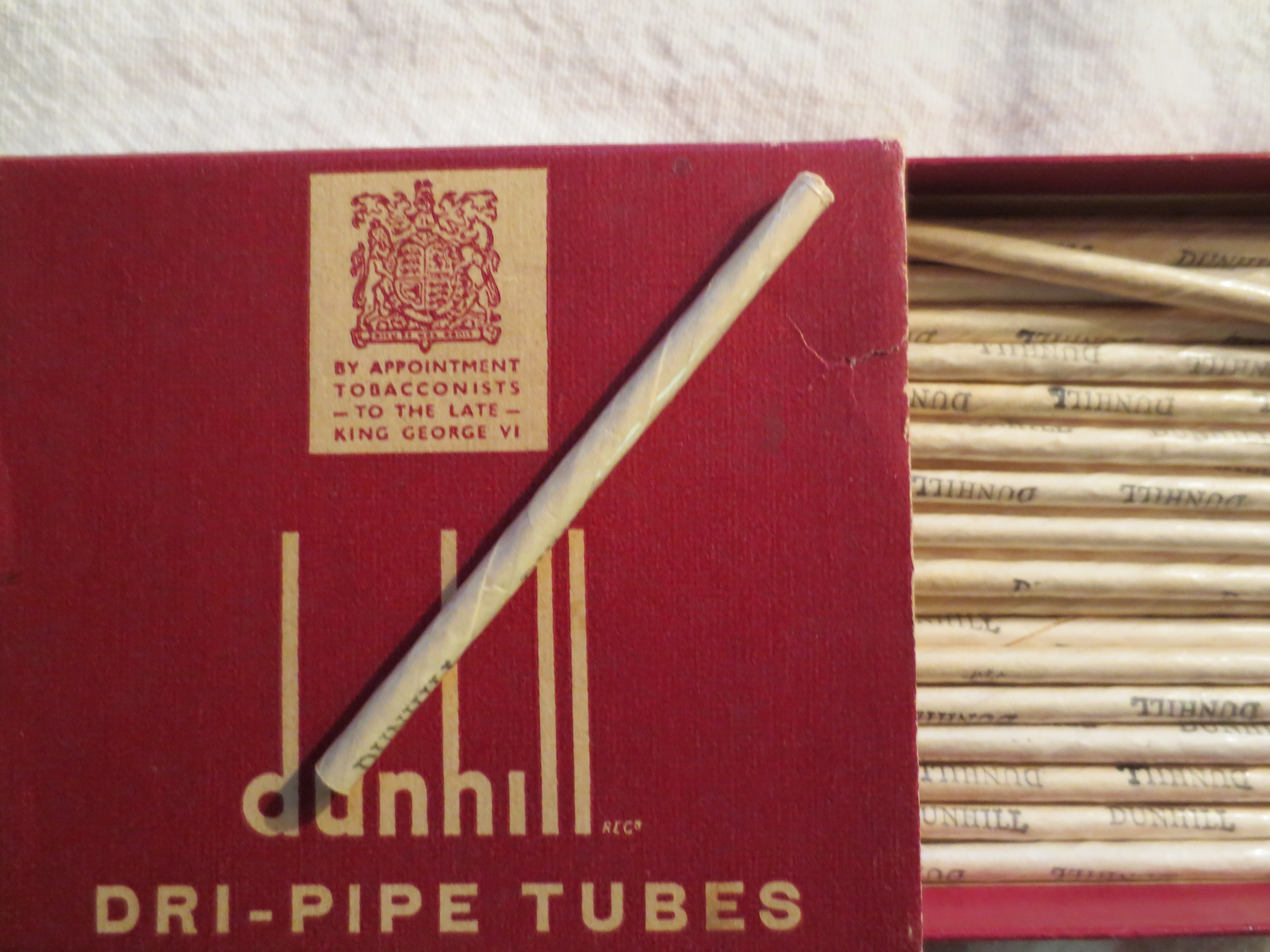
I have a full box of these Dunhill Dri-Pipe Tubes. I am not sure where I picked them up but I was going through some stuff in the drawer today and came across this piece of pipe history. Anyone have any ideas on the time frame for these? The box says: “This absorbent tube is designed to provide a clean dry smoke. It is ideal for wet smokers and should be changed frequently.” The box has 100 tubes in it. It is marked Alfred Dunhill Ltd. 30 Duke Street, St. James’s, London, S.W.1. I love old stuff like this and I am always keeping an eye for it. I believe these were to be inserted kind of like the more modern 9MM or 6MM filters or even the Medico or Dr. Grabow filters. I figured I would post them on the blog to see if anyone has seen them or has information on them. Just another interesting piece of tobacciana
IMG_0777

IMG_0778

IMG_0779

IMG_0780

Father Tom – A Serendipitous Encounter in Frankfurt


Father Tom heard the announcement over the intercom at Heathrow that his plane was now boarding so he hurriedly left the smoking cage and made straight for the gate for his flight to Budapest. He knew that he would change planes in Frankfurt on the way and was hoping to get the chance to pick up some pipe tobacco from the Duty Free on the layover there. He also hoped that Jack Spratt and his wife from the Vancouver/London flight would not be on the same plane.  He was weary of obnoxious passengers. He wanted to have a little quiet down time to read over his notes for the conference in Budapest. His pipe still hung unconsciously in his mouth, though the tobacco was long since burned away and the dottle disposed of in the cage. He absentmindedly touched the pipe at different points in his walk to the gate. People would glare at him as he walked along oblivious to their stares and pointed comments about not smoking. If he had noticed he would likely have had some witty repartee to give back to them.

By the time he boarded the Frankfurt bound plane he had returned the pipe to his jacket pocket without much intention, so he had no further problems. It seemed too fortunate to be true that his troublesome travel companions were not on this plane, as he was used to a bit of hassle on his flights. He settled into his seat on the aisle so that his right leg could straighten out in the aisle once they were underway. His leg always gave him problems when he sat too long so he had learned to accommodate his aches and pains. The takeoff was uneventful and his seatmates were soon sleeping. While he read through his materials for the seminar in Budapest, he reached in his pocket and stuck his pipe in his mouth and unconsciously gnawed on it. The flight attendant made it a point to remind him of the no smoking rules.  He pointed to the bowl showing that it was empty and commented that it was his soother and would keep him quiet on the flight. As an afterthought he said, “You wouldn’t want a cranky old man whinging on this leg of the trip.” With that the flight attendant laughed, shook her head and continued down the aisle.

He settled into his reading and writing, interrupted only by the food and beverage service – some type of dark bread and a strong cheese,served with a thimble sized cup of strong coffee. He missed his mug of fine coffee and grimaced as he sipped the strong, dark, lukewarm brew. He was looking forward to finally landing in Budapest. The conference was scheduled for three days so he had booked several extra days following the conference so that he could do some sightseeing and visit the local tobacconists. He had searched online for and found some pipe shops that looked interesting. As he thought about that he took the pipe from his mouth, held it in his hand and looked out the window. He wondered how soon they would be landing. He was actually looking forward to the layover in Frankfurt – another bowl would be a comfort and maybe he could pick up some stout German lager as well. Within moments of his thoughts the plane began its descent and the announcement came over the speakers that they would be landing soon and should turn of electronic devices… He chuckled and said to himself, “That wish did not take long to be granted.”

The plane landed smoothly and taxied to gate. The passengers quickly maneuvered their way off the plane. About mid-stream among the disembarking crowd was Father Tom. His pipe hung from his mouth as he clutched his briefcase in his hand. He had put his flat cap on and he was a man on a mission. Once off the plane he looked for a smoking area where he could fire up his pipe. Seeing none, he asked at the information desk where he might find one. Somehow in his bumbling German he was able to understand where he was being directed…or at least he thought he understood. So he started on his way toward the spot pointed out to him. When he arrived he realized that something had been lost in the translation as he found himself standing in another queue for Security. He was trapped in a line that could not be exited so he moved forward with the crowd. When he arrived at the desk of the Security Officer he was asked to put his bag, coat and shoes on the belt to be scanned. He did as he was told but forgot to take the pipe from his mouth. The officer pointed at the pipe so he looked down to see his pipe in his mouth and placed it in the tray as well.

When he had passed through the scanner he realized that he was still in the gate area of the airport and had actually moved to the sets of gates where his next plane would depart. He went to the information desk and asked again for the smoking area. The attendant had a blank look on her face so he pointed to his pipe and acted out smoking… she nodded. She understood and pointed him to the area. Ah… finally he had accomplished at least a part of his mission. He expected a cage like the one at Heathrow so you can imagine his surprise when he found the newly renovated smoking lounge in Frankfurt airport. It was beautiful and new. He found a comfortable seat in an unoccupied corner of the room and soon was totally oblivious to anyone else in the room, happy to have achieved his mission. He filled his bowl, lit, tamped and relit the pipe and soon he was quietly enjoying the solitude of his smoke. He became almost invisible in a cloud of sweet Virginia smoke. No one sat near him so he could get lost in his thoughts and enjoy himself thoroughly.

Image

Suddenly his quiet repast was interrupted by a tap on his shoulder. He came back to the present and was prepared to give a ready retort to anyone asking him to put out his pipe; but before he could speak the chap at the other end of the hand came into focus.  It was an older gentleman wearing much the same dress as he did that came around the chair to stand in front of him. He even sported a pipe in his mouth. He was saying something and Father Tom had to quickly shake away his surprise and listen. The older gent seemed to guess Tom had not heard him, so with a twinkle in his blue eyes he repeated himself.

“Good day sir. May I join you for a bowl while I am waiting? I have been sitting in this room in the opposite corner smoking a bowl by myself when I saw you come in. I thought to myself it would be a fine thing to have a word or two with a fellow pipeman. Do you mind?” said the old gentleman.

Father Tom shook his head in amazement and said, “I apologize for my speechless surprise a moment ago. I am so used to having to defend my right to smoke my pipe that I was shocked to see a pipe in your mouth. I had no idea there was another pipe smoker in the room. Certainly, it would be great to have you join me for a bowl. What are you smoking? What kind of pipe is that you have?”

And with those questions the agenda for the layover was set. The thought of a pint of lager quickly disappeared from his mind as the good father and the old fellow exchanged names and settled into the kind of conversation pipemen the world over enter into with one another with little effort. The older gent’s name was John and he lived in Oxford, England. He was also heading to Budapest for a business meeting regarding some materials his company was exporting to Hungary. They enjoyed a great hour and a half smoking and talking about pipes they owned or had sold, ones that were on the wish list and old tobaccos that they missed. They heard the intercom announcement for their flight and headed for the plane to Budapest. On the way out the door they tapped out the dottle from their pipes into an ashtray on one of the tables. They chatted on their way to their gate and made arrangements to get together after their meetings and check out the local pipe shops. They both had done some homework and had come up with the same two shops that each of them had on his list to visit – the Pipatorium and Gallwitz Tobacconist. It was likely a curious sight to behold for the other travelers, as the two older men, each with an empty pipe in his mouth, chatting up a storm made their way down the aisle. They were like long lost brothers reunited after years of being apart.  They traded seats with another passenger so they could sit together and soon were lost in an ongoing discussion. The flight to Budapest went quickly and soon they had landed. They left the plane, picked up their luggage and parted company for their respective hotels.

John said, “See you on Wednesday when I am finished and we can spend the evening laying out the plans for our walkabout on Thursday. Who knows we may find a couple other shops to check out as well. I know that Davidoff has a shop here and there is also a Cigar shop shaped like a tube that we can check out near the Vaci Utca. Hope you enjoy your conference.”

Father Tom responded, “Talk to you soon John. I am looking forward to Wednesday evening. We can have some dinner and a bit of Hungarian wine and layout the plan. Good luck on the business meetings.”

They left the plane, nodded to each other as they made their way to meet their rides. As Father Tom waited for his ride he thought to himself, “What a serendipitous turn of events to meet another pipe smoker in Frankfort and to have each booked extra time on their trip to visit some tobacco shops. The trip was going to be a memorable one regardless of the outcome of their individual meetings”. The random events of travel had come together to their mutual favor, for a change from the typical trials both had known.

Steve Laug 03/22/13 Copyright 2013

Father Tom – an odd bird in the cage


It had been a long flight from Vancouver to London, made longer and harder to endure because of the seatmates around him on the plane, Father Tom was tired.  He had been seated across the aisle from a couple who seemed to have brought a picnic basket stuffed with incredible amounts of food on the plane with them. The man was a Jack Spratt type fellow and his wife was the direct opposite. They made a comical picture for the first part of the flight but the novelty soon wore off. The man sat quietly, almost like he was not present and the woman continuously ate from the moment she took her seat in Vancouver until the plane had touched down in London. You can now imagine the size of her food hamper. The eating would not have been unbearable, but the ongoing smells that kept wafting across the aisle, the cacophony of sound of rustling wrappers and crackling papers as one package after another was opened. Added to that was the visual image of her mouth constantly opening to take in yet another goody, before she was finished chewing what was already in it! On top of that, the man behind him insisted on reading the newspaper with it virtually sitting on top of Father Tom’s head. It seemed that each time he would doze off one or the other passengers would crackle, pop or hit him on the head. The snoring of the person on his right, and the envy of his escape…, you can imagine the frustration from the lack of any rest. Yes indeed it had been a long flight without rest or distraction from the chorus of poor travel companions!

It seemed as if he was never happier than when the rubber tires hit the tarmac of the runway and the plane landed. When the seat belt sign went off he stood and put on his Harris Tweed jacket, his flat cap and took his brief case and quickly headed for the door. Once off the plane, he hung the briefcase by a strap on his shoulder and rummaged through his jacket pocket to find his pipe and tobacco pouch. He packed the bowl with a nice thick Virginia flake as he walked down to corridor of the airport. He remembered that there was a smoking cage in Heathrow near the shoeshine stand at one end of the airport. He set his sights for the cage and the tranquility of being engulfed in a cloud of blue smoke. He had long ago learned that the most ardent cigarette smoker moved away from the blue cloud and he would have space alone.

His bag bumped along against his leg as he walked. Once the pipe was packed he stuck it in his mouth and clenched it as he walked. He was oblivious to the stares of people walking by staring at the aging priest with the pipe in his mouth. I am sure several must have said something about the airport being a non-smoking environment but Father Tom would not have heard that at all. His target was in sight and he was a man on a mission. If you had been close to him you might have heard him humming a song to himself as he walked – or at least you might have thought it was a song. I think though, in reality it was a countdown in terms of steps and paces from the gate to the cage – a series of steps that he had counted before and knew by heart.

He edged his way to the cage, walking in front of several people who seemed intent on blocking his way; oblivious to their words and comments about his person and character. He had made it! He pushed open the door to the cage and entered the smoke filled room. Just inside the door he fumbled for his lighter in his pocket and brought it out to light the pipe. He struck the wheel on BIC lighter and a flamed danced over the surface of the tobacco. The first plume of smoke came out of the pipe. He tamped it with his finger, long ago calloused and impervious to the heat of the burning tobacco. He flicked the lighter and lit the tobacco and drew the smoke into his mouth to savour. Only then did he look in front of him at the crowded room.

The place was packed with a relatively young crowd – at least in comparison to him and how he felt at this time in his life. At that moment they were staring at him – an aging priest with a pipe in his mouth and smoke billowing out around his cap and whiskers. I think that they must have found him comical to look at and were wondering what he was thinking of in his moment of relief. Obviously he was totally immersed in lighting his pipe and savoring the comfort of the moment. Only at that instant did he realize that he was the only one smoking a pipe, the only one over 30, the only one with a coat and collar in the whole room. He edged his way over to a side of the room where there was a ledge on which he could set his briefcase and lean in for the smoke. He nodded to the smokers in the room as he settled in for his retreat.

At that moment he cared not to give one thought to those around him. He did not care what they were thinking or even what they were talking to one another about as he puffed contentedly on his pipe. His eyes were closed and he was lost in thought – nothing profound or philosophical, mind you – just the thought of the long awaited pipeful. He sipped it and settled in comfortably to his corner. The smoke continued to billow out of the pipe and the corners of his mouth. At one moment he blew a couple of smoke rings and probably a soft sigh of contentment.

At the apex of his smoke he was rudely awakened to the crowd around him. A young chap was patting his arm and his shoulder, not softly either but almost roughly. He was saying something and Father Tom was brought out of his reverie to find that several sparks of his tobacco were burning holes in his Harris Tweed and not only was he smoking but his jacket was as well. The young chap almost doused him with some water but Father Tom stopped him and squeezed the sparks with his thumb and forefinger and extinguished them. He winked at the chap and thanked him for his kindness and waved off the crowd. To their amazement the pipe never left his mouth through the entire event. He made the comment that this was indeed one of the best smokes he had enjoyed in quite some time and thanks to the watchfulness of the group it had not been hazardous to his health!

With a twinkle in his eye he settled back into his quietude and finished his bowl before heading back out into the hallways of Heathrow to find a pint and some bangers and mash. He had a three hour layover in London before heading on to Budapest, Hungary for the meetings he was attending.