Tag Archives: Stories and Essays

The Pipe Hunt – Rule # 5: Never pass up pipe parts when you see them


Year ago now, I was visiting a lawn mower repairman who worked out of a shop in his back yard. I have a 30+ year old Snapper gas powered mower that works great and have had parts and gears that have broken or seized up. Joe always is able to get things back in tip top shape. It always starts with one pull of the cord. On one of my first visits to Joe he looked at what I needed and took me into his workshop. He reached up to a shelf that held many small bins and took down one that had several of the parts that I needed. He selected the one he wanted and within short order fixed my lawn mower. I asked him about the part bins and he said that he scavenges parts from where ever he can. He buys broken mowers and strips them down and buys parts whenever he can. He stock piles old parts – some of them are no longer are made so his bins are truly a treasure trove. Over the years I continue to go back to Joe and he keeps my old lawn mower running like a watch. He never has to go and buy parts because his bins hold much.

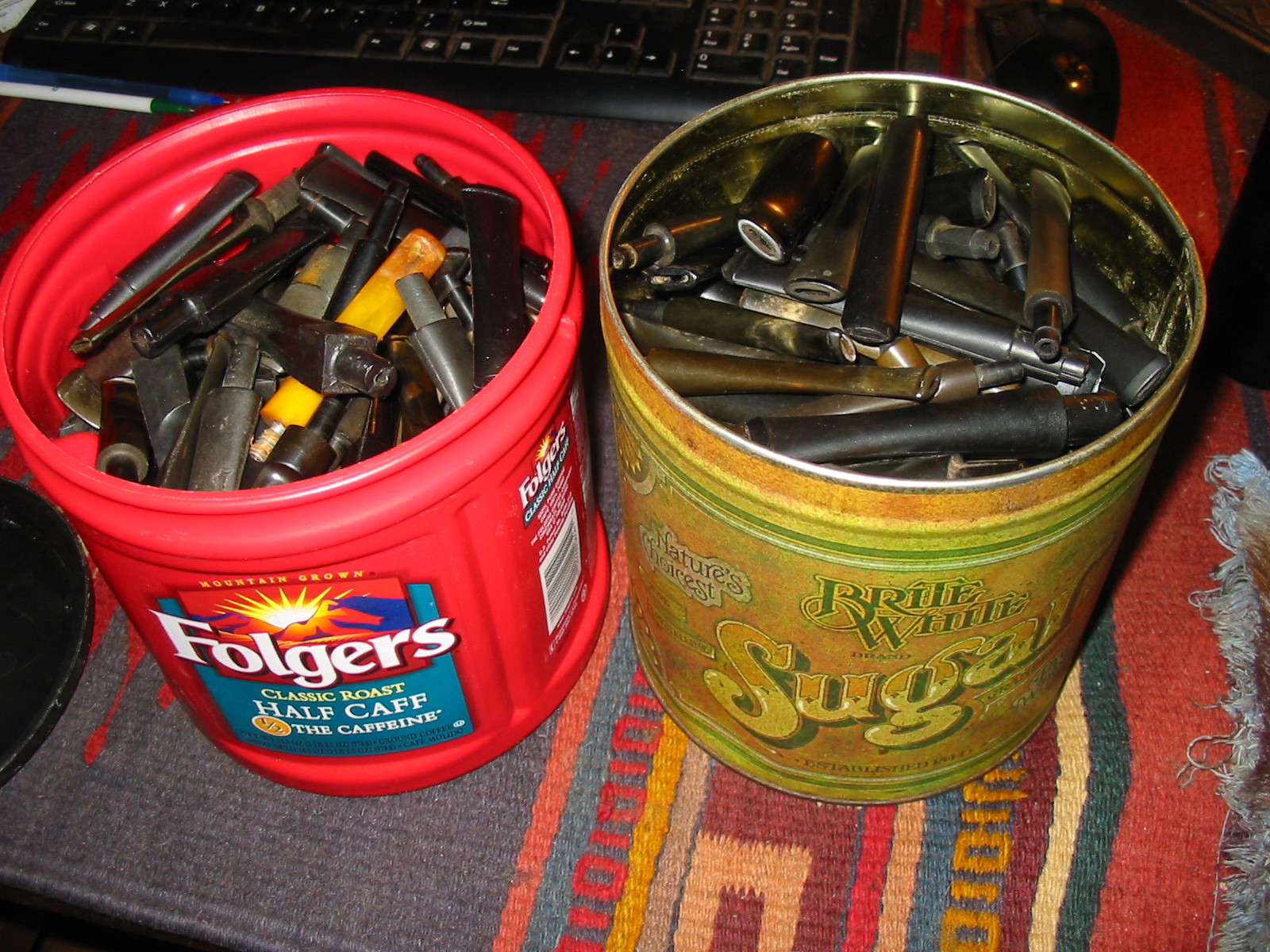
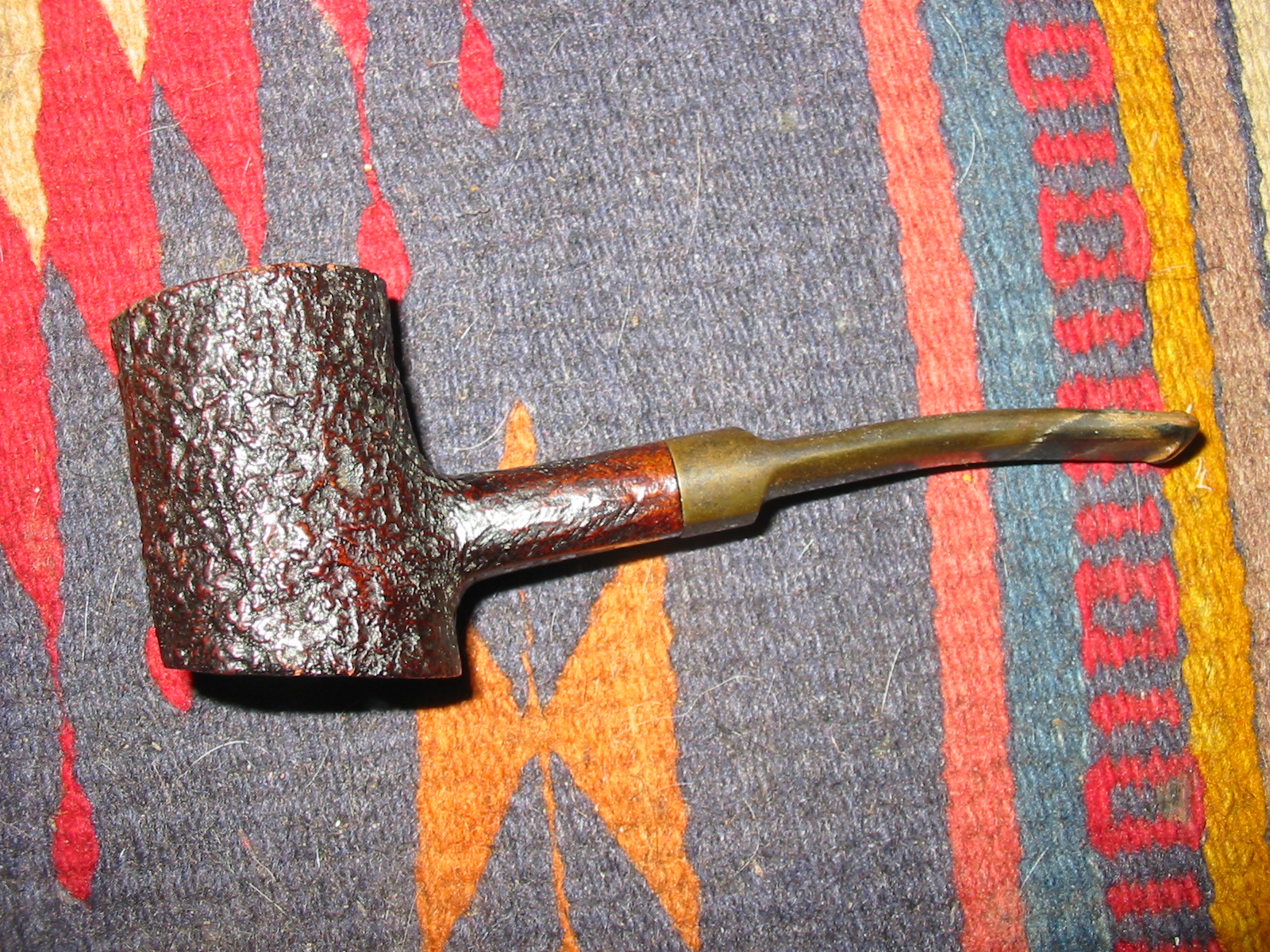
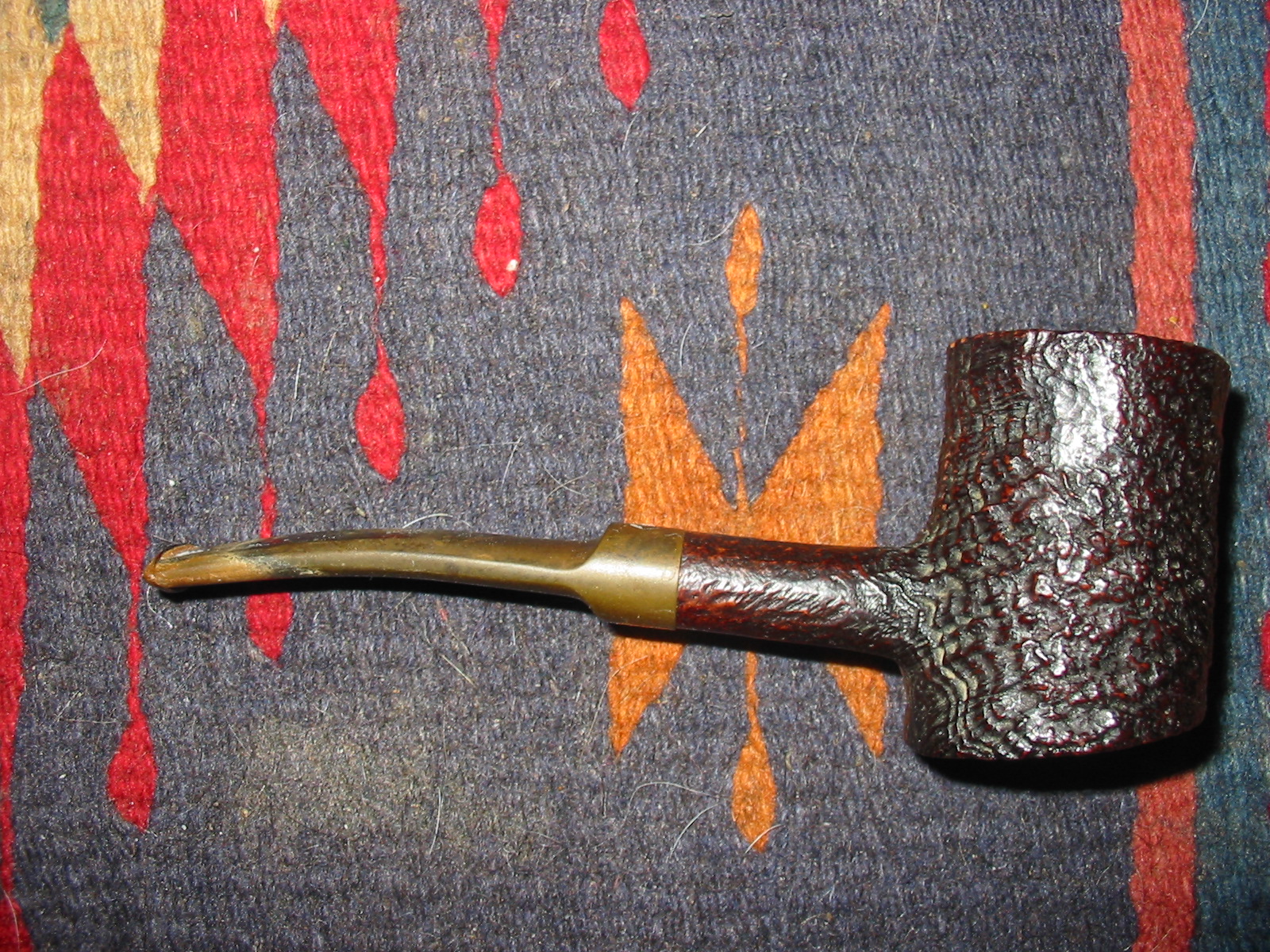
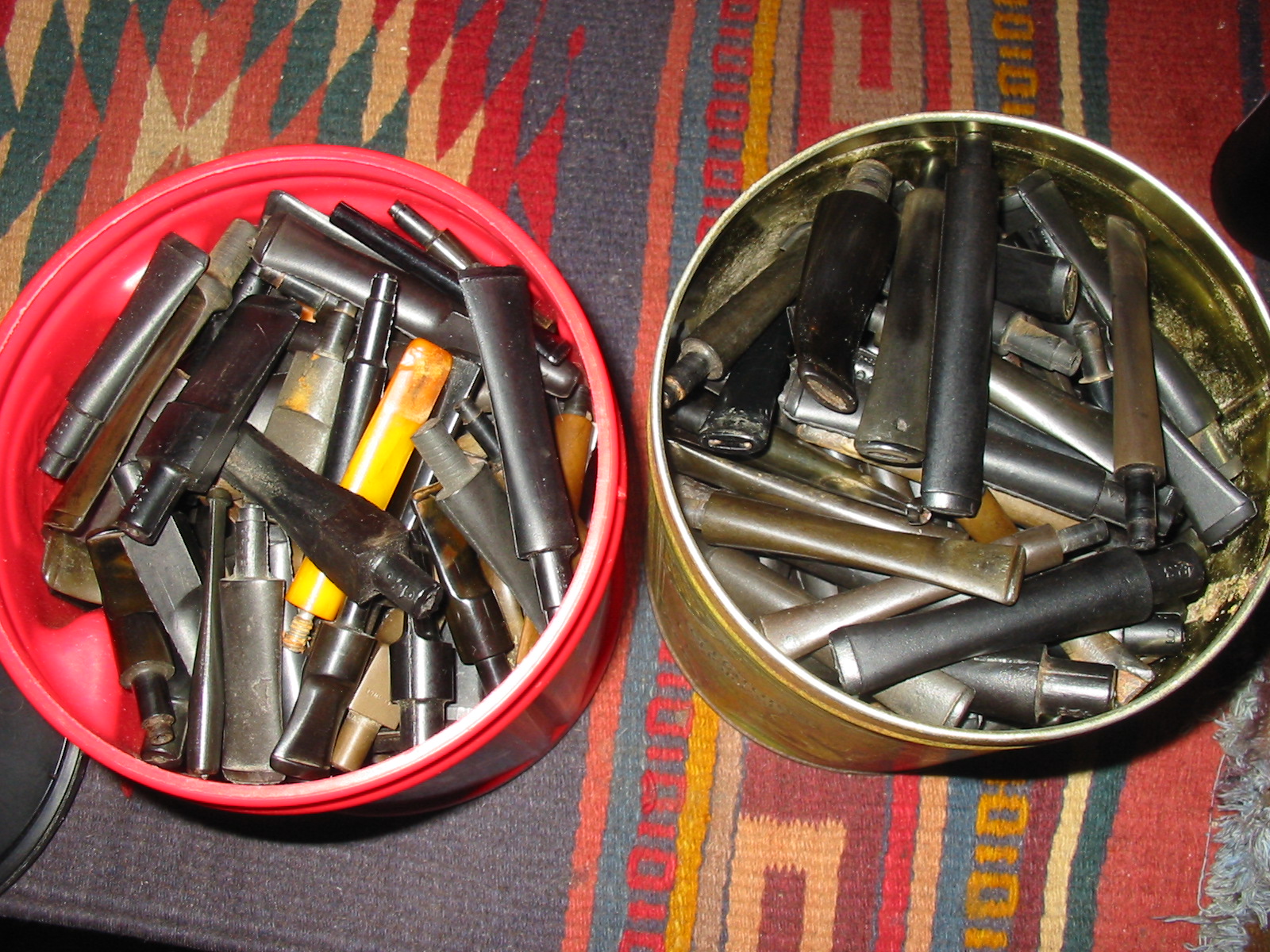
You might ask what that has to do with pipes and pipe refurbishing. Well in a very personal way it set the course of my pipe repair work. I have never forgotten Joe’s example with lawn mower parts. Since I don’t fix lawn mowers or motors I collect a totally different set of parts. I love refurbishing old pipes so I have started my own bins of pipe parts. I am looking forward to the day when I can set up a small shop of my own the yard where I can have the parts readily accessible when I am working on things. Until that time I collect the parts and store the bins in cupboards and drawers in the basement and laundry room. I have several bins of stems – old stock unused, scavenged used stems from broken pipes, new stem blanks in a variety of shapes and sizes. I buy stem blanks from Ebay and from Pipe Makers Emporium and new and used old stems where ever I find them. Currently I have them divided into a tin of round stems and a tin of different shaped stems. I also have bags of tenons, tins of stingers, a shelf of broken briar pieces and a box of bands of different sizes and shapes. I collect as many pipe parts as I can find from as many places as I find them.
IMG_2374

IMG_2375

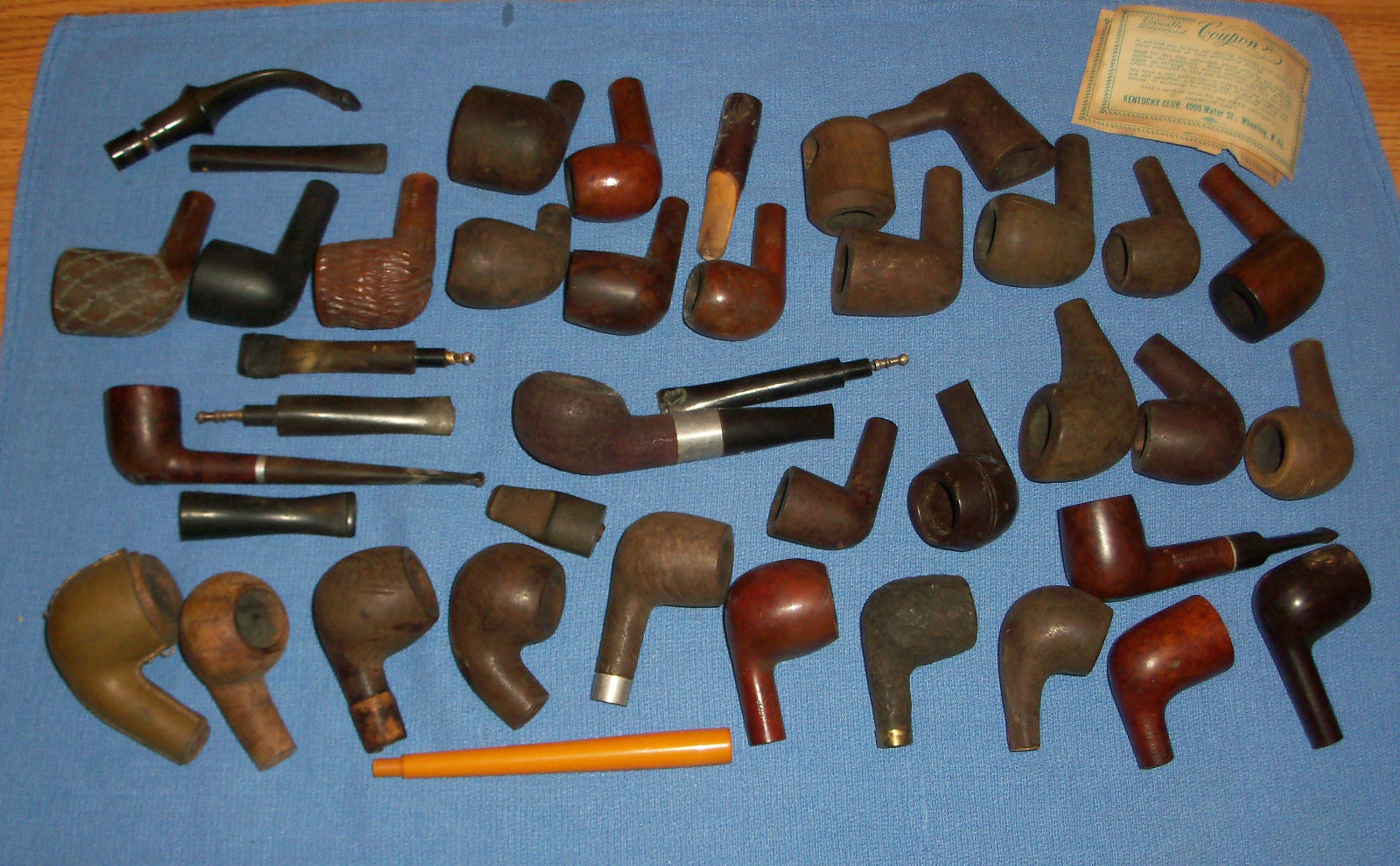
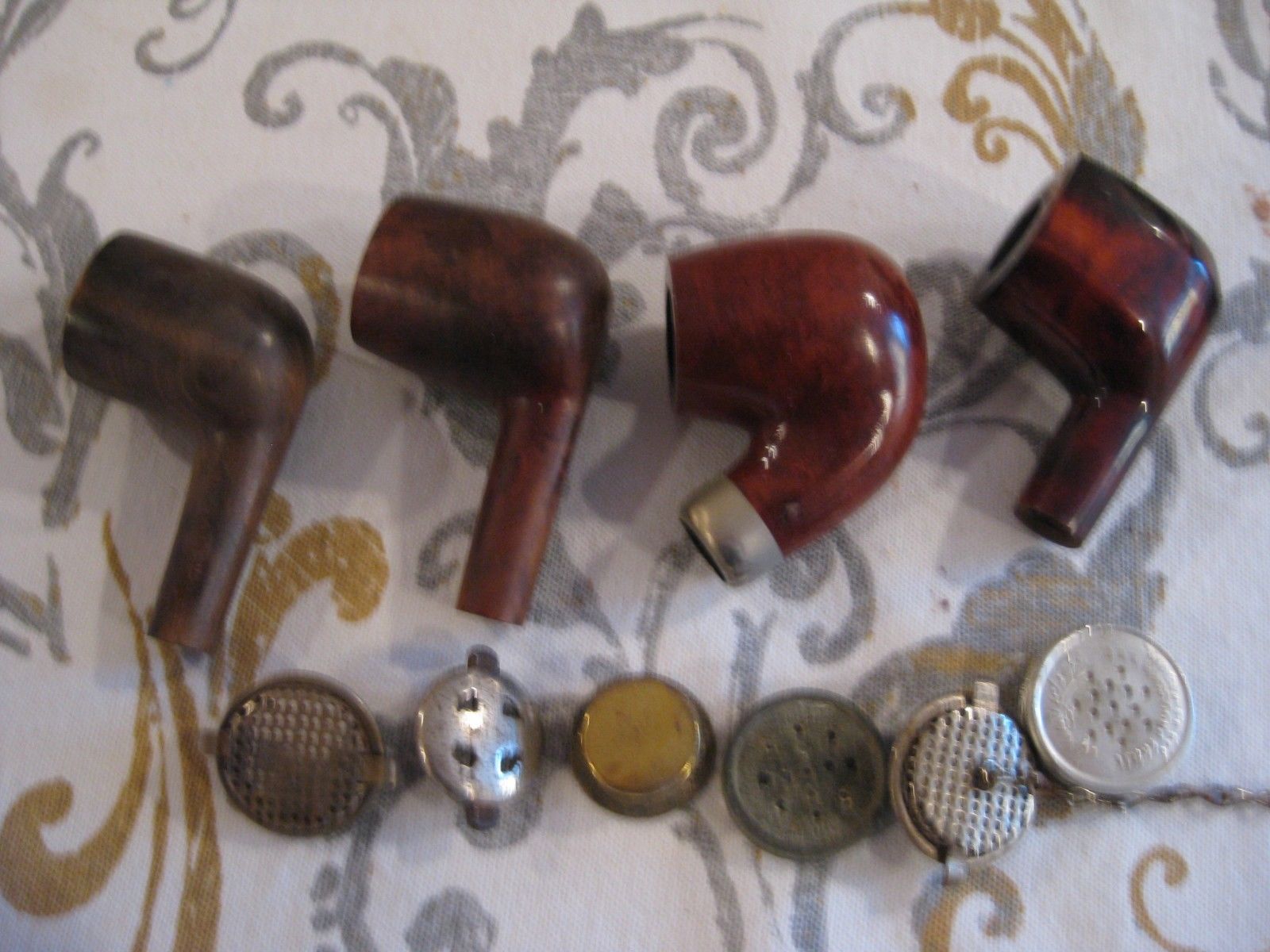
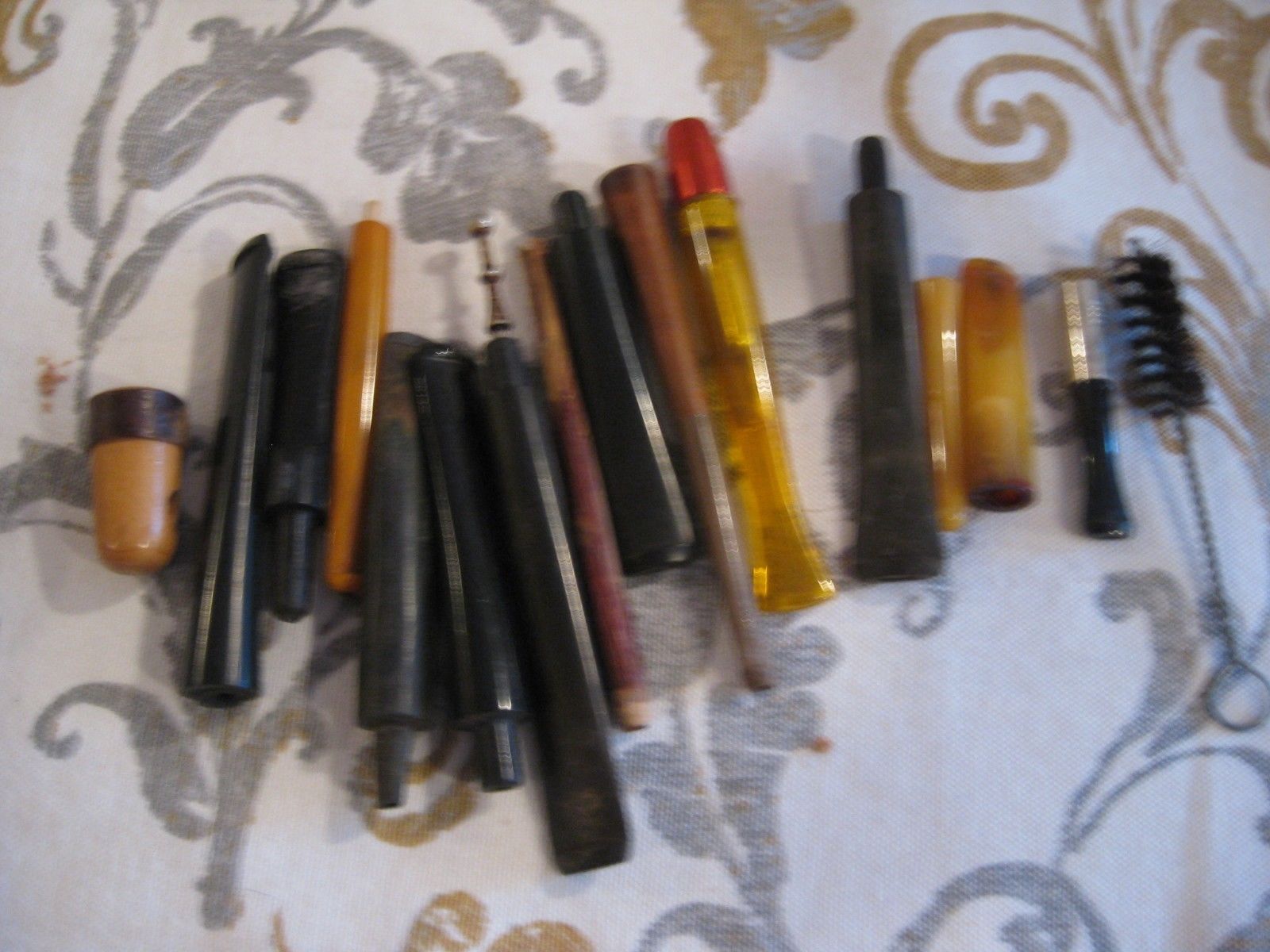
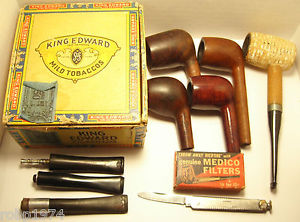
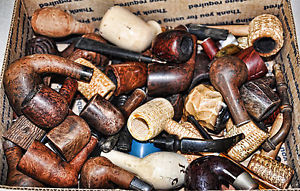
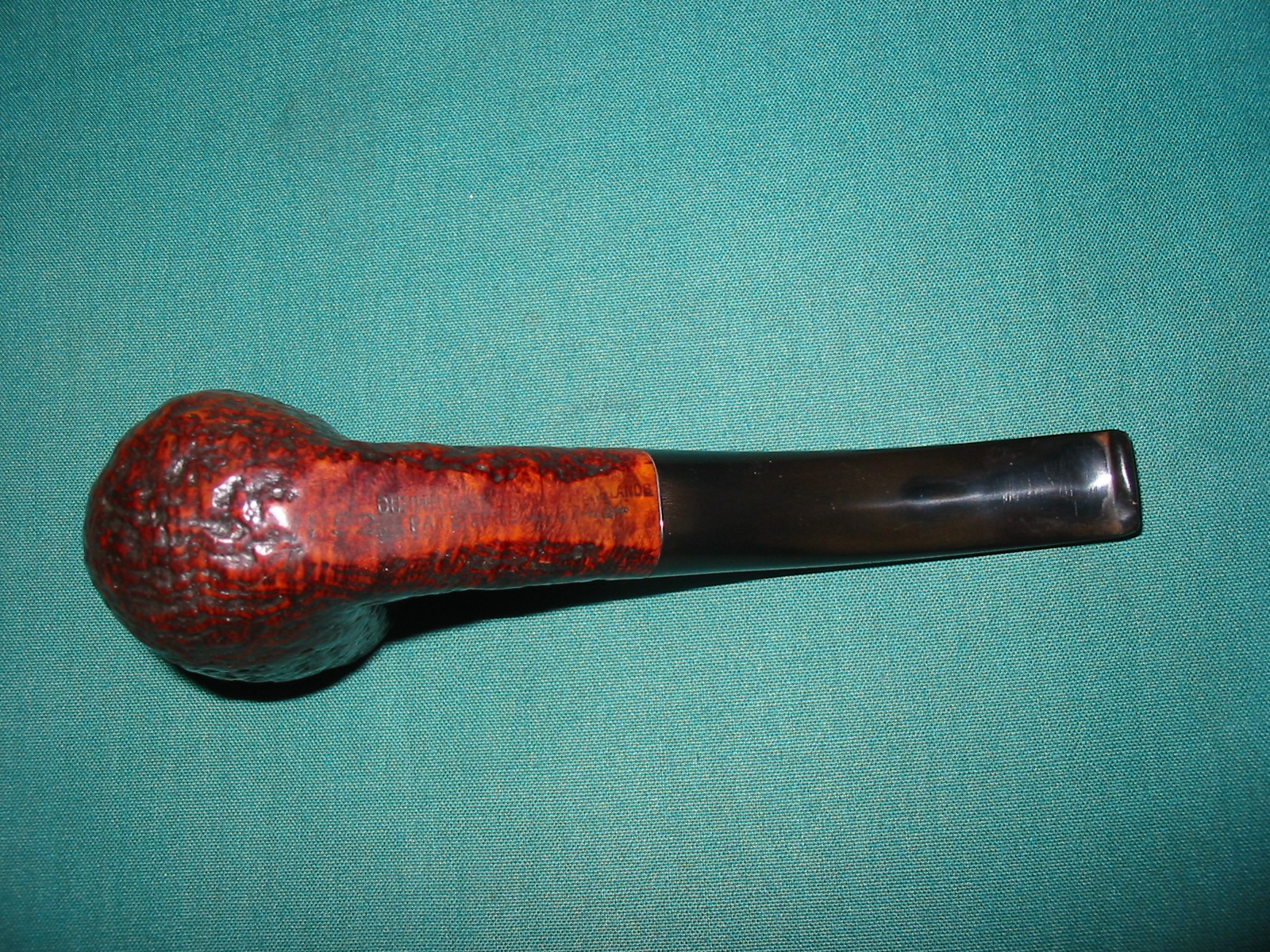
If you were to follow me around on the hunt, you would see that I don’t just look for pipes that I can refurbish or collect. I also keep an eye out for pipes that can be cannibalized for parts. I find them in the pipe lots I buy on EBay (like the pictures below) – these often have extra stems, bands, broken pipes and parts that can be recycled and put to use again. (The photos below come from random EBay ads that are of the type that I usually bid on. There are a lot of redeemable parts in the lots below. I include them to give an idea of the things I look for.)
hunt1

hunt2

hunt3

hunt4

hunt5

hunt6

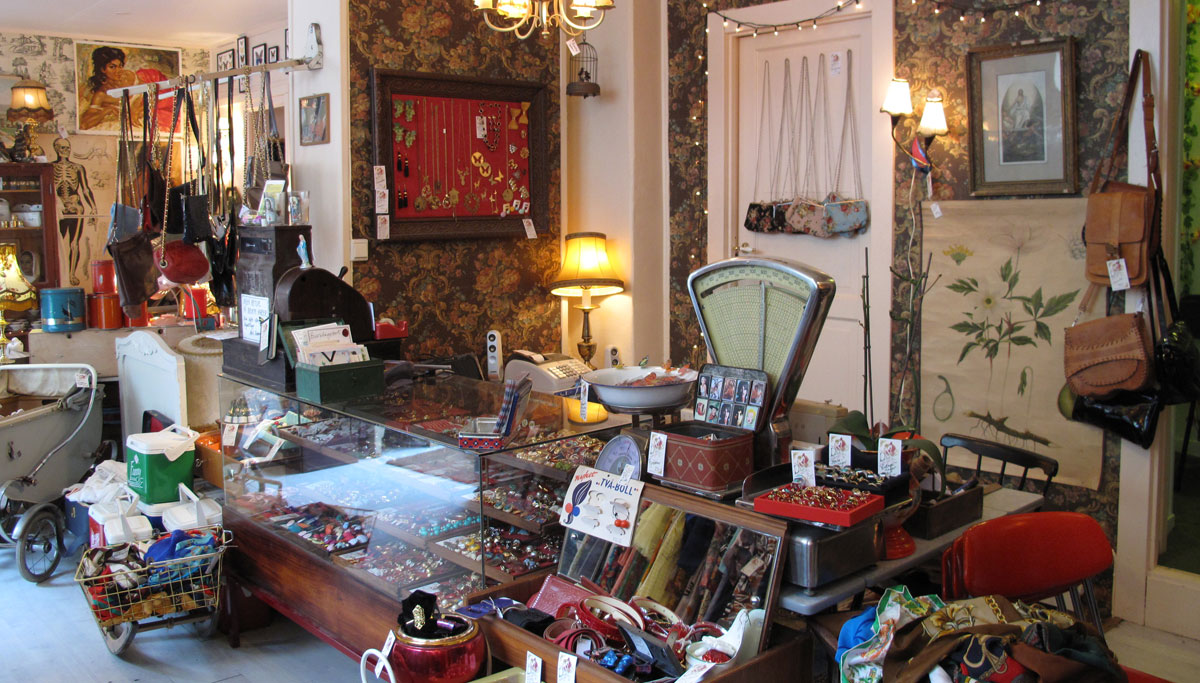
I email online estate pipe sellers and ask if they have old stock used stems that they want to sell. I literally look everywhere I can think of in the process of the hunt. I have stems and parts shipped from Denmark, Sweden, Germany, England, the US and Canada. I also scavenge for them. I pick up pipe parts at flea markets, antique shops, and thrift and rummage shops. Sometimes they are attached to beat up old pipes that are worthless and other times they are sitting in an old cigar box or tobacco tin. I bring them home and the stems and the old briar are kept for repurposing in my repairs.

When I find them in a shop of any kind I make an offer to the seller for the lot and have had success in picking up the parts at a good price. Both the seller and I are happy with the deal. But important to the process is to not just look for parts – any pipe can supply parts for you. I have bought chewed stems for the sole purpose of rescuing the logo from the stem. I have heated and removed metal tenons from stems, removed threaded parts from the tenons of broken pipes to use as replacements, removed stingers and labeled them for use in pipes that I come across that had stingers that were either broken or missing. I have also removed inserted logos from the shanks of broken pipes for reuse. I have also cut down broken stems, shortened them to fit and cut new buttons for them. I also pick up pipe bowls that can be cleaned up and restemmed. I have found some amazing old pipes that have been great smokers when repaired with a new stem. I rarely skip over bowls because I find that there are many uses for them. Worst case scenario – I have sold packages of bowls and stems for others to practice on.

There truly is no end to the parts you can strip off old pipes and very little that truly needs to be thrown away. I have found that most parts can be repurposed and used on other pipes in my repair work. Thus I always keep an eye on the minutiae of the pipes I am looking at – seeing them for the whole but also seeing the individual parts that can be reused. I never pass up buying parts and search regularly for them.

I am thankful to my lawn mower repairman Joe for giving me the vision to craft Rule #5. It has served me well and will be a part of the hunt for as long as I am hunting.
The Pipe Hunt – Rule #4: Buy estate pipes that challenge your refurbishing abilities


When I formulated Rule #4 it was a natural outcome of my pipe refurbishing self-training. I purchased according to what I wanted to learn until I had learned it. For me this method of buying old pipes provided the class time/workshop time where I could practice some of the tips I was reading about and learning from others in the online community. I have never been particularly shy about asking “how” and “why” questions. Ask my daughters and they will tell that one of my nicknames is “Why”. Buying pipes according to what I wanted to learn in refurbishing quickly became a habit that I really did not take time to think about until I was ready to move on to something new. I often picked pipes that I really was not interested in keeping in my collection but because they had problems that would be teaching/practicing opportunities for me. This has been the case each step along the learning curve for me. In the rest of this article I will trace out my journey in refurbishing through the kinds of pipe I bought. Through this monologue on the journey you will see my process and the method to my madness.

When I began my refurbishing education in earnest my earliest purchases were pipes that were dirty and caked but did not have any issues requiring technical skills. I was looking for very straightforward cleanup jobs. The bowls just needed to be reamed and cleaned and the stems cleaned and deoxidized. They were not chewed on or beat up on the edges of the rim. They were not charred or badly damaged. They had merely been smoked and used. I bought that kind of pipe and worked on them until I was ready to move from learning how to cleanup minimal external and internal issues. I wanted to learn how to clean a pipe from the inside out. I bought reamers – actually I have over twenty different kinds now residing in my work kit. I tried them all until I found the ones that worked best for me. I read about processes of cleaning shanks and bowls. I bought a retort and learned how to use it. I practiced with salt and alcohol treatments. Everything I did was done with a single purpose in mind – to learn how to clean a pipe. Once I felt comfortable in the process of cleaning out a pipe it was time for me move on and learn other aspects of the craft.

The second skill I wanted to learn was to refinish a pipe bowl. This influenced the type of pipes that I hunted for and purchased. I looked for ones that still had intact stems with little damage but bowls that needed to be refinished. I bought sandblasted bowls, rusticated bowls, smooth bowls all types and shapes. I wanted to learn how to remove the finish from a pipe and then to prepare it for restaining. This involved different methods for cleaning each kind of finish.I learned to top a bowl and remove damage to the inner and outer edge of the rim. I learned to steam out the dents in the bowl and to remove or minimize dings and scratches. I learned to sand smooth bowls and rims with varying grades of sandpaper and micromesh sanding pads. Each step in sanding taught me to be pickier regarding the scratches and sanding marks I left behind. Once you have a pipe almost finished and have to start over and resand you quickly learn to work at the preparation more carefully. I spoke with several pipe makers to learn the art of staining and where to get the aniline stains. I learned (and I am still learning) the techniques of staining and practiced them on many pipes. I worked on various colours and blends of colours. I worked on understains and overstains. I worked on learning how to do contrast stains. I worked on buffing the bowls and sanding them after staining. It was a great learning curve, one fueled by the kinds of pipes I bought.

The next step in my refurbishing course came from the previous one. After staining old pipes and still being bothered by the fills that were eyesores to me I decided to learn how to replace the old pink wood putty fills. I tried a variety of methods all learned on bowls I picked up at garage sales, antique malls, junque stores and thrift shops. The idea was to remove the fill and replace it with something that would take the stain. I tried putties and filler sticks and still was not happy. I tried wood glue and briar dust mixed with a bit of stain and was a bit happier. But I found that the wood glue dried shiny and still stood out on the bowl. I moved on to try superglue and briar dust and am very pleased with how it works. It is a dark colour in contrast to the lighter/pinker colour of the putty but it is solid and hard when it dries and does darken with the stain. I began to look for pipes with fills to remove and practice on in the stores. I found many pipes that I practiced on and then passed on to the racks of new pipe smokers. The pipes I worked on had begun to look better and better but I still had much to learn. Everything up to this point was pretty simple and cosmetic. The real challenges were just around the corner for me.

It was time for me to learn stem repairs with a greater degree of technicality. I say repairs and not restemmingbecause as yet I had not tackled that aspect of refurbishing. With that objective firmly in mind I was on the hunt for and purchased pipes with tooth marks, bite throughs on the stems, cracks and broken pieces. I wanted to learn how to make patches on the stems and also to recut and shape a new button on the stem. I shortened the stems. I cut buttons with files and sanding blocks. I learned to shape slots in the button with needle files. I called repair people and pipe makers to make sure I got the right tools. I bought and discarded many in the process of building the right kit. I worked with epoxy patches mixed with vulcanite dust. I worked with patches using pieces of vulcanite and epoxy. I worked with superglue and finally settled on black superglue for patching holes and bite through areas. In the process I learned to use heat from a hot water bath, a heat gun and then even a lighter to raise bite marks in the stem and to reduce tooth chatter. I learned a variety of methods to remove oxidation. All of this was part of the process of learning to refurbish stems.

When I felt more competent in the stem repairs I wanted to learn how to fit new stems to the bowls. I went on to purchasing bowls that were missing stems and learned how to turn the tenons on precast stems and to shape the stems with a Dremel and files. I bought precast stems from Pipe Makers Emporium and also bought lots of used stems on Ebay and scavenged them from broken pipes. The learning included fitting tenons, shaping stems, adjusting the taper, making saddle stems, reducing the diameter at the shank, countersinking the shank to make for a tight fit, shaping the button and opening the slot in the end. Lots of experimenting took place in learning to use the PIMO tenon turning tool which meant that some tenons were too small and others too large. All were part of the process of learning to use the tool, its limitations and methods of working around those limitations.I also learned how to shape a stem from a piece of rod stock. Each step was part of the education for me in stem repair and shaping. You can see with this method in mind I bought many bowls that later I ended up giving away and/or selling very cheaply. They ended up being good pipes for starters.

I always keep an eye out for pipes that push the limits of my restoration abilities to see if I can learn new tricks and tools. For me the purchasing of estate pipes is for my ongoing education. I am always looking for better methods and learning new methods and acquiring new skills and tools. The above paragraphs spell out my learning journey. A few more years down the road I will add new skills and thus new paragraphs to the learning journey. The long and short of Rule #4 is to buy for the purpose of learning.

A Short Story: A Blend of Tobacco at the Root of a Friendship


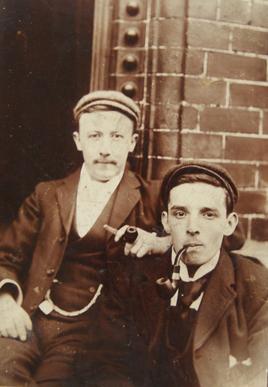
One of my side hobbies is to collect old photos of pipemen (both hard copies and electronic versions) and try to craft a story from them. I love to try and imagine the lives of the men and women in the photo and then write a short story from there. This particular story came to me from a photo I have had on my hard drive for quite a while. One day this past week I sat down and looked at it and the story came to me. You might imagine a totally different story and so might I on a different day. That is the fun of the process for me. As for this version of the story I am sure it will be revised over time but I thought I would share it as it currently stands. Thanks for taking time to read it.

2friends Henry and Paul first met at the local pipe shop in Gastown. Henry had come in to replenish his supply of his favourite tobacco and Paul was behind the counter working as a clerk. They were close to the same age and both had a love for their pipes. Being young they did not have a large collection of pipes. In fact if you had followed them home from the shop and seen where they each lived you would understand that like many young men renting a room in the city and working long hours they did not have much more than a change of clothes, a few books and a pair of boots. These two each had the pipe in their mouth, a pouch of tobacco and a match safe full of dry matches in the pocket of his coat. They both had a nail with a large head that served as a tamper as they smoked.

The day they met it was a rainy Vancouver day – normal for November. Henry was on a lunch break from his office on Cordova Street and had run over to the shop to pick up some tobacco. As he came through the door he was surprised to see that Richard was not working that day – or at least he was not out front. Rather, behind the counter stood a dapper young fellow with a waistcoat and watch fob. His sandy coloured moustache matched his hair perfectly. Henry had always wanted to grow a moustache but just did not have much luck with it. Once the young man had finished with his customer he introduced himself to Henry.

“Good afternoon sir, my name is Paul. I am new in the shop so I have not met many of the regulars yet. By new, I don’t mean I am new to the trade. I have been working in Victoria for several years at the Old Morris Shop and just moved to Vancouver. I stopped by and introduced myself to Richard and he hired me. What can I help you with?”

Henry replied, “Good to meet you Paul. I just came to pick up a couple of tins of my regular tobacco. I am quite taken with Dunhill Nightcap and I am just about out. I will take two tins of that if you have them. I am also interested in trying one of Richard’s blends that is kind of like Nightcap. Do you have any recommendations?”

They both made their way to the tobacco counter to see what Richard had available. Henry looked and smelled a few of the blends but nothing quite caught his fancy. So instead of one of the regular blends Paul decided he would custom blend a batch for Henry. He took down the recipe book and found the blend he was looking for. It would provide a base for the mixture he had in mind. He had a few additions of his own that he would put in the new blend. He took down the jars of tobaccos that he would blend to make the batch for Henry. He mixed the components noted on the card on the blending board, added his contributions and then tossed them together to mix the pieces. All the while Henry was watching the “chef” at work. He was amused at the drama of the production in front of him. Paul was so intent on his work that he almost forgot that Henry was there. He just mixed and checked the recipe and when he was done looked up. He had to laugh at himself.

“Sorry about that old chap. I was so intent on the mix that I totally lost sight of the customer. Have a whiff of this. Do you have your pipe with you? Dumb question, I know but it has happened so often that I always ask. Load a bowl of this and see what you think.”

So Henry did just that, he took his pipe from his coat pocket tamped out the dottle and then loaded a bowl of the “recipe”. He took his time packing the bowl – mind you it did not take too long. The whole thing from the question, to the mixing to the filling a bowl had taken a few minutes. When he had a bowl packed he lit a match and drew on his pipe. The smoke curled around his head as he breathed out. He was quiet for a while as he tasted the new blend.

“Hmmm, this is good stuff. I can taste the Orientals, the Latakia, the Virginia and is that a bit of cigar leaf?” He contentedly puffed on his pipe. This was a good blend.

Paul answered, “Yes I put a dab of cigar leaf in – my addition to the recipe. I always have liked the added taste that it brings to a blend. What do you think? Remember it will only deepen in flavour as it sits in your pouch.”

Henry silently puffed his pipe, drawing the smoke into his mouth, sipping the flavour and letting it curl out around the mouthpiece. This was truly a good smoke.
“Excuse me Paul, what time is it? I need to get back to the office before I am late. Can you pack that up for me and I will settle up. I will continue to smoke it over the weekend and be back in on Monday at noon. I am thinking I will need to get some more of this if it continues to smoke this well.”

With that Paul picked a small tin from under the counter, packed in the 4 ounces of his recipe and sealed the tin. He wrote the mixture components on a card and put it on file with Henry’s name and a date. Next time around it would be just a matter of following the recipe – kind of a My Mixture Gastown style. He handed the newly tinned batch to Henry with the words, “Enjoy the new blend my friend. I am sure I will see you Monday and we will adjust things as necessary.”

Henry went out the door, saying over his shoulder, “Talk soon Paul. I am pretty sure this one will be a keeper. I just have a good feeling about it.”

The door bounced closed and once the chime over it was stilled Paul went back to work, cleaning up the remnants off the blending table and putting them in a jar that Richard kept under the counter. The jar was beginning fill up with a good bunch of tobacco and would soon go into the leavings bags that were sold at a great price to the daring pipemen who came through the door.

by Steve Laug 10/21/13

The Pipe Hunt – Rule #3: Check out every tobacco tin


Blog by Steve Laug

This third rule is one that I have learned through a lot of trial and error. I have walked through and entire shop and found nothing, only to ask at the counter if there are any pipes or tobacco items available and be taken back to a shelf of tins. The shop owner took the lid off several to reveal pipes and pipe items to me. They went back to their till and I went through the shop with new eyes. I not only found pipes in the tins but also found old tobacco that was smokable as well.I have found tins of Dobie Four Square Green, Prince Albert, Half and Half, Flying Dutchman, MacBarens Scottish Mixture, Amphora Brown and Red and others too numerous to mention all available for little cost. In every case, a little hydration and even the open tins provided enjoyment for me. It was these finds that keep me looking through old tins. I have looked and found them in antique malls, thrift shops, rummage sales, thrift shops and even garage sales. There does not seem to be any rhyme or reason to what I may find in the hunt.

This particular rule has, since that lesson from the shop keeper, played out quite naturally for me. I now always shake every tobacco tin or open each one when I come across it on the shelf. I dig through the piles of tins in the displays – not just tobacciana displays but also collectible tin displays, removing cookie tins, oil cans, spice tins etc. to hand pick every tobacco tin I can possibly check. The only way I am certain they are empty is if I can see the shiny or rusty bottom of the tin through the open lid. I take each of them down and if open, remove lid and look inside. If the tin closed I shake it and see if the contents are still inside and solid. I can often tell by the weight when I pick it up that it has something inside. I have also learned to not get my hopes up too soon as I have opened seemingly full tins with great expectancy and found button collections or nails and screws. Nonetheless I continue checking them out.

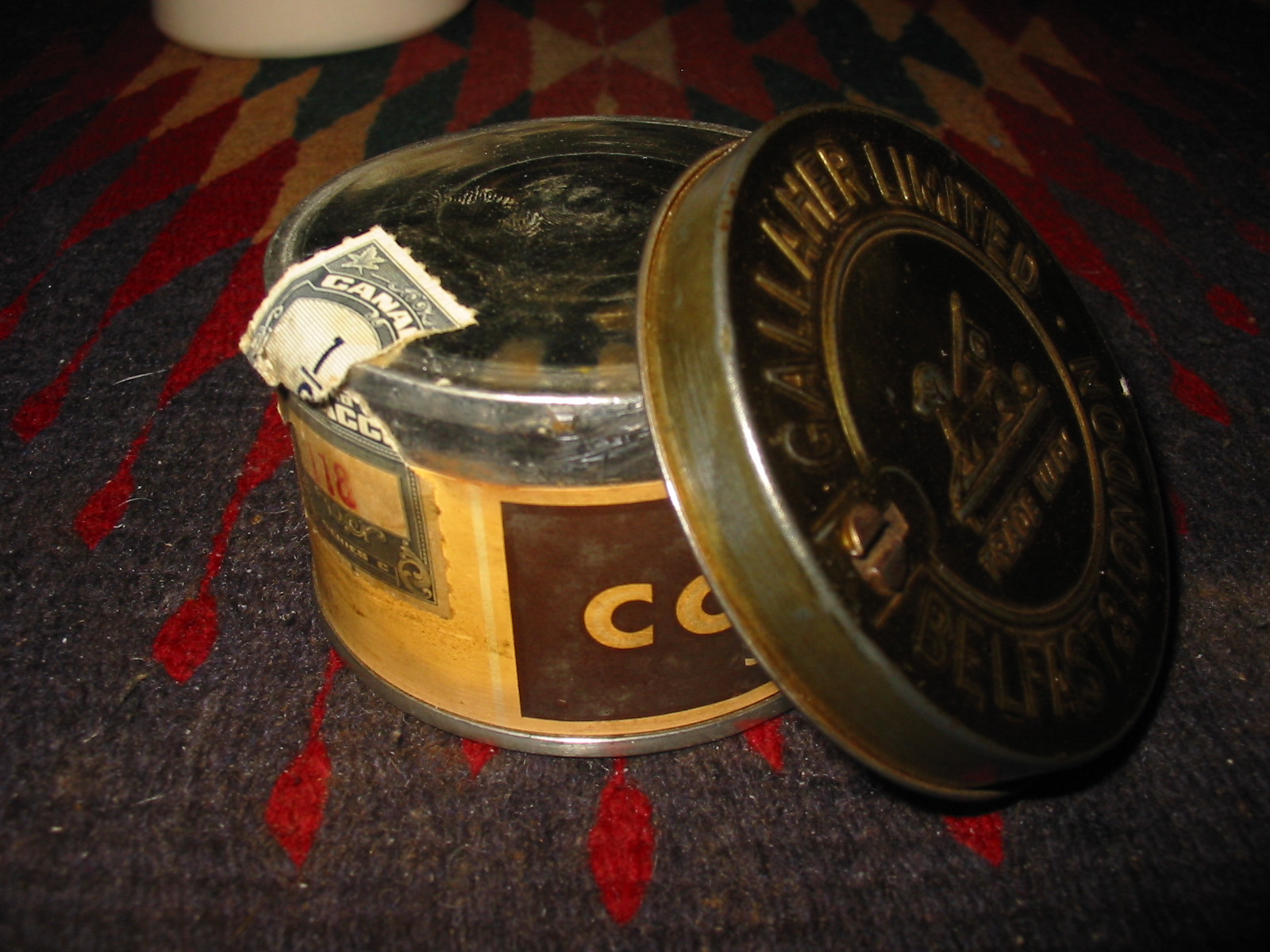
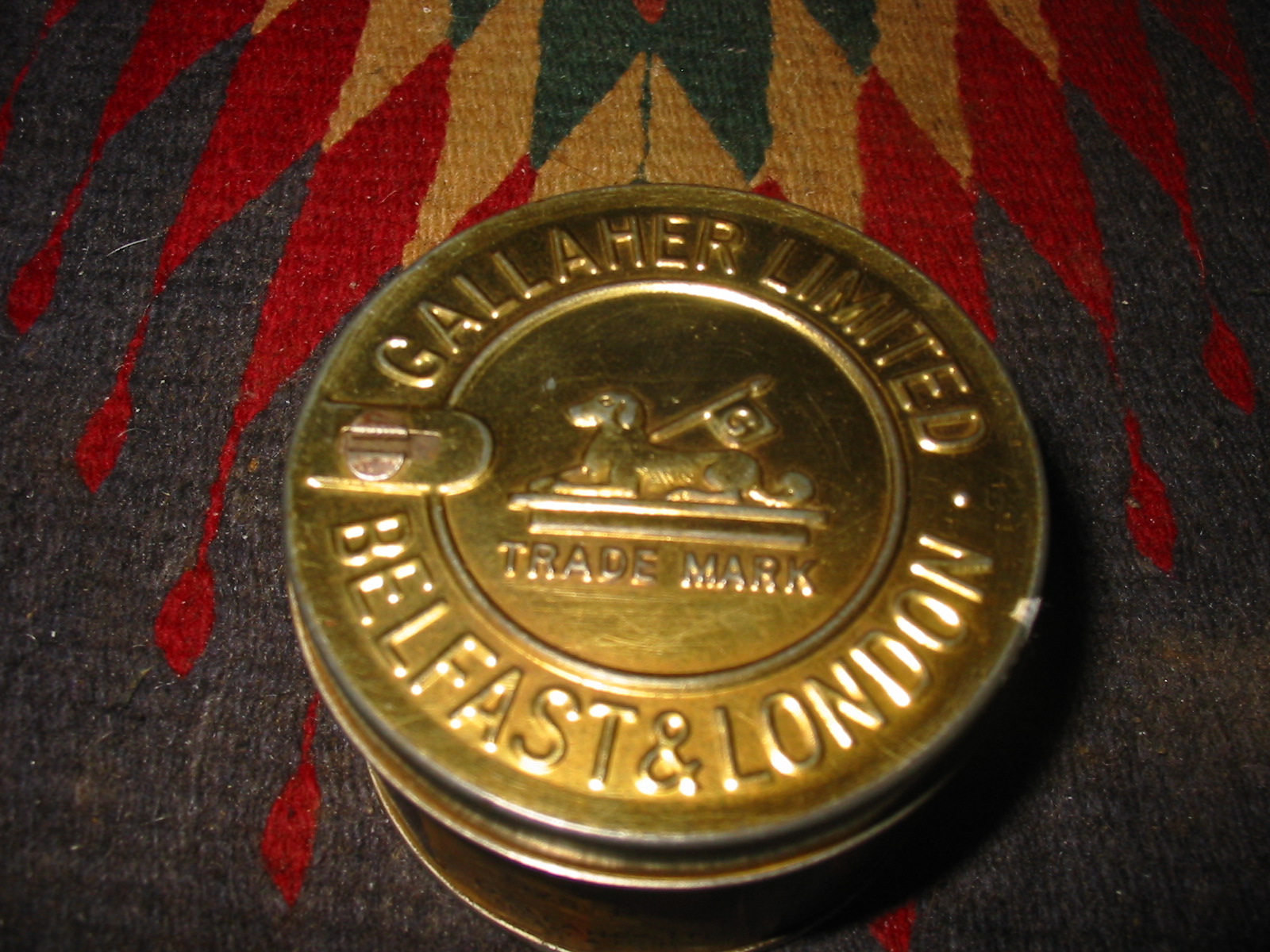
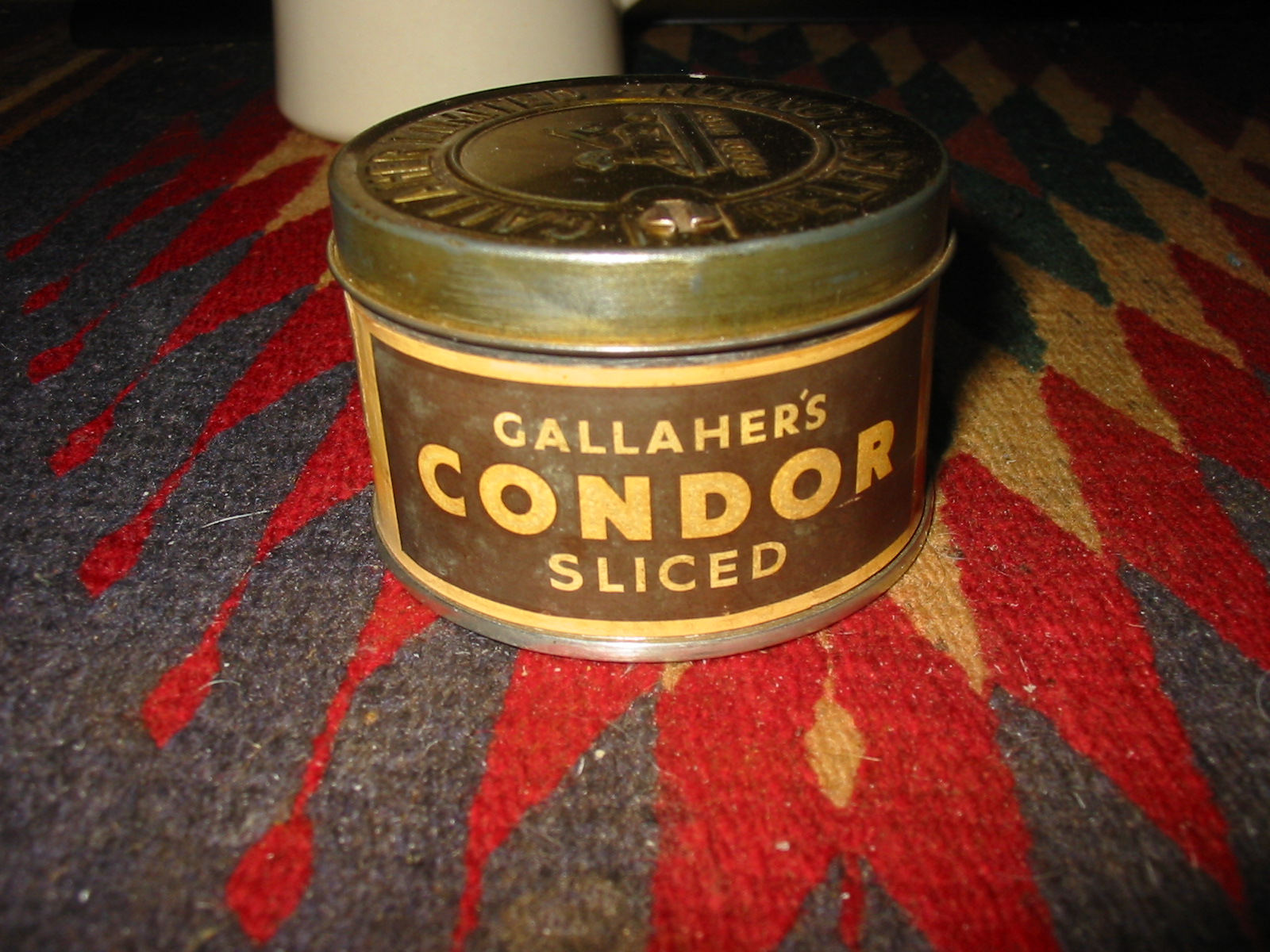
The wisdom of following this rule while I am on the hunt was proved to me twice in the last month of pipe hunting. I found two older tins of tobacco that I enjoy and which are no longer available in their original renditions. The first one was an unopened cutter tin of Gallaher’s Condor Sliced. (I wrote about finding this tin earlier on the blog https://rebornpipes.wordpress.com/2013/10/11/tobacciana-dating-an-old-cutter-top-tin-of-condor-sliced/ ) I am not entirely certain regarding the age of the tin but the seal in unbroken and the tin shows no sign of rust on the outside or at the bottom or top edges of the tin. All of which leads me to believe that the tobacco inside is still in great shape. It also does not rattle around when it is shaken which is great news to me. I have found that the rattling inside a tin is a bad sign and can mean that the seal has been broken and the tobacco may be dry and dusty. However, the point is that clearly Rule #3 was proved true once again. I reached for a tin of tobacco on display in an antique mall and came back with this old unopened tin of tobacco. The bonus for me is that it is a blend I enjoy!I am still in the process of deciding whether to smoke it or keep it in the collection for display. The verdict is still out on that decision.
IMG_1940

IMG_1945

IMG_1941

The second tin that I found this past weekend when my son-in-law and I were wandering through some antique malls and shops. As usual I was on the prowl for pipes and tobacciana. This old tin was situated deep in the back of the display case that made up the front sales counter of the antique mall. It was well enough hidden that I had missed it the first two times I scanned the display looking for pipes and tobacciana. When I was settling my bill for a pipe I had found I looked down for just a moment at the case. And out of the corner of my eye I saw the tin. It was well hidden behind some other items – poker chips, lighters, decks of cards and pocket knives so it was easy to pass over. I paused in my paying the bill and asked the clerk if I could see the tin. As she moved the other pieces away from it I could see the tin still had a lid on it and seemed like it also had something inside from the way she handled it as she gave it to me.

I took the tin in my hand and found it had a bit of weight to it – it was not empty. I gave it a light shake to see if the items inside rattled – if it was tobacco it would have a different kind of rattle than nails or screws or even buttons. It sounded like tobacco to me. I checked the lid and could see that it had been opened. I twisted it off and found that when I opened it there was a slight whoosh of air meaning that there was still a seal on the tin. When it was open, I could see that the tobacco inside was a broken flake and was not dried out too much. I picked up a small piece and found that it still had some bend and play in it rather than crumbling in my fingers.

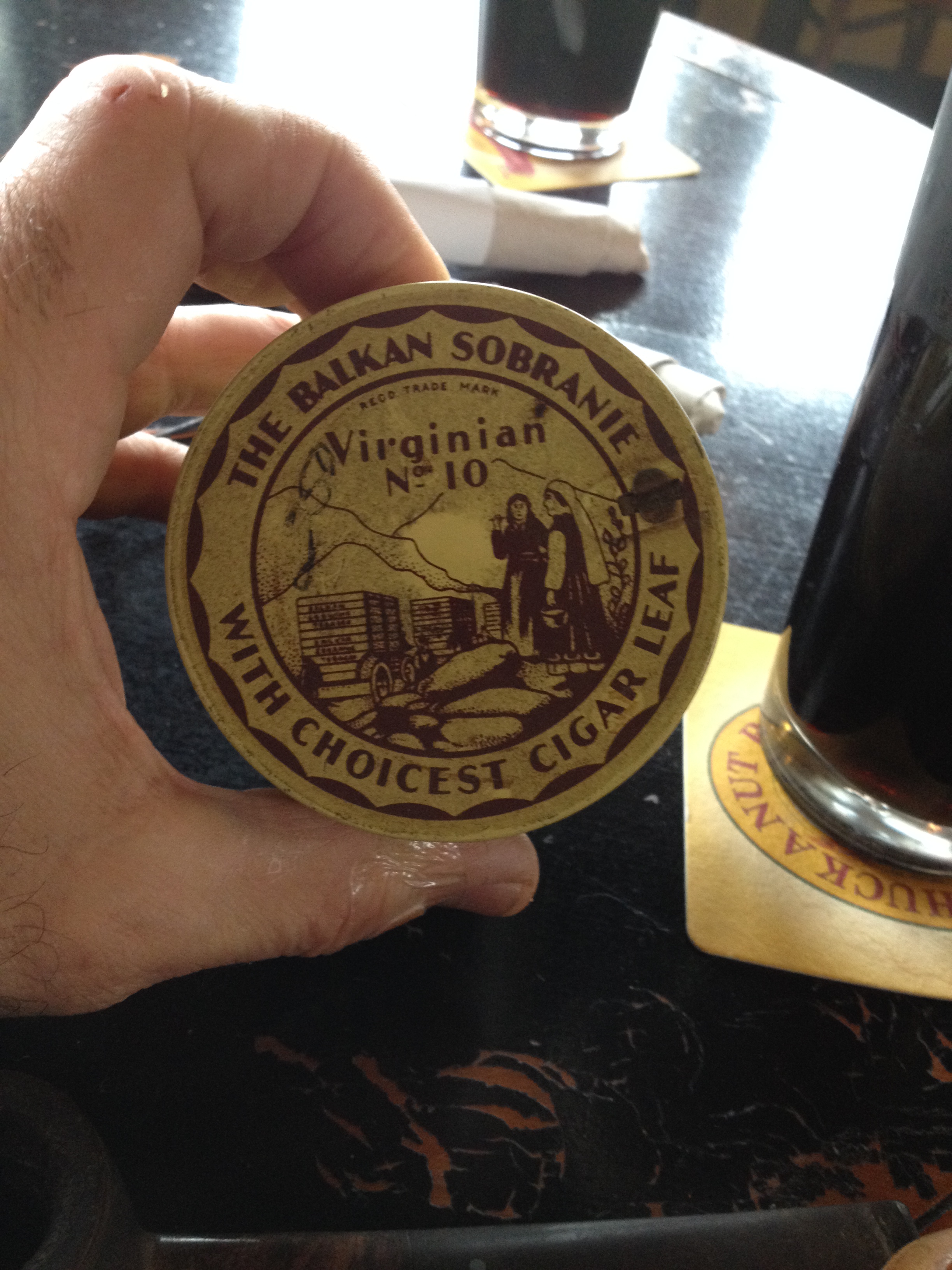
This tin was an old cutter top can of Balkan Sobranie Virginia No. 10. I have smoked this blend in the past and thoroughly enjoyed the taste of it so I was sold on it before I knew the cost. I looked on the backside of the can and saw that they were selling it for $4 – a full four ounce tin of very mature and smokable Virginia. It smelled heavenly and the low price for a tin of this age made my heart skip a beat. That fact that it was full was a bonus to me no matter what the clerk thought. She apologized for the “inconvenience” of the tobacco still in the can, but I was excited about it. I decided to play it cool though and settled my accounts – a pipe and the tobacco and left the store having spent just under $15 US. Once outside to the car, I explained what I had found to my son-in-law and then opened the tin and took a deep whiff. This tobacco smelled divine and the moisture content was perfect for smoking according to my liking. It sits on my desk waiting for me to fill a pipe this evening and give it a smoke.
IMG_0486

IMG_0488

Both of these finds illustrate the point of Rule #3. It is worth checking all old tobacco tins for potential finds. Some will have tobacco that you can smoke and others will have pipes, tampers, lighters or pouches that can still be used. The list of finds that I have come across leads me to continue to shake and check out all the old tins that I come across on my journeys. I know that each and every tin I pick up could potentially have something worth keeping inside its confines. Whether that find be a pipe related item or just some good smoking tobacco really does not matter to me for both are part of the potential that keeps me picking up old tins and checking them out.

The Pipe Hunt – Rule #2: Look Inside ALL Small Boxes, Cupboards and Drawers


Blog by Steve Laug

A second rule of the pipe hunt that I have learned over the years is that not all pipes and tobacco related items are in plain view as I walk around a shop. This took time to learn and by and large I learned it by asking sellers if they had any old pipes or tobacco items for sale. I used to do this after an initial walk through but now ask as soon as I enter a shop. It saves time and generally is a way of engaging in a conversation that may lead to more pipes. When the answer was affirmative I followed them to the stall or spot in the shop and watched where they had placed the items. This quickly taught me where to look. But they would also often have pipes or items at home or in the back room and they would gladly bring them out for me. I have learned that it never hurts to ask.

As a result I quickly look through a shop (I know quickly is a relative term but to me it is quicker than it used to be and way more focused). I walk through after my initial scan and open small drawers, cupboards, cigar boxes, and look inside revolving display cabinets. This may seem intrusive but trust me, it is not (well at least in my mind it isn’t). Small typography cabinets can hold pipes and tobacciana. Revolving display cases can hold pipes, tampers, lighters and other pipe related objects. I have found wind caps, tampers, Baccy Flaps, Bakelite stems, pipe holsters and other items too numerous to list by just going through these revolving cases slowly looking for tobacciana. Coffee cans, tobacco tins and old cigar boxes can often hide old pipe paraphernalia in their interiors. Don’t hesitate to have a look. Here is a tale of an old pipe I picked up by doing what I am suggesting – a nice older bent billiard for $20. I can tell you it was well worth opening drawers and digging deeper.

My wife Irene and I love doing an antique mall crawl on our days off. We generally visit as many as we can fit in before lunch and then have a good lunch at a neighbourhood pub before finishing the day with visiting a few more shops on our way home. Over the years one of our favourite spots is found not far from Vancouver. Just across one of the many bridges and upriver it is a spot with several antique shops and several larger antique malls. On the day of this tale we had visited several of them in the morning and so far had struck out on any significant finds of pipes or tobacciana for me or anything of interest for her. We had stopped for a great lunch at the local pub and were now visiting the last of the shops. We were almost finished looking and still empty handed. I had passed by some very high priced drugstore pipes – no deprecation intended here as I have many of them in my collection but I am not willing to pay the exorbitant prices that sellers mark these – $50 or more is an unacceptable price in my opinion.

I turned down the last aisle. It was lined from floor to ceiling on the right side of the aisle with display cases. These cases had drawers underneath that were labeled with different key items that resided inside. I did a quick walk by of the display cases checking them out. In one I found a couple of older Brighams that I noted. I would need to get the sales clerk to open the displays for me so that I could look at them more closely. That could wait. I turned my attention to the drawers beneath the cases. In the middle case I opened a drawer labeled miscellaneous collectibles and dug through it. There in the middle of the drawer, nestled among lots of unrelated items such as linens and doilies I found an older looking pipe that captured my attention. I stopped for a minute before picking it up. (I have a habit of trying to guess what the pipe might be before I actually look at. Quirky I know but it is what it is.)
1938 Dunhill Shell

I made my guess (a Dunhill of some sort) and then I picked it up. It was a sandblast bent billiard. I turned it over in my hands and noted a slightly darkened white spot in the top of the stem and then read the stamping on the underside of the shank. It read Dunhill Shell Made in England 8 and underneath that it was stamped Patent No. The number itself was obscured in the dirt and grime that accompanied the old pipe. It was caked with a heavy carbon buildup and the stem was oxidized and had several small tooth dents on the top and bottom of the stem. Other than that it was a good clean find. To say that I was excited is to understate the case. Here in the drawer under the display cabinet I had found not just a Dunhill pipe for $20 but a Patent Era Dunhill pipe with fairly clear stamping and in a condition that would easily be refurbished. I was ecstatic. I called my wife over to show her the cause of my ecstasy and she just shook her head – another pipe. Big deal. She wandered off and I was left standing there.
I almost totally forgot the Brighams and just stood there basking in the joy of discovery! This is what I always dreamed of finding one day in my pipe hunts. And now here it was in my hands. I could hardly believe my good fortune on finding it. I shook myself and carefully cradled the old pipe while I went and found the sales clerk. She brought the keys with her and opened the case so that could add the two old Brighams to the lot. I carried the three pipes to the counter and paid for them before they disappeared in my dreams. The clerk carefully wrapped them in tissue paper and placed them in a bag for me. She handed me receipt for my purchase and I went looking for Irene. I had my haul and I was finished. I just wanted to get home and do some research on this lot.

When I got home I went to my basement work table and used my jeweler’s loupe to check out the stamping more clearly. I had read the majority of the stamping correctly at the shop. I was also able to read the patent number on the bottom of the pipe. I looked up the information on John Loring’s Dunhill dating site and found that I had a 1938 Patent Era Dunhill Shell bent billiard. I could not have been more pleased. I cleaned up the old timer carefully and gave it several coats of wax. Here are a few pictures of the restored pipe.
IMG_2083

IMG_2084

IMG_2088

IMG_2086

It is this kind of find that keeps me pulling out the drawers and looking in the boxes and behind tins and displays. I am confident that there are other hidden treasures out there. So Rule #2 will always be right up there next to the first rule I posted about earlier. I will look in every nook and cranny while I am working my way through a shop looking for “treasures”. Will you join me in following this rule of the hunt?

Finding an Old Parker Super Briar Bark Cherrywood


Whenever I visit Edmonton there are three places I always visit in old Strathcona – two Antique Malls and Burlington on Whyte Tobacconists. My last trip I visited all three and one of the Antique Malls yielded a couple of treasures while the other was a bust. You never know which place will yield something but generally I don’t walk away from both with nothing to show for the stop. This time I found two items in the same display case in the mall (this is truly a Mall – it is large, two stories of things to look at, many stalls and many sellers). The first was a beautiful older Parker Super Briar Bark Cherrywood and the other was the old cutter top tin of Condor Slices I have already written about earlier. Let me tell you the story of that find.
IMG_1865

The shop is full of antique hunter’s eye candy and what astonishes me is that things I played with as a child and used in my dad’s garage have now become antiques. (Hmmm, I wonder what that makes me. Ah well that is another story, back to the walk about.) As I walked through the shop there were many displays that had pipes – older Brighams, Dr. Grabows, Yello Boles, Whitehalls, Medico’s and new Meerschaum pipes. The place had a lot of old pipes and each of them warranted a good look. To complicate things and I suppose to give a modicum of security in a world of shop lifters, I had to hunt down a store clerk to get a key to open the locked displays before I could look at any of the pipes. Because of that I was very selective about the ones I looked at more closely. The mall was full of people that day and they were milling about looking at everything – everything but pipes in this case. I made my way through the shop and noted case numbers that I would need to have opened for a more thorough look. My method in this kind of shop is to get two or three case numbers in my head before I get help from a clerk. Why two or three? Well, simply put – that is the most numbers I can remember in my head these days! With that limitation the hunt in a mall that size can take me awhile. Ask my wife and children how long it can take and they will tell you, I have no sense of time when I am on the prowl for old pipes.

I checked out some Mario Grande pipes – new ones – that were in one display and several other brands that looked promising but none of them grabbed my attention. I am getting more particular than I was when I first started picking up old pipes in shops like these. I think it was on the second or third set of case numbers that I took back to the main desk to get a clerk with keys to open that I found the little Parker. I know that it was in the back portion of the mall, in the far right corner of the shop. It was a small display case, upright glass with internal lighting. When I saw the case it caught my eye. There were quite a few pipes on the shelves of the case, arranged to attract attention. On the second shelf was a little sandblast cherrywood shaped pipe sitting in a pipe rest that caught my eye. The stem was slightly bent and the blast was craggy and deep – kind of like the blast you find on early Dunhill Shells. The size was diminutive but looked like it would sit well in the hand. Even though it was only one case number in my head this time, because of the beauty of this pipe, it was time to go and get the clerk and the keys.
IMG_1863

I went back to the front of the shop and got the clerk and we headed back to the case. I am always in a bit of a rush in this phase of the hunt in an Antique Mall because I am paranoid that someone else has spotted the object of my desire and will beat me to the punch. So I made my way back to the case in a hurry by the most direct route. There was no fooling around along the way. I saw other pipes in other cases as I hurried to the back corner but I merely glanced at them and noted their location for later looking. I was a man on a mission and nothing would deter me from reaching my goal.
We made it back to the case and no one was bent over an open door fondling the little pipe when we arrived. Whew, I beat all contenders (I know, probably no one else in the mall cared about the little pipe, but let me have my delusion). The clerk fiddled with the keys until he had the correct one in the lock and the door opened. He stepped back and let me pick up the pipe that had caught my eye – the little cherrywood sandblast. I turned it over in my hands checking it out for cracks and damage. The thin shank looked fine, the stem had some small tooth marks and was oxidized but in good shape. The finish and blast were very nice. It was in excellent shape and there was even a wad of tobacco still in the bowl – almost as if the old pipe man had laid it down while he went out to check the mail or eat dinner… It would clean up very nicely. I checked out the stamping on the underside of the shank. It read Parker over Super in a diamond over Briar Bark. I had a nice older Briar Bark in my hands – the equivalent of a Dunhill Shell in my book. It was also stamped Made in London England and had the shape number of 283. It sported a 4 in a circle stamp was well, which was the group number (Dunhill based sizing system). This surprised me a bit as it is pretty tiny for a group 4 pipe but that was its stamping. Up close the stem also bore a faded and worn stamping of the P in the Diamond of the Parker line. At the low price of $15 it was a keeper and it was definitely going home with me.
IMG_1864

The clerk took it in hand, as they have a policy to carry items to the front and hold them for you until you are done shopping. He was just locking the case when I looked at the shelf a last time before he closed the door and there in the back of the display case was an old tin with the label Gallaher’s Condor Sliced. I stopped him and reached into the case and picked up the old tin. It was full! I turned it over in my hands and noted that it was a cutter top tin – probably WWII vintage. It was two ounces of old tobacco, unopened and pristine. The tin itself was in great shape. I added this to my lot. Not a bad find for an afternoon – an older Parker sandblast cherrywood and an old tin of Condor Sliced. Since I am one of the few who actually like Condor Slices this was a great find for me.
IMG_1862

I followed the clerk back to the front of the shop to pay for my purchases with the satisfaction of a well spent afternoon. I had a tin of old tobacco – cost $10 and a Parker – cost $15 – all totaled a $25 hunting spree. Not bad at all and to top it off when I got to the till a young clerk commented on the pipe. He too was a pipe smoker and collector. (In this case I believed him rather than cynically assume more sales hype. To date I have not received many comments from sales clerks on old and dirty pipes I buy so odds are he was telling the truth.) He commented on how he did not know how he had missed seeing those two. Before I settled the bill he offered to give me a walk-through of other potential pipes that he had scoped out. He spoke of some of the great finds he had scooped while working at the mall. He told me he had Burlington on Whyte do his restorations on the pipes he found and asked who did mine. I told him that part of the fun of the hobby for me was restoring my own. He laughed and said one day he would venture into that part of things. During our walkabout nothing else caught my eye so we went back to the till and I paid up. I walked out of the mall satisfied with the hunt and with two pieces of tobacco history. I couldn’t have asked for more. Now off to find a pub and celebrate the finds and examine them more closely.

By Steve Laug 14 October 2013

The Pipe Hunt – Rule #1: Never Drive by Small Nondescript Antique Mall Without Stopping for a Look


Over the years I have added another hobby to my refurbishing one. I have been crafting a set of simple rules of the pipe hunt. A rule does not make the list until it is tried and proven to be a truism repeatedly. These rules are elastic in that they continue to grow as time goes on and my pipe hunting becomes more refined. But, I try to follow these whenever I am on the prowl looking for pipes and even when I am not. I have decided that any trip I take will end up with me stopping and hunting for pipes. My wife and kids can tell you that this is a fact. Over the years I generally end up finding a pipe or two. These rules have worked well for me over the past 20 plus years. The tale below illustrates how well this first rule works for me.

I was coming back into town from a long meeting in the countryside about a half hour away. It was getting late and our host had planned a dinner for us so I was aiming on getting “home” and not really paying attention to the buildings as I came into town. But as I got closer to town and drove by the nondescript buildings on my right, out of the corner of my eye I caught a small sign that said Antique Mall. It was located on the outer edge of a small town, across the railroad tracks from the town centre. It was five o’clock in the afternoon and the sign said the shop was still open so I decided to pull over, park the car and have a look. By the time I got to the front door it looked dark inside so I figured the owner had evidently closed up shop. However, the door was still open, the sign still said open, but the lights were out in the back portion of the shop. I decided to chance it, opened the door, called out and asked if they were still open and a gruff voice called out from a room off to the left, “Well you are inside the shop aren’t you so I guess it doesn’t matter or not if we are open.”

I shrugged off his gruff manner and asked if they had any pipes and tobacciana. He turned on the lights and said he would quickly take me to the cases in the shop that had “what little they had available”. He was not a friendly shop clerk anxious to make a sale and it seemed that the my presence did nothing to change his otherwise grumpy attitude. I had a friend with me and he gave me the “we should probably just leave” look but I ignored it and kept up a steady flow of “yak” to diffuse the situation a bit. I figured if I found anything I would make his day and it looked like the place could well yield some interesting old pipes. It was pretty dusty and looked like it had not had many folks picking through the stock of “antiques”. (I made a mental not to come back here for a visit on my next trip through but I would do so in the early part of the day and give it a good walk through at that time.)
second

He walked us toward the back part of the shop (calling it an antique mall was an overstatement of epic proportion as it was not much bigger than a small convenience store. I suppose that it may have had multiple vendors gathered under the roof but still mall was overstating the case). There was a lot of clutter in the aisles and the accumulated detritus of junk stores that I have come to appreciate for their potential. It is in shops just like this, passed by quickly by the antique hunter and having a grumpy proprietor that have often yielded a veritable treasure trove of pipes and tobacco items. Many times I have found that these nondescript out-of-the-way shops can be rich with old pipes and tobaccos all to be had at very reasonable prices. There used to be way more of these little shops, but there are still a few where you can find some good stuff if you keep your eyes open.

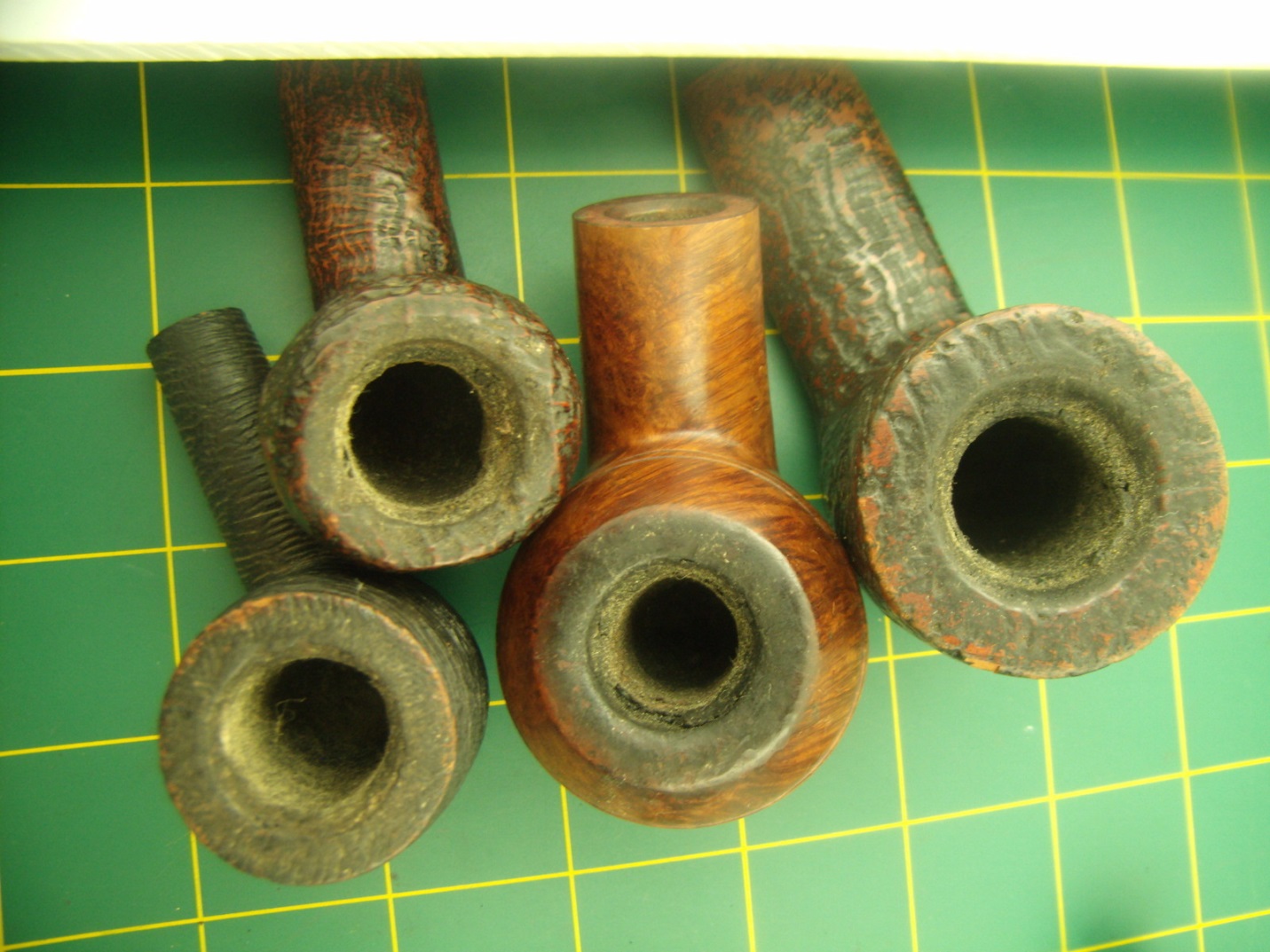
I began to get excited as we made our way to the first display case. It was a crowded glass case with lots of dust and fingerprints. On the shelf next to the case were old packets of tobacco that looked like ancient drugstore blends, long past their shelf life even with all of humectants. There was also the standard collection of old Edgeworth and Prince Albert tins piled on the top shelf of the case. I bent down to get a closer look at the second shelf as it had a collection of about ten pipes piled on it. (So much for the shop owner’s “what little we have” comment.) I sorted through the lot and among the collection there I found three older pipes that caught my eye. I was attracted to them because of their shapes and finishes. They were all well used and dirty but I examined them showed no real damage under the dirt and oxidation.

This threesome included a Douwe Egbert Billiard, an Amphora Pot and long sandblasted Canadian stamped Birkdale Superb, Made in London England. None of these had show stopping names but the shapes all reflected an older European look. When I first saw the Canadian my heart nearly skipped a beat, it had the look of an older Dunhill Canadian. The white dot was missing in the stem but the hole was clearly there where it had been. I gingerly picked it up and saw that it was a Birkdale – a brand I knew nothing about. (I later found out as I researched the brands and stamping on these pipes on the internet that the Birkdale was probably a Comoy’s brand.) I left behind some older, worn pipes on the shelf that I may have to go back and pick over again when I get to the area in the future. But these three were to my liking. I happily added the first additions to my purchase – three pipes in my hand.

The owner had said nothing as I picked over the pipes and carried them with me. No comments or questions were asked as he locked up the first display case. Once locked, he hurried on to the second display case. I was feeling good about this stop on the road. It was already a great place and I had added three nice pipes to my collection so it did not really matter what I found in the second case. But who can stop looking and hoping for more after that kind of find in the first display case. We rounded the corner in the shop to the second case. On the middle shelf there were more interesting pipes to look over. I could not believe the luck I was having in this old shop. I sorted the 8 or 9 pipes on the shelf and settled on three nice looking older pipes – a Hardcastles Jack ‘O London Billiard, an African Meer Prince stamped Tanganyika with a shape stamp or 27 on the shank and an Old Pal diminutive Barling like pot with a pencil shank. I added this threesome to the lot in my hand. I now had six old pipes for refurbishing. All would clean up very well and be good additions to the collection or be sellable to help fund future purchases. Not too bad a find for a quick stop that could have easily been overlooked.

The grumpy shop owner led us to the counter at the front of the shop where he tallied what I owed him for the six pipes. I had noticed that several were marked $10 and some were $11. He said nothing as he scribbled out the bill and peeled off the stickers recording the display cases they each came from. Once he had finished his scribbling he pushed the bill my way. I could not believe my eyes – the total was $60 plus a bit of tax thrown in. What do you know; the old gent had given me a deal of sorts. He took my cash, put the pipes in an old grocery bag and handed me the change and the pipes. He then followed us to the front door and locked the door as we went out. He had probably spoken a total of three words – no more, no less in the entire time he had walked us around the shop. But I did not go there for the wit of the seller or the ambience of the shop but for exactly what I had come out with – six “new” old pipes that would be a welcome addition to my stock at home.

I guess it goes to show you, keep your eyes open when you are driving through the outskirts of the small towns you pass through on your travels. It is the nondescript shops that often are full of surprises. But then again, don’t bother to look too hard. It will leave more of them for me to find on my journeys.

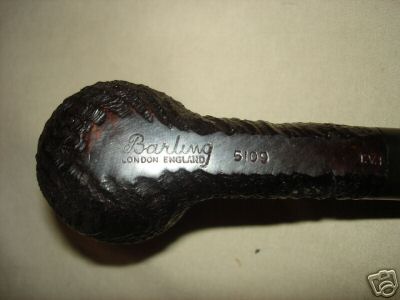
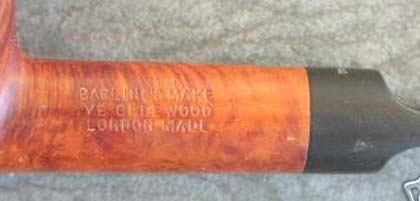
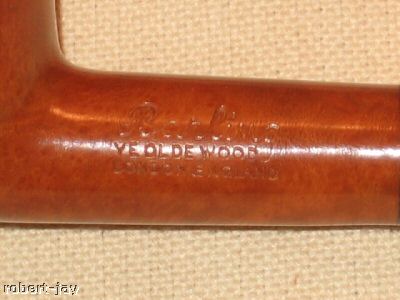
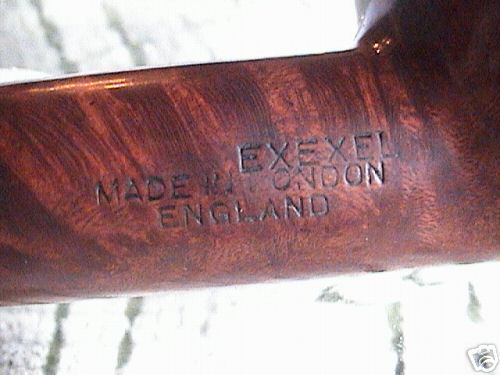
Notes and Visual References on Barling Pipes – Compiled by Les Sechler


I came across this brief article by Les online a few years ago and have found it very helpful in narrowing down the dates for the Barling pipes that come across in my ongoing hunt for estate pipes. I wrote to Les through EBay and asked his permission to reprint the article here on rebornpipes. He graciously replied as noted below. Thank you, Les.

… if you get a comment by collector Tad Gage, his judgment is better than mine since I learned much of what I know from him as well as others. Most of this info I deduced over time by close observation of the nomenclature I found on my own pipes but also from pics I saw on ebay pieces that were listed for sale… Note – Barling nomenclature has never been an exact science and this info should be considered as a guideline rather than a mandate. Even the book done by the late John Loring about Dunhill nomenclature is not perfect since exceptions have been found in those pipes as well.

Good luck and let me know how things turn out. I have it in mind to print a small paper on the subject at some point in the future and give it away at shows. – Les Sechler

The following is a visual reference guide that allows the reader to identify the various eras of Barling nomenclature. Please note that some exceptions will occur since not every pipe had stampings that are completely in conformation to the norm.

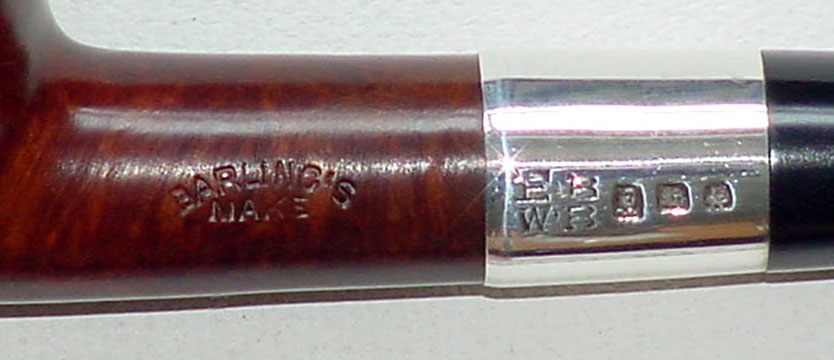
Barling1 Older Pre-transition nomenclature, probably 1900 or after. Date can be determined by silver hallmarks.

Barling2 Late 40’s – 1962 Typical Pre-Transition nomenclature

Barling3 Used only for the Guinea Grain US distributed pipes

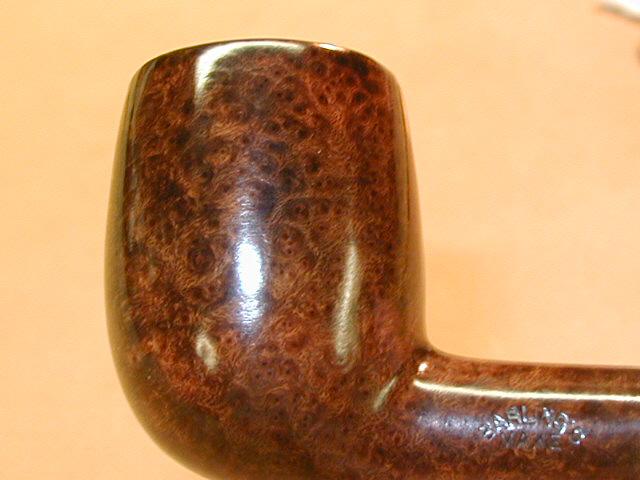
Barling4 Typical Pre Transition nomenclature, M in Make is under the R. Shape number is three digits or four digits beginning with a 1 (for UK distributed pipes).

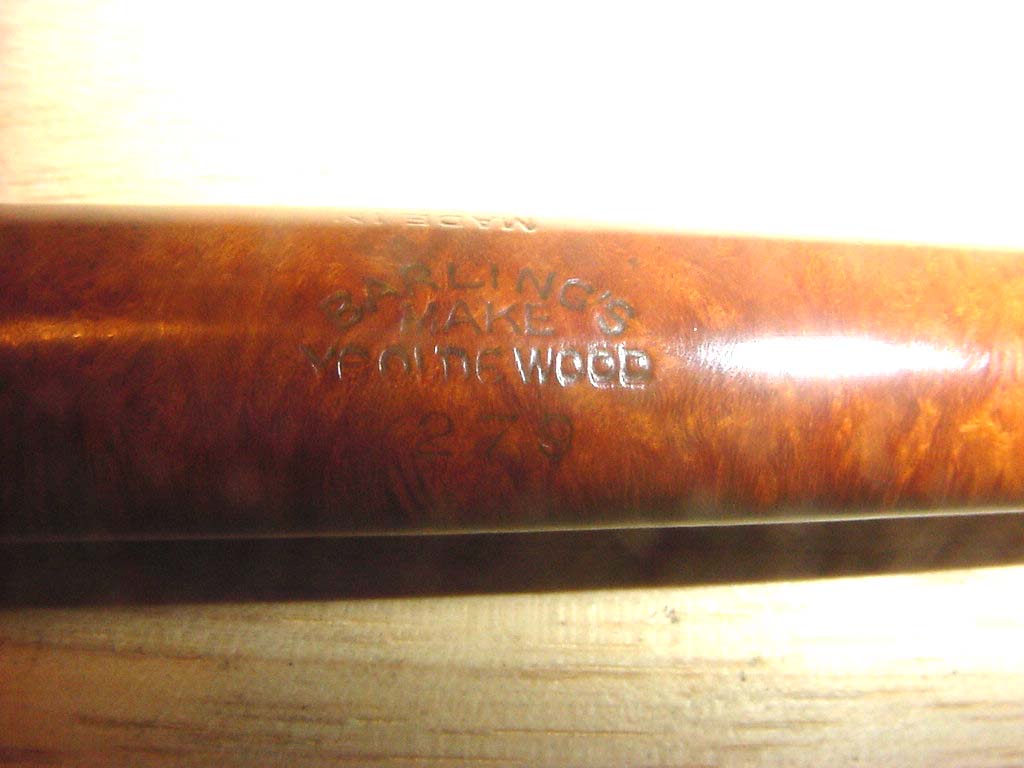
Barling5 Barling Early Transition Example: Ye Olde Wood remains but shape number is now four digits not beginning with a 1. First digit indicates size of pipe with 6 being “very large” and 7 being the largest. Pipes marked this way are thought to be late 1962 or 63’.

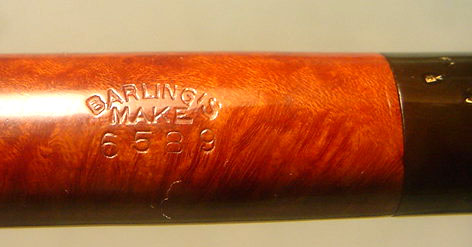
Barling6 Next version of early Transition Nomenclature: Ye Olde Wood is gone and shape number is four digits not beginning with a 1. First number of shape indicates size. Notice that the M in Make is now under the A.

Barling7 Typical Transition Barling Nomenclature, Barling is now in script.

Non Conforming Examples of Barling Nomenclature
Barling8 Probably a fake stamp

Barling9 Note Ye Olde Wood is present, with spaces between the words, but Barling is in script and London England. This is an error stamp probably done by factory worker not paying enough attention, or a stamp that was not used for very long. This is the only example of this stamp I have ever seen.

Barling10 The word London exists on a few examples only. This is a rare stamp that was used for a brief period, probably just before the company sold in 1962 or just after.

Why I Chose the last Ebay lot of bowls to restem and refurbish


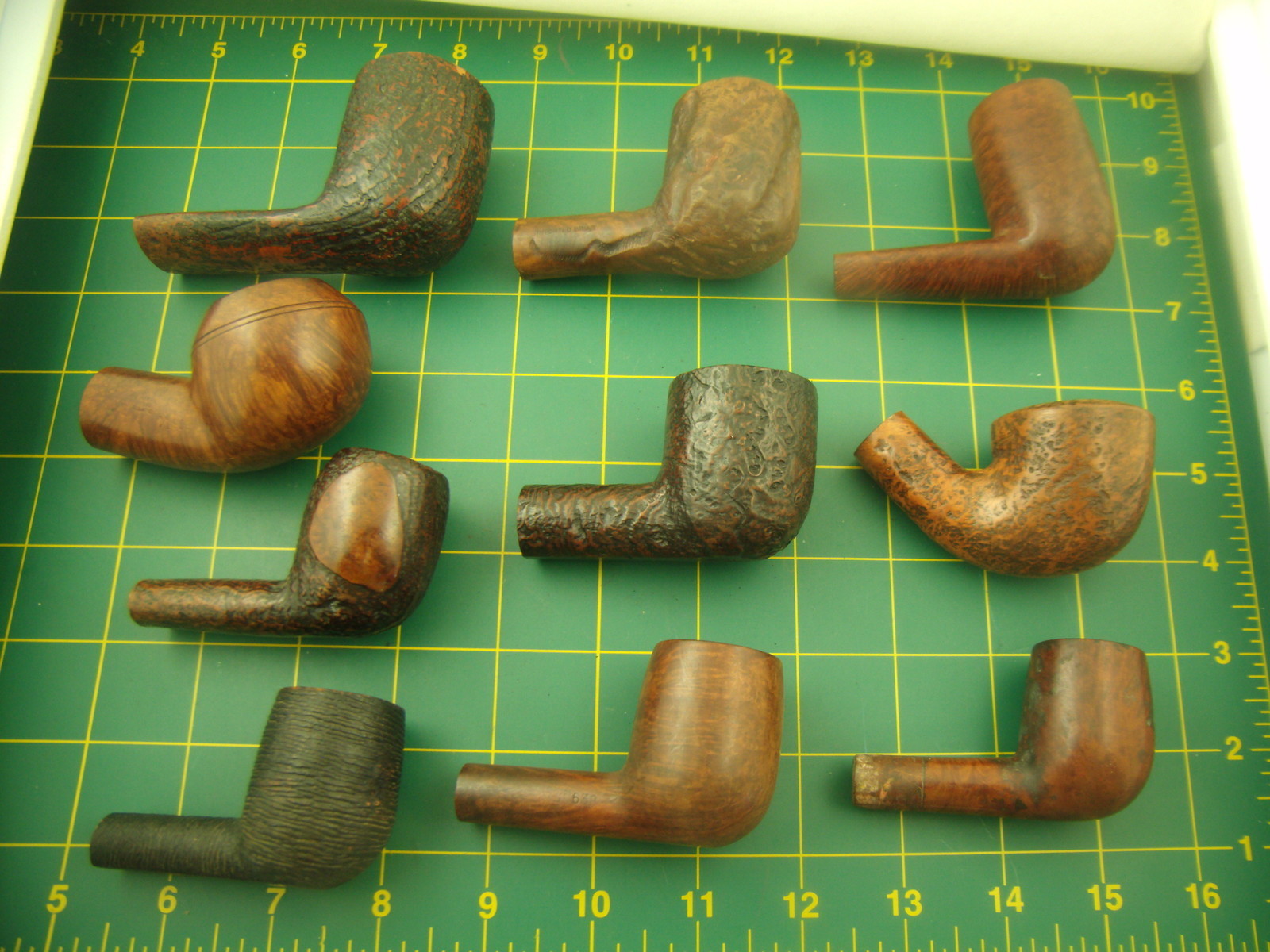
I just finished restoring and restemming the last of the Ebay lot that is pictured below. I thought it might be helpful to reflect on what I look for when I pick a lot of pipes like this on Ebay. There are many lots that I pass over in my hunt for estate pipes but there are some commonalities to what draws me to them and why I bid and win most of the ones I choose.

bowls1

bowls2

When I came across this listing there was no information available as to brands, makers or stampings. I always look for certain shapes or designs that catch my eye and then save the photo and enlarge it to see if I can see clearly any issues with the pipes. I also enlarge the side views to see if I can read any of the stamping that may be present on the pipe. In this lot the stamping was unreadable in the photos so it made me wonder if I would be able to identify them once they arrived. The most I could do was to judge by experience what was present. The seller of this lot included several photos showing both sides and the top of the bowl. Upon examining them carefully in the enlarged pictures I can be relatively certain of the issues that I will find and minimize any unexpected ones.

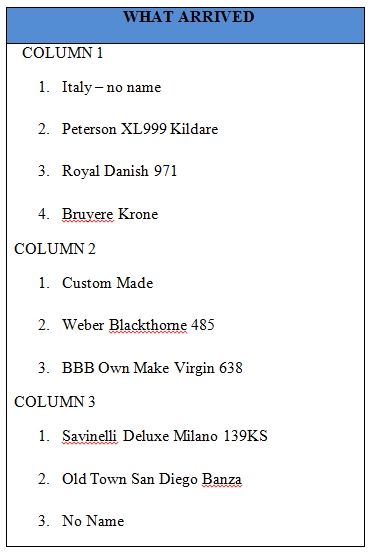
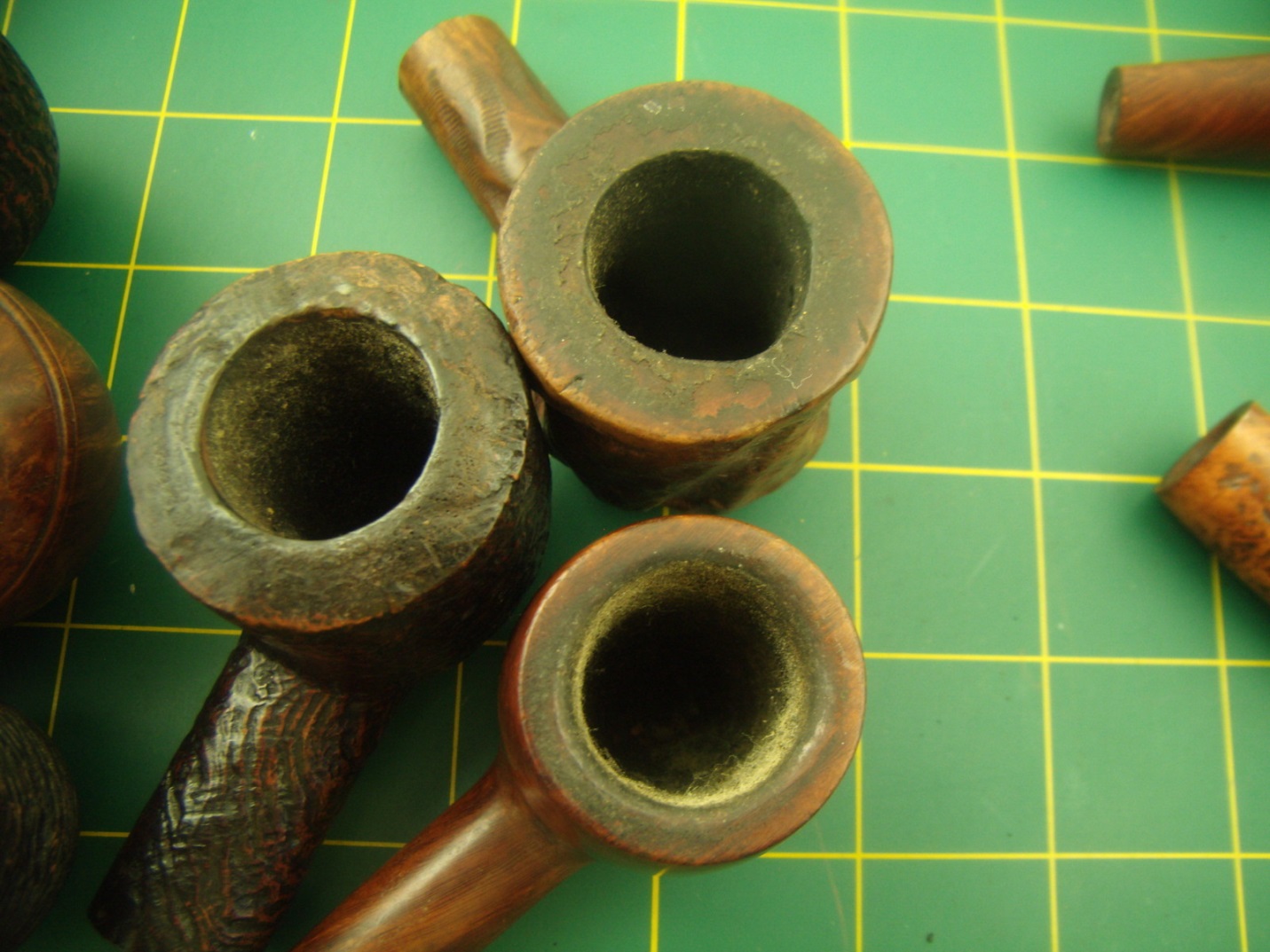
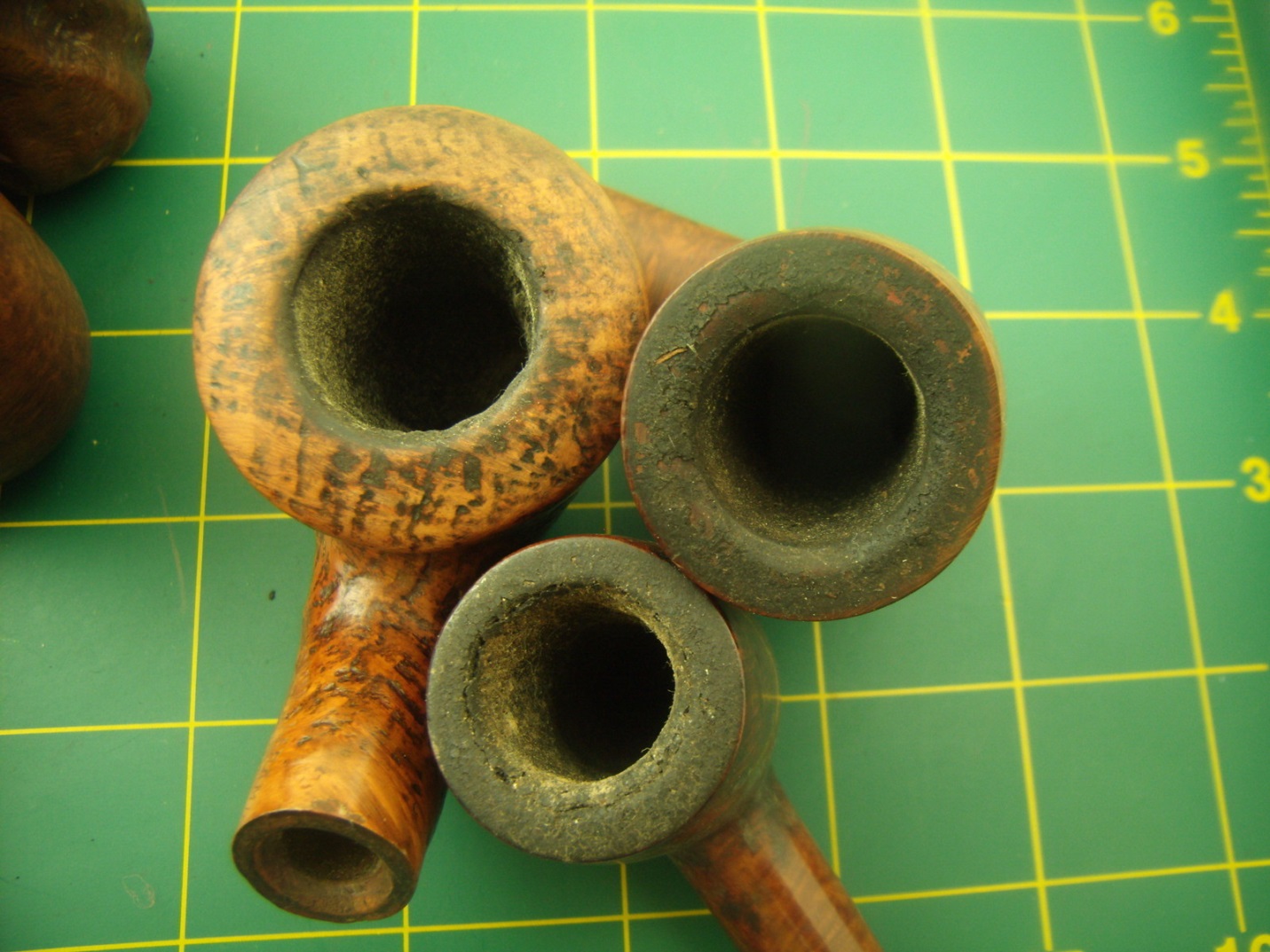
In this lot there were several there that I thought I could identify, or at least reduce my guesses to two or three possibilities for that shape of pipe. Knowing what I had learned from my examination of the photos I entered a bid for the lot and won. I decided to write down my guesses as to what the pipes were in the photos. I don’t always do that but in this case I wanted to see how close I could come to identifying brand/make and/or country of origin. I looked at the shape, design and finished to make some “educated” guesses as to what they would be when I saw them in person upon their arrival here in Vancouver. The pipes are arranged in three columns in the side photos and each of the top view photos take a column and photograph the group. So I divided my guesses into the same three columns as to what the brands are and see how close I can come once they arrive. In the chart below the left column records my guesses as to the pipes.

ebay lot1

I have included the remainder of the photos that came with the EBay listing so that you can see the same things I saw as I decided to bid on this lot. For a little challenge, try to identify the maker of the pipe before you look at the next chart. I have been working on my ability to identify either country of origin or maker by the shape and finish of the pipe. I find it really helps when I am scanning through EBay to look over pipes there or also when I scan flea markets or rummage shops. It quickly sorts potential pipes I am considering purchasing. I have listed what actually came in the chart below. There were some great old pipes in the lot. All of them have been restemmed and refurbished. All of them have been written up on the blog.

ebaylot2

ebay lot 5

ebay lot 6

ebay lot 7

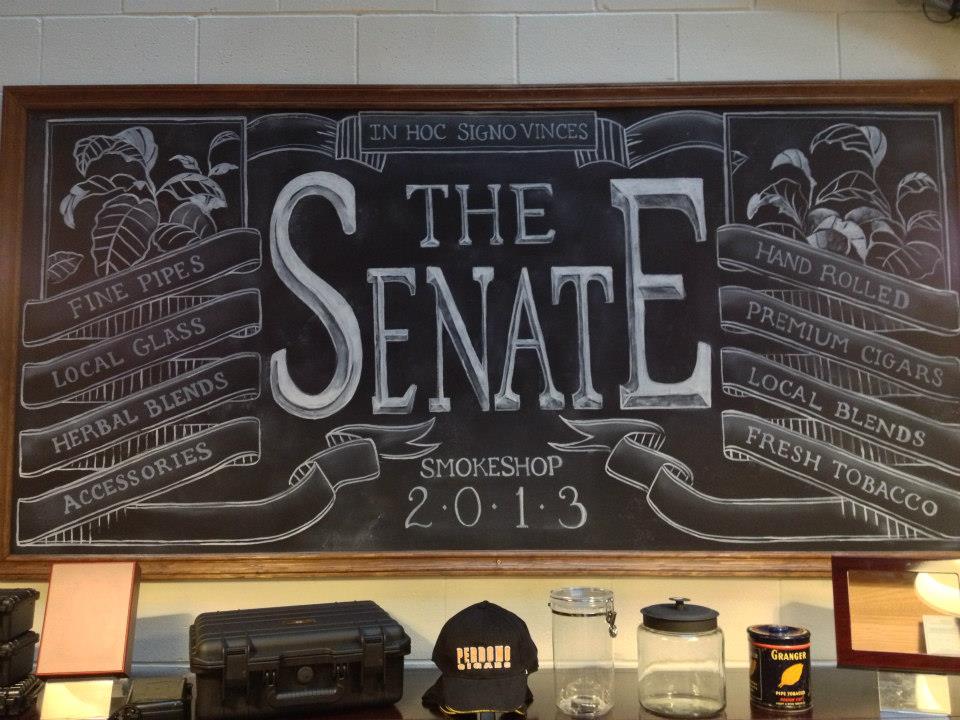
Experiencing a New Smoke Shop in Bellingham, Washington – The Senate Smoke Shop


Blog by Steve Laug

For many years now I have been making the trek from Vancouver, British Columbia into the US to Bellingham, Washington to visit a pipe shop in old Bellingham, a place called Fairhaven. The shop is called the Fairhaven Smoke Shop and is located at 1200 Harris Avenue Suite 100 Bellingham, Washington. When I first started visiting shop 15-18 years ago it was operated be an older gent who seemed like he could have cared less if he had customers, but he had a huge assortment of estate pipes and some great older tobaccos. I got to know him over the years and enjoyed his company. About 8 years ago a young fellow – mid 20’s bought the shop and took over. I had visions of it becoming yet another head shop! But you got to give him credit. He kept it as a pipe and tobacco shop (mind you he added the typical glass pipes and hookahs). He upgraded the shop layout and look, added new pipes and tobaccos and continued in the tradition of a pipe shop. He set up a web presence at http://fairhavensmokes.com/ I really expected the place to shrivel up and disappear in the anti-smoking environment of Washington State. But instead it seems to have done well.

On Saturday I made the trip to Bellingham once again. I really was hoping to get a side trip over to Fairhaven but we did not have time to visit the shop on this trip. My wife and I brought along two of our daughters for the day. Whenever we are in Bellingham my wife and I always visit a little coffee and donut shop on Holly St. called Rocket Donuts so we wanted to show it to the girls. As we made our way to the shop my youngest daughter pointed up the street to a sign that said The Senate Tobacconist and Smoke Shop. I have walked down that street for over 20 years and I had never seen that shop. You know how sometimes you wonder if you missed seeing something because you were focused on other things? That is what crossed my mind when she pointed out the shop. My wife and the girls went in for coffee and donuts but needless to say, I had to go check out the shop.

In a world in which more and more head shops with glass pipes, bongs and the like are replacing the old bona fide tobacconist shops I had really low expectations about this shop. I walked up the street toward it and paused to read the sandwich board on the street. As yet I had not looked in the window. I have to say the sign had elements of both hopefulness and resignation in its words – hopeful: tobacco at the top of the list, and cigars – resignation: herbs and glassware. Before getting to the shop I had already made up my mind as to what I could expect when I entered. Glassware! Herbs! Sheesh, it was almost like experiencing again what I had experienced when the Tinderbox Tobacco Shops became glorified gift shops that also sold tobacco and cigars. So was this going to be a head shop that also sold a few cigars and some tobacco? I tell you what, I almost turned and went back to the coffee and donuts. I really did not want yet another disappointment.

Senate23

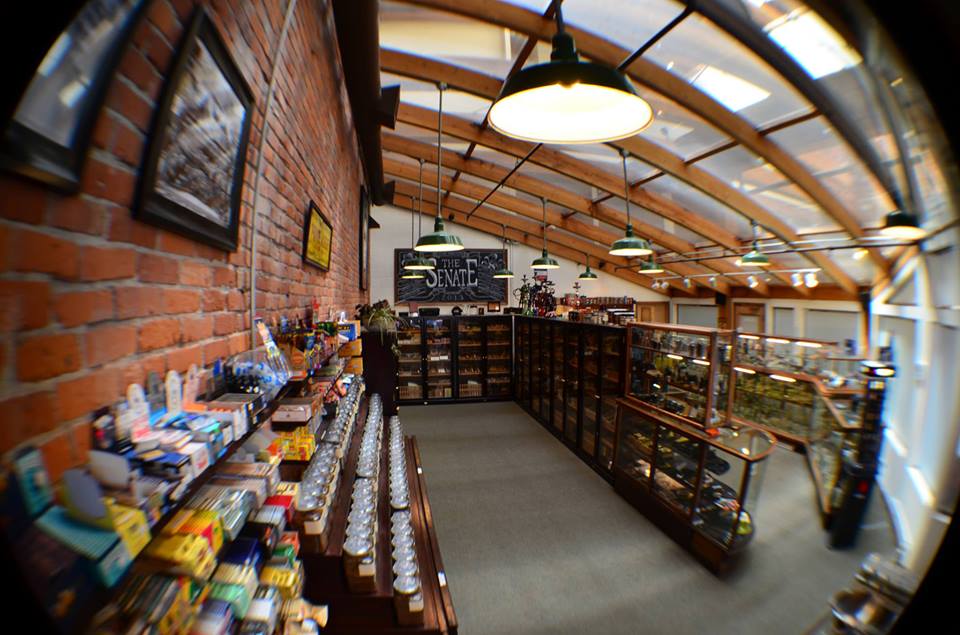
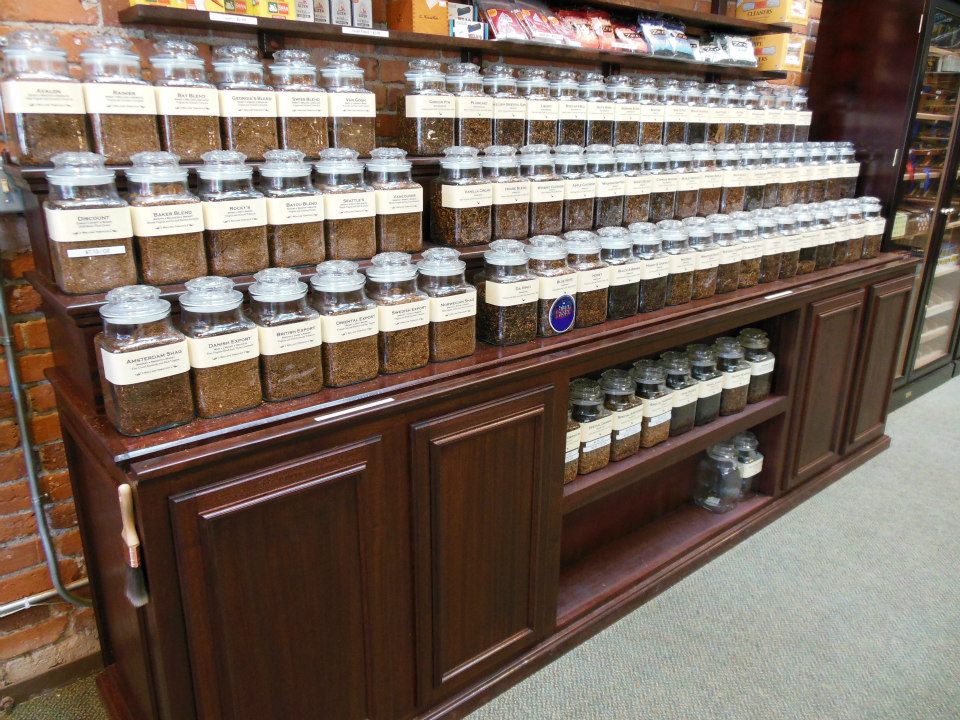
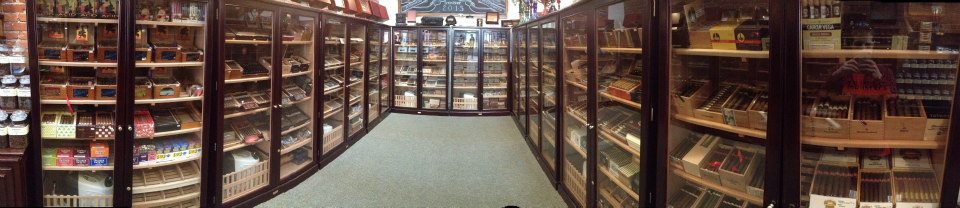
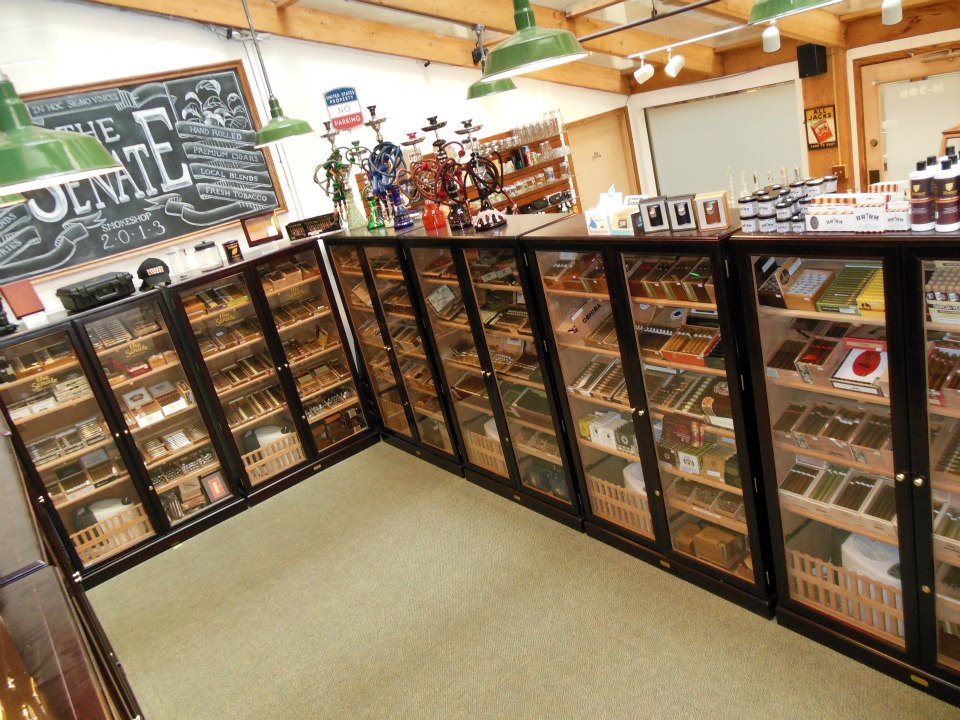
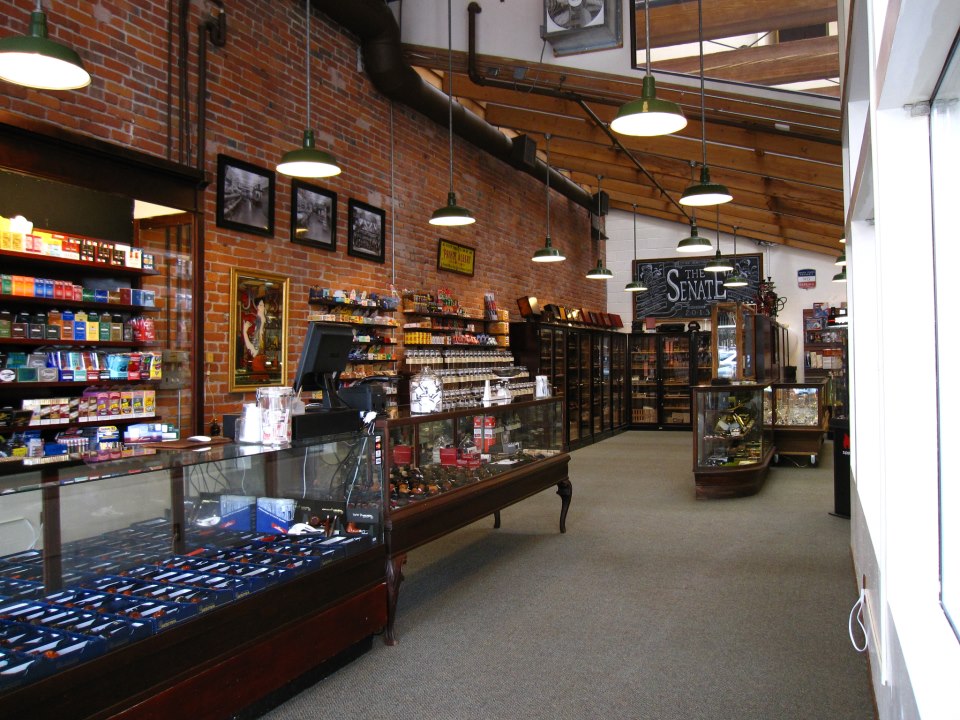
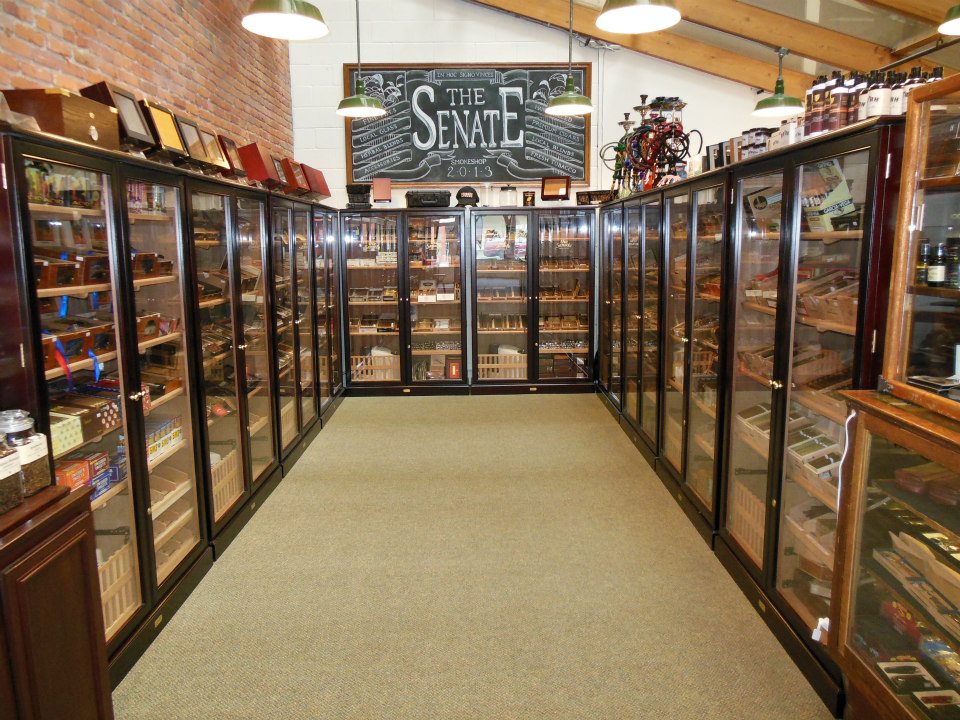
But my curiosity got the better of me and I shrugged my shoulders and went over to the window and looked in. I fully expected a typical smoke shop/paraphernalia shop but what I saw was not that. I could not believe my eyes. The glassware was not that visible and what I saw through the window was a pipeman’s feast – lots of display cases with pipes and tins and jars of bulk tobacco front and center. Then in the back, away from the window were bookcase style humidors with many cigar choices. Off to the side in the corner was the collection of glassware. To be honest I never went over to that corner to have a look. It is truly amazing in this day and age to see a shop like this in my neck of the woods. This was a fully-fledged tobacconist!

Senate26

Senate29

Senate19

Senate15

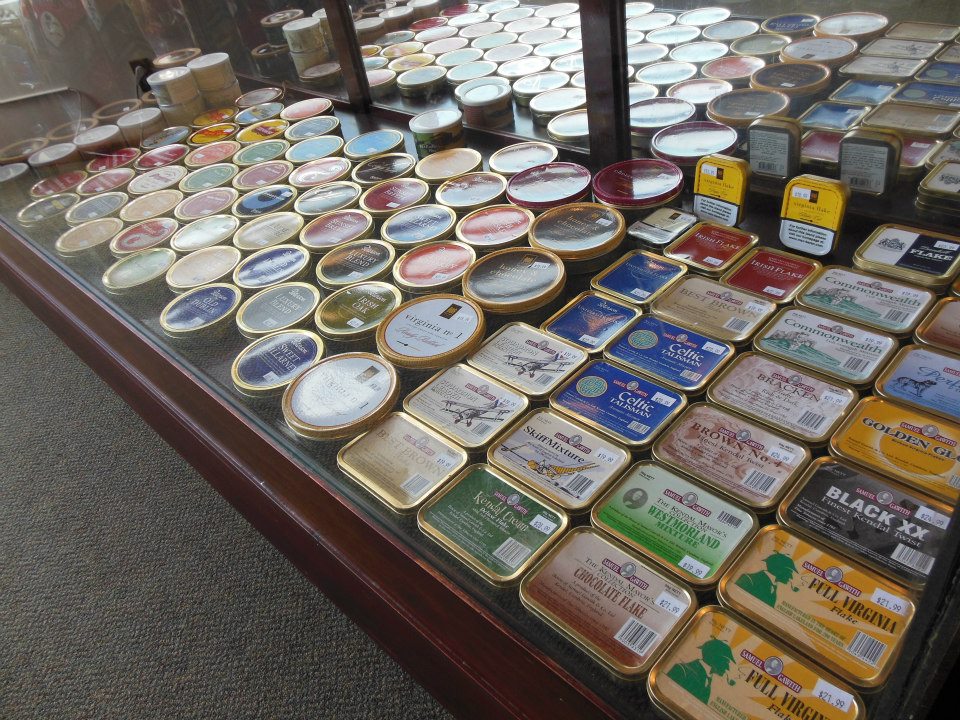
I opened the door and went in. I laugh now, but I must have looked like a kid in a candy shop. I eyed the open topped display case of tins and pouches of tobacco for sale on my left. I looked at the brands of tobacco that were carried and available and was pleased to see many of my favourite blends. I proceeded down the display counters on the left and looked at pipes – Vauen, Peterson, Ascorti, Big Ben, Stanwell, Butz-Choquin and others beautifully laid out for the buyer to see. There were both briars and meerschaums of every shape and size and price range. The display cases were well lit and the pipes were well displayed. It was a briar feast for the eyes. I only wish I had had more time to look things over more carefully. I walked past the cash register and the Three Brass Monkeys on display in front of it, past the tobacco scales on the counter to have a look at the bulk tobacco selections. There was an unbelievable array of blends – Aromatics, Virginias, English and some straight blending tobaccos – Latakia and Perique. There were even some cigarette cut tobacco. I went through the well labeled Virginia, Virginia Perique and English blends and took each lid off to have a good sniff of the blend in the jars. I skipped over the aromatics – chocolate, raspberry, cherry, vanilla, mocha, caramel and other mixtures with edible names as it has been a long time since I smoked them. I could easily have spent more time going through the many blends that were carried by the shop. As I was only in Bellingham for one day I could only purchase a 100 gram pouch and hope to not get dinged with duty at the border. But I would be back!

Senate24

senate2

Senate18

I wandered through the cigar humidor sections – I loved the cherry wood cabinets that each housed cedar lined walls and shelves and a humidor unit so that each glass doored cabinet was a sealed unit. The only thing missing that I could see were the Cubans that we have in Canada. There were all kinds of cigars and all kinds of sizes. I am pretty cigar ignorant but the selection seemed to cover a wide range of country of origin, price, blend and style.

Senate14

Senate11

Senate12

Senate13

I went back to the bulk tobaccos and picked the blend I had chosen, a Dark English – Virginias, Stoved Virginias, Latakia, Orientals and Perique and carried the jar to the scale to have the proprietor weigh it out and bag it up for me. To my surprise the gent behind the counter was the same fellow who had purchased the old Fairhaven Shop, now eight years older. He recognized me and remembered our first meeting many years earlier when he had given me two tins of Erinmore Flake on a visit I made to the shop. I asked him how that shop was doing and he said it was doing well. I asked him when he had opened the Senate and why. He responded that he had always wanted a shop in this area and had opened the doors four months earlier. Business was doing well and he loved the new location. We had a great visit and I asked him about several tobaccos that he did not have. He said he would order them in. I paid for my tobacco and a couple of bundles of pipe cleaners before I headed out the door. I am looking forward to another longer visit soon.

Senate25

If you find yourself in the Bellingham area, I would heartily recommend that you stop by the shop and have a visit. The shop is called the Senate and is located at 215 West Holly Street, Suite H-20. The phone number is 360-756-7552. It has a great selection of pipes and cigars as well as house blends and tinned tobacco to purchase. The proprietor Mike Waters is a great guy – personable, knowledgeable and genuinely interested in serving the pipe and cigar smoking public. Stop by and say hi. In this anti-smoking state of Washington in the anti-smoking climate of our world it was great to see a new tobacco shop open its doors. It was encouraging to see this young fellow doing well enough in his first shop to open this second one. The store will have a web presence soon as the shop website, http://www.senatecigar.com is under development. Check it often as Mike says that the full site will be open soon. Who knows we may run into each other at the shop. Until then enjoy your pipe!

Senate

Steve Laug
06/17/13