
Blog by Steve Laug
Several weeks ago, my Buffer packed it in. It was an older machine (maybe 15 years or more as I don’t remember not having it). I was buffing a pipe with Blue Diamond when all of the sudden the buffer stopped mid buff. I checked the power and it was still attached to the outlet so I checked the entry of the wire to the back of the buffer. That too was intact and undamaged. Then I checked what I should have checked first if I had thought about it – the switch. When I touched the switch, the pieces fell out in my hands. The main portion of the switch had broken off inside the buffer. I took the plate that held the switch in place off the stand and found that it had been a plugin switch that I could detach. I did a bit of searching and did not find one. I would continue to look for one but I needed to have a working one fairly quickly.
I spoke with Kenneth Lieblich about his buffer and he told me that it was a KMS buffer that he had purchased used. It was an 8-inch buffer with two spindles and it worked well for him. He only wished that it was easier to change the pads on. He sent me a link to the buffer he had on KMS Tools. They have a retail store near where Kenneth lived so he said if I wanted the buffer he would be willing to pick it up.
Here is a link to the buffer (https://www.kmstools.com/magnum-8-quot-bench-buffer.html) as well as a picture and the specs to the machine. It described the machine as ideal for all material buffing and polishing: wood, plastic, glass, steel, brass, copper, jewellery and more.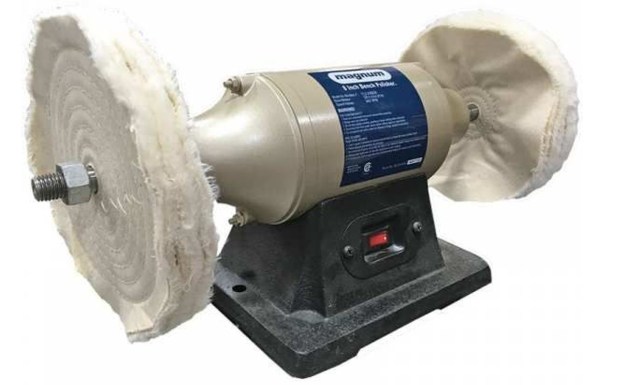 Here are the specs on the buffer.
- 4.8A, 3450 RPM
- 8″ x 3/4″ (1) soft, (1) spiral sewn wheel
- Long shaft design for big items buffing
- Cast iron base ensure steady running
- Lock safety switch
Some may think that 3450 RPM buffers are too much buffer, to high an RPM for the work. However, I have been using that RPM buffer for many years now with no issues. You just need to pay attention to the process and hold on tight to the briar. I always buff with a finger or thumb inside the bowl to anchor it firmly in my hand. I find that this works very well for me and I have had very few issues with it. When I first started I had a few projectile bowls which led me use the finger or thumb to hold the bowl in hand.
My old buffer had 6” buffing pads that I had purchased from Lee Valley Tools here in Vancouver. These pads were 8” and ¾ of an inch thick which seemed significantly thinner than the ones I had used previously. I gave Kenneth a call and put in my order. He picked it up for me and soon I had it in my hands. I unpacked it from the well packed/padded box and took a photo of the parts. You can see the twin spindles with a pair of washers – one for each side of the buffing pad and a threaded nut to hold them all in place.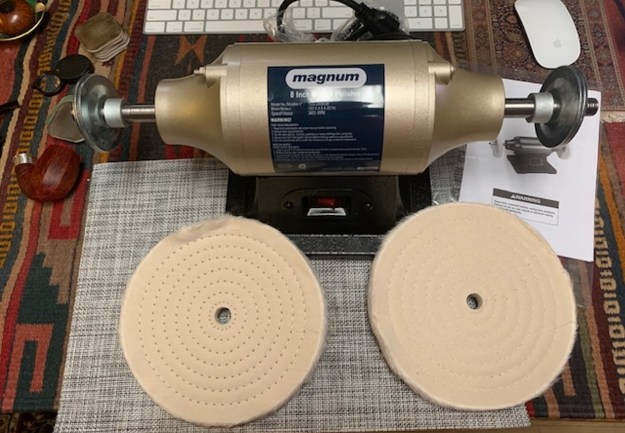 I put the parts together with a pad on each spindle. I set it up the same way as my older one. The soft pad on the left side and the harder one on the right side. I use the harder pad to buff the pipe with Blue Diamond polishing compound. I used the softer pad to apply the carnauba wax. I have a second buffer with a fluffier pad to polish the wax and raise a shine on the briar. I think this one will work great for me.
 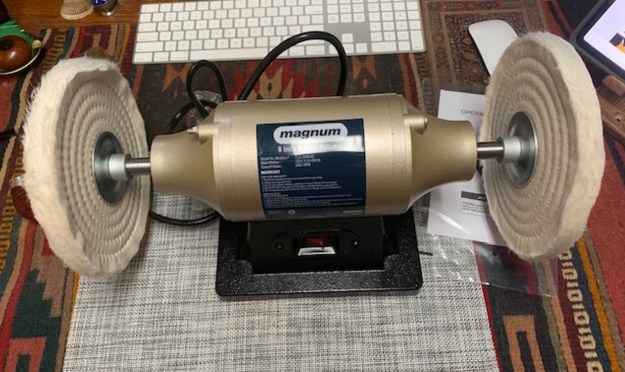 I have now put the buffer in place on the washing machine in the back room where the old one used to reside. I have been buffing a good number of pipes on it already and two things have transpired. First, the fresh buffing pads shed a huge amount of strings/threads all over the room I had forgotten that fact as my previous pads had long since ceased to shed and were fully charged with polishing compound and carnauba. This one will shed for a while. Second, I am really enjoying the larger buffing wheels and the thin ¾ inch pads are fluffing up and they look exactly like the thickness of my previous pads.
 rebornpipes