Tag Archives: pipe related topics

My choices in Pipe Reamers – a review


Blog by Steve Laug

In the process of refurbishing estate pipes, a thing that I enjoy doing, I use two pipe reamers almost every time I begin the work. Both of them have different strengths or advantages that I have come to count on in the process of using them. They work on the thickest and hardest cake that I have found in these old work horse pipes. I have written of the advantages and weaknesses of both in the review that follows.  

The first of these is readily available on EBay as Kleen Reem pipe reamers. There is also a similar reamer available going under the label of the Senior Reamer which can be purchased at most of the online pipe vendors. The reamer I have is pictured below. It is an adjustable three blade hardened steel reamer. The top is the adjustment knob and as it is turned it opens the blades wider or narrower. The utility of this reamer is that it is able to be adjusted to multiple bowl sizes. The blades remain vertical so that the bowl does not taper. It works very well for cylindrical shaped bowls. The hardened steel does a great job cutting back the carbon of the cake and can be adjusted to allow for different cake depths. The one draw back of this reamer is that it does not do a great job on the heel of the bowl in rounded or U shaped bowls. It is perfect for the conical bowl or V shaped bowl that tapers to a point. In the U shaped bowls I have to finish the reaming by using the second tool below or a piece of sand paper wrapped on a dowel.

Image

The case that the reamer came in is functional and strong. In the bottom edge of the case there is a banded group of cut pipe cleaners.

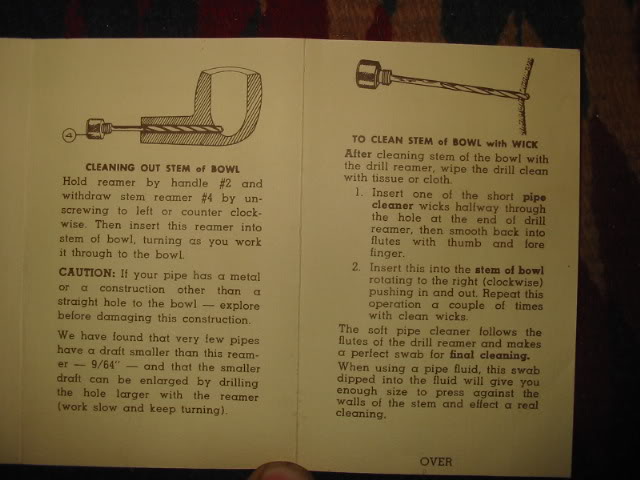
A brilliant part of this tool is found under the adjustment knob on the top. The knob can be turned to unscrew it from the main unit. Once it is removed it reveals a drill bit attached to the knob that is designed to clean out the airway in the shank. It can be twisted into the shank to reopened clogged and restricted airways without damaging the pipe. I use the drill bit by itself the first few times through the shank to remove the grime and tars. I then follow up with the pipe cleaners inserted and wrapped up the bit then dipped in alcohol to remove the loosened grime from the shank of the pipe. I have replaced the original ones that came with the kit many times with cut pieces of regular or fluffy pipe cleaners. The diagram below shows the bit inserted in the shank. It also shows the winding of the pipe cleaners on the drill bit that I referred to above.
Image 

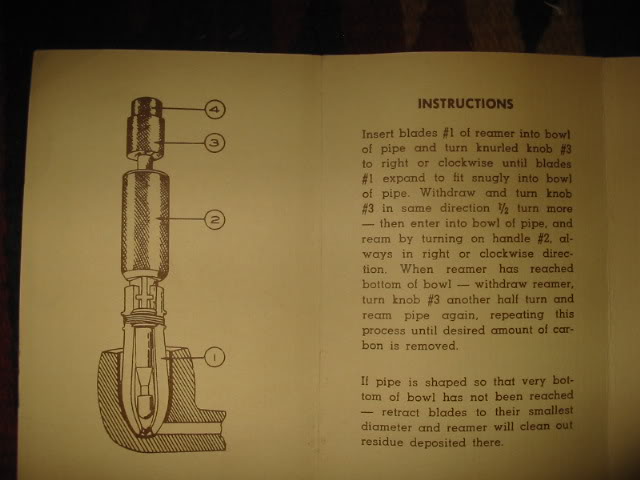
The picture below shows the reamer as diagrammed with the instruction manual that came with the Kleen Reem kit. The numerals on the diagram are explained in the instructions on the right side of the picture. I use the reamer as a regular part of the cleaning routine I have established for working on estate pipes.
Image 

I would recommend either the Senior Reamer or the Kleen Reem Reamer for all those who clean and work on their own pipe and those who do refurbishing of estate pipes. When you purchase it know that you will need another tool or have to use sandpaper and dowel to maintain the heel of the bowl.

The second reamer that is in my refurbishing tool kit is called a Pipnet Reamer. I found this reamer when the one above left me with work to do at the bottom of the bowl. I was searching for a tool that did a better job in that part of the bowl. This reamer has also been packaged and sold in North America under the Castleford name. From my experience while these two versions of the reamer look the same, the Castleford set is not as well made as the Pipnet set. I will comment on that later in this article. Both sets come in a cardboard storage case and include a foam insert with cut spaces for the “T” handle and four heads of different diameters. To use the reamer the heads (tenons) are inserted into a square slot (mortise) on the bottom of the handle and then can be turned into the bowls for a thorough reaming. The picture below shows the Pipnet set that I have. I have reboxed it in an old wooden box that my kids had around. I found that it is a perfect fit and keeps the parts together.

 Image

The greatest asset of this tool in my opinion is that the interchangeable heads make it possible to work with a variety of bowl sizes and with various cake thicknesses. On older heavily caked bowls the reaming can be done in stages until it is the cake thickness matches the desired depth chosen by the refurbisher. This also makes it very easy to ream the cake all the way back to the wood or to leave any amount of cake you chooses. The size and shape of the combined handle and heads make it easy to keep the tool vertical in the bowl and avoid over reaming or ruining the roundness of the bowl by reaming at an angle.

Often when I am refurbishing older pipes I use both reamers mentioned in this article to complete the reaming to my satisfaction. I start reaming with the Pipnet and end with the KleenReem or the reverse depending on the bowl shape. I find that the design of the tool allows me to have a good grip on the handle as I turn the blades to cut the cake. I begin with the smallest head and work my way up to the size that brings the bowl to a place where I then use the KleenReem to finish the work.

Each cutting head of the Pipnet tool has four blades inserted into a hard plastic head. They are basically hardened steel “U” shapes that meet at the bottom of the head and go up the length of the head. The cutting head, though obviously designed for “U” shaped bowls, also can be used in conical bowls. Again the reaming process should begin with the smallest head that fits into the bottom of the bowl and then working up the varying sizes of heads until the bowl is completely reamed. The design and shape of the heads is visible in the picture of the Castleford Set below.

Image 

In terms of durability I have used the Pipnet set for five years without any damage to the handle or heads. I was concerned when the tool arrived that the stress on the handle head connection (tenon/mortise) when turning it into the bowl would be problematic. When twisted or turned I can feel the give or strain in the plastic junction. In the 5 years I have used the Pipnet set I have not had any problems with this concern. Last year I was given a Castleford set to use as a backup. It looked like it was the same tool at a glance. I broke the handle mortise connection after the first couple of uses. In comparing the two sets I can see that the Pipnet set is made of a heavier/thicker plastic in the handle connection than the Castleford. That is probably the reason that it has outlasted the Castleford.

I purchased my Pipnet on EBay and continue to see sets show up there regularly. It is also available through various pipe and tobacco shops on the web. One or both of these reamers will serve the refurbisher well in the quest for a clean, restored pipe. Take into consideration the strengths and limitations of both and make your choices from an informed position. Enjoy your restoration work.

List of supplies for refurbishing


Blog by Steve Laug

I have had quite a number of emails over the past years asking for a list of tools and supplies that I use for pipe refurbishing. I have made a list and broken it down into 4 parts – two dealing with the bowl and two dealing with the stem. The first in each category is what I call field dressing the pipe. It involves the initial breaking down of the pipe and stripping and cleaning it. The second in each category is the finishing.

Refurbishing stems:

1. For the stems – field dressing

– Oxyclean for soaking oxidized stems. I use it to soften the oxidation rather than remove it. It works great. It does not remove oxidation as some have suggested but it does soften it so it is more easily removed.

– a pint jar or container with a lid that can be used for soaking stems (I use an empty Oxyclean container for the alcohol bath and another for the Oxyclean wash.)

– Sanding pads – coarse, medium and fine pads – these are 2″x3″ and about an inch thick. I find that they are firm but flexible. The edges work great against the button.

– 400 and 600 grit wet dry sand paper

– Pipe cleaners – both bristle and fluffy

– Dental pick for getting the corners of the button, the slot and the tenon

– Pliers for removing stinger apparatus

– Small microwave bowl or heat gun to lift bite marks and dents from the stem

– Retort system – available on eBay or from Shield on Smokers Forums http://www.smokersforums.co.uk/

2. For the stems – Finishing

– Sanding pads (see above), 240 grit sand paper and 400, 600 wet dry sand paper and Micromesh pads in 1500, 1800, 2400, 3200, 4000, 6000 grits.

– Buffer with pads – Tripoli, then White Diamond and then Carnauba. These are used after the sanding process. I don’t use a Dremel for this as it can cause ripples in the Vulcanite stem.

– I just started using Obsidian Pipestem Oil on the stems and it is fantastic. I rub it into the stem, let it sit for 30 minutes, polish and repeat.

– I then wax the stem with either Carnuaba Wax, Renaissance Wax or Paragon Wax. The first I apply with a buffing wheel the latter two can be applied by hand. When the latter are used apply them, let them dry and then buff with a soft cotton cloth.

– Soft cloths for hand buffing

– Bright light to identify scratches in the bowls and in the stems

 Refurbishing Bowls:

1. For the bowl – Field dressing

– Jewelers Loop to examine the hallmarks and stamping on the pipe before sanding

– Reamer (I use a Pipnet Reamer that is available from Synjeco. It is also made by Castleford. It is a ‘T’ handle with four different blade heads that fit in the bowl. Very easy to use and maintain roundness of the chamber. I also use a KleenReem or Senior Reamer as well. I have a review and comparison of the two on the blog.)

– Soft bristle tooth brush for scrubbing with the oil soap

– Brass bristle tire brush for use in scrubbing on plateau and in rustication

– 2×3 inch sanding pads of different grits (Coarse, Medium and Fine). I found these at a paint shop/hardware store as they are used in drywall patching and painting. Home Depot carries them as well. These are used to remove the tars and lava on the top of the bowls.

– Murphy’s Oil Soap

– Several soft rags for wiping and application of soap

– 100s of pipe cleaners – fluffy, bristle and thin

– Q-tips cotton swabs – I use these to clean out the mortise area of the shank as well as the sump in system pipes.

– Cotton boles that are used with the retort and also in using them for stuffing the bowl and adding isopropyl alcohol to draw out the tars a oils of old tobacco from the bowl.

– Silver polish for bands – both a liquid/paste application and a polishing cloth that is available through jewelry shops.

– A pint jar/container with a lid for the alcohol bath

– 99% isopropyl alcohol

2. For the bowl – Finishing

– 400 and 600 grit sand paper

– Micromesh pads in 1500,1800, 2400, 3200, 4000 and 6000 grit available online at Lee Valley Tools and other wood working suppliers.

– A knife that can be heated and a cloth that can be wet to use to steam dents from the bowls. You can use a knife – I heat the blade on my gas stove and then use a wet cloth on the dent and apply the hot knife to the dent and the steam lifts the dent. You can also use an iron to do the same with a damp cloth.

– Stains – I use Feibings Shoe dye – aniline based stains that are far cheaper than labeled wood stains. I use Medium and Dark Brown, Oxblood or Cordovan, and Black almost all the time but it is available in other colours as well. Those three match most of the older English and American pipes that I rework.

– Matches or lighter for flaming the stain once it applied

– Rubber gloves for applying stain unless you don’t mind wearing it for a while

– Q-tip cotton swabs or pipe cleaners bent in half for applying the stains

– Soft rags for wiping off stains and applying them

– You can get a polishing kit from Lee Valley that includes three buffer pads, and arbor and attachments for a bench grinder. That is what I have. It also comes with a bar of Tripoli, White Diamond and Carnauba wax in the kit. It will last a long time. I think it is about $70 or less for the kit.

– I also have a jar of Halcyon wax for use on blasts and rusticated. It is applied by hand and buffed off with a soft cloth. They also have Paragon wax for smooths. It is available on eBay for sale or you can Google it to get it – it comes from Fine Pipes.com

You can add other tools to the kit as you want to. I also have a specially cut screw driver for rusticating bowls, a tenon expander, a wood screw that I use to remove broken tenons, a battery terminal brush that fits the bowls, a plumbers 3/4″ wire brush for bowl reaming etc. Necessity is the mother of invention in the process of refurbishing. I am always looking for new tools and ideas.

Poor draw on a stem


Blog by Steve Laug

I was working on a stem for a friend this evening. The bowl on the pipe had a great wide open draw. The stem by itself was awful – it was like sucking on a coffee stirrer. It was a Aerosphere pipe. He had plugged the carburetor which was good. Somehow the stem itself was not drawing. I heated it and straightened it. I pushed a pipe cleaner through the straight stem and a chunk of some kind of fabric fell out. I used a light and looked down the stem and saw that the airway was a half circle. I used a needle file to open it up and to open the slot on the button as well. I then reheated with a pipe cleaner inserted to keep the airway open and then bent it so as not to kink the stem. The draw is wide open now. This caused me to post here regarding opening airways on bent stems.

Here are a few things to consider:
1. Is there anything in the stem itself clogging the airway? Could be a chunk of pipe cleaner lint, or fabric or just plain gunk.
2. Is the button open or is the slot on it constricting?
3. Is there a kink in the airway caused by the bend itself? This can happen when the stem is bent too far for the thickness of the stem at the bend.
4. What is the shape of the airway from shank to button? Round? Oblong? Oval? half circle? Check it before you drill it?

Anyway just a heads up – check before you drill it open.

Confessions of a Pipeman – First edition – Gary B. Schrier


Confessions of a Pipeman – First edition

Gary B. Schrier

Schrier subtitles his book “an irreverent guide for today’s pipe-smoking man.” It is indeed that!! In its short 90 pages he takes on almost every aspect of the life of a pipe smoking man. He debunks a lot of traditions and takes exception to some commonly held myths that seem to float around everywhere these days. Some of his takes on things will certainly ring true to you and some will actually tick you off, but all will make you sit up and take notice. Schrier has a knack for stringing together words in ways that carry a lot of punch for their schrift.

I sat down to read the book last weekend, with a pipeful of nice Virginia, and could not put it down. It is a quick read and there are even cartoons to convey his points. For those who need to have a page full of type interrupted by an occasional picture or cartoon these are great. I always read the foreword and the preface of every book I read. I have the often mistaken belief that the author or whoever wrote the foreword might actually tip his or her hand on what to expect of the book in hand. In this case that is exactly what happens. The foreword is written by Marty Pulvers. He says “For the aspiring pipe smoker, there is no source that can educated and inform as this book. It would not be going an inch to far to call this a critical resource for that incipient pipe smoker, because the information contained herein is not going to be readily available anywhere else, and without it,  the beginner just might well lose his/her way and give up on the wonderful world of pipe smoking.” He sings high praise regarding the helpful data that Schrier included in the book.

The chapters cover a broad range of topics. The first two reflect on the state of pipe smoking today. In them Schrier argues that the age of the pipe smoker is closed. The old pipemen of ages past are all but dead. We have entered a new time that requires the pipe man to adapt to get by. Smoking in public is quickly becoming a thing of the past with few places remaining where that is allowed. He really asks pipe smokers to count the cost of being a pipe man. It is a tradition that is almost gone according to his thinking.

The next section of chapters – 3-6 – delves into the life style of the pipeman and call the new pipe smoker to look at the challenge. He includes a chapter on the importance of reading to be a well rounded conversationalist – this includes a book list of pipe and tobacco books but also calls us to read more widely. The lifestyle also includes being a conscientious smoker and one who has a natural savoir-faire. This section is delightful to read and full of interesting and insightful topics that would be worth discussing with others.

After a brief chapter on not missing out on the delight of a cigar now and then the book turns to a discussion of choosing the right pipe and tobacco. There are some helpful insights here. Schrier’s take (like mine) is that a new pipeman should begin with an English like Dunhill 965 as it will minimize tongue bite and get rid of the tootie fruitie flavours that are sure to produce a bite in the new smoker. You may not agree with him but to be honest he does not particularly care about that. Just give a good reason for your disagreement. He turns to discuss aged tobacco and the ritual of keeping a pipe in good order. There is an interesting take on collecting pipes – I am not going to give it away but it is worth a read just to get your blood pressure up a bit if you are a collector!!

The next section of the book covers a variety of topics on travelling with your pipe and where to smoke it – pipe clubs, your own pipe den, etc. and gives a brief introduction to the questions about pipe smoking and health.

The last two chapters are set apart for the debunking of myths and the concept of mentoring others in the gentle art of the pipe.

The book is a great read. Easy to work through and digestible in small chunks due to short chapters. The language is colourful and at times irreverent. But it makes it fun to read. I found myself laughing at times and at other times reflecting on my own habits and practices. Marty Pulvers says it is a great book for the beginner, but I can say as an old timer with more years with a pipe under my belt than I care to admit it is enjoyable and educational. It is well worth the price of the book to have a conversation with Schrier between the covers of his book. You will laugh, agree, disagree, strongly take exception and at times wish he had said it more strongly. Highly recommended.

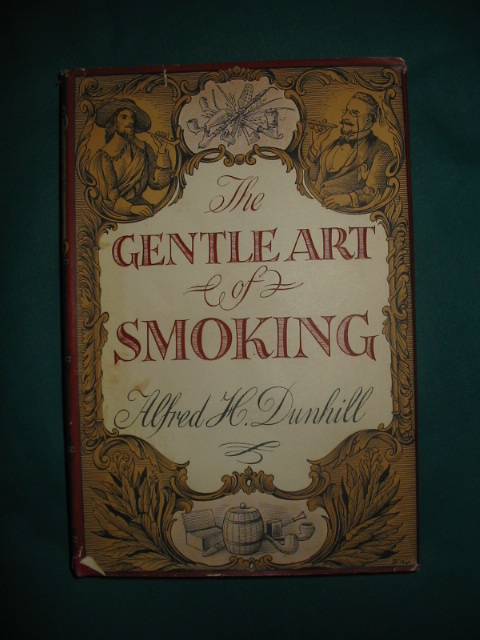
The Gentle Art of Smoking – Alfred H. Dunhill


Image

The Gentle Art of Smoking 

Alfred H. Dunhill

This book is quite different from Pipe Book by his father. Here Alfred H. Traces the history of smoking in all of its forms throughout history. He looks at it on the various continents and how it took form among the religious and the ordinary people. He looks at cigars, cigarettes, pipes and even snuff. Each is described from its inception to its ongoing development in the first chapter. In later chapters he develops each of the various smoking methods.

From the history of smoking a chapter is developed on the growing tobacco. There is some great material on the tobacco plant and the various layers of the plant from lugs, cutters to leaf and what each section is used for. He spends time explaining the cultivation of tobacco and the growing seasons in the various regions in which it is grown. Then he takes the reader through the process of harvesting, curing, grading, fermentation and marketing. The book then turns the preparation of tobacco from the harvest to transportation and the methodology used to create the various forms tobacco packaged. He does a great job going through the machinery for processing from the first to the last. The cigarette machines, that roll, pack and cut each cigarette and then package them in cartons or soft packs are described. Throughout the book sketches are used to depict the various sections of development.  He also looks at the way pipe tobacco and cigars are made.

The fourth chapter of the book picks up the history of pipes and to me this chapter is very reminiscent of is father’s book on pipes. He uses different but similar sketches to picture the pipes evolution but the text is very similar in my mind. There is nothing new or added in this section of the book that has not been covered by others.  From the history the author takes us to the making of the pipe. He addresses briar pipes first and of course gives a good picture of the process of making them from briar burl through finished product. In this section as in others there are also black and white plates that are really nicely done and lend illustration to the procedures that are being talked about. The section closes with a brief description of clay pipes and their manufacture and meerschaum and their development.

Chapter 6 looks at cigars and traces the rise and decline of cigar smoking throughout history. It also gives a good concise summary of the process of making, grading and packing cigars. Chapter 7 discusses the manufacture, history and use of snuff. There are some great plates in this section of antique snuff boxes, etc. Chapter 8 looks at the various methods of lighting tobacco products throughout history and gives some great historical development material on the discovery and manufacture of lighters. Again plates and sketches illustrate the variety of lighters used to bring fire to the weed.

The book closes with a section on the practice of smoking. The majority of the section deals with the choice, use and variety of pipes. It goes into the method to use in choosing shapes, stems and sizes. It also goes into a great description of the loading, smoking and after care of a pipe for the beginning smoker. Then the section turns to cigars. Here the choosing of a cigar is discussed with guidance on how to make that choice. Then directions are given for preparing and smoking the cigar you have chosen in order to get the most pleasure from the smoke. This chapter and the book closes with guidelines on the care and keeping of cigars.

Overall this is a great read; nothing new or profound but some very nice summaries of a variety of topics. The section on pipe smoking was by far one of the best sections in the book. It would make a great read for the new pipe smoker and a good review for those of us who have forgotten more than we remember about the great hobby that is ours.

The Pipe Smoker – John Paul Beaumier & Lewis Camp


Image

A Review – The Pipe Smoker
John Paul Beaumier & Lewis Camp

The sub title sums up the purpose of this book very well: “Being an entertaining and scientific treatise on pipes and tobaccos with wholly new revelations about the pipe smoker.” If you have you ever really thought about why you smoke a pipe or why some people smoke pipes and others just cannot be bothered, then this is a book you could have written given the time and thought… or at least one that you should read

The Pipe Smoker was written from a different slant according to the authors in the introduction. Their names on this book are pseudonyms for two northern California psychologist/authors. One is a scientific consultant to a leading American pipe manufacturer, the other is an expert on mind-body relationships and a long time pipe smoker.

Almost all other books written about pipes and tobacco focussed on that topic. This one has taken the tact of focussing on the pipe smoker. It is a study into what make a pipe smoker different from other humans. The argument is that once we have come to know some of the compelling reasons for this difference we will better understand why the infinite varieties of tobaccos and pipes have such special meaning to this special person.

With that purpose in mind the authors set out to look at us – the pipe smokers. The outline of the book illustrates this clearly. Each chapter in the five major sections is introduced by a pipe smoking quote from famous and anonymous pipe smokers that illustrate the content of the chapter. They add an interesting dimension to the book and to its overall direction – they give voices to the person of the pipe smoker. The five major sections are organized as follows:

Section 1:The personality of the pipe smoker – in which the authors look at the aspects of the collective and individual personality of the pipe smoker. They discuss masculinity, social image, extraversion vs. Introversion and what they say is the penultimate pipe smoker – the healthy introvert.

Section 2: What the body says – here the authors look at the pipe as a means of relaxation, sex and the pipe smoker, meditative mindset and pipe smoking. This is a fascinating section of the book and contains reflections that I have never read elsewhere.

Already you can see the different direction of this book takes. It was a hard book to put down without finishing the last pages.

Section 3: A sensual guide to the art of pipe smoking – Here the authors discuss the sensuality of the pipe and its effects on the smoker. They discuss the odour and taste of tobacco, the look and feel of the pipe, the caking, filling and lighting of the pipe, the exquisite pleasure of puffing and finally the care and feeding of the pipe. Here they capture for me in a way few have, the pleasure of the ritual of the pipe. Each chapter in this section captures what goes on in my senses and feelings as I savour a pipe. Well written.

Section 4: The Grand world of pipes – This section finally gets to the normal pipe book topics – it is the shortest section of the book. It covers what pipes are made of and the geometry of pipes – how they are made. Even this mundane section is written in a captivating manner.

Section 5: The book closes with a section on the religious and symbolic aspects of pipe smoking – but lest one get confused that somehow they are merely talking about sacred smoke the chapters in this section discuss the sensuous symbolism of pipe smoking the sacred and the profane in pipe smoking. It is a delightful ending to a wonderful treatise on the person who smokes a pipe.

I found that this book was a great read and thoroughly engaging. It is unique in pipe smoking literature. It treads some of the ground that lately Gary Schrier does in his Confessions of a Pipeman and does it as uniquely and interestingly as Schrier does. The book gives one much to think about – whether you agree or disagree with any one piece of their premise. Worth the read!!

The Pipe Smoker’s Tobacco Book – Robert Winans


Blog by Steve Laug

Book Review

The Pipe Smoker’s Tobacco Book

Robert F. Winans

Winans’ book on tobacco is just that a book on tobacco. He says in his introduction that the focus of his book is to concentrate on the subject of tobacco as it relates to pipe smoking consumers. Winans says it this way in his introduction, “It is a paradox that of all the people concerned with tobacco, the consumer is probably the most poorly informed about the content of a tobacco blend and its quality. There are some practical reasons for this. Foremost is his preoccupation with the end result. As long as a pipe tobacco blend delivers a smoke which produces the desired taste sensation and pleasure, the details surround the growing process, chemical analysis, type of tobacco, flavouring process are secondary.”  Yet many of us are interested in the details of what it takes to produce a quality smoke.

If you are one of those who want to know those details, like I am, then this book is a gold mine of info that walks you through the process of tobacco production from the seed, the growing area and conditions to the processing and the marketing. Winans includes many charts and tables to help facilitate understanding tobacco. The tables and charts are worth the price of the book. These include maps and charts of regions where various types of tobacco are grown and how the climate, geography and soil conditions impact the chemical make up of the tobacco. There are tables of percentages of tobacco varieties produced and where within the US they are produced. There are rating scales and diagrams to help understand which part of the plant is used for what particular tobacco product. All are well drawn and composed to aid in understanding.

The book is divided into three main parts after the brief introduction that justifies the book. Each part picks up a piece of the picture of the tobacco product. Part one is about the kinds of tobacco. This section was a bit surprising to me as he argues that there are only three kinds of tobacco: flue-cured, Burley and Oriental. From these he works through the variations under each of those broad categories. For 57 pages he works through the makeup and composition of each of the kinds of tobacco. He looks in depth at the conditions they are grown under, the impact of that on the taste and the curing methods. This section of the book is very interesting and has many helpful charts, drawings, graphs and maps to help explain the processes and the chemical composition of each of the tobaccos. In it he also shows the impact of climate change on the sugar and nicotine content of tobacco. He compares a normal growing season, a wet season and a dry season in terms of the output of sugar and nicotine percentages in tobacco. Each of the varietals of tobacco are looked at in terms of their classifications – class 1: flue-cured, class 3(a): light air-cured burley, class 3 (b): dark air-cured, class 2: Dark fire-cured, class 3 (a) Light air-cured Maryland, class 7: Perique. He then turns to a discussion of Turkish tobacco and Cavendish. Part one closes with discussion on the importance of sugar in tobacco.

Part two of the book is approximately 8 pages in length and has reflections on tobacco and what makes a quality tobacco. This section focuses on what a pipe smoker wants from a tobacco. This includes such things as tobacco bite and the coolness of a smoke. He discusses the relationship of temperature and time at the point the smoke enters the mouth. In this section he talks of the relationship of puffing cadence to temperature. This section, though brief, is fascinating. The charts and graphs on temperature and cadence are helpful in explaining why things work the way they do in a smoke. The final part of this section seeks to lend some objectivity to the concept of what makes up a quality smoke. Part two is a great read full of helpful information delivered in short pithy explanations.

Part three of the book is short as well and is packed with tobacco statistics and bibliographic materials. He has statistics on the amount of tobacco grown and where it is grown globally. There are also statistics on the kinds of tobacco grown and what percentage they make up of the total global tobacco crop. These tables are dated in that they reflect the world in 1975 but they still give a helpful glimpse of things to those of us who are interested in such things. These graphs and charts are clear in their presentation of the state of tobacco production, the values of tobacco in percentages to type, and the geographic regions that produce the most tobacco by kind. The final chart in the book is a graph predicting tobacco use in terms of rise and decline.

The book is a great read. It is well written and well documented. It is a short book (80 pages of information) but it is packed with great information. The facts are very clearly presented and substantiated. There is little left to personal opinion or argument by the method which the author chooses to present the material. This is a concise handbook on tobacco that enables the pipe smoking reader to intelligently look at the “leaf” he/she is stuffing into their pipes to smoke. I highly recommend it. I purchased the book at http://www.pipes2smoke.com

Look What I Found


The lid came off the old tin with a whoosh of air. The bouquet of rich, earthy tobacco filled the small space under the stairs where my desk sits. I sat and inhaled that smell for the longest time… But I am getting ahead of myself.

That tin was a “treasure” I had found in an antique store by the railroad tracks in my home town on a yearly visit with family. I still remember visiting the shop and wandering through the three floors of detritus that has come to be called antique. Strange how the things that I grew up with and regularly threw away are now collectible and “valuable”. I have developed my own method of scoping out these old shops, sorting through the plethora of stuff, to find the pipes and tobacco items that catch my eye. As I enter these shops, I suppose I could ask the clerk if they had anything that might interest me, but that has always seemed too easy and it feels like it robs me of the thrill of the hunt. So when I come into a shop I scope out the sales floor and then begin the winding wander through the shop. I usually do a fairly quick walk through on the first pass just noting things that might possibly be worth spending a bit of time picking through. On the second pass I spend a bit more time at the likely spots.

On this particular visit to the railway shop I had passed through all three floors and saw a few chewed up pipes and old tins. On the second pass through I saw this old tin that I had missed on the first pass – a big tin actually – the old 1 pound metal tobacco tins of days past. It had the metal opener attached that allowed the pipe smoker to lever the lid off and then reseal it so the tobacco would not dry out. I picked it up fully expecting it to be a typical old empty. But it was not empty. I shook it carefully to listen to what was inside. I know you all will be saying I should check to see if it had been opened but I did not do that! I shook it. Over the years of hunting I have found tins full of herbs, spices, grass seeds, nails, screws, and any number of things that give it weight and can fool you, so I shook it! This time there was no loud rattle or telltale noise that would identify one of those inside. There was only the familiar sound of tobacco inside the can. Once I figured that out I began to get more excited.

I examined the can for rust. There was none. I shook it again to listen to see if it was dry sounding. It was not. Then I checked the seal on it and found that not only was it still sealed but that the tax stamp was unbroken. It was sealed and not even torn. The date on the tax stamp said 1954. The paint and picture on the tin was in great shape with no scratches or dents. It was like being transported back to the 50’s to a time when the can was new. I was pretty excited because the odds were that I was holding a tin of tobacco from at least 1954 and it was sealed and available to me. I carried it to the front of the store and asked the clerk what they were charging for the tin.

“$10 is all for that old tin,” she said as she looked up sleepily from the romance novel she had been reading.

“Consider it sold!” I said. And with that I took out my wallet and paid the $10 and the obligatory share that the governor of the state claims as his due on every item purchased in his state. I carried it out to the car and placed it in the back with the other things that I had picked up on my hunt. It would sit there until I returned to Canada and carried it to my basement study.

Now fast forward to the opening lines of this tale. I popped the tin open and prepared to smoke a bowl of the aged tobacco. It was a nice crimp cut and it packed really well. The aroma was pleasant in the can and the bowl. It was a bit dry from the years of sitting but still hydrated enough for me. I lit the pipe and sat back and enjoyed the first of many bowls that I would enjoy from that big pounder. The nutty taste and the sweetness was not that different from the new versions of this old blend but the depth and fullness far outstripped them. I just sat with the tin open and smoked my pipe full and let the memory of the find carry me a bit. That was a banner day and a great find. It is finds like this that keep me on the hunt and always stopping to see what “treasure” the little out of the way antique shop might reveal to the searching eye.

Oh, you want to know what the old tobacco was. Some of you may have already figured it out but I probably ought to let the rest of you in on it. It was a tin of 1954 Prince Albert and it is still with me!

antique-prince-albert-tobacco-tin_4606107

A Volkswagen Bus, a pipe and a Tootsie Pop


This is a piece I wrote on the anniversary of my uncle’s death.

The sun was bright and the temperature was already climbing on that Iowa summer morning in the early 1961. I was in Denison, Iowa visiting my grandma, Momo I called her, along with my aunts and uncles (my mom’s brothers and sisters). My cousins were older than me so I was pretty much invisible to them. The one person that stands out in my memories is my uncle Gene. He was always ready to spend time with his nephews and was fun to be with.

He had taken over my Granddad’s dry cleaning business after he died. It was one of those old school businesses that did pickup and delivery of items needing cleaning and having been cleaned for all their customers. He drove an old, green VW Bus for all of his deliveries. The console between the front seats held his pipes, an old bean bag ash tray and several pouches of Prince Albert and Carter Hall tobacco. His lighter and a box of matches also sat on it. What made this particular summer morning exciting was that I was going with Uncle Gene on his deliveries. We would spend the day together and share all the adventures that my 7 year old imagination could conjure.

Uncle Gene was my Mom’s oldest brother and my favourite uncle. He was a tall, lanky veteran of WW2 and a survivor of POW camps. He always had a pipe in his mouth, a habit he said he picked up in the camps. He loved his old pipes. I remember a pipe rack in the car filled with several old well smoked Grabows that he used throughout his day. He was a clencher and he always seemed to have a pipe in his mouth in my memories. I don’t remember ever seeing him without a pipe. As I recall, he even talked around the pipe as he told his jokes and stories. I can still smell the tobaccos and pipes when I close my eyes and let my memory wander.

Momo woke me early that morning and fed me her famous oatmeal and milk. I had eaten in a hurry. I still remember hustling to get dressed and find my baseball cap for the day. As I was brushing my teeth at Momo’s insistence (I mean, why did I need to do that! I was in a hurry to get to “work”) I heard a horn honk in the driveway. I left the tap running, threw my toothbrush in the cup on the shelf above the sink and ran out the door. The screen door slammed behind me on the back porch and I heard Momo holler, “You forgot to turn off the water…You behave now! Do what your uncle tells you and don’t make a fuss!” I ignored her and ran to the van.

My Uncle reached across the console and opened the door for me. As I climbed up into the van he said, “Whew, looks like escaped her clutches this time son. We better get out of here fast before she comes after you!” I looked over at him as he winked at me and the smile crinkles around his eyes and his mouth almost vibrated as he clenched his pipe and chuckled.

“Do you think she will come after me Uncle Gene?” I said.

“You never know with Momo… depends on what you did when you ran out that door. You didn’t go and get yourself in trouble now did you?” He laughed as he replied. “Reach down on the floor by your feet and pick up that bag will you.”

I did as he said and climbed back up on the seat.

“Go ahead and open it up. I picked something up for you for our day. I will smoke my pipe but you need something in your mouth as well.” As I opened the bag he used his old Zippo to relight his pipe. He was a master at doing it with one hand as he drove. So while a wreath of smoke filled the front of the VW I reached into the bag and lifted out a box of Tootsie Roll Pops. I don’t know if they were bigger then than now or if they tasted better but that day I began my love affair with Tootsie Pops. I remember that my eyes were as big as saucers as I lifted out a grape Tootsie Pop, unwrapped it and stuck it in my mouth. I held the stick in my hand just like Uncle Gene held his pipe! He looked over at me, winked and nodded and we were on the way.

I don’t recall what we talked about that day, but I do remember that Uncle Gene was great to hang out with. He always had a ready story and a joke going as we went from house to house and back and forth to the shop. I must have sucked on half a dozen Tootsie Pops between the morning and lunch and then between lunch and the time he took me back to Momo’s house. I have no idea how many times he refilled his pipe or if he changed pipes between smokes. I kind of don’t think he did but then memory is a funny thing. All I know is that to this day, whenever I get into a VW van I always smell my Uncle Gene’s pipe. I see his face and hear his chuckle every time I fire up a bowl of Prince Albert. When the pipe is lit and the smoke fills the room I am transported back to that day in 1961 and the VW, the pipe and the Tootsie Pops.

Uncle Gene died many years ago now but my memory of that day lingers with me like the taste of my last smoke on my moustache. I will never forget him and his kindness to me as a young boy. I raise my Tootsie Pop, er… my pipe in his memory.

A Medico Lancer, Prince Albert and the birth of my first child


Today, it is a quiet day at the office. Everyone has gone home or out to do work outside the office. It is raining and grey outside. In the warehouse, my daughter is working on designing new jewelry for our foundation. We send the designs to Nepal and the women who our organization has rescued from human trafficking make beautiful pieces for us to sell for them in Canada. I had an urge to write this story for her this afternoon and the muse was active. I want to share it with you. Thanks for reading this.

This week was my eldest daughter’s 30th birthday. Now that means a couple things to me – she is getting older and also I am getting old. When I am in that space I get a bit introspective and reflective. I found myself taking a trip back to the day she was born – February 1, 1982. I remember it well for a bunch of reasons beyond the obvious that she is my eldest!

My wife and I drove to the hospital like all expectant parents a few times with false alarms before the actual event was upon us. But when the time arrived we drove to the hospital – It was the last evening of January 1982 and we were ready for this birth. It was a bit of a circus at the hospital. My wife went through 20 hard hours of labour before they decided to do a C-section. I was the first dad they let into the operating room for a C-section birth. I was robed and ready and the surgery happened about 2am Feb. 1. We were amazed at the beautiful little girl that was our new born daughter. To this day we are still amazed by her – just so you know. I stayed with my wife for awhile and around 6am I headed out to go home.

It was a beautiful February day in Escondido, California. There was a light breeze but it was warm. I remember getting in the car and wishing I had a cigar to smoke or a pipe. It was time to celebrate my new daughter! That is not startling in itself, but what makes it an interesting moment is that I had not smoked my pipes in about 7 years. Somehow I had laid them aside during university days and not thought much about them. In fact I had no idea where they were at that moment – at my parents, at a thrift shop, in the trash… I did not know but I knew I wanted a pipe now!

So where does one get a hold of a pipe at 6am. I remember dropping the car in gear and heading to a 7-Eleven Convenience Store not far from the hospital. In those days they carried pipes and tobaccos. It did not take long to get there. I remember pulling into the store parking lot and getting out of my car. As I did I heard a shout – “Up against the car, hands on the hood.” I looked around and it dawned on me I was the one being addressed. I raised my shoulders and hands in a question mark and the voice said, “Yeah you do it now.” So with that I did what I was told and was immediately frisked by a young police officer. He took my license and left me standing against the car hood. I tried to ask him what I had done but he refused to answer and told me to be quiet. So, contrary to my normal behaviour, I did as I was told. In what seemed like an eternity he spun me around and handed me back my wallet and a ticket. I was flabbergasted. I asked him what in the world I had done. By this time the store clerk and a few early morning coffee drinkers were gathered looking at me. All he said was, “It is on the ticket, read it yourself.” With that he turned and got in his car and left.

I could not believe what had just happened to me. I looked at the ticket and saw that according to him I had run a red light. Whatever I had done it did seem like overkill. I mean come on it was 6am and the roads were empty. And what about the “up against car” stuff? Ah well, I shrugged it off and went into the store. They had a fair assortment of Medico pipes and some over the counter tobaccos. I was not a fan of the carved Medico’s so I was looking at smooth ones and found a nice looking billiard that I liked. It was a nice dark brown and had a great feel to it. It was placed on the counter and I turned to the tobacco. I seem to have remembered that my uncle had smoked Prince Albert so I bought a package of that tobacco and a bic lighter. I was set to celebrate. I also grabbed a good cup of coffee and headed to my car.

I opened the pouch of PA and took a good whiff of it. Man did it smell good to me. I took a pinch and began to load the new pipe that I had purchased. It was loaded in no time at all and I touched the flame to the bowl and I was on my way to bliss. I sat and sipped my coffee and the smoke for what seemed like a long time. I was in the zone. It was heavenly. The first pipe I had had in a long time and a perfect way to celebrate this morning’s event. I pulled out into traffic and headed for home. It was about a 20 minute drive so I stopped at least one time I remember and repacked the bowl. I spent the better part of the drive on that second bowl. When I got home I pulled up under the palm trees. As I got out of the car my dogs came to me and we sat on the porch and enjoyed the new morning. What a day. I don’t know how many bowls I smoked that morning but I do remember it was quite a few. I fell asleep with the pipe in my mouth and a last bowl going. I slept that way until a good friend woke me to see how the birth went.

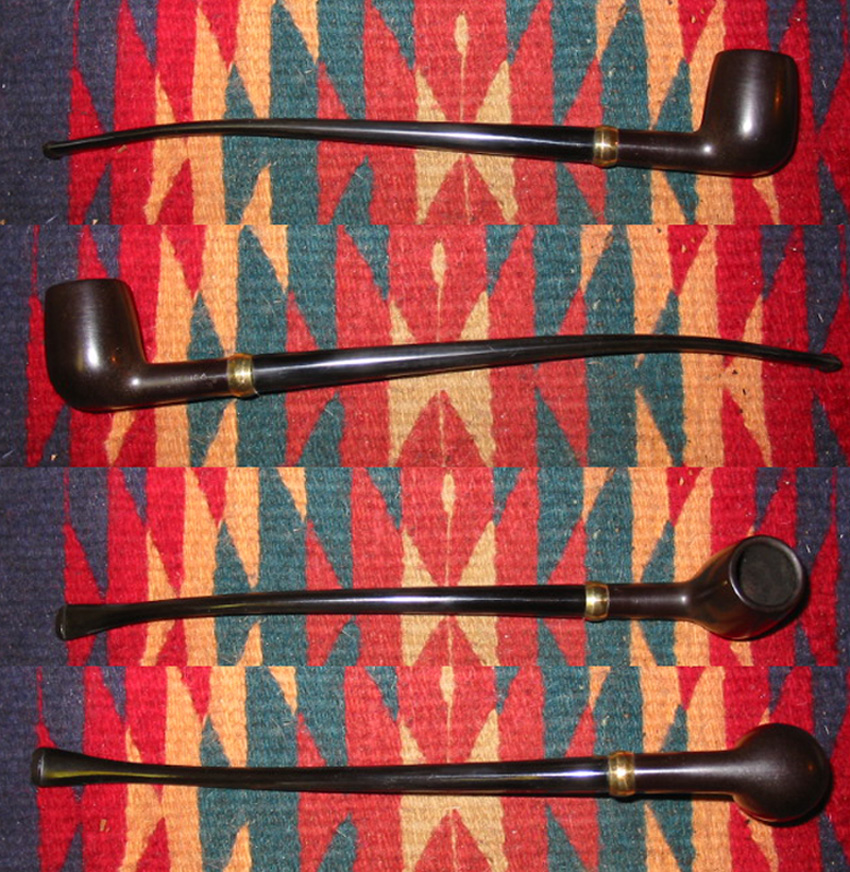
Each Feb. 1 I still get that old Medico out and fire it up in memory of that day. Today, I know that it is made of Brylon and not briar. It is what many would call a cheap pipe. And it is certainly not one I would ever buy today but it has a beauty to me that goes beyond its appearance. Plus it has a magnificent story attached to it that comes back to me every time I smoke it. I return to that corner parking lot in Escondido in my memory and enjoy that first smoke on a glorious morning – I was a new dad! Many years have gone by now, my daughter is 30 this year. But the memory never fades for me. A few years ago I had to make a new stem for the pipe because I had chomped it up to a point that it was not repairable. I think it actually looks better than ever. It is now a nice looking church warden with a brass band; sports a good hard cake and smokes extremely well.

Happy Birthday to you my dear daughter. I raise a bowl to you.

Image