Tag Archives: Pipe related essays

My Pipe Collecting Habits


I have been reading over the years about different people’s pipe collecting habits and what they look for in buying pipes. It is always a pleasure to read about their finds and purchases and to enjoy the photos of their pipes. I have seen folks beset with what has jokingly been dubbed, PAD (pipe acquisition disorder) who purchase all kinds of stuff seemingly indiscriminately. (I have to admit that when I first discovered Ebay that is pretty much what I did). It has literally taken me years to purge my collection of many of the ones I bid on and won. I have to say that I am glad to say that the majority of them have passed out of my hands either through trades or sales. Since then I am becoming much more selective. I now have focused my pipe purchases, whether on Ebay or through carvers, to 4 different groups. These groups have very different focuses and also very different purposes. By virtue of purpose they also can stay with me for longer or shorter periods of time.

Group 1: Pipes for refurbishing

Figure 1 Assorted pipe bowls for restemming
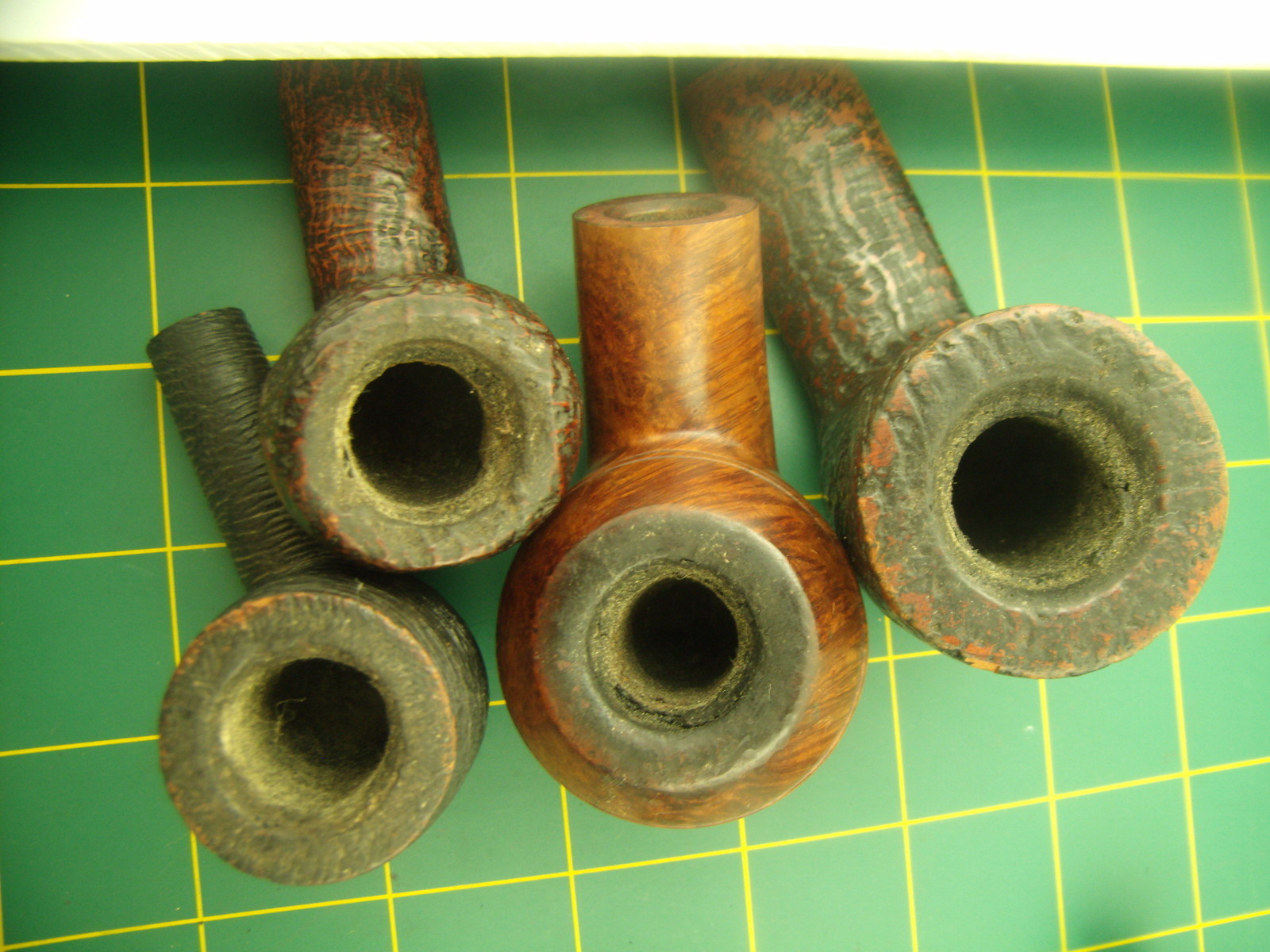
Figure 1 Assorted pipe bowls for restemming

Figure 2 Assorted bowls for restemming

Figure 2 Assorted bowls for restemming

This is probably the largest portion of pipe buying that I do. In fact I would say that most of the pipes I purchase from thrift shop, antique malls, rummage shops while on the prowl looking for pipes fall into this category. I periodically get emails or personal messages from people who wonder if I keep all the pipes I purchase or if I sell them. To be honest I think my wife and daughters have the same question. But the answer for me is that any pipe is always open to be sold or traded (with very few exceptions). Over the years I have sold, traded and given away hundreds of pipes. As far as I can predict with any certainty that will always be true as long as I am in the hobby. The joy of the hunt and the process of finding and restoring pipes are a large part of the hobby for me.

But truly buying these lots and pipes is an investment for me. So far I have not, nor is it likely that I ever will make a lot of money on these pipes. But that is not the point of the investment. I do not collect pipes like I invest for the future. It is an investment in terms of my education and skill development. Every pipe I purchase that crosses my refurbishing bench is part of my ongoing development as a pipe refurbisher. I love the process of bringing an old pipe back to life but even that is part of learning methodologies and become adept with tools. It is all about becoming skilled and proficient at something I love to do. And if there is no other reason that satisfies at least it gives me a justification for a part of the hobby that I really love.

With that in mind you will better understand that whatever I plan to work on in my skill set is determines to some degree what I purchase.This is somewhat arbitrary and determined by what I find but nonetheless it governs what I buy and work on. But even with that there are layers at work. For example I collected bowls that needed restemming over the past months because I wanted to work on honing my ability to restem and shape stems for a good fit to the shank.I wanted to learn to work with round, saddle, diamond and oval shanked pipes to be able to cut, fit and shape the new stem. Because that was my purpose the brand etc. of the pipe was utterly irrelevant to me. I just wanted a variety of shapes, styles and challenges. It is always a bonus if there is crossover with some of the other part of my collection but the primary purpose is skill training.

I have purchased pipes over the years for the purpose of learning about staining and finishes on bowls. I wanted to learn about application of stains, mixes and blends and even multi layered stains. I wanted to learn to make the grain stand out and how to make the flaws less visible. I wanted to learn how to replace fills and repair dents and damages to the finish of bowls. Because of this purpose I looked for rough-looking pipes that needed TLC to make them shine again. This included bowls that needed topping, finishes that were peeling, bowls that were scratched and dented. Again the purpose was educational rather than building pipes into my permanent collection. If that happens, again it is a bonus.

I have also purchased pipes knowing full well that they had broken shanks for the sole reason of having the opportunity to learn how to repair shanks and fit bands. This involved learning how to repair a cracked shank from within and without, how to repair a shank with a band and without using a band. The point was to learn methods and skills so the purchase of pipes to some degree was a search for those that needed this kind of work.

You get the point of what I am saying, I am sure. For me this aspect of my collecting will be a permanent feature. From it I will sell, trade or gift the majority of the pipes I have repaired or refurbished. All have been learning opportunities. This will also help explain why I take on what often seem to be impossible refurbs – I do it for the challenge and I will definitely build my skill set in the process.

But this is not the sole focus of my pipe collection. It is not the only kind of pipes I purchase. In fact this first group is where I carry on my education for the purpose of refurbishing pipes that will end up in my second group.

Group 2: Pipes from an Early Era
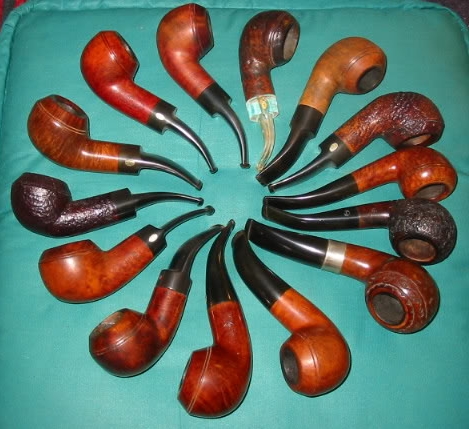
Figure 3 Some of my GBD 9438 pipes and others

Figure 3 Some of my GBD 9438 pipes and others

This aspect of my pipe collecting is one that I enjoy and which has some definite overlap with Group 1 pipes. I am constantly on the lookout for old-time pipes or just pipe bowls. I work to restem them with an age appropriate stems and bring them back to life. It is something that is relaxing and therapeutic for me in an otherwise busy time of my life. I find that I can unwind and relax while my hands are busy rehabilitating an old pipe. I can listen to books on disk, sermons, music, lectures whatever while I work away at the minute tasks of refurbishing. These pipes often become a part of my permanent collection.

This part of the collection is made up of two larger subsets of pipes – English and North American pipes from days gone by. In both subsets I look for pieces that represent the shapes that I appreciate and are in excellent condition or can be returned to that condition. This means that in both subsets there will be turnover as I find better examples in the course of my refurbishing and in the course of the hunt. This portion of my collection represents about half of my entire collection. It is pretty much equally divided between English and North American. In both I am not looking for newer pipes I am looking for pipes from the late 1800s through the early to mid-1900s. I am looking for signature pieces from that time period made by companies that in many cases have either disappeared with time or have been bought out by others. The briar in these old pipes is generally very good.

In terms of brands that I collect they are as follows. In the English line I collect GBD, BBB, Orlik, Loewe, Simms,Weingott, Barlings, Sasieni, Parker, Friborg&Treyer,Charatan, Comoy’s, Bewlay, older Dunhill, and others. In the North American line I collect old CPF, GFB, WDC, KBB, Kaywoodies, Yello Bole, Dr. Grabow, Barclay Rex, Custom Bilt, Custombilt, Tracy Mincer,Malaga, Blatter and Blatter, Brigham and others.

When I am in the antique shops and malls in the states and in Canada I have an eye out for these kinds of pipes. It is amazing where they turn up and the condition I find them in. I have become picky if they are intended to be keepers for me so I select hard, unless of course, they fit a learning/skill objective that I have set for myself. Even then I choose according to what I want to work on and leave behind some that just do not fit the collection or the objectives.

Group 3: Pipes that are Oddities
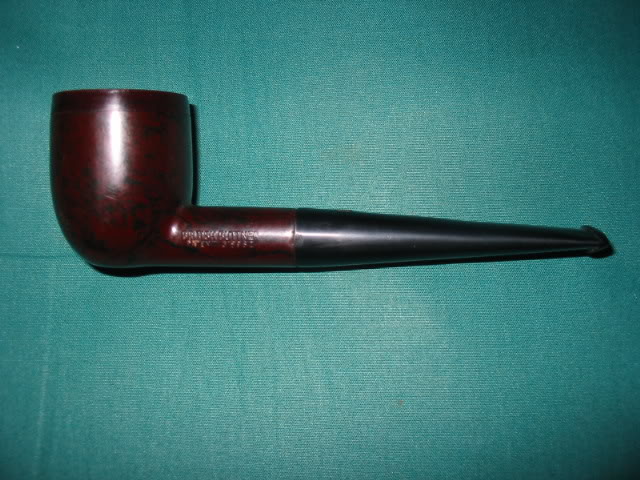
Figure 4 Odd Pipe 1 - a British Buttner Bakelite pipe bowl with a clay insert
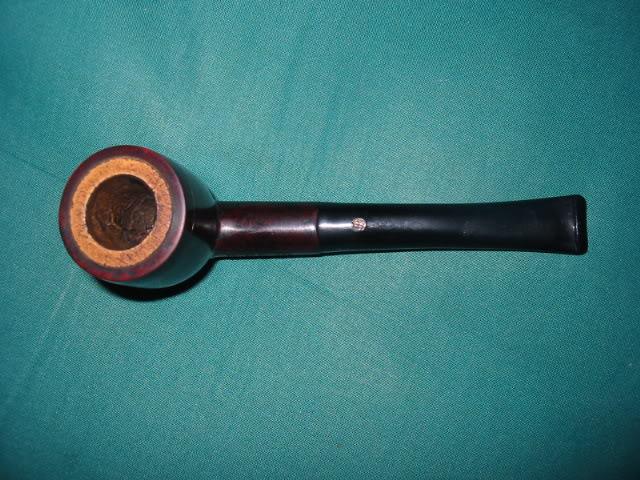
Figure 4 Odd Pipe 1 – a British Buttner Bakelite pipe bowl with a clay insert

Figure 5 Odd Pipe 1 - a British Buttner Bakelite pipe bowl with a clay insert

Figure 5 Odd Pipe 1 – a British Buttner Bakelite pipe bowl with a clay insert
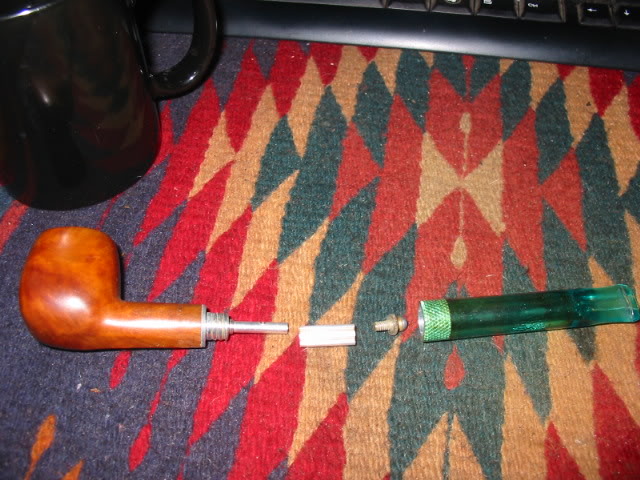
Figure 6 Odd Pipe 2 An LHS system pipe
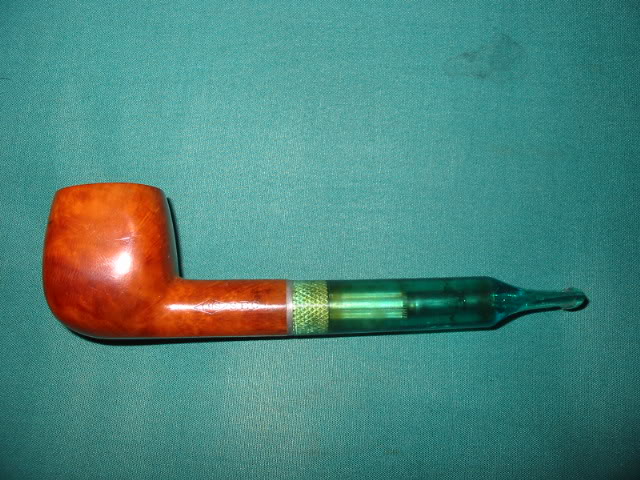
Figure 6 Odd Pipe 2 An LHS system pipe

Figure 7 Odd Pipe 2 An LHS system pipe
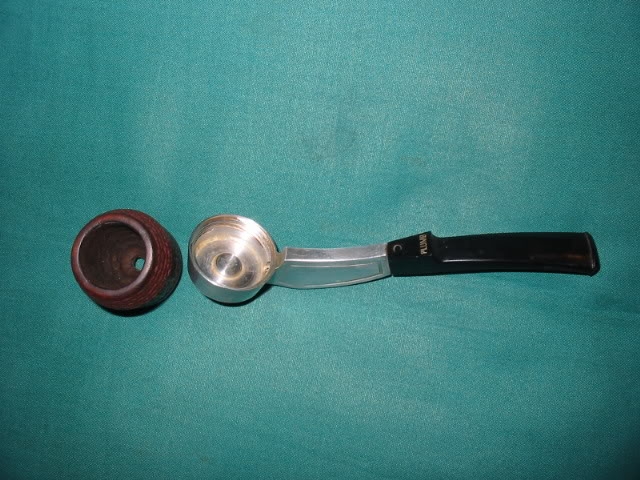
Figure 7 Odd Pipe 2 An LHS system pipe

Figure 8 Odd pipe 3 a Dr. Plumb Metal

Figure 8 Odd pipe 3 a Dr. Plumb Metal

Figure 9 Odd pipe 3 a Dr. Plumb Metal
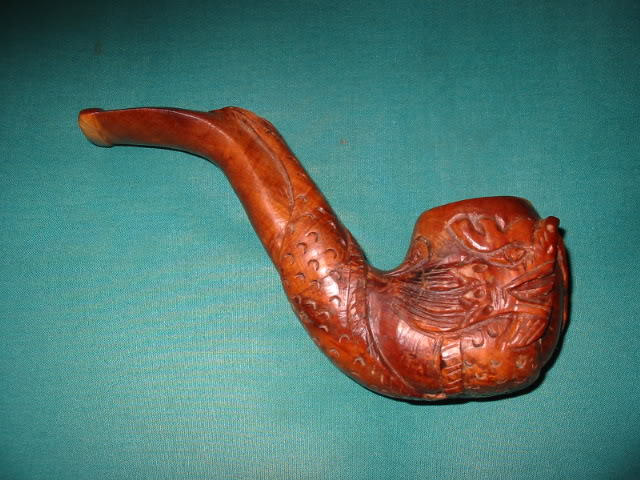
Figure 9 Odd pipe 3 a Dr. Plumb Metal

Figure 10 Odd pipe 4 a Chinese Chicken Wood Dragon
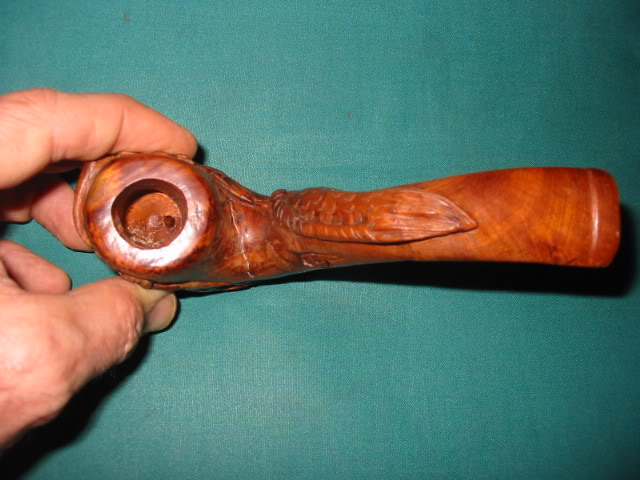
Figure 10 Odd pipe 4 a Chinese Chicken Wood Dragon

Figure 11 Odd pipe 4 a Chinese Chicken Wood Dragon
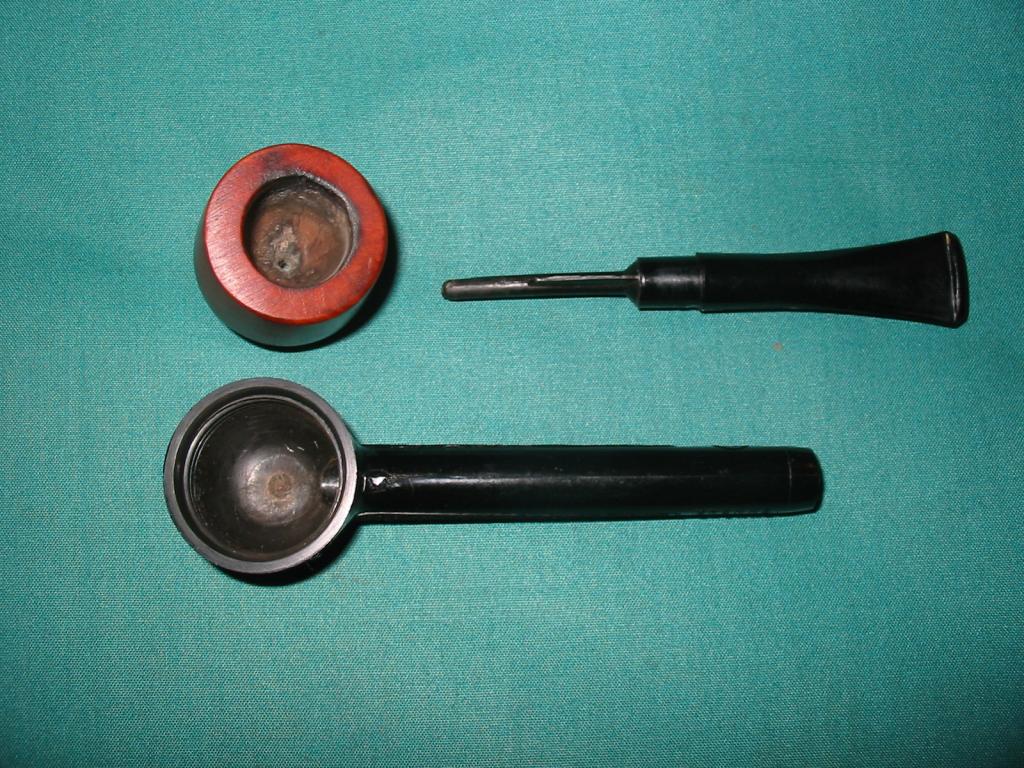
Figure 11 Odd pipe 4 a Chinese Chicken Wood Dragon

Figure 12 Odd pipe 5 a Swedish Broma Nylon Pipe with screw on briar bowl

Figure 12 Odd pipe 5 a Swedish Broma Nylon Pipe with screw on briar bowl

A third category of pipes that I collect is more accidental than by choice. It is made up of uniques and oddities. For some reason I am drawn to odd pipes that were attempts at finding and ensuring the perfect smoke. The variety of creativity and experimenting intrigues me and I like taking these apart and cleaning them up. They are often more of a collection of historical pieces and are not in the regular rotation. The collection itself is quite indiscriminate and in many ways strange. They are misshapen, built with internal gizmos and gadgets for trapping moisture, made out of alternative woods, metals, Bakelite or other unique materials. But all of them have in common inventive designs that caught my attention. This part of my collection is actually quite small and broad in scope. It contains pipes from England, Scotland, North America, South Africa, Canada, France, Holland, Hungary, China, Nepal, Vietnam, and other places. The oddity of the pipe is what catches me. Again this group is somewhat transient as I look for better examples of the various types of pipes some of the original pieces are sold or given away to make room for better examples. I am always looking to upgrade the pieces that I have so that I can have the best examples that I can find for this group of pipes.

Group 4: Artisan Pipes
This part of my collection is specialized to some degree. I love beautiful hand carved pipes with hand cut stems. In this part of my collection there are pipes from a variety of countries and a variety of artisans. I enjoy having some of them commissioned for me personally and being part of their creation. I also enjoy purchasing some of them directly from the craftsman. In both cases the point for me is to have works of art/hand craft that I enjoy looking at and smoking. In this group are pipes by Stephen Downie, Rad Davis, Oliver Camphausen, Larry Roush, Michael Parks, Tony Fillenwarth, Frank Axmacher, Brad Pohlmann, Paul Bonaquisti, Peter Heeschen, Peter Matzhold, Steve Morrisette, Dan Cheblove, Jack Howell, Trevor Talbert, James Gilliam, Mark Tinsky, John Calich, Blatter Brothers and Jeff Gracik of J. Alan Pipes are just some of the ones that I have examples of in my collection. This is an aspect of collecting that I take seriously and have built up slowly and consistently over the years as I could afford their pipes. It continues to grow and develop as pipes from Group 1 provide the funds for expansion.

As I finish writing this piece, I am struck by the breadth and variety of the pipes in my pipe cupboard. There are many but only a few of them hold places that are at least semi-permanent. I have one simple rule in my collecting – pipes are always for sale for the right price and the right reason. That reason for me is to upgrade and fill out places in the collection.

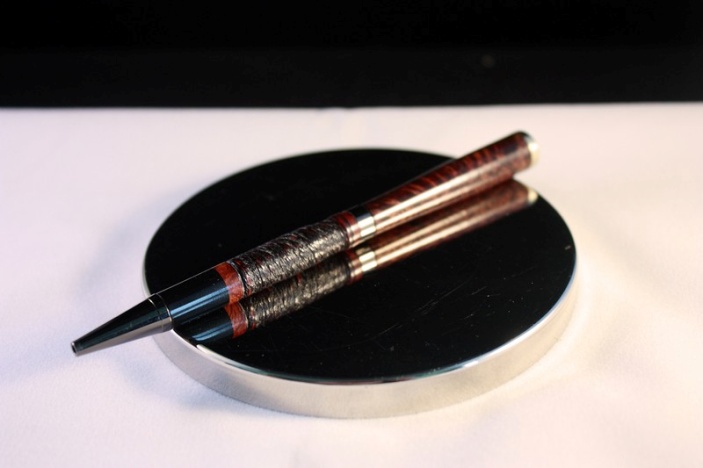
Its a Tamper, No its a Pen – No Actually it is a Pipe Pen Tamper – Robert Hudspeth & Steve Laug


This article originally appeared in Pipesmoker Unleashed EMagazine http://www.pipesmokerunleashed.com/magazine/may2012.html Since that time I have edited it and also added my own reflections on the Pen Tamper that I also purchased from Eric Archer. My additions to Bob’s original article are inserted in italics so that it is clear what was in the original article.

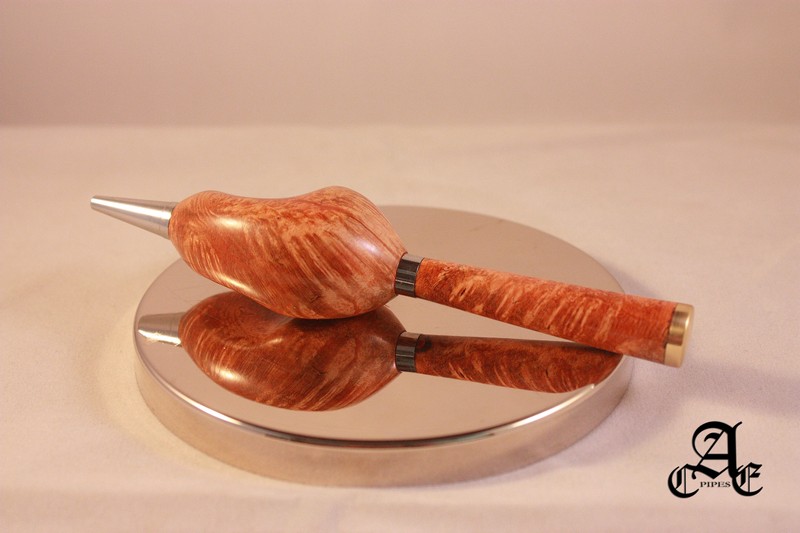
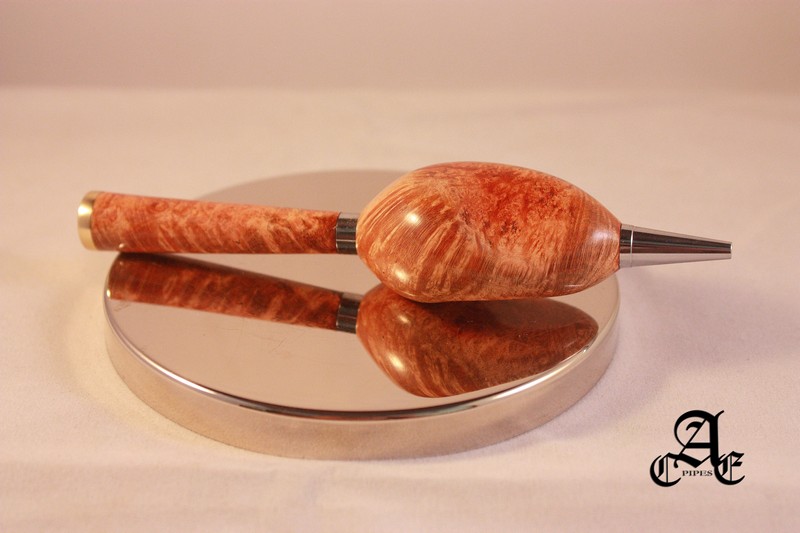
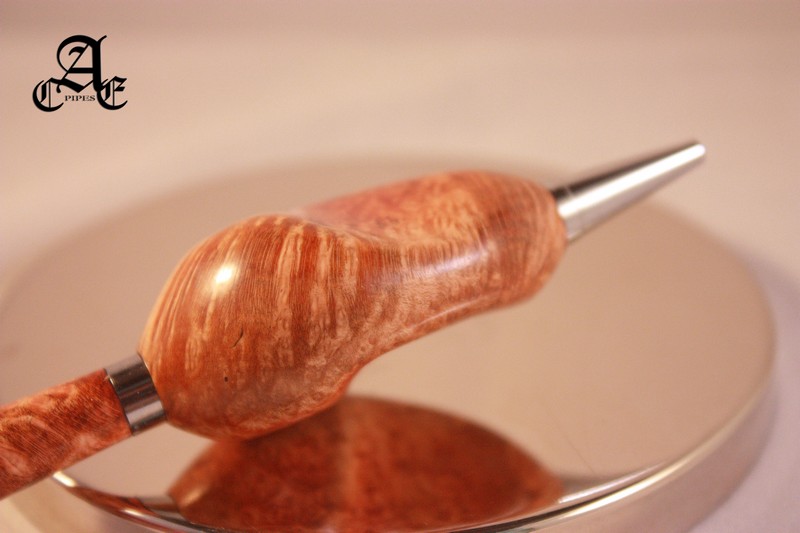
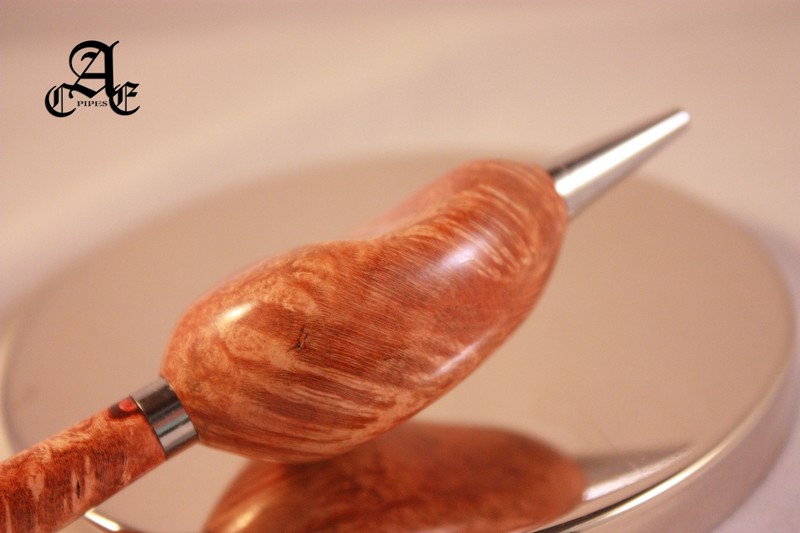
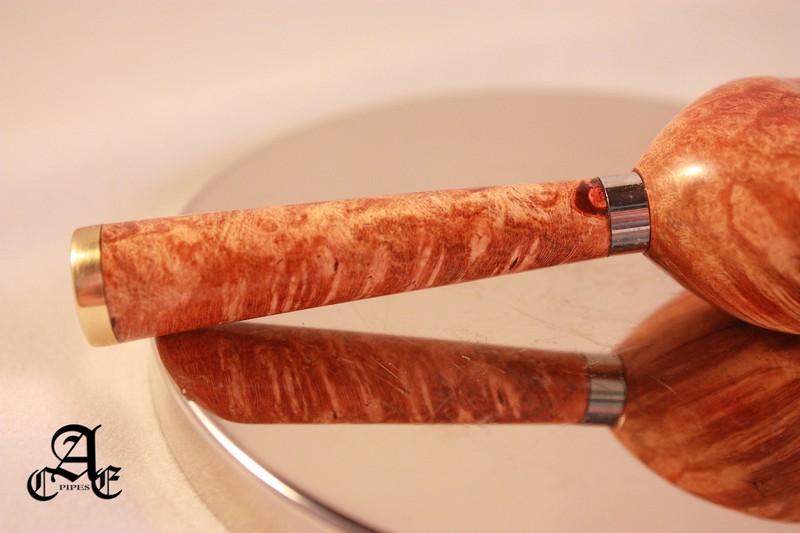
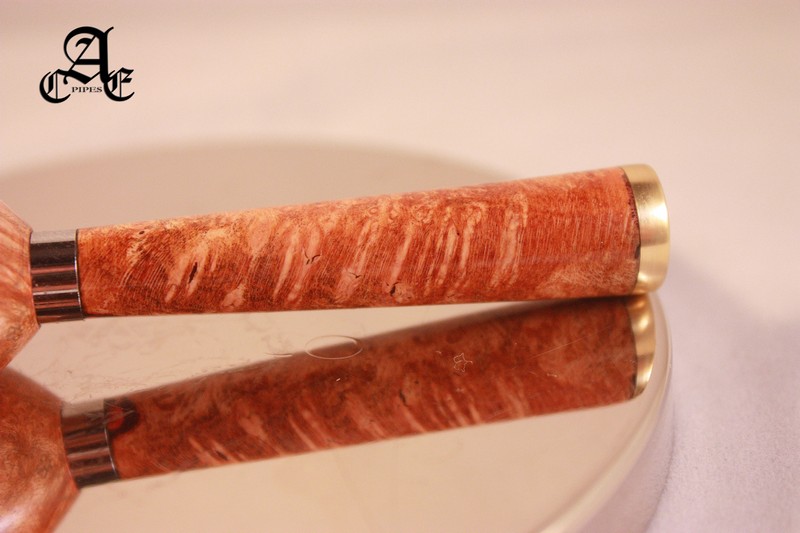
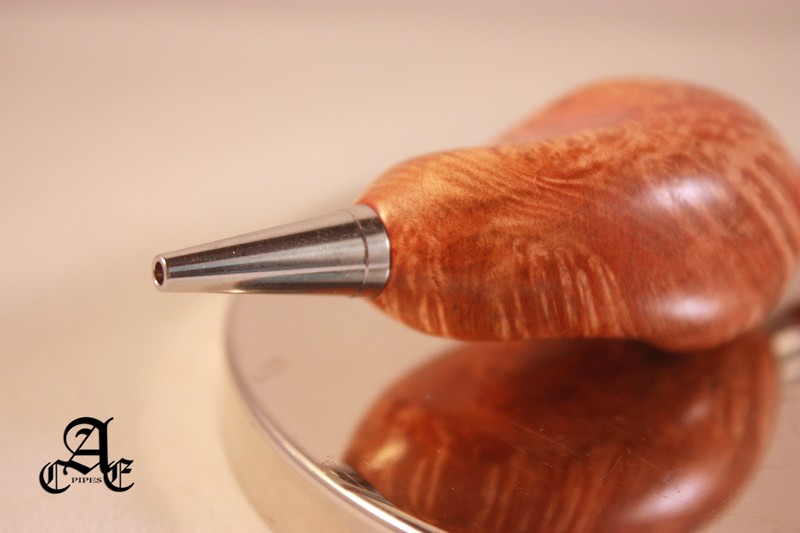
Eric Archer of CEA Pipes came up with a winner when he designed and crafted a new item, the Pipe Pen Tamper. It combines two of the tools that I use all the time into a single handy and beautiful piece – it combines both a pen and a tamper in a hand turned barrel. He calls them Pipe Pen Tampers. They are custom made out of briar, vulcanite and brass. I think if these were readily available they would be instant sellers in any pipe shop where pipemen gather to enjoy a bowl and the fellowship of the briar. They are available for special order on the PSU Storefront ( http://www.pipesmokerunleashed.com/forum/forum.php ). Click on the link and it will take you to The Pipesmokers Unleashed Website. Once there you can click on the online store on the left side of the home page. You can contact Eric through his listings or through the contact information is available in the members list or through a private message (PM).

When Eric posted his first edition Pipe Pen Tamper on one of the threads on Pipe Smoker Unleashed (PSU) internet forums “wow!” was all that I could say. I immediately knew that I had to have one. The problem was that I was not alone; it seemed that many of the other members also wanted them. Soon there was a list of folks waiting for their unique and custom Pipe Pen Tamper. I decided that I wanted mine to be a bit different from the others that Eric had made before so he used vulcanite as a band at the middle and in the lower portion of the barrel as pictured in the pictures below to make that happen.

Pentamp1

Pentamp2

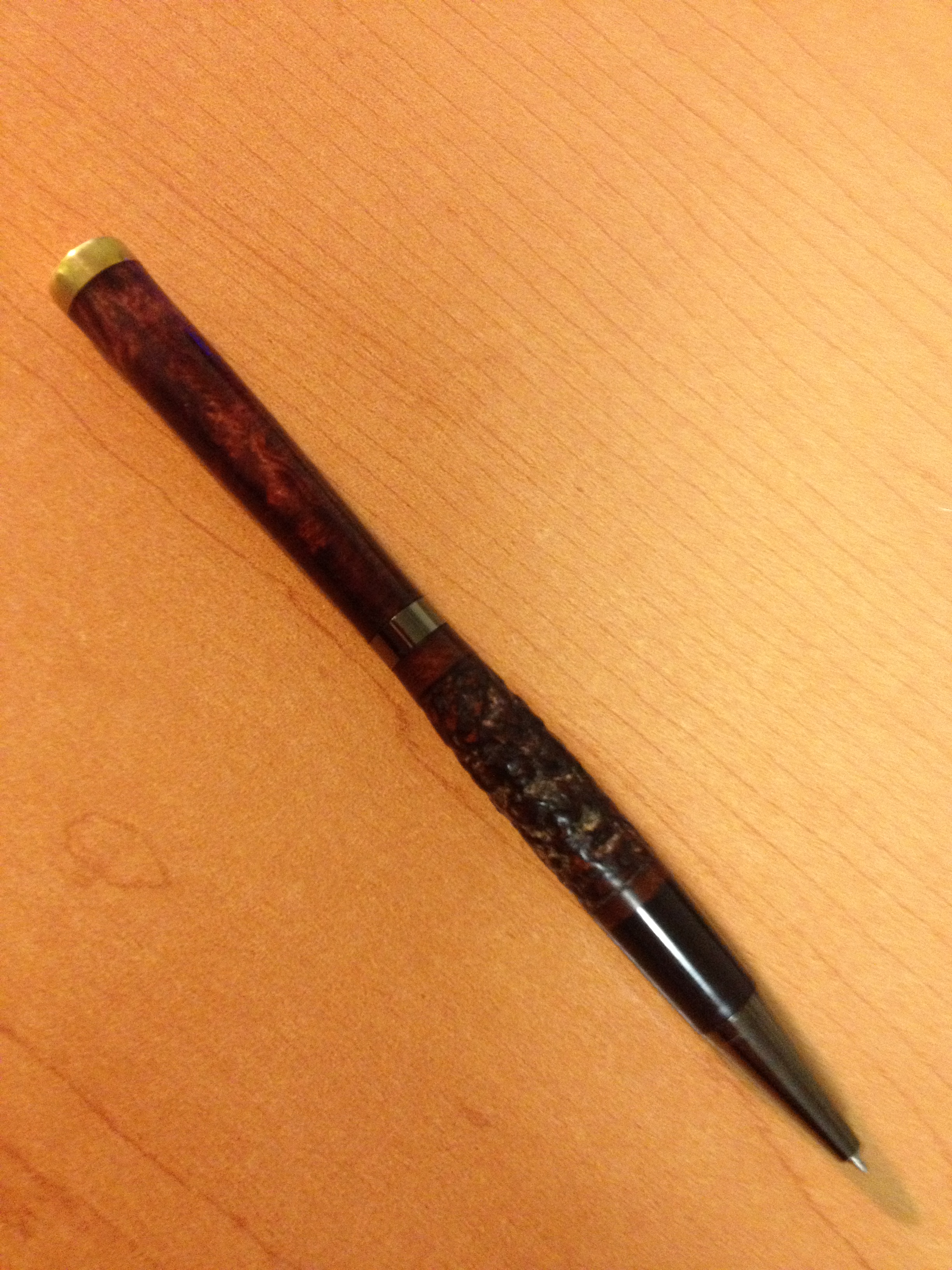
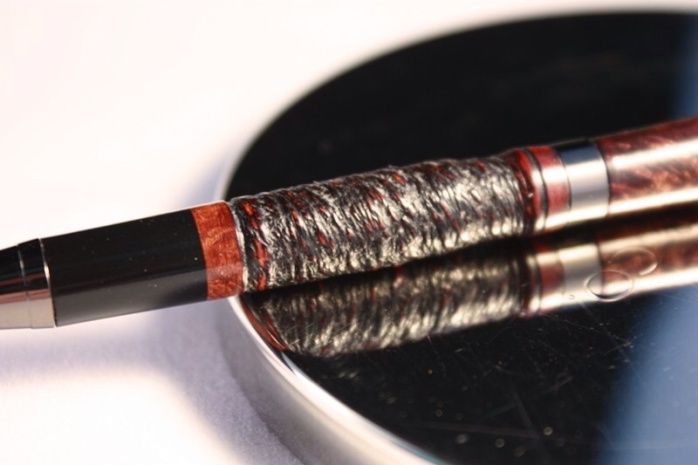
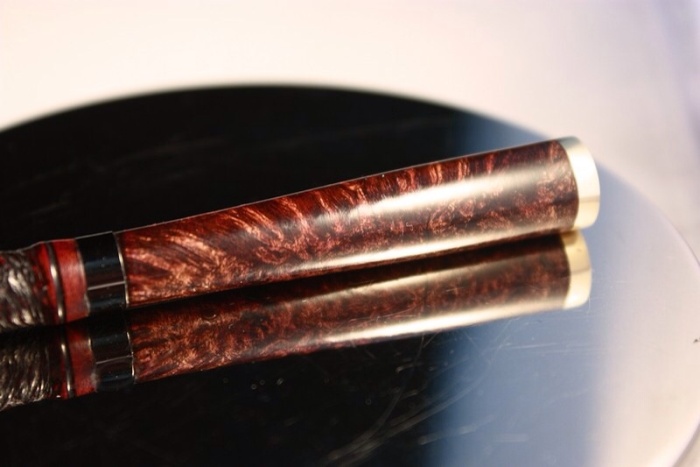
I too had to have one so I contacted Eric and asked him to make one for me that was slightly varied from the one that Bob pictures below. I have attached pictures of my pen tamper below for comparison. Mine also has a smooth upper portion on the barrel with a metal band separating the upper portion from the lower portion of the barrel. The silver/metal band matches the tip of the pen. The lower portion of the barrel has a slightly different rustication pattern and the smooth band at the top and bottom of the rustication sets it off nicely. The bottom of the lower portion is vulcanite against which the silver tip of the pen stands out nicely.

Pentamp3

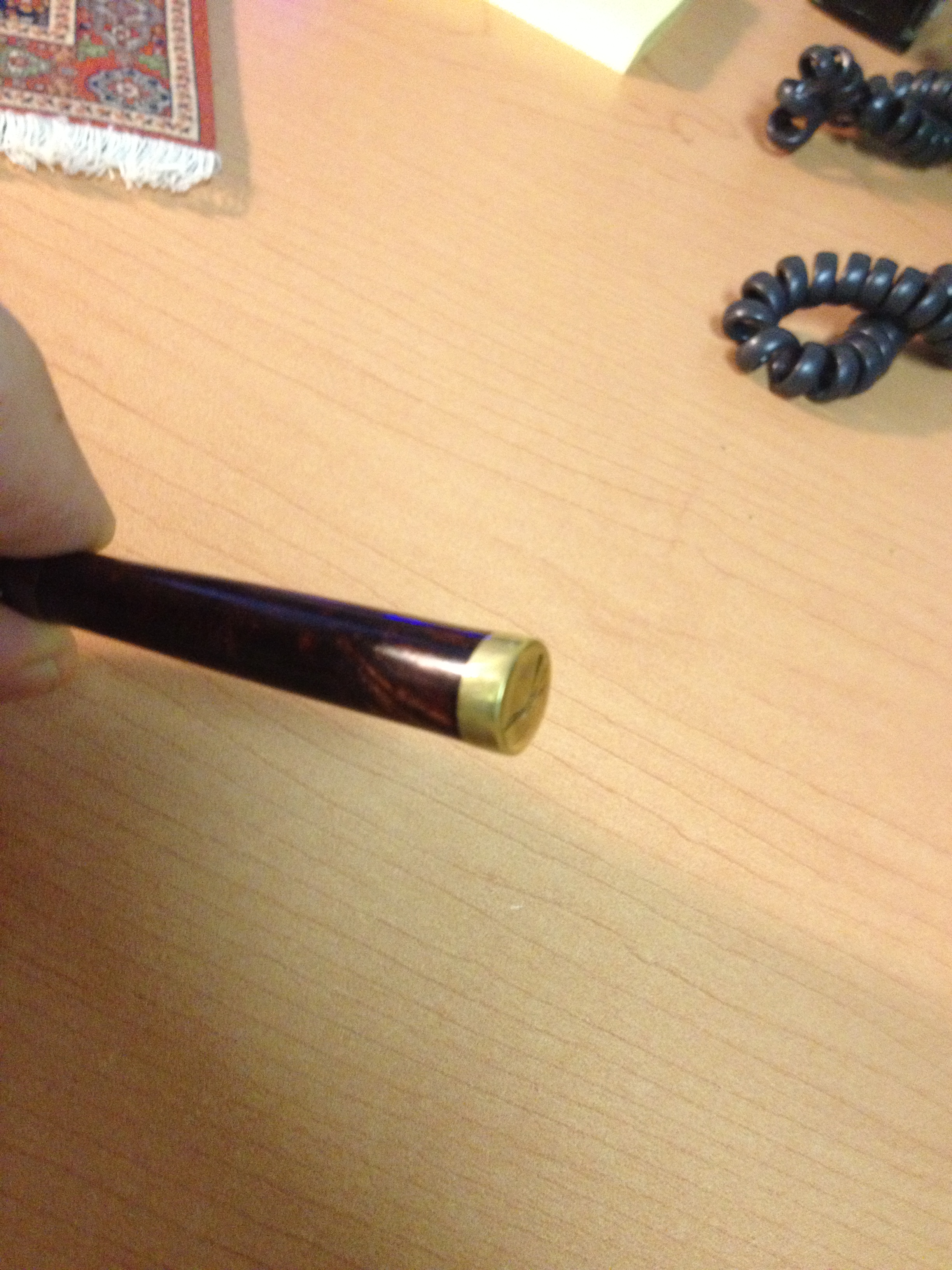
It is constructed of a stunning piece of briar. There are no visible flaws in the briar and the craftsmanship is excellent. The vulcanite is used in a band on the top portion of the pen barrel and also on the lower end of the barrel. The tip is a silver metal that looks very good with the briar and vulcanite. He mounted a flattened and polished brass tamper head on the top of the upper barrel. The lower part of the briar pen barrel has been nicely rusticated with an interesting rustication pattern leaving a band of smooth briar between the rustication and the vulcanite and between the upper band and briar as well. The rustication is stained with a darker stain than the smooth parts. It works to highlight that part of the piece. The upper portion of the barrel is sanded and polished to smooth finish; then it was stained to accentuate the natural grain of the briar. The two distinct styles of working the briar combined with the vulcanite and the brass at the top make this Pen Tamper a functional piece of pipeman’s art. It seems almost too nice to use but I won’t let that stop me!

Pentamp4

Pentamp5

Mine is also constructed from a nice piece of briar. As in Bob’s tamper, there are no visible flaws in the briar. Eric’s craftsmanship is consistently excellent. The tip is a silver metal that rests agaisnt a wide vulcanite band. For the tamper portion he mounted a flattened and polished brass head on the top of the upper barrel. The upper portion is stained with a reddish brown/medium brown stain while the rustication is stained with a darker stain. The combination looks well designed. Bob was very correct in calling Eric’s Pen Tampers functional pieces of pipeman’s art. And like Bob, once I had it in my hands it seemed too nice to use. But I have continued to use it since I received mine.

Pentamp6

Pentamp7

The PenTamp feels great in the hand. In Eric’s design the centre point of the pen is squeezed to make it fit nicely between the fingers when tamping. The rounded flair on the lower barrel makes it fit well between the fingers and thumb when writing. The rustication gives the barrel a grip so that it does not roll in the fingers when writing. It is a stable writing instrument as well as a well-built tamper. It is surprisingly much lighter in weight than it appears; both tampers tip the scale at .635 ounces or 18 grams. They both have a length of 5 1/8th inches or 13.0175 centimeters which is the standard length of most pens. The PenTamp works great as both a tamper and a pen and obviously we both are already using both ways. As a pen it writes with a fine line and flows smoothly. As a tamper it fits most bowls and is weighted enough to lightly tamp a bowl as you smoke it. We cannot recommend Eric’s workmanship highly enough. Contact Eric Archer through PSU to order one of your own.

I received an email from a friend and reader of this blog after posting this and he sent me pictures of a special pentamper Eric made for him as well. It is designed specifically for those with arthritis in their hands and fingers. This is a great piece of work. Dallas says that it is comfortable in his hands and easily gripped. Thanks Dallas for the additions. I had totally forgotten that you had this one.
Pipe Pen Tamper 1

Pipe Pen Tamper 2

Pipe Pen Tamper 3

Pipe Pen Tamper 4

Pipe Pen Tamper 5

Pipe Pen Tamper 6

Pipe Pen Tamper 7

Behold the Lowly Stinger


Blog by Steve Laug

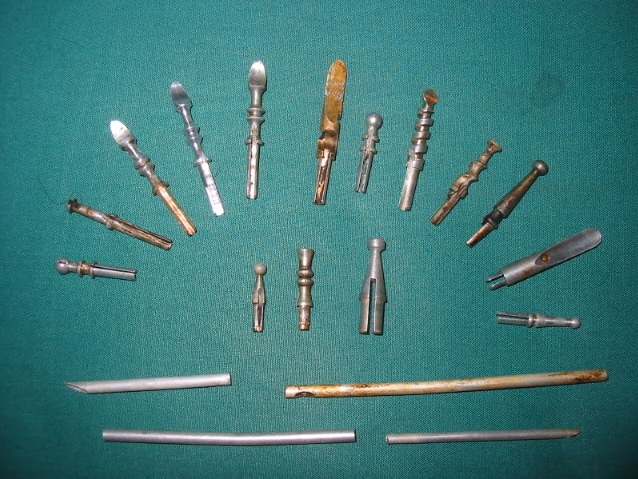
Not too long ago I laid out the various stingers I have removed from the pipes that have passed over my refurbishing work table. I don’t know why I have kept them all, but I have. Most of them came from pipes that are no longer in my collection. I was reminded of this photo that I had taken in the past because of a stinger I removed from a Comoy’s the Guildhall pipe. The shapes and sizes of stingers and the size the mortise in the pipe to accommodate them is as varied as the inventors who came up with the “brilliant” idea in the first place. Fundamentally it is designed to act as a condenser to draw out and trap the moisture in the smoke of the tobacco. The burning tobacco in the bowl creates moisture as it burns. As it is drawn into the mortise it either naturally condenses on the walls of the briar or metal shank by simple cooling or its condensation is enhanced by the introduction of the metal apparatus that is commonly known as a stinger.
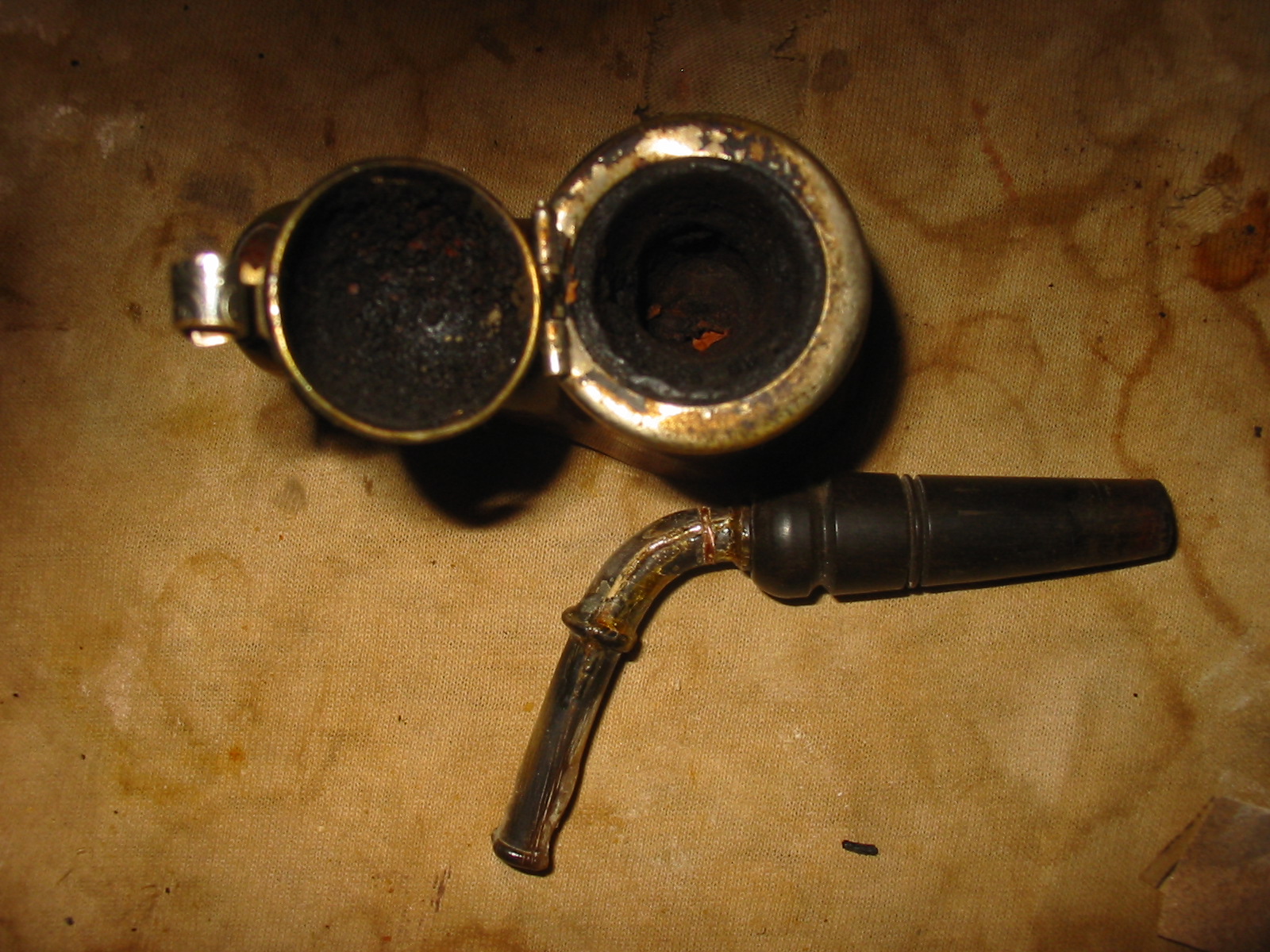
The basic concept is that the stinger provides multiple surfaces on which the moisture is condensed and collected. Theoretically, the smoker is to clean the stinger after each smoke and thus remove the debris of the condensation before the next smoke. Doing this would provide a clean surface for each smoke. The built in stingers that are a part of the screw in tenon were made to encourage taking the pipe apart while it was warm and the cleanup would be relatively simple. However, judging from the many pipes I have cleaned over the years this theoretical assumption of cleaning the apparatus between smokes never happened – or at best rarely happened. The juices and moisture from the heated smoke hardened into a dark tarry substance that often welded the stinger and tenon into the mortise until the time I decided to take it apart and clean it at my table. The sheer amount of “gunk” in the shank of pipes with stingers versus those that do not have stingers seems to prove the effectiveness of the stinger. It truly seems to work in condensing the moisture from the smoke. Though that should be no surprise – the introduction of a metal tube or apparatus into the path of hot/cooling smoke drawn through the shank can only attract moisture.

All that being said I question the validity of the supposed effectiveness of the apparatus. It seems to me that the introduction of the metal stinger into the shank, no matter what unique or strange design, in fact exacerbates the problem of moisture rather than reduces it. I have smoked many pipes without a stinger and had very few issues with moisture gurgling in the shank. And those that do can be tweaked to not gurgle at all. I have also smoked pipes with the stinger in place and struggled with gurgles and moisture in the stem and shank. I still recall an old pipeman on skid row where I worked showing me how to put my thumb over the bowl and flick the pipe to get rid of the moisture. It was not a pretty sight but it was very effective. Once I removed the stinger from the tenon I found that the same pipe would smoke dry. That led me to conclude that the stinger, while certainly working to attract moisture, may actually create more moisture. In its design the stinger was also believed to calm down hot smoking tobacco and remove tongue bite. This claim assumes that the tongue bite is caused by the moisture in the smoke. While this may be true in part, I believe it is also the effect of heat on the tongue generated by too energetic a puffing cadence. The hard puffing on burning tobacco in the bowl heats up the briar so why would it not also affect the tongue? I have found that when I slow the cadence I slow the likelihood of tongue bite. So in my opinion, the stinger’s effectiveness in alleviating tongue bite may be exaggerated. Or maybe it is just the constricted draught on the pipe that makes the likelihood of tongue bite reduced, for in my experience it seems that no matter how hard you puff on the pipes with stingers the draught is the same – constricted.

In looking at the many stingers I have collected over the years I have noted both similarities and some very distinctive differences. I only took photos of the ones that are removable and to be honest over the past months I have added at least another dozen variations on the theme. The pieces pictured below can be grouped into four categories – tubes, blades, round balls, twists/spirals. When I removed them from the pipes they all were equally dirty and tarred. All of them had a brown lacquer like substance under the tar that was almost permanently bonded to the aluminum of the apparatus regardless of the shape. In the next section of this article I will give a description of the shape, structure and function of each stinger within the particular group to understand the concept behind their design.

Tubes: The first group I have collectively called Tubes. The basic design is clear from the designation – they are all open tubes. The four pictured below are all different lengths. Some of the tubes extended into the bowl of the pipe. The top left tube and the bottom right tube are a Dunhill Inner Tubes and they have an angled end that fit up against the opening in the bottom of the bowl. They are both different diameters based upon the size of the bowl and the size of the drilling in the shank. The first is from a Group 4 sized pipe and the second from a Group 2 sized pipe. The second tube down on the left side came from a no name pipe and sat in the airway pressed against the opening in the bottom of the bowl. It fit flush against the opening in the bottom of the bowl and also flush against the opening in the tenon. It thus was intended to provide a clean and direct airway into the stem. The interior of the tubes acted to cool the smoke on its way to the mouth. The first tube on the right has a hole on top of the tube where it extended into the bottom of the bowl. It thus provided a 90 degree angle for the smoke to travel from the bowl bottom into the airway. The tube extended into the tenon of the stem about a ½ inch. Once again the concept was to provide a clean airway that would not collect the moisture in the shank of the pipe and provide a cool smoke. The problem with this apparatus is that it was easily plugged by small pieces of tobacco that entered the rather large hole in the tube at the bottom of the bowl.

Blades: The second group I have called Blades because of a prominent bladelike feature included in their design. From the left of the photo, the fourth, fifth, sixth and eleventh stingers all have a variety of blades on the end of the stinger. The first three have a form like a shovel. The end is turned up like a scoop to collect moisture on the topside and the underside of the blade. Behind the blade on these three were three different ridges. The third ridge was slotted for the flow of the air to enter the stem. The fourth blade is extended and the same diameter from the front of the blade to the edge that rests against the tenon. There is a slight twist cut into the blade about 2/3 of the way down the blade that is intended to “spin” the smoke around the blade before it enters the slot at the top back edge of the blade. This “spinning” was intended to remove moisture. The fifth blade is tubular in shape. There is a portion that is scooped out of the tube with an airhole in the end of the scooped out portion. The flat surface of the tube collects moisture and also the blade does. The shape of the blade directs the air across a broad surface and into the airway of the stem.

Round balls: The third group I have called Balls because of the round ball on the end of each of them. From the left side of the photo – the first, second, seventh, tenth and twelfth as well as the first and third in the centre of the photo all are variations on the ball theme. The first, second (half ball), and seventh all remind me of trailer hitches. The ball is quite large in proportion to the stinger. The ball sometimes has holes drilled into it surface (like the Kaywoodie Stinger) and sometimes does not. Behind the ball is a flat ridge that is slightly smaller than the second ridge that rests against the tenon. There is a slot in this ridge that is aligned with a slot in the second ridge that through which the air/smoke is drawn. The interior and exterior surface of the ball collects moisture on the drilled balls and the exterior surface collects it on the undrilled ones. I find that the undrilled balls are significantly larger than the drilled ones, thus providing more surface area for condensation. The eleventh, twelfth, and the first and third in the centre all are all balls resting on top of cones with a slight ridge to no ridge below the cone. The cone is slotted to direct air/smoke into the stem. The cone/ball combination again increases the area of condensation for the smoke.

Twists/Spirals: The fourth group I have called Twists or Spirals to summarize the shape of each of them. From the left side of the photo below – numbers 8 and 9 and the second one in the centre have been grouped together in this category. These stingers are actually very unique. The 8th one is a spiral around a centre rod. The end of the spiral is flattened like a small blade, similar to a spear tip. The smoke follows the twist up to the point it enters the stem and the moisture is almost spun out of the smoke in the process. The ninth one is a more smooth and scooped spiral or twist. The tip is a flat, round disk. The smoke is dissipated around the disk and then travels down the spiral to the slot in the bottom where it joins the tenon. Again the spiral serves to spin the moisture from the smoke. The second stinger in the middle is really not a spiral in the same sense as the other two. It is two cones separated by two tire shaped rings. The moisture is given many surfaces to condense on before it moves through the slot at the end where the stinger sits against the tenon.

Stingers
The diversity of the shapes and styles of stingers that have been created seems to be endless. Each new estate pipe I purchase that has a stinger, has one that is a variation on the ones above. Those pictured are representative of the creative energy that has been invested into making a cooler, drier, cleaner smoke for the pipeman. In my humble opinion, all of them achieve the same end. All of them collect moisture and may very well increase the moisture collected from the smoke. In the long run do they achieve what they were purposed to achieve? I leave that answer up to you. But to me they are appendages that are better removed from the shank and tenon. I have found that their removal holds the key to a drier and cooler smoke.

Whatever Happened to the Orific Button?


While I was sitting at my desk, looking over my pipe cabinet the other evening, it suddenly came to me that I could divide my pipes into two distinct groups – all grouped by the shape of the airway in the end of the button or stem – either round/orific or a slot. I have often wondered about the transition between the two types of airways as they each seem to come from two different time periods. What happened to the rounded one and when did the slotted airway begin to have ascendancy? I am not sure I can answer that question with any definitiveness but I want to look at both types and surmise what may have transpired to bring about the end of the orific button.

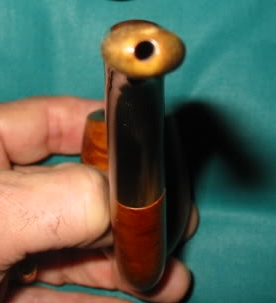
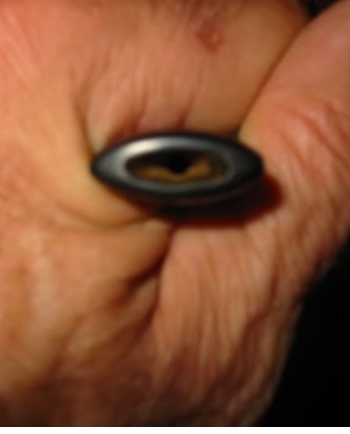
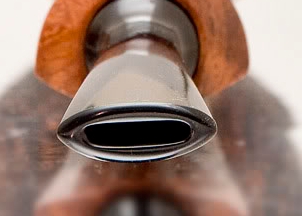
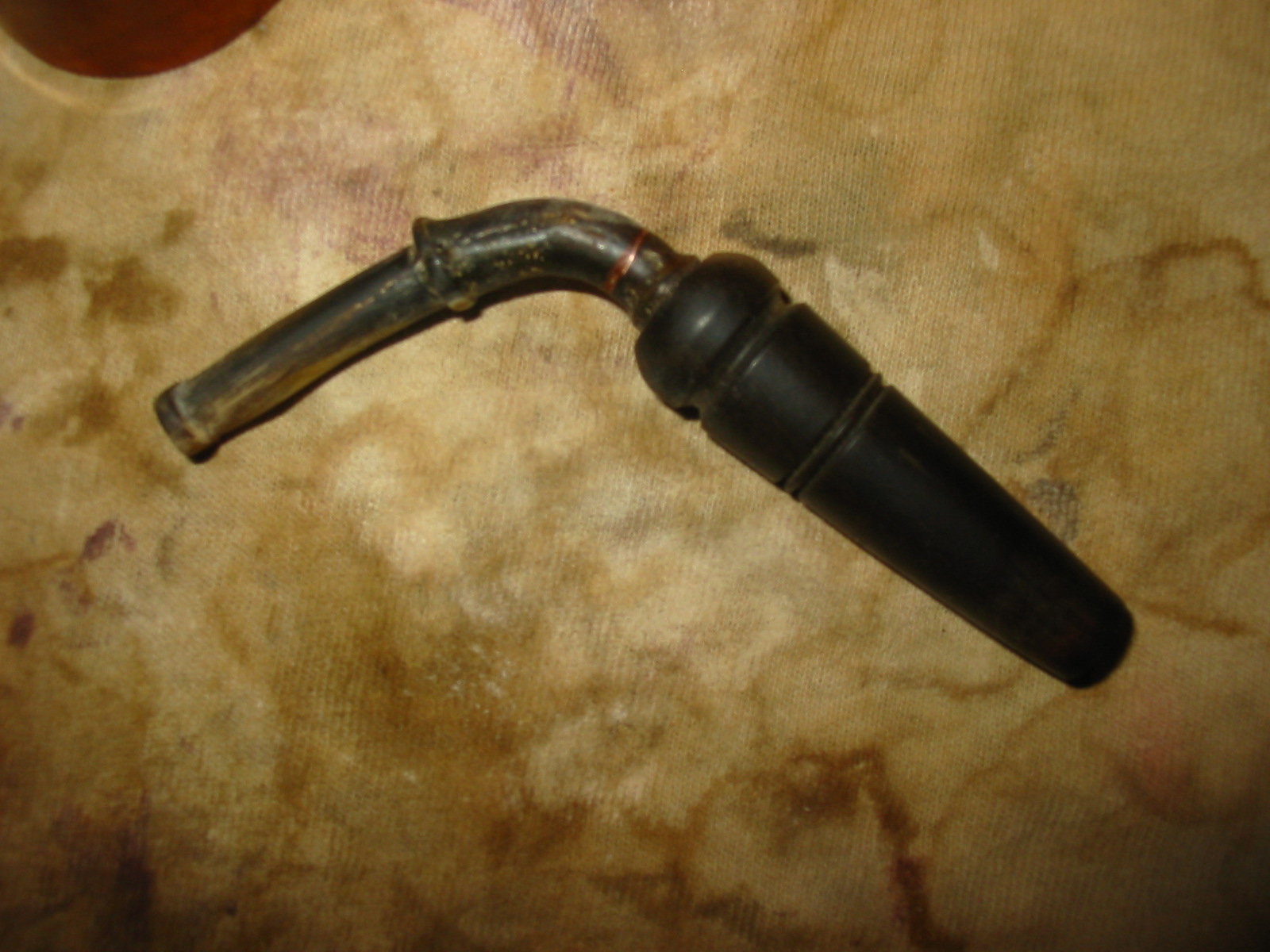
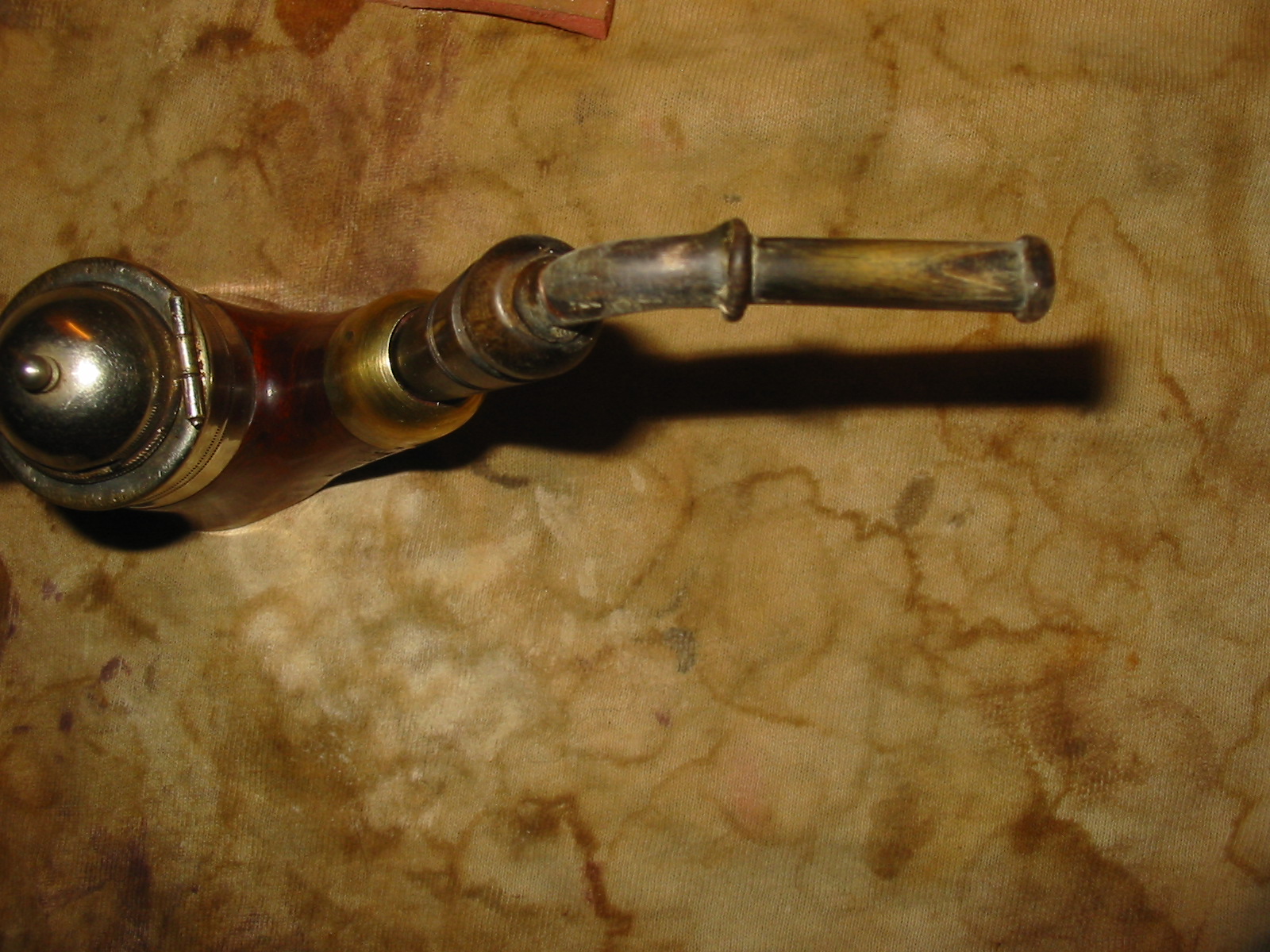
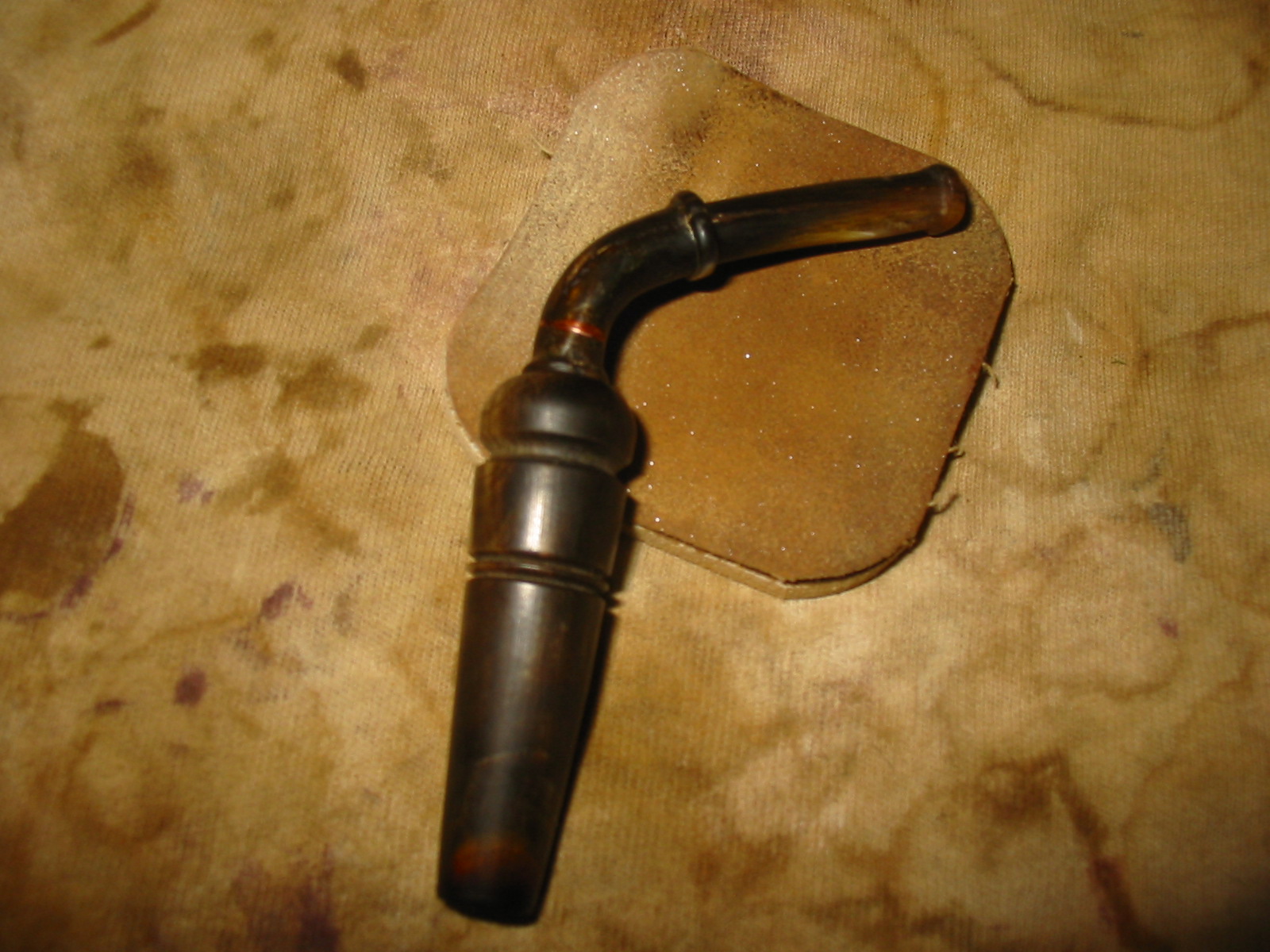
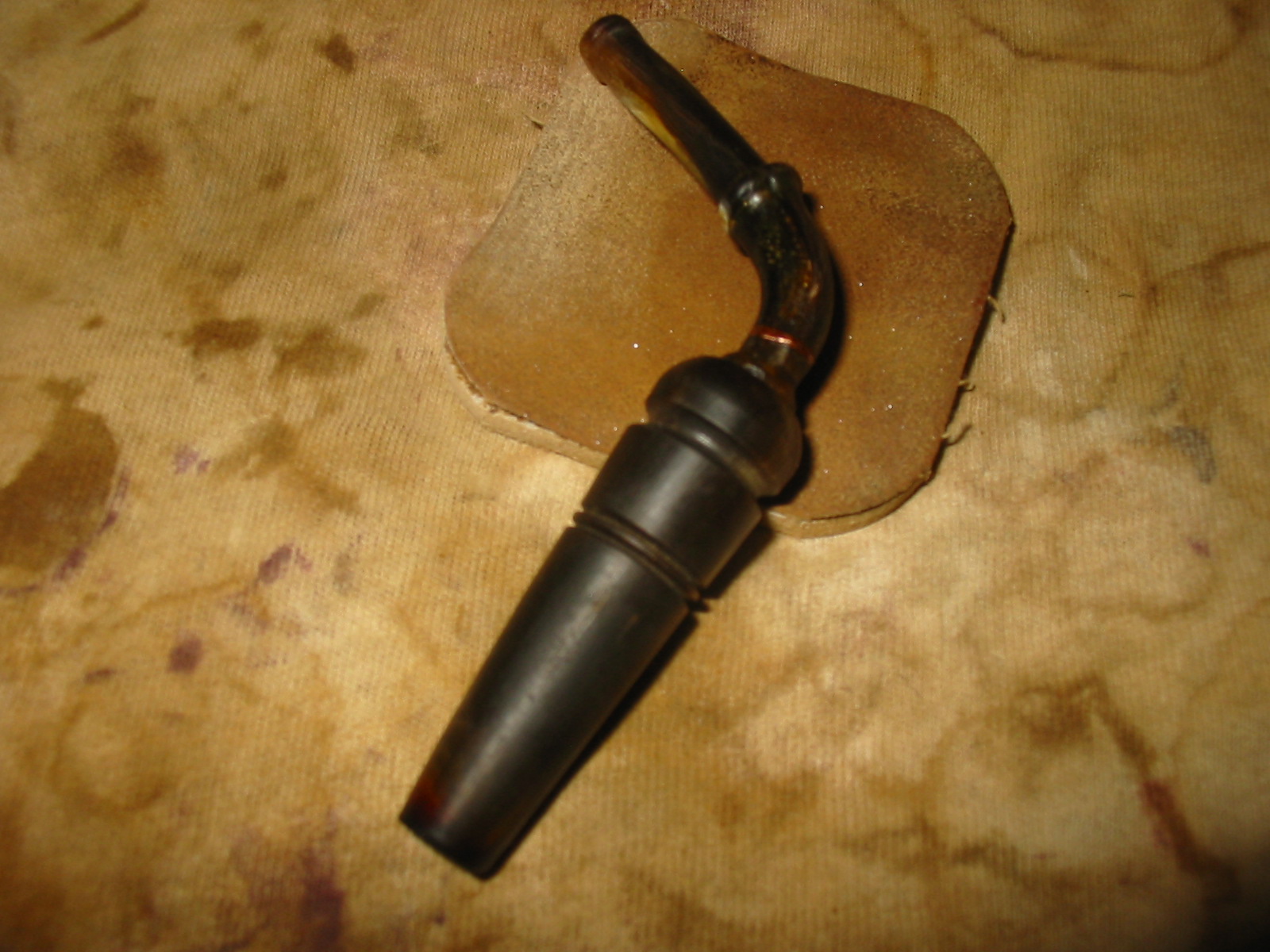
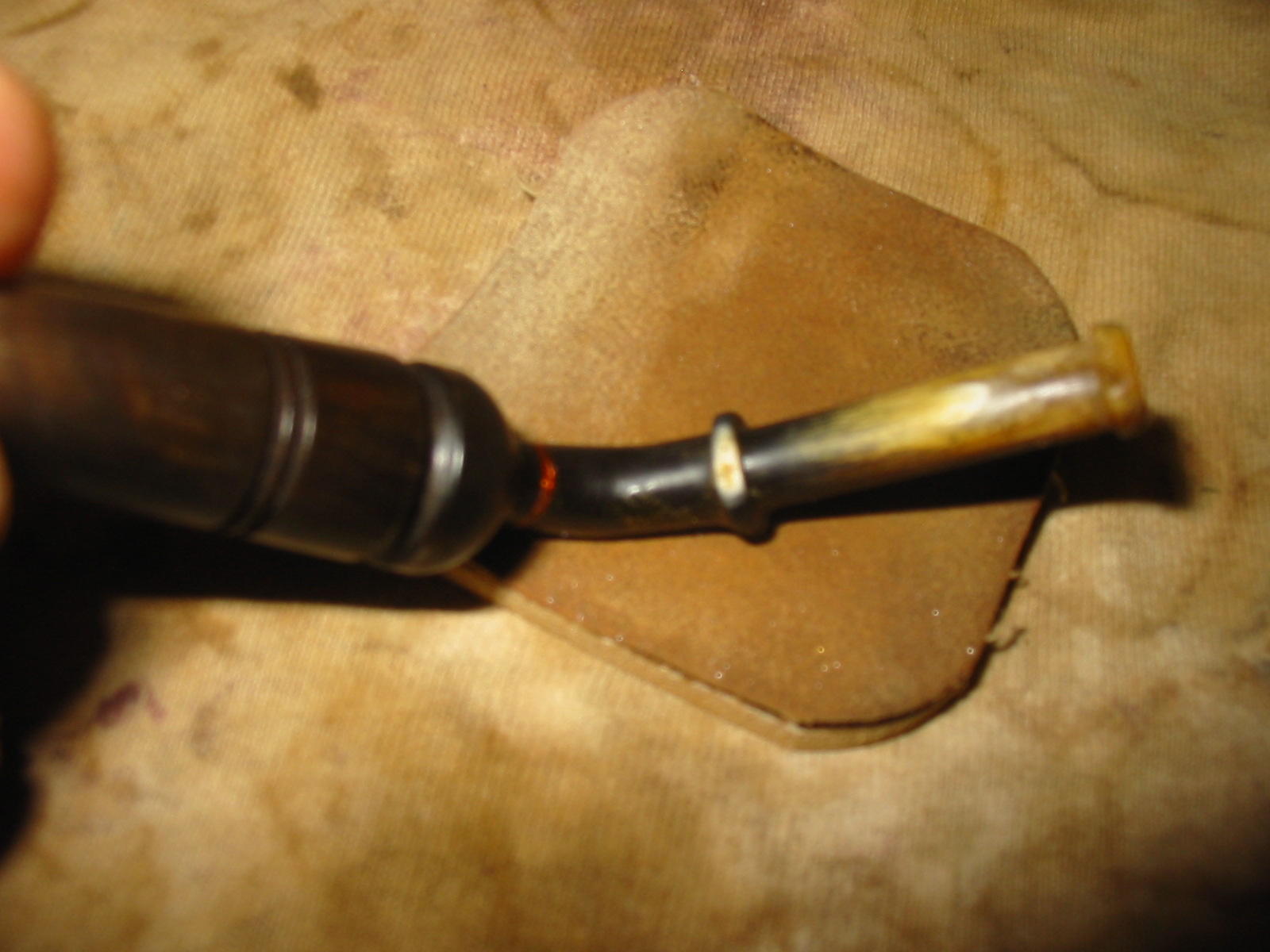
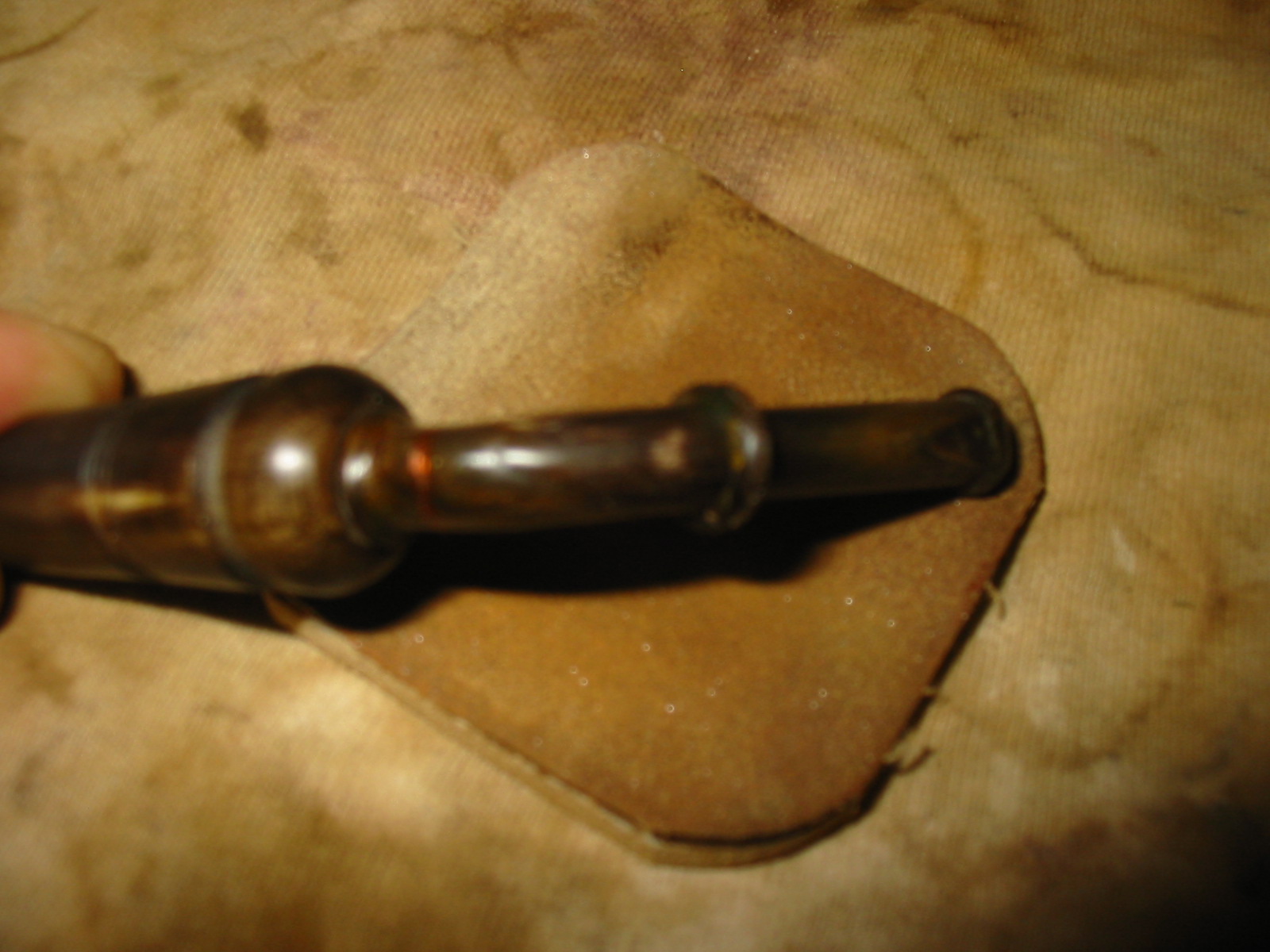
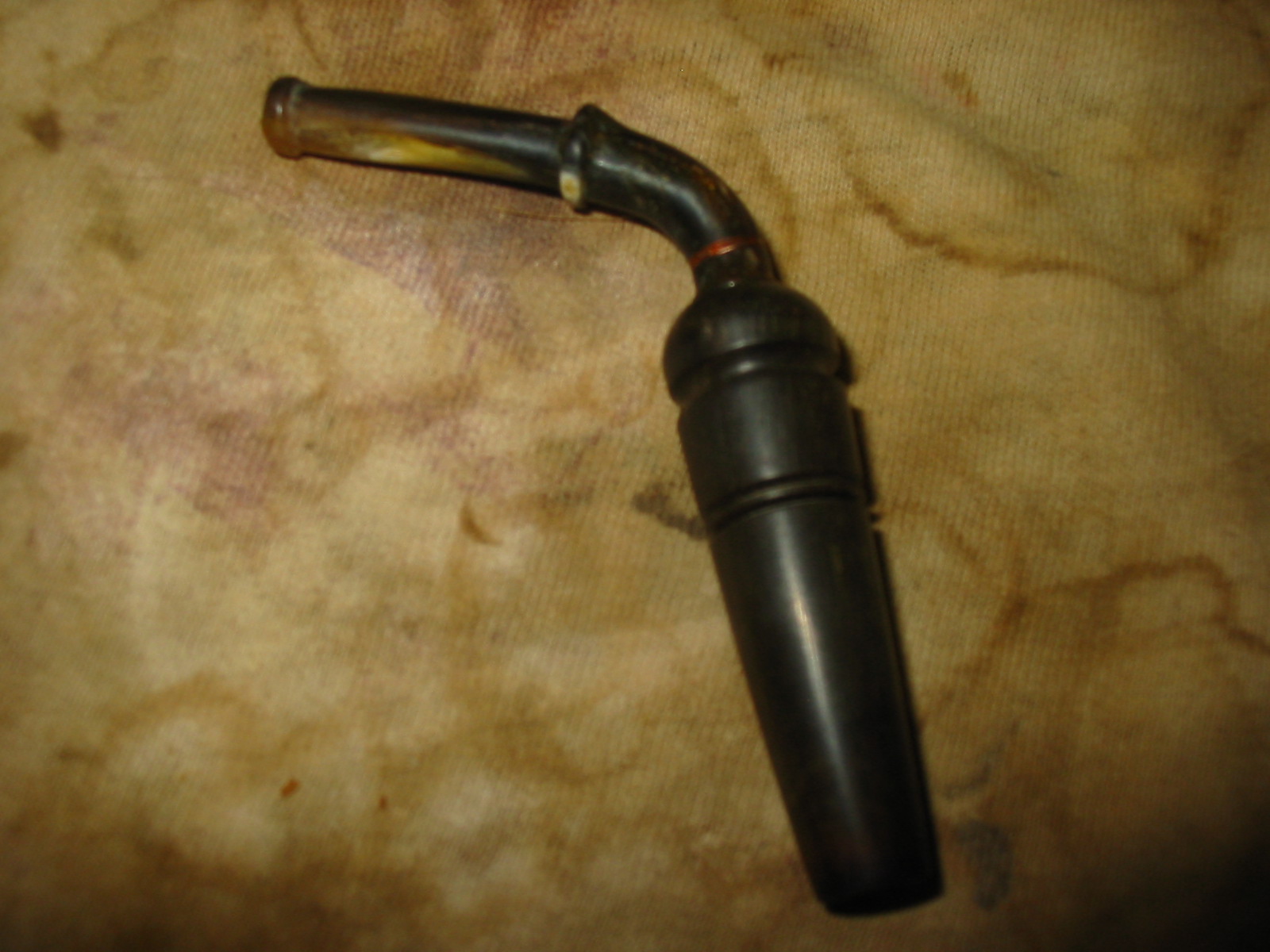
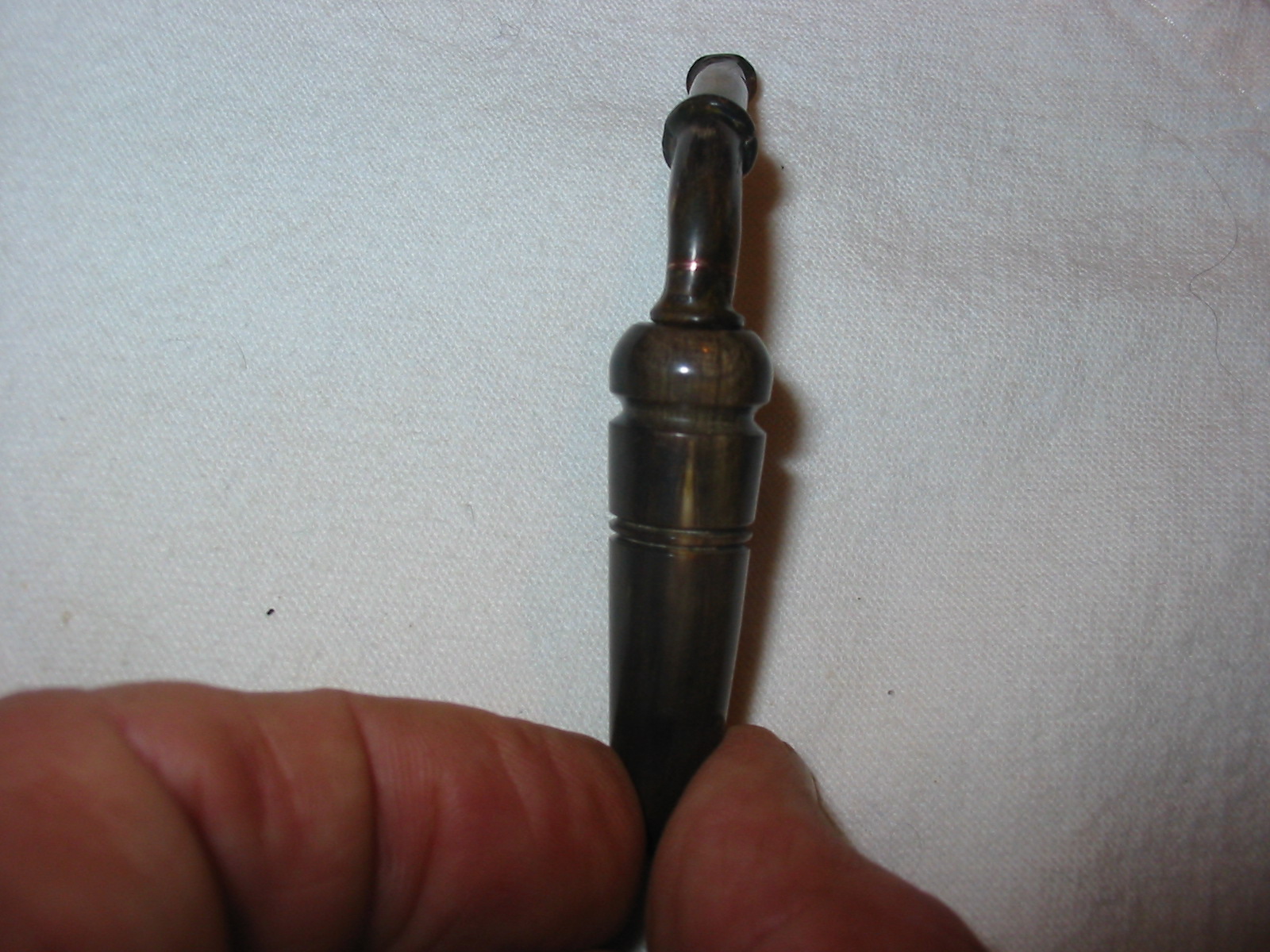
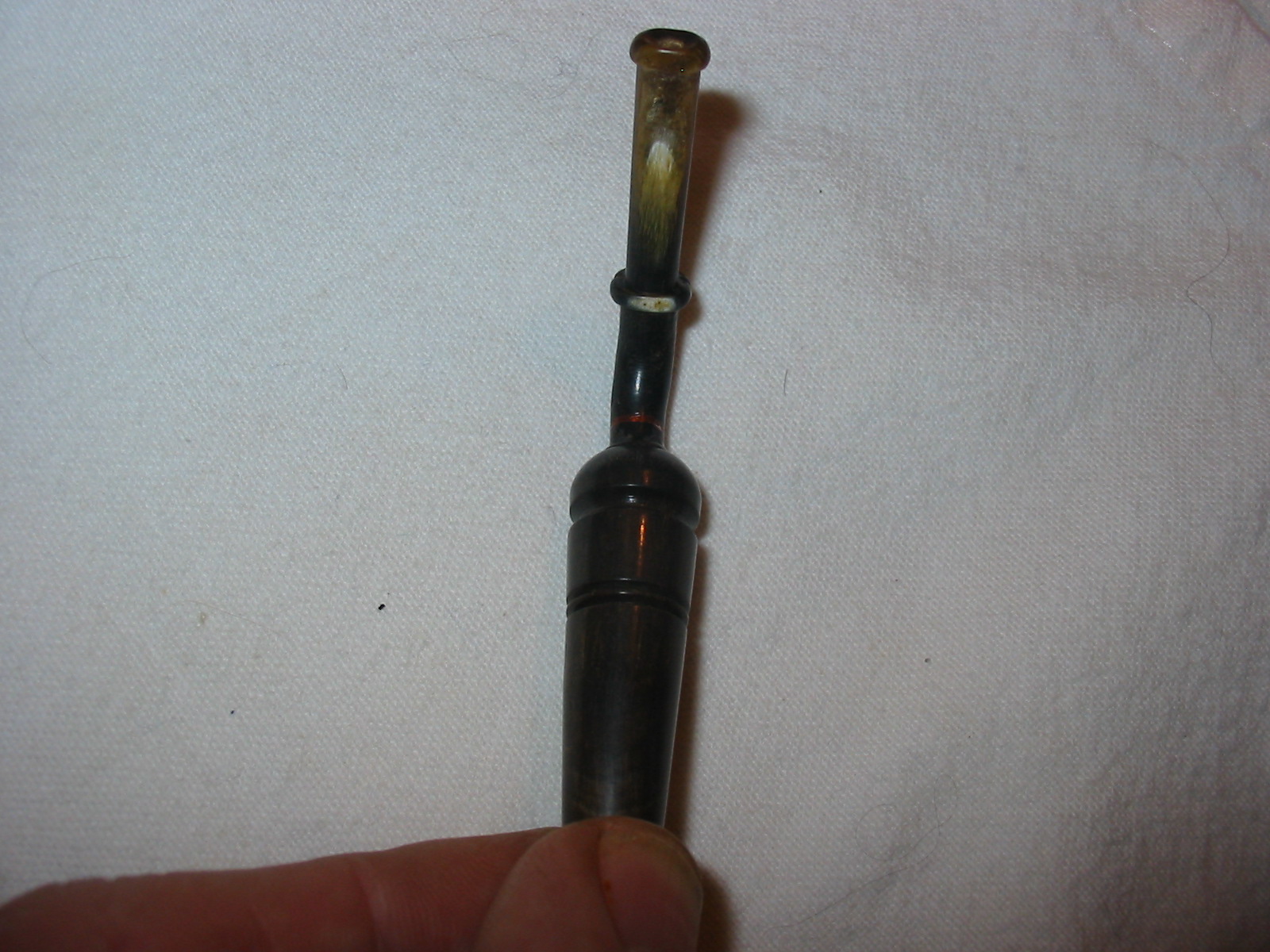
The pipes I would place in the first group are all older pipes with stems made of a variety of materials – amber, vulcanite, Bakelite and horn. In this group there are 45-50 pipes with this type of airway. All of them come from the mid to late 1800s and the early 1900s, literally another time and place. For some of them I can identify the time period they were manufactured and for some I have only the faintest idea of the era. The earliest dateable pipe I have is from 1912 – this is knowable from the hallmarks on the silver band on the shank of the pipe. The earliest ones in my collection appear to come from the 1850s and possibly earlier as far as I can tell. They have the filigree decorations, stampings and shapes of that earlier time. The stems, regardless of the time frame within this lot, all have a round/orific opening or airway in the end of the stem. The orific opening is a hole shaped like an O and is sometimes tapered into the airway from the outside. But often it is a straight shot into the airway with no variation in size. The button is generally oval/or round in all of them and the stem coming into the button is also thicker and more oval as well. There is not one thin stem in the lot. As a rule they are thicker and more rounded on the top so they are harder to clench. The two photos below show two different pipe stems from pipes that are in my collection. The first picture shows a horn stem with the orific or “O” shaped opening. The button on this one is quite oval and rounded. The stem itself is also oval and shaped similarly to the shape of the button. The second photo shows the same orific opening on a vulcanite stem. The shape of the button on it is an oval with pointed ends, like an American football. This stem is on a bulldog with a diamond shaped shank and stem. The blade or flat portion of the stem is crowned terminating in the button. The crown on the top and bottom of the stem matches the oval shape of the button both having pointed edges on the right and the left side.
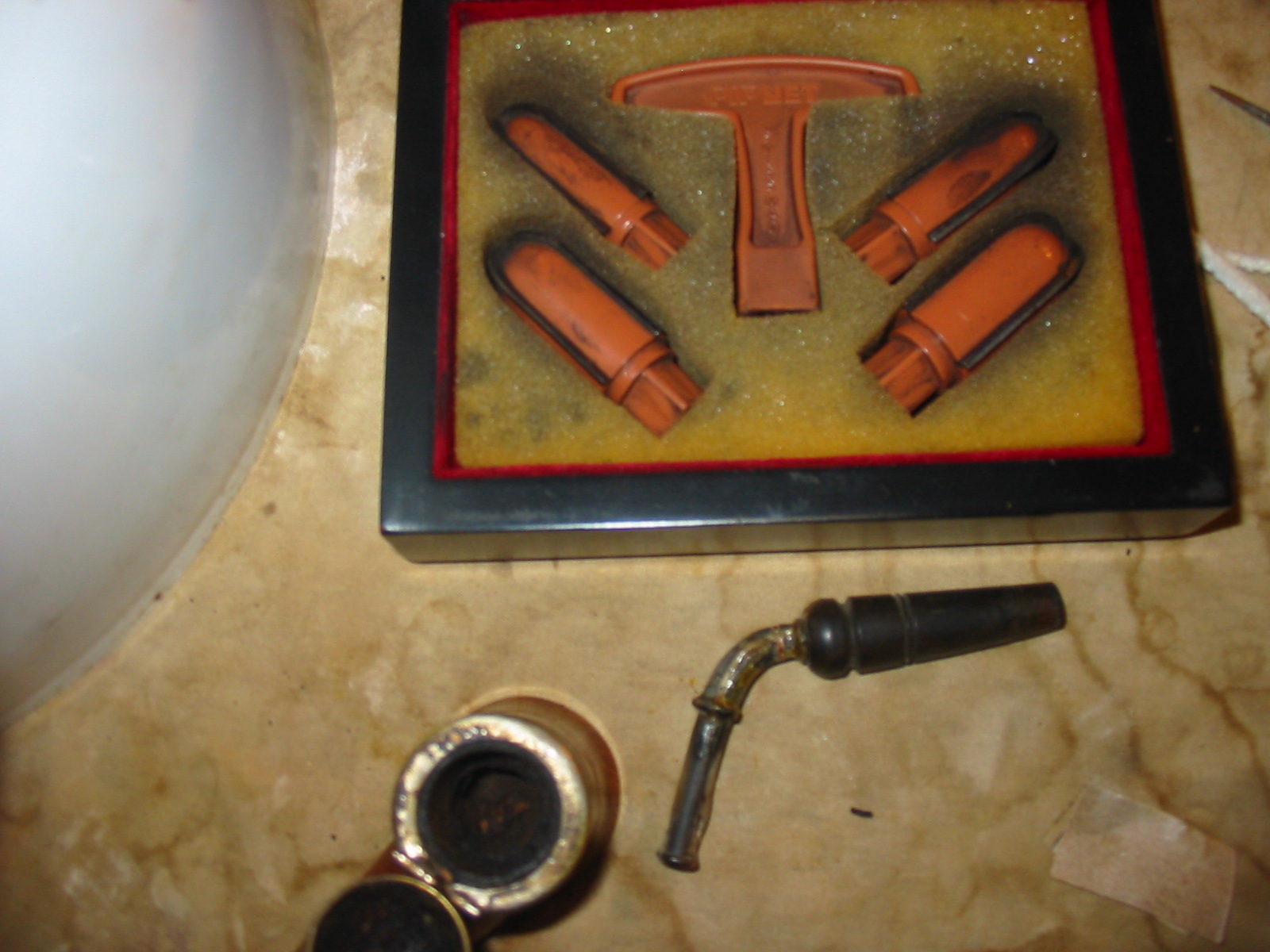
Orific button1

Orific button2
I spent some time examining all of the pipes that I have with this kind of stem to observe similarities and differences. In looking at them I have found some interesting observations. First, it can be generally stated that when I received these pipes as estates that they did not have bite marks or tooth marks in the stem itself though there were marks/dents in the button surfaces on many of them. All had tooth chatter or tooth scratches on the surface of the stem regardless of the material. A second observation I made is that in the straight stems the airway is the same size from front to back or at the most minimally tapered from the tenon to the opening in the button. Holding the stem up to light and looking down the stem the airway is uniform. I would assume that the same would be true for the bent stems that are in my collection. Third, all take a pipe cleaner very easily. Fourth, all of them are thicker than my stems with slots. Fifth, at one level all are less comfortable than the thin stems. I say at one level, in that I find them uncomfortable when I am smoking them on the go or in the car as they are hard to clench. However, if I am sitting in my office or on my porch with one I find that the thickness is no detriment as I tend to hold them in my hand.

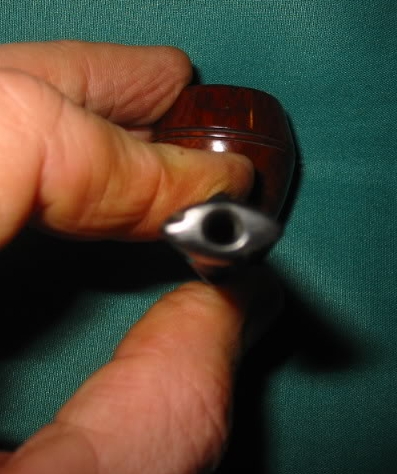
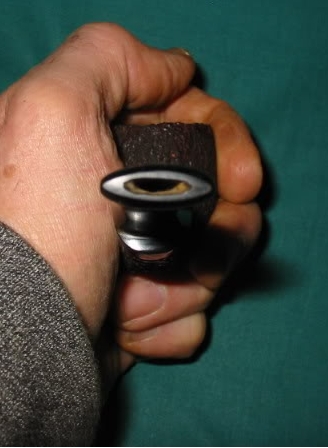
The second group of pipes in my collection is “newer” in age as a whole. As I observe this group of pipes I can make the following generalizations. I know that they are generalizations but that is my point in this article, I want to look at broad commonalities of each group. The buttons are thinner on the pipes throughout this group. They are flattened on the top and the bottom edges, which reduces the thickness of the button. The airway on the end of the stem is either a flat slot or a flattened oval that flares inward toward the airway in the stem. This slot becomes a funnel shape from the slot to the airway in many of the pipes. The drilling is also tapered and the airway flattened in the button end of the stem so that the stem can be significantly thinner. This is true in all of the pipes in this group regardless of the material that is used for the stems. In this group of pipes the stems are made out of vulcanite, Lucite, Bakelite and acrylic. All of the tapered stems have a more flattened profile, with more gentle angles to the taper from either the saddle or the taper from the shank to the button. The higher end pipes and handmade pipes all show a customization of the button slot. The machine made pipes generally have a straight line slot. Some of the machine-made pipes have slots that are very thin/ tight and will only take a thin pipe cleaner with effort. Others are wider and accommodate pipe cleaners easily. In my handmade/artisan pipes the slots are all of various shapes and adaptations. The one overarching theme in all of them is the flare on the inside of the slot that tapers back to the internal airway. The next three photos show a customized slot on three different pipes in my collection. Both pipes have vulcanite stems and both have oval shaped buttons and slots.

Slot 1

Slot 2

Slot 3

What have I learned from this comparative observation of both kinds of buttons/stem? What generalizations can I take away as I try to understand why the orific button was replaced with the slotted button? I can say unequivocally from my observations, that it seems the quest for ever thinner stems and the advent of “new” ideas regarding internal engineering of the airway from the bowl to the tip of the stem have brought about the end of the old orific button. I don’t know if anyone ever questioned its disappearance or mourned its demise. It almost seems to me that it just disappeared slowly and like the dinosaur left behind a few “fossil” remains to remind us of its presence.

An Interesting Challenge – Restoring a Horn Stemmed Austrian Silver Capped Briar Sitter


Blog by Steve Laug

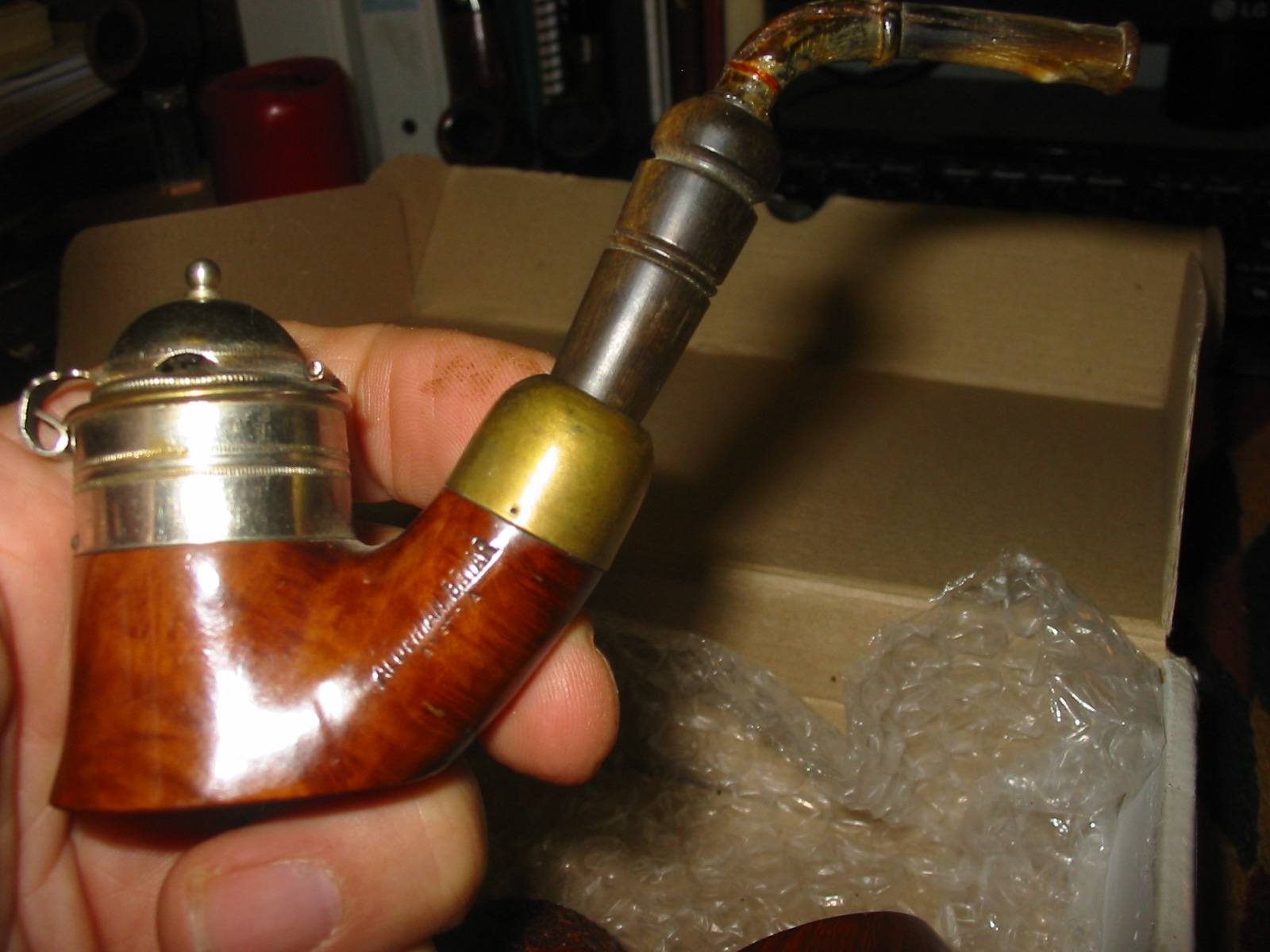
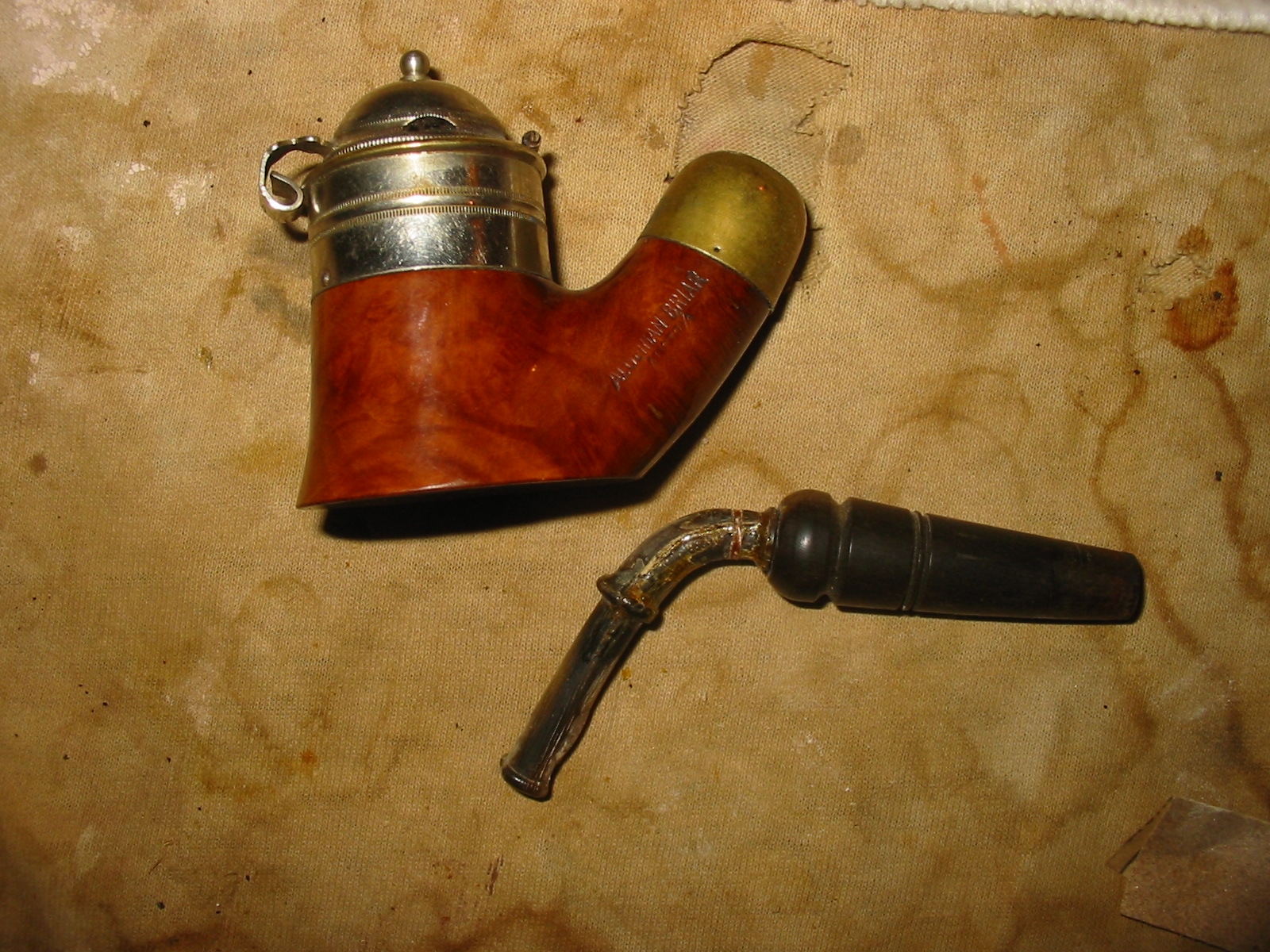
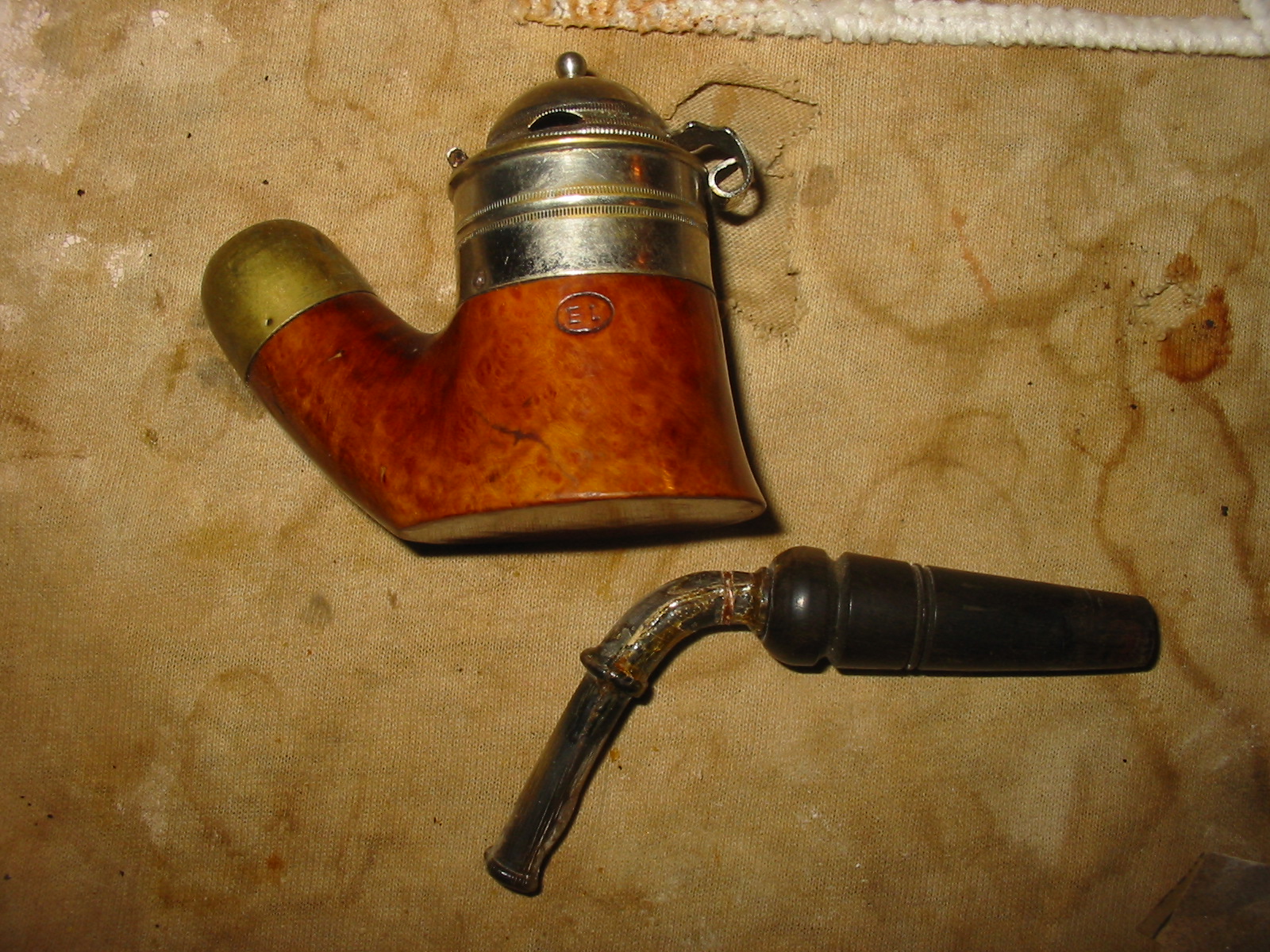
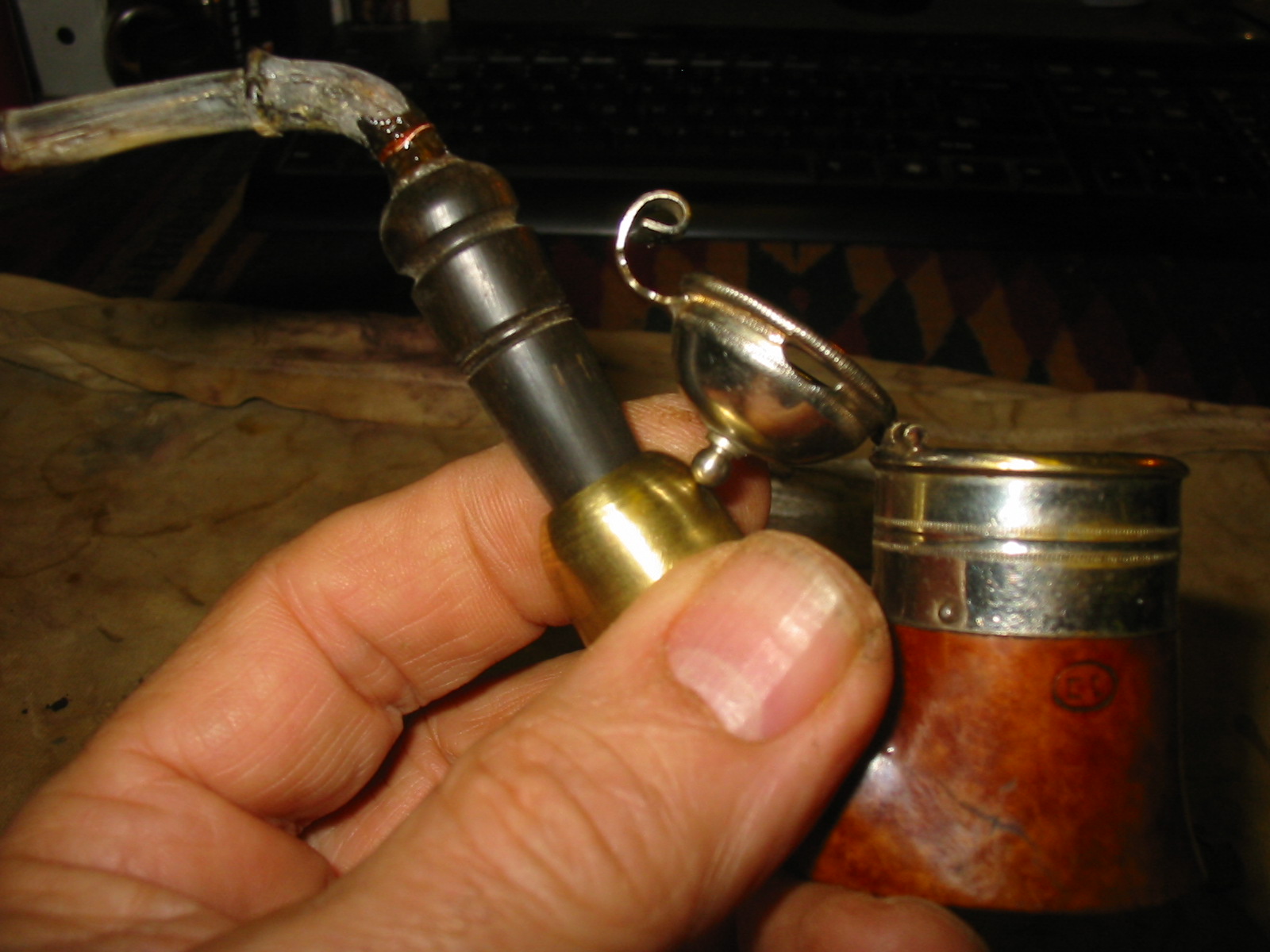
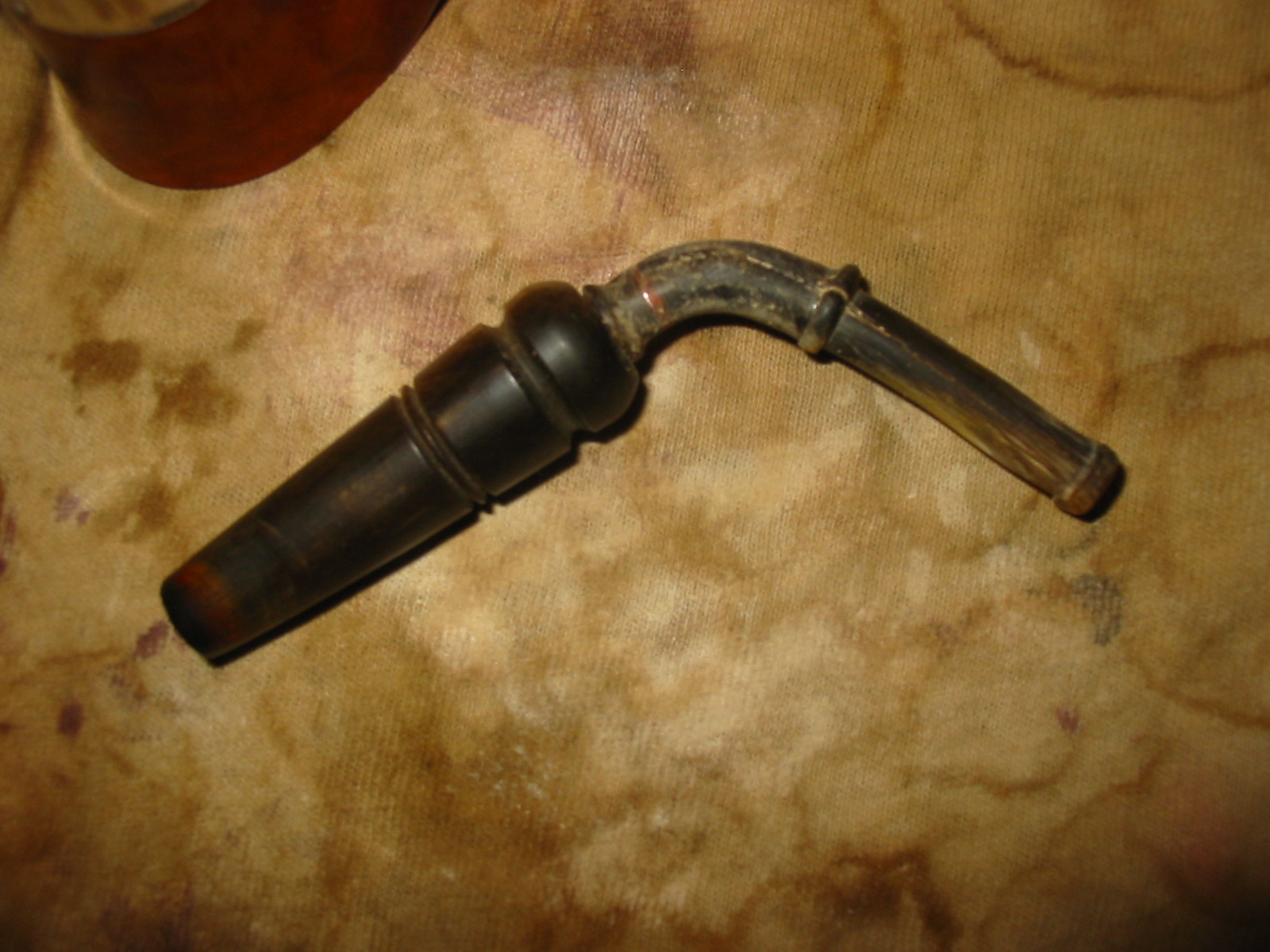
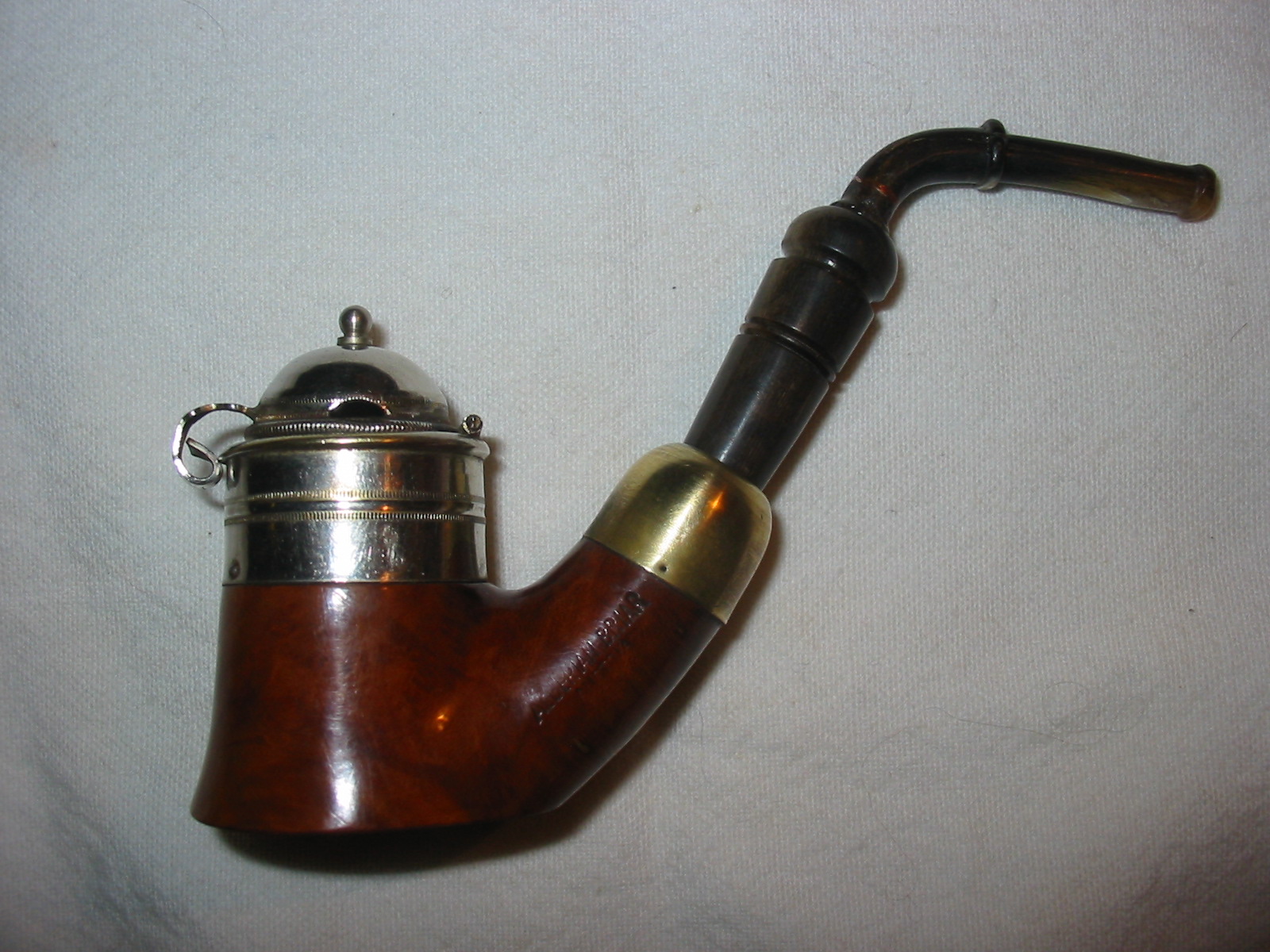
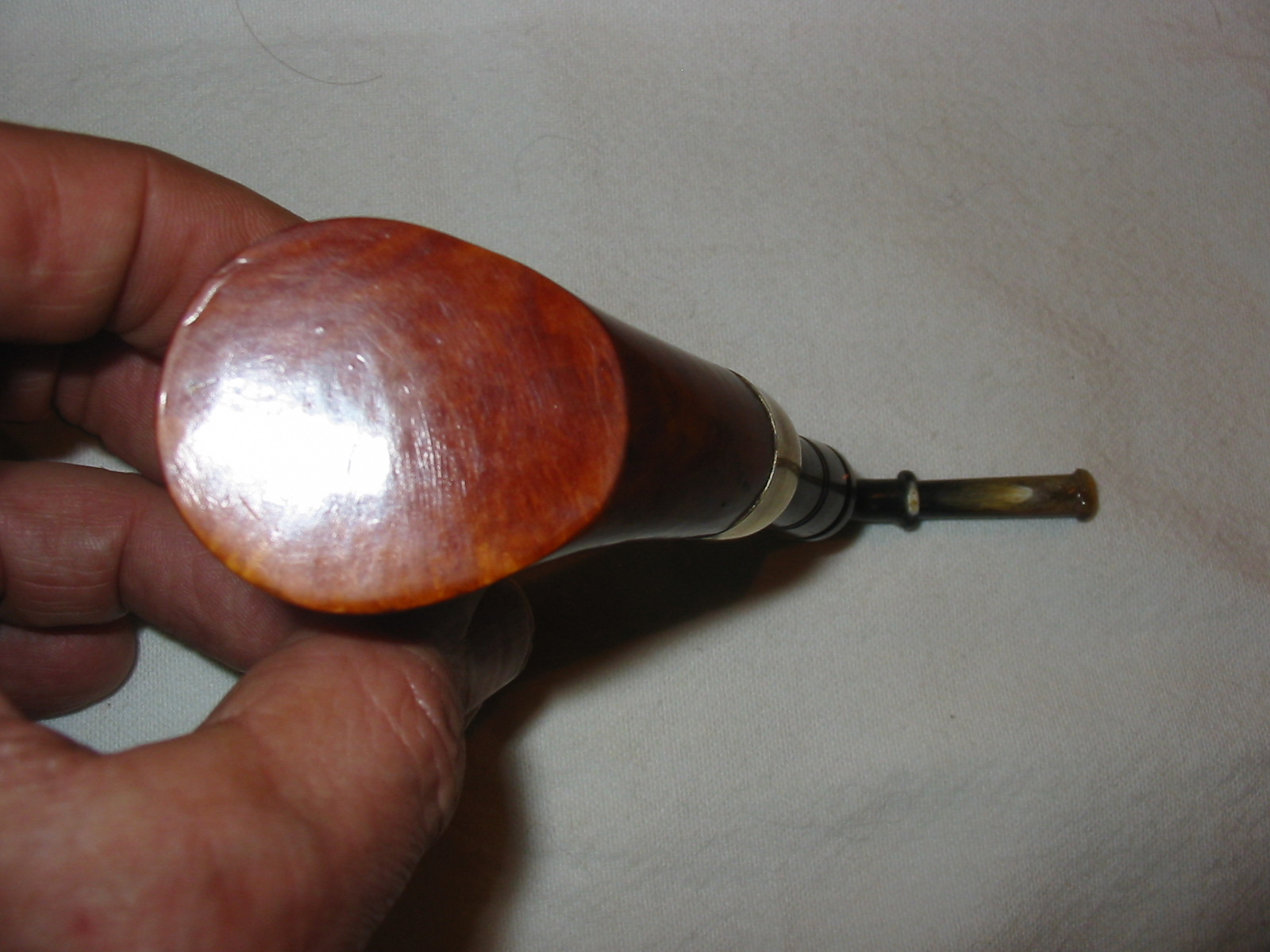
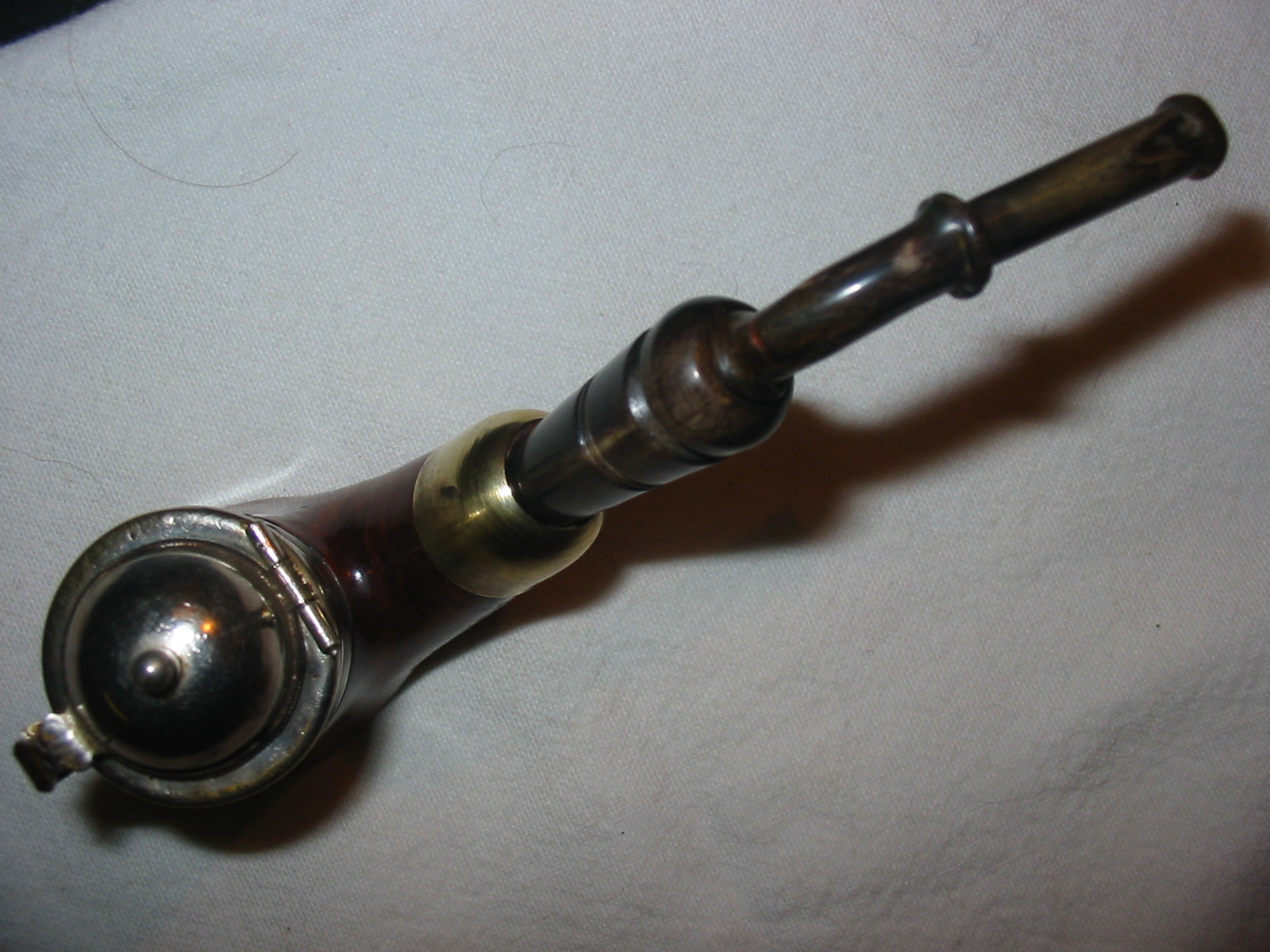
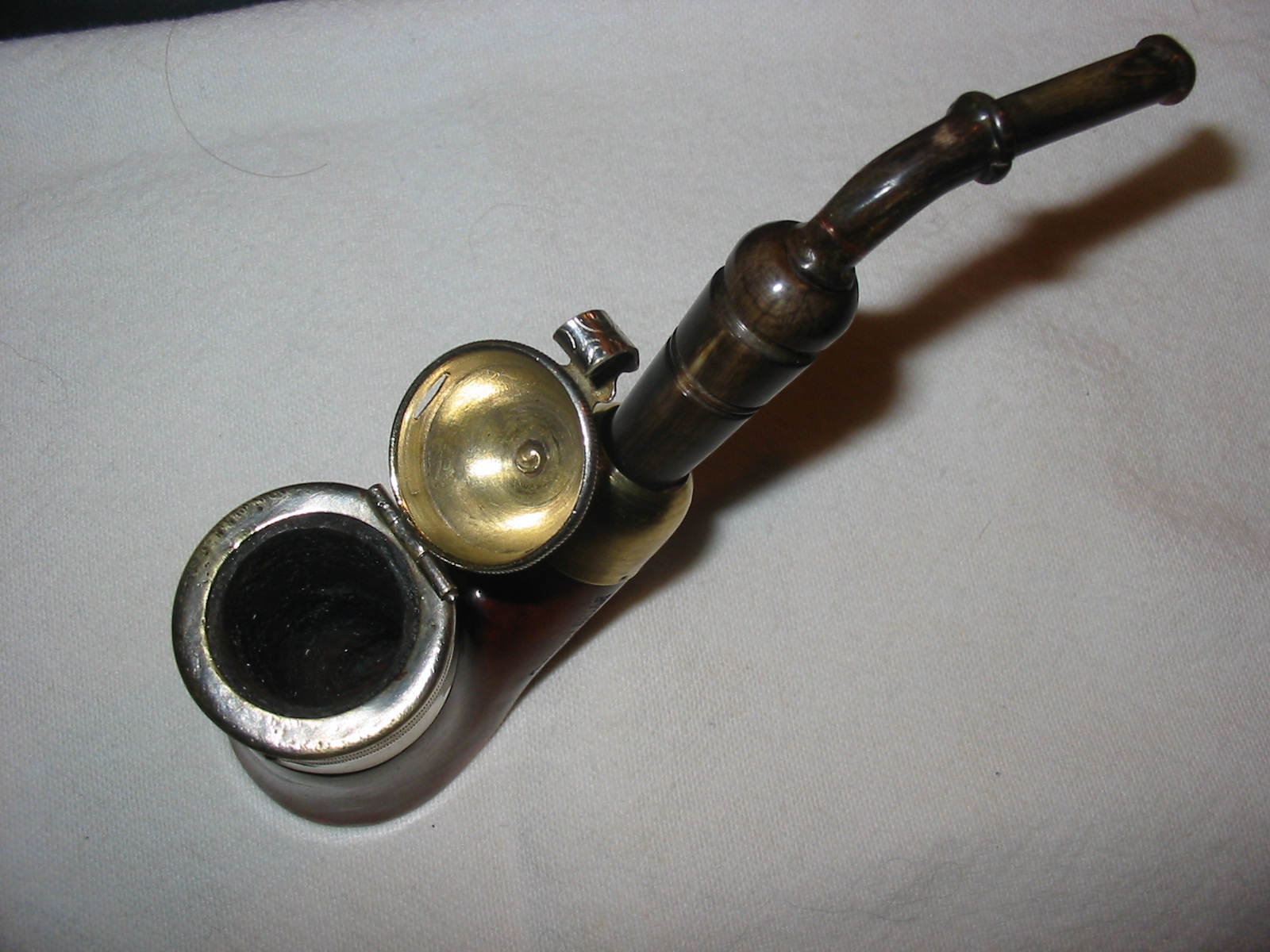
This is the second pipe that was given to me by Chuck Richards. It was a real challenge and it was actually an enjoyable restoration project. This particular pipe is stamped Algerian Briar over Austria on the left side of the shank and on the right side of the bowl below the cap it is stamped EL in an oval. It is actually a nice piece of briar. It is capped by a silver rim cap that goes down the bowl a 1/2 inch. It is rounded over the edges of the rim and flattens in towards the inner rim leaving a briar edge of 1/8 inch. It is topped by a silver wind cap that is hinged a little off centre toward the right side from the back of the bowl. The front of the cap has a folded ornate flap stamped with curls and swirls on the surface. This flap acts as a catch for the lid on the outer lip of the bowl. The cap has a small ball-shaped handle on the top that is for decoration. The cap also has two half circle opening for air. The bowl was heavily caked with a crumbly and soft cake. The stem was horn and was nicely carved. It had also been repaired at least once in its life. At the junction of the smaller part of the stem to the saddle there had been a repair done. It looked at first as if it was copper wire that was used to band the horn which seemed to have splintered and been repaired. Upon closer examination I am almost certain it is a small copper band that was set into the horn stem to secure the break. It is solid. The upper portion of the stem had also splintered and not been repaired. The round end of the button had been worn down on the top and bottom edges to where it was almost squared off. The splinter on the bottom of the stem was loose. The horn was also covered with a shiny lacquer like substance that hid the beauty of the horn. I wonder if it was part of the original repair. The next series of three photos show the pipe as it appeared when I took it out of the shipping box and bubble wrap. I was really interested in seeing what I could do with this one – a worthy challenge that would be enjoyable to work on.
IMG_0668

IMG_0669

IMG_0667
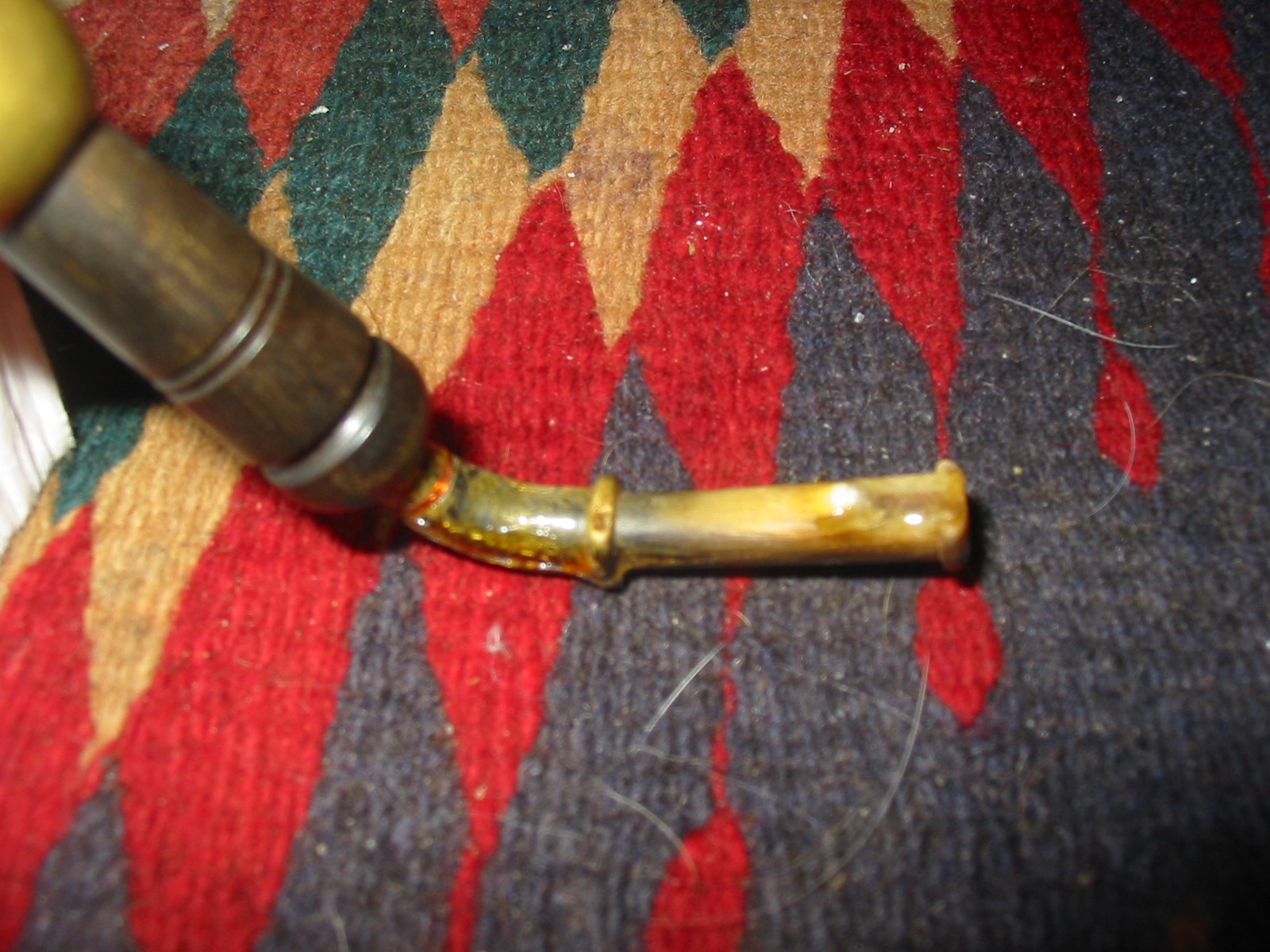
I took it to my work table and removed the stem. I examined the shank and the bowl as well as the stem. I have noted above what I saw in my examination. The interior of the shank was in good shape, there was little wear on the inside from the insertion of the horn stem. The drilling was similar to a Peterson in that it had a sump area with the airway drilled above that. It allowed for condensation of the tobacco juices to settle into that well. It was full and dark and the stain of the juices had migrated up the stem and stained the bottom edge. You can also see the repairs that had been made to the stem in the three photos below. The bowl cap was tarnished and the brass shank cap was also tarnished. The stamping is also clearly visible in the photos. At this point I sat and examined the stem to make a decision whether to seek and revive it or to replace it with a newer Peterson style fish tail stem. After some time examining it I decided to see what I could do with the existing stem and left the other stem idea in reserve should I need to do that.
IMG_0670

IMG_0671

IMG_0672
The first of the next two photos shows the bottom of the bowl and give a clear idea of the nice piece of briar that I was dealing with. The second photo shows the inside of the bowl and the wind cap. The cake and build up of lava like tar on the lid is prominent.
IMG_0673

IMG_0674
I decided to begin with cleaning the bowl. I used a PipNet reamer set with different sized cutting blades. I used the first two heads on this bowl. The first one, the smallest opened up the cake and cut off the broken edges. I followed that up with the second cutting head and took the cake back to the briar so that I could give it a thorough cleaning. The next four photos show the reaming process. I also cleaned out the sump and the airway in the shank with folded pipe cleaners, cotton swabs and Everclear. Once that was done I also scraped out the inside of the cap with the head of the cutting blades on the PipNet set.
IMG_0675

IMG_0676

IMG_0677

IMG_0678
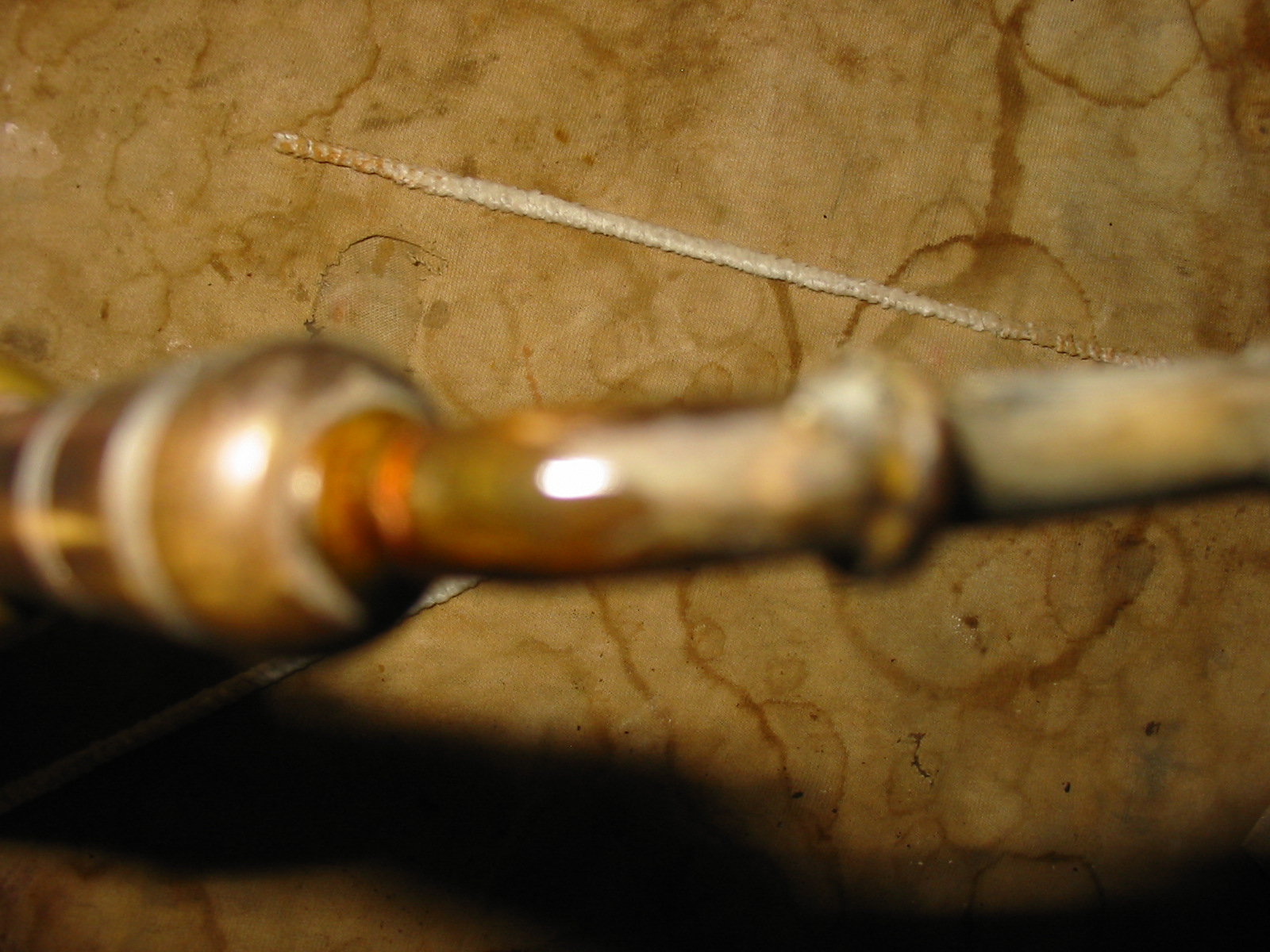
I took a break from the work on the cap and bowl to work on the stem. I cleaned of the surface with a damp cloth and then used superglue to fill the openings in the surface of the stem left from the previous repaired splits. I also used it to repair the splintered part on the bottom of the stem. Once the glue was dry I used 240 grit sandpaper to sand off the excess glue and also the clear coat of varnish or lacquer on the stem. I tried to put a pipe cleaner through the stem and was not successful. I blew through it and found that it was open but that the draw was tight. I would work on that later. The main purpose at the moment was to see what was underneath the clear coat. The next photos show the grain pattern on the horn stem underneath the clear coat. That gave me hope to see if I could restore that unique pattern in the horn stem and bring it back to life. The entire stem from tip to the bottom of the tenon was all horn so it would have a unique look if I was able to restore it. Several of the photos below are out of focus, I apologize for that, however they help to see the pattern and colours of the horn stem. You can also see the repairs on the side of the stem toward the button and the copper band around the lower part of the stem.
IMG_0679

IMG_0680

IMG_0681

IMG_0682

IMG_0683
I worked on the inside of the cap and the rim with 0000 steel wool to remove the build up and tars. I worked on that until the surface of the inside shined and the rim was clean. I then polished the silver with a silver cloth to bring back some of the shine to the bling. The next three photos show that process. (You might have the impression from the photos that I bounced back and forth between the stem and the bowl in this refurbishing. While it appears that way in the photos it actually happened over the period of several days and hours. Each time I set the pipe aside to go and do something else I would come back and pick up at whatever point struck my fancy at the moment.)
IMG_0684

IMG_0685

IMG_0686
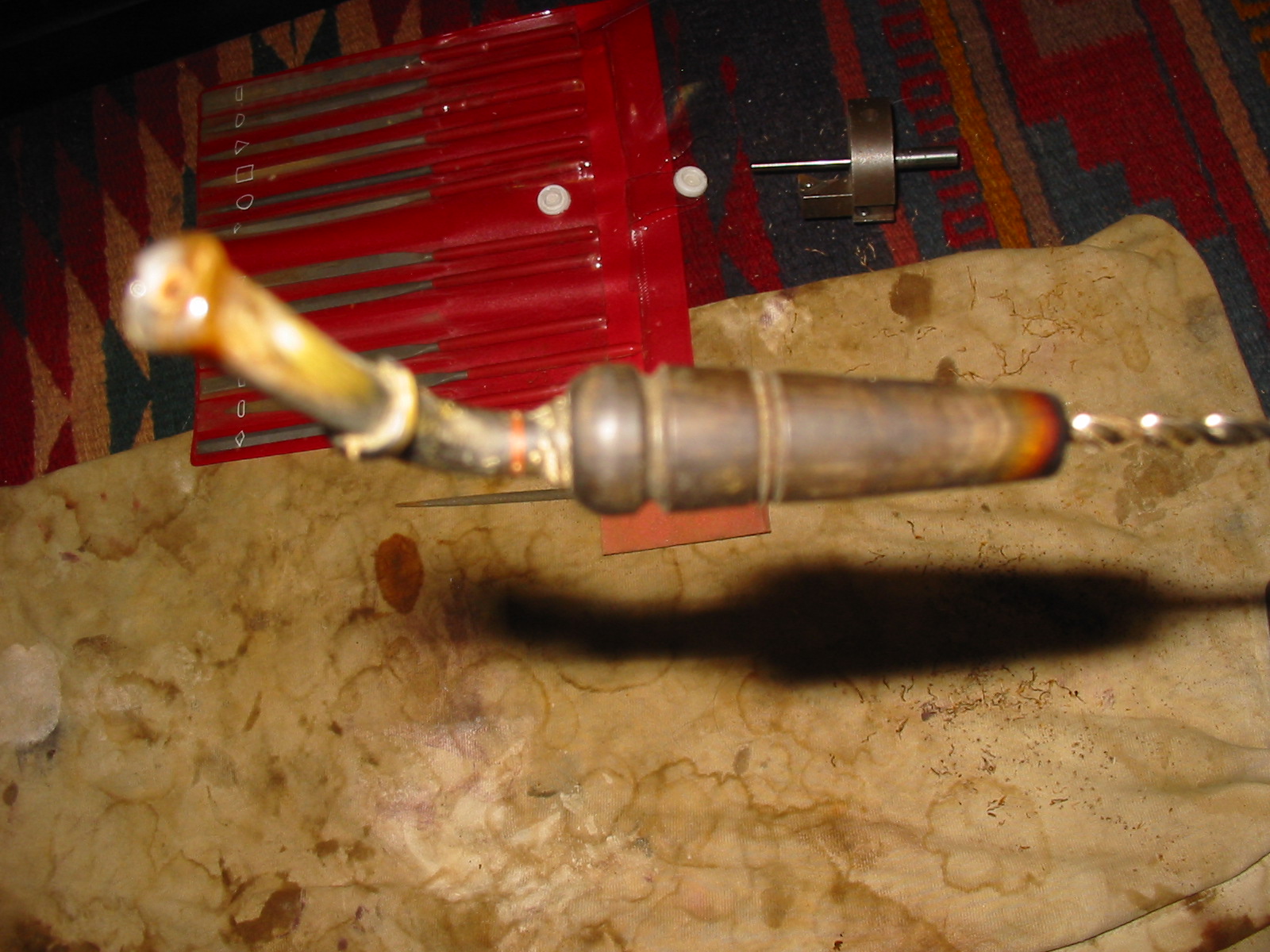
The next time I came back to work on the pipe I decided to open up the stem and improve the draw. I was able to ascertain that the tenon end of the stem was much more constricted than the button end. I could easily fit a pipe cleaner in the button and down about half way but was unable to do the same from the tenon end. Even the thinnest pipe cleaner would not go through from the tenon end. I measured the length of the tenon portion of the stem and then used a small drill bit to drill the depth of the larger portion of the tenon. I did this with a cordless drill and proceeded slowly. I was careful to keep the drill bit at the same angle as the airway as I did not want to make the problem worse by slanting the airway or overdrilling the stem. The next two photos show the drilling. The third photo below shows the newly opened end of the stem. The draw was now quite open and the airway clear for a pipe cleaner to easily pass all the way through the stem.
IMG_0699

IMG_0700

IMG_0701
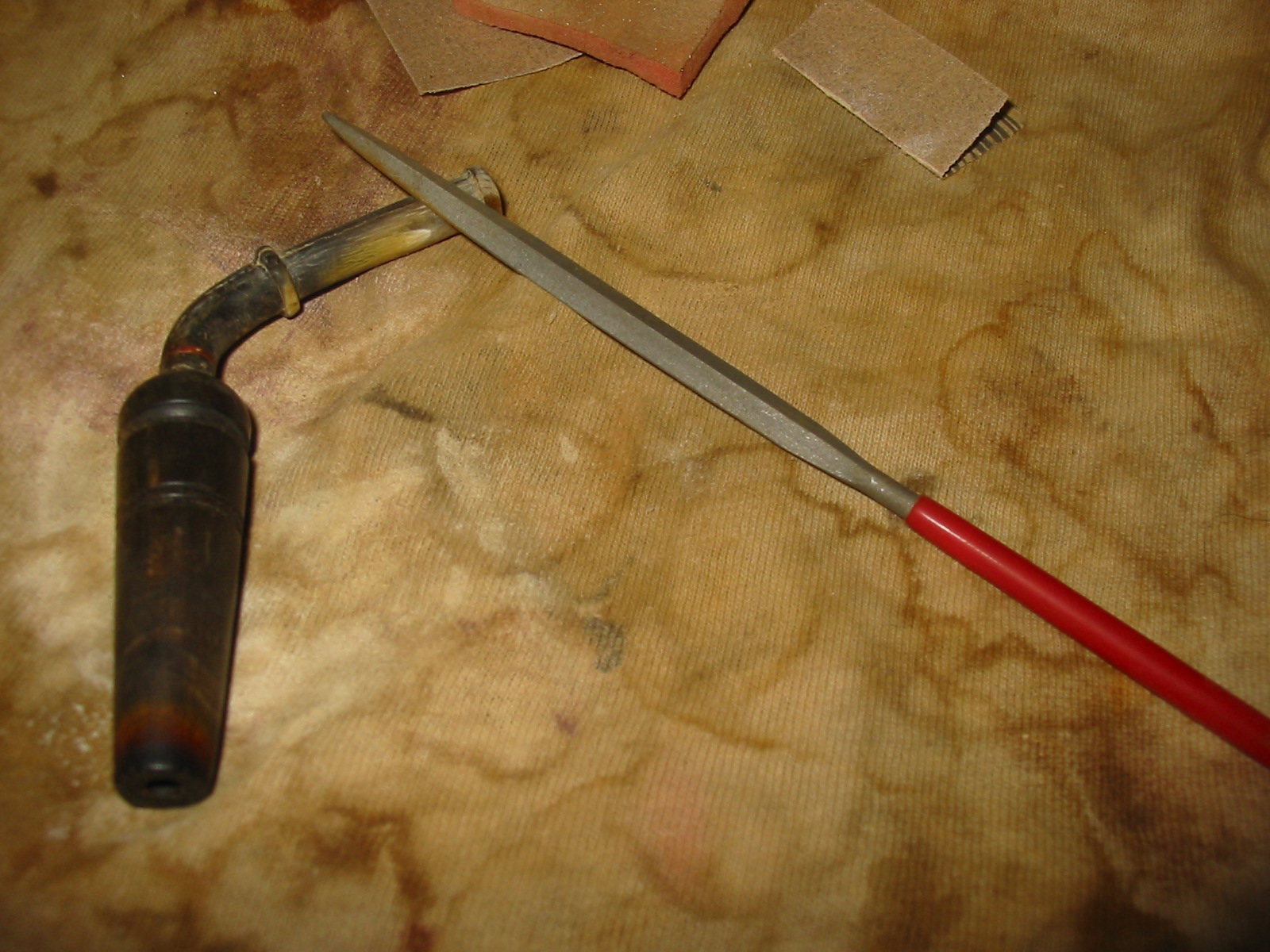
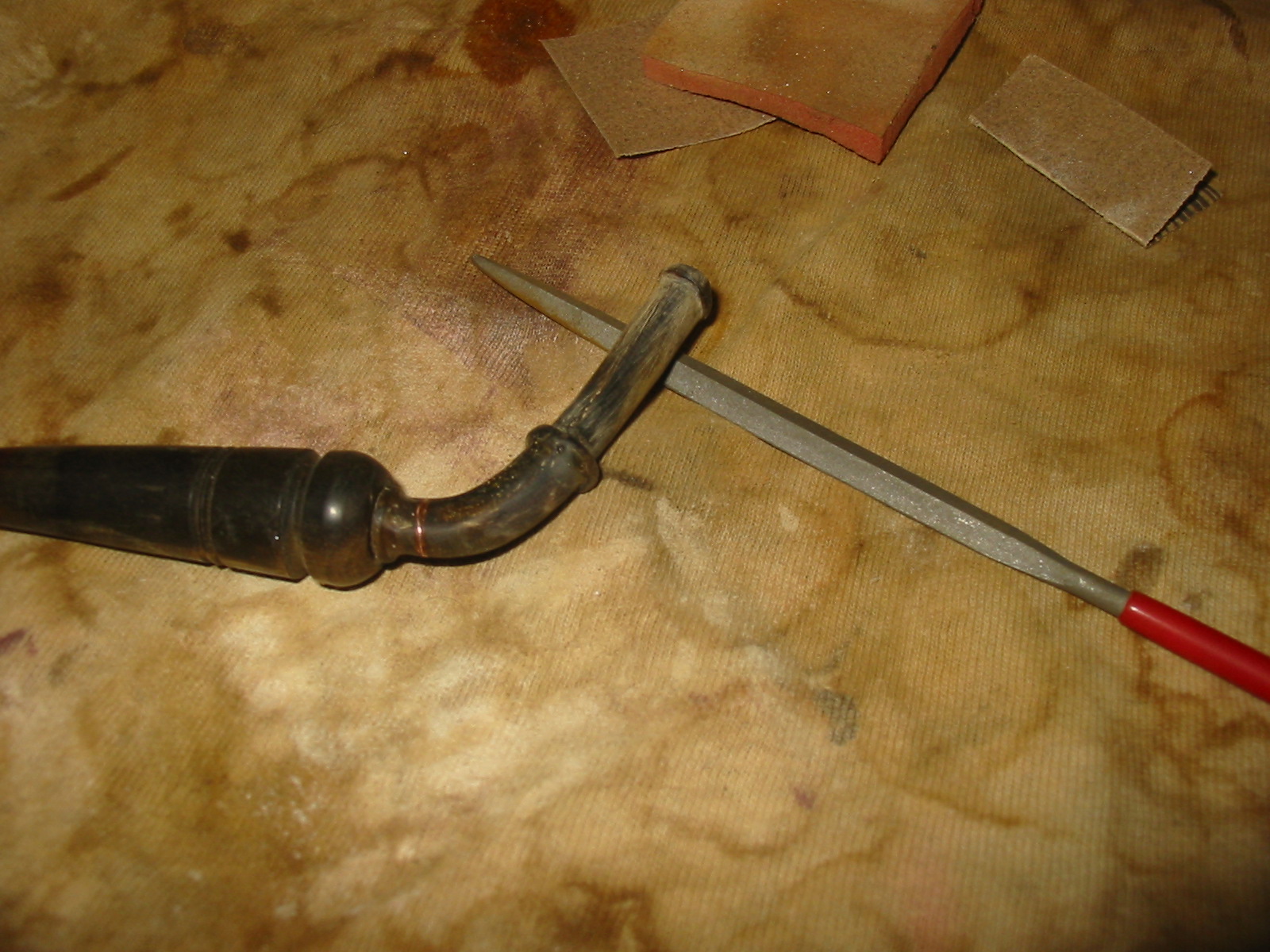
I redefined the button area using needle files. The top edge and the bottom edge next to the button were not sharp and distinct. As the top and the bottom of the button had been flattened, it was almost parallel with the stem. I used the needle files to sharpen the edge and to round the button surface as well. The next two photos show the process and picture the results. Note also that the stem is shaping up nicely with the various sandpaper and the colours and definition of the horn are coming out beautifully.
IMG_0702

IMG_0703
The next series of four photos shows the progress of sanding the stem with 240, 320 grit sandpaper and a fine grit sanding sponge. The thick, shiny coat that hid the horn is pretty well gone at this point. The sanding has also smoothed out the shape of the stem and removed the overfills of the previous repair. The stem is beginning to take shape and the grain of the horn is visible. I think that the repair will work well and when I am done I will have a stem that will work quite well.
IMG_0704

IMG_0705

IMG_0706

IMG_0707
I continued to sand the stem with micromesh sanding pads from 1500-12,000 grit. I wet sanded with the 1500, 1800 and the 2400 grit pads. My goal was to remove the scratches in the horn and begin to bring out the natural shine of the material. The next series of four photos show the effects after sanding with the 1500 grit pads. The next four that follow show the finished stem after sanding with all of the micromesh pads. Once it was finished I coated it with Obsidian Oil to add some life to the horn stem. I have found that it soaks into the horn material and builds some luster over time. You can now see the variations in colour, almost striations in the horn stem. This pearlescence is what I love about the old horn stems and what made me want to try to redeem this old-timer.
IMG_0708

IMG_0709

IMG_0710

IMG_0711

IMG_0712

IMG_0713

IMG_0714

IMG_0715
I took the stem to my buffer and carefully buffed it with White Diamond. I was careful to have a light touch on the wheel as I did not want to damage the horn. The material is sensitive to pressure on the wheel so care must be exercised when buffing it. I gave it multiple coats of carnauba wax and hand buffed with a shoe brush and a soft cotton cloth. The next four photos show the rejuvenated stem ready to be put back on the pipe.
IMG_0718

IMG_0719

IMG_0720

IMG_0721
I reinserted the stem in the pipe, polished the entirety with another coat of carnauba and buffed it by hand to give it a shine. The next five photos show the finished pipe. This old-timer is ready to be loaded with a bowl of aged tobacco, fitting to the age of the pipe and given its reintroduction to its original purpose. This restoration was a pleasure to do and one that gave me a sense of accomplishment in bringing back the old horn stem. The variations in colour and the striations in the horn really give life to this old pipe. The copper repair in the stem actually adds a flair of uniqueness and mystery to the pipe – it makes me wonder who did it and where it was done. Thanks for the challenge Chuck.
IMG_0722

IMG_0723

IMG_0724

IMG_0725

IMG_0726

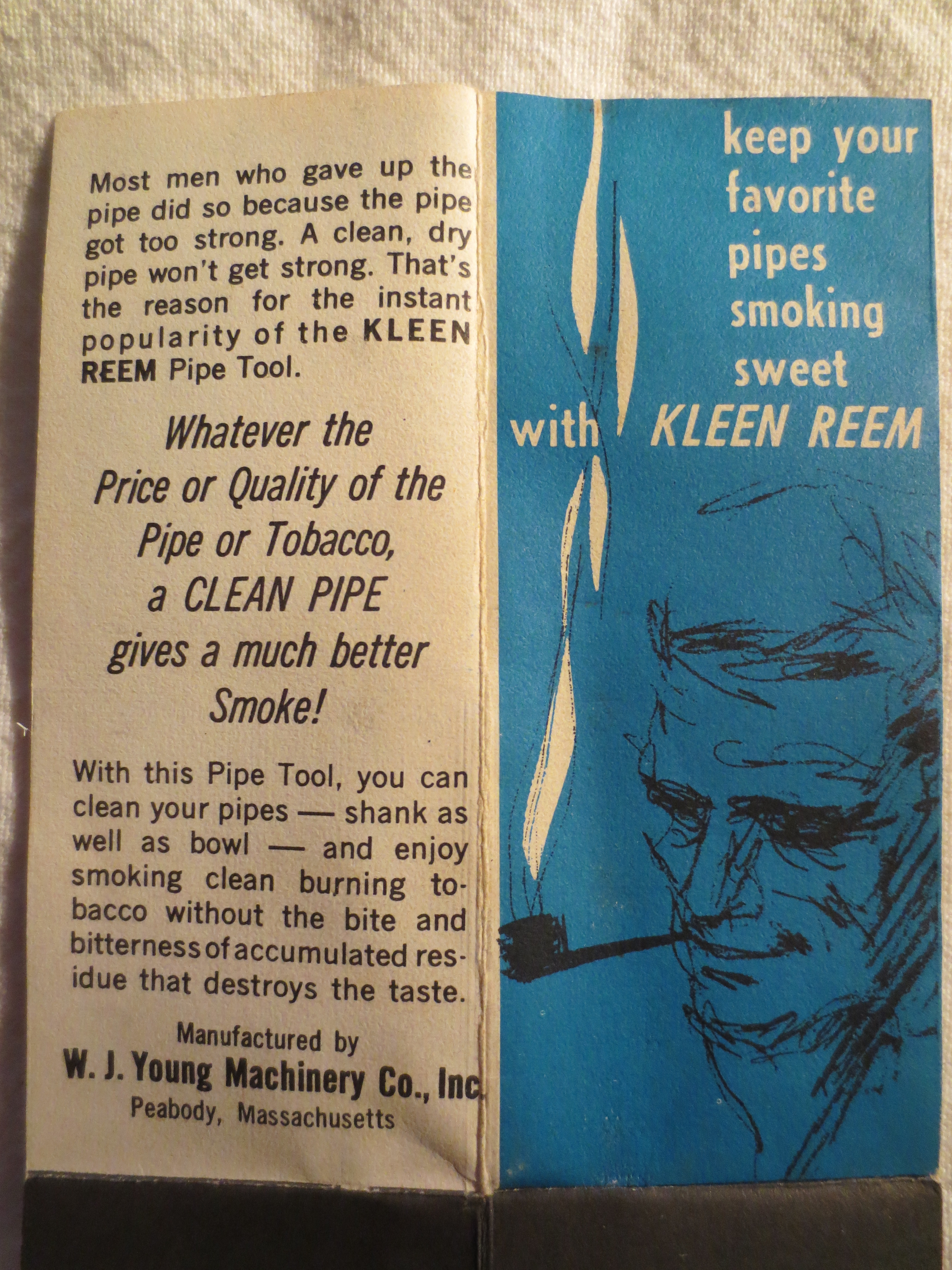
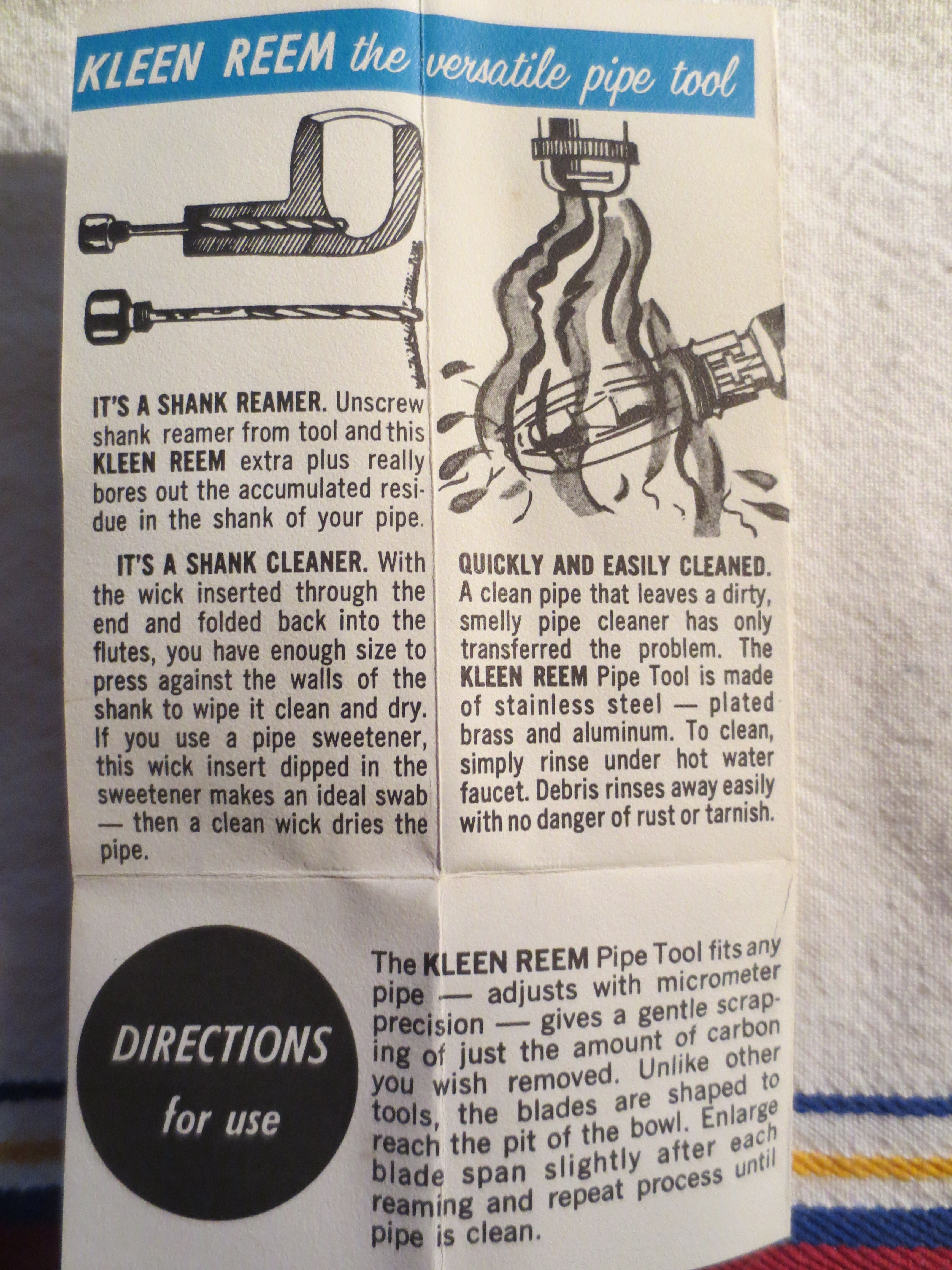
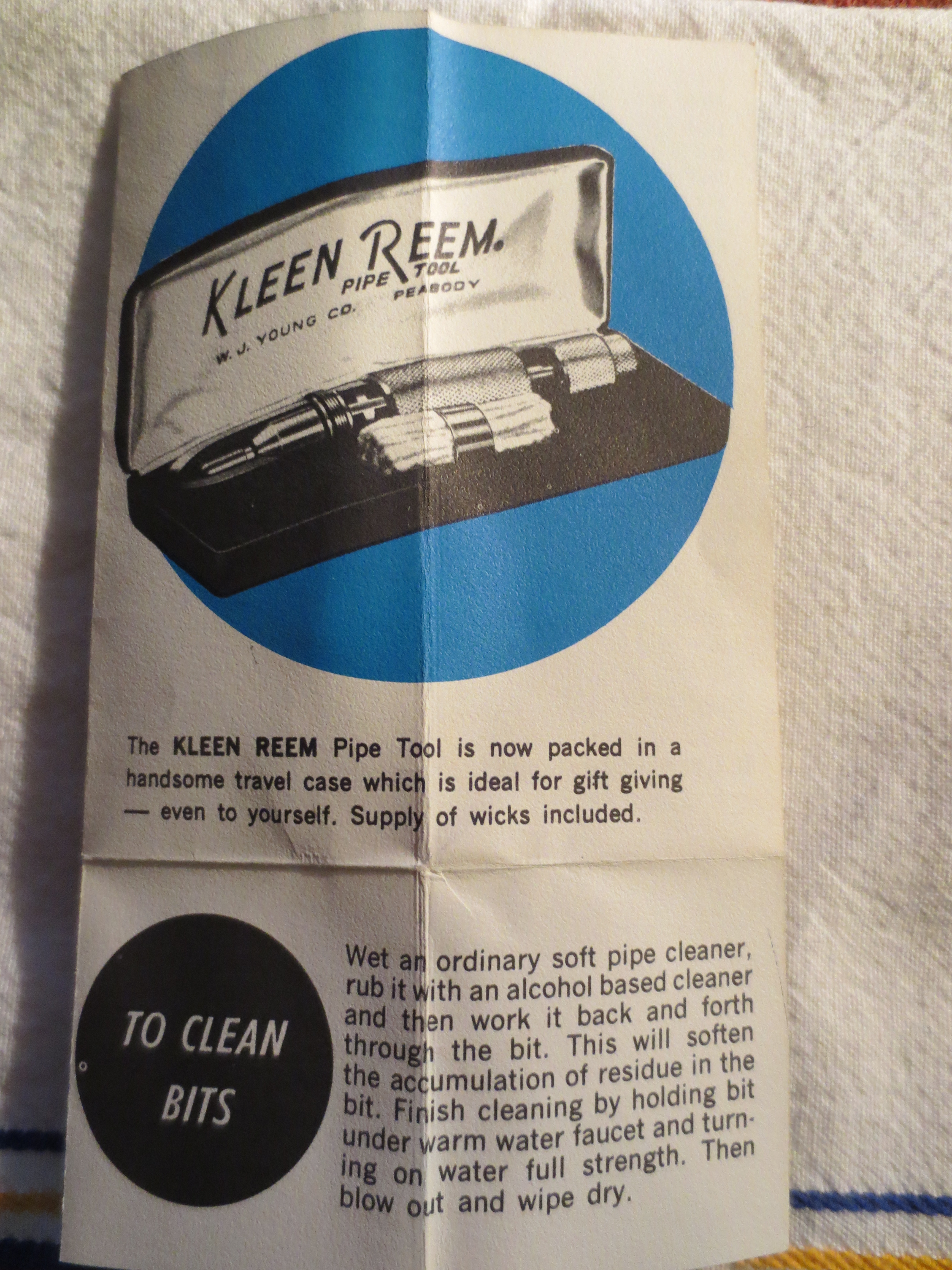
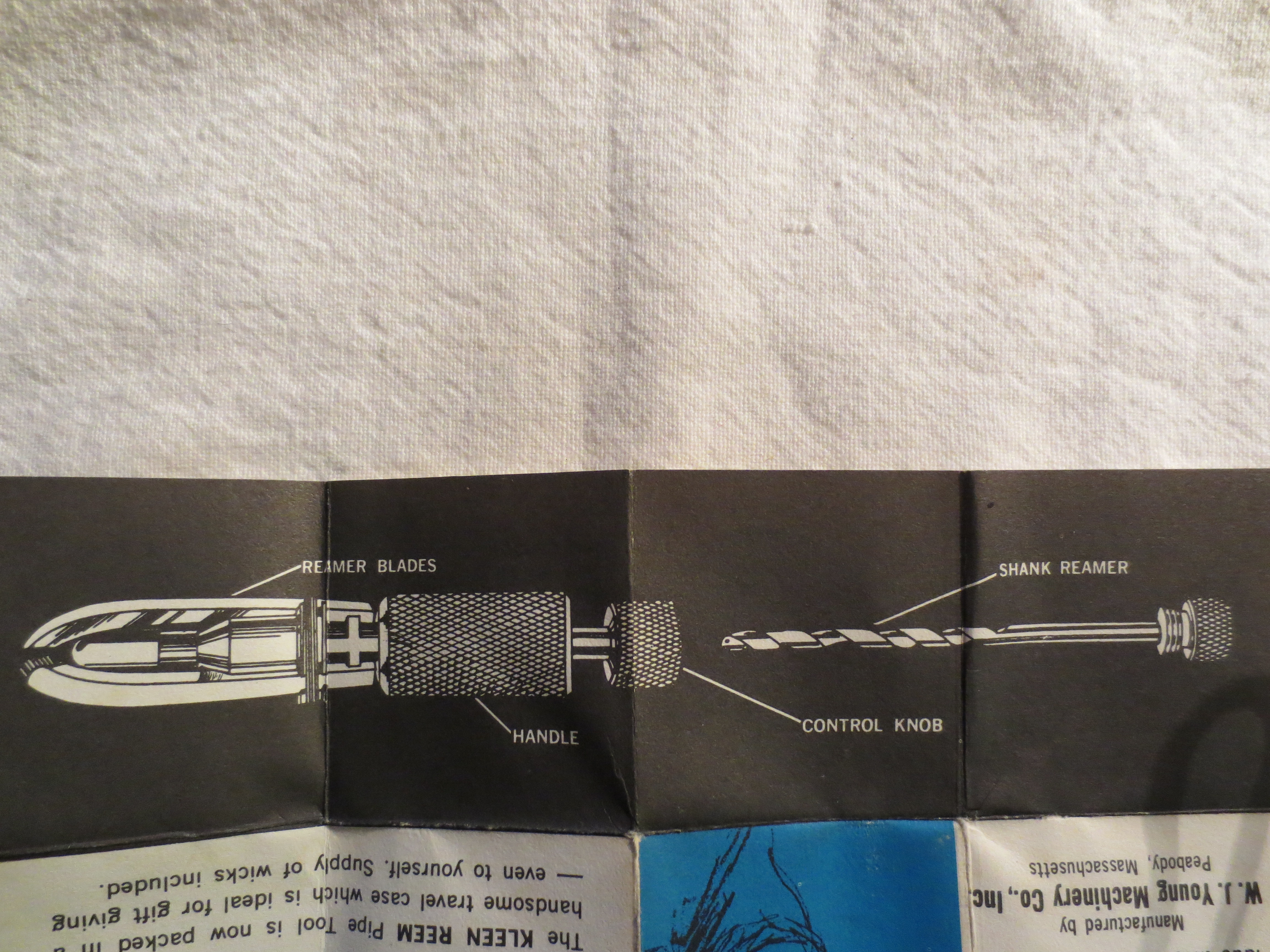
Another Instruction Manual for Kleen Reem Pipe Reamers


As I was going through some of my collection of pamphlets and brochures in a drawer this afternoon I came across this Instruction Manual for Kleen Reem Pipe Reamers. It is the second one that I have. Both are very different in design and layout and seem to be from a different era. I enjoy looking at this kind of tobacciana so I thought I would pass it on to others who might also be interested in such things.
IMG_0781

IMG_0785

IMG_0786

IMG_0787

IMG_0788

IMG_0783

Flash Tour of Gallwitz Pipe Shop – Budapest


Blog by Steve Laug

When I was preparing for my trip to Budapest I came across this great old tobacco shop. I enjoyed the video/flash presentation of the shop, its history and wares and thought I would post the link here.

http://www.gallwitz.hu/

Once you are on the website click on the word Belepes (If you are Hungarian, please forgive my lack of accents on the Hungarian words. I do not have the ability to add them at this point) as pictured in the screen below. That will take you to the second screen pictured below.

Image

Or you can just click on this link http://www.gallwitz.hu/gallwitz.html and you will be taken to the screen pictured below. Once you have the screen pictured above on the website click on KEPEK UZLETUNKROL and a new screen will open with a video tour of the pipe shop. You can also click on the headings on the screen for a bit of a tour of the wares. Click on PIPAK for Pipes etc.

Gallwitz2

It is an amazing place. Having been there in person I can tell you that it met my expectations of a place filled with pipe history. Enjoy!

(You will need to have Adobe Flash installed to watch the video.)

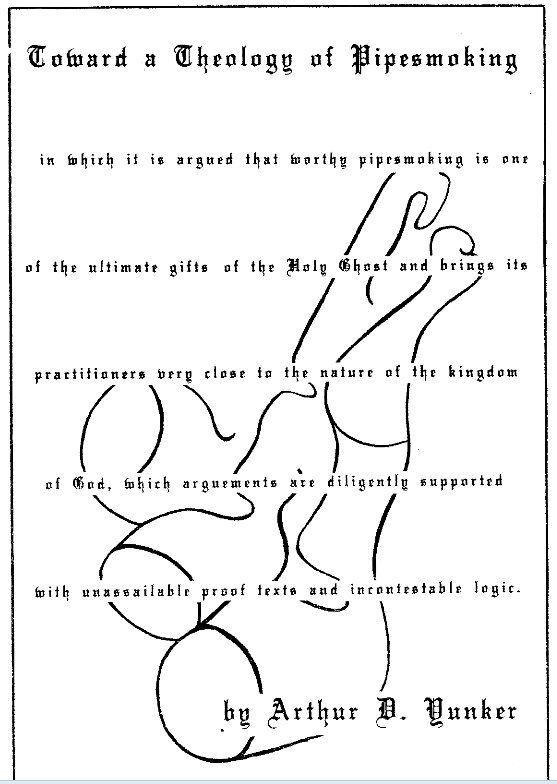
Toward A Theology of Pipesmoking


Theology of pipesmoking cover

Many years ago now, I came across this great 2 part Toward a Theology of Pipesmoking, written by Concordia student Arthur Yunker in 1970. I read it and laughed and laughed. It is a well written 73 page document, including 5 appendices. Its hilarious and whimsical. I was rereading some of the documents I have on my hard drive and came across this again. I read it again and it still brought a laugh to me and yet also a time to reflect. Have a look and see what you think. Remember to read it without taking yourself to seriously. Toward a Theology of Pipesmoking is quite interesting and entertaining.  Read it when you have some time on your hands and can settle into your favorite chair with a pipe.

Click on the hyperlinks that follow and you can then read online or download the two parts.

Theology of Pipesmoking part 1 of 2

Theology of Pipesmoking part 2 of 2

I raise my pipe to you Arthur D. Yunker for your great whimsical work and say thank you for the hearty laugh and sense of pleasure that you provide for me every time I read your work.

Here is an abstract of the work to give you an idea of the content:

Toward a Theology of Pipesmoking

In which it is argued that worthy pipesmoking is one of the ultimate gifts of the Holy Ghost and brings its practitioners very close to the nature of the Kingdom of God, which arguments are diligently supported by unassailable proof texts and incontestable logic.

My Methodology for a Pipe Hunt


The many comments about how lucky I am to find old estate pipes in the variety of places that I do has led me to write this piece. I am convinced that by and large, it is not a matter of luck but rather a matter of a well-defined strategy of the hunt. Over the years I have developed a pattern in my pipe hunt that I rarely vary when I am out looking for pipes. That pattern has served me well and I have come home with some nice pipes that need varying degrees of work. Whether the shop I enter is an antique shop, antique mall, flea market, garage sale, thrift shop, rummage shop the pattern remains the same.

For me the hunt begins before I walk in the door. I am not looking for yuppified businesses that have a strident non-smoking policy and seem to carry that over to the items sold in their shops. I am looking for a slightly chaotic shop or mall, where there are lots of places that pipes and such can disappear into the raft of stuff for sale. I also eye the sales people to see if they are smokers (often standing outside here in Vancouver having a smoke). If so that is a good sign. I also find that one of the telltale signs of this kind of shop is overcrowded windows and stuff for sale on the sidewalk. When I see all those things I almost always find a pipe or two in the shop. I may not buy any as I am getting picky these days but I will find pipes there.

When I get in the door I am on the alert for all the spots that I have found pipes in shops like this – in boxes, cans, tobacco tins, cigar boxes, jars, pitchers, behind humidors, inside humidors. You get the picture. They are not always obvious to a cursory look so as I do a quick walk through the shop noting where the pipes may be I look literally in and behind many items. I look through locked cases, on the bottom shelves of display cases, behind crammed shelving in cabinets. Many times even these items are relegated to either the top shelf or the bottom shelf throughout the store. At this point in the hunt I usually do not pick up anything as I don’t want to carry it with me through the shop. I merely note the places I see the pipes; I quickly look through them to see if there are any worth more attention and keep moving. I also keep an eye out for tobacciana – tins, reamers, racks, tampers, etc. The idea for me is to get an overview of the shop and its pipe and tobacco contents.

After the quick walk through I will make a second pass through the store if the first walk turns up anything of interest. If not I will often check a few spots in the store that have been fruitful to me in the past. If I have seen things that interest me I will start the second walk through. It is a more slowly paced walk through specifically looking through the pipes that I found on the first pass. What always amazes me is that no matter how well I look on that first walk about it is this second that seems to turn up pipes that have appeared after I walked through the first time. The idea on this walk is to take time to pick up the pipes and examine them carefully. The first walk takes me very little time, but the second one is longer by virtue of the objective.

On this walk remember to look behind items on the shelves, move things to see what you can find. To me this is the fun of the hunt. I think it is also what drives my wife nuts about our stops at shops, antique malls, flea markets and the like. I walk through the shop at least twice. I go back to the places/stalls where I had noted the pipes that I wanted to take a bit more time looking at. I pick each one up and assess its condition. I look at the stampings, the stem fit, the rim and the finish, the stem condition (bite marks, etc.) and try to estimate the amount of work it will take to bring it back to life. I then look at the price and estimate the value when I add the cost of my work on the pipe to see if it is one that can be sold to recoup the cost. Often, even if the pipe is a wreck, there is something in the look of the pipe that grabs my attention. That “call of the pipe” seems to be something that is inexplicable to me. It takes no regard of the stamping, brand or condition, but it calls me to make this pipe my own. Sometimes I think it is the story that seems to come through in the condition of the briar, or the tobacco that is still in the bowl. Whatever it is it is a part of at least some of the pipes that make their way back to the sales counter.

If the display cases are locked, I note the number on the case and enlist the help of the sales staff to open the cases for me. I get them to walk with me through the various locked cases that I found. I take advantage of having them with me on this part of the walk and while I have their attention I ask about other pipes that may be in the back room, in boxes at home or just somewhere in the shop that I have not seen. Often they will tell me about the same ones that I have seen already, but it has happened often enough that I have missed something so I ask every time. When I find a pipe in one of the cases that I want to buy I give it to the sales person and have them carry it to the front for me. Once I have finished with them I continue looking at the other areas that I had noted at first. I have found quite a few full tins of tobacco – ranging from Dobie’s Four Square to Prince Albert. The tobaccos in the tins are often well preserved and ready for smoking. Some of them need to be rehydrated, but even those smoke well for me. I have also picked up pipe rests, tampers and reamers in the process of the hunt.

Once I have finished looking through the store I take my haul to the cashier. Usually there is a counter that I can lay the pipes on to go through them all again to make sure that I have not missed anything. I do this because in the past I have gotten home and taken the pipes out of the bag only to find some surprises, cracks or damage that I had not paid attention to in the store. I sort them into two piles – the “have to have pile” and the “want to have pile”. This takes a bit of time but I have found that it is worth the effort as it keeps me from buying things on impulse. I check out the nomenclature of the pipes and if they are screw mount stems I check out the threads and the stinger apparatus. I look more closely for cracks in the bowl, shank or stem. Shank cracks and stem cracks don’t disqualify a pipe for me, though a cracked bowl does. These go into the “want to have pile”. When I finish the sorting I always ask the sales clerk if there are any other pipes that I may have missed. I learned to do this because often they have some under the counter or in the back that may have been overlooked. I add those to the piles and then make a final decision as to what I am taking home with me.

Before I leave I usually give them my phone number and ask them to call me if they find any pipes at home or if someone brings some in. Not everyone will call, but many will. I also make sure to pick up a business card and add it to my business card file. I make it a habit to call the productive shops and malls regularly and ask if they have any pipes that have come in. Doing this makes it more likely that they will call me when some come in. I have had them call and have called myself as an estate has come in. Because I have taken the time to call and build a bit of a relationship with the staff I have picked up some nice older pipes. Sometimes in doing this I find that it is necessary to take the whole lot even if there are some useless pipes there. I do not want to jeopardize the connection as it is those calls that have brought me some of the best pipes I have found.

My hunting has turned up some beautiful older estates for me to work on. I have found Kaywoodies, Yello Boles, Lees, Stanwells, Brighams, Loewes, Bertrams, Dunhills, Larsens, Kriswell, Savinellis, Bewlays, Comoys, Barlings, GBDs and others that escape my memory. For example I have found 12 or more Dunhills over the years – the best one being an unsmoked 1962 Tan Blast Billiard and the oldest being a 1932 Shell Bent Billiard. I have cleaned up and sold many of the pipes I have found and still have over a hundred that I need to sell. I have added many to my own collection as well. The hunt goes on and will continue as long as I have breath. The joy of the hunt and the amazing finds keep me looking.

I Guess I Collect Pipe Reamers


Blog by Steve Laug

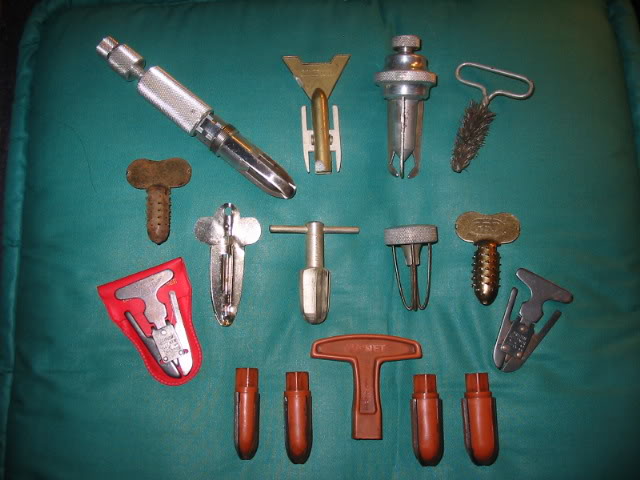
One of the side hobbies that came with collecting pipes was the collection of pipe reamers. I love the creativity and inventiveness that went into each one in my collection. I use many different reamers in the process of refurbishing pipes. It seems like I always need one that is shaped a bit differently than the one I am using so I reach into my box of reamers and almost certainly I will have one that fits the bowl size and shape.
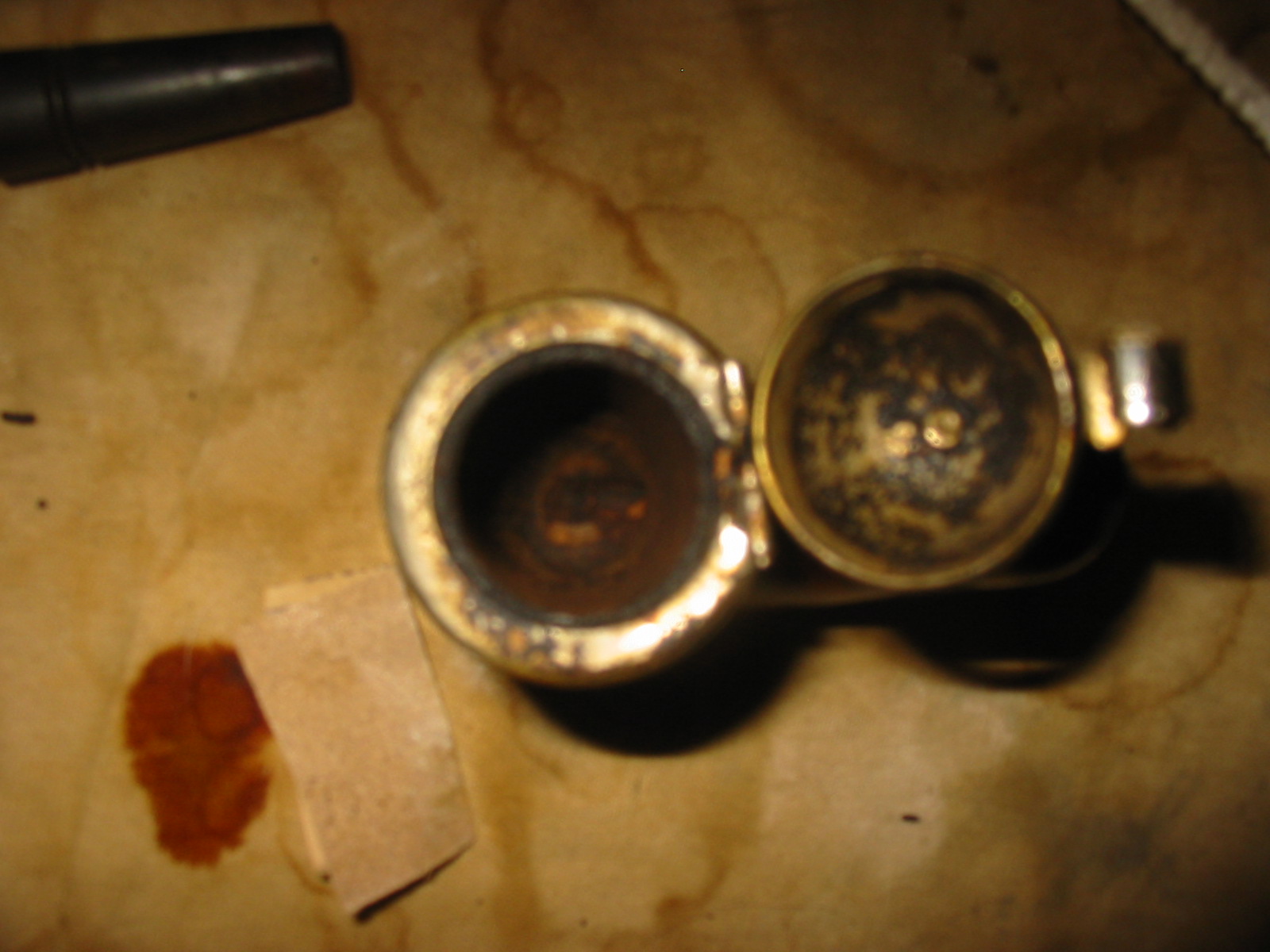
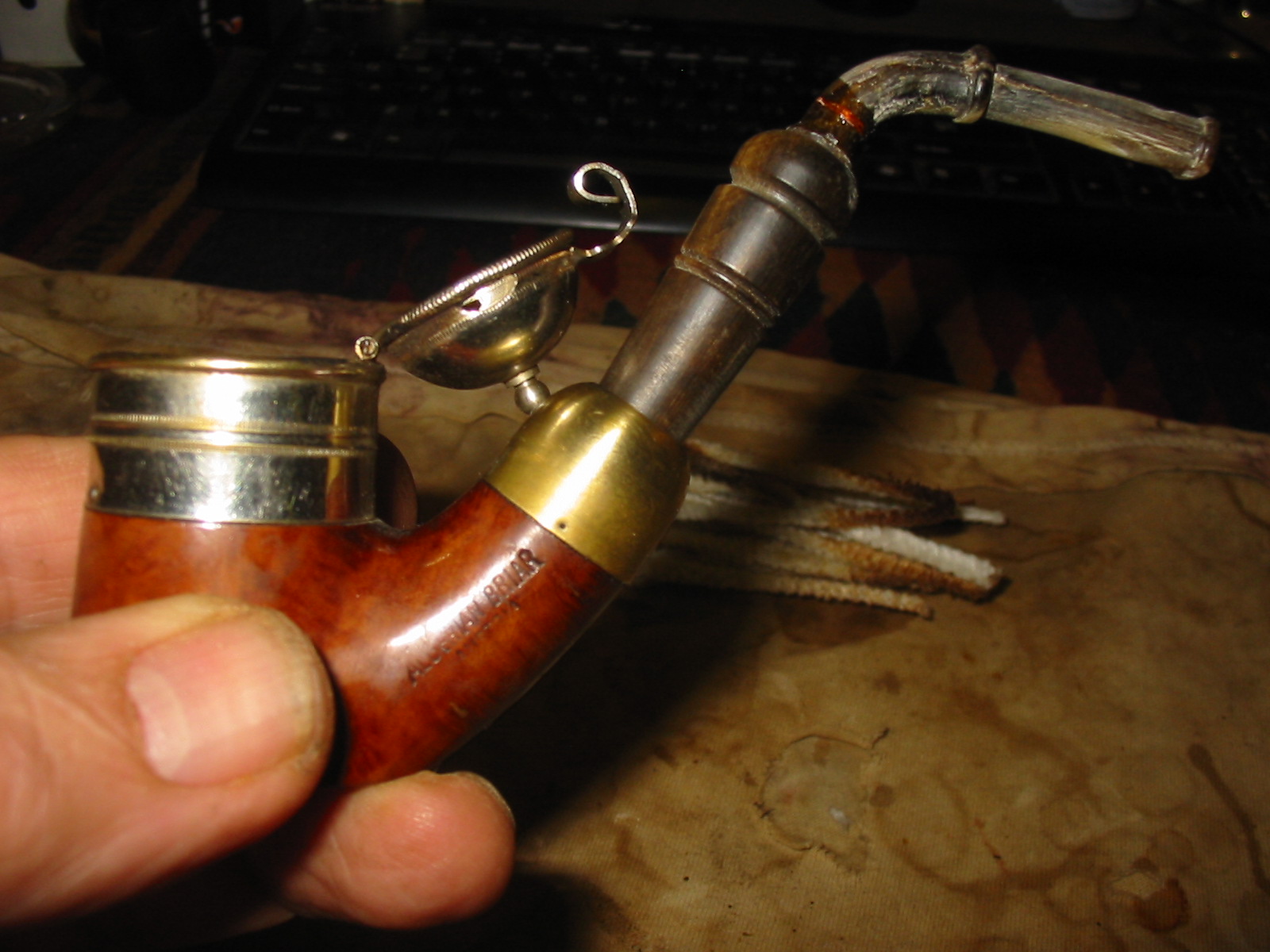
Image

In the top row from left to right – a KleenReem reamer, an Atlas Rocket, A Rogers Rocket, and bristle brush on a handle. The KleenReem is one of the reamers that I use almost all of the time. It is adjustable and has a built in drill bit that work well in cleaning out the shank. The Atlas Rocket is spring loaded and work in both conical bowls and U shaped bowls. I use it on lightly caked pipes that I am cleaning. The Rogers Rocket is a bit of overkill but works well on U shaped bowls as the blades are adjustable. The steel bristle brush is very good for just knocking off lightly coated bowls and as a finish to bowls that I have reamed.

The second row from left to right – A Hedgehog Reamer, a no name folding reamer, a Dunhill T handle reamer, a spring steel blade adjustable reamer, a GBD reamer. The Hedgehog and the GBD reamer are similar – they are a steel bullet shaped end with a key top that has sharp metal spikes all around it. These two I rarely use as they just seem too brutal. The no name reamer is really nice for narrow conical bowls and reaches to the bottom of the bowl. The spring steel bald reamer is great as an initial field ream of the pipe. The Dunhill T handle reamer I have used to finish a reaming of many pipes. It seems to be sharp and is capable of smoothing out the cake and bowl walls to a nice finish. The spring steel blades adjust to fit any bowl size or shape.

The bottom row from left to right – In the red package is a British Buttner reamer and on the far right bottom is a second one. These two I generally have with me when I am travelling and on the prowl for estate pipes. They work great on pretty much any pipe bowl to give me a good cleaning before I bring them home to the shop. Care must be exercised as they can easily make a bowl lose its round shape if you do not hold it vertically when you turn it. In the centre at the bottom is my favourite reamer – a PipNet reaming set. It includes a T handle and four heads of different sizes that each has four blades embedded in the plastic. These can quickly be changed from size to size and any bowl is easily reamed. They do work best on U shaped bowls.

I think since I took this picture I have picked up several more reamers for the collection but these give the basic idea of what I use in the process of a refurbishment. Keep an eye open for reamers while you are out and about in the shops looking for estate pipes or on EBay looking for pipe lots. You never know what kind of great tool you are going to find. If you have some that are not in the picture above and want to part with them drop me a line or comment on this post. We can work something out!