
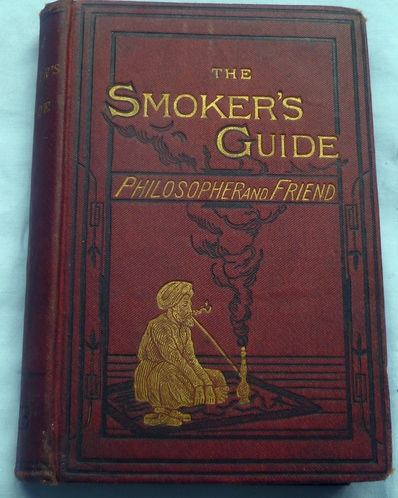
 I picked up this old book on eBay after I came across it a few months ago. I was the only bidder so I got it for a good price. It is subtitled What to Smoke –What to Smoke With – And the Whole “What’s What” of Tobacco, Historical, Botanical, Manufactural, Anecdotal, Social, Medical, Etc. The author identifies himself as A Veteran of Smokedom. The book was originally published by Hardwicke & Bogue, 192 Piccadilly, London in 1877. The cover is stamped and embossed with gold leaf and shows a Turkish pipe smoker sitting on a carpet with his water pipe putting out a cloud of smoke. The spine of the book is stamped in gold leaf with the title, The Smoker’s Guide at the top of the spine and a line with H&B at the bottom of the spine.. The back cover is embossed with a rosette. The entire book is in great shape for its age with the only detracting feature being that the binding is a bit shaken and the corners of the cover and the top and bottom of the spine are slightly worn.
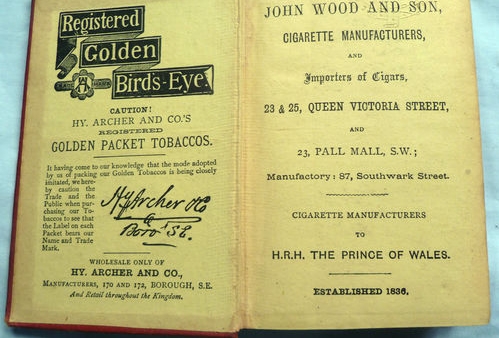
Like many of the books from this era the end papers on the front and the back of the book bear advertising broadsides. Inside the front cover is one for Registered Golden Bird’s-Eye Tobacco a product of the HY Archer and Co. The advert warns of others who have imitated their product and cautions the buyer to beware. Across t he page is an advert for John Wood and Son, Cigarette Manufacturers and Importers of Cigars. The content of these adverts is great to read.
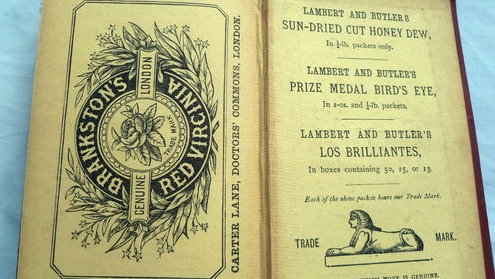
Inside the back cover is an advertisment for Lambert and Butler’s Sun-Dried Cut Honey Dew tobacco. Across the page is one for Brankston’s Red Virginia Tobacco. All of these advertisements make my mouth water and create a desire to try out these old time tobaccos.
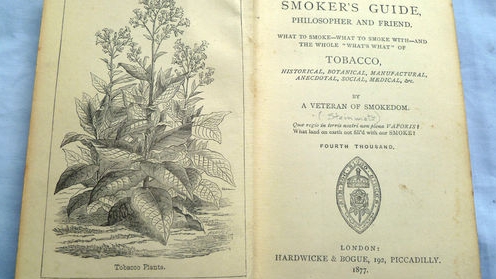
Turning the pages from the front one is taken to the title page of the book with an engraving of a tobacco plant on the opposite page. It appears that someone has written the name Steinmetz in brackets under the author’s title “A Veteran of Smokedom”. I am not sure if this is a guess of the original author’s name or a factual statement of the writer added by a librarian or previous owner of the book.
The book begins with a note to the reader that reads as follows: “The adoption of Pope’s memorable words addressed to Lord Bolingbroke for the title of this little work inspired the entire design, and made it incumbent upon the Author to do his utmost to render it worthy of so comprehensive a designation.
In the attempt he has been largely assisted by his innumerable predecessors in Tabacology, and almost every other “ology.” But, whilst drawing from every available source, he has taken nothing without striving to adorn it – after the good example of Virgil, Milton, Byron, and all the most enduring writers of ancient and modern times, who have thereby secured immortality – simply because so many other worthies have contributed to, and can vouch for, their excellence.
In like manner, whilst thankful to all the gods of Literature and Science for the gifts they have showered into his casket, the Author trusts that he has fashioned and set their gems in a new light, for livelier appreciation.”
After the note to the reader the Table of Contents shows the brief and broad categories of the chapters of the book. The Table of Contents also gives a brief description of the content of each chapter. I find this helpful in being able to look for particular topics that are covered in the book.
I have included a copy of the table of contents for you to have a look at. It will show you the flow and development of the book over the course of the pages.
A few words to begin with
Chapter 1 – The curious history of the Weed
Chapter 2 – The cultivation, manufacture and consumption of Tobacco
Chapter 3 – He who smokes dines
Chapter 4 – What Tobacco shall we smoke?
Chapter 5 – Of the Cigar and Cigarette
Chapter 6 – Of the qualities of a good pipe
Chapter 7 – Of Tobacco in the religious point of view
Chapter 8 – Of Tobacco and ‘Les Miserables,’ or as the comfort of the afflicted
Chapter 9 – Tobacco in the artistic point of view
Chapter 10 – Of Tobacco in the medical point of view
Chapter 11 – Tobacco a mine of gold to trade and government
Chapter 12 – Tobacco the firmest support of constitutional government
Chapter 13 – Smoking compared with other extravagances
Chapter 14 – Tobacco and its enemies
Chapter 15 – Words of the wise on Tobacco
Chapter 16 – Tobacco in the literary point of view
Chapter 17 – Tobacco and the Franco-German war
Chapter 18 – Of Tobacco in the poetic point of view
Chapter 19 – Tobacco and the fair sex
Chapter 20 – Of Tobacco in the ruminant or Quid point of view
Chapter 21 – Of snuff and snuffers
Chapter 22 – Useful hints to smokers
Chapter 23 – A word of advice to our young friends
Each chapter is written in a very clear and easy to read style. It is written in the period of the style of the age. The author uses language well and in a very picturesque way describes each of the topics at hand. The author also makes use of quite a few contemporary authors as well as ancient ones to substantiate his work. The quotes are well footnoted in the text of the book.
The first two chapters give the background information regarding the history and manufacture of tobacco. These provide the base from which he will develop the rest of the book. Chapter 1, the longest chapter in the book, gives a quick overview of the history of tobacco and traces it through various countries and kingdoms in terms of acceptance and rejection. I appreciate the way in which the author covers the history on both sides of the pro and anti camps. He traces the argument through each time period he covers. His method in looking at the history is a unique and fascinating read of the times. Chapter 2, also a long chapter looks at the various countries which produce tobacco and the amount and variety of the tobacco produced. After covering these bases the author steps aside from the background information and looks at the use and enjoyment of tobacco.
In the remaining chapters he intersperses what he call the various points of view from which he views tobacco. He develops chapters on the religious point of view, the use of tobacco for the suffering individual, the artistic point of view, the medical point of view, the literary point of view, the poetic point of view and from the point of view of the ruminant. Each of these chapters cites various authors and authorities in the particular field that is being viewed from both the positive and negative point of view. In between these chapters he covers a wide variety of topics. He has an essay on each of the following topics: the choice of tobacco that we use and the means of that use whether pipe, cigarette, cigar, snuff or chew. There are also topics on the economics of tobacco for governments – in other words taxation and its benefits to the government, on the enemies of tobacco and on the friends of tobacco – those he calls the wise. He writes about smoking in comparison to other extravagances, tobacco and women and even a chapter on tobacco and the Franco-German war. He concludes the book with two chapters in which he applies the information of which he has written. The first is written as hints to the smoker and the final he entitles advice to our young friends.
I appreciate the candour and thoroughness of the treatment he gives to tobacco. The older style of writing is not beyond our modern aversion to old and flowery language. He writes in a clear and entertaining fashion about the hobby we love. If you can find a copy of the book I highly recommend it for your reading pleasure. There is a quaint and delightful sense of being transported back in time as you turn the pages of chapter after chapter.
 rebornpipes