
Blog by Steve Laug
When I knew I was heading to Budapest again in September 2022 I was certain that I wanted to visit a shop that had first gone to in October 2010 (twelve years ago now). I have visited and revisited this particular pipe shop in Budapest several times over the years. I have gone there and each time I visited it had been reduced more and more by the restrictive laws and interventions of the Hungarian government. I was not sure the shop would still be there this time as it had been seven years since the last time I had been there. I am including the link to the blog I wrote on the last visit below (https://rebornpipes.com/2015/10/10/will-it-still-be-there-next-time-memories-of-the-pipetorium-in-budapest-hungary/).
It was quite a shop back in 2010 when I made my first visit. To me it was the epitome of the old European Tobacco Shop. It was small and packed with all kinds of pipes and pipe accessories. The back walls behind the counter were packed with tins and pouches of tobaccos and pipe cleaners and tampers and… the list could go on. Everything one needed for smoking – pipes, tobacco, cigars, cigarettes, even books for teaching how to use your pipe lined the shelves. The owner was a hobbitlike fellow that obviously enjoyed his shop and had a keen eye for all things pipe. If you could not figure out what you needed he was a master at it. Along the walls and in the display window were pieces of pipe history from a far removed time period that gave you a glimpse of the way things once were. It was the oldest independent pipe shop in Hungary founded in 1933 and still in operation when I was there in 2010. When I went back in 2015 and it had become significantly less even though the old fellow who ran the shop was still there at that time. It was located at József krt. 38, Budapest, Hungary 1085 and was open from 10am to 6pm during the week. My hope was that the shop would still be there on this visit.
I was hoping that the unique little shop with its hobbit like shop keeper had not changed. The following three photos are pictures of what the shop looked like the first time I visited it in 2010. I have included them to show the stark contrast to what I met on this trip. The building was cut stone and the arched doorway had the words Dohanybolt over the door. There was an awning that had flowers and copper tiles. When I had been there the first time in October 2010 the awning looked as it is in the first photo below. The door itself occupied the right side of the archway and had the words PIPA painted on the glass. The left side of the archway was a display window that I spoke of above. There were pipes and racks, old tins and pouches and pipes from days gone by that I had never seen the likes of. There were old meerschaum and briars and decorative tins and jars of tobacco that no longer was sold. To the left side of the door on there was a rich red sign with a pipe in an oval that had the words Pipatorium across the bottom.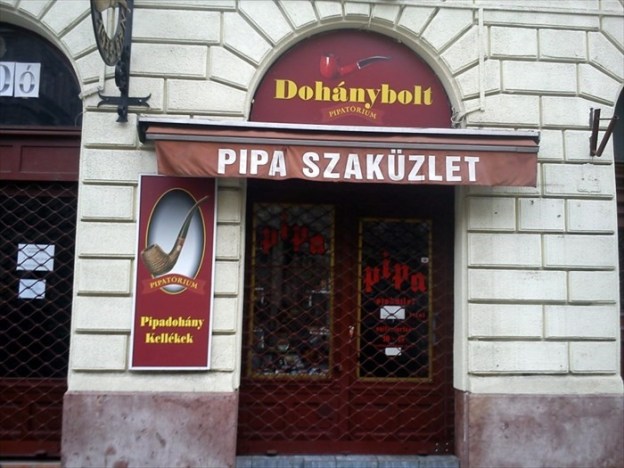
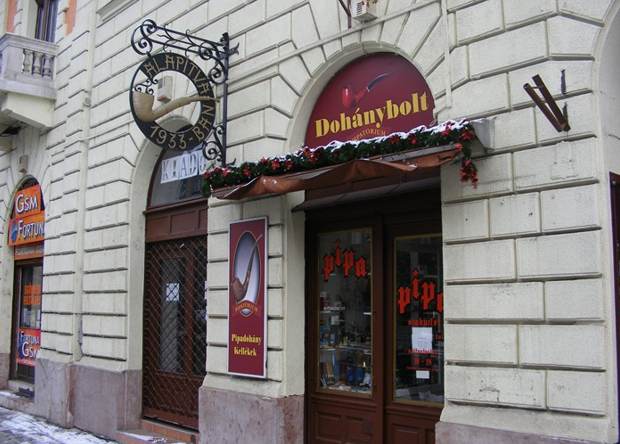
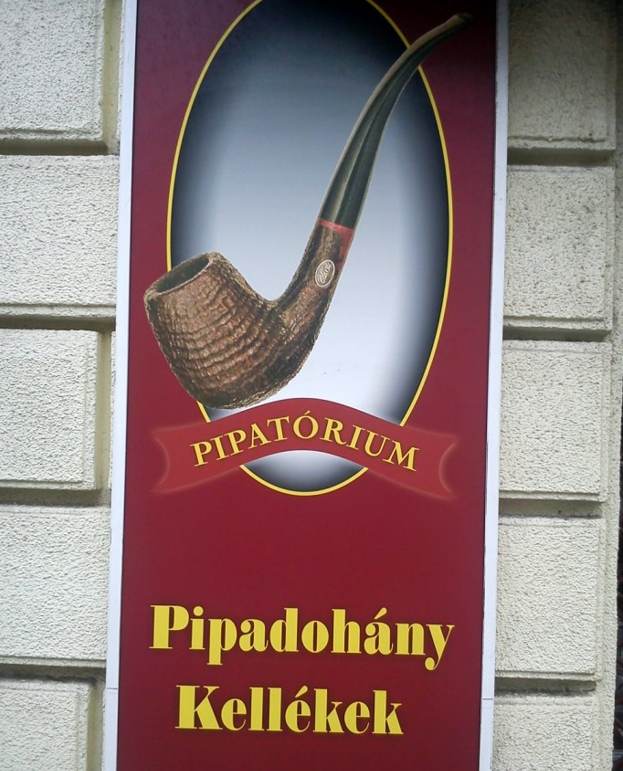 Above the Pipatorium sign on the wall there had been an elaborate sign that stood out from the wall on wrought iron braces. It was in Hungarian but left little doubt as to its meaning. The pipe in the middle made it clear that it was a pipe shop and the date at the bottom made clear the date it had been established. To me that sign became the singular memory that stuck in my mind of the outside of the shop. The last time I visited in 2015 all the identifying signs were removed and a sanitized storefront remained. Last time I remember that my friend said that the shop owner was struggling with the oppressive laws regarding tobacco and the signage and frontage of tobacco shops. I included these photos of the amazing sign that I remembered so well even though I knew that it was gone.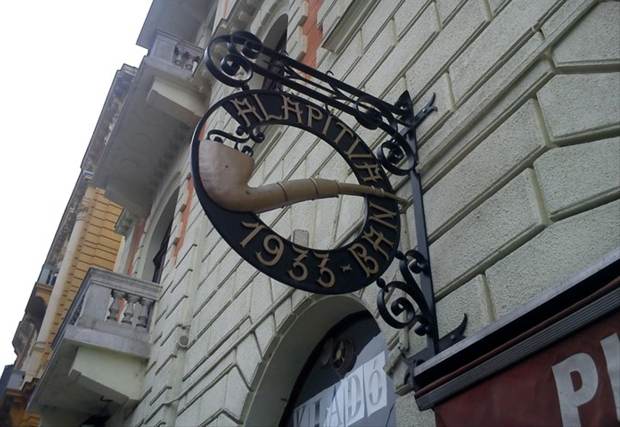
 We turned the corner on József Krt came to the location of the shop. I was surprised. Even though I had been here since it had been sanitized I would easily have walked right by without
 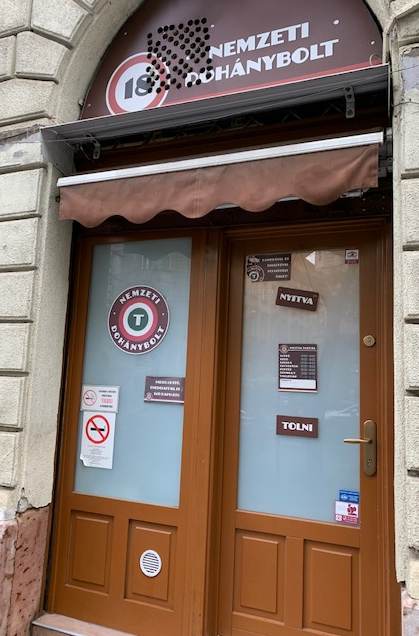 knowing that I had missed it. All of the unique, classic pipe signage was gone and in their place was the circular government tobacco shop sign. The display window to the left of the door and the window on the door itself had been painted over. The front of the shop looked like the photo below. I don’t know about you but the sanitized look was lacking all of the previous charm of the original shop. From the outside there was no reason to believe that the shop of my memories was still there. Everything I loved about the curb appeal of the place was still gone and as in 2015 the place had a cold sanitized looking frontage. The fancy awning had been removed and in its place above the door a motorized metal shutter had been installed so that when the shop was closed even the door disappeared and in its place was a steel door that made the place not only “safe” in the eyes of the government but also made it disappear. I just paused and shook my head trying to fathom the loss of another of my memories. I wondered what was behind the door. I really wondered if anything would be left.
Honestly, I was expecting the worst. Would the inside of the shop be worse than even the memory of my last visit? Would the sanitizing hand of governmental bureaucracy have even stripped away even more of the inside of the shop? I was not sure. The painted windows and door had darkened what had once been a bright hobbit hole of a shop. I looked at the wall to the right of the counter – yes, it still had the display cases but they were much more empty. I looked at the one to the right and saw that the shelves of older pipes and museum like pieces was gone and not even a remnant of them was present. There were screws in the wall where displays had been. 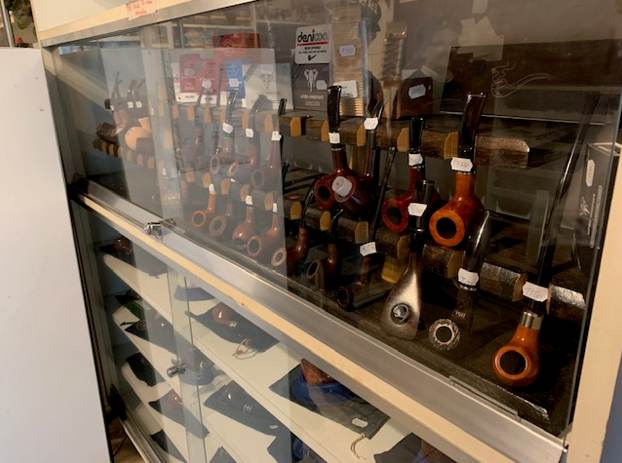
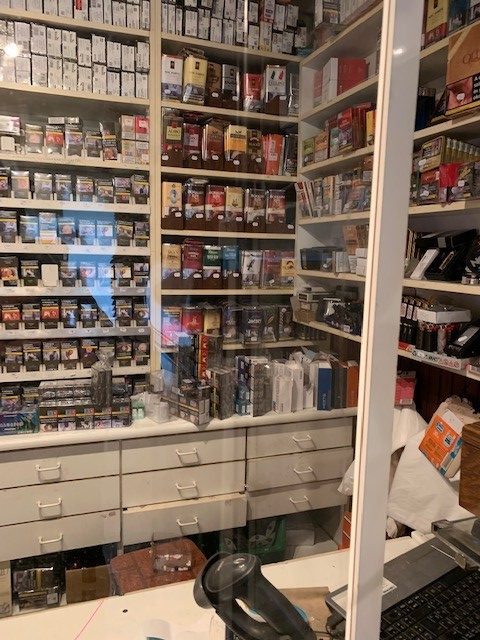
 The back wall still held the counter but in this post-COVID world even that had changed and been locked behind a glass wall that not only protected the owner from me but left little sense of the original humanity of the shop. The shelves were lined with tobacco and it seemed to be a large selection but on closer examination proved to mostly filled with cigarettes and the makings and rolling papers of the same. The right corner of the photo below shows what remained of pipe tobaccos – a mere remnant of what had been there before. In the place of Hungarian and Czech tobaccos were now primarily MacBaren pouches and tins that are now available throughout the EU. Tucked at the bottom of the shelf in the corner were several small pouches of Hungarian tobaccos.
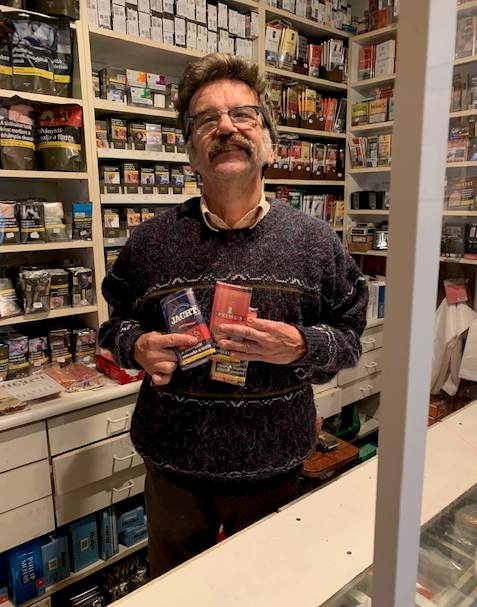
  The hobbitlike owner who I had met previously still sat behind his counter. We visited and talked about the state of his shop. He told me that he was saddened by the changes that had been forced upon him by the government regulations. He said that he was still surviving. I shared with him my memories of the way the shop had looked when I had been there previously and the special place it occupied in my mind from that first visit. I could tell that he too missed those days. Sitting in the darkened shop with none of the charm that drew people like me into it interior must have been very difficult for him. I picked up some of the only Hungarian Tobaccos that remained in the shop – one labeled Jacht and the other Primus 1 and both were Virginias. There was nothing left of the Balkan Tobaccos that had special display on the wall. The right wall had a smattering of cigars and a selection of throw away lighters. The shop was a skeleton of what it had once been. I took a photo of him holding my purchases so I would have a clear memory of the visit.
 I bade him farewell for perhaps the last time and made my way back to the door and out to city beyond. Before leaving the shop I took another look around at the interior of the shop. I took in the now meager displays of pipes and tobaccos and wondered if this would be the last time I came to this shop. If things continued as they had in past seven years then who could truly say if the marvelous Pipatorium would be here on my next visit to Budapest. Time would tell.
 rebornpipes