
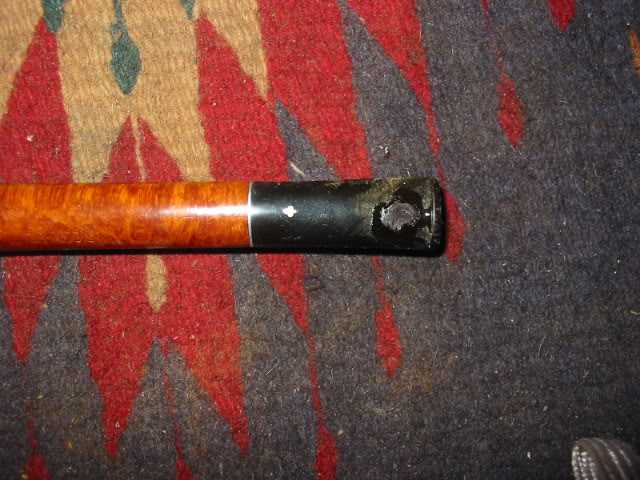
I thought I would write an article on this topic as I just finished repairing a bite through on an old London Made pipe with a vulcanite stem. It is fresh in my mind so it will be easy to write it down, plus I enjoy passing on my refurbishing processes to others to experiment with.
To begin the patching process you need to make sure the stem is clean of all oils, waxes and oxidation. You want the patch to bond well with the original stem. I have also found that any oxidation will show through the patch and leave a blemish on the stem that is cannot be removed as it is under the patch. With that in mind I removed the oxidation from the stem with repeated soaks in a tub of Oxyclean. I mix it 1 scoop to a quart of hot water. I put the lid on it and shake vigorously to mix the powder. Once it is well mixed the stem goes into the water for its first soak. I wash it off and sand or buff between soaks to remove any oxidation that is soften enough to remove it. Then it goes back into the jar for another soak. I repeat the process until the stem comes out clean.
I take it from the final wash and I sand the stem with multiple grits of sand paper to get the stem back to a matte black finish. I don’t want a sheen on the stem yet as I want a bit of roughness in order that the patch will adhere well. Once completed, I use a dental pick to clean up the area around the bite through and remove any remaining rubbish in the hole. I then used a small needle file to roughen the broken surface of the spot to prepare it for the patch.
I soak a pipe cleaner in olive oil (not dripping oily but enough to make it slick as you do not want it gurgling out the hole and messing up the part you have just cleaned. Believe me Super Glue will not stick to oily slick surfaces and it will never dry when mixed with oil.) The pipe cleaner is inserted into the button on the stem just past the bite through. This provides a block on the underside of the hole and also a non stick surface so that the glue used in the repair does not fill the airway and cause the pipe cleaner to bond to the inside of the stem.
I used clear Krazy Glue/Super Glue (you can get black Super Glue from wood working supply sites online) and did an initial fill on the hole. The idea is to get a good bond on the hole itself and not try to over fill. Once it was dry (very quickly) I sanded the surface to roughen the initial patch and then filled the hole and surrounding dent to a bit overfilled (a bubble if you can picture that). I set it aside over night and then the next morning sanded it smooth to match the surrounding surface. If the hole is large the idea is to build out toward the middle with repeated applications of the glue.
I have experimented with different drying times that are optimal for the sanding process and found that the one I stated above works the best for me. The first application is a quick dry and is sanded while the glue is not cured. The second application is hard when I sand it. I use multiple grits (400, 600) of wet dry sand paper and then microfiber sanding disks (1800, 2400, 4000) to blend the patch to the surrounding stem area and then gave the entirety a buff with red Tripoli and then white diamond. I finished the polishing with 4000 grit microfiber disk and it is virtually invisible and has formed a hard bond with the stem.
I am just an amateur refurbisher sharing how I do a patch. I am sure others here, particularly the pipe repair folks, have other methods and better ones. But this one works for me. I will try to do a photo essay on the next pipe stem I patch to show pictorially what I do.
Oh… for information sake – I have pipes that I have repaired in this manner that I have been smoking for 10 years that show no breakdown in the patch.




 rebornpipes