
A needle file is a tool that I have referred to often in this blog and one that I use almost every time I work on a stem or shank in the refurbishing process. I have three sets of files that each has 12 files in various shapes. The reason for the three sets is the size of the files in each set. The picture below shows one of the sets that I have.
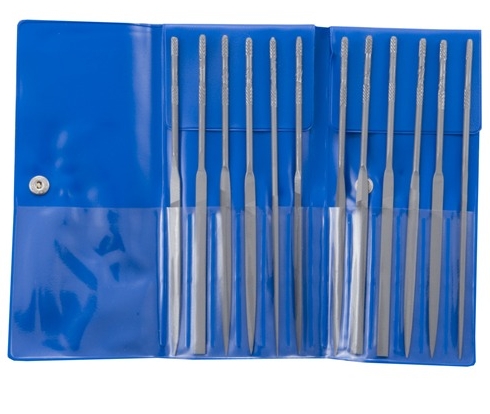
Needle files are commonly used in crafts or design work to finish small pieces of material. My daughter uses them in her jewelry design work to open the tiny holes in beads to make them easier to thread. They are also used in model building, guitar making, fine instrument repairs and a world of other work. They are an indispensable tool to do the fine and detailed work needed in tight spaces. Most common files are made from a hard steel bar with a series of narrow or pointed ridges or teeth that face upward. The needle file is no different and is made up of a series of teeth laid out on a piece of metal, usually with a handle on the end. It is a very small tool that is usually sold in sets of five or more files. Two of my sets have handles – one with a hard plastic handle and one with the end dipped in rubberized material. The third and smallest set is exactly like the one pictured above.
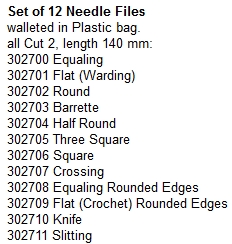
You will find if you do a Google search for needle files that there are many different types and descriptions and it can be a bit daunting to figure out the difference. The easiest explanation on the difference in the files that are available on the market is based on the cut of the teeth and the size and shape of the file, as each file is designed to be used for a different purpose. The teeth in the file are specifically designed to create different finishes on an object. Diamond needle files, hand files, checkering files, crossing files and half round ring files are a few of the common types of needle files that exist today. The chart below shows some of the shapes that are commonly found in a set of files.
I have found that a needle file is excellent for shaping, designing and smoothing the button area on a stem, opening the airway in the slot and also opening the airway in the tenon. The different shapes of the files allow me to cut the vulcanite or Lucite in the shapes that I am aiming for. I personally like an oval slot so I use three different shapes – a round, an oval and a wedge to shape the slot. The round file and the oval file also work well on the tenon. I use a rectangular flat one to cut the edge of the button and to shape and reshape that area of the stem. The file is pushed it back and forth over the piece to create friction between the teeth of the file and the object. The teeth of the needle file pushing against the object will work to shave off pieces of the material until the desired effect is produced. A needle file is typically used to carve out the intricate details, smooth out a surface or provide a specific finish on a piece.
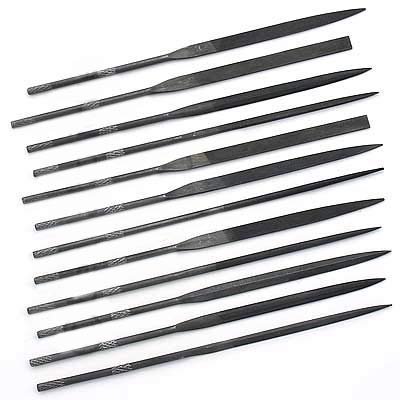
When you look at the file sets you will see that needle files each have a slightly different shape to allow for different uses and handling. In the sets I have there are certainly some shapes that I have never used extensively. At one time or another I have tried them all to see what they can do but have settled into the common 5 or 6 that are close at hand. Each of these files is specifically used for detailing work on the surface of a project. Some of the needle files have a sharp pointed tip, which can be used for opening airways or even puncturing blocked stems or airways. I clean the files with isopropyl alcohol and a soft tooth brush to remove the vulcanite dust from the teeth and to keep the files sharp and useable. Remember, a needle file is not a tool that I would use to file large amount of vulcanite on the stem or to remove excess material, but rather to fine tune shapes and airways on the stem.
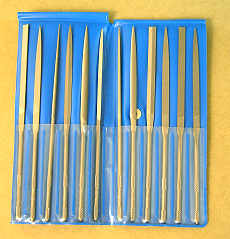
Pick up a set and give them a try. You can read various articles on the blog on opening a stem or and airway, shaping a button or opening a slot on the stem. Each gives detailed pictures and comments on the use of the files.
 rebornpipes