Tag Archives: Joe Gibson articles

Do Higher Priced Pipes Smoker Better?


Blog by Joe Gibson
(© J. Gibson Creative, April 19, 2018)

The topic keeps resurfacing on pipe smoking forums. Do the higher priced, premium pipes really smoke better than less expensive pipes?

There are some pipe smoking snobs who claim the more expensive pipes do smoke better. But how does that explain the thousands of pipe smokers who collect and swear by the smoking qualities of Kaywoodies and Dr. Grabow’s for example?

My test pipes:
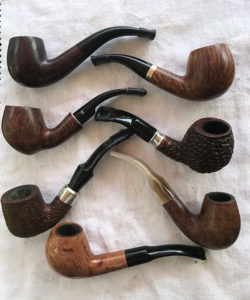
Pipes used in my test

I decided to test some of my pipes to see if I found a difference. My one Dunhill is a 3/4 bent billiard made in 1926, so I chose bent pipes for this test. I smoked the following for the test:  Dunhill 151 Inner Tube, Rinaldo Triade YYY 1, Stefano Santambrogio (not a full 3/4 bend, but close), Stanwell Hans Christian Anderson Smooth Dublin, a Savinelli Dry System 2622, an Italian briar with the only stamping being Christmas 1988 and a Borkum Riff pipe.

The tobacco for the test? Dunhill My Mixture 965 so there was no variance because of the tobacco blend. I measured out 2 grams for each bowl, straight from the tin without any additional drying time. I packed and smoked each bowl using the same technique.

Four of the pipes were new when I received them (One purchased, two contest prizes, one included in an on-line tobacco purchase deal).  Two pipes I rescued and the last was a gift to me.  All seven are in good smoking condition.

Part of the premise that more expensive pipes smoke better, is that the engineering and quality of workmanship makes a difference. I settled for examining the drilling of each pipe and stem as a comparison in engineering. A perfectly drilled pipe should smoke better than a poorly drilled pipe, in my opinion. To check this, I performed a “pass a pipe cleaner” test on each pipe. By “pass a pipe cleaner,” I mean I can insert a Dill’s pipe cleaner through the bit and it goes all the way into the bowl.

What makes a perfectly drilled pipe:

In my opinion, a perfectly drilled pipe has three things: 1. Draught hole dead center in the mortise, 2.  Hole and airway in the stem perfectly aligned (will pass a pipe cleaner), and, 3. Draught hole and airway the same diameter.

If the draught hole is not perfectly centered in the mortise, then the airway in the stem will not line up properly. It won’t necessarily prevent the pipe from being a decent smoker, but it won’t be a great pipe until you get it re-drilled. If the airway in the stem is larger than the draught hole, you may hit briar when inserting the pipe cleaner and must wiggle the cleaner to get it into the draft hole of the bowl. Conversely, if the draught hole is bigger than the airway, it should pass the pipe cleaner more easily.

When setting up for my test, I shined a bright LED light into the mortise of each pipe I used. Surprisingly, none of my pipes were what I would call perfectly drilled. The drilling on my Savinelli Dry System 2622 looks more like the drilling on a Cavalier. For example, the draught hole is drilled into the top of the airway and there is a space at the bottom of the mortise where moisture can collect. This is part of the engineering design of a Dry System pipe. It’s a very good smoker and I’ve never notice it gurgle.

On the other hand, the Borkum Riff bent pipe is just badly drilled. A cleaner inserted into the mortise bottoms out in briar. Shine a light in the mortise and you don’t see the draught hole. Run the cleaner along the top of the mortise and it does slide into the draught hole.  Of all the bent pipes I tested, this was the worst in my opinion.

My unscientific method of measuring the size of the airway and draught hole was equally as simple. A single pipe cleaner fits into the draught hole and the stem airway. Five of the pipes did this. The Savinelli and the Dunhill have larger bores. The Savinelli is a balsa filter pipe and the Dunhill originally came with an aluminum inner tube (hence the name, Inner Tube). I don’t use either. I can easily insert 2 pipe cleaners at one time in both pipes.

The pipe test:
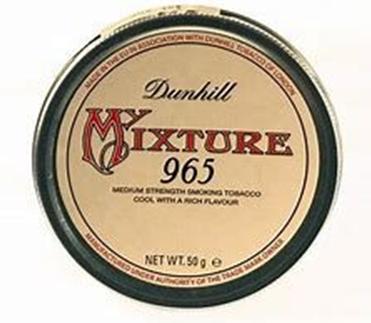
I used My Mixture 965 for the test.

For the testing I loaded two grams of Dunhill My Mixture 965 in each pipe.  I weighed the tobacco on my kitchen scale.

Stanwell HCA:

Passes a pipe cleaner with some wiggling. Draft hole off center high. Avg. size airway in stem.

Good, easy draught – like sipping a fountain drink through a plastic straw. Bowl was warm but comfortable to hold. Session lasted 55 minutes with no relights. Ash and minimal tobacco bits left at the end of smoke. Good flavor from the tobacco throughout the smoke. (Acquired as a prize give-away from This Pipe Life pipe forum. MSRP listed as $250. The pipe came with both a regular stem and a churchwarden stem.)

Christmas 1988 pipe:

Does not pass a pipe cleaner. Draft hole drilled high and the airway in the stem seems smaller than Stanwell.

Decent draught, open and unrestricted (probably because of gap between the tenon and bottom of mortise. The bowl got warm but not hot. Session lasted just over 50 minutes with some dottle in the bottom. Relit once around the 41-minute mark. Good flavor from the tobacco throughout the smoke. (Used pipe found at antique/collectible shop for $15.  Probably sold by Tinderbox originally)

Stefano Santambrogio

Doesn’t pass a pipe cleaner. Even with the draught hole drilled high of center it’s very good smoker.

I have won two long smoke competitions with this pipe. My record is 1 hr. 27 minutes with this pipe. The bowl got warm but still comfortable to hold. Session lasted 67 minutes with no relights. Good flavor to the end with a minimal amount of dottle remaining. (Bought new, unsmoked off eBay for $80.)

Borkum Riff Bent

– Does not pass a pipe cleaner. Draught hole drilled into the top of the airway. Gurgles. Smoked the worst of the pipes tested. To my eye, the airway seems smaller than the rest and the draught feels more restricted, like sipping a drink through a cocktail straw. Bowl gets hot while smoking. Session lasted 43 minutes and required 3 relights. Approximately 1/8th of a bowl left at the end. Flavor didn’t seem as developed in the other pipes. (Acquired new as part of a package special from an only retailer) I find myself wondering why I still have this pipe.

Savinelli Dry System 2622

Smoked without the Savinelli Balsa Filter. Draught hole drilled into the top of the airway, probably by design.

Because of the design, the airways in the stem and the mortise are large enough to fit two pipe cleaners at the same time. However, the pipe cleaner does not go through the bit because it is a P-lip design. As I smoke it with no filter, the draught is wide open (like using a jumbo drink straw). The session lasted 49 minutes with only ash left. It seemed to produce more smoke than the rest. The bowl got warm but doesn’t get hot. From a flavor standpoint, the tobacco started tasting “ashy” just before it went out. (Used pipe found at an antique/collectible store. Paid about $20 for it.)

Dunhill “Inner Tube” 151”
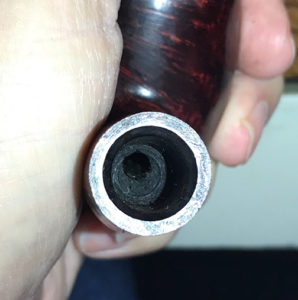
Even this Dunhill is drilled a little off center.

Produced in 1926 according to the markings, this pipe originally came with an aluminum “Inner Tube.” Mine doesn’t have the tube. The airways and draught hole are big enough to fit 3 pipe cleaners into them at one time. It passes a single pipe cleaner from the lip or button into the bowl with no effort.

With the openness of the airway and draught hole the draught was like drinking through a jumbo size straw. I expected this pipe to smoke faster, but I found myself smoking slower. Flavor was good, tobacco burned evenly and required less tamping than I expected. Bowl gets warm but not as warm as some of the other pipes. Session lasted 71 minutes with no relights and just ashes left. Unlike the Savinelli Dry System, I did not get the ashy taste at the end though. (Used. A gift from a friend after he learned I didn’t have a Dunhill.)

Rinaldo Triade YYY 1

Easily passes a pipe cleaner. Instead of a perfect circle, the draught hole is elongated and reaches from the top of the mortise to the bottom.

Good, even draw like a plastic fountain straw. Bowl gets warm but not as warm as some of the other pipes. Session lasted 59 minutes without a relight. Very minimal dottle at the bottom of the bowl and good flavor throughout.  (New. Won in a long smoke competition.)

Linkman Hollycourt Special 7023 (Bonus addition)

Produced between 1938 – 1943. Threaded stinger but looks like the end of the tip of the stinger cut off. Easily passes a pipe cleaner to bowl.

After the Dunhill, this is the oldest pipe I own, so I decided to include it in the test. The bowl gets hotter at the bottom than I expected but it can still be held. Bowl is deep, and 2 grams only fills about half of it. Very open draught. Tobacco burns evenly and I noticed more flavor at the start. Where the tobacco was medium strength in previous test, it was stronger at the end of this bowl. Session lasted 50 minutes. (Used. Acquired at antique/collectible shop for $25.)

My Conclusions…

After conducting my smoking test and talking to several expert pipe carvers and restorers, I decided the answer is so subjective for a yes or no answer. What makes a pipe a quality smoker depends on the definition of a quality smoker by each pipe smoker. I have several hypotheses and a theory.

First the theory.

The reason more expensive pipes are considered to be better smokers is because more time, money and effort go into producing the pipe and the quality control is better. In other words, high-end manufacturers usually have strict quality control guidelines. If at the end of the manufacturing process, the pipe doesn’t meet those guidelines, it is either destroyed or sold as a second or basket pipe. This doesn’t mean that every high-end pipe is perfect but the chance of it being a bad smoker is less.

This also apply to Artisan pipes carved by people like Mark Tinsky, Walt Cannoy, Ryan Alden, Rad Davis, et al. Artisan pipes are more likely to be great smokers because they are going to make sure it is a perfect pipe before selling. If for some reason, the pipe has problems, they tend to stand behind their work and fix it.

Now for the hypothesis.

After the engineering, the most important part is the quality of the briar itself. I believe artisans and companies always buy the best briar blocks that they can afford. They don’t call up a dealer and send me 1,000 lbs. of whatever is on the shelf. They ask about the aging, curing and grading.

After harvesting, cutting, boiling and air drying for two years minimum, the briar is ready to sell. The longer the briar is aged, the more it’s worth.  In some cases, the blocks are aged for decades before selling. Briar dealers inspect each block and assign it a quality grade. Carvers and manufacturers make their purchases based on the length of aging and the grading. The more money they spend, the chances of better blocks increases.

Conversely, there is the old saying that “even a blind squirrel occasionally finds an acorn.” By that I mean even carvers/manufacturers on the lower end of the pay scale can and do occasionally find and produce a pipe worth more than what the end user pays.

Good smoking, low cost pipes…

Wait! What about Kaywoodie, Dr. Grabow, Wally Frank and other mass-produced pipes from the mid-20th century? My hypothesis is there weren’t as many high-end artisan carvers back then, so it was easier for them to get better grade briar. Also, despite not being “hand-made” the engineering on the pipes was very good. Large collecting communities for Kaywoodie and Dr. Grabow will attest to this.

Finally…
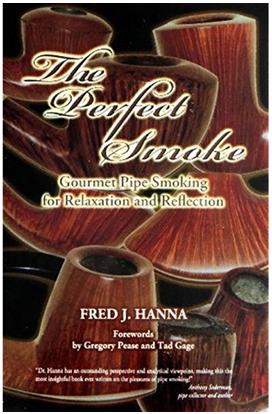
The book every pipe smoker should read.

While pipe smokers will continue to argue this question no matter what I say, I want to turn to one I consider an expert – Dr. Fred J. Hanna. His book, “The Perfect Smoke” published in 2012, is a collection of his essays about pipe smoking

I recommend the essays in Chapter Three of his book. “Choosing the Great Briar Pipe: Factors to Consider (Pages 91-102) discusses the 24 factors Hanna considers important for choosing a great briar pipe. These include the draught hole location and the size, the length of the tenon, the thickness of the bowl wall, etc.

The third essay in the book, “The Myth of Brand and Maker in Pipe Smoke and Tasting” (pages 111 – 124) is also very enlightening as he explains that “a great-smoking pipe is not the same as a great-tasting pipe.” (page 112) I also found his comment that, “The brand myth has the potential to harm our hobby. It can lead us to believe that only the wealthy collectors of high- and ultra-high-grade pipes can enjoy the truly sublime, superlative smoking and taste experience.” (page 124)
 

Broken Pipe Blues


Blog by Joe Gibson (PappyJoe)

I have followed PappyJoe on Twitter ever since our paths crossed on the Country Squire Radio show. We have fired tweets back and forth and not long ago he sent an invite to his blog PappyJoe’s World – Pipe Smoking and other thoughts.  Since then I have frequented the blog and read quite a number of his posts. During my lunch hour at work today I decided to visit again. I read three really interesting posts that I thought would be great to share on rebornpipes. I wrote PappyJoe and asked permission to post these blogs here. This is the first of them. Well worth the time to read. Thanks PappyJoe and welcome to rebornpipes. Without further words from me here is his blog (https://pappyjoesblog.com/broken-pipe-blues/).

This is a cautionary tale about buying “estate” meerschaums at antique/collectible/junk shops…

As mentioned in an earlier post, we like to walk around antique/collectible/junk shops, malls and flea markets.  I also said most of those pipes are overpriced. I’ve seen briar pipe so dirty you would have trouble fitting a toothpick into the bowl and priced upwards of $75. Look carefully and instead of something like a Dunhill or Charatan, you will find a Dr. Grabow or Medico you could have bought just a few years ago at a drugstore. Get real lucky though and you can find a nice briar with 50 or 60 years of age on it that is still worth cleaning and sanitizing. Just inspect them carefully. I once examined a nice looking Charatan that you could run a pipe cleaner though – the bowl that is. It had burned through the bottom.

My Sultan Saxophone meerschaum. The crack is along the base of the turban

The worst offenders seem to be vendors selling meerschaum pipes. I’ve seen figural meerschaum pipes with broken stems and bowls priced at $400. I looked at CAO Sherlock Holmes pipe priced at $350 because it was “signed.” Unfortunately it was signed in big block letters along one side  by someone using a rotary tool. You could still see the tool marks. I passed on both of those.

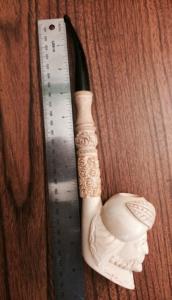
I do have a Sultan saxophone meerschaum I paid $10 for at a flea market. It has a 3-part stem (one acrylic and two sections of meerschaum) and was unsmoked. I examined it carefully before buying and didn’t see any cracks. But as I smoked it the first time and it got hot, two long cracks at the base of the bowl appeared. I quickly applied super glue to it and it’s been sitting on my shelf since then. It looks nice sitting on display as a $10 piece of art. It is also my first cautionary tale about buying pipes at these shops.

Floral meerschaum in case was only $20

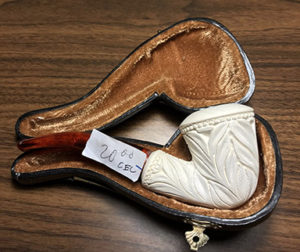
And it brings me to my second cautionary tale. This past weekend we made an overnight swing through southwest Mississippi. At one stop I found an unnamed, never smoked, Meerschaum in its hard case for $20. After carefully examining it with a magnifying glass, I took the stem off and inspected the stummel end. I felt I gave it a thorough examination and other than a musty, moldy, almost mothball smell in the bowl, it looked in great condition. Until I started the cleaning process when I got home.

I removed the stem by gently turning and pulling it with no problem. Next, I inserted a clean and dry pipe cleaner through the airway and then filled the bowl with baking soda to see if that would get rid of the smell and let it set.  A few hours later, I dumped the baking soda and removed the pipe cleaner. Wiped out the bowl with a tissue and then dipped the pipe cleaner in water and ran it through the airway.

The invisible crack appears...

The first crack, before attempted repair

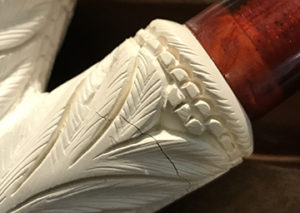
That’s when a crack at the very end of the stummel, where the nylon screw went appeared. Don’t you hate it when that happens? I have five rescued meerschaum pipes. I have cleaned each of them this way. This is only the first one to crack when cleaning. I sat there and watched as the crack around the stummel expanded and a half inch piece fell off.

I hate it when that happens. My first thought was to throw it in the trash.  My second thought was it may be salvageable. The broken part was only part of the threaded stummel so if I glued it back together it might not affect the smoking capability of the pipe. That’s what I was hoping for, anyway.

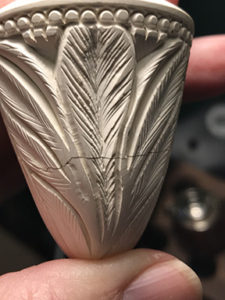
It wasn’t what I got. After letting it sit for 24 hours, I loaded the bowl and lit it carefully. About five minutes into the smoke, as the tobacco started burning good, I heard a crackle which I first attributed to maybe the tobacco not being dry enough. Then I look at the right side of the pipe and saw another thin, almost imperceptible crack extending from the stummel along one side of the bowl. Then I heard another crackle and saw the crack had expanded around the bowl and up the left side.

The crack expanded around the front of the bowl

Lesson learned? Not really

Nothing can save this pipe, so I gentle pried the tobacco out of it to prevent more damage. It now sits on top of one of my pipe shelves with the Sultan which is also never smoked. Either the pipe had not been cared for properly or the block was flawed when carved. It only takes a drop or two on a hard surface for a meerschaum to crack.

Won’t stop me from rescuing more pipes in the future.

(© J. Gibson Creative Services 2018)

Determining the Cost of Rescue Pipes


Blog by Joe Gibson (PappyJoe)

I have followed PappyJoe on Twitter ever since our paths crossed on the Country Squire Radio show. We have fired tweets back and forth and not long ago he sent an invite to his blog PappyJoe’s World – Pipe Smoking and other thoughts. Since then I have frequented the blog and read quite a number of his posts. During my lunch hour at work today I decided to visit again. I read three really interesting posts that I thought would be great to share on rebornpipes. I wrote PappyJoe and asked permission to post these blogs here. This is the first of them. Well worth the time to read. Thanks PappyJoe and welcome to rebornpipes. Without further words from me here is the second of his blogs (https://pappyjoesblog.com/determining-the-cost-of-rescue-pipes/).

Two pipes I rescued from an antique/collectible shop. The Kaywoodie Stembiter was first on the market in the 1950s.

Here’s the question. When shopping at antique/collectible/flea market/junk shops, how much is too much to pay for a pipe?  Of course, the final answer is, “It depends on how much the buyer is willing to spend.”  But other than that, how do you determine if the pipe you’re looking at is a good value?

I look at different factors when I find a pipe in one of these shops. First, if it says “Made in China” I don’t buy it. Period. Second is the brand name because there are some pipes I don’t personally collect – Dr. Grabow, Medico, Yello Bole and most Kaywoodie. (In an effort to be honest, I do have four Kaywoodies, 1 Yello Bole Spartan (It was my grandfathers.) and a Linkman Hollycourt Special made before the name changed to Dr. Grabow.) Let me be clear, there is nothing wrong with these pipes and many pipe smokers collect them. With some exceptions, I don’t.

I also don’t normally collect pipes to sit on display. I own five pipe designated as display pipes. Two are Meerschaums which displayed cracks after the bowl got hot. One is a gourd Calabash with a cracked Meerschaum bowl. The last display Meerschaum I bought specifically because of the intricate carving and the size. Two Bavarian Hunter style briar pipes round out my “display only” pipes. Eventually I may clean and smoke them as well.

A Bavarian style pipe

For the most part, I look for pipes European made pipes like Savinelli, Jobey, Chacom, Peterson, etc. My personal holy grail would be to find a Dunhill that I could afford to buy and restore. While I have had luck finding a few Savinelli’s and other Italian made pipes, the rest have eluded my efforts. So far.

The next thing I look for is the condition of the pipe bowl and stem. I only buy pipes that are in such a condition that I can either clean and restore it myself or it would be worth the cost to send it to a professional. Having the work done by professional pipe restorers can range from very reasonable to the cost of a new pipe. Whether it’s worth it or not, is again, a personal choice.

Here are some things I consider when hunting for a rescue pipe as I call them.

Who Made It.

Lighthouse Pipe by Akdolu. The top of the lighthouse comes off.                                                  Total weight: 5.92 ounces (168 grams)

As I mentioned above, I don’t necessarily collect every pipe I see. I like looking for higher quality names. One exception is Kaywoodies. I learned the difference between 2, 3 and 4-digit Kaywoodies. If I find one with 2 or 4 digits, I generally will look at it more closely. If it’s a 3-digit pipe, it was made after 1972 or so and I am less interested. This generally doesn’t apply to Meerschaum because most I find are not signed.

What Condition Is It In?

Obviously, I check for cracks and burnouts. After that I look at whether the smoker took care of the pipe or abused it. The amount of cake in the bowl is one indicator I look at. For example, I passed on several pipes recently because I couldn’t fit my little finger into the bowl. The cake in each of them was thick and old. In two pipes, the cake was separating from the wall in spots. These pipes included a Dunhill, a Savinelli, a Jobey, a Butz-Choquin and a Wally Frank. They also had other condition problems.

I also look at the stem condition. If I can’t remove the stem of the pipe from the stummel I will usually pass on the pipe. The stems on three of pipes I mentioned above were stuck so bad I couldn’t remove them. I did remove the stem from the Savinelli but there was about a 1/4-inch gap between the stem and the ferrule. It just wouldn’t go in all the way.

The stems on these pipes were all heavily oxidized and severally chewed on, also. The Dunhill, for example, looked like a weathered orange ball used as a chew toy for a large dog. The deep tooth marks extended for almost an inch down the stem. Again, it was a matter of my personal choice, to not buy any of these pipes because I felt the stems were not repairable.

Does it Smell Bad?

In addition to the amount of cake in the bowl, I smell the pipe. If it smells like tobacco, I consider buying it. If it smells like mothballs, mold, ammonia or anything else, I pass. This is especially important when it comes to Meerschaum pipes. I have come to learn that if an unsmoked Meerschaum in one of these shops smells like acetone or chemicals, then it’s been broken and glued back together.

How Much Is The Cost?

Savinelli Giubileo d’Oro. I paid $3 for at an Antique Street Fair

A lot of shops I visit are not one-owner businesses but consist of numerous vendors. That makes haggling over the price of an item difficult because the person at the register must track down the vendor and discuss offers over the phone. Sometimes it’s worthwhile, other times it’s not worth the effort. Here’s where personal choice comes into play, again. I look at a pipe, estimate what it would cost to restore (time, effort & money) and add that to the asking price. Then I consider the cost of a similar pipe either new or from a reputable estate pipe vendor.

(© J. Gibson Creative, April 2018)


Antique? Vintage? Estate? Or, Just Junk No One Wanted?


Blog by Joe Gibson (PappyJoe)

I have followed PappyJoe on Twitter ever since our paths crossed on the Country Squire Radio show. We have fired tweets back and forth and not long ago he sent an invite to his blog PappyJoe’s World – Pipe Smoking and other thoughts  Since then I have frequented the blog and read quite a number of his posts. During my lunch hour at work today I decided to visit again. I read three really interesting posts that I thought would be great to share on rebornpipes. I wrote PappyJoe and asked permission to post these blogs here. This is the first of them. Well worth the time to read. Thanks PappyJoe and welcome to rebornpipes. Without further words from me here is his blog (https://pappyjoesblog.com/antique-vintage-estate-just-junk-no-one-wanted/).

I’m one of those pipe smokers who loves shopping for “estate” pipes. The wife and I enjoy walking around so called antique/collectible shops, malls, flea markets and street fairs. I like being able to pick up the various pipes I find and try to identify the maker and age. I have probably 25 rescued pipes I’ve bought from these shops. (I call them my rescued pipes because while they are definitely not antique, I have cleaned, sanitized and polished them into smoking condition.) But to be clear, none of these are “antiques.”

If it’s not 100 years old, it’s not an antique. And, not all of these shops are really antique shops.

Savinelli Giubileo de Oro

To be clear, I looked up the definition of antique. To be considered a true antique, the accepted rule is the item has to be at least 100 years old. Anything between 40 and 99 years old is vintage. Old items actually bought at an estate sale, are estate. Anything you find in a shop that is less than 20 years old is probably just a piece of junk someone threw out. In other words, it takes more than being old to be an antique.

Mostly these are shops which throw the name “Antique” around like a used hamburger wrapper. Some are collectible shops. Others are vintage shops. Some may even contain a few items that are bordering on being real antiques. In my opinion, real antique shops are as clean and organized as a good jewelry or furniture store. The individuals working in it are neatly and professionally dressed. And, it is one store. That is an antique store on the upper end of the scale.

You will know you are not in good antique stores when you walk in the door. If you see a sign that says, “Over 100 different vendors,” it’s not an antique store. When you walk in and smell the dust and mildew, and vendors look like they’ve been cleaning out their attic, chances are it’s a flea market.  If you walk down the aisle and each booth looks like someone just dumped out a bunch of garbage bags, it’s not an antique store.

My opinion is that these places are flea markets and the vendors spend way too much time watching American Pickers to get their prices. They all operate under the premise that if it’s old and the price it about 10 times what its worth, someone will call it an antique and buy it.

I’m not saying these places should be avoided. I’m just saying don’t go into them with the expectation that you are going to find something along the lines of a Dunhill for $20.

Finding good pipe deals…

Sure, you may find some real antiques like broken clay pipes from the civil war era, but for the most part everything found in these shops are more likely from the 1930s to 1990s.  Mostly I have found were Dr. Grabow, Medicos, Kaywoodie, Yellow Boles and unnamed briar basket pipes. But, I have also found Savinelli, WDC’s, and a variety of Italian maker pipes like Mauro Armellini. I have seen a number of “Made in London” or “Made in England” basket pipes. I even have found Edward’s Algerian Briar pipes.

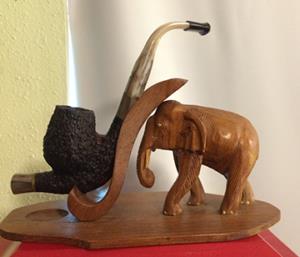
Mauro Armellini Cavalier in an Elephant Pipe Holder

Some of my finds have been at really good price points. Who wouldn’t want to buy a Savinelli Guibileo de Oro for $3.00 or a Savinelli Nonpareil 9604 for $10? I also have a Mauro Armellini Cavalier I found for $25. If you do your research and learn how to identify them, you may even find more desirable Kaywoodie or Dr. Grabow.

Educating yourself is key. I have missed out on a couple of briars that I didn’t recognize the markings on. Mainly those “Made in London” or, “Made in England” pipes I mentioned earlier. They definitely weren’t Dunhill’s, but I later learned they were good, collectible pipes. They are out there; you just have to learn to recognize what you are looking at.

Let me say something about estate pipes. In my opinion, an estate pipe is one found in the collection of a pipe smoker whose last bowl has been extinguished. The family will pick over the collection and maybe choose a few as keepsakes. The majority of the remaining pipes will be sold to antique shops specializing in estate sales or to reputable pipe shops or pipe dealers. Many of these pipes will be cleaned and sanitized before they are sold.

(© J. Gibson Creative Services 2017)