
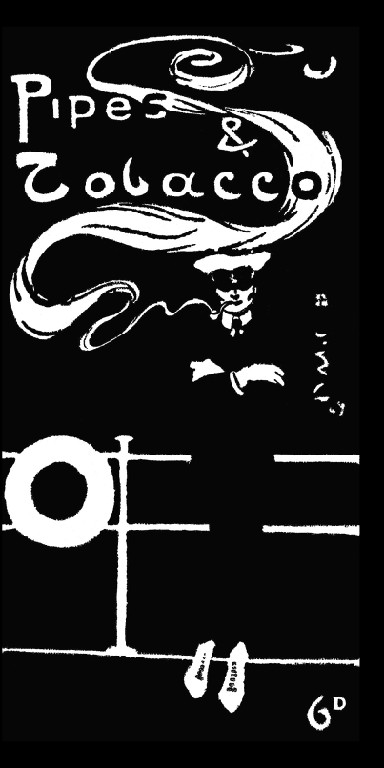
 What attracted me to this book when I saw it on Briar Books Press was the press release that Gary Schrier posted on his website. It is a rather long opening to this review but I find that it is a great piece of writing and a simple summary of the book itself. There he wrote the following:
“What they were saying in 1901 about “Pipes and Tobacco. A Bright and Interesting Discourse on Smokers” by J. W. Cundall.Long 8vo. Cloth, 6d.”
“To-day. – Mr. J. W. Cundall has written a little volume which all lovers of the fragrant weed will read with interest and amusement. In addition to an account of the history of tobacco, and the science of it growing and blending, many entertaining anecdotes are related of famous smokers, and a large amount of odd information of use to smokers imparted. For a modest outlay of sixpence, at which price it is published, no devotee of ‘My Lady Nicotine’ need lack this latest appreciation of his goddess.”
“My how times have changed! That’s inflation for you. No longer sixpence, but then who other than Briar Books Press discovers such unusual, worthwhile, and most importantly, such entertaining literature for the pipe-smoking man. Hidden for over a century, this delightful gem is a look into our collective past for all the reasons smoking is such good medicine for the soul. Historical yet in many ways contemporary, Pipes and Tobacco is the smoking man’s guide to everything which is important to him. Author Cundall spins an entertaining read for the Englishman on so many of the topics of interest to him at the turn of the last century. From tobacco as a luxury and aid to meditation, to social smoking and as a medicinal aid, to soldiers and smoking, to poetry, to juvenile and royal smokers and smoking in parliament, to Smokiana and the Brotherhood of Smokedom, Cundall covers the subject concisely yet comprehensively. Peppered with quaint tobacco and briar-pipe advertisements, Pipes and Tobacco includes a never-before-divulged statement attesting to the origin of J. M. Barrie’s secret Arcadia mixture as written in his 1890’s novel My Lady Nicotine. A delightful and informative read that will leave you wanting for more.”
Who could resist that press bite and all for only $20USD. I ordered my copy and when it arrived sat down and read the short 103 pages with great interest.
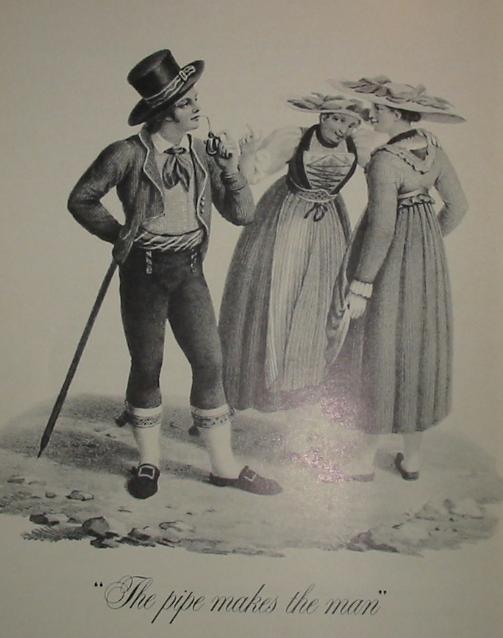
As I often do with these reproductions of older books I turned through the pages to enjoy the layout and design before giving it a read. In this case the book is filled with lots of period advertisements for books and all assortments of items from that time. It also has great illustrations that are well worth the price of purchase in my mind. I am including a copy of the Table of Contents as I also read through that before proceeding with a general read of the book. I have grouped the topics of the chapters into related sections even though the author did not. Even before reading through a book in total I try to organize the flow of the book with a quick scan of the chapters. I look for the logic of the book and then section of the book to get an idea of the author’s direction and intent for his book. Below is a chart showing my grouping of chapters.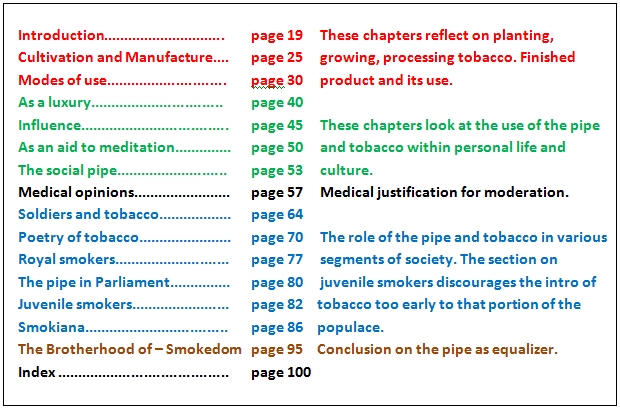 The style of this book is very readable and timeless. Cundall’s use of language is clean and forthright and simple to read. It has some of the marks of its age such as punctuation and long sentences but the content flows very well. The design as a pocket-book full of advertisements from the time it was written give it a flavour of nostalgia that for me is refreshing and speaks to a time when things moved more slowly. I can easily see this book carried in a pipeman’s pocket and read on the train or in the evening over a pipe and drink in front of the fire. Schrier has done a great job in reprinting this old classic of pipedom.
I thought it would be helpful to a potential reader to give a quick summary of the sections that I noted above. I don’t do this to spoil the read as much as to give an idea of what you can look forward to when you pick up the book and read it for yourself.
FIRST SECTION (noted in red in the chart)
The author starts as many pipe books before and after him have started. He gives a quick overview of the history, cultivation and how the harvested tobacco is processed and delivered to smokers for use. There is nothing truly new or unique to this section but the style of writing makes it a quick overview or refresher for those who want to jog their memories of the early years and development of tobacco.
SECTION TWO (noted in green in the chart)
Cundall takes a slightly different tack than other writers on the subject have done. He acknowledges that tobacco is a luxury but one that is well worth spending your hard-earned money to procure. It provides enjoyment and community in a way that is out of proportion to its expense. To load a bowl of tobacco and enjoy a smoke enables one to be meditative and contemplative on the one hand but also invites the smoker into a society of smokers that is convivial and erudite. I include two quotes below that give an idea of his style of writing.
“All tobacco is good, only be careful to have only the best.” Page 44
“The pipe draws wisdom from the lips of the philosopher and shuts up the mouth of the foolish. It generates a style of conversation – contemplative, thoughtful, benevolent and unaffected.” Page 53
SECTION THREE (noted in black in the chart)
Cundall begins with the fact that there will always be opponents to pipes and tobacco. While it is vocal and comes from a broad spectrum of society it is contrary to the facts. While abuse and overuse of tobacco can cause physical ailments the facts are there that moderate tobacco use is beneficial. I find that this chapter sets the stage for the further sections of his book. It provides the justification of the remaining sections where he explores the use of tobacco within many settings by many different kinds of people. The quotes from medical and scientific authorities provides the rational base for his advocacy of moderate enjoyment of the pipe.
SECTION FOUR (noted in blue in the chart)
This section explores the spectrum of pipe smoking in the world of Cundall’s day. It could easily be developed by someone to include the use of the pipe in the world of our day. It covers the use of tobacco among the military, authors and poets, the politicians and royalty of his day. One of the charming features is his inclusion of a description of the Smoking Room in the House of Commons in Britain. He includes a chapter which advocates for withholding tobacco from youth until they come of age (when that is does not appear clear to me). However, it is an interesting read nonetheless. The section closes with a collection of quote regarding smoking from clergy, academics, doctors, scientists, politicians and writers that is intriguing. Each quote is singularly worth reading and reflecting on. He entitles it Smokiana – a phrase that he seems to have coined for his use.
CONCLUSION (noted in brown in the chart)
The chapter is entitled “The Brotherhood of Smokedom” and to me serves as the conclusion of the entire book. It is a concise statement of the pipe as an equalizer. Regardless of status or strata of society the pipe takes the smoker to the same place of enjoyment and satisfaction. It provides uncensored enjoyment to all who lift the bowl and sip the smoke. The quote below captures the focus of the chapter.
“When contented are not all men equal, and who can be other than contented with his pipe between his teeth and the tobacco glowing redly in the, whither it be Bird’s-eye or Returns, Shag of the mixture of Arcady.” Page 97
If you enjoy reading about your pipe and tobacco and the relaxation and pleasure that it gives then this is a book you should purchase. It is not a long book but it is one that can be best savoured with a pipe in hand, a favourite drink at your side. Sip the pipe and drink and savour the well written prose of this little book in the quiet of the zone that the pipe opens to you. I recommend that you contact Briar Books Press and order a copy for your own reading as soon as you are able. Who knows when it will once again be out of print.

 rebornpipes