
Blog by Steve Laug
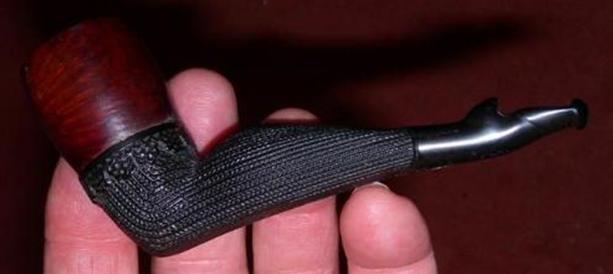
A friend on Facebook contacted me about an older Cavalier pipe I worked on recently with a suggestion that it might be made out of Gutta Percha rather than Bakelite as I suggested in the restoration blog. It was a pipe with a stem and base unit made out of a dark hard material and a pressure fit wooden bowl. The stem and end cap were all a single unit. Nothing, other than the bowl was removable. When I first picked it up to work on it, I assumed it was vulcanite and soaked it in a deoxidizer bath. The colour was constant. I took it out, dried it off and tried sanding what I thought was oxidation from the base. Nothing happened other than adding many scratches to the material. The more I worked with the material the more I realized that it was not vulcanite but was something else. From my experience cleaning up many older pipes, I assumed that it was Bakelite. But even then I was not sure about my assessment. When I received the message about it potentially being Gutta Percha I had to go and look at what that was. I had no memory of that material (or so I thought). After reading as much about the material as I could find, I think he is correct – Gutta Percha it is. Here is a link to the blog on the restoration of the pipe. https://rebornpipes.com/2017/11/13/restoring-an-interesting-old-bakelite-cavalier/. 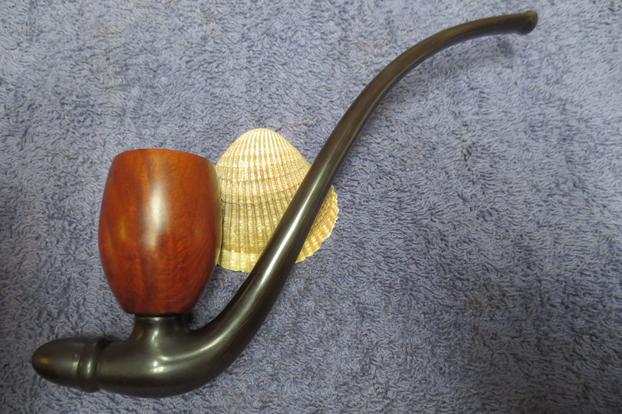 I am including some of the material I read for your reference. Certainly, I am not the only person who knows next to nothing about Gutta Percha. My friends suggestion left me flummoxed as to what that was. I went through the old memory bank to see if I could recall anything about the material. Surprisingly one memory came back. The only Gutta Percha I recall was the hard core in older golf balls. As a kid, I remember taking balls apart getting to the hard core but I cannot recall what the material looked like. I do remember it being hard and that it bounced. I remember my Dad (or someone) saying that it was Gutta Percha. That was the extent of my memory. But I don’t recall ever hearing about the material being used on pipes and I still really had no idea what it was.
That led me to do some research on the web to see what I could find out about the material. (Honestly, I don’t know what I would do without Google. I don’t know how I survived college and graduate school without it.) The first link I found and turned to was on Wikipedia (https://en.wikipedia.org/wiki/Gutta-percha). I quote large portions of that article below to set the base for understanding the material’s composition and origin.
Scientifically classified in 1843, it was found to be a useful natural thermoplastic. In 1851, 30,000 long cwt (1,500,000 kg) of gutta-percha was imported into Britain.
During the second half of the 19th century, gutta-percha was used for myriad domestic and industrial purposes, and it became a household word (emphasis mine). In particular, it was needed as insulation for underwater telegraph cables, which, according to author John Tully, led to unsustainable harvesting and a collapse of the supply.
According to Harvey Wickes Felter and John Uri Lloyd’s Endodontology: “Even long before Gutta-percha was introduced into the western world, it was used in a less processed form by the natives of the Malaysian archipelago for making knife handles, walking sticks and other purposes. The first European to discover this material was John Tradescant, who collected it in the Far East in 1656. He named this material “Mazer wood”. Dr. William Montgomerie, a medical officer in Indian service, introduced gutta-percha into practical use in the West. He was the first to appreciate the potential of this material in medicine, and he was awarded the gold medal by the Royal Society of Arts, London in 1843.”
…In the mid-19th century, gutta-percha was also used to make furniture, notably by the Gutta-Percha Company (established in 1847). Several of these ornate, revival-style pieces were shown at the 1851 Great Exhibition in Hyde Park, London. When hot it could be moulded into furniture, decorations or utensils (emphasis mine).
It was also used to make “mourning” jewelry, because it was dark in color and could be easily molded into beads or other shapes (emphasis mine). Pistol hand grips and rifle shoulder pads were also made from gutta-percha, since it was hard and durable, though it fell into disuse when plastics such as Bakelite became available (emphasis mine). Gutta-percha found use in canes and walking sticks, as well.
The material was adopted for other applications. The “guttie” golf ball (which had a solid gutta-percha core) revolutionized the game. Gutta-percha remained an industrial staple well into the 20th Century, when it was gradually replaced with superior (generally synthetic) materials, though a similar and cheaper natural material called balatá is often used in gutta-percha’s place. The two materials are almost identical, and balatá is often called gutta-balatá.
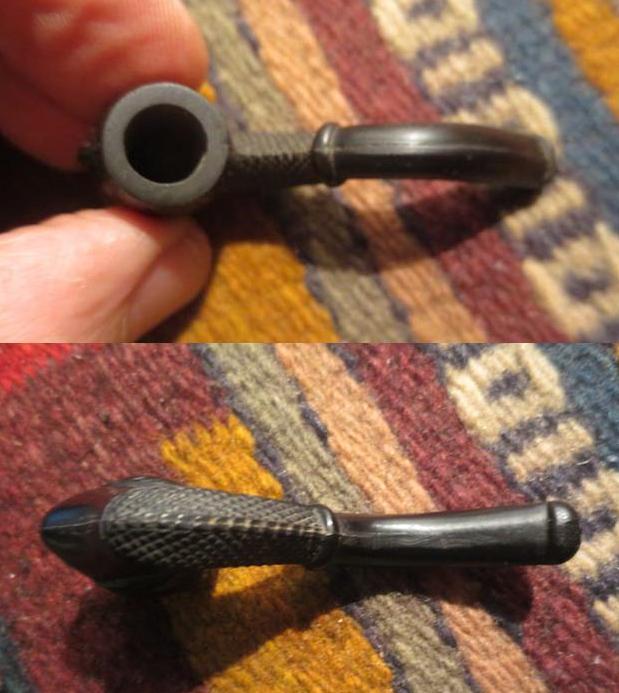
It seems that I have unwittingly worked on several pipes made of this material over the years and had no clue what they were made of. I figured that they were all made of some form of Bakelite, which is actually a far newer product than Gutta Percha. One of those pipes that stands out to me was a tiny salesman’s pipe that was a carved figural pipe. Even though it was very small, the features and hair on the head were well defined. The close up photos below show the stamping on the pipe. The first photo shows the stamp on the left side of the shank reading Bob’er. The second photo shows the stamping on the left side of the neck and chin of the figure reading Reg. US.Pat.Off. The final photo shows the stamping on the right side neck and chin reading Des.Pat. 71062. When I researched the number online, I was unable to find any pertinent information on the patent. Following the close up photos, I have included photos of the pipe from a variety of angles. Perhaps some of you who are reading this can give me some information.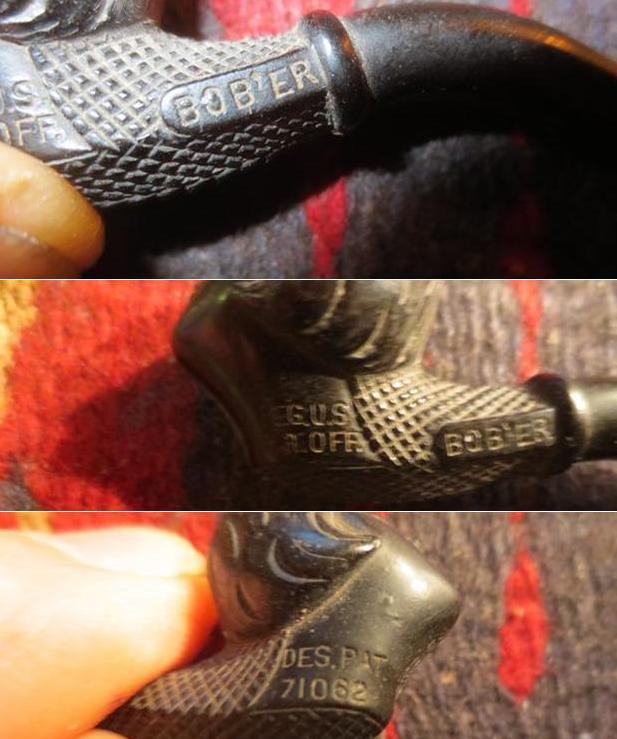
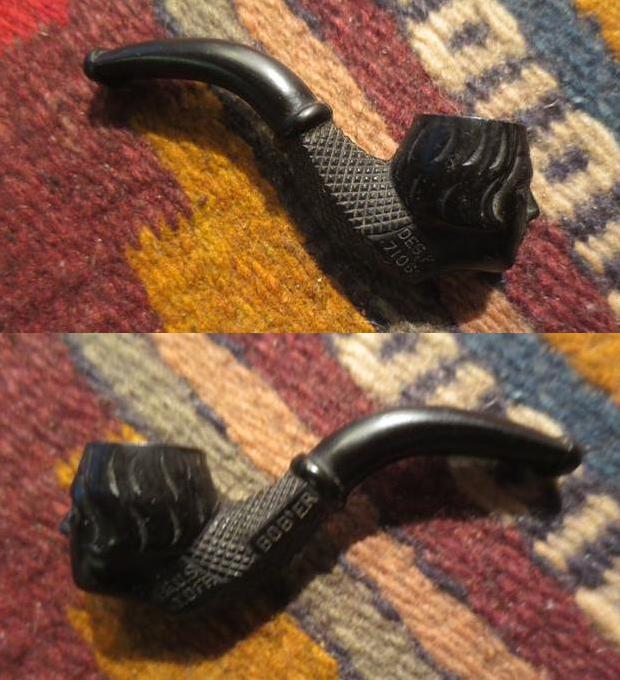
 I decided to search for other examples of pipes made of Gutta Percha. I found a surprising number of shapes and sizes that were available during that time. I have included some of them below to give a general idea of what they were like and the wide variety of shapes manufactured. I am sure that many of you can add other examples to this blog.
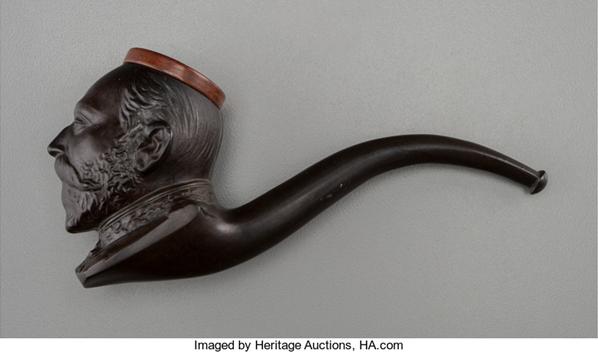
The first of these is a photo of revolver pipes – a Gutta Percha base and stem unit with a wooden/briar bowl. The examples in this photo show the variety of even this pipe shape.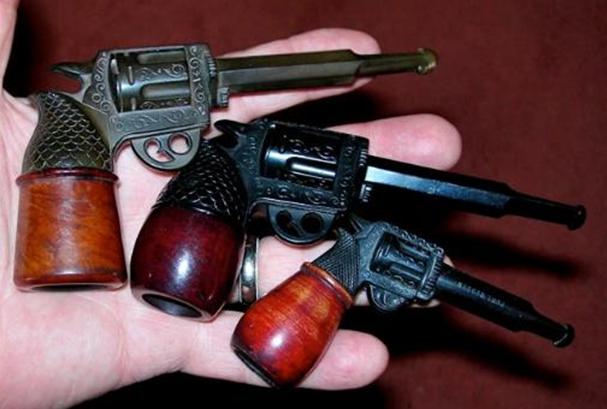 The second photo shows another figural. It is far more detailed and refined than the Bob’er that I included above. The bowl is wooden/briar cup insert. It is taken from an auction site.
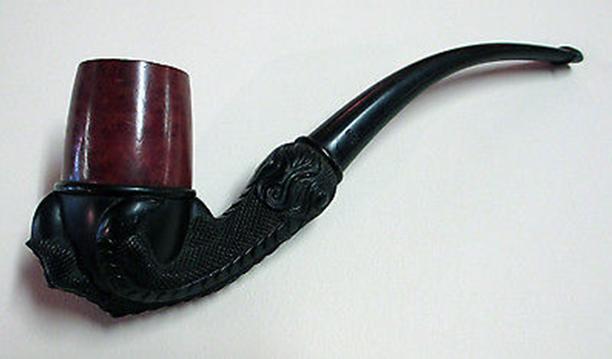
 The third is a decorative Eagle claw with a wooden/briar bowl. The hatch marks on it are very similar to that on the Bob’er.
 The fourth is a risqué, decorative woman’s leg pipe. The bowl is briar/wood that fits into the Gutta Percha leg. The top of the base is a garter that holds the stocking on the leg that is below. The base ends with a shoe that forms the mouthpiece for the pipe.
 The final two examples are also from an auction house. I am including them here because of their uniqueness and the details of each pipe. The first is a detailed rifle stamped Defender with a wooden/briar bowl. The second is a footballer (American style) grabbing onto a ball as he slides on the ground.
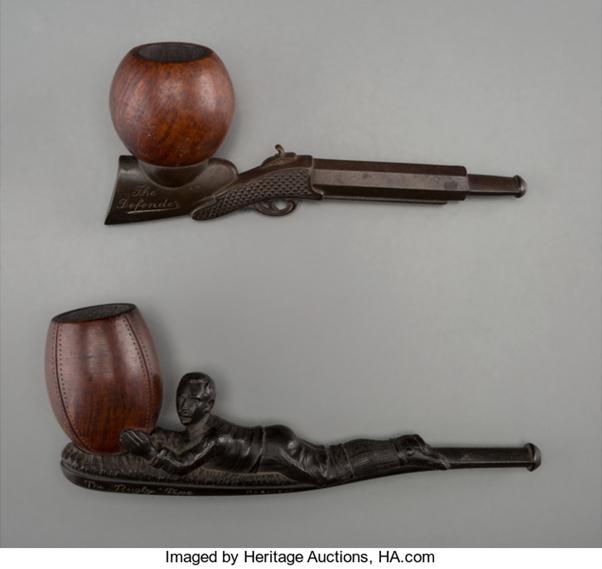 The fact that Gutta Percha could be molded and cast easily, made many variations possible for pipe makers. You can see from the photos I picked from the net, that the detail and shaping can be very meticulous. The only limitations seem to be the talent of the mold or pattern maker. I am amazed at the variations that artisans came up with for the pipe bases in the mid-19th century. The variety of the pipes also extends to the size of the pipe. I have held miniature cast face pipes and I have seen larger pipes similar to the Cavalier pictured at the beginning of this blog. I raise my pipe to the pipemen and makers who put these pipes on the market. I enjoy both the process of smoking them and looking at them again and again. Thanks for humoring this pipeman in reading this blog. Cheers.

 rebornpipes