Tag Archives: Book reviews

A Book Review – The Five Laws of Pipe- Companioning by Mark Irwin


Blog by Steve Laug

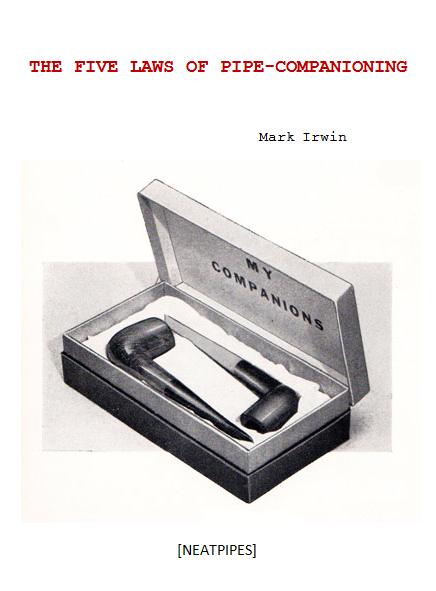
Several weeks ago now I received a cryptic email from Mark telling me to keep an eye out for a small package coming from Luca at Neatpipes. Knowing Mark’s proclivity for pipes – Irish and Italian I was not sure what to expect. But I also know he writes a blog for Luca Neatpipes http://www.neatpipes.com/blog/list/diary-of-a-mad-padster/&id=1 so I wondered if there was not a new book on its way to Vancouver.
coda-companions
On the blog was a series of blog articles on what Mark called the Five Laws of Pipe-Companioning. I had read them earlier and enjoyed his writing and what he was proposing. Sure enough when the package came it contained a copy of Mark’s book on the subject. I was thrilled to be able to give it a read. It was published by Luca of Neatpipes and is a small pocket sized book. I know it is pocket sized because I have had it in my pocket several times over the past week and have taken it out for a read at lunch hour, coffee breaks, while standing and waiting in various queues. It is the perfect size for this kind of subterfuge. I am one of those guys who always has a book in the pocket of his jacket so regardless of where I have to wait I have something to make the wait endurable – bank lines, grocery lines, transit lines, you get the picture. Mark’s little book is perfect for my habit.

The Table of Contents gives a short version of the Five Laws and is a great summary of the content of the chapters that follow. I have learned a habit garnered from Mortimer Adler’s How to Read a Book many years ago now, of reading the Table of Contents and Preface of the book to get a feel for the author’s focus and purpose. Doing so this time around did not let me down. The chapters in this little book are as follows:

Preamble 7-9

Pipes are for use 11-17

Every pipeman his pipe 19-25

Every pipe its pipeman 27-33

Preserve the pipes 35-41

Your pipe community is a growing organism 43- 49

Afterword 51-57

Coda 59-67

While Mark writes the book from the Preamble to the last chapter, Rick Newcombe writes the Afterword and Luca Di Piazza writes the Coda.

As can be seen above the book is a brief 67 pages long and can be read in one sitting, but I have found myself reading and rereading the chapters and reflecting on the concepts that Mark proposes in them. It is not so much the profundity of the concepts as the turn of phrase that I have come to associate with Mark’s writing that brings me back again and again. It is a good read for that reason alone in my opinion. But certainly there is more grist for the mental mill than just the turn of phrase in this book – whose concepts go beyond the scope of the short 67 pages. They open a world of reflection for those with that bent. So, load a pipe, find a quiet spot and delve into the words and ideas of the Five Laws of Pipe-Companioning.

In his Preamble Mark spells out what he means by the use of the word, “laws”. Rather than explain it myself I will let Mark do it in his own words. The following comes from the Preamble: “I need to be clear that what follows aren’t “laws” in the sense of something we need to debate, argue about and legislate according to majority rule. They’re universal principles, viz., underlying operative conditions of our hobby…You’ll see beliefs and opinions – mostly mine – but these are not about the laws themselves, but about the way the laws can best be practiced (or observed), something always open to interpretation.” With those introductory words the Five Laws are applied and examined. The layout of the book is well done and draws the reader into the work. There is lots of white space making it easy on the eyes and some beautiful pipe photos inserted between chapters to add colour and “eye candy” for a break to ponder to the words that have just been read in the previous chapter. It is a beautiful little book.

As can be seen above the book is a brief 67 pages long and can be read in one sitting, but I have found myself reading and rereading the chapters and reflecting on the concepts that Mark proposes in them. It is not so much the profundity of the concepts as the turn of phrase that I have come to associate with Mark’s writing that brings me back again and again. It is a good read for that reason alone in my opinion. But certainly there is more grist for the mental mill than just the turn of phrase in this book – whose concepts go beyond the scope of the short 67 pages. They open a world of reflection for those with that bent. So, load a pipe, find a quiet spot and delve into the words and ideas of the Five Laws of Pipe-Companioning.

In his Preamble Mark spells out what he means by the use of the word, “laws”. Rather than explain it myself I will let Mark do it in his own words. The following comes from the Preamble: “I need to be clear that what follows aren’t “laws” in the sense of something we need to debate, argue about and legislate according to majority rule. They’re universal principles, viz., underlying operative conditions of our hobby…You’ll see beliefs and opinions – mostly mine – but these are not about the laws themselves, but about the way the laws can best be practiced (or observed), something always open to interpretation.” With those introductory words the Five Laws are applied and examined. The layout of the book is well done and draws the reader into the work. There is lots of white space making it easy on the eyes and some beautiful pipe photos inserted between chapters to add colour and “eye candy” for a break to ponder to the words that have just been read in the previous chapter. It is a beautiful little book.

The first chapter looks at the First Law, Pipes are for use. At first glance the concept seems clear to those of us who smoke pipes but in the chapter Mark puts folk on a continuum that extends from “absolute pipe smoker to absolute pipe collector. Most of us he says fall in between the poles in a broad field. He suggests that we are called pipe companioners – those who enjoy the company of their pipes. This is a concept that Mark and I have written to one another about as we discuss our love of the pipe. It views the relationship of the pipeman and the pipe as almost sacramental in nature. The pipe has the ability to lift the pipeman to a different plane and provide a connection to a separate reality. This particular chapter is chock-full of concepts that take time to ponder and savor. The ideas in this chapter alone are well worth the meager price of the book.

The second chapter looks at the Second Law, Every pipeman his pipe. This law acknowledges the diverse range of likes and dislikes of pipemen. Another way of saying this could be, “to each his own”. The idea developed in the application of this law is simply to build tolerance for another pipeman’s tastes. Each of us is drawn to the pipes that become our companions and generally move out those that do not fit our criteria. Tolerance and pleasure in the passions of another keep us from becoming elitist in our hobby. Life is far too short to not take pleasure in the joy of another’s discoveries.

The third chapter looks at the Third Law, Every pipe its pipeman. The idea here is that every pipe was made to be smoked by someone at sometime in its life. Mark explores the application of this law to the companioning of pipes (BM – Before Mark: collecting). This law shows the breadth of the room on the continuum between Absolute Pipe Smoker and Absolute Pipe Collector. I have never ceased to enjoy the wide variety of pipe collections that I have seen on my travels when I connect with other pipemen. I love to hear the stories they bring forth from their companioning to regale the beauties and joys of their particular pipes that have found a home with them. To me this is profundity of the application of the Third Law.

Chapter four looks at the Fourth Law – Preserve the pipes. This law is a pleasure for me to read. As a hobbyist pipe refurbisher I have come to believe that all of my pipes will certainly outlive me. All of the ones I have reclaimed and renewed will go on to the next generation of pipemen and give them the same pleasures that they have given me. Not only is there integrity in the pipe companioning in my cupboard but there is also an integrity that is cross generational as the pipes pass through my hands and experience into the hands of the still unknown next generation. Thank you Mark for your reflections on this. He covers the topic beyond my brief excursus above and looks at the application of the law in several different ways. Give it a read.

Chapter five reflects on the Fifth Law – Your pipe community is a growing organism. Mark looks at the idea that every pipe has a story and the fact that you too have a pipe story. To me this is a natural followup to the Law Four. My trust of a given pipe adds another layer to the story of the pipe and to my own pipe story. I am still pondering all of the implications of the application of this law in Mark’s book.

The Afterword by Rick Newcombe really gives the reader Rick’s take on the Five Laws and one can see in it the truth of what Mark mentions in his Preamble, “You’ll see beliefs and opinions – mostly mine – but these are not about the laws themselves, but about the way the laws can best be practiced (or observed), something always open to interpretation.” I appreciated Rick’s words as he walked through each of the Laws and gave us a look at pipe companioning through his eyes. The inclusion of this piece actually does exactly what the book purports to do. Thanks Rick.

The Coda by Luca is yet another application of the Laws from his perspective. He takes us into the world of his companions and we seem how he applies the laws. This too is a great inclusion and a good way to round out the concepts set forth in The Five Laws of Pipe-Companioning.

I certainly appreciated the work Mark has done in putting his thoughts on paper regarding a topic that has always been rattling around in my brain. The concepts explicated by these Laws have been something that I have explored in my own Father Tom stories and the various pieces I have written on the rebornpipes blog. If you are interested in reflecting on your own pipe “collection” and broadening your perspective on it or just interested in all things pipe related then by all means contact Neatpipes to purchase a copy of this great little companion.
A Book Review – Our Family Business by Mary Dunhill


Blog by Steve Laug

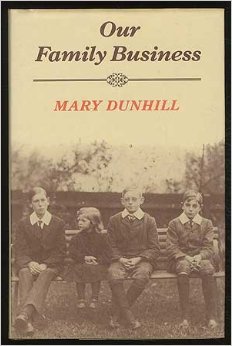
9dca8450e349c2007078376e9fa56ebdI just finished reading Our Family Business by Mary Dunhill (pictured to the left). The book is written in the style of personal reminiscences of the author. It is quite engaging. She starts with her memories of the family from birth and moves through the various business developments as they happened and as she saw them in her growing up years. She gives a brief glimpse at the history of the Dunhill family and their settlement and house building efforts that ran parallel to the family business. It is an inside glimpse of the making of the Dunhill business groups and the people and family behind the development.

After reading the book I believe that the words written on the fly-leaf of the cover summarize the book really well: “At the age of seventeen Mary Dunhill joined her father’s pipe making and tobacco business, starting at the bottom as an assistant cashier. 38 years later she became the chairman of the Dunhill group of companies, a job she held through fourteen years of international expansion. Her book demonstrates the demands that a professional career make on a woman as well as the skill that women can bring to the problems of management. Yet this is more than a career story, more than a history of an enterprise unlikely to be rivalled in the economic conditions of today. It is a candid portrait of the Dunhill family, of their beginnings as harness makers and of the very different personalities that went into the building of a rare quality and character.”

Like most books or reminiscence the book does not have a table of contents. There are no simple headings on the chapters to give the reader an idea of the content of that chapter. It is written in a flowing style that proceeds from the early years to the later years of the writer. It is as if the reader is taken inside the head of the writer and given an intimate glimpse of her life. Mary had done a masterful job in being transparent about what she when through in a way that I have seldom seen in personalities of this ilk.

To help potential readers make a decision on whether to purchase and read the book, I have summarized the content of each chapter below.

41Xh2VfDTLL._SY344_BO1,204,203,200_ Preface – pages 5-7 – a note from Mary Dunhill on the flow and content of the book as she tells the story of her life within the Family Business.

Chapter 1 – pages 9-13 – Mary’s birth into the Dunhill family in Edwardian London. The development of her father’s move into the tobacco business is introduced. The opening of the shop in Jermyn and Duke Street stocked with pipes, tobaccos and cigars.

Chapter 2 – pages 14-21 –The early history of the Dunhill family and the related trades and businesses they engaged in. The development of the Dunhill Motorities. The chapter ends with a description of the early work of Mary’s father prior to opening his tobacco shop.

Chapter 3 – pages 22-29 –The life of Mary’s family in Harrow before the WWI. The hard times of the tobacco business on Duke Street. Her father began to make a name as a blender of the My Mixture blends. She also introduces the reader to her mother.

Chapter 4 – pages 30-38 – The life in the new house in Woodlands with a look at her school and social events. She met Rex, the man she married forty years later. Inserted into this chapter are a collection of family photos. Each is labelled and gives a clear picture of life in those times.

Chapter 5 – pages 39-46 – The development of the Dunhill pipe and the rise of that pipe to fill the need for pipes that did justice to Alfred’s blends of tobacco. A brief history of briar pipes and the way Dunhill pipes were made and the number of pipe makers employed to meet the demand.

Chapter 6 – pages 47-54 – The prosperity of the Dunhill’s is explored and their move into a life of maids, cooks and butlers is described.

Chapter 7 – pages 55-61 –Mary’s life in boarding school and how it led her to leave school and enter the family business as a junior clerk.

Chapter 8 – pages 62-72 – Her work at the Notting Hill Gate factory. Notting Hill factory turned out several thousand Dunhill pipes per week. The history of the Dunhill lighter is introduced toward the end of the chapter.

Chapter 9 – pages 73-83 – Another move to another house – the “Barn” is described and detailed. Mary explains the start of her own small cosmetics business that introduced her to customer service and business management (later it became a lucrative part of the Dunhill label).

Chapter 10 – pages 84-92 – A second photo section. The details of business development in US, Canada, France and England are mentioned and some of the famous clients of Dunhill products. The chapter ends with the birth of her first daughter, Kay.

Chapter 11 – pages 93-102 – Beginning with the birth of her second daughter, Tessa and exploring the development of the Dunhill Company during Hitler’s rise to power in Germany and the war years. She describes the bomb damage to the Jermyn Street frontage of the Duke Street shop and the destruction of much stock. Reflections on how they survived the war years.

Chapter 12 – pages 103-109 – Post war growth of the Dunhill Company. The global developments of the business are detailed. The changes in the family are also noted with the deaths of many of the older Dunhill family members of Mary’s first husband Geoffrey.

Chapter 13 – pages 110-119 – Mary’s growing involvement in the work of the Board. Her responsibility of management of the struggles of the Company in the late 50s is detailed. Her line of Mary Dunhill cosmetics had expanded across the US. The chapter ends with her marriage to Rex.

Chapter 14 – pages 120-126 – Mary’s role as Chairman of the main Dunhill board beginning in 1961. This chapter details her role on the board and the changes and developments that occurred in the early years.

Chapter 15 – pages 127-133 – The Far East marketing of the Company with significant development in the Japanese Market added to a Far East boom period. The company was also in a boom in Europe and the US. As Dunhill continues to develop, Mary’s daughter Tessa killed herself in hospital.

Chapter 16 – pages 134-140 – Summarizes the business of the Dunhill Company from 1912 through 1975 when her nephew, Richard took over the company – pipes, tobacco, lighters and accessories, jewellery, leather goods, watches, writing instruments. A diversified portfolio of products was sold.

Chapter 17 – pages 141-146 – Summarizes some of the lessons learned in her life in the family business. She describes the happiness that she experienced in leading the company during its growth years.

This book is autobiographical in nature but at the same time given the length of Mary Dunhill’s involvement in the family business it gives an intimate picture of the history of the Dunhill Company with all of its constituent parts. The inner workings of the company and the development of the tobacco blending and later pipe making aspects are rich with history for the pipeman who loves to understand the ins and outs of his/her hobby. Well worth the read. The style and manner of the writing is clear, concise and also full of revelations about Mary’s own feelings and struggles both in life and as the head of a large company.

A Book Review – The Smoker’s Guide – Philosopher and Friend


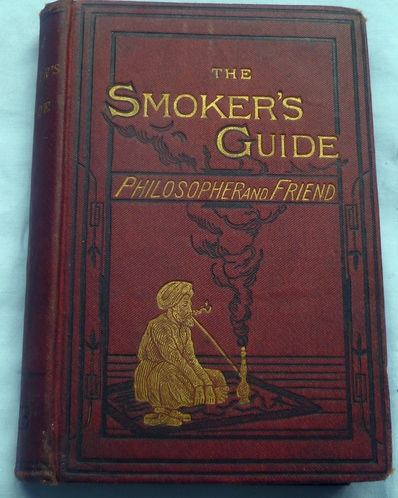
Smokers Guide 1 I picked up this old book on eBay after I came across it a few months ago. I was the only bidder so I got it for a good price. It is subtitled What to Smoke –What to Smoke With – And the Whole “What’s What” of Tobacco, Historical, Botanical, Manufactural, Anecdotal, Social, Medical, Etc. The author identifies himself as A Veteran of Smokedom. The book was originally published by Hardwicke & Bogue, 192 Piccadilly, London in 1877. The cover is stamped and embossed with gold leaf and shows a Turkish pipe smoker sitting on a carpet with his water pipe putting out a cloud of smoke. The spine of the book is stamped in gold leaf with the title, The Smoker’s Guide at the top of the spine and a line with H&B at the bottom of the spine.. The back cover is embossed with a rosette. The entire book is in great shape for its age with the only detracting feature being that the binding is a bit shaken and the corners of the cover and the top and bottom of the spine are slightly worn.

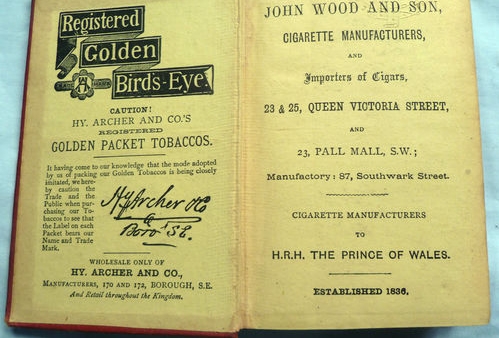
Like many of the books from this era the end papers on the front and the back of the book bear advertising broadsides. Inside the front cover is one for Registered Golden Bird’s-Eye Tobacco a product of the HY Archer and Co. The advert warns of others who have imitated their product and cautions the buyer to beware. Across t he page is an advert for John Wood and Son, Cigarette Manufacturers and Importers of Cigars. The content of these adverts is great to read.
smokers guide 2
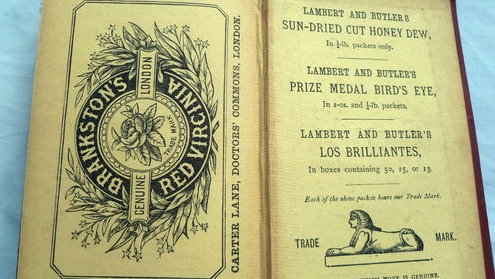
Inside the back cover is an advertisment for Lambert and Butler’s Sun-Dried Cut Honey Dew tobacco. Across the page is one for Brankston’s Red Virginia Tobacco. All of these advertisements make my mouth water and create a desire to try out these old time tobaccos.
smokers guide 4
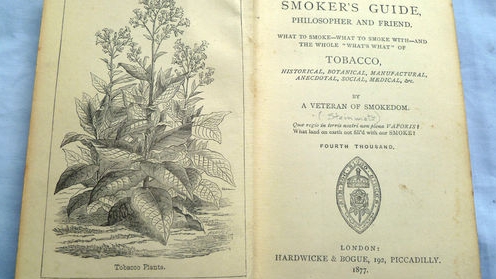
Turning the pages from the front one is taken to the title page of the book with an engraving of a tobacco plant on the opposite page. It appears that someone has written the name Steinmetz in brackets under the author’s title “A Veteran of Smokedom”. I am not sure if this is a guess of the original author’s name or a factual statement of the writer added by a librarian or previous owner of the book.
smokers guide 3
The book begins with a note to the reader that reads as follows: “The adoption of Pope’s memorable words addressed to Lord Bolingbroke for the title of this little work inspired the entire design, and made it incumbent upon the Author to do his utmost to render it worthy of so comprehensive a designation.

In the attempt he has been largely assisted by his innumerable predecessors in Tabacology, and almost every other “ology.” But, whilst drawing from every available source, he has taken nothing without striving to adorn it – after the good example of Virgil, Milton, Byron, and all the most enduring writers of ancient and modern times, who have thereby secured immortality – simply because so many other worthies have contributed to, and can vouch for, their excellence.

In like manner, whilst thankful to all the gods of Literature and Science for the gifts they have showered into his casket, the Author trusts that he has fashioned and set their gems in a new light, for livelier appreciation.”

After the note to the reader the Table of Contents shows the brief and broad categories of the chapters of the book. The Table of Contents also gives a brief description of the content of each chapter. I find this helpful in being able to look for particular topics that are covered in the book.

I have included a copy of the table of contents for you to have a look at. It will show you the flow and development of the book over the course of the pages.

A few words to begin with
Chapter 1 – The curious history of the Weed
Chapter 2 – The cultivation, manufacture and consumption of Tobacco
Chapter 3 – He who smokes dines
Chapter 4 – What Tobacco shall we smoke?
Chapter 5 – Of the Cigar and Cigarette
Chapter 6 – Of the qualities of a good pipe
Chapter 7 – Of Tobacco in the religious point of view
Chapter 8 – Of Tobacco and ‘Les Miserables,’ or as the comfort of the afflicted
Chapter 9 – Tobacco in the artistic point of view
Chapter 10 – Of Tobacco in the medical point of view
Chapter 11 – Tobacco a mine of gold to trade and government
Chapter 12 – Tobacco the firmest support of constitutional government
Chapter 13 – Smoking compared with other extravagances
Chapter 14 – Tobacco and its enemies
Chapter 15 – Words of the wise on Tobacco
Chapter 16 – Tobacco in the literary point of view
Chapter 17 – Tobacco and the Franco-German war
Chapter 18 – Of Tobacco in the poetic point of view
Chapter 19 – Tobacco and the fair sex
Chapter 20 – Of Tobacco in the ruminant or Quid point of view
Chapter 21 – Of snuff and snuffers
Chapter 22 – Useful hints to smokers
Chapter 23 – A word of advice to our young friends

Each chapter is written in a very clear and easy to read style. It is written in the period of the style of the age. The author uses language well and in a very picturesque way describes each of the topics at hand. The author also makes use of quite a few contemporary authors as well as ancient ones to substantiate his work. The quotes are well footnoted in the text of the book.

The first two chapters give the background information regarding the history and manufacture of tobacco. These provide the base from which he will develop the rest of the book. Chapter 1, the longest chapter in the book, gives a quick overview of the history of tobacco and traces it through various countries and kingdoms in terms of acceptance and rejection. I appreciate the way in which the author covers the history on both sides of the pro and anti camps. He traces the argument through each time period he covers. His method in looking at the history is a unique and fascinating read of the times. Chapter 2, also a long chapter looks at the various countries which produce tobacco and the amount and variety of the tobacco produced. After covering these bases the author steps aside from the background information and looks at the use and enjoyment of tobacco.

In the remaining chapters he intersperses what he call the various points of view from which he views tobacco. He develops chapters on the religious point of view, the use of tobacco for the suffering individual, the artistic point of view, the medical point of view, the literary point of view, the poetic point of view and from the point of view of the ruminant. Each of these chapters cites various authors and authorities in the particular field that is being viewed from both the positive and negative point of view. In between these chapters he covers a wide variety of topics. He has an essay on each of the following topics: the choice of tobacco that we use and the means of that use whether pipe, cigarette, cigar, snuff or chew. There are also topics on the economics of tobacco for governments – in other words taxation and its benefits to the government, on the enemies of tobacco and on the friends of tobacco – those he calls the wise. He writes about smoking in comparison to other extravagances, tobacco and women and even a chapter on tobacco and the Franco-German war. He concludes the book with two chapters in which he applies the information of which he has written. The first is written as hints to the smoker and the final he entitles advice to our young friends.

I appreciate the candour and thoroughness of the treatment he gives to tobacco. The older style of writing is not beyond our modern aversion to old and flowery language. He writes in a clear and entertaining fashion about the hobby we love. If you can find a copy of the book I highly recommend it for your reading pleasure. There is a quaint and delightful sense of being transported back in time as you turn the pages of chapter after chapter.

A Book Review – Tobacco Leaves – Being a Book of Facts for Smokers


The cover of the book

The cover of the book

I picked up a few tobacco and pipe books from Project Gutenberg as EBooks that I am reading on my iPad. The first of these is a fascinating read. It is written in a very modern and readable style that belies the fact that it came out in 1915. It is called Tobacco Leaves – Being a Book of Facts for Smokers – W.A. Brennan 1915. Brennan’s states his purpose in the paragraph’s below copied from the introduction to the book.
“This little book is intended for the man who uses tobacco. While there is a very extensive literature concerning tobacco, yet it is surprising how few books there are written expressly for the smoker. Much has been written concerning culture, production and manufacture; the historical and anecdotal aspects have been catered for; pamphlets and books abusing and denouncing the use of tobacco are plentiful; but the smoker will find it difficult to get a book just giving him the facts concerning tobacco and smoking, which he ought to know, and omitting matters, which, although interesting, are not necessary. This little book is an attempt to fulfill that purpose; and it is felt that no apology is needed for its appearance. (My emphasis) If the average user of tobacco is questioned concerning the matters treated in the following pages, he will be found ignorant of them. This ought not be so. The custom of tobacco smoking is so general and so intimate a part of the daily life of the great majority of men that a better acquaintance with the plant, its qualities, uses and effects should be cultivated and welcomed.

No claim is made for originality. The facts here stated have been gathered from various sources and the only credit claimed is for putting them together in a concise and consecutive form. The object aimed at is to give information. Whether the custom of tobacco smoking is desirable, whether in any individual case it would be beneficial or otherwise to smoke—these and similar questions are left to the reader’s own judgment from the facts and opinions presented, as well as from his own observations. The man who uses tobacco daily should know what he is doing. If statements are made either verbally or in print concerning the custom he should be able to verify them or show that they are incorrect. It is trusted that the information given in these pages will enable him to form a clear judgment whatever the judgment may be.

It may be felt that many aspects of the use of tobacco and matters connected with it have either not been touched on, or only referred to very briefly. The reader who may desire further information will find it in the bibliographical references given throughout the book. These references have generally been consulted by the author and his indebtedness is acknowledged here.” Tobacco Leaves – W.A. Brennan, page 5.

I have divided the book into three parts for ease of reference for me as I write this review and as a way to classify the material found in each part of the book. What I have labeled as Part 1 covers all of the material regarding cultivation, production, processing and sales of the product. Brennan begins the book with a short history of tobacco and its place in the botanical world as he calls it (Chapter 1). From there he covers cultivation, production and curing of tobacco both in the US and in Europe. He talks in a clear and non-confusing way about the chemical composition of tobacco (Chapters 2-6). All of this material serves as a backdrop to the marketing, manufacture and processing of tobacco into the products that smokers imbibe (Chapters 7-9).
Part 2 (Chapters 10-16) looks at the various tobacco products available and talks about their history, manufacture and use. It is this section that covers the products that are manufactured from the processed tobacco. He covers cigars, pipe tobacco, chewing tobacco, cigarettes and snuff. Each chapter gives the details in production and use of the product. I found the material interesting to read and also very informative. I learned things about each product that was new information to me. He begins three chapters on cigars. He is not as concerned with various brands that are available but is looking at the historical and general facts about cigars, their quality and their making (Chapters 10-12). He combines the chapter on Pipe smoking and chewing tobacco into a brief and concise description of preparation of the tobacco and the products themselves. He covers such topics as Qualities required–Description of kinds–Perique tobacco—and Statistics (Chapter 13). He gives a brief description of cigarettes and their manufacture and use as well as domestic and imported brands (Chapter 14). Chapter 15 is a very good description of the use of snuff and it making. He concludes the part of the book I call Part 2 with a brief discourse on Tobacco pipes. I found this chapter interesting even though there was no new information. I enjoyed his way of talking about the subject. He gives a brief history of pipes and how they are made as well as the materials used in making. He speaks of Meerschaum, briar, and the materials used for the stems. He gives a brief discourse on special kinds of pipes and ends the chapter with a few pointers on the care of pipes (Chapter 16).

Part 3 (Chapters 17-19) develops several chapters on the effects and benefits of tobacco us. Chapter 17 is a brief chapter on the physical effects of tobacco smoking on the human system and gives medical opinions on tobacco use and discusses the merit of the opinions. Chapter 18 discusses the beneficial effects of tobacco. This section is one that never would have been printed in today’s politically correct climate. He speaks of the disinfecting action of tobacco as protection against infectious disease and ends this chapter with an interesting piece on the psychological effects of smoking. Chapter 19 concludes the book with topics that really do not fit anywhere else within the scope of the book but are interesting nonetheless. These cover such topics as revenue, taxation, etc., in connection with tobacco, the insect pests which attack tobacco and tobacco flavoring fluids, etc.

The book is very readable and the style is fresh and enjoyable. The author has met the objectives that he spelled out in his purpose statement early in the book. I heartily recommend this book to fellow pipemen. I don’t know about you but there is always something to learn or be refreshed on in the arena of our pipes and tobaccos.

I have included a short version of the table of contents for you to have a look at. It will show you the flow and development of the book over the course of the pages.

Chapter 1 – Historical and Botanical
Chapter 2 – The Cultivation of the Tobacco Plant
Chapter 3 – Production of Tobacco
Chapter 4 – Production of Tobacco in the United States
Chapter 5 – The Chemical Composition of Tobacco
Chapter 6 – The Curing of Tobacco Leaf
Chapter 7 – The Marketing and Sale of Tobacco Leaf
Chapter 8 – Rehandling and Fermentation of Tobacco Leaf Prior to Manufacture
Chapter 9 – Manufactured Products of Tobacco in the United States
Chapter 10 – Cigars: Historical and General Facts
Chapter 11 – Cigars and Their Qualities
Chapter 12 – Cigar Making
Chapter 13 – Pipe Smoking and Chewing Tobacco
Chapter 14 – Cigarettes
Chapter 15 – Snuff
Chapter 16 – Tobacco Smoking Pipes
Chapter 17 – Effects of Tobacco Smoking on the Human System
Chapter 18 – The Beneficial Effects of Tobacco
Chapter 19 – Miscellaneous

The book is available as a free e-book from the Gutenberg Project. It can be downloaded in a format the works on iPads or Kindles etc. It is also available in PDF format or can be read online. Here is the link: http://www.gutenberg.org/ebooks/37388

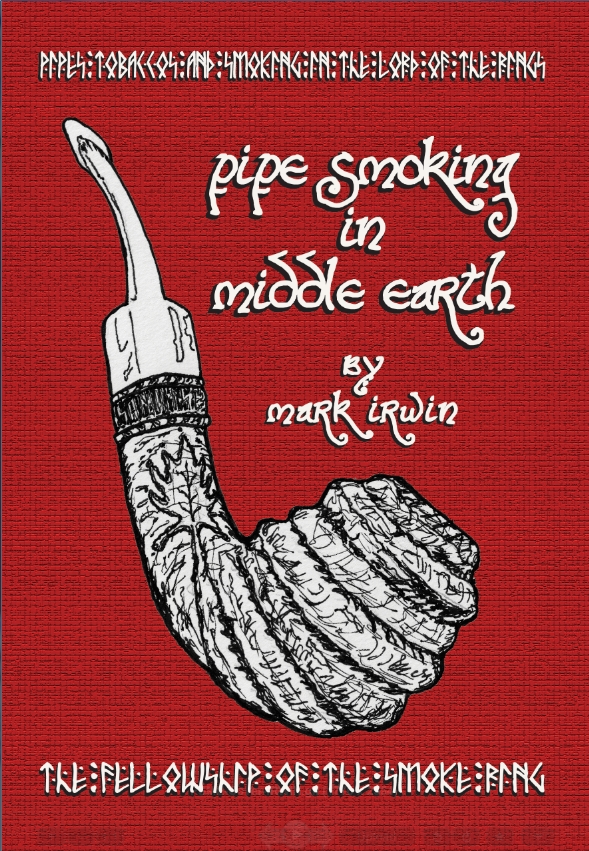
A Book Review: Pipe Smoking in Middle Earth – Mark Irwin


Blog by Steve Laug

Image

I have been putting off reviewing this book for quite awhile now. I ordered it from Mark at the end of May and read it the first time in June, soon after it arrived. The reason I put it off is because I have also been rereading The Hobbit and The Lord of the Rings. I don’t know what read this is – I have been reading and rereading it for over 50 years probably. Each time I do I learn more and get more lost in its brilliant images and the magnificent tale. Well, since this is not a review of the LOTR but of Mark’s book I better get on with it.

Mark has done a masterful job in describing the pipes and tobaccos as he imagines them from many years of reading and rereading the books. His own book is filled with descriptions of the tobacco and the pipes of Middle Earth. He has hand drawn illustrations of the pipes of each of the pipes from a combination of his imagination and the descriptions provided by Tolkien of both the individual and their pipes in the pages of the Hobbit and the LOTR. He draws both his words and illustrations in marked contrast with those seen in the movies by Peter Jackson.

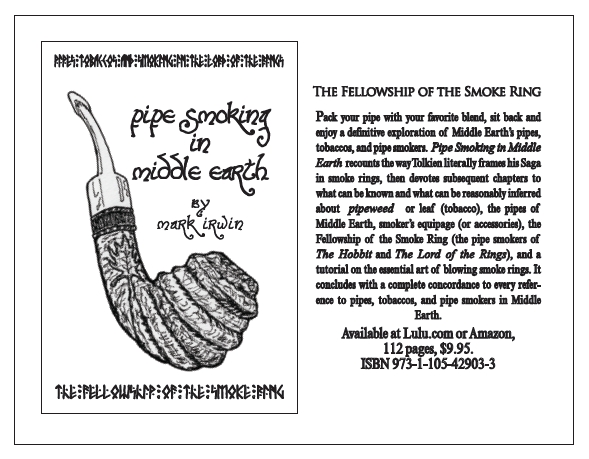
The book is divided into two major sections for ease of reading. The first is a series of essays on the pipes, tobacco and smokers of Middle Earth. The second is an annotated concordance or all of the occurrences of pipes, tobaccos and smokers in the Hobbit and the LOTR as well as other books of Middle Earth. Each of these two major divisions is further broken down. The first is broken into an introduction and six essays/chapters on a variety of topics pipes and tobacco as seen in Tolkien’s books. This section is illustrated with pen and ink drawings by Mark. The second is broken into two parts – a concordance on the books (Hobbit, LOTR and other relevant Middle Earth books) and a concordance on the extended version of the movies by Peter Jackson. It also has a variety of pen and ink drawings. The book closes with end notes worthy of the scholar Mark is.

The little book opens with an essay entitled Charring Light in which the direction of the book is delineated. The essay poses two problems that face the pipeman as he deals with the pipes, tobaccos and smokers of Middle Earth. The first is diminishment, or downplaying the role of pipes and tobacco in the books. He sets out a convincing argument that this is what Peter Jackson does in the movies. The second is enlargement, or over emphasizing the role pipes and tobacco play in the books and neglecting the larger purpose of the saga and its author. Mark is convinced that Tolkien shows us the middle way between diminishment and enlargement. To illustrate this he cites “an apocryphal but probably authentic letter” where Tolkien writes that basically he has said all that needs to be said about pipe smoking and Hobbits in the prologue. Mark’s purpose is to strive to stick with the text and set out the facts regarding what the books say about pipe smoking and what can be inferred from the text. He seeks to leave behind his own opinions and ideas and search what is on the pages of the books.

The details of the first six essays/chapters need not be mentioned at this point, as you can purchase the book and have a read yourself. But it is enough to say that they cover a variety of topics pipes and tobacco such as pipeweed or leaf, the pipes of middle earth, smoker’s accessories and how to blow smoke rings. Mark covers each of these and other topics relevant to Tolkien and pipe smoking in the chapters of this part of the book. I was repeatedly amazed at what he lifts from the books in his descriptions and drawings. For example take this section from the chapter entitled “Tolkien’s Smoke Ring”:

The Hobbit begins with Bilbo’s smoke, continues through the narrative with another nine evenly-spaced references to the art of smoking (smoke-rings in particular), then ends as Bilbo hands Gandalf the “tobacco jar” – which are the last two words of the story. And let us never forget that Bilbo’s finding of “the precious” – the One Ring – is precipitated by his search in Gollum’s dark cave for another treasure, albeit one much less perilous – his pipe.” PSME pg. 13.

Mark goes on to note the number of references in each of the three divisions of the Lord of the Rings to show that the pipe smoking concern that is evident in the Hobbit is repeated in the LOTR. Each volume of the three part division has numerous references to the pipe and tobacco. In fact Tolkien considers it important enough to include a section entitled, Concerning Pipeweed in the middle of his tripartite prologue of the book. Mark writes in a clear and captivating style and demonstrates a grasp of the middle way that Tolkien set forth in the “letter” referenced above.

In each of the chapters of the first section he uses the same clear and forthright style to show the type of pipes the characters may have smoked according to their personality and style as described in the story and how they used the pipe in their lives. The section on the tobaccos of Middle Earth is entertaining and probably the best explanation of the kinds of tobacco that may have been in Tolkien’s mind as he wrote about them in his books. Well done Mark.

The second major section of the book is devoted to a concordance of citations about pipes, tobaccos and pipesmokers as I mentioned above. Mark has done a stellar job of cataloguing these quotations in an annotated presentation. He works through each – the Hobbit, the Lord of the Rings and other Middle Earth related books gathering the quotes and references. Each citation is complete with reference notes to the page, chapter and section of the book cited. He continues the same process with an annotated concordance to the Peter Jackson movies (extended version) and quotes the scene and segment of the movie where the quotation was used.

The book is a short 112 pages of interesting and imaginatively written material on what has to be one of my all time favourite author’s books. Thank you, Mark for a job well done. I only have one serious complaint for you – why didn’t you extend the book, and like Peter Jackson make and extended version for those of us who cannot get enough.

Image

Confessions of a Pipeman – First edition – Gary B. Schrier


Confessions of a Pipeman – First edition

Gary B. Schrier

Schrier subtitles his book “an irreverent guide for today’s pipe-smoking man.” It is indeed that!! In its short 90 pages he takes on almost every aspect of the life of a pipe smoking man. He debunks a lot of traditions and takes exception to some commonly held myths that seem to float around everywhere these days. Some of his takes on things will certainly ring true to you and some will actually tick you off, but all will make you sit up and take notice. Schrier has a knack for stringing together words in ways that carry a lot of punch for their schrift.

I sat down to read the book last weekend, with a pipeful of nice Virginia, and could not put it down. It is a quick read and there are even cartoons to convey his points. For those who need to have a page full of type interrupted by an occasional picture or cartoon these are great. I always read the foreword and the preface of every book I read. I have the often mistaken belief that the author or whoever wrote the foreword might actually tip his or her hand on what to expect of the book in hand. In this case that is exactly what happens. The foreword is written by Marty Pulvers. He says “For the aspiring pipe smoker, there is no source that can educated and inform as this book. It would not be going an inch to far to call this a critical resource for that incipient pipe smoker, because the information contained herein is not going to be readily available anywhere else, and without it,  the beginner just might well lose his/her way and give up on the wonderful world of pipe smoking.” He sings high praise regarding the helpful data that Schrier included in the book.

The chapters cover a broad range of topics. The first two reflect on the state of pipe smoking today. In them Schrier argues that the age of the pipe smoker is closed. The old pipemen of ages past are all but dead. We have entered a new time that requires the pipe man to adapt to get by. Smoking in public is quickly becoming a thing of the past with few places remaining where that is allowed. He really asks pipe smokers to count the cost of being a pipe man. It is a tradition that is almost gone according to his thinking.

The next section of chapters – 3-6 – delves into the life style of the pipeman and call the new pipe smoker to look at the challenge. He includes a chapter on the importance of reading to be a well rounded conversationalist – this includes a book list of pipe and tobacco books but also calls us to read more widely. The lifestyle also includes being a conscientious smoker and one who has a natural savoir-faire. This section is delightful to read and full of interesting and insightful topics that would be worth discussing with others.

After a brief chapter on not missing out on the delight of a cigar now and then the book turns to a discussion of choosing the right pipe and tobacco. There are some helpful insights here. Schrier’s take (like mine) is that a new pipeman should begin with an English like Dunhill 965 as it will minimize tongue bite and get rid of the tootie fruitie flavours that are sure to produce a bite in the new smoker. You may not agree with him but to be honest he does not particularly care about that. Just give a good reason for your disagreement. He turns to discuss aged tobacco and the ritual of keeping a pipe in good order. There is an interesting take on collecting pipes – I am not going to give it away but it is worth a read just to get your blood pressure up a bit if you are a collector!!

The next section of the book covers a variety of topics on travelling with your pipe and where to smoke it – pipe clubs, your own pipe den, etc. and gives a brief introduction to the questions about pipe smoking and health.

The last two chapters are set apart for the debunking of myths and the concept of mentoring others in the gentle art of the pipe.

The book is a great read. Easy to work through and digestible in small chunks due to short chapters. The language is colourful and at times irreverent. But it makes it fun to read. I found myself laughing at times and at other times reflecting on my own habits and practices. Marty Pulvers says it is a great book for the beginner, but I can say as an old timer with more years with a pipe under my belt than I care to admit it is enjoyable and educational. It is well worth the price of the book to have a conversation with Schrier between the covers of his book. You will laugh, agree, disagree, strongly take exception and at times wish he had said it more strongly. Highly recommended.

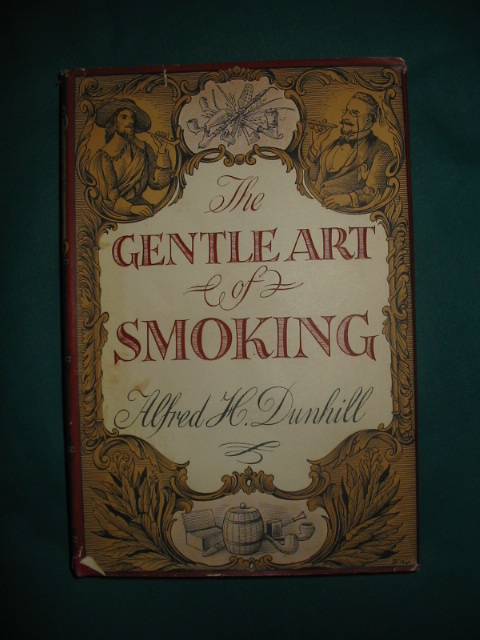
The Gentle Art of Smoking – Alfred H. Dunhill


Image

The Gentle Art of Smoking 

Alfred H. Dunhill

This book is quite different from Pipe Book by his father. Here Alfred H. Traces the history of smoking in all of its forms throughout history. He looks at it on the various continents and how it took form among the religious and the ordinary people. He looks at cigars, cigarettes, pipes and even snuff. Each is described from its inception to its ongoing development in the first chapter. In later chapters he develops each of the various smoking methods.

From the history of smoking a chapter is developed on the growing tobacco. There is some great material on the tobacco plant and the various layers of the plant from lugs, cutters to leaf and what each section is used for. He spends time explaining the cultivation of tobacco and the growing seasons in the various regions in which it is grown. Then he takes the reader through the process of harvesting, curing, grading, fermentation and marketing. The book then turns the preparation of tobacco from the harvest to transportation and the methodology used to create the various forms tobacco packaged. He does a great job going through the machinery for processing from the first to the last. The cigarette machines, that roll, pack and cut each cigarette and then package them in cartons or soft packs are described. Throughout the book sketches are used to depict the various sections of development.  He also looks at the way pipe tobacco and cigars are made.

The fourth chapter of the book picks up the history of pipes and to me this chapter is very reminiscent of is father’s book on pipes. He uses different but similar sketches to picture the pipes evolution but the text is very similar in my mind. There is nothing new or added in this section of the book that has not been covered by others.  From the history the author takes us to the making of the pipe. He addresses briar pipes first and of course gives a good picture of the process of making them from briar burl through finished product. In this section as in others there are also black and white plates that are really nicely done and lend illustration to the procedures that are being talked about. The section closes with a brief description of clay pipes and their manufacture and meerschaum and their development.

Chapter 6 looks at cigars and traces the rise and decline of cigar smoking throughout history. It also gives a good concise summary of the process of making, grading and packing cigars. Chapter 7 discusses the manufacture, history and use of snuff. There are some great plates in this section of antique snuff boxes, etc. Chapter 8 looks at the various methods of lighting tobacco products throughout history and gives some great historical development material on the discovery and manufacture of lighters. Again plates and sketches illustrate the variety of lighters used to bring fire to the weed.

The book closes with a section on the practice of smoking. The majority of the section deals with the choice, use and variety of pipes. It goes into the method to use in choosing shapes, stems and sizes. It also goes into a great description of the loading, smoking and after care of a pipe for the beginning smoker. Then the section turns to cigars. Here the choosing of a cigar is discussed with guidance on how to make that choice. Then directions are given for preparing and smoking the cigar you have chosen in order to get the most pleasure from the smoke. This chapter and the book closes with guidelines on the care and keeping of cigars.

Overall this is a great read; nothing new or profound but some very nice summaries of a variety of topics. The section on pipe smoking was by far one of the best sections in the book. It would make a great read for the new pipe smoker and a good review for those of us who have forgotten more than we remember about the great hobby that is ours.

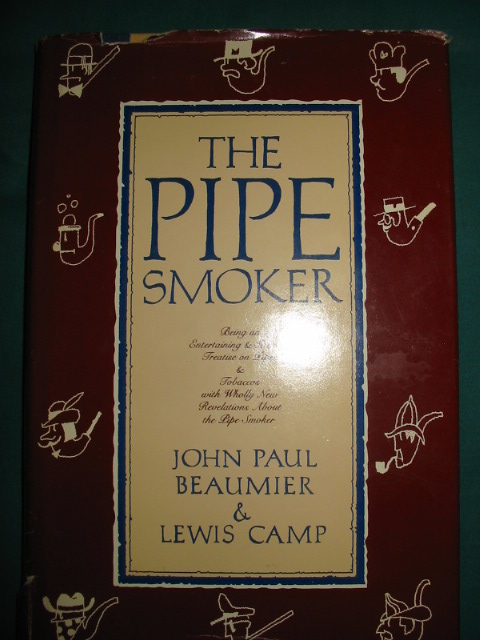
The Pipe Smoker – John Paul Beaumier & Lewis Camp


Image

A Review – The Pipe Smoker
John Paul Beaumier & Lewis Camp

The sub title sums up the purpose of this book very well: “Being an entertaining and scientific treatise on pipes and tobaccos with wholly new revelations about the pipe smoker.” If you have you ever really thought about why you smoke a pipe or why some people smoke pipes and others just cannot be bothered, then this is a book you could have written given the time and thought… or at least one that you should read

The Pipe Smoker was written from a different slant according to the authors in the introduction. Their names on this book are pseudonyms for two northern California psychologist/authors. One is a scientific consultant to a leading American pipe manufacturer, the other is an expert on mind-body relationships and a long time pipe smoker.

Almost all other books written about pipes and tobacco focussed on that topic. This one has taken the tact of focussing on the pipe smoker. It is a study into what make a pipe smoker different from other humans. The argument is that once we have come to know some of the compelling reasons for this difference we will better understand why the infinite varieties of tobaccos and pipes have such special meaning to this special person.

With that purpose in mind the authors set out to look at us – the pipe smokers. The outline of the book illustrates this clearly. Each chapter in the five major sections is introduced by a pipe smoking quote from famous and anonymous pipe smokers that illustrate the content of the chapter. They add an interesting dimension to the book and to its overall direction – they give voices to the person of the pipe smoker. The five major sections are organized as follows:

Section 1:The personality of the pipe smoker – in which the authors look at the aspects of the collective and individual personality of the pipe smoker. They discuss masculinity, social image, extraversion vs. Introversion and what they say is the penultimate pipe smoker – the healthy introvert.

Section 2: What the body says – here the authors look at the pipe as a means of relaxation, sex and the pipe smoker, meditative mindset and pipe smoking. This is a fascinating section of the book and contains reflections that I have never read elsewhere.

Already you can see the different direction of this book takes. It was a hard book to put down without finishing the last pages.

Section 3: A sensual guide to the art of pipe smoking – Here the authors discuss the sensuality of the pipe and its effects on the smoker. They discuss the odour and taste of tobacco, the look and feel of the pipe, the caking, filling and lighting of the pipe, the exquisite pleasure of puffing and finally the care and feeding of the pipe. Here they capture for me in a way few have, the pleasure of the ritual of the pipe. Each chapter in this section captures what goes on in my senses and feelings as I savour a pipe. Well written.

Section 4: The Grand world of pipes – This section finally gets to the normal pipe book topics – it is the shortest section of the book. It covers what pipes are made of and the geometry of pipes – how they are made. Even this mundane section is written in a captivating manner.

Section 5: The book closes with a section on the religious and symbolic aspects of pipe smoking – but lest one get confused that somehow they are merely talking about sacred smoke the chapters in this section discuss the sensuous symbolism of pipe smoking the sacred and the profane in pipe smoking. It is a delightful ending to a wonderful treatise on the person who smokes a pipe.

I found that this book was a great read and thoroughly engaging. It is unique in pipe smoking literature. It treads some of the ground that lately Gary Schrier does in his Confessions of a Pipeman and does it as uniquely and interestingly as Schrier does. The book gives one much to think about – whether you agree or disagree with any one piece of their premise. Worth the read!!

The Pipe Smoker’s Tobacco Book – Robert Winans


Blog by Steve Laug

Book Review

The Pipe Smoker’s Tobacco Book

Robert F. Winans

Winans’ book on tobacco is just that a book on tobacco. He says in his introduction that the focus of his book is to concentrate on the subject of tobacco as it relates to pipe smoking consumers. Winans says it this way in his introduction, “It is a paradox that of all the people concerned with tobacco, the consumer is probably the most poorly informed about the content of a tobacco blend and its quality. There are some practical reasons for this. Foremost is his preoccupation with the end result. As long as a pipe tobacco blend delivers a smoke which produces the desired taste sensation and pleasure, the details surround the growing process, chemical analysis, type of tobacco, flavouring process are secondary.”  Yet many of us are interested in the details of what it takes to produce a quality smoke.

If you are one of those who want to know those details, like I am, then this book is a gold mine of info that walks you through the process of tobacco production from the seed, the growing area and conditions to the processing and the marketing. Winans includes many charts and tables to help facilitate understanding tobacco. The tables and charts are worth the price of the book. These include maps and charts of regions where various types of tobacco are grown and how the climate, geography and soil conditions impact the chemical make up of the tobacco. There are tables of percentages of tobacco varieties produced and where within the US they are produced. There are rating scales and diagrams to help understand which part of the plant is used for what particular tobacco product. All are well drawn and composed to aid in understanding.

The book is divided into three main parts after the brief introduction that justifies the book. Each part picks up a piece of the picture of the tobacco product. Part one is about the kinds of tobacco. This section was a bit surprising to me as he argues that there are only three kinds of tobacco: flue-cured, Burley and Oriental. From these he works through the variations under each of those broad categories. For 57 pages he works through the makeup and composition of each of the kinds of tobacco. He looks in depth at the conditions they are grown under, the impact of that on the taste and the curing methods. This section of the book is very interesting and has many helpful charts, drawings, graphs and maps to help explain the processes and the chemical composition of each of the tobaccos. In it he also shows the impact of climate change on the sugar and nicotine content of tobacco. He compares a normal growing season, a wet season and a dry season in terms of the output of sugar and nicotine percentages in tobacco. Each of the varietals of tobacco are looked at in terms of their classifications – class 1: flue-cured, class 3(a): light air-cured burley, class 3 (b): dark air-cured, class 2: Dark fire-cured, class 3 (a) Light air-cured Maryland, class 7: Perique. He then turns to a discussion of Turkish tobacco and Cavendish. Part one closes with discussion on the importance of sugar in tobacco.

Part two of the book is approximately 8 pages in length and has reflections on tobacco and what makes a quality tobacco. This section focuses on what a pipe smoker wants from a tobacco. This includes such things as tobacco bite and the coolness of a smoke. He discusses the relationship of temperature and time at the point the smoke enters the mouth. In this section he talks of the relationship of puffing cadence to temperature. This section, though brief, is fascinating. The charts and graphs on temperature and cadence are helpful in explaining why things work the way they do in a smoke. The final part of this section seeks to lend some objectivity to the concept of what makes up a quality smoke. Part two is a great read full of helpful information delivered in short pithy explanations.

Part three of the book is short as well and is packed with tobacco statistics and bibliographic materials. He has statistics on the amount of tobacco grown and where it is grown globally. There are also statistics on the kinds of tobacco grown and what percentage they make up of the total global tobacco crop. These tables are dated in that they reflect the world in 1975 but they still give a helpful glimpse of things to those of us who are interested in such things. These graphs and charts are clear in their presentation of the state of tobacco production, the values of tobacco in percentages to type, and the geographic regions that produce the most tobacco by kind. The final chart in the book is a graph predicting tobacco use in terms of rise and decline.

The book is a great read. It is well written and well documented. It is a short book (80 pages of information) but it is packed with great information. The facts are very clearly presented and substantiated. There is little left to personal opinion or argument by the method which the author chooses to present the material. This is a concise handbook on tobacco that enables the pipe smoking reader to intelligently look at the “leaf” he/she is stuffing into their pipes to smoke. I highly recommend it. I purchased the book at http://www.pipes2smoke.com