Tag Archives: antique malls and estate pipes

The Pipe Hunt – Rule #4: Buy estate pipes that challenge your refurbishing abilities


When I formulated Rule #4 it was a natural outcome of my pipe refurbishing self-training. I purchased according to what I wanted to learn until I had learned it. For me this method of buying old pipes provided the class time/workshop time where I could practice some of the tips I was reading about and learning from others in the online community. I have never been particularly shy about asking “how” and “why” questions. Ask my daughters and they will tell that one of my nicknames is “Why”. Buying pipes according to what I wanted to learn in refurbishing quickly became a habit that I really did not take time to think about until I was ready to move on to something new. I often picked pipes that I really was not interested in keeping in my collection but because they had problems that would be teaching/practicing opportunities for me. This has been the case each step along the learning curve for me. In the rest of this article I will trace out my journey in refurbishing through the kinds of pipe I bought. Through this monologue on the journey you will see my process and the method to my madness.

When I began my refurbishing education in earnest my earliest purchases were pipes that were dirty and caked but did not have any issues requiring technical skills. I was looking for very straightforward cleanup jobs. The bowls just needed to be reamed and cleaned and the stems cleaned and deoxidized. They were not chewed on or beat up on the edges of the rim. They were not charred or badly damaged. They had merely been smoked and used. I bought that kind of pipe and worked on them until I was ready to move from learning how to cleanup minimal external and internal issues. I wanted to learn how to clean a pipe from the inside out. I bought reamers – actually I have over twenty different kinds now residing in my work kit. I tried them all until I found the ones that worked best for me. I read about processes of cleaning shanks and bowls. I bought a retort and learned how to use it. I practiced with salt and alcohol treatments. Everything I did was done with a single purpose in mind – to learn how to clean a pipe. Once I felt comfortable in the process of cleaning out a pipe it was time for me move on and learn other aspects of the craft.

The second skill I wanted to learn was to refinish a pipe bowl. This influenced the type of pipes that I hunted for and purchased. I looked for ones that still had intact stems with little damage but bowls that needed to be refinished. I bought sandblasted bowls, rusticated bowls, smooth bowls all types and shapes. I wanted to learn how to remove the finish from a pipe and then to prepare it for restaining. This involved different methods for cleaning each kind of finish.I learned to top a bowl and remove damage to the inner and outer edge of the rim. I learned to steam out the dents in the bowl and to remove or minimize dings and scratches. I learned to sand smooth bowls and rims with varying grades of sandpaper and micromesh sanding pads. Each step in sanding taught me to be pickier regarding the scratches and sanding marks I left behind. Once you have a pipe almost finished and have to start over and resand you quickly learn to work at the preparation more carefully. I spoke with several pipe makers to learn the art of staining and where to get the aniline stains. I learned (and I am still learning) the techniques of staining and practiced them on many pipes. I worked on various colours and blends of colours. I worked on understains and overstains. I worked on learning how to do contrast stains. I worked on buffing the bowls and sanding them after staining. It was a great learning curve, one fueled by the kinds of pipes I bought.

The next step in my refurbishing course came from the previous one. After staining old pipes and still being bothered by the fills that were eyesores to me I decided to learn how to replace the old pink wood putty fills. I tried a variety of methods all learned on bowls I picked up at garage sales, antique malls, junque stores and thrift shops. The idea was to remove the fill and replace it with something that would take the stain. I tried putties and filler sticks and still was not happy. I tried wood glue and briar dust mixed with a bit of stain and was a bit happier. But I found that the wood glue dried shiny and still stood out on the bowl. I moved on to try superglue and briar dust and am very pleased with how it works. It is a dark colour in contrast to the lighter/pinker colour of the putty but it is solid and hard when it dries and does darken with the stain. I began to look for pipes with fills to remove and practice on in the stores. I found many pipes that I practiced on and then passed on to the racks of new pipe smokers. The pipes I worked on had begun to look better and better but I still had much to learn. Everything up to this point was pretty simple and cosmetic. The real challenges were just around the corner for me.

It was time for me to learn stem repairs with a greater degree of technicality. I say repairs and not restemmingbecause as yet I had not tackled that aspect of refurbishing. With that objective firmly in mind I was on the hunt for and purchased pipes with tooth marks, bite throughs on the stems, cracks and broken pieces. I wanted to learn how to make patches on the stems and also to recut and shape a new button on the stem. I shortened the stems. I cut buttons with files and sanding blocks. I learned to shape slots in the button with needle files. I called repair people and pipe makers to make sure I got the right tools. I bought and discarded many in the process of building the right kit. I worked with epoxy patches mixed with vulcanite dust. I worked with patches using pieces of vulcanite and epoxy. I worked with superglue and finally settled on black superglue for patching holes and bite through areas. In the process I learned to use heat from a hot water bath, a heat gun and then even a lighter to raise bite marks in the stem and to reduce tooth chatter. I learned a variety of methods to remove oxidation. All of this was part of the process of learning to refurbish stems.

When I felt more competent in the stem repairs I wanted to learn how to fit new stems to the bowls. I went on to purchasing bowls that were missing stems and learned how to turn the tenons on precast stems and to shape the stems with a Dremel and files. I bought precast stems from Pipe Makers Emporium and also bought lots of used stems on Ebay and scavenged them from broken pipes. The learning included fitting tenons, shaping stems, adjusting the taper, making saddle stems, reducing the diameter at the shank, countersinking the shank to make for a tight fit, shaping the button and opening the slot in the end. Lots of experimenting took place in learning to use the PIMO tenon turning tool which meant that some tenons were too small and others too large. All were part of the process of learning to use the tool, its limitations and methods of working around those limitations.I also learned how to shape a stem from a piece of rod stock. Each step was part of the education for me in stem repair and shaping. You can see with this method in mind I bought many bowls that later I ended up giving away and/or selling very cheaply. They ended up being good pipes for starters.

I always keep an eye out for pipes that push the limits of my restoration abilities to see if I can learn new tricks and tools. For me the purchasing of estate pipes is for my ongoing education. I am always looking for better methods and learning new methods and acquiring new skills and tools. The above paragraphs spell out my learning journey. A few more years down the road I will add new skills and thus new paragraphs to the learning journey. The long and short of Rule #4 is to buy for the purpose of learning.
The Pipe Hunt – Rule #2: Look Inside ALL Small Boxes, Cupboards and Drawers


Blog by Steve Laug

A second rule of the pipe hunt that I have learned over the years is that not all pipes and tobacco related items are in plain view as I walk around a shop. This took time to learn and by and large I learned it by asking sellers if they had any old pipes or tobacco items for sale. I used to do this after an initial walk through but now ask as soon as I enter a shop. It saves time and generally is a way of engaging in a conversation that may lead to more pipes. When the answer was affirmative I followed them to the stall or spot in the shop and watched where they had placed the items. This quickly taught me where to look. But they would also often have pipes or items at home or in the back room and they would gladly bring them out for me. I have learned that it never hurts to ask.

As a result I quickly look through a shop (I know quickly is a relative term but to me it is quicker than it used to be and way more focused). I walk through after my initial scan and open small drawers, cupboards, cigar boxes, and look inside revolving display cabinets. This may seem intrusive but trust me, it is not (well at least in my mind it isn’t). Small typography cabinets can hold pipes and tobacciana. Revolving display cases can hold pipes, tampers, lighters and other pipe related objects. I have found wind caps, tampers, Baccy Flaps, Bakelite stems, pipe holsters and other items too numerous to list by just going through these revolving cases slowly looking for tobacciana. Coffee cans, tobacco tins and old cigar boxes can often hide old pipe paraphernalia in their interiors. Don’t hesitate to have a look. Here is a tale of an old pipe I picked up by doing what I am suggesting – a nice older bent billiard for $20. I can tell you it was well worth opening drawers and digging deeper.

My wife Irene and I love doing an antique mall crawl on our days off. We generally visit as many as we can fit in before lunch and then have a good lunch at a neighbourhood pub before finishing the day with visiting a few more shops on our way home. Over the years one of our favourite spots is found not far from Vancouver. Just across one of the many bridges and upriver it is a spot with several antique shops and several larger antique malls. On the day of this tale we had visited several of them in the morning and so far had struck out on any significant finds of pipes or tobacciana for me or anything of interest for her. We had stopped for a great lunch at the local pub and were now visiting the last of the shops. We were almost finished looking and still empty handed. I had passed by some very high priced drugstore pipes – no deprecation intended here as I have many of them in my collection but I am not willing to pay the exorbitant prices that sellers mark these – $50 or more is an unacceptable price in my opinion.

I turned down the last aisle. It was lined from floor to ceiling on the right side of the aisle with display cases. These cases had drawers underneath that were labeled with different key items that resided inside. I did a quick walk by of the display cases checking them out. In one I found a couple of older Brighams that I noted. I would need to get the sales clerk to open the displays for me so that I could look at them more closely. That could wait. I turned my attention to the drawers beneath the cases. In the middle case I opened a drawer labeled miscellaneous collectibles and dug through it. There in the middle of the drawer, nestled among lots of unrelated items such as linens and doilies I found an older looking pipe that captured my attention. I stopped for a minute before picking it up. (I have a habit of trying to guess what the pipe might be before I actually look at. Quirky I know but it is what it is.)
1938 Dunhill Shell

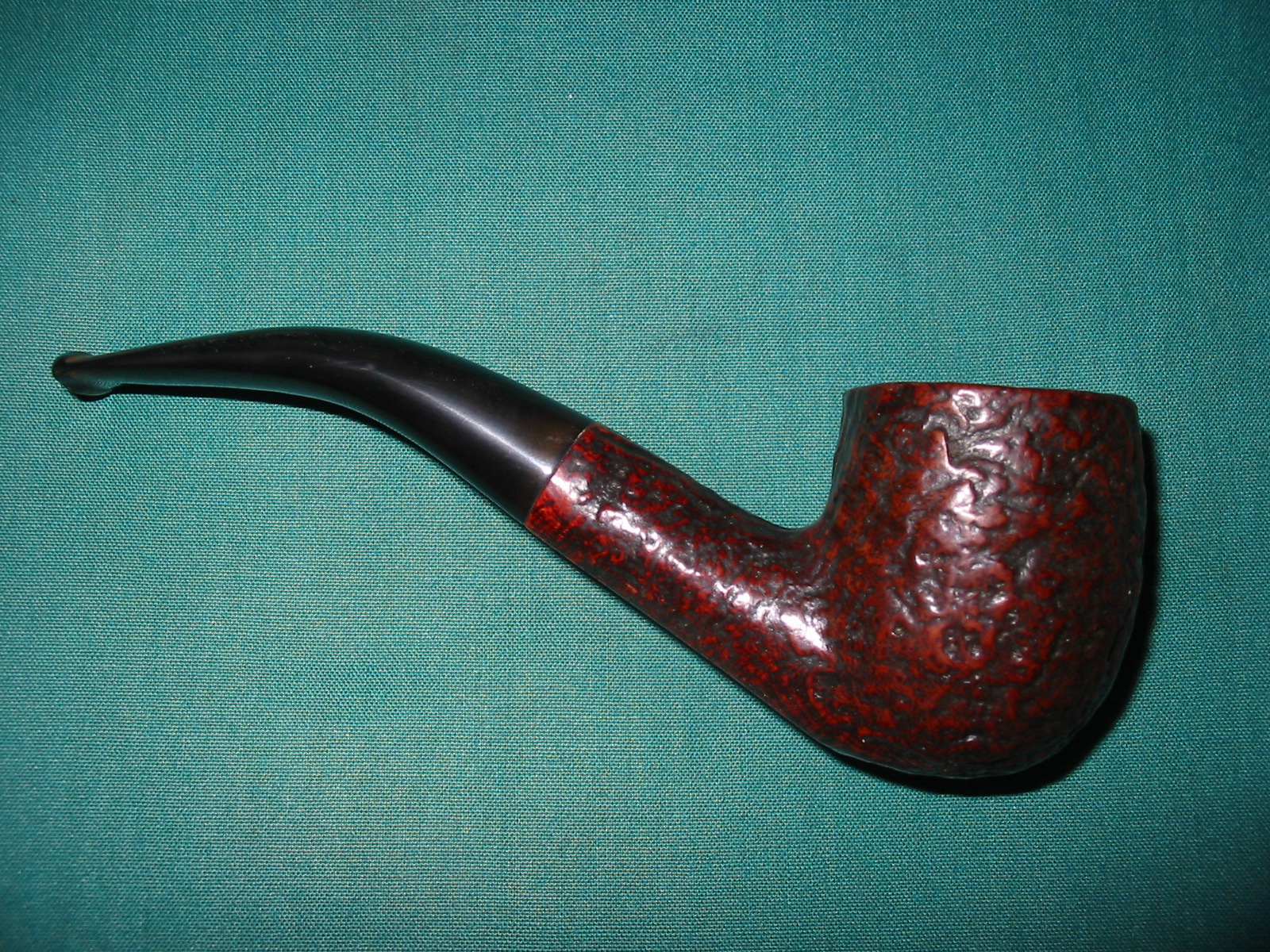
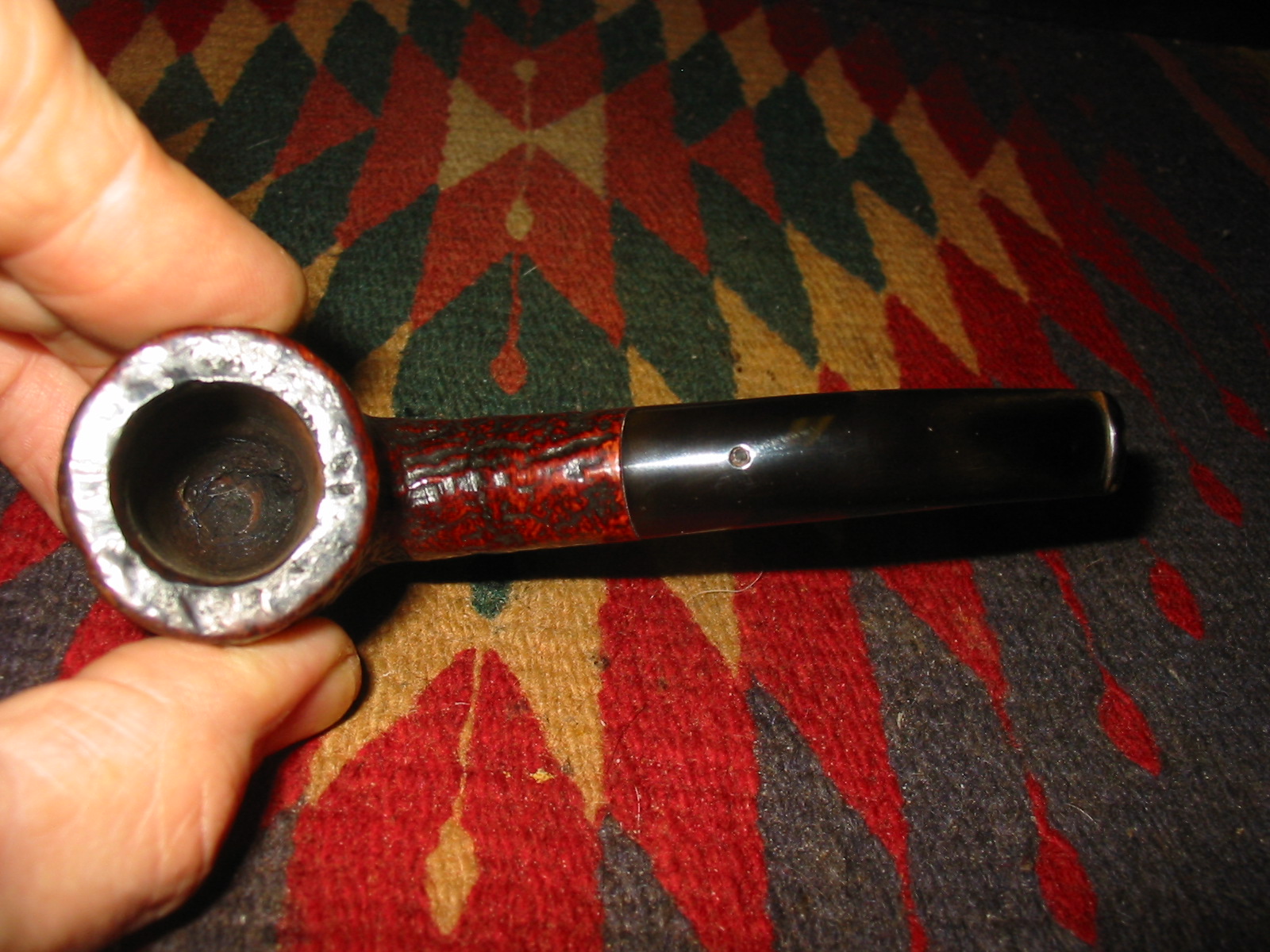
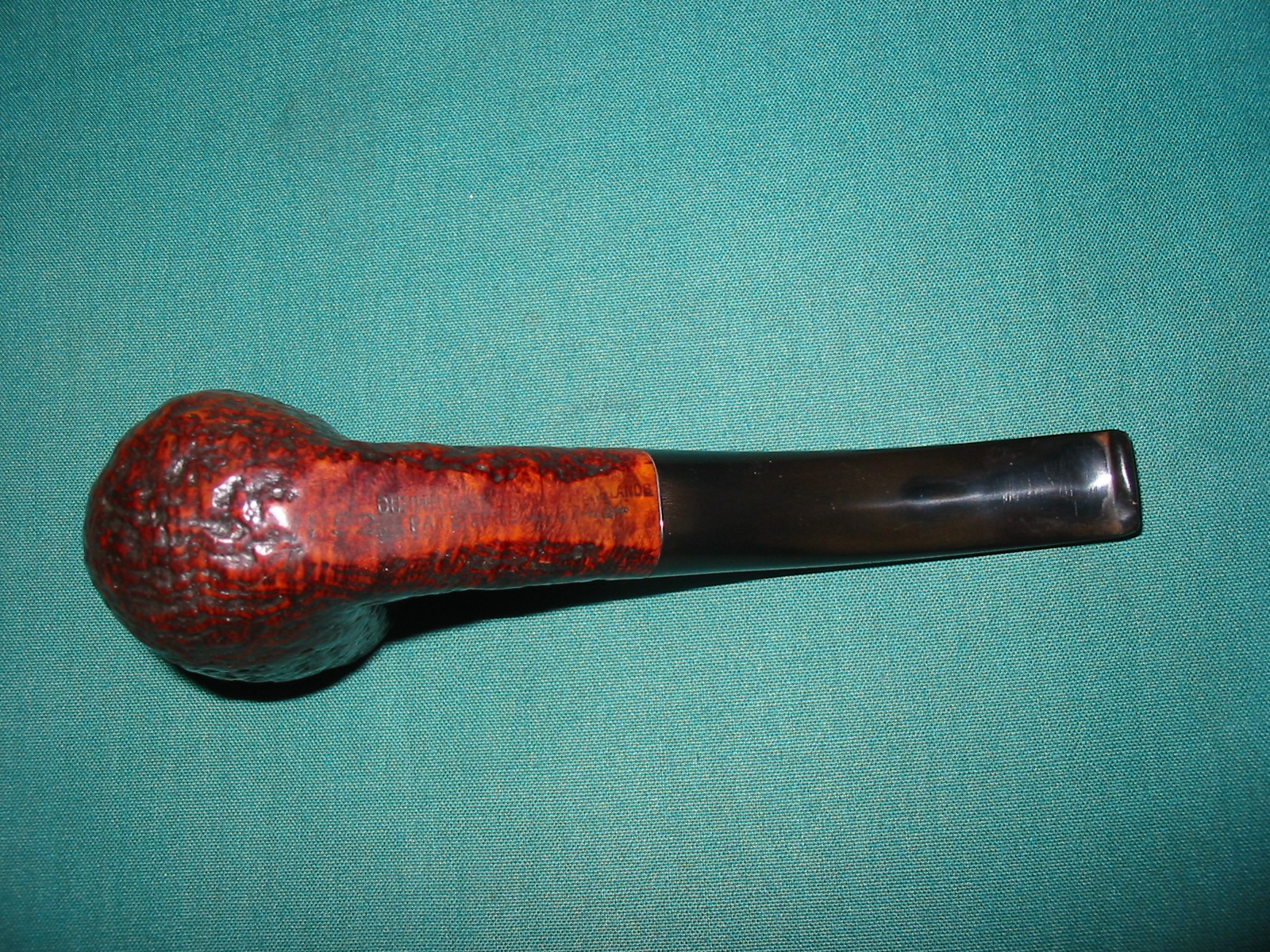
I made my guess (a Dunhill of some sort) and then I picked it up. It was a sandblast bent billiard. I turned it over in my hands and noted a slightly darkened white spot in the top of the stem and then read the stamping on the underside of the shank. It read Dunhill Shell Made in England 8 and underneath that it was stamped Patent No. The number itself was obscured in the dirt and grime that accompanied the old pipe. It was caked with a heavy carbon buildup and the stem was oxidized and had several small tooth dents on the top and bottom of the stem. Other than that it was a good clean find. To say that I was excited is to understate the case. Here in the drawer under the display cabinet I had found not just a Dunhill pipe for $20 but a Patent Era Dunhill pipe with fairly clear stamping and in a condition that would easily be refurbished. I was ecstatic. I called my wife over to show her the cause of my ecstasy and she just shook her head – another pipe. Big deal. She wandered off and I was left standing there.
I almost totally forgot the Brighams and just stood there basking in the joy of discovery! This is what I always dreamed of finding one day in my pipe hunts. And now here it was in my hands. I could hardly believe my good fortune on finding it. I shook myself and carefully cradled the old pipe while I went and found the sales clerk. She brought the keys with her and opened the case so that could add the two old Brighams to the lot. I carried the three pipes to the counter and paid for them before they disappeared in my dreams. The clerk carefully wrapped them in tissue paper and placed them in a bag for me. She handed me receipt for my purchase and I went looking for Irene. I had my haul and I was finished. I just wanted to get home and do some research on this lot.

When I got home I went to my basement work table and used my jeweler’s loupe to check out the stamping more clearly. I had read the majority of the stamping correctly at the shop. I was also able to read the patent number on the bottom of the pipe. I looked up the information on John Loring’s Dunhill dating site and found that I had a 1938 Patent Era Dunhill Shell bent billiard. I could not have been more pleased. I cleaned up the old timer carefully and gave it several coats of wax. Here are a few pictures of the restored pipe.
IMG_2083

IMG_2084

IMG_2088

IMG_2086

It is this kind of find that keeps me pulling out the drawers and looking in the boxes and behind tins and displays. I am confident that there are other hidden treasures out there. So Rule #2 will always be right up there next to the first rule I posted about earlier. I will look in every nook and cranny while I am working my way through a shop looking for “treasures”. Will you join me in following this rule of the hunt?

The Pipe Hunt – Rule #1: Never Drive by Small Nondescript Antique Mall Without Stopping for a Look


Over the years I have added another hobby to my refurbishing one. I have been crafting a set of simple rules of the pipe hunt. A rule does not make the list until it is tried and proven to be a truism repeatedly. These rules are elastic in that they continue to grow as time goes on and my pipe hunting becomes more refined. But, I try to follow these whenever I am on the prowl looking for pipes and even when I am not. I have decided that any trip I take will end up with me stopping and hunting for pipes. My wife and kids can tell you that this is a fact. Over the years I generally end up finding a pipe or two. These rules have worked well for me over the past 20 plus years. The tale below illustrates how well this first rule works for me.

I was coming back into town from a long meeting in the countryside about a half hour away. It was getting late and our host had planned a dinner for us so I was aiming on getting “home” and not really paying attention to the buildings as I came into town. But as I got closer to town and drove by the nondescript buildings on my right, out of the corner of my eye I caught a small sign that said Antique Mall. It was located on the outer edge of a small town, across the railroad tracks from the town centre. It was five o’clock in the afternoon and the sign said the shop was still open so I decided to pull over, park the car and have a look. By the time I got to the front door it looked dark inside so I figured the owner had evidently closed up shop. However, the door was still open, the sign still said open, but the lights were out in the back portion of the shop. I decided to chance it, opened the door, called out and asked if they were still open and a gruff voice called out from a room off to the left, “Well you are inside the shop aren’t you so I guess it doesn’t matter or not if we are open.”

I shrugged off his gruff manner and asked if they had any pipes and tobacciana. He turned on the lights and said he would quickly take me to the cases in the shop that had “what little they had available”. He was not a friendly shop clerk anxious to make a sale and it seemed that the my presence did nothing to change his otherwise grumpy attitude. I had a friend with me and he gave me the “we should probably just leave” look but I ignored it and kept up a steady flow of “yak” to diffuse the situation a bit. I figured if I found anything I would make his day and it looked like the place could well yield some interesting old pipes. It was pretty dusty and looked like it had not had many folks picking through the stock of “antiques”. (I made a mental not to come back here for a visit on my next trip through but I would do so in the early part of the day and give it a good walk through at that time.)
second

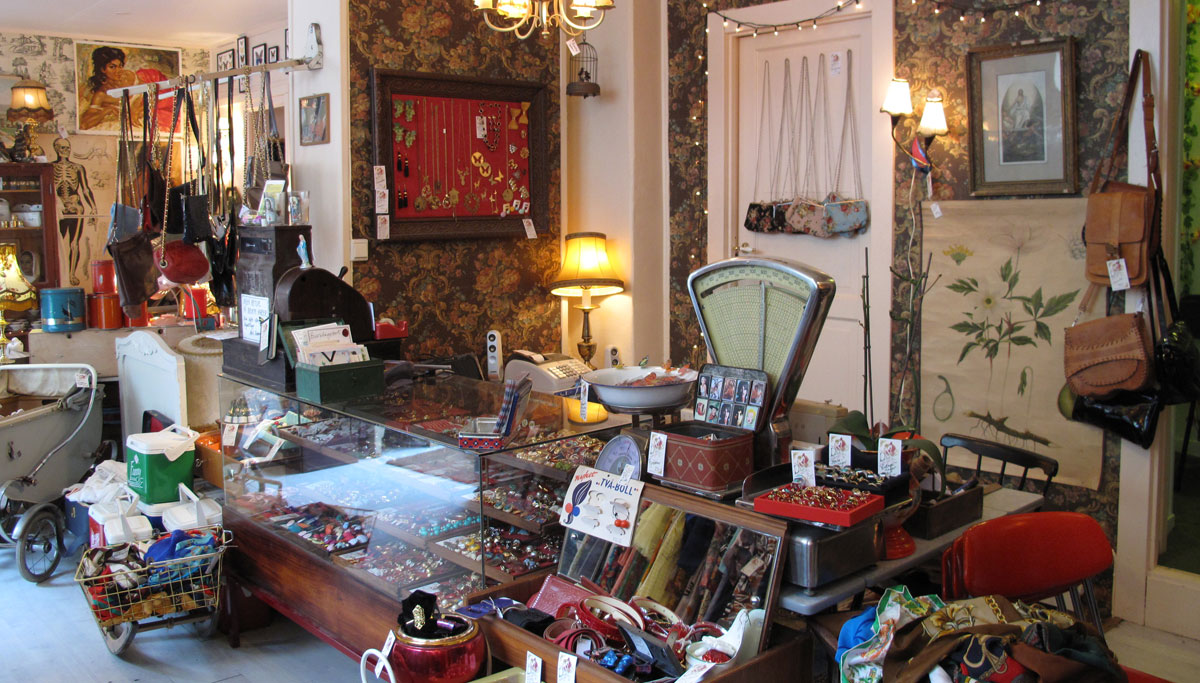
He walked us toward the back part of the shop (calling it an antique mall was an overstatement of epic proportion as it was not much bigger than a small convenience store. I suppose that it may have had multiple vendors gathered under the roof but still mall was overstating the case). There was a lot of clutter in the aisles and the accumulated detritus of junk stores that I have come to appreciate for their potential. It is in shops just like this, passed by quickly by the antique hunter and having a grumpy proprietor that have often yielded a veritable treasure trove of pipes and tobacco items. Many times I have found that these nondescript out-of-the-way shops can be rich with old pipes and tobaccos all to be had at very reasonable prices. There used to be way more of these little shops, but there are still a few where you can find some good stuff if you keep your eyes open.

I began to get excited as we made our way to the first display case. It was a crowded glass case with lots of dust and fingerprints. On the shelf next to the case were old packets of tobacco that looked like ancient drugstore blends, long past their shelf life even with all of humectants. There was also the standard collection of old Edgeworth and Prince Albert tins piled on the top shelf of the case. I bent down to get a closer look at the second shelf as it had a collection of about ten pipes piled on it. (So much for the shop owner’s “what little we have” comment.) I sorted through the lot and among the collection there I found three older pipes that caught my eye. I was attracted to them because of their shapes and finishes. They were all well used and dirty but I examined them showed no real damage under the dirt and oxidation.

This threesome included a Douwe Egbert Billiard, an Amphora Pot and long sandblasted Canadian stamped Birkdale Superb, Made in London England. None of these had show stopping names but the shapes all reflected an older European look. When I first saw the Canadian my heart nearly skipped a beat, it had the look of an older Dunhill Canadian. The white dot was missing in the stem but the hole was clearly there where it had been. I gingerly picked it up and saw that it was a Birkdale – a brand I knew nothing about. (I later found out as I researched the brands and stamping on these pipes on the internet that the Birkdale was probably a Comoy’s brand.) I left behind some older, worn pipes on the shelf that I may have to go back and pick over again when I get to the area in the future. But these three were to my liking. I happily added the first additions to my purchase – three pipes in my hand.

The owner had said nothing as I picked over the pipes and carried them with me. No comments or questions were asked as he locked up the first display case. Once locked, he hurried on to the second display case. I was feeling good about this stop on the road. It was already a great place and I had added three nice pipes to my collection so it did not really matter what I found in the second case. But who can stop looking and hoping for more after that kind of find in the first display case. We rounded the corner in the shop to the second case. On the middle shelf there were more interesting pipes to look over. I could not believe the luck I was having in this old shop. I sorted the 8 or 9 pipes on the shelf and settled on three nice looking older pipes – a Hardcastles Jack ‘O London Billiard, an African Meer Prince stamped Tanganyika with a shape stamp or 27 on the shank and an Old Pal diminutive Barling like pot with a pencil shank. I added this threesome to the lot in my hand. I now had six old pipes for refurbishing. All would clean up very well and be good additions to the collection or be sellable to help fund future purchases. Not too bad a find for a quick stop that could have easily been overlooked.

The grumpy shop owner led us to the counter at the front of the shop where he tallied what I owed him for the six pipes. I had noticed that several were marked $10 and some were $11. He said nothing as he scribbled out the bill and peeled off the stickers recording the display cases they each came from. Once he had finished his scribbling he pushed the bill my way. I could not believe my eyes – the total was $60 plus a bit of tax thrown in. What do you know; the old gent had given me a deal of sorts. He took my cash, put the pipes in an old grocery bag and handed me the change and the pipes. He then followed us to the front door and locked the door as we went out. He had probably spoken a total of three words – no more, no less in the entire time he had walked us around the shop. But I did not go there for the wit of the seller or the ambience of the shop but for exactly what I had come out with – six “new” old pipes that would be a welcome addition to my stock at home.

I guess it goes to show you, keep your eyes open when you are driving through the outskirts of the small towns you pass through on your travels. It is the nondescript shops that often are full of surprises. But then again, don’t bother to look too hard. It will leave more of them for me to find on my journeys.