
Blog by Steve Laug
Several weeks ago, my Buffer packed it in. It was an older machine (maybe 15 years or more as I don’t remember not having it). I was buffing a pipe with Blue Diamond when all of the sudden the buffer stopped mid buff. I checked the power and it was still attached to the outlet so I checked the entry of the wire to the back of the buffer. That too was intact and undamaged. Then I checked what I should have checked first if I had thought about it – the switch. When I touched the switch, the pieces fell out in my hands. The main portion of the switch had broken off inside the buffer. I took the plate that held the switch in place off the stand and found that it had been a plugin switch that I could detach. I did a bit of searching and did not find one. I would continue to look for one but I needed to have a working one fairly quickly.
I spoke with Kenneth Lieblich about his buffer and he told me that it was a KMS buffer that he had purchased used. It was an 8-inch buffer with two spindles and it worked well for him. He only wished that it was easier to change the pads on. He sent me a link to the buffer he had on KMS Tools. They have a retail store near where Kenneth lived so he said if I wanted the buffer he would be willing to pick it up.
Here is a link to the buffer (https://www.kmstools.com/magnum-8-quot-bench-buffer.html) as well as a picture and the specs to the machine. It described the machine as ideal for all material buffing and polishing: wood, plastic, glass, steel, brass, copper, jewellery and more.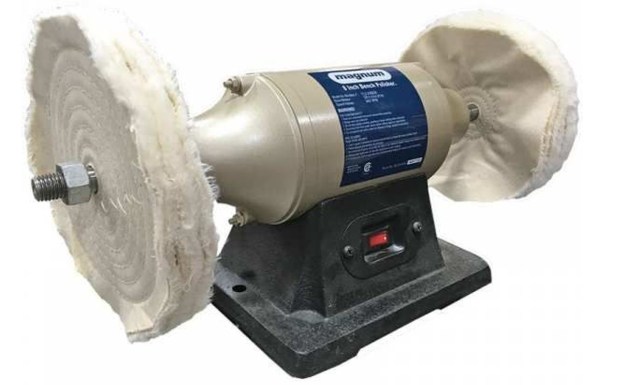 Here are the specs on the buffer.
- 4.8A, 3450 RPM
- 8″ x 3/4″ (1) soft, (1) spiral sewn wheel
- Long shaft design for big items buffing
- Cast iron base ensure steady running
- Lock safety switch
Some may think that 3450 RPM buffers are too much buffer, to high an RPM for the work. However, I have been using that RPM buffer for many years now with no issues. You just need to pay attention to the process and hold on tight to the briar. I always buff with a finger or thumb inside the bowl to anchor it firmly in my hand. I find that this works very well for me and I have had very few issues with it. When I first started I had a few projectile bowls which led me use the finger or thumb to hold the bowl in hand.
My old buffer had 6” buffing pads that I had purchased from Lee Valley Tools here in Vancouver. These pads were 8” and ¾ of an inch thick which seemed significantly thinner than the ones I had used previously. I gave Kenneth a call and put in my order. He picked it up for me and soon I had it in my hands. I unpacked it from the well packed/padded box and took a photo of the parts. You can see the twin spindles with a pair of washers – one for each side of the buffing pad and a threaded nut to hold them all in place.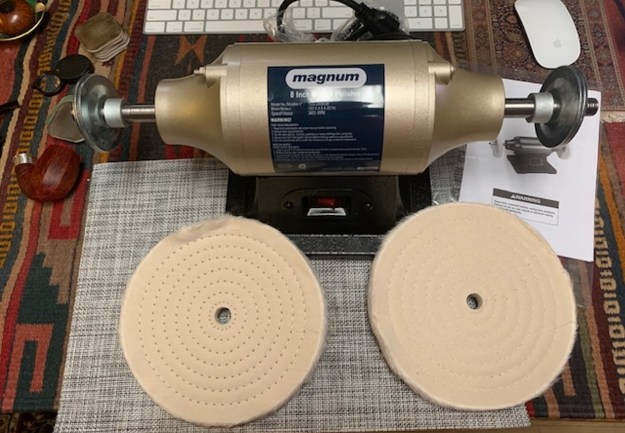 I put the parts together with a pad on each spindle. I set it up the same way as my older one. The soft pad on the left side and the harder one on the right side. I use the harder pad to buff the pipe with Blue Diamond polishing compound. I used the softer pad to apply the carnauba wax. I have a second buffer with a fluffier pad to polish the wax and raise a shine on the briar. I think this one will work great for me.
 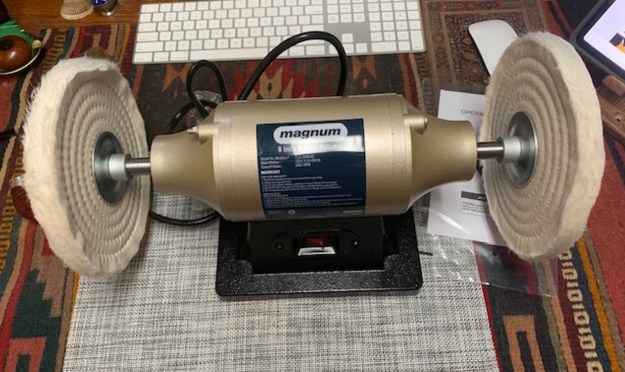 I have now put the buffer in place on the washing machine in the back room where the old one used to reside. I have been buffing a good number of pipes on it already and two things have transpired. First, the fresh buffing pads shed a huge amount of strings/threads all over the room I had forgotten that fact as my previous pads had long since ceased to shed and were fully charged with polishing compound and carnauba. This one will shed for a while. Second, I am really enjoying the larger buffing wheels and the thin ¾ inch pads are fluffing up and they look exactly like the thickness of my previous pads.
 rebornpipes
Steve, congratulations on new machine, you have restored thousands of pipes, your buffer has served you well. I solved the problem of quick pad changes, by changing out that spindle nut, for a wing-nut of the same thread pitch/size. You can match it up at your local hardware store. I did find the stock wing nut “wings” stuck out a bit and I was afraid of catching a stem, or briar. I used a grinder wheel to grind down and smooth the wings. I can still remove the nut by hand, which is convenient, and I have never damaged a pipe. See image here: https://postimg.cc/pyGnbSZd
I3 years later, I’m still on my original bar of carnuba wax and bar of White Diamond! New buffs will really shed. You might want to use a rake on it,to cut down on the initial mess (buy a real rake, don’t use a hacksaw blade). You might want to check out Caswell Electroplating in NY, they have a great selection of pads and they have very reasonable prices. (they also own British Tools & Fasteners – used when I had vintage Triumph motorcycles)
https://caswellplating.com/
The other key, in my opinion, to a suitable buffer in addition to RPM’s is power. Your link doesn’t show the HP. My carnuba buffer (single pad) is 1/4 hp. My white diamond/plastic polish dual arbor motor is 1/2 HP. My metal polishing buffer, used for motorcycle/car parts is 3450 RPM and 1 HP (likely too much for a rubber pipe stem)
I never understand when folks say be careful with a buffer, it will throw your pipe across the room. If that happens, your buffer is spinning in the wrong direction. If you lose the object, it should throw it to the ground at your feet (obviously not good on the pipe, but its also not going to put your eye out)
Have fun with the new machine
LikeLike
Thanks Al. I believe it is a 1/2 HP motor
LikeLike