
Blog by Greg Wolford
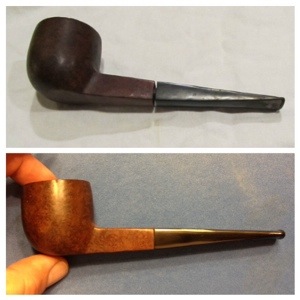
This GBD pot shaped pipe came with the Edwards Algerian Briar that I restored recently. Most of the stem work and clean-up done on this pipe was done at the same time as the Edwards and in the same manner, so I won’t go into that process in this article but you can read it here.
The stem was, upon closer inspection, a replacement; there are no markings, the tenon is a tad short, and you can see the tool marks from the turner. The nomenclature was very faint and I needed good light and some magnification to read it accurately. The right side of the shank has the GBD in an oval and the model Century stamped on it. The left side has the London England in a straight line, meaning it is a pre-Cadogan pipe that should’ve had an inlaid rondel on the stem, over the shape number 9486. Since the stamping was so faint already I didn’t want to risk any sanding or buffing and make it worse, or remove it. I decided to only top the bowl and sand nowhere else on this pipe. These photos are post-alcohol bath, cleaning and most of the stem work.
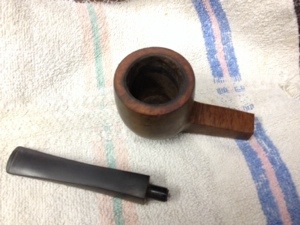
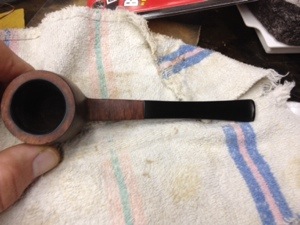
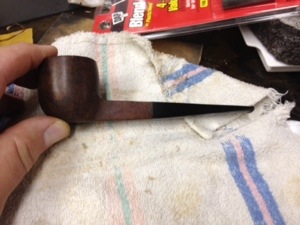
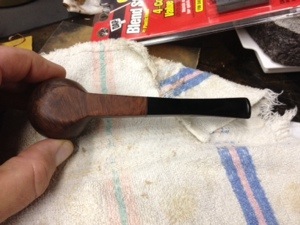
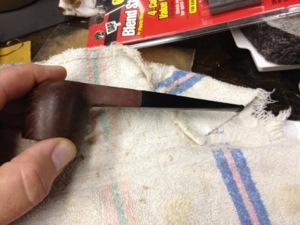
I used 320 grit wet/dry paper to top the bowl, which was badly dinged and burned. I worked it in circles on my bench, checking every so often on the progress. I worked out a smooth, flat rim with much of the charring gone. But the edges had a few sharp dings that I ended up leaving rather than trying to take the bowl down much farther or bevel off the nice edge I’d gotten. The finish now was non-existent on the rim and my options were pretty limited on how to match it up again; I decided that the stain markers I’d recently bought were the best choice and started with them. I “drew” on the finish with the marker one “round” at a time, blending it with my finger, and letting it set for a minute of so before continuing. When I got the rim to a point I was okay with I moved on to that last of the stem work.
I micro meshed the stem from 1500-4000 grits. The stem wasn’t ultra shiny but the pipe was not going to be a prize so I was happy with the level of shine and removal of oxidation I had and stopped there.
Since I didn’t want to buff the pipe I opted to wax it by hand. Before any wax, I polished the stem and the stummel with plastic polish, not something I’ve ever done before and actually by accident this time; I was polishing the stem and absentmindedly applied the polish to the wood before I realized it. I recalled someone reviewing another polish somewhere saying “an abrasive is an abrasive, no matter what it’s intended purpose” and I hoped I hadn’t made anything worse. It actually made the wood look better, and also the stem, to my surprise without harming the nomenclature.
After I buffed the entire pipe clean by hand with an old t-shirt, I applied some paste wax by hand and let it set up for about 10 minutes before hand buffing it back off, to a fairly nice shine. This is the completed pipe:
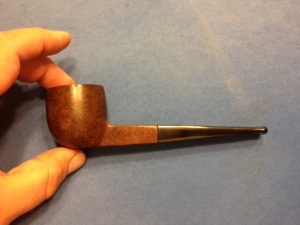
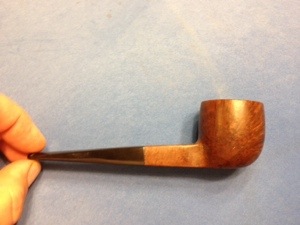
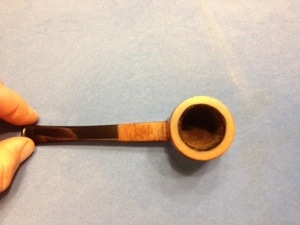
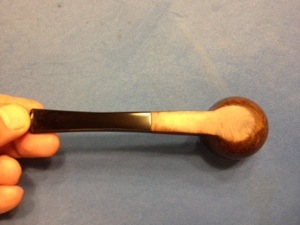
I’m not a big fan of the pot shape, though I do like GBDs in general. The pipe’s poor condition that I received it in made it hard to do a restoration on without re-stemming it and possibly reshaping the bowl and loosing the stamping altogether. I don’t know what I’ll end up doing with this one yet – I may still re-stem it when I get a square stem to do it with – but I do believe this reclaimed briar will still make someone a good smoker, just not a stunning looker.
 rebornpipes
Thanks Greg (and everyone else) for the information on retailers that carry these pens. I look forward to getting them, and trying them out on some “project” pipes in the near future.
LikeLike
They really do a nice job, Dave, I think. I hope you have good success with them, too.
LikeLike
Nice job Greg. Great pictures. I need to find the pens you (and others) have mentioned. Where do you get them?
LikeLike
Hi, Dave, and thank you. I found them at Walmart in the cleaning aisle near furniture polish. They came in a three pack for about $4, a lot cheaper than the $7-$9/each for other brands!
LikeLike
These are similar to the ones I use. Available on amazon in a 6 pack for $6.36 and free shipping:
LikeLike
Thanks, Alan. I’d wanted a wider variety and this is a great price.
LikeLike
I have used the pens for a long time – even for re-staining entire bowls. One tip for using them if you are trying to match a rim to the pipe. Always work from lighter colours, you don’t want the rim to be over dark. What I have found is if the rim is slightly lighter after applying the pen, dry it off using a lighter flame. This tends to darken the stain down a little more. It is a trick that gets different colours from the same pen.
The final colour also depends on the underlying colour of the raw briar. With experience using them, you will eventually know exactly which pen to reach for in each instance. When using pens to stain a whole pipe, you can get a range of colours from the same pen depending on the raw briar.
My shop has been out of stock with them for a long time, so I am back mostly using leather dye again.
LikeLike
Alan, thanks for the tips on the pens. It was actually your post on them that got me look ink for them. I’d not thought if flaming it off: great idea and tip.
I have another pipe I’m working on and will post soon (I hope) that I use the pens on in a new-to-me way- touching up the areas that I spot sanded to fill. It was a fun experiment and worked out well I think.
LikeLike
I think that’s a sharp little pipe Greg, but I’m admittedly a fan of the pot shape. Nicely done my friend! I don’t know if you have been using the paste wax on others or not since I just joined the blog recently, but you may want to check into What chemical thinners are used in it. I don’t know anything about it personally, but I’ve heard several wood turners say that they don’t use it on anything that food will touch, like bowls and such. They say that because of the thinners used in it that it isn’t food safe???
Great little pipe brother!
Tim
LikeLike
Thanks, Tim. I have used the paste several times in the paste, mostly on rusticated pipes and before I got my buffer. I’ve never had any trouble or ill-effects. I think I looked into the wax pretty hard before I made my decision on it, though it’s been a while and I can’t recall now, and got one that was rated pretty safe.
LikeLike
Nice work Greg. I have get some of those touch up pens. That is for sure a replacement stem. You are pretty stuck unless you pick up a shank extension from PME glue in place and return the tenon to an added length.
LikeLike
Thanks, Steve. And thank you for the extension idea; I hadn’t thought of that but think it would be a help on this one.
I’m really enjoying “playing” with those pens. I have another project that when I get it all done to write up, I use them for more than the rim. And I got a real good result in my opinion at least.
LikeLike