
I don’t’ know about you, but sometimes when I have too much time on my hands my head can begin to reflect on things that I had not thought of before that moment. That happened recently and I can tell you that up to that moment the topic of this post is one that I had not given much thought before that time. I mean really – the shape of the end of the stems or the button. Yet the other day (I am on holidays right now for another week before the grind of a new year of work begins) I was at my desk in the study and I looked over to my pipe cabinet. To give you a bit of the geography of my study might help visualize the moment. My study is in the basement of my old Victorian Cottage. On the west wall just under the stairs is my desk. Behind me on the east wall are books. To the south are also books and to the North on both sides are books. But at the north end of the room is a pipe cabinet that houses my pipes and tampers. The picture below gives a bit of an idea of what I am speaking about.

As I looked across the pipes in my collection I was struck by something I had not paid attention to before. Now understand that I often pick up my pipes either to smoke them or fondle them – if you are a pipe smoker you know what I mean. The thing that I saw was that among the pipes of my collection there were two distinct shapes to the end of the stems. For lack of a more definitive description I have chosen the descriptors convex and concave (curved out and curved in respectively as pictured below). Both types of stems are in my pipe collection – both the pipes I have refurbished to sell or give away and those that retain a more permanent position in my cupboard. The division seems to be equal betweeb both types of button curvature. Now mind you, there are variations on the theme. Some of the older, late 1800’s and early 1900’s orific button stems have a very pronounced convex shape. Think of the convex shape of a Peterson system type stem and you understand the concept of convex stems. Some of my Dunhill’s fishtail stems have a very pronounced concave button – almost an open “(“ shape. These are on the extreme ends of the spectrum but the rest of the pipes I have also fall into those two categories with different degrees of flattening to the curves.
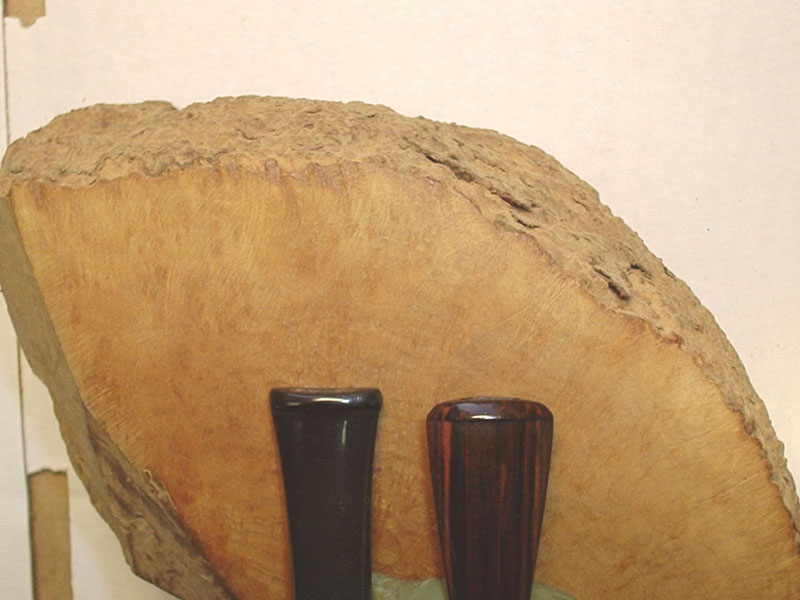
As I looked at them I wondered about the difference. Is the difference merely one of preference of the maker as they are machined? Is it the preference of the craftsman as he decides on the overall look of his finished piece? In other words is it a matter of aesthetics? What difference does the shape of the button make? Is it a comfort issue or is there something mechanical that led to the shape? I don’t think that I will ever know for sure but it is probably safe to assume that many of you either don’t care or have not thought about it. But here are my thoughts as I processed the difference.
The older pipes in my collection – those from the late 1800’s and early 1900’s – all seem to have convex stems like the one on the right. They have either a soft convex curve or a more pronounced curve. One thought that comes to my mind as I study them is that most have an orific (or round) opening in the button. In fact I don’t think it is a far stretch to say that all the pipes that have an orific opening have a convex shape. I don’t have any orific openings on pipes that have concave buttons. The logic of that seems to make sense. If the opening in the button is a round hole as opposed to a slot, it is pretty natural that it would be at the centre of the convex curve. To test this idea I looked at the newer pipe stems that I had that are convex and I found that as the orific opening disappeared and a more oval or football shaped slot takes the place the convex shape begins to flatten and in some cases becomes concave. Thus the survey of the pipes in my cupboard leads me to believe that the shape of the end of the button, at least at first, may be a function of the shape of the opening at the end of the button.
As I smoke each of them I have no particular opinion as to which is more comfortable in the mouth. This seems to be a more complex topic than just button shape. Both types of buttons can be very comfortable and deliver a great smoke or a lousy one. I wonder too if it is not something of an era issue. It seems that today the orific slot on the button has gone by the way of the dinosaur. The only manufacturer that I see still using a modified form of the style is Peterson. I do not know of any current pipemakers that use that style of button. The two shapes of button now seem much more a thing of form versus function.
Those are just a few of my thoughts from the end of the stem this morning. What are your thoughts? Some may think that this reflection is a waste of time but think it has a practical implication for the refurbisher. I fit quite a few replacement stems on older and newer stummels that I have. One of my goals is to make the stem as much as possible like the one that would have been on the pipe when it left the workshop or factory. I research the stem shapes on a particular brand and seek to match the shape of the button, the tenon and the slope of the stem to the original. For example when I restemmed several early 1900’s era BBB pipes that I in my collection I researched the BBB catalogues and did web searches to see what the stems looked like from the tenon to the button. I sought to duplicate what I found as much as I could. I know that to some this will seem like an unnecessary step in the process. Can’t you just put a new stem on the pipe and smoke it? Certainly I can do that but on these old gentlemen I aim to bring them back to their former glory even in terms of the stem style and shapes. Call it a quirk if you like, but it has become an integral part of the hobby of refurbishing to me.
Anyway enough on the topic. I am curious to read your thoughts. Post a reply and weigh in on the end of the stem. Post some examples if you have them in your collection.
 rebornpipes
Great read! Thank you, much to ponder…
LikeLike
Steven, this is a very interesting essay. For myself and I suspect a lot of pipe smokers, the button is a make or break thing on a pipe. I am not a clencher, those stems are too hard to restore. Putting bite marks BACK in them just isn’t in me. I like a button that has just enough ridge to balance it against my top teeth and bottom lip.
I purchased a Taylor made Ashton at the Richmond show. It is a lovely pipe, but the button was way too over-pronounced and ungainly in my mouth. I decided to reduce the profile and reshaped it with a file and than sandpaper/micromesh. Now it is much more comfortable and I enjoy smoking that pipe.
One of my more unique buttons is on this old Diby, a 9242 shape. That stem really tapers into almost a “pucker” that is just a little too small to enyoy regularly. But, I love that pipe shape so much, it remains on my rack for an occasional smoke.

[URL=http://s1295.photobucket.com/albums/b623/upshallfan/Pipes%20Gallery%20Pix/?action=view¤t=Digby_LW_2388_Gallery.jpg][IMG]http://i1295.photobucket.com/albums/b623/upshallfan/Pipes%20Gallery%20Pix/th_Digby_LW_2388_Gallery.jpg[/IMG][/URL]
I might have to go back and photograph some of my buttons, just to see the contrasts.
LikeLike
My quite new Dr. Grabow Omega has a “fake” p-lip — that is, it’s p-lip shape but uses an orific hole in the very centre of the convex tip. If you remind me, I’ll show you next time we have lunch!
LikeLike
Yes, I recall the p-lip variations on Grabows and others still have an orific hole in a convex tip. Thanks for the reminder.
LikeLike